Infamous Fukushima town sign praising nuclear energy to become permanent museum display
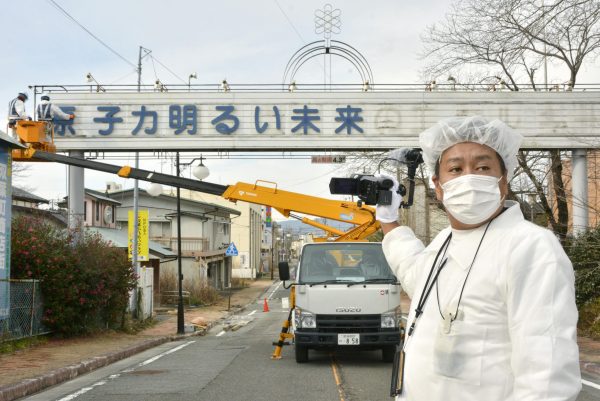
全町避難が続く福島県双葉町で、原発推進看板の撤去工事を見守る標語考案者の大沼勇治さん=21日
 Infamous Fukushima town sign praising nuclear energy to become permanent museum display https://mainichi.jp/english/articles/20210320/p2a/00m/0na/006000c, March 20, 2021 (Mainichi Japan) FUKUSHIMA — A sign hailing nuclear energy and formerly located on the main street of Fukushima Prefecture town Futaba, which was rendered inaccessible following the nuclear meltdowns triggered by the March 2011 Great East Japan Earthquake, will go on display at the Great East Japan Earthquake and Nuclear Disaster Memorial Museum in the town from March 24. Infamous Fukushima town sign praising nuclear energy to become permanent museum display https://mainichi.jp/english/articles/20210320/p2a/00m/0na/006000c, March 20, 2021 (Mainichi Japan) FUKUSHIMA — A sign hailing nuclear energy and formerly located on the main street of Fukushima Prefecture town Futaba, which was rendered inaccessible following the nuclear meltdowns triggered by the March 2011 Great East Japan Earthquake, will go on display at the Great East Japan Earthquake and Nuclear Disaster Memorial Museum in the town from March 24.
The sign measures 2 meters by 16 meters, and reads “Nuclear Power: Energy for a Bright Future.” After the 2011 nuclear disaster at the Tokyo Electric Power Co. Fukushima Daiichi Nuclear Power Station, the sign became iconic nationally as a symbol of the northeastern Japan town that pushed for nuclear power and still remains entirely subject to evacuation orders. The sign was removed in March 2016 because its deterioration posed dangers, and photos of the sign were displayed at the museum. It is too large to be placed indoors, so authorities delayed its display when opening the museum in September 2020; in the meantime, discussions on how to exhibit it were held with the Fukushima Prefectural Government. Then, on March 19, the prefectural government announced the sign will go on permanent display at the museum’s outdoor terrace from March 24. Yuji Onuma, 45, who came up with the sign’s slogan when he was in elementary school, said, “I believe exhibiting the sign will symbolize a resolve to never have another nuclear accident, and to aim for a bright future this time around. It took a long time after its removal for display plans to be finalized, but I hope coming face to face with the real thing will give visitors a chance to think about the nuclear disaster.” (Japanese original by Ryusuke Takahashi, Fukushima Bureau) |
|
New research into the effects of nuclear bomb tests on Montebello islands
 By Susan Standen 22 Mar 21, A new Edith Cowan University research project hopes to collect important data on the impact of historical nuclear testing in the remote Montebello Islands area. Key points:
Sixty years after the British government conducted nuclear explosion testing on the islands, there is little data available to find how much residue plutonium still exists. The project hopes to be the first study to outline how and where man-made radioactivity is still existing in the marine sediment. Collections of sediment are being collected from remote field trips to the islands to analyse amounts of residue plutonium radionuclides.,,,,,,,,,,,, Ms Hoffman says other island nations affected by nuclear blasts will be able to use the Montebello Islands research as a reference baseline to start their own investigations. Will it inform health research? Ms Hoffman says the first step is to find out what remains there as a legacy………….. The project is a collaboration between the Edith Cowan University, the Department of Biodiversity and Conservation and the Australian Radiation Protection and Nuclear Safety Agency. https://www.abc.net.au/news/2021-03-22/montebellos-nucelar-fallout-research/13260242 |
|
Why Boris Johnson rejected Scott Morrison as speaker at climate summit, to Morrison’s fury
|
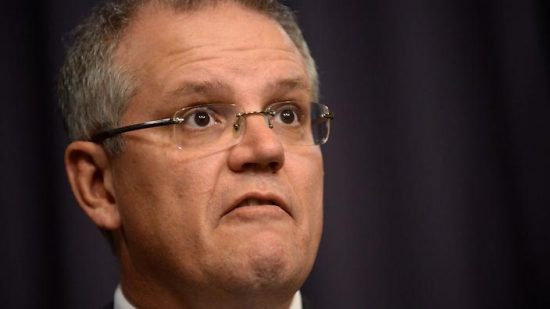
Boris Johnson outlines why Scott Morrison was rejected to speak at climate summit, The Age, By Rob Harris March 22, 2021 British Prime Minister Boris Johnson told Scott Morrison that Australia was denied the opportunity to speak at last year’s climate summit because he wanted to encourage nations to set more ambitious emissions reduction targets.
Mr Johnson, who is rallying the world’s leading economies towards achieving net zero emissions by 2050, explained his rationale in a letter to the Australian Prime Minister in December last year while acknowledging the domestic political challenge over climate policy. Mr Johnson had originally invited Mr Morrison to speak at the December 12 summit but later walked away from the offer amid a behind-the-scenes diplomatic tussle over whether Australia’s climate change policies were insufficient to warrant a speaking slot………. While Mr Morrison told Parliament at the time he was not bothered by the snub, the government was privately furious behind the scenes and much of its anger was directed towards the British PM, who hosted the conference in partnership with the UN and France. Mr Johnson said Mr Morrison should understand that “we have tried to set a high bar for this summit to encourage countries to come forward with ambitious commitments”………https://www.theage.com.au/politics/federal/boris-johnson-outlines-why-scott-morrison-was-rejected-to-speak-at-climate-summit-20210322-p57d2o.html |
|
Will Australia’s states save the day on climate and the clean energy transition? — RenewEconomy

Renewable policy is getting better in Australia’s states, but is it enough to cancel out federal inaction? The post Will Australia’s states save the day on climate and the clean energy transition? appeared first on RenewEconomy.
Will Australia’s states save the day on climate and the clean energy transition? — RenewEconomy
Tasmania, South Australia lead, while Morrison is deadweight on energy transition — RenewEconomy

States continue to do the heavy lifting on a clean energy transition, as Morrison ignores chance for a clean energy recovery, WWF scorecard shows. The post Tasmania, South Australia lead, while Morrison is deadweight on energy transition appeared first on RenewEconomy.
Tasmania, South Australia lead, while Morrison is deadweight on energy transition — RenewEconomy
How the world can reach net zero target without resorting to nuclear power
 IW Long Reads: Is Nuclear Energy On The Road To Ruin Or A Sustainability Silver Bullet? How the world can reach net zero target without resorting to nuclear power, Investment Week, Anna Fedorova-22Mar 21, Anyone who has seen the TV series Chernobyl knows that when things go wrong with nuclear power the consequences are dire. And while it may seem that matters have evolved since the days of the Soviet Union, the nuclear disaster in Fukushima that happened just ten years ago suggests otherwise. IW Long Reads: Is Nuclear Energy On The Road To Ruin Or A Sustainability Silver Bullet? How the world can reach net zero target without resorting to nuclear power, Investment Week, Anna Fedorova-22Mar 21, Anyone who has seen the TV series Chernobyl knows that when things go wrong with nuclear power the consequences are dire. And while it may seem that matters have evolved since the days of the Soviet Union, the nuclear disaster in Fukushima that happened just ten years ago suggests otherwise. ……….[Elizabeth Stuart, analyst, sustainability research at Morningstar Europe], says with every other aspect of sustainability, “there is no silver bullet and nuclear is so very far from a perfect solution”.
For example, even when nuclear reactors are running properly, they use “tremendous amounts of water to cool the reactors”, while mining and refining the Earth’s finite resources of uranium ore also requires a large amount of energy. And of course, there is the question of waste management over many generations, given that uranium rods remain dangerously radioactive for 10,000 years. “There are also second order effects to investment in nuclear energy such as the certainty that this research can be used to create nuclear weapons and that plants are a high value targets should a war break out,” Stuart adds. “Disruption in a nuclear plant invariably won’t remain within country borders so there is also the issue of diplomacy to consider. In short, nuclear is a textbook example of a controversial stock and any investor would be wise to question its place in an ESG portfolio.” ………………. the balance is expected to shift towards renewables, which is expected to lead to a decentralisation of the power grids, posing further challenges for nuclear. Jonathan Cohen, partner at Howard Kennedy, says: “Currently, nuclear power projects are being developed at very high costs and it is difficult to finance new projects without large state expenditure. ……………wide scale support from the private sector just is not there, with investors increasingly choosing to stay on the safe side and invest in renewables instead. Robeco, for example, excludes electricity utilities that generate more than 30% of their power from nuclear sources from all of its sustainable strategies, and does not invest in nuclear power at all in its RobecoSAM Smart Energy Equities strategy. This decision is driven by a combination of “unique risks”, negative environmental impacts, relatively high costs of nuclear and the “impressive technological and cost developments in both renewables and storage technologies”. Mark Campanale, founder of the Carbon Tracker Initiative, says: “Our view is that given so many cheaper renewable energy resources available, why would anyone want to go to the expense of what is an uncompetitive technology on price, one which takes hundreds of years to clear up its waste?” According to Eduardo Monteiro, co-CIO at Victory Hill Capital Advisors, even if nuclear is to play a “robust role” in a country’s energy supply, it has too many shortcomings as a sustainable investment alternative, and should therefore be avoided. “The waste generated will be a legacy for future generations to deal with and as such investors need to think about the very real negative impact these holdings will have in both the broader sense but also to financial returns,” he says. According to Eduardo Monteiro, co-CIO at Victory Hill Capital Advisors, even if nuclear is to play a “robust role” in a country’s energy supply, it has too many shortcomings as a sustainable investment alternative, and should therefore be avoided. “The waste generated will be a legacy for future generations to deal with and as such investors need to think about the very real negative impact these holdings will have in both the broader sense but also to financial returns,” he says. According to Eduardo Monteiro, co-CIO at Victory Hill Capital Advisors, even if nuclear is to play a “robust role” in a country’s energy supply, it has too many shortcomings as a sustainable investment alternative, and should therefore be avoided. “The waste generated will be a legacy for future generations to deal with and as such investors need to think about the very real negative impact these holdings will have in both the broader sense but also to financial returns,” he says. “Such managers may naturally prefer to invest in renewables to support their interpretation of ESG investing and the transition to ‘clean’ energy more widely,” he says. https://www.investmentweek.co.uk/analysis/4028635/iw-long-reads-nuclear-energy-road-ruin-sustainability-silver-bullet |
|
March 22 Energy News — geoharvey

Opinion: ¶ “Have Rosy Forecasts About The Legacy Energy Industry Created A Financial Bubble?” • We’ve heard a lot lately about a “bubble” in Tesla and other EV-related stocks. But a report from the independent think tank RethinkX argues that a far more dangerous bubble exists around conventional coal, gas, nuclear, and hydroelectric energy assets. […]
March 22 Energy News — geoharvey
Bill Gates backs costly nuclear reactor design fueled by nuclear-weapon-usable plutonium
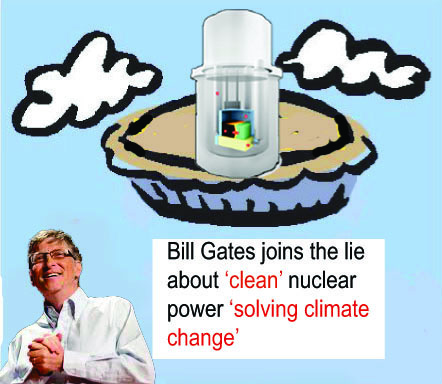
Bill Gates’ bad bet on plutonium-fueled reactors https://thebulletin.org/2021/03/bill-gates-bad-bet-on-plutonium-fueled-reactors/?utm_source=Newsletter&utm_medium=Email&utm_campaign=MondayNewsletter03222021&utm_content=NuclearRisk_Gates_03222021 By Frank N. von Hippel | March 22, 2021
One of Bill Gates’ causes is to replace power plants fueled by coal and natural gas with climate-friendly alternatives. That has led the billionaire philanthropist and Microsoft co-founder to embrace nuclear power, and building nuclear power plants to combat climate change is a prospect worth discussing. But Gates has been persuaded to back a costly reactor design fueled by nuclear-weapon-usable plutonium and shown, through decades of experience, to be expensive, quick to break down, and difficult to repair.
In fact, Gates and his company, Terrapower, are promoting a reactor type that the US and most other countries abandoned four decades ago because of concerns about both nuclear weapons proliferation and cost.
The approximately 400 power reactors that provide about 10 percent of the world’s electric power today are almost all water-cooled and fueled by low-enriched uranium, which is not weapon usable. Half a century ago, however, nuclear engineers were convinced—wrongly, it turned out—that the global resource of low-cost uranium would not be sufficient to support such reactors beyond the year 2000.
Work therefore began on liquid-sodium-cooled “breeder” reactors that would be fueled by plutonium, which, when it undergoes a fission chain reaction, produces neutrons that can transmute the abundant but non-chain-reacting isotope of natural uranium, u-238, into more plutonium than the reactor consumes.
But mining companies and governments found a lot more low-cost uranium than originally projected. The Nuclear Energy Agency recently concluded that the world has uranium reserves more than adequate to support water-cooled reactors for another century.
And while technologically elegant, sodium-cooled reactors proved unable to compete economically with water-cooled reactors, on several levels. Admiral Rickover, who developed the US Navy’s water-cooled propulsion reactors from which today’s power reactors descend, tried sodium-cooled reactors in the 1950s. His conclusion was that they are “expensive to build, complex to operate, susceptible to prolonged shutdown as a result of even minor malfunctions, and difficult and time-consuming to repair.” That captures the experience of all efforts to commercialize breeder reactors. The United States, Germany, the United Kingdom, France, and Japan all abandoned their breeder-reactor efforts after spending the equivalent of $10 billion or more each on the effort.
Today, despite about $100 billion spent on efforts to commercialize them, only two sodium-cooled breeder reactor prototypes are operating—both in Russia. India is building one, and China is building two with Russian help. But it is not clear India and China are looking only to generate electricity with their breeders; they may also be motivated in part by the fact that breeder reactors produce copious amounts of the weapon-grade plutonium desired by their militaries to expand their nuclear-weapon stockpiles.
The proliferation risks of breeder-reactor programs were dramatically demonstrated in 1974, when India carried out its first explosive test of a nuclear-weapon design with plutonium that had been produced with US Atoms for Peace Program assistance for India’s ostensibly peaceful breeder reactor program. The United States, thus alerted, was able to stop four more countries, governed at the time by military juntas (Brazil, Pakistan, South Korea, and Taiwan), from going down the same track—although Pakistan found another route to the bomb via uranium enrichment.
It was India’s 1974 nuclear test that got me involved with this issue as an advisor to the Carter administration. I have been involved ever since, contributing to the plutonium policy debates in the United States, Japan, South Korea and other countries.
In 1977, after a policy review, the Carter administration concluded that plutonium breeder reactors would not be economic for the foreseeable future and called for termination of the US development program. After the estimated cost of the Energy Department’s proposed demonstration breeder reactor increased five-fold, Congress finally agreed in 1983
Gates is obviously not in it for the money. But his reputation for seriousness may have helped recruit Democratic Senators Cory Booker, Dick Durbin, and Sheldon Whitehouse to join the two Republican senators from Idaho in a bipartisan coalition to co-sponsor the Nuclear Energy Innovations Capabilities Act of 2017, which called for the VTR.
I wonder if any of those five Senators knows that the VTR is to be fueled annually by enough plutonium for more than 50 Nagasaki bombs. Or that it is a failed technology. Or that the Idaho National Laboratory is collaborating on plutonium separation technology with the Korea Atomic Energy Research Institute at a time when about half of South Korea’s population wants nuclear weapons to deter North Korea.
Fortunately, it is not too late for the Biden administration and Congress to avoid repeating the mistakes of the past and to zero out the Versatile Test Reactor in the Department of Energy’s next budget appropriations cycle. The money could be spent more effectively on upgrading the safety of our existing reactor fleet and on other climate-friendly energy technologies.
Frank N. von Hippel
Frank N. von Hippel is a co-founder of the Program on Science and Global Security at Princeton University’s School of Public and International…
The week in nuclear news
Not a lot of remarkable news on nuclear this week . The nuclear lobby is doubling down on its media propaganda, touting nuclear as the solution to climatev change. Also it is determinedly promoting the Tokyo Olympics – the so-called ‘recovery Olympics’, despite the fact that international visitors are banned.
Coronavirus. Incidence of new cases globally continues to rise, but death numbers are falling. Problems in distribution of vaccines.
Climate. Developments in global heating are covered each week in Radio Ecoshock, which is a jump ahead of most news media. This week, it’s been about the predicted high temperatures in the world’s cities. Also, it’s a warm\ning that climate tipping points are coming sooner than expected.
A bit of good news. March 20 was the U.N.’s International Day of Happiness. For the fourth year in a row, Finland has been named the happiest country in the world, with Iceland coming in second, followed by Denmark, Switzerland, and the Netherlands.
AUSTRALIA.
BHP, Rio Tintom given carte blanche to export uranium to global hotspots .
Australian Senate vote on Kimba nuclear dump delayed till mid-May, but dump opponents will be fighting on. Resources Minister Keith Pitt on radio – same old same old Bluff and Bribery about Kimba nuclear dump plan.
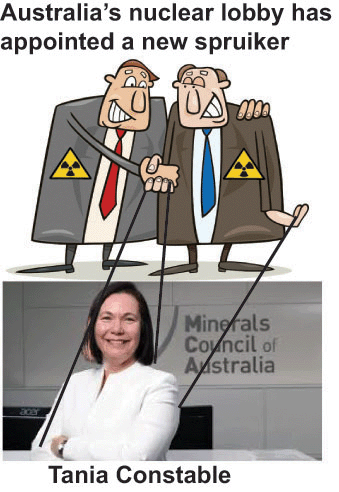
Minerals Council of Australia trying to influence European Commission, to push for fossil fuels and nuclear.
Need for ‘consent laws’, as Australian mining companies trample on Aboriginal rights.
INTERNATIONAL.
Investigative journalism – Advanced nuclear reactors : Assessing the Safety, Security, and Environmental Impacts of Non-Light-Water Nuclear Reactors. New science report: advanced nuclear reactors no safer than conventional nuclear plants. The economics of nuclear power plants are not favorable to future investments.
Nuclear power has become irrelevant — like it or not. Why the Fukushima disaster signalled the end of Big Nuclear.
New research to determine plutonium pollution and its sources.
Don’t believe hydrogen and nuclear hype – they can’t get us to net zero carbon by 2050
Review of Michael Shellenberger’s book on ”Why Environmental Alarmism Hurts Us All”.
Need for ‘consent laws’, as Australian mining companies trample on Aboriginal rights
“The Australian government needs to amend native title and land rights legislation to include a requirement for companies to gain free, prior and informed consent from traditional landowners before proceeding with projects, as well as mandatory human rights due diligence assessments.”
The report also recommends governments at all levels work to remove financial and other barriers to Indigenous people accessing the courts to ensure they can effectively challenge decisions that affect them.
Close the gap in consent laws for major resource projects: report. A new report highlights accountability shortfalls in major resource projects and calls for legislative reform to protect Indigenous people’s rights. https://www.rmit.edu.au/news/all-news/2021/mar/mining-first-nations Michael Quin, 21 Mar 21,
The First Peoples and Land Justice Issues in Australia report by researchers at RMIT University’s Business and Human Rights Centre (BHRIGHT), reveals the human rights impacts of companies operating on Aboriginal and Torres Strait Islander land.
BHRIGHT Director, Associate Professor Shelley Marshall, said the case studies revealed a pattern of companies failing to meet international business and human rights norms, as well as a lack of respect for the fundamental principle of obtaining free, prior and informed consent from landholders on projects impacting them.
“Our research reveals a legal framework and corporate behaviour that refuses to acknowledge lack of consent,” Marshall said.
“The fact that companies can operate within Australian law while failing to respect and uphold their international human rights obligations underlines the urgent need for legislative reform at state, territory, and federal levels.”
“These companies also need to step up and take their obligations under human rights frameworks much more seriously.” Continue reading
Minerals Council of Australia trying to influence European Commission, to push for fossil fuels and nuclear
|
The Minerals Council of Australia has weighed into a European commission climate policy debate, urging it to back fossil fuels with carbon capture use and storage (CCS) and nuclear power on a list of environmentally friendly developments.
In a written submission to the commission, the minerals council (MCA) said a proposed EU taxonomy for sustainable activities intended to shape investment under a European green deal was inconsistent in how it dealt with clean technologies because it favoured solar, wind and biofuels over nuclear and CCS. The mining lobby group said it was concerned this approach would have a flow-on effect on the types of energy investments backed by EU-based companies across the globe and “increase the cost of reducing CO2 emissions”. It called for an overhaul. InfluenceMap, a London-based thinktank that tracks corporate climate lobbying, said the MCA’s submission suggested it wanted to export its “negative approach to climate policy” by pushing for changes in other parts of the world that would allow continued use of coal and gas. The MCA submission argued there was “no valid basis” for treating CCS and nuclear differently given EU countries currently used coal, gas and nuclear……….. But InfluenceMap’s program manager, Rebecca Vaughan, said the MCA appeared concerned a science-led approach to dealing with the climate crisis would hurt the industries it represented. “While the MCA says it wants the EU to take a technology neutral position, its submission appears to advocate for the continued use of coal and gas with carbon capture utilisation and storage, which is clearly at odds with the commission’s science-based policy,” Vaughan said. The MCA has long been accused of hindering action to tackle the climate crisis in Australia, and campaigned aggressively against Labor’s two attempts to introduce a carbon pricing scheme. In recent years it has come under pressure to change its anti-climate stance from its biggest members, BHP and Rio Tinto. It followed the big mining companies facing repeated calls from their investors to abandon the MCA over its commitment to coal. It resulted in the MCA releasing a climate plan that said it was committed to the Paris agreement and reaching net zero emissions, but did not include a timeframe in which that target should be reached. The EU taxonomy is intended to help it meet a target of at least a 55% cut in its emissions below 1990 levels by 2030 on the way to net zero by 2050 by defining what activities are considered environmentally sustainable and warrant investment support. The commission said it expected the taxonomy would “create security for investors, protect private investors from greenwashing, help companies to plan the transition, mitigate market fragmentation and eventually help shift investments where they are most needed”.
The final version of the EU’s sustainable finance rules was due in January but a decision was delayed until April after 10 countries objected to the initial proposal because they wanted gas to be deemed a sustainable energy source. Nuclear energy plays a significant role in some EU countries but has been found to be in decline in the developed world, and to be more expensive and less efficient at reducing emissions than renewable energy……….. Nuclear energy remains banned in Australia. Some Coalition MPs and industry leaders want the prohibition lifted. https://www.theguardian.com/australia-news/2021/mar/21/australias-miners-urge-europe-to-define-nuclear-power-and-fossil-fuels-with-carbon-capture-as-sustainable |
|

Fukushima disaster 10 years on: How long will it take to clean up the nuclear waste?
Fukushima disaster 10 years on: How long will it take to clean up the nuclear waste?
Decontamination and living with ‘black bags’
Piles of black bags were generated by the vast, painstaking clean-up and then transported from other storage places. Those black bags have occupied more than 90 blocks ranging from 180 sq m to 6,500 sq m in the northern part of Tomioka since 2015.
According to a 2018 report from Japan’s Ministry of the Environment, the estimated total quantity of decontaminated soil will be somewhere between 16 and 22 million cubic metres after volume reduction. This is 13 to 18 times larger than the volume of the Tokyo Dome.
The Ministry says the total will likely be at the lower end of the provided range, in a latest reply to The Straits Times’ query.
Limits of decontamination
The “decontamination” only involves soil removal in flatland areas – the government has said that it is impossible to clear the soil in mountainous areas, but more than 70 per cent of the hardest-hit areas are mountainous.
Mr Nobuyoshi Ito is one of those who live in the mountainous areas where vast decontamination is hard to carry out.
Mr Ito first moved to Iitate village in Fukushima prefecture in 2010 after he retired as an IT engineer, to work as an “apprentice farmer”.
He had no ties with the village before that, but the self-professed “guinea pig” ended up staying on there, in open defiance of government orders to evacuate, and against his children’s wishes for him to live with them in Niigata prefecture on the west coast.
“When the government asked us to evacuate… I asked if there would be criminal charges if I continued to live here,” he told The Straits Times in 2016. “They said no.”
He carries a dosimeter around with him all the time, measuring anything he can lay his hands on from soil, plants to animal carcasses. He also owns a laboratory-grade radiation measuring machine at his cabin, deep in the mountains in the village.
He thinks the government’s decision to not decontaminate forested mountainous areas will backfire due to factors such as rain that may spread radioactive material, and in a study last year found that 43 out of 69 locations along the Olympic torch relay route had radiation levels above the government limits.
He told The Straits Times that he fears that Tokyo is overly eager to portray that everything was “under control”, given that this could give the impression that it is “case closed”.
Non-profit Greenpeace notes that such standards in towns neighbouring the nuclear plant would not pass in other parts of the world.
The indefinite future: Where to permanently store 16 million bags of nuclear waste
The law requires that the final disposal site of high-level nuclear waste should be outside of Fukushima by March 2045.
Two fishing villages in Hokkaido are vying to host the final storage facility of Japanese nuclear waste for half a century, splitting communities between those seeking investment to stop the towns from dying, and those haunted by the 2011 Fukushima disaster who are determined to stop the project.
I cannot give a deadline at this moment. We will consider the entire schedule based on the progress at the two new potential sites, along with nationwide public relations activities.
MS MASARU KASHIMA
The nuclear lobby’s lying propaganda on the run up to COP Climate Conference
Ya gotta admire the global spread and relentless persistence of the nuclear industry at every level. Whether it be aimed ast schoolkids or heads of state, – the message is just such a lie – that nuclear power is ”essential to fight climate change’‘
Never mind that nuclear power is itself very vulnerable to climate change (over-heating, rising sea leveles, storm surges, water shortages……)
Anyway, today I was captivated by a charming, pretty, graphic, touted by the Public Service Enterprise Group, (PSE&G’) in an article extolling nuclear power, published by INSIDER NJ.
I just felt the need to make PSE&G’s picture honest.

Need for more research into causes of increased incidence of childhood lukaemia near nuclear site
National Library of Medicine 15th March 2021, A previous investigation of the occurrence of childhood acute leukemia around the Belgian nuclear sites has shown positive associations around one nuclear site (Mol-Dessel). In the following years, the Belgian Cancer Registry has made data available at the smallest administrative unit for
which demographic information exists in Belgium, i.e. the statistical sector. This offers the advantage to reduce the potential misclassification due to large geographical scales.
Results confirm an increased incidence of acute childhood leukemia around Mol-Dessel, but the number of cases remains very small. Random variation cannot be excluded and the ecological design does not allow concluding on causality. These findings emphasize the need for more in-depth research into the risk factors of childhood leukemia, for a better understanding of the etiology of this disease.
The economics of nuclear power plants are not favorable to future investments
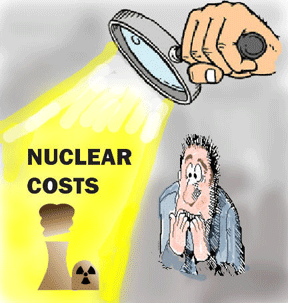 Investing into third generation nuclear power plants – Review of recent trends and analysis of future investments using Monte Carlo Simulation https://www.sciencedirect.com/science/article/abs/pii/S1364032121001301 Renewable and Sustainable Energy Reviews Volume 143, June 2021, 110836
Author links open overlay panelB.WealerabS.BauerbC.v.HirschhausenabC.KemfertacL.Göke
Highlights
- •Cost escalations in the nuclear sector observed in previous research continue until today.
- •Investing into a nuclear power plant today is not a profitable business case.
- •The net present values are mainly negative, in the range of five to ten billion USD.
- •Interest during construction is a major cost driver not to be underestimated.
- •Policy debates should consider total costs including interest and construction time.
Abstract
This paper provides a review of trends in third generation nuclear power plants, and analyzes current and future nuclear power plant investments using Monte Carlo simulations of economic indicators.
We first review global trends of nuclear power plant investments, including technical as well as economic trends. The review suggests that cost escalations in the sector observed in previous research continue until today, including the most recent investment projects in the U.S. and in Europe.
In order to extend this analysis, we carry out our own investment analysis of a representative third generation nuclear power plant, focusing on the net present value and the levelized cost of electricity. We base our analysis on a stochastic Monte Carlo simulation to nuclear power plant investments.
We define and estimate the main drivers of our model: Overnight construction costs, wholesale electricity prices, and weighted average cost of capital, and discuss reasonable ranges and distributions of those parameters.
Model runs suggest that investing in nuclear power plants is not profitable, i.e. expected net present values are highly negative, mainly driven by high construction costs, including capital costs, and uncertain and low revenues.
Even extending reactor lifetimes does not improve the results significantly. We conclude that our numerical exercise confirms the literature review, i.e. the economics of nuclear power plants are not favorable to future investments, even though additional costs (decommissioning, long-term storage) and the social costs of accidents are not even considered.
1 This month
17 October, Free Public Talk on Nuclear Issues in South Australia
David Noonan will speak on public interest concerns over the new Roxby Downs Indenture Act 2026 on BHP copper-uranium mining and ore processing in SA, and on how AUKUS may face SA with a High-Level nuclear waste agenda.
Dr Jim Green will discuss international developments in the field of nuclear power including ‘small modular reactors’ and Generation 4 ‘advanced’ nuclear reactor concepts.


Help Aunty Sue Protect Her Land and Sacred Sites From Destructive Rocket Testing.
.

Australians deserve the truth
about
AUKUS – https://aukuspublicinquiry.com/

PETITION – To: Prime Minister Anthony Albanese and the Australian Labor Government

of the week – Australians for War Powers Reform (AWPR)
To see nuclear-related stories in greater depth and intensity

