New South Wales Energy Minister ”excited about the opportunities” for nuclear power
Energy minister backs nuclear option , Daily Telegraph, 14 Mar 21,
NSW’s energy minister has said the state is “excited about the opportunities” being afforded by nuclear power as he denied climate policies were leading to the closure of coal-powered plants…… (subscribers only)
Space radiation – harmful to astronauts, not only with cancers, but also with heart and blood vessel effects
From Vitamin C to Spinach: Researching Ways to Protect Astronaut Cardiovascular Health From Space Radiation. Review explores ways that space radiation can damage cardiovascular health, and discusses how we can protect astronauts, from vitamin C to spinach. SciTech Daily 14 Mar 21, Space: the final frontier. What’s stopping us from exploring it? Well, lots of things, but one of the major issues is space radiation, and the effects it can have on astronaut health during long voyages. A new review in the open-access journal Frontiers in Cardiovascular Medicine explores what we know about the ways that space radiation can negatively affect cardiovascular health, and discusses methods to protect astronauts. These include radioprotective drugs, and antioxidant treatments, some of which are more common than you might think.
Space is incredibly inhospitable. Outside of low earth orbit, astronauts are bombarded with radiation, including galactic cosmic rays, and ‘proton storms’ released by the sun. This radiation is harmful for the human body, damaging proteins and DNA, and is one of the major reasons that we haven’t yet been able to send anyone to Mars, or beyond.
These issues inspired Dr Jesper Hjortnaes of the Leiden University Medical Center in the Netherlands to investigate what we know about the harmful effects of space radiation. “If we want to see human long distance space travel, we need to understand the impact of space-induced disease and how to protect our bodies from it,” said Hjortnaes. However, Hjortnaes has an interest in a specific aspect of space radiation: its cardiovascular effects.
You may be surprised to learn that aside from the illnesses we typically associate with radiation, such as cancer, it can also have serious effects on the cardiovascular system. Suffering from cardiovascular illness would be catastrophic for crew members on long-haul space missions, and so it’s important to identify what the risks are, and how to reduce them.
Hjortnaes and colleagues reviewed the evidence to establish what we know about the cardiovascular risks of space radiation. Much of what we know comes from studying people who have received radiation therapy for cancer, where cardiovascular disease is a common side-effect, or from mouse studies of radiation exposure.
So, what are the effects? Radiation can cause myocardial remodeling, where the structure of the heart begins to change, and tough, fibrous tissue grows to replace healthy muscle, potentially leading to heart failure. Other effects include atherosclerosis in blood vessels, which can cause stroke or heart attack. Radiation exerts its effects by causing inflammation, oxidative stress, cell death and DNA damage.
Researchers have also investigated potential ways to protect astronauts. These include drugs that an astronaut could take to protect themselves from space radiation, and antioxidants. Interestingly, an antioxidant diet, including dairy products, green vegetables such as spinach, and antioxidant supplements such as vitamin C, has potential in protecting astronauts from the damaging reactive oxygen molecules produced during radiation exposure.
Overall, the review revealed that so far, research has only scratched the surface of space radiation and the best methods to protect astronauts from it. There is little conclusive evidence of radiation-induced cardiovascular disease in astronauts themselves, as so few of them have ever gone further than low earth orbit, and mouse studies aren’t an exact match for humans……..https://scitechdaily.com/from-vitamin-c-to-spinach-researching-ways-to-protect-astronaut-cardiovascular-health-from-space-radiation/
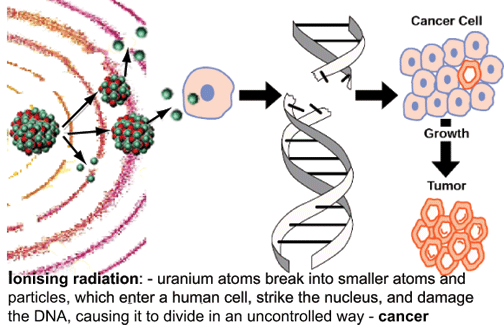
Low doses of radiation used in medical imaging lead to mutations in cell cultures
|
Discovery that radiation creates breaks that allow in foreign DNA must be confirmed in animal studies Science Daily, January 16, 2020 Source: PLOS
|
|
Nuclear power losing out in the UK – not a good omen for the global nuclear industry
 Seeking Alpha 13th March 2021, My comments on offshore wind making other forms of energy uncompetitive in 2017 have only become more clear in the past 3 years. Now the adoption ofnoffshore wind is happening elsewhere around the world including in the US, Japan, South Korea, Taiwan, China, India.
indicator for the status of nuclear power adoption in the West. I concludenthat, notwithstanding a lot of lobbying for SMR (Small Modular Reactor) technology, nuclear power is a fading force.
consumers before the nuclear reactor commences power generation. It will be interesting to see how such a model of financing might be regarded.
not one, but 16 of these plants with a capacity of 440 MW at a cost of 2 billion pounds each.
The Rolls Royce strategy is that by building multiple SMRs it will get good at it and the cost might go down. The reality behind this proposal is that it seems pretty ambitious to set out to build 16 plants before one has been successfully constructed. Time seems against this concept as the UK will have largely exited nuclear power by 2030.
How to convince households to offer battery storage to boost the grid — RenewEconomy

Sydney start-up UPowr to apply behavioural science techniques in study into how to boost participation in solar and storage orchestration initiatives. The post How to convince households to offer battery storage to boost the grid appeared first on RenewEconomy.
How to convince households to offer battery storage to boost the grid — RenewEconomy
March 14 Energy News — geoharvey

Opinion: ¶ “A Victory In The Fight To Save Our Coast, But The War Isn’t Won” • Louisiana coastal advocates have been celebrating release of the US Army Corps of Engineers’ environmental impact study on the state’s proposed Myrtle Grove river sediment diversion. It is to cost $50 billion. But it won’t be $50 billion, […]
March 14 Energy News — geoharvey
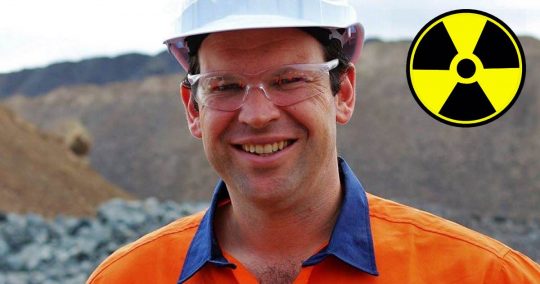
Refuting Senator Matt Canavan’s inaccurate hype about small nuclear reactors
|
Canavan Keeping The Nuclear SMR Vaporware Dream Alive , Solar Quotes ,March 12, 2021 by Michael Bloch ”…… Senator Matt Canavan: ”Keep Nuclear Energy On The Table” It’s probably been a disappointing week for pro-coal Senator Matt Canavan with the news Yallourn Power Station will retire in mid-2028 instead of 2032. But as well as a passion for coal, Senator Canavan is a nuclear power supporter.In an interview with Sky News yesterday, Senator Canavan commented:
A year ago he referred to renewables as the “dole bludgers” of energy, using the same logic. With regard to the Fukushima incident, he stated: “The latest nuclear technology is much safer; more self-contained. Small modular reactors are effectively the size of shipping containers that are much more suited to our country and size and don’t have the same safety issues.” He also managed to squeeze in a mention about instances of fatalities associated with installing solar panels on rooftops just for good measure. But back to the small modular reactors (SMRs). Where are these SMRs he speaks of? The World Nuclear Industry Status Report 2020 released in September last year states:
|
|
The Australian government’s Kimba Nuclear Waste Dump Bill moribund in the Senate

Fukushima’s nuclear waste nightmare – a warning to Australia’s pro-nukers

The Advertiser,Robyn Wood, 11 Mar 21, Today is the 10th anniversary of the Fukushima earthquake and nuclear power station reactor meltdown in Japan. Far from being under control, there are still serious problems with the reactor. In addition, there are thousands of large plastic bags of contaminated soil with nowhere to go, and thousands of litres of radioactively contaminated water that the Japanese government intends to release into the Pacific Ocean. Former residents of the area are still suffering with many on welfare, as they have lost their livelihoods and their homes, farms and shops are uninhabitable. Serious food for thought for those advocating for Australia to adopt nuclear power.
Inaccuracy of Robert Parker and his nuclear lobby
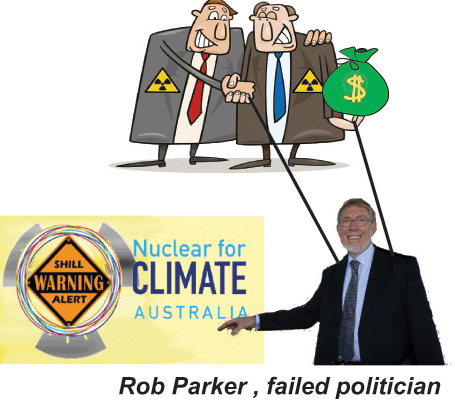 Robyn Wood.13 Mar 21, So much for all the pronukers BS about SMRs.
Massive $3 billion wind, solar and battery project approved in South Australia — RenewEconomy

Massive Goyder South wind, solar and battery storage project in South Australia gains planning approval, with first stage to begin construction later this year. The post Massive $3 billion wind, solar and battery project approved in South Australia appeared first on RenewEconomy.
Massive $3 billion wind, solar and battery project approved in South Australia — RenewEconomy
Funds have $1 trillion to spend on renewables, but are scared of Australia’s policy chaos — RenewEconomy

Big global pension funds have a huge and growing appetite for renewables, but they need policy stability, and Australia’s policy chaos is scaring them away. The post Funds have $1 trillion to spend on renewables, but are scared of Australia’s policy chaos appeared first on RenewEconomy.
Funds have $1 trillion to spend on renewables, but are scared of Australia’s policy chaos — RenewEconomy
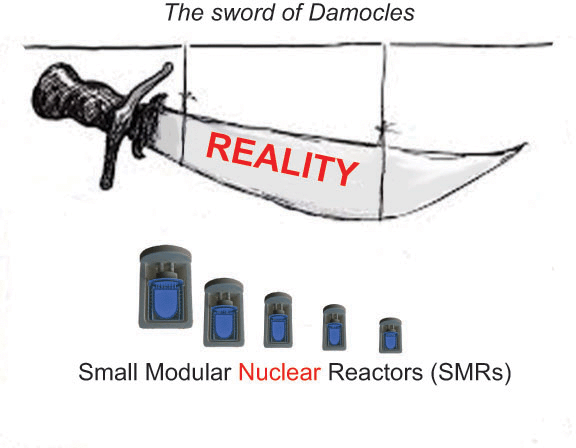
Small modular nuclear reactors and net-zero carbon emissions by 2050? The math doesn’t add up.
|
Hill Times 10th March 2021, MV Ramana: Small modular nuclear reactors and net-zero carbon emissions by 2050? The math doesn’t add up. In December 2020, Natural Resources Minister Seamus O’Regan released an action plan for small modular nuclear reactors (SMRs), which assured us that SMRs will enable, among other things, “a net-zero economy by 2050.” Earlier, O’Regan also stated: “We have not seen a model where we can get to net-zero emissions by 2050
without nuclear (power).” How does one evaluate such assertions? A nuclear plant takes around a decade to go from start of construction to
producing electricity. But one can’t start construction of a nuclear reactor immediately. The requisite planning and raising the finances might take another decade. How about SMRs? These will take even longer because the SMRs being developed in Ontario and New Brunswick are just conceptual designs. To develop full-fledged constructible designs is time consuming and expensive. NuScale, the leading U.S. design, has been under development for nearly two decades; it is still not licensed for construction because the Nuclear Regulatory Commission has identified various safety concerns.
All this after nearly US$1-billion has been spent on the design. The second parameter influencing climate mitigation potential of a technology is cost. Nuclear power, today, is about the most expensive way of generating
electricity. The only reactors being built anywhere in North America are currently forecast to cost US$29-billion up from a promised US$14-billion. In the United States, home to the most nuclear plants globally, it costs more than US$10,000 per kilowatt of generating capacity to construct a new nuclear plant, roughly eight to 10 times the cost of wind and utility scale solar power plants, respectively. The bottom line is that the math on SMRs just doesn’t add up. Investing in SMRs is a waste of time and money. |
Report: Cancer death rates rising near Fermi nuclear plant
A new study is looking to test baby teeth from children living near the plant. NEWPORT, Mich. (WTVG) – A new report from the Radiation and Public Health Project claims that the cancer death rate in Monroe County, Michigan is on the rise and it’s tying that growth to the Fermi 2 nuclear plant in Newport.
According to the report, which uses public health data from the Centers for Disease Control and Prevention, the rate of death due to cancer in Monroe County was roughly equal to that of the rest of the United States. Since 1988, that rate has risen steadily, reaching 11.3% higher than the national average in the most recent 10 years (2009-2018). From 2014-2018, that rate was 14.3% higher than the national average, amounting to 1,794 deaths. In the period between 1969 and 1978, outlines the report, that rate was 4.5% lower than the national average.
The Fermi 2 nuclear power plant went online in June of 1985, and while the report has no concrete evidence that the plant is the definitive cause of the rise in cancer deaths in the county, it does provide a correlative pattern. 13abc has reached out to DTE Energy, owners of the Fermi 2 plant, for comment.
“The trends in Monroe County cancer rates since the mid-1980s cannot overlook the startup of the Fermi reactor, and the potential role of radioactive emissions on health,” says Joseph Mangano MPH MBA, Executive Director of RPHP and study author.
“The report needs to be taken seriously, and follow-up measures are urgently needed,” adds Christie Brinkley, a long-time activist on nuclear issues, Board member of RPHP, and a native of Monroe County. “In particular our children must be protected, as they are most vulnerable.”
In an effort to further understand the role the reactor may have had in the rise in cancer rates in the area, the RPHP is conducting a “Tooth Fairy” study. They’re collecting baby teeth from children living near the power plant to test for levels of Strontium-90, a chemical created by nuclear reactors. They’re hoping to test up to 50 teeth and will compare the results to Sr-90 levels in Detroit-area residents from a 1950s-era study of atomic bomb test fallout. Information about the study, including how to participate, can be found at their website.
UN report claiming no connection between thyroid cancer and Fukushima disaster is not credible
|
Beyond Nuclear 11th March 2021, A new UN report which dismisses the March. 11, 2011 Fukushima disaster as the cause of elevated rates of thyroid cancer in that region’s childrennleaves serious questions unanswered and appears to be a rush to press to maximize publicity around the nuclear accident’s 10th anniversary, concluded Beyond Nuclear today. An advance publication of a section of the 2020 United Nations Scientific Committee on Atomic Radiation (UNSCEAR) report —Sources, effects and risks of ionizing radiation, Scientific Annex B, Advance Copy — claims that “a rise in thyroid cancer among children in the last decade was not related to increased radiation,” and nstead attributes the increases to more thorough and sophisticated testing.
But according to Dr. Ian Fairlie, a leading radiation scientist, the doses delivered by the Fukushima disaster — and as established by UNSCEAR’s own estimates— would be high enough to cause thyroid cancer among exposed children. Dr.Fairlie asserts the report’s conclusion, that “the increase…is not the result of radiation exposure”, is
“scientifically unsound..[and] inconsistent with UNSCEAR!s own estimates of high collective doses to the thyroid published in its 2012 and 2013 reports.” |
|

1 This month
17 October, Free Public Talk on Nuclear Issues in South Australia
David Noonan will speak on public interest concerns over the new Roxby Downs Indenture Act 2026 on BHP copper-uranium mining and ore processing in SA, and on how AUKUS may face SA with a High-Level nuclear waste agenda.
Dr Jim Green will discuss international developments in the field of nuclear power including ‘small modular reactors’ and Generation 4 ‘advanced’ nuclear reactor concepts.


Help Aunty Sue Protect Her Land and Sacred Sites From Destructive Rocket Testing.
.

Australians deserve the truth
about
AUKUS – https://aukuspublicinquiry.com/

PETITION – To: Prime Minister Anthony Albanese and the Australian Labor Government

of the week – Australians for War Powers Reform (AWPR)
To see nuclear-related stories in greater depth and intensity

