CSIRO patiently and methodically slaps down Peter Dutton’s nuclear nonsense.

nuclear power does not ‘back up” wind and solar as Dutton and O’Brien often claim, it must displace it. And in Australia, that’s likely to mean household solar first and foremost.
Giles Parkinson, Dec 9, 2024
Australia’s premier scientific organisation, the CSIRO, has patiently and methodically slapped down the major nuclear talking points promoted by Coalition leader Peter Dutton in its latest GenCost report, which confirms – yet again – that integrated wind and solar are easily the cheapest option.
The CSIRO first published the GenCost report in 2018, under the then Coalition government, and its conclusions have been consistent – integrated wind and solar are by far the best and lowest cost options. The new draft of the 24/25 version, which notes ongoing cost reductions in solar PV and battery storage, confirm this.
In short, it finds that firmed renewables, including transmission and storage costs, will cost between $80 a megawatt hour and $122/MWh in 2030, should they account for 80 per cent of variable generation, which is the federal government target.
That compares to between $145 and $238/MWh for large scale nuclear, and up to an eye-watering $487/MWh for so-called small modular nuclear reactors, which are part of the Coalition’s energy proposals, but which don’t exist in commercial form. The CSIRO says neither could be deployed before 2040.
See more details here: GenCost: Falling costs of solar and batteries confirm integrated renewables are cheapest option
The CSIRO, however, has also faced extraordinary and relentless attacks from the Coalition over its analysis, amplified by right wing so-called “think tanks” and the Murdoch media, and given a largely uncritical run in much of mainstream media.
Dutton’s and the nuclear lobby’s main beef with the CSIRO calculations is that it makes nuclear power look very expensive. Which it clearly is.
They argue the CSIRO report gives their favoured technology no credit for being long life (they say 60- 100 years), for having high capacity factors, and they insist that the CSIRO has got it wrong on its estimated build times.
The CSIRO has addressed each of these claims in its draft 2025 GenCost report. In fact, it is remarkable just how much of the report is devoted to a technology that it notes could not possibly be delivered in Australia before 2040 – and it forensically debunks the lot of them.
Benefits of longer life
Let’s go to the life time issue first, because it has been a particular focus of Dutton and his energy spokesman Ted O’Brien as they promote their nuclear campaign around the country.
They say that because nuclear power plants can last 60 or even 100 years, their huge up front capital costs should be smeared across the period, rather than the 30 years calculated by the CSIRO.
That sounds plausible, but the CSIRO makes a number of important points. Firstly, the 30-year calculation is standard practice for the energy industry because no financial institution will lend for longer.
And if loans were to be spread over a 60 year or 100 year period, the interest payments would be crippling. It means that the benefits of such calculations would be just 11 to 15 per cent – and not be experienced by Australian consumers until at least 45 years – or around 2070.
“It’s not a magical halving of costs or anything like that. The savings are relatively modest,” CSIRO chief energy economist Paul Graham says in the latest episode of Renew Economy’s weekly Energy Insiders podcast (to be published on Monday).
But there is another problem. The CSIRO also points out that if nuclear power plants are to last that long then they need regular refurbishment. Based on overseas experience, it puts the capital cost of those refurbishments at nearly one third of the original capital cost of the plants.
And it also puts a large hole in another linked Coalition argument, which is that wind and solar power must cost more because their facilities have to be replaced after 25 or 30 years.
The CSIRO says yes, they do need to be replaced. But when they are rebuilt, they will be rebuilt at considerably lower cost, and that’s not even taking into account the fact that wind and solar will be built where current facilities already exist, with connection points, land deals and other important infrastructure already in place.
“What we concluded from that was, actually it’s hard to identify any real unique benefit that nuclear delivers from having a long life,” Graham tells Energy Insiders.
“You can get the same benefit from shorter lived technologies, even when you have to build them twice, because both things essentially involve a reinvestment step. And when you look at the savings, they’re pretty similar.”
Indeed, the CSIRO puts the cost of rebuilt wind and solar at a considerable discount to refurbished nuclear – The experience in Ontario, the Australian nuclear lobby’s poster market, confirms this. (See table above -on original).
Each of Ontario’s main reactors will be off line for around three years – the cost is huge – and some of the world’s biggest batteries are being built to help fill in the gap, which torpedoes another nuclear lobbyist fantasy that somewhere these power plants do not need back up.
“It’s not a magical halving of costs or anything like that. The savings are relatively modest.
Capacity factors
The second issue is also critical. The nuclear lobby and the Coalition have told the CSIRO that it must calculate nuclear costs based on a 93 per cent capacity factor, and only at that rate.
This is important to them because – at such a high capacity factor – the nuclear plants are rarely switched off or even dialled down, and that gives the technology the best chance to recoup its high costs more quickly.
The CSIRO says that while such high capacity factors exist in the US, it is not the reality in the rest of the world, and is unlikely to be the case in Australia, particularly with the growth of rooftop solar and large scale renewables.
It says the global average capacity factor for nuclear plants is 80 per cent, and 10 per cent of nuclear power plant have capacity factors of less than 60 per cent. “On international data alone, the proposition of only considering 93% is not supported by the evidence,” Graham says.
And in Australia the experience of baseload power plants – in this case coal – is that they run at a capacity factor of around 59 per cent.
“In Australia we have more than 100 years of experience with operating baseload generation, not nuclear but coal,” Graham says,
“The average for black coal in the past decade is 59%. On this basis we cannot support the proposal that 93% adequately captures market conditions in Australia.”
It is interesting to note here that nuclear power does not ‘back up” wind and solar as Dutton and O’Brien often claim, it must displace it. And in Australia, that’s likely to mean household solar first and foremost.
Development lead times
The third argument that CSIRO addresses is that of the time it takes to build a nuclear power plant. This is important because the Coalition insists it can deliver its first nuclear power plant by 2035, although no one outside the Coalition and the nuclear lobbyists actually believe that.
“Many stakeholders have agreed with the GenCost estimate of at least 15 years lead time for nuclear generation,” the CSIRO report says. “Nuclear has no projects in the Australian development pipeline, has additional safety and security steps and needs new legislation and regulations.”
Where the nuclear lobby points to projects with faster lead times, CSIRO has looked at that too, and makes the interesting and relevant observation that these occur in countries where the democracy score is low, and where labour costs and protections are also low.
When it comes to small modular reactors, the Coalition argument makes no sense. They don’t actually exist in commercial form and it is unlikely any will be built before the end of the decade.
Dutton and O’Brien says they will only build an “nth of a kind”, meaning they will wait for the tech ology to be established and lower costs,.
But that is not going to happen in the timeframe that would allow the first power to be delivered by 2035.
The CSIRO, kindly, assesses its nuclear costs on an “nth of a kind” basis.
“We have been seeing all these big cost blowouts overseas, in countries like the UK and the US, and mostly it’s because these countries have come back (to building nuclear after a gap of several decades) and they’d lost all their knowledge about how to build nuclear,” Graham says.
So – after all that – and working through all the Coalition and nuclear lobby talking points – where does that put nuclear in comparison to other technologies?
“So large scale renewal, large scale nuclear, is sitting at a position one and a half to two and a half times the cost of firmed renewables,” Graham says on Energy Insiders.
“And if we look at small modular reactors …. that’s between about four to six times higher. And that’s because that’s really a pre commercial technology.
“We don’t really have any any sort of commercial deployment of that technology globally. So it’s still carrying some very high costs at the moment, which will come down once it’s once they successfully build a few more of them. But at the moment, it’s a very high cost.”
The report released on Monday is just a draft, and will go out to consultation until February, before a final report is prepared. In the meantime, the Coalition will release its own costings, and the CSIRO can expect some more blowback from the lobbyists.
“You do have to have a bit of a thick skin,” Graham tells Energy Insiders.
“But that’s the way we sort of improve things. And what’s been, I guess, unique about the last two years of GenCost is that the discussion that’s been had around it isn’t just a sort of energy insiders conversation, to forgive the pun, but it’s, it’s blown out into a sort of a, yeah, it’s much more of a public conversation.
“It’s not always at the level of sort of the sort of scientific and engineering discussion that we tend to have inside the industry, but that’s fine.
“We’ve adapted, and we’ve it’s given us a big opportunity to sort of deep dive into some of these topics, like nuclear that people want to hear about. So we’re sort of glad to do it. And we think we’ve, we hope people think that we’ve done a reasonable job of presenting fair and balanced information.”
Nuclear energy questioned again as new CSIRO report finds it will push up power prices

By Daniel Jeffrey Dec 9, 2024, https://www.9news.com.au/national/csiro-gen-cost-report-nuclear-twice-expensive-renewables/53b37f54-ad6e-4542-9ab0-35fdf48dec96
Experts have once again cast serious doubt on the viability of nuclear energy in Australia, with a new CSIRO report finding it would likely be more than twice as expensive than using renewables.
The latest version of the GenCost report, published this morning, concluded a mix of solar and wind power with firming is the cheapest form of energy production, and will remain so well into the future.
It found nuclear presents “no unique cost advantage over other technologies”.
[Excellent table here – on original]
“Similar cost savings can be achieved with shorter-lived technologies, including renewables, even when accounting for the need to build them twice,” CSIRO chief energy economist and report lead author Paul Graham said.
“The lack of an economic advantage is due to the substantial nuclear re-investment costs required to achieve long operational life.”
The report found renewables with firming produced power at a cost of $98-$150 per megawatt-hour (MWh) this year, and is set to drop to between $67-$137 in 2030.
Large-scale nuclear generation has a cost, on the other hand, of between $155-$252, which is set to only drop to $150-$245, while the respective figures for nuclear small modular reactors are more expensive again at $400-$663 and $285-$487.
The findings come as the federal opposition prepares to release the long-awaited costings for its proposal to build seven nuclear power plants.
Asked about the report, Opposition Leader Peter Dutton didn’t answer whether his party’s plan would push up power prices, instead questioning the methodology used by the CSIRO.
“The assumptions and the methodology have been disputed before… they were disputed before, and do you know what? They haven’t even seen our plan yet, and yet they’re out bagging it,” he said.
The national science agency has changed its methodology used to assess nuclear power costs, to the point it gives the technology “extremely generous” assumptions, emeritus professor Ian Lowe said.
“The study confirms the view of the electricity industry that solar and wind with storage are much cheaper than any nuclear power station would generate, even with extremely generous assumptions about the costs and operating life of nuclear reactors,” he said.
Western Sydney University’s Dr Thomas Longden said there are a number of issues facing nuclear power.
“For nuclear to achieve the lowest levelized cost of electricity, it needs to be built big and operate all the time and for a long time,” he said.
“Yet, the bigger it gets; the more upfront cost needs to be paid. And if it isn’t used as often or as long as expected, then it gets more costly.
“The true cost of nuclear will be revealed over a long time and is subject to construction costs, plus there’s also the issue of operational, fuel, and waste costs, which will be higher for nuclear.”
Energy expert Ken Baldwin noted the report showed the cost of solar and battery storage has significantly decreased, while wind, coal and particularly gas have increased.
“Solar and wind remain the cheapest form of electricity generation, even when taking into account the additional cost of firming with storage, and the additional transmission costs,” he said.
“This cost advantage over nuclear is projected to widen over the coming decades – especially by the earliest date that nuclear could foreseeably be expected to operate in Australia in the late 2030s, given the projected lead time of around 15 years.”
Dutton promised to unveil the Coalition’s nuclear costings later this week.
Policy bum Dutton has two big ideas. They’re both in bad trouble
Peter Dutton has two big ideas: cut migration and build nuclear power plants. He’s now abandoned one, and we know the other will be a disaster.
Bernard Keane, Crikey.com Dec 09, 2024
This opposition caper is pretty easy, Peter Dutton must have been thinking throughout the year. Just bag the government, disappear from the media cycle if things ever get hectic, and let the Reserve Bank’s smashing of the economy do the job of undermining government support.
At some point, however, he was going to have to produce at least some policy. Not too soon, and not too much — just enough to look like he has some sort of plan. It should have been doable. After all, he has the entirety of News Corp on his side to praise his policy offerings, and the fencesitters and bothsiders of the press gallery in other outlets won’t criticise Dutton without making sure they offer equal criticism of the government.
But that overlooks the fact that Dutton is, to use a term made famous by Paul Keating, a policy bum. There is nothing in his political history that indicates either ministerial competence or policy nous. He was an indifferent health minister who failed to push through a Medicare copayment. As immigration and then home affairs minister, he lost control of borders to organised crime and failed to fix the many basic problems of the Immigration Department. His shorter time at Defence was of a Marlesian quality — a blithe indifference to the department’s many failings, while shrilly yelling at China.
Dutton’s limited forays into policy as leader have been characterised by confusion. It’s still not clear exactly what the Coalition’s tax policy is, with the initial opposition confusion in the aftermath of Labor’s changes to the stage three tax cuts — remember those — lasting to this very day: when even your mates at News Corp say you’re “kicking the can down the road“, it’s not a good sign.
………………………………………………………………………………………………………………………….. But the confusion has now gotten worse…………………………………………………………………………
Dutton’s other signature policy, an unprecedented, fiscally devastating entry of the government into power generation, will receive some time in the spotlight this week with Dutton having promised for the umpteenth time he’ll release details of it. That the Coalition is busy trying to invent numbers for Labor’s policy to argue that the hundred-billion-plus cost of nuclear reactors is the cheap option suggests no amount of fake “independent modelling” or Panglossian assumptions have been able to get the costing down to anything reasonable.
In that context, it’s worth reading the CSIRO’s latest GenCost report, which sets out to address the complaints of nuclear power fans and the Coalition that the assumptions behind its 2023 demolition of the economic case for nuclear power (and, it shouldn’t be forgotten, Labor’s carbon capture and storage scam) were unfair.
The opposition complained that the lives of nuclear reactors are much longer than modelled. GenCost notes that nuclear power plants can indeed run for many decades, but they need refurbishment to do so, and renewables plants can run for similar lives at a much lower refurbishment cost.
The opposition complained the CSIRO should have used a US power capacity figure of 93%, not the global nuclear industry average of 80% or the Australian coal-fired power plant average of 59%. GenCost pointed out it uses the same capacity range for all power sources, and it’s not prudent financially to assume the best-case scenario.
The opposition complained that nuclear power plants could be up and running in 10-15 years and not 15 years as GenCost assumed. Gencost points out that nuclear construction times have now blown out by 2.2 years recently, and that the only countries building reactors quickly are non-democracies that don’t have to worry about public consultation.
But what about changing costs for different power sources? Well:
The capital costs of onshore wind generation technology increased by a further 8% in 2023-24 and another 2% in 2024-25 while large-scale solar PV has fallen by 8% in consecutive years. Large-scale battery costs improved the most in 2024-25 falling by 20% in 2024-25.
Even with some of the tweaks demanded by the Coalition, the latest GenCost report shows large-scale nuclear is significantly more expensive than coal, gas and solar or wind with firming capacity. The only things large-scale nuclear is cheaper than is carbon capture and storage, and small modular reactors — which are at least twice the cost of any other energy source and three times the cost of the cheaper ones.
Dutton might be better off abandoning any policy and simply going to the election with nothing more than incessant criticism of Labor. He’s a policy bum, and any time he opens his mouth on his own policies, he confirms it. https://www.crikey.com.au/2024/12/09/peter-dutton-immigration-nuclear-energy/
Renewable energy trounces nuclear on generation costs

By Marion Rae, December 9 2024 – https://www.newcastleherald.com.au/story/8841115/renewable-energy-trounces-nuclear-on-generation-costs/
Power planners have found nuclear energy does not stack up for Australia even after considering new parameters, with large-scale solar and big batteries still the lowest-cost option.
In an official update released on Monday, as the federal opposition prepares to release its costings, scientists warn taxpayers will need deep pockets and a lead time of at least 15 years to develop nuclear energy generation.
For the seventh straight year, renewables were the lowest-cost of any new-build electricity-generating technology.
After a global energy crisis and equipment supply crunch several years ago, large-scale solar and lithium battery storage have weathered the inflationary period the best of all technologies.
The cost of batteries recorded the largest annual reduction, with capital costs down by one-fifth. Rooftop solar costs are also coming down.
Australian Conservation Foundation nuclear policy analyst Dave Sweeney said four million households with rooftop solar, energy producers and retailers have already voted with their feet and wallets.
“Nuclear is not right for Australia, which has some of the best renewable energy resources on the planet,” he said.
The GenCost 2024-25 Report released for consultation comes as the coalition pushes for an end to Australia’s nuclear ban and promises to have reactors online in as soon as 10 years if elected in 2025.
Opposition Leader Peter Dutton, eyeing sites in seven regional centres, has pledged to release the coalition’s nuclear costings “this week”.
But nuclear energy generation would be 1.5 to two times more expensive than large-scale solar, according to the analysis by the national science agency CSIRO and the Australian Energy Market Operator.
A one-gigawatt nuclear plant has a price tag of roughly $9 billion, but the bill would double to $18 billion as the first of its kind.
Operators would also need to establish new connection points to safely supply the national electricity grid, experts warn.
Advocates have demanded greater recognition of the potential cost advantages of nuclear’s long operating life compared to solar panels and wind turbines, but CSIRO chief energy economist and GenCost lead author Paul Graham said he found none.
“Similar cost savings can be achieved with shorter-lived technologies including renewables, even when accounting for the need to build them twice,” Mr Graham said.
Nuclear’s capacity factor – referring to how much of a year a reactor could operate at full tilt – remains unaltered at 53-89 per cent based on verifiable data and consideration of Australia’s unique electricity generation needs.
Nor would the often-touted United Arab Emirates example of a relatively quick 12-year nuclear construction time-frame be achievable here, the report found, because Australians require consultation.
“The facts are laid out very clearly in the GenCost report, and our government respects the work of CSIRO scientists and researchers and listens to that advice,” Industry and Science Minister Ed Husic said.
“Peter Dutton’s nuclear fantasy not only threatens to blow out the budget, it also threatens jobs and household power bills,” he said.
Energy Minister Chris Bowen said renewables remain the cheapest new-build electricity generation in Australia to 2050, as standalone assets and when also accounting for the required storage, transmission and firming.
The report is open for industry, community and political feedback until February 11.
Counteracting the nuclear-military-corporate-media – week to 9 December

Some bits of good news:China completes its own version of a Great Green Wall. Christian institutions divest from fossil fuels. Incredible progress on AIDS for Africa and India .
TOP STORIES. Amnesty International investigation concludes Israel is committing genocide against Palestinians in Gaza .
Gender and radiation: New report shows girls most at-risk group.
Biden’s Nuclear Going Out of Business Sale.
Climate . Just listen to Radio Ecoshock – it is way ahead of everyone else in climate information. Just Shut Up about Climate. Countdown to an ice-free Arctic:New research warns of accelerated timelines. Younger people at greater risk of heat-related deaths this century – study.
Plastic pollution. ‘Big Oil must be dancing for joy‘: Anger builds at failure to deliver Global Plastics Treaty. ‘The process is broken’: Major oil producing countries kill UN plastics treaty over cap on production.
Noel’s notes. Misplaced jubilation as UK’s old brittle nuclear reactors allowed to crack on Surprise ! surprise! – the nuclear lobby has co-opted an ex-politician with a dubious history – Tony Blair.
Plastic pollution. International talks on curbing plastic pollution fail to reach agreement.
**********************************
AUSTRALIA.
The question of nuclear in Australia’s electricity sector
. Nuclear energy questioned again as new CSIRO report finds it will push up power prices. A sneak preview of Peter Dutton’s nuclear costings.
Peter Dutton cops backlash over push to build seven nuclear power stations in Australia. The seven ways the Federal Coalition could cook the books on nuclear costings
Nuclear energy debate draws stark gender split in Australia ahead of next year’s election.
Nuclear energy inquiry draws emotional response in Port Augusta.
Senior Netanyahu Adviser Served in Victorian Court facing Genocide Charges. ‘Nothing to see here’ says Australia as third Thales corruption case starts globally. More Australian nuclear news headlines at https://antinuclear.net/2024/12/03/australian-nuclear-news-2-9th-december/
NUCLEAR ITEMS.
| ATROCITIES. Gaza’s Civil Defense Says Nearly 100 Killed by Israeli Attacks Over 24 Hours |
| ECONOMICS. Tony Blair is wrong to love nuclear energy -ALSO AT …. Why NuScale Power Stock Slumped Today. Key partner quits EDF’s Nuward small nuclear reactor project- ALSO AT https://nuclear-news.net/2024/12/06/1-b1-tony-blair-is-wrong-to-love-nuclear-energy/ UK Seeks More Investors as Sizewell Funding Talks Drag On. Starmer to court United Arab Emirates for British nuclear power investment. |
| EDUCATION. Midlands Regional Hub for Nuclear Skills officially launched. |
| ENERGY.The LA Times Makes the Case for Shutting the Diablo Canyon Nukes.Meta misguided in calling for massive nuclear energy scale-up.Baseload power generators not needed to guarantee supply, say science and engineering academies.Cost of switching off UK wind farms soars to ‘absurd’ £1bn. |
| ENVIRONMENT. Radioactive sea spray is dosing communities. |
| ETHICS and RELIGION. What happened to integrity and honor in the age of Technocracy? |
| HEALTH. Cancer mortality in the USA and atmospheric nuclear weapons test fallout ratio – Identifying the principal origin of the global cancer epidemic.Relationship Between Urinary Uranium and Cardiac Geometry and Left Ventricular Function: The Strong Heart Study. |
| INDIGENOUS ISSUES. Nuclear industry selects site in northwestern Ontario for waste disposal amidst regional opposition. |
| LEGAL. Campaigners lose bid to challenge Sizewell C licence decision in High Court. |
| POLITICS. The First Seven Billionaires Trump Has Tapped for Top Jobs. Gabbard has more intelligence than entire Intelligence Service she’s slated to head. Trump’s Pro-Israel Dream Team: Patel Nomination Caps Hawkish Cabinet. Britain’s Energy Secretary Follows Tech Giants In Pursuit Of New Nuclear Power Stations |
| POLITICS INTERNATIONAL and DIPLOMACY.Assad Is Out, Woke Al-Qaeda Is In. Zelensky Says He’s Willing To Cede Territory in Exchange for NATO Protection. Biden to Zelensky: ‘Our $210 billion not enough…send 18 year olds to die in our Russian proxy war. Iran’s uranium enrichment ‘worrisome’ – nuclear watchdog. |
| SAFETY. EDF set to extend life of UK nuclear plants as Government replacement plans falter. EDF Brings Sizewell Back Online, Balancing UK’s Nuclear Grid. Delays to nuclear plants giving Sizewell B a new lease of life – ALSO AThttps://nuclear-news.net/?s=Delays+to+nuclear+plants UK underestimates threat of cyber-attacks from hostile states and gangs, says security chief.Drugs found in control room at Dungeness Nuclear Power Station. NRC Finds Apparent SecurityViolations at Pilgrim. |
| SPINBUSTER. Tony Blair think tank says UK needs to build new nuclear ‘at pace’ -ALSO AT https://nuclear-news.net/2024/12/06/1-a-tony-blair-think-tank-says-uk-needs-to-build-new-nuclear-at-pace/ . TONY BLAIR: STILL A NUCLEAR NUTTER! |
| TECHNOLOGY. Hinkley update: mixed reaction as first reactor drops into place. The Moltex Reactor and used CANDU Fuel. |
| URANIUM. Niger takes control of French nuclear firm’s uranium mining operations. Green Group Sounds Alarm Over Meta’s Nuclear Power Plans |
| WASTES.Backfilling of Gorleben salt mine (former German nuclear waste dump) starts.Putin’s huge, rusting nuclear battlecruisers symbolise Russian naval decline.Lincolnshire county councillors demand answers on Nuclear Waste Services’ (NWS) proposed Geological Disposal Facility (GDF) at Theddlethorpe. Canada’s nuclear waste problem is not solved . Licensing of Finnish repository further delayed.Decommissioning: Explosives speed Sizewell A turbine hall decommissioning. |
| WEAPONS and WEAPONS SALES. These Billionaires Subsidize the Israeli Military Through a US Nonprofit. We used to laugh at North Korean nuclear submarine boasts- Not any more. The growing arsenals. |
WAR and CONFLICT. Netanyahu Takes Credit for Assad’s Overthrow, Israel Seizes Golan Heights ‘Buffer Zone’
The question of nuclear in Australia’s electricity sector

https://www.csiro.au/en/news/All/Articles/2024/December/Nuclear-explainer 9 Dec 24
In Australia’s transition to net zero emissions, the electricity sector has a major role to play. But does nuclear power have a place in our future grid?
Key points
While nuclear technologies have a long operational life, this factor provides no unique cost advantage over shorter-lived technologies.
Nuclear power does not currently provide the most cost competitive solution for low emission electricity in Australia.
Long development lead times mean nuclear won’t be able to make a significant contribution to achieving net zero emissions by 2050.
This explainer was updated on 09 December 2024 to reflect costings included in the draft GenCost 2024-25 Report.
As Australia works towards emissions reduction targets in the transition to net zero, we know the electricity sector has a major role to play. We also know it makes sense to assess a full range of technologies: some new and emerging, some established and proven.
In this context some proponents want nuclear to be considered as an option for decarbonising the electricity sector.
Despite nuclear power being a component of electricity generation for 16 per cent of the world’s countries, it does not currently represent a timely or efficient solution for meeting Australia’s net zero target.
Here’s why:
- Nuclear is not economically competitive with solar PV and wind and the total development time in Australia for large or small-scale nuclear is at least 15 years.
- Small modular reactors (SMRs) are potentially faster to build but are commercially immature at present.
- The total development lead time needed for nuclear means it cannot play a major role in electricity sector emission abatement, which is more urgent than abatement in other sectors.
Understanding GenCost calculations
GenCost is a leading economic report by CSIRO in collaboration with the Australian Energy Market Operator (AEMO) to estimate the cost of building future electricity generation and storage, as well as hydrogen production in Australia.
It is a policy and technology neutral report and the annual process involves close collaboration with electricity industry experts. There are opportunities for stakeholders to provide pre-publication feedback, ensuring the accuracy of available evidence.
Paul Graham, our Chief Energy Economist and lead author of the report, said GenCost is an open and public process.
“The report’s data is not just for AEMO planning and forecasting; it’s also used by government policymakers and electricity strategists who require a clear, simple metric to inform their decisions,” Paul said.
“To facilitate a straightforward comparison across different technologies, the GenCost report conducts a levelised cost of electricity analysis. This method calculates a dollar cost per megawatt hour (MWh) over the economic life of the asset, incorporating initial capital expenses and any ongoing fuel, operation, and maintenance costs.”
The draft GenCost 2024-25 Report released on 09 December 2024 found renewables continue to have the lowest cost range of any new build electricity generation technologies.
[Excellent table here -on original]
One of the factors that impacts the high and low cost range is the capacity factor. The capacity factor is the percentage of time on average that the technology generates to its full capacity throughout the year. Costs are lowest if technologies. such as nuclear, can operate at full capacity for as long as possible so they have more generation revenue over which to recover their capital costs.
Nuclear technology is capable of high capacity factor operation but globally its capacity factor ranges from below 60% to above 90% with an average of 80%. Australia operates a similar steam turbine based technology in coal generation for which the average capacity factor over the last decade was 59% with a maximum of 89%.
The shape of the electricity load and competition from other sources is very different between countries and so our preference is to always use Australian data where it is available. Consequently, we apply the historical coal capacity factors when considering the potential future capacity factors of Australian nuclear generation.
Capital cost assumptions
While nuclear generation is well established globally, it has never been deployed in Australia.
Applying overseas costs to large-scale nuclear projects in Australia is not straightforward due to significant variations in labour costs, workforce expertise, governance and standards. As a result, the source country for large-scale nuclear data must be carefully selected.
GenCost estimates of the cost large-scale nuclear are based on South Korea’s successful continuous nuclear building program and adjusted for differences in Australian and South Korean deployment costs by investigating the ratio of new coal generation costs in each country.
The large-scale nuclear costs it reported could only be achieved if Australia commits to a continuous building program, following the construction of an initial higher-cost unit or units. Initial units of all first-of-a-kind technologies in Australia are expected to be impacted by higher costs. A first-of-a-kind cost premium of up to 100 per cent cannot be ruled out. These assumptions remain for the draft GenCost 2024-25 Report.
Life of the investment
GenCost recognises the difference between the period over which the capital cost is recovered (the economic life) and operational life of an asset.
GenCost assumes a 30-year economic life for large-scale nuclear plants, even though they can operate for a longer period. It is standard practice in private financing that the capital recovery period for an asset is less than its full operational life, similar to a car or house loan. For power stations, warranties expire and refurbishment costs may begin to fall around the 30-year mark. As a result, we use a 30-year lifespan in our cost calculations.
After the final GenCost 23-24 Report was released in May 2024, nuclear proponents clarified they will seek to achieve longer capital recovery periods, closer to the operational life, by using public financing to realise potential cost advantages.
The draft GenCost 2024-25 Report has calculated those cost advantages for the first time (using a 60-year period), finding that there are no unique cost advantages arising from nuclear technology’s long operational life. Similar cost savings are achievable from shorter-lived technologies, even accounting for the fact that shorter lived technologies need to be built twice. This is because shorter-lived technologies such as solar PV and wind are typically available at a lower cost over time, making the second build less costly.
The lack of an economic advantage for long-lived nuclear is due to substantial nuclear refurbishment costs to achieve long operational life safely. Without new investment it cannot achieve long operational life. Also, because of the long lead time in nuclear deployment, cost reductions in the second half of their operational life are not available until around 45 years into the future, significantly reducing their value to consumers compared to other options.
Current figures for Small Modular Reactors (SMRs)
The Carbon Free Power Project was a nuclear SMR project in the United States established in 2015 and planned for full operation by 2030. It was the first project to receive design certification from the Nuclear Regulatory Commission, an essential step before construction can commence. In November 2023, the project was cancelled following a 56 per cent increase in reported costs.
Despite being cancelled, this project was the first and currently remains the only project to have provided cost estimates for a real commercial venture with detailed data. Until now, most sources were for theoretical projects only.
“The main area of uncertainty with nuclear SMR has been around capital costs,” Paul said.
“The Carbon Free Power Project provided more confidence about the capital costs of nuclear SMR and the data confirms it is currently a very high-cost technology.”
“We don’t disagree with the principle of SMRs. They attempt to speed up the building process of nuclear plants using standardised components in a modular system and may achieve cost reductions over time. However, the lack of commercial deployment has meant that these potential savings are not yet verified or realised,” Paul said.
Time is running out for the energy transition
Nuclear power has an empty development pipeline in Australia. Given the state and federal legal restrictions, this is not surprising.
But even if nuclear power was more economically feasible, its slow construction and its additional pre-construction steps, particularly around safety and security, limit its potential to play a serious role in reducing emissions within the required timeframe.
In the last five years, the global median construction time for nuclear has been 8.2 years. Furthermore, in the last ten years, no country with a similar level of democracy to Australia have been able to complete construction in less than 10 years. Overall, it will take at least 15 years before first nuclear generation could be achieved in Australia.
“The electricity sector is one of our largest sources of emissions and delaying the transition will make the cost of addressing climate change higher for all Australians,” Paul said
The electricity sector must rapidly lead the transition to net zero, so other sectors like transport, building and manufacturing can adopt electrification and cut their emissions.”
CSIRO reaffirms nuclear power likely to cost twice as much as renewables
By energy reporter Daniel Mercer and National Regional Affairs Reporter Jane Norman, ABC News, 9 Dec 24
In short:
The CSIRO’s new GenCost report again says a nuclear power plant for Australia would likely cost twice as much as renewable energy.
Australia’s leading science agency also said nuclear power plants enjoyed relatively little financial advantage from their long lives and would run at a capacity similar to coal.
What’s next?
Opposition Leader Peter Dutton prepares to release the much-anticipated costings of the Coalition’s nuclear power policy this week.
Building a nuclear power plant in Australia would likely cost twice as much as renewable energy even accounting for the much longer life-span of reactors, according to a new report from Australia’s leading science agency.
In its latest economic analysis of the cost of building various energy projects, the CSIRO found nuclear plants enjoyed relatively little financial advantage from their long lives, which could be double a solar or wind farm.
It comes as the Opposition Leader Peter Dutton prepares to release the much-anticipated costings of the Coalition’s nuclear power policy this week. Mr Dutton has repeatedly said the policy would help bring down power bills, a claim challenged in this latest report.
The CSIRO regularly releases the GenCost report, which looks at the cost of Australia’s energy sources. It has consistently found renewable to be the cheapest option, despite a run of inclusions at the request of critics to make changes to the modelling — the latest being the life span of a nuclear plant.
And the agency said there was little evidence to suggest nuclear reactors in Australia would be able to benefit from running flat-out around the clock, noting they would face the same forces that are hollowing out the business case for coal.
The conclusions come after the CSIRO copped heavy criticism over a report in May that found Australia’s first nuclear power plant would cost up to $17 billion in today’s dollars and not be operational until 2040.
At the time, critics including opposition energy spokesman Ted O’Brien, who is spearheading the Coalition’s case for nuclear power, said the CSIRO analysis was flawed.
………………….an update of its GenCost report — which it carries out annually alongside the Australian Energy Market Operator — the CSIRO has largely stood by its earlier findings.
Nuclear’s long life ‘no advantage’
………………….CSIRO chief economist Paul Graham said even if a nuclear project could get a loan with a 60-year term, higher interest payments would wipe out many of the supposed gains.
……………………… low costs would be short-lived because nuclear reactors faced substantial refurbishment costs running into billions of dollars after about 40 years of operation.
For these reasons, Mr Graham said there was no “unique” cost advantage offered by nuclear compared with renewable energy projects backed by transmission lines and so-called firming technologies such as batteries and gas plants.
…………………………………………………………………………… No plant likely until 2040
On the subject of lead times to build nuclear, Mr Graham was steadfast.
He said suggestions Australia would be able to build its first nuclear reactor in sooner than 15 years seemed to stretch plausibility.
Nuclear proponents have pointed as an example to the United Arab Emirates, which went from having no reactors to commissioning its first project in 12 years.
Mr Graham said the UAE was, in many ways, a best-case scenario for the nuclear industry but the country was hardly comparable to Australia.
The UAE was an absolute monarchy with an autocratic style of government but Mr Graham said Australia was a democracy where policies were subject to many checks and balances.
Accordingly, he said overturning Australia’s ban on nuclear power, “planning, permitting and financing” a reactor would be a daunting task that took a lot of time.
……………………… “After we evaluated these three topics, potential for longer life, how often nuclear generates throughout the year, when we applied those numbers, we are still finding that large-scale nuclear would be 1.5 to 2.5 times the cost of generating from firmed solar and wind,” Mr Graham said.
……………………………….In line with its earlier findings, the CSIRO concluded renewable energy and the technologies required to back it up would be the cheapest way of meeting Australia’s future energy needs.
Energy Minister Chris Bowen said the CSIRO had accommodated the Coalition’s concerns and still found that Labor’s renewables-led approach was the cheapest way of overhauling the electricity grid.
He described the nuclear policy as “wildly optimistic”, in light of the report’s findings.
“[It] thought about those criticisms, analysed those criticisms and found that those criticisms don’t stack up,” Mr Bowen said.
………………………………..In what Mr Graham described as an “amazing achievement” in an inflationary environment, the CSIRO found battery costs had tumbled 20 per cent in the 12 months to June 30, while there had been back-to-back decreases of 8 per cent for large-scale solar.
Wind projects, by contrast, increased by 2 per cent last year following a whopping jump of 35 per cent in 2022-23 and an 8 per cent hike in 2023-24.
Cost estimates for miniature nuclear plants called small modular reactors (SMRs), meanwhile, were still by far and away considered the most expensive type of new energy project……https://www.abc.net.au/news/2024-12-09/nuclear-power-plant-twice-as-costly-as-renewables/104691114
If you don’t know, vote no on nuclear
Paul SEKFY,
Yarranbella. News Of The Area – Modern Media – , https://www.newsofthearea.com.au/letter-to-the-editor-if-you-dont-know-vote-no-on-nuclear?fbclid=IwY2xjawHCJhpleHRuA2FlbQIxMQABHfZmi7k4NSrBSYSgCBdH1DMvb4qmQAyFkXq6z6NPT1O3fwFestYaRYCKdg_aem_Ce9U6F-WQb71jMpXOintCw
THE fatuous debate about potential nuclear power options for Australia cannot be taken seriously.
There is no credible evidence supporting any such proposal either economically or environmentally in the Australian context.
The most recent Royal Commission, in 2016 in South Australia, into the nuclear fuel cycle concluded as much.
The history of nuclear power plant accidents and disasters should sound enough warning.
There is an increasing level of radioactive pollution due to the nuclear fuel cycle more generally and the ongoing release of radioactive material continues.
We now have a nuclear waste storage facility in South Australia due to our AUKUS agenda, but we have not been able to locate a necessary more permanent nuclear waste storage facility anywhere.
Sensible people do not want one to be anywhere.
This should signal game over but sadly not.
The economics do not add up and the time taken to build reactors will not assist in meeting our essential carbon reduction targets.
Further concentration of power generation capital in the hands of a wealthy few, regardless of suggested initial taxpayer investment is clearly not desirable or justifiable.
Just look at the coal and oil industries in terms of their dominant power and influence.
Owned by an elite few, they continue to pollute and expect subsidies to do so.
We now recently have seen how this folly grows.
Locally we have proponents of nuclear power promoting that it is somehow in our interests to pay them our money to hear these paid proponents spruik their theories.
Creative and clever solutions to energy and climate are needed, not this dangerous misdirection.
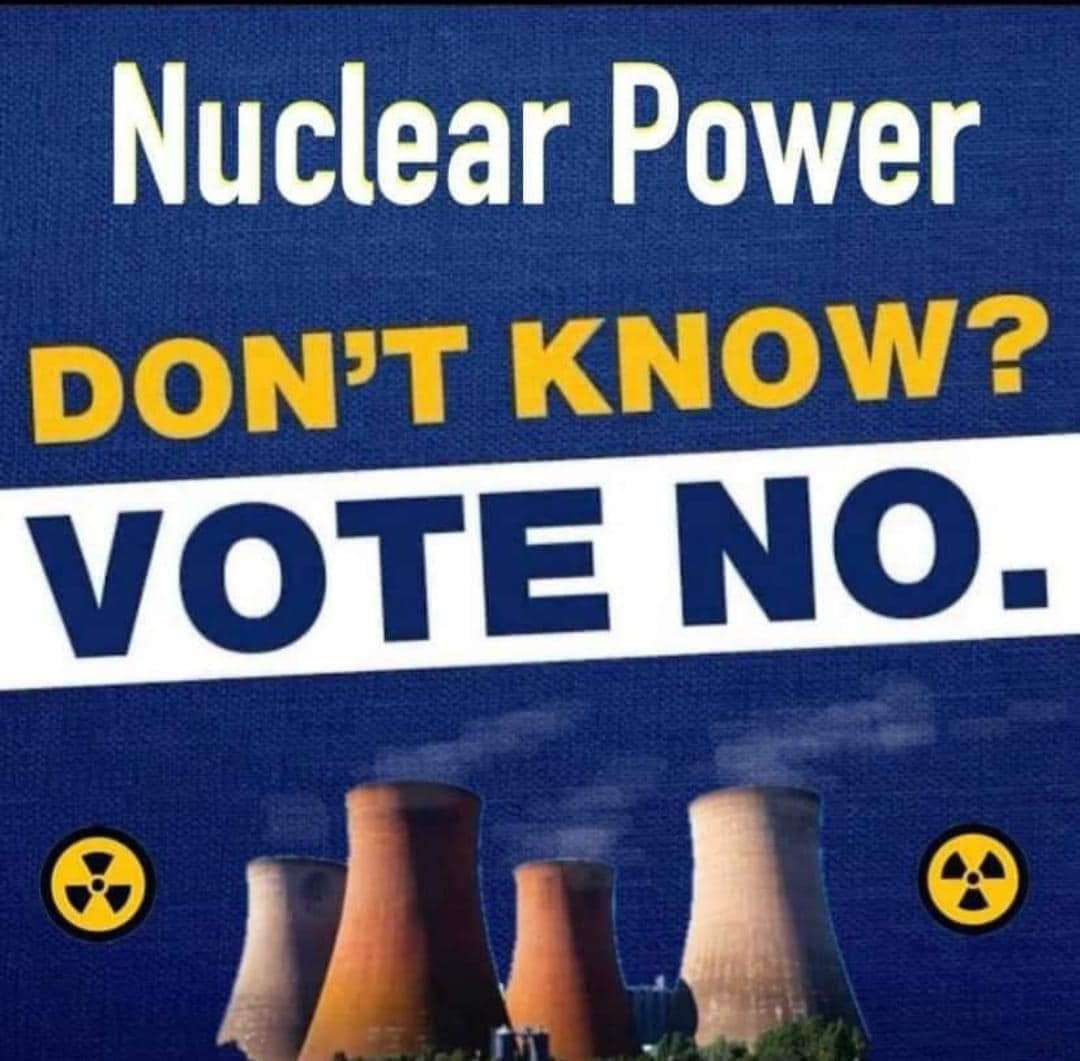
If you don’t know, vote no is the most appropriate advice with regard to the nuclear issue.
Surely a more sensible nuclear agenda for humanity and us Australians is a ban on nuclear weapons.
What happened to integrity and honor in the age of Technocracy?

Charles Hugh Smith, oftwominds.com, Fri, 06 Dec 2024, https://www.sott.net/article/496524-What-happened-to-integrity-and-honor-in-the-age-of-Technocracy
The hope here is that facing the reality of moral collapse frees us of the delusion that fiddling with technocratic financial abstractions and policy tweaks can reverse moral collapse.
Ours is a technocratic culture with a short attention span, and so problems and solutions are understood to be 1) technocratic and 2) instant. The problem is something that can be distilled down to a spreadsheet, formula, algorithm or legalistic policy, and the solution is some modification of spreadsheet, formula, algorithm or legalistic policy: all our problems will go away if we just end the Fed, switch to cryptocurrency, tweak some laws, get rid of the bankers, eliminate an agency, and so on.
These solutions will offer immediate relief. The problems will start melting away the minute we modify the spreadsheet, algorithm, financial settings or legal code.
But what if the problem is the collapse of integrity and honor, a moral rot that has consumed the foundations of our social order? If this is the root problem, then technocratic-financial solutions are the equivalent of excising a wart from the big toe and declaring that as a result of this procedure, the brain cancer has been cured.
What if the problem is that everything we’re cheering as Progress is actually the opposite–it’s Anti-Progress? What if all the technocratic “advances” that are constantly being hyped as wondrous are actually harming our physical and mental health?
So a product labeled as a “veggie snack” that’s nothing more than fat-soaked, sugary potato starch is lauded because it’s immensely profitable, a virtue gained by deceiving parents into thinking a “veggie snack” is a healthy snack.
That this is a culture in moral collapse is obvious, but we dare not admit it. That integrity and honor have decayed to the point of parody is equally obvious, but that too doesn’t register in a culture attuned to novelty, profit, gadgets, legalese, techno-fantasies and technocratic “solutions” to problems that aren’t even visible to technocrats.
Integrity and honor have, along with everything else, been commoditized into something we sell as a “product” or “enhancement.” Virtue-signaling has replaced actual integrity, and as the host of my latest podcast observed, the job of corporate CEOs is not to make quality products; their job is to elevate the corporation’s stock price by whatever means are available–including hollowing out quality, reliability and durability.
Seeking a Culture of Honor and Integrity with Emerson Fersch and Amy LeNoble (59 min)
In this state of moral collapse, we look to centralized authorities to solve all our problems. But the collapse of integrity and honor does not have a legal, financial or technocratic solution. We have to reverse that collapse ourselves rather than rely on centralized diktats from on high to fix what’s broken.
Before we get to the hope, let’s first review reality. Here is loneliness–soaring. – [excellent graphics here, on original]
And we all know how positive online interactions are for our collective mental health:
Every one of these graphics depicts a social order in collapse, yet this truth is greeted with silence or delusional misdirections and self-referential parodies being passed off as “solutions.”
Let’s say we want a lifestyle stripped of denial, moral rot, techno-fantasies and technocratic delusions, a lifestyle of responsibility, accountability, integrity and honor. Oops, sorry, that lifestyle is out of stock and we don’t anticipate any reordering.
The hope here is that facing the reality of moral collapse frees us of the delusion that fiddling with technocratic financial abstractions and policy tweaks can reverse moral collapse and Anti-Progress. We are then free to see the problem is spiritual and cultural, realms that we change in our own lives, not by waiting around for central authorities–the state, Big Tech, etc.–to fix for us.
We need a new way of living, not more gadgets and financial “innovations.” A restoration of basic integrity and honor cannot be achieved by technocratic “solutions”–policies, crypto, apps, algos, AI–for the belief that these are solutions has blinded us to the decay and collapse of the foundations of the social order.
Yes, it’s understandable that we all want a solution to the collapse of integrity and honor to be done for us by some new app or a new law, but that’s like thinking the wart on the big toe is the source of the brain cancer. Real social change comes from the ground up, not the top down. I explore these themes in my new book The Mythology of Progress, Anti-Progress and a Mythology for the 21st Century.
(free sample chapter)
New podcast:Seeking a Culture of Honor and Integrity with Emerson Fersch and Amy LeNoble (59 min)
‘Nothing to see here’ says Australia as third Thales corruption case starts globally

the NACC did not appear to have placed sufficient weight on the seriousness of the matter, particularly as Thales is linked to several international corruption matters, operates in one of the most corrupt industries in the world, and currently manages Australian Government contracts worth billions of dollars.
the Defence Department hired an external negotiator with a conflict of interest to lead its billion-dollar negotiations with Thales……………………………………Defence’s two lead negotiators together owned 55% of Scotwork, and would benefit financially.
Defence Industry Minister Pat Conroy turns a blind eye to “unethical conduct” between Thales and the Defence Department despite national audit office warning of “capture” by weapons giants
Michelle Fahy, Dec 08, 2024, https://undueinfluence.substack.com/p/nothing-to-see-here-says-australia?utm_source=post-email-title&publication_id=297295&post_id=152750589&utm_campaign=email-post-title&isFreemail=true&r=1ise1&triedRedirect=true&utm_medium=email
Part 3 of 3 (read part 1 and part 2)
The number of corruption investigations into the Thales Group continues to mount internationally with another announced two weeks ago.
The UK’s Serious Fraud Office and its French equivalent, Parquet National Financier, are jointly investigating suspected bribery and corruption by Thales on a contract in Asia. Thales has denied the allegations.
This followed news in June that police in France, the Netherlands and Spain had raided Thales’ offices in those countries as part of two separate additional corruption investigations into arms deals involving the Thales Group, as we reported in part 2.
In Australia, however, the Albanese government has swept aside a key integrity agency’s reports of “unethical conduct” between Thales and the Defence Department, appointing Thales as the fourth “strategic partner” in the new domestic missile-making enterprise.
Minister for Defence Industry Pat Conroy dismissed as an “unsubstantiated allegation” that was “flying around” the documented concerns of the Australian National Audit Office about a former defence official sharing confidential information with Thales and later soliciting a bottle of champagne from the company.
In a televised address at the National Press Club on October 30, where Conroy announced the government’s appointment of Thales as a Guided Weapons and Explosive Ordnance (GWEO) “Strategic Partner”, the minister was asked whether he remained confident in Thales and its integrity.
Said Conroy: “Let’s be very frank about this thing that’s flying around. There’s an allegation of an incident that occurred in 2017. 2017 – seven years ago – under the last government.
“Defence has thoroughly investigated it and I’m advised that’s there’s been no evidence to substantiate the allegation. It’s important to note that there is one allegation, unsubstantiated.”
But Conroy was wrong to claim the Thales deal has been “thoroughly investigated”, said Chris Douglas, a Perth-based international financial crime consultant.
“It has not been. The Defence Department does not have the capability to investigate allegations that could involve corruption.”
Douglas said that a thorough investigation could only be undertaken by a law enforcement agency, particularly the National Anti-Corruption Commission, “using a full suite of investigation powers including electronic evidence gathering”.
“There might be evidence at the person’s home, Defence isn’t going to find that, or in premises occupied by Thales, Defence won’t find that either. That is why we have a NACC.”
Following the audit office’s scathing June report on the 2020 Thales munitions deal, the Defence Department referred the matter to the NACC.
According to the ABC, after receiving the referral the NACC instructed the Defence Department to conduct the preliminary investigation. The department later said it was unable to substantiate the allegation. (See part 1.)
Douglas said the NACC did not appear to have placed sufficient weight on the seriousness of the matter, particularly as Thales is linked to several international corruption matters, operates in one of the most corrupt industries in the world, and currently manages Australian Government contracts worth billions of dollars.
He added that if Thales was an individual, “based on its past behaviour it would not be given a security clearance, and therefore no employment”.
Following the ABC’s report, Minister Conroy was asked whether he was concerned that the investigation into the unethical conduct appeared “to have hit a dead‑end, with the Anti‑Corruption Commission referring it back to the department, which then found no evidence”.
Conroy responded: “I think the important thing there is all due process was followed… All the organisations involved have investigated this matter.”
GWEO Chief, Air Marshal Leon Phillips, added: “The department has investigated that matter and cannot substantiate what was alleged. So we’ve concluded those matters.”
It is a long way from Defence Minister Richard Marles’ promise on 30 June that the matter would be “fully investigated” in a way which is “completely robust, which people have total confidence in”.
Champagne bottle “least of the concerns” about Defence probity
At a hearing of the parliament’s powerful Joint Committee on Public Accounts and Audit in November, Senator Linda Reynolds, deputy chair of the committee and a former defence minister, raised strong concerns about the 2020 Thales munitions deal.
Reynolds alluded to discrepancies between what she had been told as minister in briefings by the Defence Department and the facts contained in the report.
“When I read this audit report and remembered what had actually come up to me in the [ministerial] brief, it almost made me feel ill … and that is very consistent with the advice that is in this report that went to a different minister in 2017.”
Reynolds’ remarks corroborated the auditor-general’s report: “Defence’s advice to ministers on the tender and contract negotiations did not inform them of the extent of tender non-compliance [by Thales], [the] basis of the decision to proceed to negotiations, or [the] ‘very high risk’ nature of the negotiation schedule.” (p9)
The report also said the department’s advice in mid-2017 to then minister for defence industry Christopher Pyne was incomplete regarding the Department’s decision to proceed with Thales as sole tenderer: “The advice did not address the legal basis for the procurement method, the risks associated with a sole source procurement approach, or value for money issues — including how Defence expected to achieve value for money and maintain commercial leverage in the context of a sole source procurement.” (p10)
We’ve had a history of ANAO reports and [Defence Department] mea culpas… It’s like groundhog day
Reynolds told defence officials at the hearing: “These are not the first appalling findings by the ANAO… We’ve had a history of ANAO reports and [Defence Department] mea culpas… It’s like groundhog day… I think the bottle of champagne was the least of the concerns in relation to probity.”
She said the fact that the government was continuing to award new contracts to Thales was a concern: “You’ve inherited a smell, a big smell.”
Defence appointed a lead negotiator that was providing training to Thales at the same time
In a repeat of the future frigate contract negotiation with BAE Systems (see our Sinking Billions series), the audit report revealed (p87) that the Defence Department hired an external negotiator with a conflict of interest to lead its billion-dollar negotiations with Thales.
The joint negotiation training was provided by Scotwork to both the Thales and the Commonwealth negotiation teams at the same time and location, with no segregation. It was fully paid for by Defence.
Furthermore, in November 2019, Defence was advised by one of its lead negotiators that Thales had engaged Scotwork to deliver a negotiation course (separate to the above training). Defence’s two lead negotiators together owned 55% of Scotwork, and would benefit financially. They said they were not involved with that Thales training, that Scotwork had strict ethical walls in place, and that the revenue was “not material”. Defence accepted this and did not enquire into the dollar value of the revenue.
Defence conducted its contract negotiations with Thales from 5 December 2019 to 19 February 2020.
These are just a few of the many serious issues documented in the audit report.
“Strategic partners” or state capture?
Thales Australia’s CEO, Jeff Connolly, said the announcement of its appointment as Guided Weapons and Explosive Ordnance “Strategic Partner” was “proof of the enduring trust between Thales Australia and the Commonwealth”.
In her evidence to the audit committee, deputy auditor-general Rona Mellor was forthright about the use of such language by government and industry: “One of the big issues is this…nomenclature of ‘strategic partnership’. You’re actually not in partnership. You have a contract… you need to hold them to account.”
On the Thales deal, Mellor told the committee that while big international weapons contractors did “important heavy lifting in defence specialist military equipment and munitions”, keeping an “appropriate distance in our relationships” was important.
She said the audit office had “ongoing concern” about the implementation of the recommendations it issued to Defence, particularly for long-term contracts involving “strategic partners”.
The current report focused on the munitions group, “but next week we’ll go into the shipbuilding group and we’ll see the same thing, or the week after we’ll go into the Air Force and see the same thing”, Mellor said.
“There’s a really big challenge ahead for Defence. The biggest challenge, [as] this one shows, is that there is a culture in these very long-term contracts… There’s a real risk that you get captured by the provider, whether it’s in incumbency in turning contracts over, or in the nature of relationships that you form.”
Thales Australia has managed the Mulwala and Benalla munitions factories for the Commonwealth since the late 1990s. The company has consistently ranked in the Defence Department’s top three contractors, earning more than $1 billion a year from taxpayers. It has $7 billion in current contracts with the department, Austender shows.
Senator Reynolds was defence minister for the final year of the more than decade-long procurement process for the management of the munitions factories. She was the last of seven ministers to oversee the process, which began in 2009. Reynolds became defence minister in May 2019. She approved the deal, along with then finance minister Mathias Cormann, in May 2020. The now $1.4 billion contract expires in 2030.
Dutton axes third wind farm ahead of nuclear pitch

AFR Phillip Coorey, Dec 5, 2024
Peter Dutton has upped the ante on energy ahead of the release of his nuclear power policy, vowing to scrap plans for a massive wind farm off the NSW central coast if elected.
The opposition leader’s pledge to not proceed with a wind farm off the coast of the Hunter, north of Sydney, takes to three of the six wind farms proposed by the Albanese government the Coalition would abolish.
The others are off the NSW Illawarra coast and the West Australian coast. The remaining three off the Victorian and South Australian coasts are likely to be spared.
Mr Dutton made the announcement in the Labor seat of Paterson, in the Hunter Valley, where the wind farm proposal has polarised the community and which the Coalition is targeting at the next election……………………………………………………………………. more https://www.afr.com/politics/federal/dutton-axes-third-wind-farm-ahead-of-nuclear-pitch-20241205-p5kvzv
Dutton to claim nuclear rollout will end up cheaper than renewables
The Age , By Paul Sakkal, December 5, 2024
Key points
- Peter Dutton will reveal his costings for seven nuclear plants as soon as next week.
- They are expected to claim the opposition’s energy grid plan – including renewables, gas and nuclear – will cost ‘significantly less’ than Labor’s.
- The opposition claims Labor’s renewables-led approach will cost $642 billion, while the government relies on a $122 billion figure.
Peter Dutton will claim the Coalition’s nuclear-backed grid will cost less to deliver than Labor’s renewables-led approach, escalating a war over the key cost-of-living issue ahead of next year’s federal election.
The opposition leader will reveal his costings for seven government-backed nuclear plants as soon as next week. This masthead has confirmed the Coalition will claim its energy grid plan – including renewables, gas and nuclear – would cost less than Labor’s.
“It will be significantly less than Labor,” one top Liberal said of the tightly held nuclear costings. Another opposition source suggested the total cost of the Coalition’s energy system rollout would be about $500 billion. The opposition claims Labor’s plan would cost $642 billion………………………………………… https://www.theage.com.au/politics/federal/dutton-to-claim-nuclear-rollout-will-end-up-cheaper-than-renewables-20241205-p5kw09.html
Senior Netanyahu Adviser Served in Victorian Court facing Genocide Charges
Camp Sovereignty, December 6, 2024, https://theaimn.com/senior-netanyahu-adviser-served-in-victorian-court-facing-genocide-charges/
Mark Regev, former senior adviser to Israeli Prime Minister Benjamin Netanyahu and Australian citizen, has been served with charges of advocating genocide. The next hearing will take place at the Victorian Magistrates’ Court on 10 December 2024.
The case, initiated by Krautungalung Elder and human rights advocate Uncle Robbie Thorpe, accuses Regev of publicly endorsing actions constituting genocide during the Gaza siege. In statements broadcast on Australian media, Regev allegedly supported policies aimed at destroying the Palestinian population in Gaza, including advocating for starvation. These actions, in breach of Section 80.2D of the Criminal Code Act 1995, carry a maximum penalty of seven years’ imprisonment.
This case is a significant step forward compared to ongoing International Criminal Court (ICC) prosecutions involving Netanyahu and Israeli Defence Minister Yoav Gallant, as the ICC case cannot proceed until their arrests. In contrast, the prosecution of Regev is already underway.
The legal proceedings unfold against the backdrop of Australia’s shifting stance on Palestine, marked by its recent vote at the United Nations in support of a resolution demanding an end to Israel’s occupation of Palestinian territories. This marks a departure from Australia’s traditional alignment with the United States.
Under the Criminal Code Act 1995, this case tests Australia’s commitment to upholding justice, both locally and in the context of international accountability. With Israel invoking diplomatic immunity on Regev’s behalf, the decision to proceed with prosecution now lies with the Commonwealth and the Department of Public Prosecutions. This highlights the far-reaching implications of the case.
“This case will show whether Australia is serious about prosecuting crimes of genocide, or whether we allow our citizens to shield themselves behind bureaucracy. We have a law in place with a lower burden of proof than international law. It must be applied now to ensure accountability for actions that promote destruction and suffering” Uncle Robbie Thorpe stated.
Thorpe urges the Commonwealth Director of Public Prosecutions to take decisive action in filing an indictment against Regev. He believes this case presents an opportunity for Australia to lead in enforcing laws against genocide. “Australia has the tools, the evidence, and the obligation. Now we must act. Failure to prosecute Mark Regev for advocating genocide would be a stain on our nation’s conscience,” Uncle Robbie said.
“The charges against Mark Regev mark an important moment in the fight for accountability and justice. For far too long, leaders and officials responsible for the suffering and destruction of marginalised communities have acted with impunity. This case isn’t just about Gaza, it’s about the broader principle that no individual, no matter their position or connections, is above the law.” said Keiran Stewart-Assheton, president of the Black Peoples Union and a Traditional Owner of Wani-Wandian Country in the Yuin Nation.
If the Australian courts fail to pursue the case to its full conclusion or diplomatic immunity prevents a fair prosecution, the matter could escalate to the International Criminal Court (ICC). The ICC holds jurisdiction over genocide and other international crimes when domestic systems are unable or unwilling to act. With Regev already served and the case progressing, this prosecution presents an opportunity to set a precedent for domestic accountability while reinforcing global justice mechanisms.
TODAY. Misplaced jubilation as UK’s old brittle nuclear reactors allowed to crack on
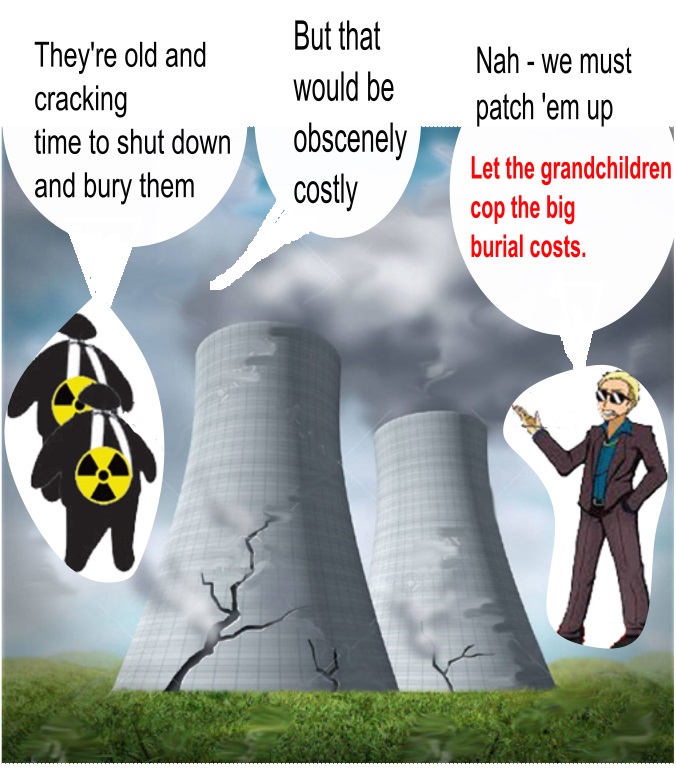
Joy and delight expressed by one corporate media outlet after another, as they report the announcement from (debt-laden) French nuclear company EDF that four UK nuclear power stations will be allowed to crack on, way past their use-by date.
“Crack” is the operative word here. Take for example, the Torness nuclear reactor in East Lothian – with 46 cracks in the nuclear core reported last July. It was scheduled to close in 2023.
Hunterston B, in North Ayshire is at long last to be decommissioned. In 2020 one of its reactors had an estimated 377 cracks, while the other had 209. The reactors were beginning to crumble, with cracks causing at least 58 fragments and pieces of debris to break off.
The Office for Nuclear Regulation (ONR has said that cracking could cause debris to inhibit vital cooling of highly radioactive reactor fuel. This can lead to a reactor meltdown, which can result in the escape of radioactivity to the environment.
Nobody in the prevailing establishment – corporate media, politicians, industry executives – nobody is facing up to the huge problem and huge cost of dismantling dangerous old nuclear reactors – so much better to pretend that it’s the charitable thing to just keep them going, Then it’s “jobs jobs jobs” and “community benefit” and “clean cheap energy” and “improved safety” “isn’t it wonderful” So say EDF 4th Dec 2024, the BBC, and Business Green 4th Dec 2024, and New Civil Engineer 4th Dec 2024, and Independent 3rd Dec 2024, The Herald, Lancs Live 4th Dec 2024.
Nary a word about the costs and dangers of the transport of radioactive materials, the ever-growing piles on nuclear wastes, the risks of terrorist attacks – and the completely unethical postponing of problems – just leave them for future generations to cope with.
Not nearly as much fuss was made about the world’s largest liquid air energy facility to be built at Hunterston – to store renewable energy, and provide 1000 jobs in the construction phase and 650 jobs in the local supply chain by its completion in 2030.

I try to be polite – but I empathise with Sir Jonathon Espie Porritt, 2nd Baronet, CBE who has just got so fed up with the cheerful glowing stories about prolonging the lives of decrepit nuclear reactors – “the whole deep nuclear state working away behind the scenes – as well as the UK’s astonishingly gullible media which just goes along with all this nuclear crap, year after year after year.“
Before you swallow Dutton’s nukes, look at the evidence

When it comes to a politician versus Australia’s peak scientific body about the cost of nuclear energy, I know who I’d rather believe.
So, Peter Dutton tells us that his nuclear policy will be cheaper than Labor’s renewables policy (“Dutton to claim nuclear rollout will end up cheaper than renewables”, December 6). I would recommend to readers the Climate Council’s myth-busting article “The seven ways the federal Coalition could cook the books on nuclear costings”.
Some points it includes are: excluding the cost of keeping our ageing power stations open until 2038, estimated at $225 million per year for the Eraring station alone; excluding the prohibitory costs for storing nuclear waste for no less than 100,000 years and giving no consideration to the cost of continuing to burn possibly 1.5 billion tonnes of carbon by 2050, which will increase the number of climate disasters and a rise in insurance premium costs for all of us.
It also ignores the reality of cost blowouts for building a nuclear system, and the cost of transmission upgrades that are needed at the ageing power stations that they are pretending to be cost-neutral sites for their nuclear plants and are already being used for new battery, wind and solar power. Charmain Brinks, Newcastle
The Intergovernmental Panel on Climate Change has stated that solar- and wind-produced energy is 10 times more effective at reducing carbon dioxide emissions than nuclear energy, which delivers far less power per dollar and is now adding as much energy in a year as renewables do in just a few days. Stanford University studies show new nuclear plants cost up to seven times as much as onshore wind or solar per kilowatt hour, and take five to 17 years to deploy. It will be interesting to compare Dutton’s estimated cost to store nuclear waste safely with the current estimated cost in Britain of £53 billion ($105 billion). Peter Nash, Fairlight
The claim that nuclear, in Australia, is cheaper than renewables is simply false. It ignores price changes over the past 20 years, whereby the cost of renewables, as predicted, has fallen by 90 per cent. Also, 2050 is 25 years away; anyone who thinks solar power will be the same 25 years from now is deluding themselves. Batteries will be much cheaper, in real terms, in 25 years’ time. Critical materials such as lithium will be in the recycling phase by then. On the other hand, since nuclear energy depends so much on the fuel cycle, it could become more expensive. Meanwhile, renewables will continue to get cheaper as transmission lines with aluminium cables improve, and get cheaper, and hydrogen-generation costs fall by a factor of 10 or more with natural gas feed. Noel Thompson, Riverview
It appears that the Coalition is pushing its nuclear power idea solely based on dubious capital cost estimates produced by a friendly associate. Nobody is considering such important issues as waste disposal, plant location with cooling water supply security or the availability of specialist labour and construction timelines. Giorgio Genocchio, Lane Cove
Rather than pouring hundreds of billions of dollars into nuclear submarines, our money would be better spent on building a national fast train network to the advantage of all Australians. The estimated cost of the submarines is $368 billion, while the estimated cost of a national fast train network is $150 billion. The days of manned submarines are limited, and nuclear subs bring with them all the attendant problems of basing, manning and maintenance – for a questionable defence benefit. The rail job should be put out to international tender. In a fair competition, China might well be the winner, as China has the world’s largest fast train network. Clive Williams, Forrest (ACT)
At $500 billion, Peter Dutton’s 2045 nuclear plan is not only late, it’s expensive. At that price, we could put $33,000 worth of batteries on each of Australia’s 15.2 million buildings and abandon the grid altogether. Sarah Hart, Gordon
When it comes to a politician versus Australia’s peak scientific body about the cost of nuclear energy, I know who I’d rather believe. Dave Horsfall, North Gosford
1 This month
Chernobyl: The Lost Tapes – A good documentary on Chernobyl on SBS available On Demand for the next 3 weeks– https://www.sbs.com.au/ondemand/tv-program/chernobyl-the-lost-tapes/2352741955560
15 April – Zoom –Nuclear Power is Not the Solution
Apr 15, 2026 01:00 AM in Canberra, Melbourne, Sydney

Join the International Physicians for the Prevention of Nuclear War (IPPNW) on Tuesday, April 14th for a timely webinar exploring the risks associated with nuclear power and challenging the myth that it offers a simple, safe, carbon-free solution to the climate crisis

21 April Webinar: No Nuclear Weapons in Australia
Start: 2026-04-21 18:00:00 UTC Canberra, Melbourne, Sydney (GMT+10:00)
End: 2026-04-21 19:30:00 UTC Canberra, Melbourne, Sydney (GMT+10:00)
Event Type: Virtual
A virtual link will be communicated before the event.
Host Contact Info: australia@icanw.org

of the week – Australians for War Powers Reform (AWPR)
To see nuclear-related stories in greater depth and intensity
 Antinuclear