Small Nuclear Reactors – NuScam an expensive pipe dream

Look Over There! Jason Kenney’s Phoney Nuclear Power Distraction Why the Alberta premier’s small nukes pipe dream  makes no economic sense., David Climenhaga 14 Aug 20, | TheTyee.ca
When Alberta Premier Jason Kenney says small nuclear reactors “could be a game changer in providing safe, zero-emitting, baseload power in many areas of the province,” as he did this week in a tweet, he’s pulling your leg…….
No electrical utility is ever going to buy one unless they are forced to by government policy or regulation — the kind of thing Alberta’s United Conservative Party purports to oppose……..
Small nuclear reactors are not as cheap to build as the premier’s fairy tale suggests.
Bringing an acceptable small nuclear reactor design all the way from the drawing board to approval by a national nuclear regulatory authority will cost hundreds of millions of dollars.
While dozens of speculative companies are printing colourful brochures with pretty pictures of little nukes being trucked to their destinations, very few are serious ventures with any possibility of building an actual reactor. The United Nations International Atomic Energy Agency says diplomatically there are about 50 concepts “at different stages of development.” Those that are serious, like NuScale Power in the United States, have huge amounts of government money behind them.
The only small nuclear reactor plant known to be operating in the world now is the Akademik Lomonosov, Russia’s floating power barge with two 35-megawatt reactors aboard. From an original estimate of US$140 million in 2006, its cost had ballooned to US$740 million when the vessel was launched last year.
The kind of small reactors Kenney is talking about won’t be cheap by any yardstick.
Small reactors are less economical to run than big reactors…….
This is why nobody wanted to buy the scaled-down CANDU-3 reactor, development of which was paid for by Canadian taxpayers in the 1980s. At 300 megawatts, they were just too small for commercial viability. A working CANDU-3 has never been built.
The cost of small reactors would have to come down significantly to change this. And remember, the research and development requirements of small reactors are just as high as for big ones. With nobody manufacturing modules, there are no existing economies of scale. In other words, dreamy brochures about the future of small reactors are just that — dreams.
By the way, in 2011 the Harper government privatized the best commercial assets of Crown-owned Atomic Energy of Canada Ltd. to… wait for it… SNC-Lavalin Group Inc. Think about that every time you hear Conservatives in Ottawa screeching about the goings on at SNC-Lavalin!
Small reactor designs mostly require enriched uranium, and Canada doesn’t produce any……
Small reactors might be safer than big ones, but we don’t really know.
Kenney and Savage talk about small reactors as if it were a fact they’re safer than big reactors. Maybe they are. But we don’t really know that because nobody but the Russians actually seems to have built one, and in most cases they haven’t even been designed.
Remember, the Russians’ small reactors are both on a barge. For what it’s worth, critics have called it “Floating Chernobyl.”
Small reactors won’t be safe without public regulation……..
Then there’s the matter of waste disposal.
Nuclear plants don’t produce a lot of waste by volume, but what there is sure has the potential to cause problems for a very long time. Thousands of years and more. So safe storage is an issue with small nukes, just like it is with big ones.
Where are we going to store the waste from all these wonderful small nuclear reactors Kenney is talking about?
How many jobs is it likely to create here in Western Canada? Well, Saskatchewan’s Ministry of Environment recently posted a job for a director of small modular reactors. That person will supervise four people. That’s probably about it for jobs for the foreseeable future.
If Alberta ever ends up with the same number of people working on this, we’ll be lucky https://thetyee.ca/Analysis/2020/08/13/Kenney-Nuclear-Power-Plant-Distraction/
$6.6 trillion in annual GDP at risk as Asian climate warms – McKinsey Global Institute
 McKinsey sees $6.6 trillion in annual GDP at risk as Asian climate warms, https://www.smh.com.au/business/markets/mckinsey-sees-6-6-trillion-in-annual-gdp-at-risk-as-asian-climate-warms-20200813-p55ley.html By Bloomberg News, August 14, 2020 Lethal heatwaves, droughts, floods and typhoons will become more common in Asia-Pacific, which faces more severe potential impacts from climate change than many parts of the world, McKinsey & Co. researchers warn.Asia is particularly at risk because it has such a high number of poor people, who tend to rely more on outdoor work, living in areas most vulnerable to extreme increases in heat and humidity, McKinsey Global Institute said in a new report published on Thursday. By 2050, the loss of that labor could cost the region as much as $US4.7 trillion ($6.6 trillion) a year in GDP, about two-thirds of the global total at risk. The report underscores the economic risks of delaying investments that mitigate or adapt to climate change. The potential for widespread damage is similar to the region’s experience during the current pandemic, according to McKinsey. What we have seen is that countries, cities and people can take resolute actions and if we do take these actions and sustain them, we can cooperate globally and see positive outcomes,” said Oliver Tonby, McKinsey’s Asia chairman, who co-authored the report. The projections are based on a scenario in which the world fails to cut greenhouse gas emissions and Asia warms by 2 degrees Celsius. They show that by 2050, between 500 million and 700 million people living in places like India, Bangladesh and Pakistan could experience heatwaves that exceed the survivability threshold. The loss of outdoor labour during those times could shave off 7 per cent to 13 per cent off GDP in those three countries, resulting in losses of $US2.8 trillion to $US4.7 trillion across the whole of Asia on average per year, according to the report. Extreme precipitation events could rise three- or four-fold by 2050 in parts of Japan, China, South Korea and Indonesia, according to McKinsey. Increased riverine flooding could cause $US1.2 trillion in damage in Asia, about 75 per cent of the global impact. Conversely, as the earth warms, parts of southwestern Australia could spend more than 80 per cent of a decade in drought conditions by 2050 and regions of China could experience droughts 40 per cent to 60 per cent of the time. Climate change will also increase the likelihood of severe typhoon strikes from the Philippines and Vietnam to Northeast Asia. It will also create winners and losers, increasing surface water supply in parts of northern India and China while depleting reservoirs in Australia.
To face the business risks, Tonby said companies need to assess their exposure and take it into consideration when making plans. A significant opportunity lies in infrastructure development in Asia as the region is still rapidly urbanising. |
Even with $1.4 billion government subsidy, NuScam’s nuclear station is still a dodgy prospect
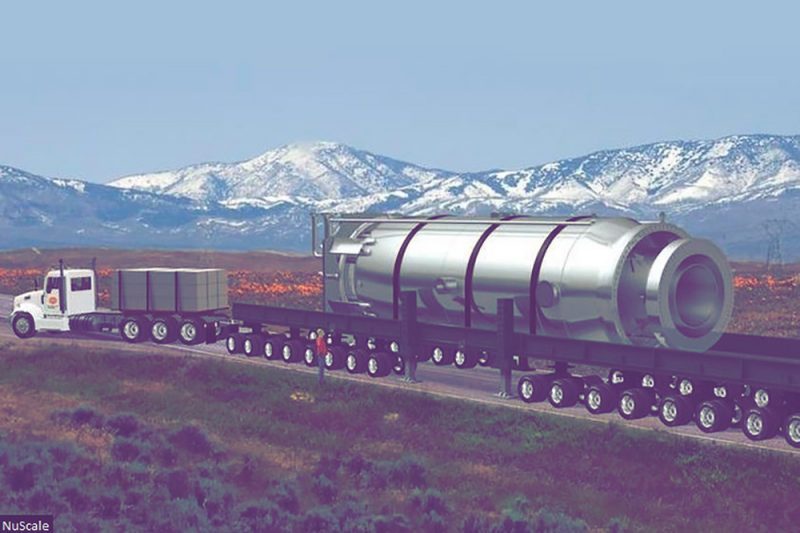
The NuScale SMR plant is designed to be built with up to a dozen 60-MW reactor modules.
UAMPS is seeking other utilities throughout the West to purchase hundreds of megawatts of the $6 billion project’s output, but no utility has agreed to such a purchase.
Utah Taxpayer Association Vice President Rusty Cannon said UAMPS members currently committed to the project should withdraw from it because of the risks.
“The development of untried new designs is no place for small utilities with no nuclear construction experience to risk their customers’ money,” former NRC Commissioner Peter Bradford said during the briefing.
the first module is now expected to be operational in June 2029. Previously NuScale had targeted commercial operation of at least one reactor module in 2027.
|
HIGHLIGHTS Utah Associated Municipal Power Systems (UAMPS) members face September decision on project Startup of first unit delayed to 2029 from 2027 Odds of members agreeing to go forward 50/50: muni Washington — A Utah municipal power association is expecting an influx of $1.4 billion in federal funds for the small modular reactor plant it is looking to build in Idaho, but association members are still deciding whether to go forward with the 720-MW project and the completion date has recently slipped, officials said. Continue reading |
Australian government using COVID recovery strategy to bolster its mates in gas industry
There have been recent media reports that the commission advising the Morrison government on its COVID recovery strategy has recommended that taxpayers provide massive support to build gas and fuel infrastructure.
However, Australia is possibly suffering something of a “resource curse”, as capital markets increasingly won’t invest in – nor insure – new coal and gas projects.
With the world seeking to accelerate the transition to low-carbon economies and societies, this would see the Australian people being asked to invest in old-world industries and technologies, rather than new, emerging industries. Or in assisting some key industries that have been severely damaged by COVID-19 to reset.
It is not unfair to claim that Australia has never really had an effective industry policy.
Sure, we have often ridden on the backs of sheep and minerals booms, and enjoyed them while they lasted…….
The current special interest push for gas and fuel infrastructure defies common sense, is directly against our national interests.
It is to the detriment of other major export/employment sectors – such as education (especially universities) and international tourism – that have been severely impacted by the COVID-19 pandemic but are not being supported by government assistance.
Coal and gas are facing declining global demand; they are hardly “infant industries” the longer-term future of which could justify investment to assist them to grow up.
These projects just wouldn’t stack up as feasible, when full account is taken of their economic/commercial, social, and environmental costs and benefits.
Investors are also reassessing their climate risks and moving out of climate exposed investments, forcing many of the big oil, gas and coal companies to make significant write downs of the values of their assets.
By comparison, investments in renewable energy (including recognising its significant potential as an export, especially to Asia), as well as in the transition business opportunities as transport is decarbonised, in regenerative agriculture, and in a host of bioenergy/circular economy projects dealing with waste and fuel security will probably stack up on such a cost/benefit assessment…..
The tragedy is that the Morrison government gives priority to its mates. ….
Today, it’s more the mining industries and banks – and now the specific influence of some on the COVID Commission with gas and related interests.
It’s time for our government to think beyond the square, and in our national interest.
John Hewson is a professor at the Crawford School of Public Policy, ANU, and a former Liberal opposition leader. https://www.canberratimes.com.au/story/6877063/how-australia-is-suffering-a-resource-curse/?cs=14246
BHP shareholders demand immediate stop to mining that disturbs Aboriginal heritage
|
BHP shareholders demand immediate stop to mining that disturbs Aboriginal heritage
The move follows the blasting of Juukan Gorge by Rio Tinto and revelations BHP has approval to destroy at least 40 significant sites, Guardian, Lorena Allam and Calla Wahlquist, Thu 13 Aug 2020 BHP shareholders have demanded the company immediately put a stop to mining that could “disturb, destroy or desecrate” Aboriginal cultural heritage sites in Australia until laws are changed, in the wake of revelations that it, like Rio Tinto, had plans to destroy ancient sites in the Pilbara.The motion, made by the Australasian Centre for Corporate Responsibility (ACCR) and supported by 100 shareholders, follows revelations BHP has approval to destroy at least 40 – and possibly as many as 86 – significant Aboriginal sites in the central Pilbara to expand its A$4.5bn South Flank iron ore mining operation, even though its own reports show the traditional owners are opposed to the move. “Investors simply can’t stand by and allow another Juukan Gorge disaster to take place,” ACCR’s Brynn O’Brien said. “Investors should be concerned that BHP does not as a matter of process make public disclosures about cultural heritage sites it plans to disturb.” In June, Guardian Australia revealed that BHP was poised to destroy the sites, which its own surveys said included rock shelters that were occupied between 10,000 and 15,000 years ago. It said evidence in the broader area showed “occupation of the surrounding landscape has been ongoing for approximately 40,000 years”. ……https://www.theguardian.com/australia-news/2020/aug/13/bhp-shareholders-demand-immediate-stop-to-mining-that-disturbs-aboriginal-heritage |
|
South Australia’s electricity prices fall as renewables ramp up and coal declines
SA power prices in steep fall [ Adelaide Now , 14 Aug 20,
Prices of electricity charged by generators are falling sharply in SA and across the market as more renewables power up and coal output falls. ... (Subscribers only)
Climate Change Is a Security Threat to the Asia-Pacific
|
Climate Change Is a Security Threat to the Asia-Pacific
Climate change is likely to alter the local physical and strategic environment profoundly, and potentially catastrophically. The Diplomat, By Shiloh Fetzek and Dennis McGinn, August 10, 2020 This week the ASEAN Joint Task Force on Humanitarian Assistance and Disaster Relief (HADR) will meet via video conference, with the COVID-19 pandemic escalating just as some countries in the disaster-prone Indo-Asia Pacific enter their cyclone, drought, heatwave, or monsoon seasons. The overlaying of the pandemic with existing complex challenges is a timely reminder that planning for HADR capacities – and regional security – needs to be attuned to the increasing likelihood of multiple, overlapping hazards and converging security risks, especially in a future where climate change alters the context in which other disasters and crises take place. Developing a clearer recognition of how climate change can reshape the strategic environment will be essential for preserving regional security, stability, and prosperity in the face of complicated and interlocking challenges, as we argue in a new report on the Indo-Asia Pacific published by the International Military Council on Climate and Security (IMCCS).
The Indo-Asia Pacific is highly exposed to climate change impacts. Climate change is likely to alter the local physical and strategic environment profoundly, and potentially catastrophically. More frequent or intense extreme weather, sea level rise, and ocean acidification (among other climate impacts) will create a range of threats to the well-being and security of countries in the region, many of which are already threatened by disaster vulnerability and increasingly complex security tensions.
As well as the immediate physical impacts, climate change will increase food and water insecurity, contribute to forced migration and displacement, and challenge disaster response and recovery capabilities …….. https://thediplomat.com/2020/08/climate-change-is-a-security-threat-to-the-asia-pacific/
|
|
August 14 Energy News — geoharvey

Opinion: ¶ “Look Over There! Jason Kenney’s Phoney Nuclear Power Distraction” • When Alberta Premier Jason Kenney says small nuclear reactors “could be a game changer in providing safe, zero-emitting, baseload power in many areas of the province,” as he did this week in a tweet, he’s pulling your leg. These nuclear reactors make no […]
August 14 Energy News — geoharvey
My home battery and rooftop solar system: How it performed in its first year — RenewEconomy

One year after installing home solar and Tesla battery storage, I decided to do some analysis on how the system performed technically and financially. Here’s what it found. The post My home battery and rooftop solar system: How it performed in its first year appeared first on RenewEconomy.
My home battery and rooftop solar system: How it performed in its first year — RenewEconomy
Coal power hits record low, but Taylor still can’t credit wind and solar for lower electricity prices — RenewEconomy

Electricity prices fall to five year low, pushed down by record high wind and solar, but still Angus Taylor advocates for a gas-led recovery. The post Coal power hits record low, but Taylor still can’t credit wind and solar for lower electricity prices appeared first on RenewEconomy.
Coal power hits record low, but Taylor still can’t credit wind and solar for lower electricity prices — RenewEconomy
Batteries, batteries, and more batteries: Alice Springs future grid plan gets ARENA boost — RenewEconomy

A new big battery, home battery incentives, and a battery-based VPP – all put on fast-track for Alice Springs with $2.1m funding boost from ARENA this week. The post Batteries, batteries, and more batteries: Alice Springs future grid plan gets ARENA boost appeared first on RenewEconomy.
Batteries, batteries, and more batteries: Alice Springs future grid plan gets ARENA boost — RenewEconomy
BHP backtracks on dodgy Kyoto accounting trick, puts fossil fuel lobby groups on notice — RenewEconomy

BHP reverses support for Australia’s use of Kyoto surplus credits, issues new set of standards on climate advocacy that puts lobby groups on notice. The post BHP backtracks on dodgy Kyoto accounting trick, puts fossil fuel lobby groups on notice appeared first on RenewEconomy.
BHP backtracks on dodgy Kyoto accounting trick, puts fossil fuel lobby groups on notice — RenewEconomy
AGL seeks approval for 500MW big battery at site of Liddell coal generator — RenewEconomy

AGL announced planning application for a big battery of up to 500MW at Liddell coal generator, and another big battery at the ageing Torrens gas generator near Adelaide. The post AGL seeks approval for 500MW big battery at site of Liddell coal generator appeared first on RenewEconomy.
AGL seeks approval for 500MW big battery at site of Liddell coal generator — RenewEconomy
Surviving the nuclear bomb at Nagasaki 75 years ago showed me nuclear weapons shouldn’t exist — IPPNW peace and health blog

[Entire article at NBC News] Dr. Masao Tomonaga, IPPNW regional vice president It has been 75 years since August 9, 1945, when the atomic bombing of Nagasaki opened the nuclear weapon age. I was 2 years old, and only 1 1/2 miles from ground zero of the nuclear explosion in there; I was, fortunately, unhurt […]
Surviving the nuclear bomb at Nagasaki 75 years ago showed me nuclear weapons shouldn’t exist — IPPNW peace and health blog
Although Australians started a move to abolish nuclear weapons, The Australian government tried to sabotage the U.N. nuclear ban treaty
 75 years after Hiroshima and Nagasaki, the arms race isn’t over, Independent Australia By Binoy Kampmark | 12 August 2020,“………………The 75th anniversary of the Hiroshima and Nagasaki bombings might have encouraged some reflection on current attitudes to the United Nations Treaty on the Prohibition of Nuclear Weapons. Passed on July 7, 2017, it has become a focal point for advocates of a nuclear weapons-free world and a source of irritation for nuclear weapons states.
Most perversely of all are those powers not in possession of nuclear weapons yet derive some form of security from states who have them, a strategic figment of the military imagination known as the ‘umbrella of extended nuclear deterrence“. For that reason Japan, despite being a global town crier for the banning of nuclear weapons, has refused to add its name to the nuclear weapons ban treaty.
Hiroshima Mayor Kazumi Matsui took the commemorative occasion to encourage the Japanese government to abandon that position:……
Australia, another U.S. annex in the Asia Pacific, similarly refuses to join the club of prohibitionists. When it participated in the UN working group on nuclear disarmament in 2016, Australian diplomats made it clear that they had no interest in seeing any document banning nuclear weapons emerge.
The disruptive involvement of Australian officials in the group was keenly exposed in documents obtained under Freedom of Information by the International Campaign to Abolish Nuclear Weapons (ICAN). ‘So long as the threat of nuclear attack and coercion exists,’ states one document from foreign ministry officials, ‘U.S. extended deterrence will serve Australia’s fundamental national security interests’.
Such a position would have to be renounced were Canberra to sign up to any treaty outlawing nuclear weapons. To avoid that outcome, they were to serve as spoilers, providing ‘a strong alternative viewpoint, notably against those states who wish to push a near-term ban treaty’.
During the course of negotiations, Australian officials also served as the ears and eyes of Washington, a role they have been accustomed to for decades. As the United States had boycotted the meetings, Canberra felt it necessary to remain in “close contact” with Washington ‘about our shared concerns’ on the working group’s disturbing move towards recommending ‘negotiations on a ‘ban treaty”’. Happily, Australia’s spoiling role merely served to strengthen the resolve of the other parties.
Canberra’s current position is that of a jaded cynic in realist’s clothes. The Department of Foreign Affairs and Trade states:
‘Australia does not support the “ban treaty” which we believe would not eliminate a single nuclear weapon.’
It scoffs at efforts that have ignored powers possessing nuclear weapons in negotiations, avoiding ‘the realities of the global security environment’. The document, furthermore, lacks the teeth of the NPT and ‘would be inconsistent with our U.S. alliance obligations’.
As long as the nuclear weapons option remains genuine, credible and desirable, there will always be a prospect for use. Once acquired, their abandonment has only ever proven exceptional (South Africa provides a unique case of this).
As things stand, a good number of countries could go nuclear overnight. It has taken much persuasion, and long discussion, to reassure South Korea and Japan not to do so before the nuclear ambitions of North Korea. The atom, in other words, still retains a deadly magic, tempting to upstarts, arrivistes and possessors. https://independentaustralia.net/article-display/75-years-after-hiroshima-and-nagasaki-the-arms-race-isnt-over,14192
1 This month
.
Australians deserve the truth
about
AUKUS – https://aukuspublicinquiry.com/

PETITION – To: Prime Minister Anthony Albanese and the Australian Labor Government

of the week – Australians for War Powers Reform (AWPR)
To see nuclear-related stories in greater depth and intensity

