Surviving the nuclear bomb at Nagasaki 75 years ago showed me nuclear weapons shouldn’t exist — IPPNW peace and health blog

[Entire article at NBC News] Dr. Masao Tomonaga, IPPNW regional vice president It has been 75 years since August 9, 1945, when the atomic bombing of Nagasaki opened the nuclear weapon age. I was 2 years old, and only 1 1/2 miles from ground zero of the nuclear explosion in there; I was, fortunately, unhurt […]
Surviving the nuclear bomb at Nagasaki 75 years ago showed me nuclear weapons shouldn’t exist — IPPNW peace and health blog
Although Australians started a move to abolish nuclear weapons, The Australian government tried to sabotage the U.N. nuclear ban treaty
 75 years after Hiroshima and Nagasaki, the arms race isn’t over, Independent Australia By Binoy Kampmark | 12 August 2020,“………………The 75th anniversary of the Hiroshima and Nagasaki bombings might have encouraged some reflection on current attitudes to the United Nations Treaty on the Prohibition of Nuclear Weapons. Passed on July 7, 2017, it has become a focal point for advocates of a nuclear weapons-free world and a source of irritation for nuclear weapons states.
Most perversely of all are those powers not in possession of nuclear weapons yet derive some form of security from states who have them, a strategic figment of the military imagination known as the ‘umbrella of extended nuclear deterrence“. For that reason Japan, despite being a global town crier for the banning of nuclear weapons, has refused to add its name to the nuclear weapons ban treaty.
Hiroshima Mayor Kazumi Matsui took the commemorative occasion to encourage the Japanese government to abandon that position:……
Australia, another U.S. annex in the Asia Pacific, similarly refuses to join the club of prohibitionists. When it participated in the UN working group on nuclear disarmament in 2016, Australian diplomats made it clear that they had no interest in seeing any document banning nuclear weapons emerge.
The disruptive involvement of Australian officials in the group was keenly exposed in documents obtained under Freedom of Information by the International Campaign to Abolish Nuclear Weapons (ICAN). ‘So long as the threat of nuclear attack and coercion exists,’ states one document from foreign ministry officials, ‘U.S. extended deterrence will serve Australia’s fundamental national security interests’.
Such a position would have to be renounced were Canberra to sign up to any treaty outlawing nuclear weapons. To avoid that outcome, they were to serve as spoilers, providing ‘a strong alternative viewpoint, notably against those states who wish to push a near-term ban treaty’.
During the course of negotiations, Australian officials also served as the ears and eyes of Washington, a role they have been accustomed to for decades. As the United States had boycotted the meetings, Canberra felt it necessary to remain in “close contact” with Washington ‘about our shared concerns’ on the working group’s disturbing move towards recommending ‘negotiations on a ‘ban treaty”’. Happily, Australia’s spoiling role merely served to strengthen the resolve of the other parties.
Canberra’s current position is that of a jaded cynic in realist’s clothes. The Department of Foreign Affairs and Trade states:
‘Australia does not support the “ban treaty” which we believe would not eliminate a single nuclear weapon.’
It scoffs at efforts that have ignored powers possessing nuclear weapons in negotiations, avoiding ‘the realities of the global security environment’. The document, furthermore, lacks the teeth of the NPT and ‘would be inconsistent with our U.S. alliance obligations’.
As long as the nuclear weapons option remains genuine, credible and desirable, there will always be a prospect for use. Once acquired, their abandonment has only ever proven exceptional (South Africa provides a unique case of this).
As things stand, a good number of countries could go nuclear overnight. It has taken much persuasion, and long discussion, to reassure South Korea and Japan not to do so before the nuclear ambitions of North Korea. The atom, in other words, still retains a deadly magic, tempting to upstarts, arrivistes and possessors. https://independentaustralia.net/article-display/75-years-after-hiroshima-and-nagasaki-the-arms-race-isnt-over,14192
Radio 3CR interviews Dave Sweeney, on matters nuclear
 City Limits Interview with Dave Sweeney, Radio 3CR 12 Aug 20 (incomplete notes from this interview.)
There are 15000 nuclear weapons globally – most of them under the control of authoritarians – Putin and Trump The sabre-rattling as the USA election approaches is deeply concerning.
The nuclear weapons race lives on anew – 75 years after Hiroshima and Nagasaki
|
75 years after Hiroshima and Nagasaki, the arms race isn’t over, Independent Australia By Binoy Kampmark | 12 August 2020, The twin bombings of Hiroshima and Nagasaki on August 6 and 9, 1945 are always moments that warrant a tick on the commemorative calendar.This has become fairly functional fare: those were the only occasions where atomic weapons were used on humans, mostly civilians. In the United States, the occasion has had to be regaled with a degree of necessary patriotic gush. No other country has ever used them in war.
Much ink and paper have been expended on the justifications, the salvations and the guiding considerations behind using these killers to conclude the Second World War. U.S. President Harry S. Truman either comes out a torn, anguished statesman who did what the thought best in a terrible situation, or a devilish huckster determined to score a success that would not merely knock out Japan but prevent the rise of Soviet (USSR) influence in East Asia. The USSR was far from intimidated. For one, Soviet officials knew well in advance of the race for the weaponised atom between the Allies and Nazi Germany, and kept abreast of advances made by the U.S.-led Manhattan Project, the name given to the development of the world’s first atomic weapon. Despite the acclaimed secrecy of the project, regular gobbets of information were conveyed back to Moscow via a network of well-planted Soviet agents. ……….. The arms race that followed between the United States and USSR was horrendously costly, needless and indicative how the human species can have those shuddering moments when extinction might just be around the corner. Both sides attempted various methods of restraint through arms-control agreements but these made only modest efforts to empty their respective arsenals. What international instruments from the Strategic Arms Limitation Talks I (SALT) to New START did was create employment for an industry that has never been threatened by termination: that of nuclear disarmament. The nuclear club also expanded, though membership numbers were restricted, at times poorly, to an elite. The international document doing so was the Treaty on the Non-Proliferation of Nuclear Weapons (NPT). The United Nations Office for Disarmament Affairs is not being ironic in describing the NPT ‘as the cornerstone of the global nuclear non-proliferation regime and an essential foundation for the pursuit of nuclear disarmament’. Roguish claims to master the nuclear option presented themselves in due course. South Africa, India, Pakistan, Israel, North Korea have all sought membership via back channels and duplicity. Now, the 75th anniversary of the bombings has caused discomfort amongst the pundits and policy wonks. Is there a new arms race before us? Ishaan Tharoor, writing in The Washington Post, fears that might be the case. The Trump Administration’s withdrawal from the Intermediate-Range Nuclear Forces Treaty and mutterings about not renewing the New START Treaty in 2021 are cited as possible incentives to avoid limiting arsenals. Ruadhán Mac Cormaic, assistant editor of the Irish Times, is even more pessimistic….. Cormaic rattles off the list of Trump’s destabilising treaty withdrawals, all doing their bit to foster the spirit of international insecurity. To the INF treaty already noted by Tharoor, he also adds Washington’s repudiation of the Iran nuclear deal (the Joint Comprehensive Plan of Action) and exiting from the Open Skies Treaty permitting state parties to conduct, according to the Arms Control Association, unarmed reconnaissance flights over each other’s territory on military forces and activities. Not renewing New START or finding some successor could fire “the starting gun” on ‘a new arms race between the cold war’s protagonists’. From the Russian perspective, encouragement for a splurge of spending, particularly in the field of tactical nuclear weaponry, abounds. …….. https://independentaustralia.net/article-display/75-years-after-hiroshima-and-nagasaki-the-arms-race-isnt-over,14192 |
|
Saturday 15 August 2020 at 7:00 PM Australian Premiere — No Extradition: Julian Assange’s Father & The Struggle for His Son’s Freedom
Saturday 15 August 2020 at 7:00 PM Australian Premiere — No Extradition: Julian Assange’s Father & The Struggle for His Son’s Freedom
(Director, Pablo Navarrete, 36 mins, Alborada Films) + Q&A
Pablo Navarrete
Pablo is a journalist and documentary filmmaker. He is British-Chilean and founded www.alborada.net and he co-edits Alborada Magazine. Pablo is on Twitter as @pablonav1
John Shipton
Karyn Hemming
Karyn regularly attends Sydney Town Hall Gatherings to support Julian Assange and various other Assange rallies including in London, UK. Karyn is on Twitter as @H11Karyn.
James Ricketson
James is an Australian film director who in June 2017 was arrested while flying a drone over an opposition party (Cambodia National Rescue Party) rally in Phnom Penh. He was found guilty of espionage and sentenced to six years in a Cambodian prison. He spent a total of 15 months in prison until he was pardoned after receiving diplomatic assistance from the Australian government.
Mark is now mostly a lawyer but he was previously a well known Australian investigative journalist and foreign correspondent. He was consistently present with Julian Assange inside the so-called ‘bunker’ at the Guardian prior to the release of the Afghan War Logs.
David McBride
As a legal officer with the Australian Special Forces, during his second deployment to Afghanistan, David leaked secret defence force documents to the ABC which included reports of troops killing unarmed men and children. These documents came to be known as ‘The Afghan Files’. David is on Twitter as @MurdochCadell.
Tickets
Tickets are available for various sized donations ranging from $5.50 to $20.00. Tickets available here. BY
Stephen Perrett https://medium.com/@GongSteve_19445/australian-premiere-no-extradition-julian-assanges-father-the-struggle-for-his-son-s-freedom-b5364229df45
Australia must place climate action at centre of coronavirus recovery, chief UN economist says

|
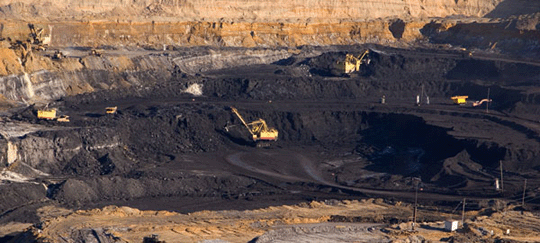
Australia must place climate action at centre of coronavirus recovery, chief UN economist says, SBS, BY TOM STAYNER 12 Aug 20, A chief economist for the United Nations has urged Australia to prioritise climate action above pouring money into fossil fuels in its coronavirus recovery.
A United Nations chief economist has urged Australia and other countries across the world to place more ambitious climate action and investment in clean energy at the centre of their COVID-19 recovery plans. Elliott Harris is helping lead the UN’s development of policy advice for nations grappling with the pandemic. Mr Harris appeared on a webinar with progressive think tank the Australia Institute on Wednesday, where he was questioned about how the Australian government should shape its recovery from the pandemic. He said developed nations such as Australia must be willing to make difficult decisions and prioritise a “green recovery”.
“What we’ve seen in this COVID crisis is that governments are indeed capable of really ambitious, rather unorthodox, extremely important and even massive interventions,” he told the webinar. “I can think of no stakes that are higher than the climate crisis that we are living in right now.” UN Secretary General Antonio Guterres has stressed coal should play no part in any country’s post-coronavirus stimulus plan, while business leaders in Australia have also been putting pressure on the federal government to prioritise renewable energy projects. The head of the federal government’s COVID advisory committee Nev Power told a Senate committee on Tuesday he has been approached about locking in a low emission future……… Mr Harris said Australia should focus on making long-term “sustainable” investments, rather than subsidising further fossil fuel projects. “This is a critical choice that all countries have to make and all investors have to make,” he said. “There is a very difficult trade-off, there is no doubt about it.” “[But] we really need to think about how we shift the flow of investment towards sustainability. “The fact of it is that, unfortunately, the world does not have the luxury of allowing itself of continuing down the path of fossil fuels.” Australia’s commitment to the Paris Agreement requires emissions reduction of at least 26 per cent by 2030, based on 2005 levels. But the government has come under scrutiny for not having a 2050 target, with the Business Council of Australia, Australian Industry Group and big miners Rio Tinto and BHP all backing a net zero-emissions goal by then. Australia is considered one of the world’s largest exporter of fossil fuels through coal and liquified natural gas projects, but also a leading investor in renewable energy. The UN has predicted the world economy will shrink by 3.2 per cent in 2020 because of the economic downturn forced by the pandemic. https://www.sbs.com.au/news/australia-must-place-climate-action-at-centre-of-coronavirus-recovery-chief-un-economist-says |
|
|
As the tundra burns, we cannot afford climate silence’: a letter from the Arctic
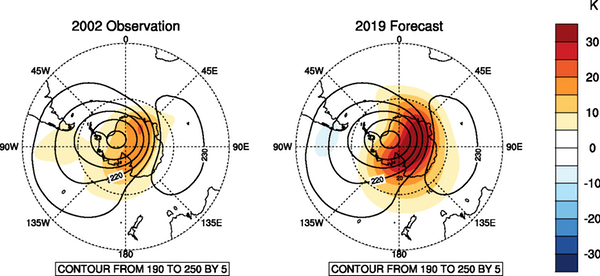 In June, the Russian Arctic reached 100.4F, the highest temperature in the Arctic since record-keeping began in 1885. The heat shocked scientists, but was not a unique or unusual event in a climate-changed world. The Arctic is warming at nearly three times the rate of the global average, and June’s single-day high was part of a month-long heatwave. This relentless heat has melted sea ice and made traditional subsistence dangerous for skilled Indigenous hunters. It’s fueled costly wildfires, some of which are so strong they now last from one summer to the next. And it’s sped up permafrost thaw, buckling roads and displacing entire communities.
I study the Arctic. The decision to withdraw from the Paris climate accord is reprehensible – but we can’t give up hope
When you stand facing an exposed edge of permafrost, you can feel it from a distance.
It emanates a cold that tugs on every one of your senses. Permanently bound by ice year after year, the frozen soil is packed with carcasses of woolly mammoths and ancient ferns. They’re unable to decompose at such low temperatures, so they stay preserved in perpetuity – until warmer air thaws their remains and releases the cold that they’ve kept cradled for centuries. Continue reading
High level nuclear waste a big danger. Low Level Waste has its dangers,too

 Feds Propose More Sites For Nuke Waste Storage (Not Disposal) Forbes , Ed Hirs 12 Aug 20,
The Nuclear Regulatory Commission (NRC) is proposing that more locations around the country be used to dispose of very low level radioactive waste. This proposal has raised the ire of environmentalists and nuclear waste storage proponents alike…….
Bad actors can make a considerable profit at the expense of public health. As the United Steelworkers union noted in their public comment urging the NRC against the ruling: “[the ruling]…requires workers with little to no training to handle contaminated material leading to a greater probability of mishandling or improper disposal; and the proposed rule lack[s] requirements to monitor surrounding soil and ground water from any exempt waste location to ensure there is no increase of radiological contamination outside of the potential dumping sites.”
Safe disposal does not equal safety when materials remain active for generations. To improve safety landfills need to keep records for generations, and to deal with low-level contamination appropriately. Over time landfills become golf courses, sources of methane for electricity generation, and mines for reclaiming metal. These activities result in exposure to radiation that future generations must be prepared for. This means meticulous record keeping, which is unlikely to be present across multiple changes of ownership and decades of time.
What the NRC proposes is an expansion of opportunities for things to go wrong. In the past this approach has given us names that remain infamous today: think Love Canal. Brio Refinery. Savannah River and DuPont. It gave us the remains of leaded gasoline.
Water supplies are particularly vulnerable. Historically, the dictum of chemists has been “dilution is the solution.” That works for chemicals. It does not work for radiation, which is being generated continuously.
The current system is better than what is being proposed. Expanding the opportunities for things to go wrong is a step backwards. If the proposal is adopted, today’s laxity and profits will become tomorrow’s health problems and remediation expenses. If we care about coming generations we should leave well enough alone. https://www.forbes.com/sites/edhirs/2020/08/11/hazardous-nuclear-waste-storage-its-not-disposal/#2086a6624ad3
Opposition to the transport and double handling of nuclear waste
 Famette/Rice: And the nuclear waste? 12 Aug 20,
What about Vermont Yankee’s nuclear waste? Or dealing with it?
High-Level Nuclear Waste (HLNW) is a byproduct of nuclear power plants and is extremely dangerous for thousands of years. The Vermont Yankee Nuclear Power Plant, in Vernon, has been shut down since 2014 and the HLNW it produced over the years of operation has been transferred into stainless steel and concrete dry casks stored onsite. Currently, our federal government has not come up with a permanent site to store HLNW safely over time.
NorthStar, the corporation which now owns Vermont Yankee, wants to transport that waste to a Centralized “Interim” Storage (CIS) site that it owns in Texas. To transport this waste is a dangerous proposition since an accident would likely result in great damage to the environment and the life forms in the surrounding area. We should only move the material once to a permanent repository. Also, if Vermont Yankee’s HLNW is allowed to be transported across the country on our highways, railways and waterways to a temporary open-air storage site, such a precedent would likely result in thousands of shipments across the country as other nuclear plants are shut down during the coming four decades.
Communities in the Southwest are speaking out in opposition to accepting our toxic waste. As members of the Vermont Yankee Decommissioning Alliance (VYDA), we support their concerns and are against the transportation and interim storage of Vermont Yankee’s waste at a CIS. We feel it is safer to keep our waste within our state in monitored, hardened, onsite storage in stainless steel and concrete dry casks while a scientifically-based permanent storage site is located.
For the above reasons, join us in contacting U.S. Rep. Peter Welch and urge him to vote against any bill that would authorize Centralized Interim Storage of High-Level Nuclear waste? https://www.timesargus.com/opinion/commentary/famette-rice-and-the-nuclear-waste/article_436e1a1b-deb3-5b6a-87a9-228cfb16afbc.html
Audrey Famette lives in Montpelier. Nancy Rice lives in Randolph Center.
Australia’s uranium fuelled the Fukushima reactors, but now, Japan’s not wanting to buy any more
 Japan’s nuclear fuel imports almost zero in 2019 as industry stagnates, Japan Times, 12 Aug 20, Japan’s imports of fuel to power nuclear plants were close to zero last year, reflecting the stagnating nuclear industry following the Fukushima disaster in 2011, official trade data showed Tuesday.The effective halt to imports of uranium — enriched, natural or their assemblies — is believed to be the first since the resource-poor country started securing the materials from overseas in the 1960s. Japan’s nuclear fuel imports almost zero in 2019 as industry stagnates, Japan Times, 12 Aug 20, Japan’s imports of fuel to power nuclear plants were close to zero last year, reflecting the stagnating nuclear industry following the Fukushima disaster in 2011, official trade data showed Tuesday.The effective halt to imports of uranium — enriched, natural or their assemblies — is believed to be the first since the resource-poor country started securing the materials from overseas in the 1960s.
Most nuclear plants in Japan remain idle as stricter safety measures were implemented after a massive earthquake and ensuing tsunami crippled the Fukushima No. 1 nuclear complex. The operations of fuel manufacturing plants have also been suspended……. Of the 54 nuclear reactors that were in operation before the Fukushima crisis, currently, only nine have come back online after clearing harsher safety measures. In the wake of the accident, 21 reactors have been flagged for decommissioning in consideration of the hefty cost of refurbishment. All four fuel manufacturing factories are offline as they are undergoing regulatory review under the new safety standards. Kansai Electric Power Co., Shikoku Electric Power Co. and Kyushu Electric Power Co., which operate the nine plants currently back online, said they have enough fuel to run their reactors for the next several years. …….https://www.japantimes.co.jp/news/2020/08/12/business/japan-nuclear-fuel-imports-zero/ |
|
Councils and community opposition to the transport of nuclear wastes
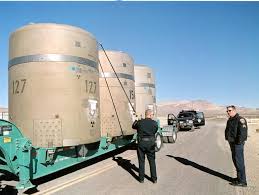
These nuclear waste cars are readily identifiable, given their huge dumbbell-like shape, size and weight, which makes them a potential target for terrorist attacks.
High-level radioactive waste is one of the most dangerous substances on earth, consisting of irradiated fuel rods that have been inside nuclear reactors. Exposure to unshielded nuclear waste is lethal.
A 2019 report of the U.S. Nuclear Waste Technical Review Board found that there is a substantial lack of data regarding potential damage of spent nuclear fuel during transport.
Many rails are only designed to carry 143 tons per car. The loaded casks for this waste weigh 210 tons or more. It is unclear whether tracks in Tarrant County would handle such weight.
And accidents can happen. A cask carrying low-level waste that was headed to Andrews caught fire in the Chicago area in June.
A better alternative would be to leave high-level waste at existing nuclear plants until a permanent repository is found to bury cannisters underground.
Tarrant County, along with the cities of Fort Worth and Arlington, should also oppose the transportation of high-level nuclear waste through our communities and advise our federal representatives and the Nuclear Regulatory Commission of our serious concerns. Our lives and economic well-being may depend upon preventive action now.
|
Fort Worth doesn’t need dangerous nuclear waste rolling through on Tarrant rail lines https://www.star-telegram.com/opinion/opn-columns-blogs/other-voices/article244891627.html BY PEGGY HENDON AND LINDA HANRATTY
AUGUST 12, 2020The Nuclear Regulatory Commission is considering licensing two different facilities to store the nation’s high-level nuclear waste.
One would be at the existing low-level storage facility in Andrews County, Texas. The second, known as the Holtec site, would be between Carlsbad and Hobbs, New Mexico. Why should Tarrant County be concerned? |
Business as usual equals many extra deaths from global warming — Systemic Disorder

Is it already too late to stop global warming? That question is not asked with thoughts of throwing up hands in despair and giving up. Rather, that question must be asked in the context of mitigating future damage to whatever degree might yet be possible. The context here is that the carbon dioxide, methane and […]
Business as usual equals many extra deaths from global warming — Systemic Disorder
‘Women in Solar’ program short-listed for CEC Community Engagement Award — RenewEconomy

Beon Energy Solutions’ community engagement program designed to increase the number of women working in solar farm construction a finalist in Clean Energy Council Awards. The post ‘Women in Solar’ program short-listed for CEC Community Engagement Award appeared first on RenewEconomy.
‘Women in Solar’ program short-listed for CEC Community Engagement Award — RenewEconomy
Mining city Broken Hill to host one of world’s biggest renewable micro-grids — RenewEconomy

Mining city of Broken Hill likely to be powered by one of the biggest renewable energy micro-grids in the world, and its good news too for the state’s biggest solar farms. The post Mining city Broken Hill to host one of world’s biggest renewable micro-grids appeared first on RenewEconomy.
Mining city Broken Hill to host one of world’s biggest renewable micro-grids — RenewEconomy
Australia “back on radar” as global companies switch to wind and solar supplies — RenewEconomy

Australian corporate PPA activity for wind and solar projects up 50 per cent in first half of 2020, as Covid-19 slows down activity across the globe. The post Australia “back on radar” as global companies switch to wind and solar supplies appeared first on RenewEconomy.
Australia “back on radar” as global companies switch to wind and solar supplies — RenewEconomy
1 This month
25 October – Film –Britain’s Nuclear Bomb Scandal: Our Story – part of the Adelaide Film Festival,
Screening and Conversation
A screening of Britain’s Nuclear Bomb Scandal: Our Story (2024) followed by a talk with 2026 Bettison and James Awardee and Tradtional Owner Karina Lester in conversation with Simone Tur.
When: Sun 25 Oct, 12:00pm-Screening, 1:15pm-Talk
Where: The Mercury
Free admission, register below by clicking on BUY TICKETS and select free event tickets, at end of web page:
https://www.adelaidefilmfestival.org/program/2026/britains-nuclear-bomb-scandal-our-story
.

Australians deserve the truth
about
AUKUS – https://aukuspublicinquiry.com/

PETITION – To: Prime Minister Anthony Albanese and the Australian Labor Government

of the week – Australians for War Powers Reform (AWPR)
To see nuclear-related stories in greater depth and intensity

