People with mild coronavirus symptoms can get serious brain disorders
 Warning of serious brain disorders in people with mild coronavirus symptoms
UK neurologists publish details of mildly affected or recovering Covid-19 patients with serious or potentially fatal brain conditions, Guardian, Ian Sample Science editor, @iansample, Wed 8 Jul 2020 Doctors may be missing signs of serious and potentially fatal brain disorders triggered by coronavirus, as they emerge in mildly affected or recovering patients, scientists have warned.
Neurologists are on Wednesday publishing details of more than 40 UK Covid-19 patients whose complications ranged from brain inflammation and delirium to nerve damage and stroke. In some cases, the neurological problem was the patient’s first and main symptom.
A dozen patients had inflammation of the central nervous system, 10 had brain disease with delirium or psychosis, eight had strokes and a further eight had peripheral nerve problems, mostly diagnosed as Guillain-Barré syndrome, an immune reaction that attacks the nerves and causes paralysis. It is fatal in 5% of cases.
“We’re seeing things in the way Covid-19 affects the brain that we haven’t seen before with other viruses,” said Michael Zandi, a senior author on the study and a consultant at the institute and University College London Hospitals NHS foundation trust.
“What we’ve seen with some of these Adem patients, and in other patients, is you can have severe neurology, you can be quite sick, but actually have trivial lung disease,” he added. …….
The cases add to concerns over the long-term health effects of Covid-19, which have left some patients breathless and fatigued long after they have cleared the virus, and others with numbness, weakness and memory problems……..
The cases, published in the journal Brain, revealed a rise in a life-threatening condition called acute disseminated encephalomyelitis (Adem), as the first wave of infections swept through Britain. At UCL’s Institute of Neurology, Adem cases rose from one a month before the pandemic to two or three per week in April and May. One woman, who was 59, died of the complication……… https://www.theguardian.com/world/2020/jul/08/warning-of-serious-brain-disorders-in-people-with-mild-covid-symptoms?CMP=share_btn_tw
Call to avoid hasty decision on nuclear waste dump, during pandemic

Pandemic Allows for New Front in Fight Against Southwest Nuclear Waste Storage Contracts https://morningconsult.com/2020/07/10/nuclear-fuel-storage-texas-new-mexico/ Activists, industry, lawmakers push for delays to interim spent fuel storage facilities planned in Texas, New Mexico , Morning Consult BY LISA MARTINE JENKINS, July 10, 2020
Two proposals to send high-level spent nuclear fuel to sites in Texas and New Mexico are seeing renewed opposition as environmental activists, the oil and gas industry and lawmakers on both sides of the aisle have formed an unlikely and informal alliance leveraging the pandemic as a reason to delay.
The proposed Texas and New Mexico facilities — which are licensed by Interim Storage Partners LLC (a joint venture of Orano USA and Waste Control Specialists) and Holtec International, respectively — have applications under review by the Nuclear Regulatory Commission for consolidated interim storage facilities intended to serve as temporary repositories for high-level nuclear waste from all over the country.
The ISP facility already stores low-level waste, but the proposals would expand its license to store high-level waste, which is exponentially more radioactive, for at least 40 years. The Holtec facility would be built on undeveloped land; both facilities are located in the Permian Basin, home to more than 7,000 oil and gas fields.
While most of the country’s more than 90,000 metric tons of nuclear waste is stored where it is generated, the Nuclear Waste Policy Act amendments of 1987 mandated that the country use Nevada’s Yucca Mountain as its only permanent nuclear waste repository. But since the Obama administration scrapped those plans for Yucca in 2009, the United States has not had a long-term destination for the radioactive waste produced by its nuclear energy facilities.
Unlikely agreement
Now, the proposals for these two interim alternatives are eliciting pushback of their own, especially in light of the coronavirus. The pandemic has brought renewed vigor to the fight by both environmental activists and the oil and gas industry, all of whom are concerned about the inability of local stakeholders to sufficiently review and weigh in on the current proposals and statements.
“Just look at what’s happened in Texas today: COVID numbers are just going through the roof,” said Tommy Taylor, director of oil and gas development for the family-owned Fasken Oil and Ranch Ltd. in Midland, Texas. “It’s just hard enough to keep your businesses afloat; we need a lot more time to be able to respond effectively and say what we need to say.”
Taylor’s primary concern is about the potential damage that an accident involving nuclear waste could cause for the industry’s Permian Basin resources, as well as the health effects for those working and living in close proximity to the waste. Fasken is among a coalition of Permian Basin landowners and operators coordinating a resistance to the plan to bring high-level nuclear waste to the region.
“We’re not against nuclear energy,” he clarified. “But if you had to do interim storage in the U.S., there are a lot of better areas to put it than in the middle of our energy security blanket. It really tees it up for something bad to happen.”
Karen Hadden, executive director of the Austin, Texas-based Sustainable Energy and Economic Development Coalition, has been vocal for years on the issue of nuclear waste and told Morning Consult the proposals are “environmental justice of the largest magnitude imaginable.”
“They’re building a nuclear empire in West Texas,” Hadden said. “The communities do not have the resources to fight back.”
The ISP facility would be located in Andrews County, a largely Hispanic region of Texas where Hadden said language and technology barriers have compromised the community’s ability to stay informed about the proposal — issues that she said have been “compounded” by the pandemic. And the Holtec facility, which would be located just across the state border in New Mexico’s Lea County, has elicited concern from Native American communities in the region because of the likelihood that nuclear waste would have to pass through tribal land, including Navajo Nation. ……..
A push for delays
The proposals’ respective draft environmental impact statements are currently open for public comment; ISP’s 120-day comment period ends Sept. 4, while Holtec’s 180-day period concludes Sept. 22. Holtec’s was initially just 60 days, but has been extended twice, which NRC Public Affairs Officer David McIntyre said is due to “the effects of the COVID-19 public health emergency.”
The NRC has held two webinars for public comment on the Holtec project, with the latest eliciting strong reactions from local Indigenous groups. McIntyre said the agency hopes to schedule a webinar for the ISP project soon, and that “decisions on in-person meetings in New Mexico and Texas will be made later, and will depend on our assessment of the public health emergencies in each state.”
But both legislators and activists have seen these attempts at engagement as insufficient and are asking for delays of months, if not years.
Rep. Lloyd Doggett (D-Texas) represents a region of the state through which the waste is likely to pass, and he sent a letter to NRC leaders June 16 requesting that the agency hold in-person public meetings in six different Texas locations regarding the draft environmental impact statement. He asked that the agency schedule the hearings “at least six months after the COVID-19 risks are fully resolved and extend the comment period deadline as well.”
“The pandemic threatens our families now; nuclear waste could endanger us forever,” Doggett told Morning Consult via email. “It’s essential that the NRC not act prematurely when we are preoccupied with the immediate threat of a pandemic greatly worsened by failures of national and state leadership.”…..
These more recent pushes to pause the endeavor until after the pandemic echo a March letter from New Mexico’s congressional delegation to the NRC, which highlighted concerns about the fuel’s transport, as well as about local agriculture and industry and disproportionate impacts of the proposal on Native American communities in the state.
“I hope that the NRC will look at what these legislators are asking and really consider a significant delay,” Taylor said, “because I think they want to get this right, and it’s not going to be right just pushing it through during the pandemic.”
Anniversary of nuclear bomb test on Mururoa Atoll

This day on July 2nd 1966, the first French nuclear test took place at Mururoa Atoll. [Image description: slides with blue and orange text on black background with text that reads, On this day in history, an orange radioactive mushroom cloud ruptured Pacific skies, seas and engulfed the atoll of Mururoa. It was the beginning of a toxic reign of radioactive negligence by the French in the Pacific region. The French President who upon witnessing the July 2nd detonation remarked, “It’s beautiful”.
The colonial power had been testing in Algeria, but as their independence became more evident, the French moved into the atolls of Polynesia. From 1966 to 1996, the French conducted 193 tests on the atoll; some of the explosions 200 times the strength of the bombs dropped on Hiroshima and Nagasaki. Information on safety, and the lasting impacts for environment and human health, was scarce if not, misleading. The sovereign peoples were led to believe testing was not only safe but would benefit their communities through military-based economic opportunity. People who worked only 15kilometres away from test sites often had no more protection than the shorts and t-shirts on their backs.
French testing, was a theatrical power display, an assertion of their priority to grasp tight to global dominance rather than world peace. Resistance to testing was prominent from the outset. Pouvanaa a Oopa, a fierce and enduring anti colonial leader, led the first protection action in 1950, collecting signatures for the Stockholm Peace Appeal. He remained an important leader and agitator, even throughout his political imprisonment and exile to France.
During the thirty years of French testing, condemnation swelled internally and across Pacific nations including Aotearoa and so called Australia. Mass protests, demonstrations, flotilla solidarity, trade union bans and boycotts on French products took place. “If it is safe to test, test it in Paris” was a phrase used by key collective, The Nuclear Free and Independent Pacific.
The radioactive fall out has had devastating impacts on both environment and human health. Tahiti the most populated island was exposed to 500 times the maximum accepted levels of radiation. Tahitian socialist, Richard Tuheiava outlines the continuing struggle for justice, ”The fact is since the nuclear testing most of the diseases were cancer, leukaemia. Most of the diseases were as a result of the nuclear testing, so we collectively also put a request for the state of France, the colonial power to not only compensate directly the veterans, but also compensate this fund, this public health care fund.”
Today, July 2nd 2020, we honour the ongoing impacts of nuclear colonialism in the Polynesia, and the enduring fight for justice, truth and accountability.] https://www.facebook.com/groups/1314655315214929/
In contradiction to Angus Taylor, Australia’s Minister On Behalf of Polluting Industries, the States are leading on clean energy
 How Australia’s state energy ministers are turning the tables on Angus Taylor, Guardian Simon Holmes à Court The state energy ministers still need to deliver on their promises, but imagine if any of them held the federal portfolio @simonahac, Sat 11 Jul 202 Sometimes it just takes a bit of leadership.
Former prime minister Malcolm Turnbull likes to say that we must choose “engineering and economics” over “idiocy and ideology”. The New South Wales energy minister, Matt Kean, has been making the right choices.
In December 2018 I singled out NSW for its reckless lack of energy policy. The state, reliant on an ageing coal fleet for 80% of its power, had been shunned by energy investors……..
NSW is blessed with high-quality wind and solar resources, but lacks transmission lines between the best wind and solar areas and the state’s major population and industrial centres. In 2018, only one-in-20 proposed renewable energy projects could be accommodated into the weak grids in the west of the state, and developers were forced to turn their attention to the other states.
In a landmark speech late last year, Kean, the newly minted energy minister, made it clear his government would respond to the climate science and embrace the opportunities presented by decarbonising the economy.
“To those vested interests and ideologues who want to stand in the way of this transition, I say enjoy your Kodak moment,” he said.
Undeterred by attacks from the Murdoch media and even the prime minister, Scott Morrison, over the following months, Kean set about turning the tables in NSW……….
What’s stunning is how much ambition has shifted, and how it’s being driven by the states. Just two years ago the modelling for Josh Frydenberg’s failed national energy guarantee predicted that NSW wouldn’t build a single wind or solar farm from 2021 to 2030. Now Kean has a plan to build as much large-scale renewable energy this decade in NSW as all of Australia built over the past 20 years. …….
The Australian Energy Market Operator and CSIRO have determined that the cheapest way to “firm” the huge amounts of renewable energy is a relatively modest mix of better interconnections with neighbouring states, batteries and pumped hydroelectricity – Snowy 2.0 project and multiple smaller projects. On economic grounds alone, fossil gas is unlikely to play an increased role.
The Rezs will also open up opportunities for energy intensive industry. Flexible demand, such as hydrogen production, can help balance the grid. Instead of fracking the Pilliga forest to produce fertiliser with a huge carbon footprint, business could build a zero-carbon factory in the New England region, making fertiliser from renewable energy.
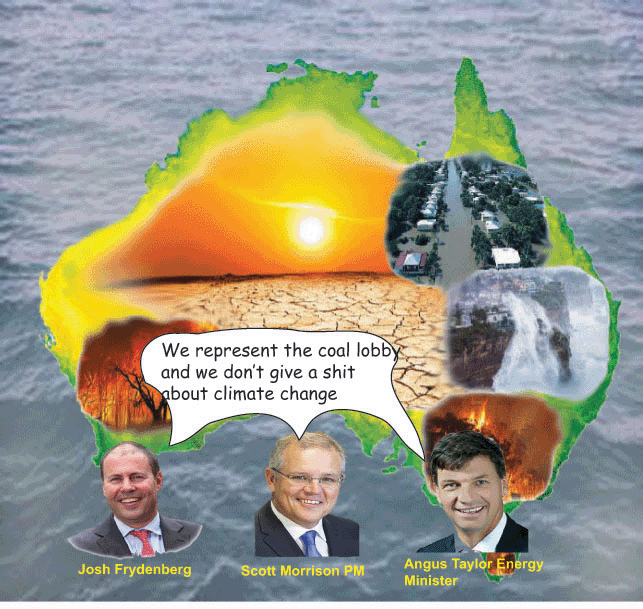
Angus Taylor, the federal minister for energy and emissions reductions, is famously no fan of renewable energy or of setting meaningful emissions reduction targets. On electricity, the state energy ministers – right across the political spectrum – are charging ahead without him, which is perhaps as it should be, given that electricity is the states’ responsibility…….
Every state and territory has now formally signed on to a net-zero emissions target by no later than 2050, a target backed by business, unions and the opposition – yet the federal government and its donors stand in the way.
Australia has three Liberal state energy ministers. South Australia’s Dan van Holst Pellekaan wants to see his state hit 100% renewables by 2030. His Tasmanian counterpart, Guy Barnett, is gunning for 200% renewables and Kean has outlined a plan for NSW to be an energy superpower.
Sure, these energy ministers still need to deliver on their promises, but imagine if any one of them held the federal portfolio. https://www.theguardian.com/environment/2020/jul/11/how-australias-state-energy-ministers-are-turning-the-tables-on-angus-taylor?utm_term=Autofeed&CMP=soc_568&utm_medium=Social&utm_source=Twitter#Echobox=1594424036
Court action in India against Adani – allegations of ‘coercion, fraud and undue influence’
 Adani power plant and coal plans threatened by land owner court action, ABC News, By Stephen Long, 11 July 20
The case filed with the court accuses Adani and its agents of using “coercion, fraud [and] undue influence” to illegally exclude thousands of people affected by the development from a required social impact assessment.
The claimants allege that a key meeting was full of labourers “from far away” who were paid to attend a crucial public hearing about the development and — in conjunction with local police — used brutal force to keep villagers opposed to Adani’s project out.
“Thousands of people gathered to go into the venue site but they were prevented both by the police, who were acting as agents of private company Adani Power Limited, as well as by their security guards,” the writ filed with the court alleges.
“The situation was so bad that the police lathi [baton] charged the affected families. When they tried to attend the public hearing were beaten mercilessly.”
Residents challenge land acquisition
The court case also challenges the forced takeover of land for the development by the State Government on behalf of Adani.
Under Indian law, a government can only acquire land for a private company if the project is for “public purpose”.
The claimants argue the project does not meet the definition of “public purpose” under the law.
Part of their argument is that the power plant will have few local benefits, since the electricity will all be exported and the coal used to generate the power will all be imported — largely from Australia.
“It is crystal clear from the various documents of Adani Power Limited that the power which shall be generated from this private project shall be exported to Bangladesh [while] the coal shall be imported from Australia … to Dharma Port and transported to the project covering a distance of around 700km causing immense pollution in transportation.
“Thus, there is not even a semblance of public interest.”….
The irony is that Jharkhand is a resource-rich state, accounting for more than 40 per cent of the mineral resources of India, and the Adani power project is situated amid some of the richest coal deposits in the nation.
Adani’s own Jitpur coal mine is just kilometres away from the project site; when the plant was first proposed five years ago, this was to be the source of the coal.
But those plans rapidly changed, apparently because under Indian law domestic coal cannot be used for thermal power projects that will export electricity to another country.
So, Adani now appears set to transport imported coal vast distances, at extraordinary expense, into a state that is home to the biggest coal reserves in India…….
‘Land is indispensable to a Santhal’
The patriarch of the Adani business empire, Gautam Adani, is one of the richest men in India, while many of the villagers affected by the Godda power project are from the other end of the wealth spectrum.
Some are from the lowest castes in the Hindu religion and others are from an Indigenous tribal group known as the Santhal.
Archaeologists estimate that the Santhal have been in eastern India for up to 65,000 years. Like Aboriginal Australians, they have an ancient and spiritual connection to the land that has long been recognised in legislation.
“Land is indispensable to a Santhal,” a local villager explained to the independent Indian filmmaker who shared her interviews with the ABC.
“It is an intrinsic part of culture. The Santhal tribe and their land are like two sides of one coin. If land exists, Santhal exists, but if the land is taken away it just means they will be totally wiped out.”
The Santhal have a practice of burying their dead in the fields they sow, which become sacred to them.
One of them says: “We belong here, this is our ancestral land. We are buried on our land. We have no problem dying on our land but we will not give it away.”
Santhal land rights have previously been protected under a long-standing law which prohibited industrial development on their farming lands, but the laws have recently been watered down…….
those fighting the project face a race against time; the High Court case, and a separate environmental challenge before India’s National Green Tribunal — scheduled for hearings in early August — will be of no consequence if construction reaches a point where the development becomes a fait accompli.
Curiously, geopolitics is working in favour of the project’s opponents.
Adani has contracts with a Chinese firm for equipment purchases and engineering work on the power plant.
With a border conflict taking India and China close to war, Adani is facing political pressure to terminate the deal, which could further delay or even jeopardise the project. https://www.abc.net.au/news/2020-07-10/adani-godda-power-plant-threatened-by-land-owner-court-action/12439624
Australia a big world player in producing greenhouse gas emissions
 Australia: an emissions super-power https://apo.org.au/node/306756, 9 JUL 2020
Not only is Australia a laggard in meeting its UN Paris emission reduction targets, it is now the world’s largest exporter of coal and gas. In fact, the emissions from Australia’s exported fossil fuels are now greater than Germany’s domestic emissions (Hein, Peter & Graichen, 2020).
Despite federal government claims that our national emissions have only a minimal impact on the global climate, Australia is, in fact, a major contributor to global climate change. The massive emissions that result from our fossil fuel exports are not counted in Australia’s national carbon budget under our UN climate obligations, nor do we take responsibility for the impact these emissions are having globally.
Key facts:
- Australia’s exported emissions have increased 4.4% between 2018 and 2019.
- In 2019, the emissions from Australian fossil fuel exports were 1.4 times greater than Germany’s domestic emissions.
- In 2019 Australia’s exported emissions were 1.4 times greater than all the CO2 emissions produced by the 2019/2020 summer bushfires.
- Every Australian is paying $1,832 per year for fossil fuel subsidies, compared to the one-off payment of around $78 for bushfire relief.
Paul Ehrlich warns overpopulation and overconsumption are driving us over the edge
Paul Ehrlich: ‘Collapse of civilization is a near certainty within decades’ MAHB, Damian Carrington | July 9, 2020 This interview was first published in The Guardian on March 22, 2018
Fifty years after the publication of his controversial book The Population Bomb, biologist Paul Ehrlich warns overpopulation and overconsumption are driving us over the edge
A shattering collapse of civilisation is a “near certainty” in the next few decades due to humanity’s continuing destruction of the natural world that sustains all life on Earth, according to biologist Prof Paul Ehrlich.
In May, it will be 50 years since the eminent biologist published his most famous and controversial book, The Population Bomb. But Ehrlich remains as outspoken as ever.
The world’s optimum population is less than two billion people – 5.6 billion fewer than on the planet today, he argues, and there is an increasing toxification of the entire planet by synthetic chemicals that may be more dangerous to people and wildlife than climate change.
Ehrlich also says an unprecedented redistribution of wealth is needed to end the over-consumption of resources, but “the rich who now run the global system – that hold the annual ‘world destroyer’ meetings in Davos – are unlikely to let it happen”.
July 10 Energy News — geoharvey
Opinion: ¶ “Silence Before The Storm At Chibwe Primary School – An Example Of Rural African Energy Development” • The pace of development in rural Africa has gone from extremely slow to very slow, but don’t be fooled by the seemingly flat end of an exponential curve, because the steep end will present the slow […]
Revealed: How the big energy lobby tried to use Covid-19 to derail energy market reforms — RenewEconomy
Correspondence released under FOI reveals just how quickly the big energy lobby moved to use Covid-19 outbreak to push for delays to crucial reforms. The post Revealed: How the big energy lobby tried to use Covid-19 to derail energy market reforms appeared first on RenewEconomy.
Pressure on new member for Eden Monaro Kristy McBain to live up to climate credentials — RenewEconomy

Having claimed victory in the Eden Monaro by-election, new Labor MP Kristy McBain is called on to deliver a strong voice for climate action in parliament. The post Pressure on new member for Eden Monaro Kristy McBain to live up to climate credentials appeared first on RenewEconomy.
NSW sets itself for biggest and quickest transition from coal to renewables — RenewEconomy

NSW calls for 8GW of wind, solar and storage, as it prepares for the biggest and most rapid transition from coal to renewables in the country. The post NSW sets itself for biggest and quickest transition from coal to renewables appeared first on RenewEconomy.
via NSW sets itself for biggest and quickest transition from coal to renewables — RenewEconomy
Keep Australia’s nuclear prohibition laws: it appears that nuclear is no part of climate action, not necessary

The most important group of nuclear power advocates who have consistently promoted concerns about climate change as the main reason for their advocacy have been the self-described ‘eco-modernists’. The main organizational focus of ecomodernism is the
 Breakthrough Institute, established by Michael Shellenberger and Ted Nordhaus in 2003.
In 2020 Chernobyl is again at risk of radiological catastrophe
Chernobyl Is Again Close To A Disaster! What Happened There In 2020? http://www.thesentrybugle.com/2020/07/chernobyl-is-again-close-to-disaster.html#.XwZuet3J6Vg.twitter Ukrainian officials have sought calm after forest fires in the restricted zone around Chernobyl, scene of the world’s worst nuclear accident, led to a rise in radiation levels.
Climate action now will get results only after 20-30 years – that is the problem
 There’s no quick fix for climate change https://www.theverge.com/21315822/climate-change-global-temperature-study-decades-fixScientists looked for a ‘shortcut’ and didn’t find one There’s no quick fix for climate change https://www.theverge.com/21315822/climate-change-global-temperature-study-decades-fixScientists looked for a ‘shortcut’ and didn’t find one
By Justine Calma@justcalma Jul 7, 2020, It could take decades before cuts to greenhouse gases actually affect global temperatures, according to a new study. 2035 is probably the earliest that scientists could see a statistically significant change in temperature — and that’s only if humans take dramatic action to combat climate change.
Specifically, 2035 is the year we might expect to see results if we switch from business-as-usual pollution to an ambitious path that limits global warming to under 2 degrees Celsius — the target laid out in the Paris climate agreement. The world isn’t on track to meet that goal, so we might not see the fruits of our labor until even later. That means policymakers need to be ready for the long haul, and we’re all going to need to be patient while we wait for the changes we make now to take effect.
“I foresee this kind of train wreck coming where we make all this effort, and we have nothing to show for it,” says lead author of the study, Bjørn Samset. “This will take time.” It will be time well spent if we manage to cut emissions — even if we have to wait to see results. Humans have so far warmed up the planet by about 1 degree Celsius. That’s already come with more devastating superstorms and wildfires and has forced people from Louisiana to Papua New Guinea to abandon their homes as rising sea levels flood their lands. Even keeping the planet to the 2 degree goal would result in the near annihilation of the world’s coral reefs. Taking into consideration all of the commitments from world leaders to work together on climate change, we’re currently careening toward global warming of about 3 degrees Celsius above preindustrial levels. To avoid burnout and keep aspirations high when it comes to tackling climate change, scientists and policymakers will need to be realistic about what’s ahead. The first line of the new study, published today in the journal Nature Communications, reads: “This paper is about managing our expectations.” The study looks at the effects of cutting down on carbon dioxide, black carbon, and methane emissions. Carbon dioxide is the toughest greenhouse gas to tackle because so much of the world economy still relies on burning fossil fuels. Methane (a more potent greenhouse that comes from agriculture and natural gas production) and black carbon (a big component of soot) are, in theory, easier to cut back. Using climate models and statistical analysis, Samset and his colleagues wanted to know whether addressing these other pollutants might lead to faster results. Their analysis isolated the effects that reducing methane and black carbon might have. They found that temperatures might respond quicker to axing these pollutants, but it wouldn’t have as big of an effect in the long term as pushing down our carbon emissions. The best bet is to tackle all three at once. “We kind of break this apart and try to see, is there a shortcut? Is there anything we can do to give people the impression that things are having an effect? And unfortunately, the answer is no,” says Samset. “There’s no quick fix to this.” Part of the problem is that carbon dioxide can persist in the atmosphere for hundreds of years after being released by burning coal, oil, and gas. Natural variations in climate can also delay the impact that cutting down greenhouse gases has on global temperatures. “There is this fundamental misunderstanding of the climate system by non climate scientists trying to use trends on a 10 year time scale for climate change, when [with] climate change a 100 or 200-year timescale is relevant,” explains Natalie Mahowald, a climate scientist at Cornell University who was not involved in the study. “All our hard work today, we will not be able to see for 20 or 30 years — this is the crux of the problem,” Mahowald says. “Humans have a really hard time doing something for future generations.” |
|
Australia now the biggest exporter of global heating- the Saudi Arabia of coal and gas
 Passing the pollution: Australia becomes world’s biggest exporter of fossil fuels, https://thenewdaily.com.au/news/2020/07/09/australia-export-fossil-fuels/ Cait Kelly, Australia is now the biggest exporter of climate change, leading the world in selling fossil fuels, a new report reveals.Emissions from nations which bought our gas, coal and oil increased by 4.4 per cent between 2018 and 2019, with Australia now the world’s biggest fossil fuel producing country, the report from UNSW says. Passing the pollution: Australia becomes world’s biggest exporter of fossil fuels, https://thenewdaily.com.au/news/2020/07/09/australia-export-fossil-fuels/ Cait Kelly, Australia is now the biggest exporter of climate change, leading the world in selling fossil fuels, a new report reveals.Emissions from nations which bought our gas, coal and oil increased by 4.4 per cent between 2018 and 2019, with Australia now the world’s biggest fossil fuel producing country, the report from UNSW says.
Our exported emissions are now greater than the domestic pollution of Germany, Canada, Turkey and the UK. “Not only is Australia a laggard in meeting its UN Paris emission reduction targets, but it is also now the world’s largest exporter of coal and gas,” the authors wrote. “In fact, the emissions from Australia’s exported fossil fuels are now greater than Germany’s domestic emissions.” Australia has been on track to become the world’s bigger carbon dioxide polluter for a while, with a report from The Australian Conservation Foundation last year warning we would hit the milestone soon. Russia and Saudi Arabia were both above Australia as recently as August last year. Using new data from the Office of the Chief Economist, emissions from exported fossil fuels were 1.2 times greater than global aviation emissions in 2018 and 1.4 times greater than all the CO2 emissions produced by the summer bushfires in 2019. When Australian fossil fuels are burned overseas, the amount of carbon dioxide they produce is higher than the exported emissions of the world’s biggest oil and gas-producing nations, like Iraq and Kuwait. “Despite Federal Government claims that our national emissions have only a minimal impact on the global climate, Australia is, in fact, a major contributor to global climate change.” “The massive emissions that result from our fossil fuel exports are not counted in Australia’s national carbon budget under our UN climate obligations, nor do we take responsibility for the impact these emissions are having globally.” Australia is the world’s biggest exporter of coal and our exported emissions should be counted towards our overall emissions footprint, said lead researcher and professor of political philosophy Jeremy Moss. “We’re the Saudi Arabia of coal and gas. That’s not a good situation to be in,” he told The New Daily. “People say we’re not responsible for exports, the government spends a billion dollar to recycle our waste which otherwise would have gone to other countries. These emissions are also our problem. “Responsibility doesn’t stop at the border. We have the same view about plastic waste, uranium and live sheep exports.” The report calls for fossil fuel non-proliferation treaty, removal of the $47 billion worth of subsidies for the fossil fuel industry and phasing out production constant with climate goals,” Professor Moss said. “At least two-thirds of the known reserves of fossil fuels must be left in the ground if climate targets are to be met (IEA, 2012). “Production of fossil fuels must, therefore, be phased out rapidly. Countries such as Australia should not get a free pass to produce and export as much fossil fuels as they are able to.” The report follows the announcement that the COVID-19 economic recovery committee has made recommendations that the government underwrite a massive gas industry expansion. Australia’s Energy Minister, Angus Taylor, is proposing a gas led recovery out of the pandemic-induced recession. But a report from the Australia Institute revealed last week that fossil fuel was the worst-performing sector in the ASX 300 over the last decade. “The poor performance of fossil fuel companies is probably surprising to most Australians, who are routinely told by industry and political leaders that coal is the “bedrock” of Australia’s prosperity, or that gas will “fire” the recovery from COVID19,” it read. |
|
1 This month
25 October – Film –Britain’s Nuclear Bomb Scandal: Our Story – part of the Adelaide Film Festival,
Screening and Conversation
A screening of Britain’s Nuclear Bomb Scandal: Our Story (2024) followed by a talk with 2026 Bettison and James Awardee and Tradtional Owner Karina Lester in conversation with Simone Tur.
When: Sun 25 Oct, 12:00pm-Screening, 1:15pm-Talk
Where: The Mercury
Free admission, register below by clicking on BUY TICKETS and select free event tickets, at end of web page:
https://www.adelaidefilmfestival.org/program/2026/britains-nuclear-bomb-scandal-our-story
.

Australians deserve the truth
about
AUKUS – https://aukuspublicinquiry.com/

PETITION – To: Prime Minister Anthony Albanese and the Australian Labor Government

of the week – Australians for War Powers Reform (AWPR)
To see nuclear-related stories in greater depth and intensity

