Peter Dutton’s nuclear lies.
Ian Lowe, The Saturday Paper, August 10–16, 2024, No. 512
https://www.thesaturdaypaper.com.au/2024/08/10/the-opposition-leaders-nuclear-lies#mtr
On June 19, Peter Dutton announced that a future Coalition government would introduce nuclear energy to Australia. A fact-check of the media release he sent out that day, and subsequent claims made by the leader of the opposition, reveals a whole series of factual errors, half-truths and barefaced lies. The media release urged an open discussion about nuclear power, but its tsunami of misinformation could have been designed to avoid serious evaluation of the proposal.
Before dealing with the explicit baseless claims, I remind you that the whole scheme is totally illegal. The Howard government legislated to prohibit nuclear power 25 years ago. Three states – New South Wales, Victoria and Queensland – have their own laws that would prevent building nuclear power stations. Since the initial media release, the Coalition found a lawyer who says the laws could be changed but didn’t admit that would require a majority in both houses of parliament.
There has been only one brief period in the past 30 years when the government had control of the Senate. Since the ban was actually proposed to the Howard government by the Greens, it beggars belief to think they would support its removal. The premiers of all the states proposed for nuclear power have come out against the scheme. Even Dutton’s Liberal National Party colleagues in Queensland, facing a state election in October, have hastened to distance themselves from the proposal. So there is a formidable legal barrier to the proposal to build nuclear power stations.
The media release claims “90 per cent of baseload electricity, predominantly coal fired power stations, is coming to the end of life over the next decade”. The clear implication is that the proposed nuclear power rollout would replace those plants. In fact, we now have about 21 gigawatts of coal-fired electricity. Three of the 15 power stations – Eraring and Vales Point B in New South Wales and Callide B in Queensland – are certainly scheduled to close by 2034 and take with them about five gigawatts of generating capacity. If a future Coalition government were to build its proposed seven nuclear power stations, that would roughly replace the three units that are certain to close. If 90 per cent of the capacity does actually retire, as the media release said, the proposed nuclear program would replace only about 30 per cent of the removed generation. What would then keep the lights on?
A second claim is that “zero-emissions nuclear energy … has proven to get electricity prices and emissions down all over the world”. This is one of nine places in the Coalition media release where the dishonest claim is made that nuclear energy is “zero-emissions”. Building a nuclear power station requires huge amounts of fossil fuel energy, about what would be produced by four years of nonstop operation. It has, like solar or wind, low emissions compared with burning coal or gas but nowhere near zero.
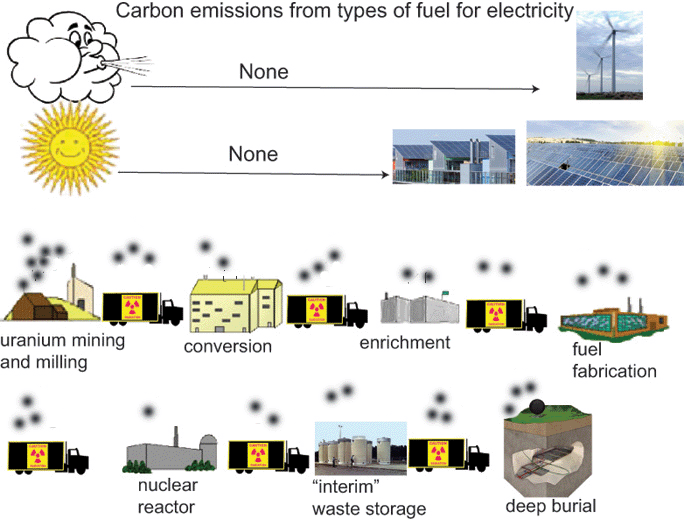
The dishonest claim of zero emissions implies we could use unlimited amounts and still meet our climate change obligations. In fact, building seven nuclear power stations would increase our greenhouse gas emissions and irresponsibly accelerate climate change.
Another falsehood is there in the very same sentence: nuclear energy is not used “all over the world”. Some 30 countries operate nuclear power stations, including four with just one reactor and six with two. About 160 countries don’t have any. Far from bringing prices down, the average price of nuclear power is much higher than solar, wind, hydro, gas or coal. Old power stations are being closed down because the costs of operation and maintenance mean they can’t compete with new solar farms and wind turbines. The world pattern of investment is telling. This year, about 500 gigawatts of new renewables will come on line. Hardly any nuclear power stations will start up. The electricity industry has voted with its chequebooks.
A third dishonest claim is that “Of the world’s 20 largest economies, Australia is the only one not using nuclear energy, or moving towards using it.” In fact, six of the 20 largest economies – Germany, Italy, Australia, Indonesia, Türkiye and Saudi Arabia – don’t operate nuclear power stations. Türkiye is the only one of those countries “moving towards using it”, with one nuclear power station being constructed.
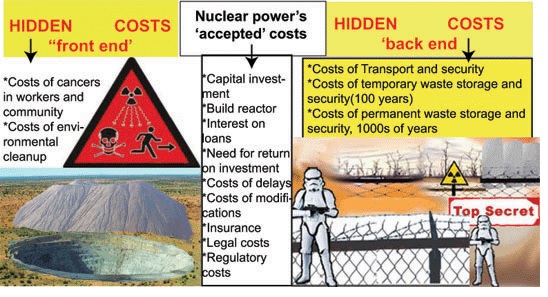
A fourth dishonest claim is that “A zero-emissions nuclear power plant will be a national asset delivering cheaper, cleaner and consistent energy for 80 years.” Again, the “zero-emissions” claim is false. Both current world average prices and regular CSIRO GenCost studies show nuclear power is far more expensive than renewables with storage. Historically, nuclear power stations have typically lasted 30 to 40 years, not 80. That is longer than the whole industry has existed.
The media release identifies “seven locations, located at a power station that has closed or is scheduled to close, where we propose to build zero-emissions nuclear power plants”. The list includes “Loy Yang Power Stations” and “Callide Power Station”. Loy Yang A is due to close in 2035, but Loy Yang B is scheduled to keep running until 2047. Callide B will close soon, but Callide C was commissioned in only 2001 and no closing date had been set. It is not true that all the power stations named will have closed within a decade.
Perhaps the most jaw-dropping of all the claims, however, is this one: “A Federal Coalition Government will initially develop two establishment projects using either small modular reactors or modern larger plants … They will start producing electricity by 2035 (with small modular reactors) or 2037 (if modern larger plants are found to be the best option)”. In fact, a report just released by the Australian Academy of Technological Sciences and Engineering shows it is unlikely we could buy small modular reactors before 2040. They do not yet exist anywhere in the OECD. Several different designs have been proposed, but they are all at the early stage of development. The idea they could be operating here by 2035 is pure fantasy.
The “modern larger plants” being built in Western Europe are years behind schedule, even though these are in countries with an established nuclear power industry, a working regulatory system and the skilled workforce needed to build these very complicated systems. The pro-nuclear Switkowski report, provided to the Howard government, concluded it would take at least 10 years and possibly 15 to build even one nuclear power station in Australia. It is just not credible to claim, even if the laws could be changed, that we could build seven by 2037, starting from scratch with no local experience and no regulatory system to assure the public of safety.
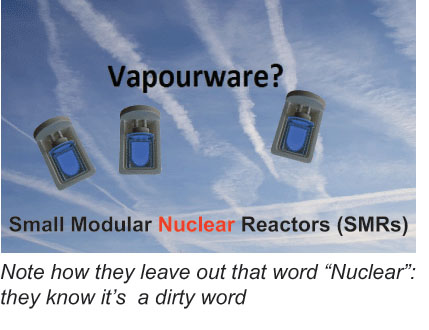
The label “small modular reactors” is misleading, too, giving the impression of a cute little device that would fit in your garage or a shipping container. The designs being proposed vary in size, but a typical so-called “small” reactor would require a site about the size of two football fields and would weigh several hundred tonnes. It would be “small” only when compared with most of the nuclear power stations that have been built. They have typically been much larger because there are economies of scale. For that reason, while there are no reliable figures at this stage, the CSIRO evaluation has consistently concluded that “small” reactors are likely to produce even more costly electricity than large ones.
A final piece of studied dishonesty is the statement that the current government’s approach of using renewables to provide our electricity would require 58 million solar panels and 3500 new wind turbines, giving a scary total investment figure. The clear implication is that seven nuclear reactors, for which no cost figures are given, wouldn’t cost as much. The recent track record for the building of nuclear power stations in Western Europe doesn’t provide much confidence. Hinkley Point C in the UK was meant to cost about $20 billion, but the total cost is likely to end up close to $100 billion. More seriously, the comparison is totally invalid. It compares an inflated estimate of the cost of providing enough renewables to meet all our needs with the unknown figure of the price of seven reactors. If they were ever to be built, they would provide about six gigawatts of generating capacity. Our installed capacity now is about nine times that much. A serious emissions reduction program will mean replacing petroleum transport fuels and gas heating with electricity. That will require doubling our capacity over the next decade. The Coalition is comparing apples with watermelons. They contrast the still-unrevealed cost of nuclear reactors to meet about 5 per cent of our needs with an inflated estimate of the cost of building enough renewables to supply our total demand.
The whole proposal is really a smokescreen. It is designed to hide the reality that a Coalition government would keep burning coal and gas for decades. There is also no plan to deal with the radioactive waste that nuclear reactors would produce, needing to be stored for geological time. The 2015 Nuclear Fuel Cycle Royal Commission, held in South Australia, estimated a storage facility would cost an eye-watering $41 billion. Peter Dutton’s nuclear plan is a farce. No part of it is real, plausible or sincere. As a proposal, it is probably the most dishonest ever put before the Australian electorate.
This article was first published in the print edition of The Saturday Paper on August 10, 2024 as “Dutton’s nuclear lies”.
Australian government would like the lucrative import of UK and USA nuclear waste ? But there’s a hitch.

Peter Remta. 12 August 24
From the information I have there is no question that Australia should like to import nuclear waste for permanent disposal principally from the United Kingdom but also from the United States if appropriate
The basic reason is that the payment for the disposal is considerable and will be some offset part of the substantial contributions – some would say astronomical – by Australia to the AUKUS arrangements
The United Kingdom has a reported legacy of 200,000 m³ of intermediate level waste with no means to dispose of it and has approached other countries for its disposal
The UK is hoping that Australia would take 40,000 m³ of this waste at obviously a negotiated fee but the applicable present cost internationally is $1.5 million a cubic metre of intermediate level waste
The British government had previously asked Australia to take this volume of waste for disposal but it could only be for long term storage at the proposed Kimba facility in South Australia which of course in timing and other reasons was not possible
An approach had also been made to Spain for disposal of that waste at the highly regarded El Cabril facility but the charges demanded by Spain were prohibitive despite being royal cousins
I understand it is affectively agreed that Australia will take 40,000 m³ of intermediate level waste as defined by the International Atomic Energy Agency from Britain as part of significantly assisting with the development and construction locally of the SSN AUKUS submarine fleet
However there can be no nuclear waste sent to Australia under the AUKUS arrangements until Australia achieves a variation of the Comprehensive Safeguards Agreement as explained in questions in the Senate, by Senator Jacqui Lambie .
Australia is still finding out what it doesn’t know about its secretive AUKUS deal
7.30 / By Laura Tingle, Sat 10 Aug 2024
When US President Joe Biden announced he would not be standing for another term, Australia’s political leaders expressed their gratitude for his contribution to public life. But this week, Australian voters had something else for which to be grateful to Biden.
For it was only as a result of a letter the US president wrote to the US Congress, that we found that there had been an update to the AUKUS agreement which will allow naval nuclear propulsion plants, rather than just nuclear propulsion “information”, to be transferred to Australia.
But it is not this part of the letter that has raised eyebrows and hackles even if, as usual, we find out about such deals from the Americans before we find out about them from our own government. The formal part of the deal will be exposed when it is submitted to the Treaties committee of our own parliament.
It is a side agreement, between the US, the UK and Australia that is of considerable concern: a non-legally binding “understanding” that includes “additional related political commitments”.
What are these? Well, they are secret.
The AUKUS saga moves on without much scrutiny
Critics argue that the “understanding” and “additional related political commitments” could include how and where these vessels are used. That is, what conflicts Australia would be expected to show up for, and how.
Some speculate on the possibility that it involves Australia agreeing to accept nuclear waste from the US and the UK, something the government has denied.
The idea that any of these such undertakings may have been made, but we aren’t allowed to know, is simply outrageous.
A quick recap of the AUKUS deal reveals that we are still expecting to receive two second-hand US Virginia class submarines, before embarking on building an entirely new, and so far unseen, British submarine in Adelaide.
Of course, we get a bit of a say in the design and plans for that new sub, don’t we?
Well the UK announced in October 2023 that it had selected BAE Systems for the SSN-AUKUS submarine. That month, Greens senator David Shoebridge asked officials about what involvement Australia had in the selection of the company that would build both the UK and Australian submarines.
The Australian Submarine Agency’s Alexandra Kelton told the Senate that “we had, through our high commission, some notification that an announcement would be made and some context around that but not of the content in great detail”.
The AUKUS submarine saga moves on with not much scrutiny in Australia, let alone apparently much input from Australia, given its cost and its huge strategic investment in one particular idea.
The second-hand Virginia class subs and later the AUKUS-class subs to be built in Adelaide are supposedly “sovereign Australian assets operating under the complete control of the Australian government”.
The Greens’ Shoebridge is one critic who warns the secret undertakings could include commitments on how the subs are used.
And this is a position which seems to be backed in by the authoritative papers written for the US Congressional Research Service.
Voters likely to be the last to know
In its latest update on the Virginia-class submarines, dated August 5, the Service’s analysts once again outline the relative benefits costs and risks of an “alternative division-of-labor approach”.
That’s technical talk for an alternative plan in which “up to eight additional Virginia-class SSNs would be procured and retained in US Navy service and operated out of Australia along with the US and UK SSNs that are already planned to be operated out of Australia … while Australia invested in military capabilities (such as, for example, long-range anti-ship missiles, drones, loitering munitions, B-21 long-range bombers, or other long-range strike aircraft)”.
That is, we don’t get any submarines, the Americans (and Brits) just run theirs out of here. Along with an expansion of bomber visits, personnel and troop rotations.
The “deterrence and warfighting cost-effectiveness” arguments for doing this “include [the fact that] Australian Defence Minister Richard Marles in March 2023 reportedly confirmed that in exchange for the Virginia-class boats, Australia’s government made no promises to the United States that Australia would support the United States in a future conflict over Taiwan.”
“Selling three to five Virginia-class SSNs to Australia would thus convert those SSNs from boats that would be available for use in a US-China crisis or conflict into boats that might not be available for use in a US-China crisis or conflict. This could weaken rather than strengthen deterrence and warfighting capability in connection with a US-China crisis or conflict.”
There’s a lot more like that.
Riled on Friday by the prime minister’s dismissal of his observations on AUKUS, Albanese’s predecessor Paul Keating warned that “the strength and scale of the United States’s basing in Australia will eclipse Australia’s own military capability such that Australia will be viewed in the United States as a continental extension of American power akin to that which it enjoys in Hawaii, Alaska and more limitedly in places like Guam”.
“Such an outcome is likely to turn the Australian government, in defence and security terms, into simply the national administrator of what would be broadly viewed in Asia as a US protectorate,” he said.
If that happens, voters are likely to be the last to know about it.
Laura Tingle is 7.30’s chief political correspondent
Buck-passing inside the murky arms trade
Australia bears responsibility for how Australian-made weapons are used in conflict zones around the world
Undue Influence, Michelle Fahy, Aug 10, 2024
‘It is almost literally true that Australia cannot go to war without the consent and support of the US.’
This statement, made in 2001, is key to understanding the deceit and denials by the Albanese government regarding weapons exports bound for Israel.
In his 2019 book Secret: The making of Australia’s security state, veteran journalist Brian Toohey quoted the 2001 research paper by the Australian parliamentary library.
Toohey explained that:
The US requires almost all countries that buy its weapons systems, including Australia, to send sensitive components back to the US for repairs, maintenance and replacements without the owners being allowed access to critical information, including source codes, needed to keep these systems operating.
To rephrase Toohey: Australia cannot use its advanced weapons platforms for any length of time without US support.
Two decades later, the F-35 fighter jet is one such advanced weapons platform.
Australia reliant on the US
Australia is now more embedded in and reliant on the US military than it was in 2001.
After nine months of denials, Defence Minister Richard Marles and Foreign Minister Penny Wong finally admitted in June that Australia is still exporting parts into the global F-35 supply chain, a point of contention because Israel is using its F-35s in its war in Gaza. Both senior ministers also noted at the same time that Australia’s F-35 fleet forms the heart of our air force’s “fast jet capability”.
Is Australia’s continuing supply of parts to the US somehow linked to the need to maintain our own F-35 capability?
The UN has stated only that supply to Israel of weapons, parts, components, ammunition and munitions should cease. It has not said all exports into global weapons supply chains that include Israel as a recipient nation should cease. Australia could continue supplying the US-led global F-35 supply chain and be compliant with UN requests provided the US has agreed that none of the Australian exports will be sent to Israel.
I asked the Defence Department whether it had sought assurances from the US and Lockheed Martin, the manufacturer of the F-35 fighter jet, that they would cease transferring Australian-made parts and components to Israel. The Department had not responded by deadline.
I also asked whether it was correct that Australia does not have access to the necessary source codes, or other critical information, needed to repair, maintain, upgrade or replace the sensitive components in our fleet of F-35s. Again, no response had been received at deadline.
As Toohey concluded in his 2019 book:
Although the ability to operate our major weapons systems independently is crucial to defending Australia, our leaders prefer to ignore this fundamental flaw and become more tightly integrated with US forces.
This may explain why the Albanese government has been intent on obscuring the extent of Australia’s involvement in the F-35 supply chain and unwilling to take decisive action to ensure that no Australian parts and components could end up in Israel.
Hot denials
“I am saying we’re not sending parts.”
That was Richard Marles, Australia’s deputy prime minister and defence minister, on ABC Radio Melbourne in June talking about Australia’s arms exports to Israel.
Marles then admitted, however, that Australia was continuing to supply parts into the F-35 global supply chain. But that was “worlds away” from claims that “we are directly supplying weapons to Israel” which, he said, “is just a falsehood”.
Marles insisted that claims by the Greens that Australia was supplying weapons to Israel were “absolutely false”, “a total lie”, “completely wrong”, and “utterly, utterly false”.
He repeated the government’s line that “there have been no weapons exported to Israel…for the past five years” and stated this to be “the absolute truth”. I have reported previously on this highly misleading statement.
Should Australia be taking stronger action?……………………………………………………………………………………………………………………. more https://undueinfluence.substack.com/p/buck-passing-inside-the-murky-arms?utm_source=post-email-title&publication_id=297295&post_id=147548747&utm_campaign=email-post-title&isFreemail=true&r=1ise1&triedRedirect=true&utm_medium=email
AUKUS Revamped: The Complete Militarisation of Australia
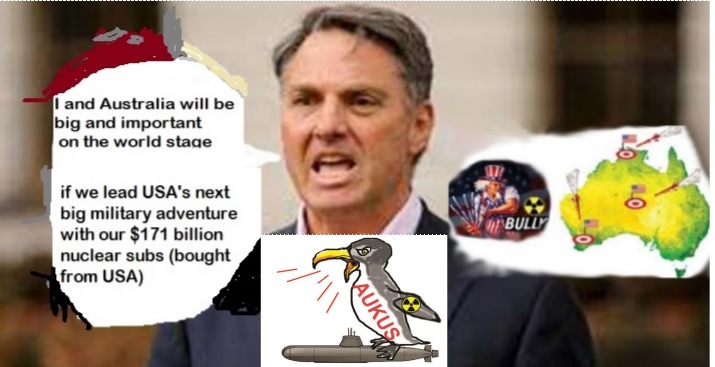
Marles, the persistently reliable spokesman for Australia’s wholesale capitulation to the US war machine, calls the document “the legal underpinning of our commitment to our international obligations so it’s a very significant step down the AUKUS path and again it’s another demonstration that we are making this happen.”
US military forces, in short, are to occupy every domain of Australia’s defence.
August 10, 2024, by: Dr Binoy Kampmark https://theaimn.com/aukus-revamped-the-complete-militarisation-of-australia/
There is much to loathe about the AUKUS security agreement between Canberra, Washington and London. Of the three conspirators against stability in the Indo and Asia Pacific, one stands out as the shouldering platform, the sustaining force, the political and military stuffing. But Australian propagandists and proselytisers of the US credo of power prefer to see it differently, repeatedly telling the good citizens down under that they are onto something truly special in being a military extension, the gargantuan annexe of another’s interests. Give them nuclear powered submarines, let them feel special, and a false sense of security will follow.
The August 2024 AUSMIN talks in Annapolis, Maryland, held between US Secretary of Defense Lloyd J. Austin III, US Secretary of State Antony Blinken, and their Australian counterparts, Richard Marles (Minister of Defence) and Penny Wong (Foreign Minister)provided yet another occasion for this grim pantomime. No one could be in doubt who the servitors were.
The factsheet from the US Department of Defense on the meeting is worth noting for Washington’s military capture – no other word describes it – and Australia’s sycophantic accommodation. As part of the “Enhanced Force Posture Cooperation,” the US and Australia are to advance “key priorities across an ambitious range of force posture cooperation efforts.” This is merely a clumsy way of describing the deeper incorporation of Australia’s own military requirements into the US military complex “across land, maritime, air, and space domains, as well as the Combined Logistics, Sustainment, and Maintenance Enterprise.” US military forces, in short, are to occupy every domain of Australia’s defence.
The greedy and speedy US garrisoning of Australia is evident through ongoing “infrastructure investments at key Australian bases in the norther, including RAAF Bases Darwin and Tindal” and “site surveys for potential upgrades at RAAF Bases Curtin, Learmonth, and Scherger.” Rotational deployments of US forces to Australia, “including frequent rotations of bombers, fighter aircraft, and Maritime Patrol and Reconnaissance Aircraft” are to increase in number. As any student of US-Australian relations knows, rotation is the disingenuous term used to mask the presence of a permanently stationed force – occupation by another name.
The public relations office has obviously been busy spiking the language with a sense of false equality: the finalising, for instance, by December 2024 of a Memorandum of Understanding on Co-Assembly for Guided Multiple Rocket Systems (GLMRS) – a “co-production”; finalising, by the same date, an MOU “on cooperative Production, Sustainment, and Follow-on Development of the Precision Strike Missile (PrSM)”; and institutionalising of “US cooperation with Australia’s Guided Weapons and Explosive Ordnance (GWEO) Enterprise.” Everywhere we look, a sense of artificial cooperation under the cover of Washington’s heavy-handed dominance, be it cooperative activities for Integrated Air and Missile Defence, or the hypersonic weapons program, can be found.
In this even more spectacular surrender of sovereignty and submission than previous undertakings, Canberra is promised second hand nuclear-powered toys in the form of Virginia Class submarines, something forever contingent on the wishes and whimsy of the US Congress. But even this contingent state of affairs is sufficient for Australia to bury itself deeper in what has been announced as a revised AUKUS agreement. More accurately, it constitutes a touch-up of the November 22, 2021 agreement between the three powers on the Exchange of Naval Nuclear Propulsion Information (ENNPIA).
The ENNPIA allows the AUKUS parties the means to communicate and exchange relevant Naval Nuclear Propulsion Information (NNPI), including officially Restricted Data (RD) as part of what is described as the “Optimal Pathway” for Australia’s needless acquisition of nuclear powered vessels.
In his letter to the US House Speaker and President of the Senate, President Joe Biden explains the nature of the revision. Less cumbersomely named than its predecessor, the new arrangements feature an Agreement between the three powers for Cooperation Related to Naval Nuclear Propulsion. In superseding the ENNPIA, it “would permit the continued communication and exchange of NNPI, including certain RD, and would also expand the cooperation between the governments by enabling the transfer of naval nuclear propulsion plants of conventionally armed, nuclear-powered submarines, including component parts and spare parts thereof, and other related equipment.”
The Agreement further permits the sale of special nuclear material in the welded power units, and other relevant “material as needed for such naval propulsion plants.” Transferrable equipment would include that necessary for research, development, or design of naval propulsion plants. The logistics of manufacture, development, design, manufacture, operation, maintenance, regulation and disposal of the plants is also covered.
Tokenistic remarks about non-proliferation are then made in Biden’s letter. The powers, for instance, commit themselves to “setting the highest nonproliferation standard” while protecting US classified information and intellectual property. This standard is actually pitifully low: Australia has committed itself to proliferation not only by seeking to acquire submarine nuclear propulsion, but by subsidising the building of such submarines in US and UK shipyards.
Marles, the persistently reliable spokesman for Australia’s wholesale capitulation to the US war machine, calls the document “the legal underpinning of our commitment to our international obligations so it’s a very significant step down the AUKUS path and again it’s another demonstration that we are making this happen.”
Obligations is the operative word here, given that Australia is burdened by any number of undertakings, be it as a US military asset placed in harm’s way or becoming a radioactive storage dump for all the AUKUS submarine fleets. Marles insists that the only nuclear waste that will end up on Australian soil will be that generated by Australia. “That is the agreement that we reached with the UK and the US back in March of last year, and so all this is doing is providing for the legal underpinning of that.”
Given that Australia has no standalone, permanent site to store high-level nuclear waste, even that undertaking is spurious. Nor does the understanding prevent Australia from accepting the waste accruing from the fleets of all the navies. Given the cringing servitude of Canberra, and the admission by the Australian government that they have made undisclosed “political commitments”, such an outcome cannot be ruled out.
Always reliably waspish, former Australian Labor Prime Minister Paul Keating gavehis assessment about the latest revelations of the AUSMIN talks. “There’ll be an American force posture now in Australia, involving every domain.” The Albanese government had “fallen for the dinner on the White House lawn.” That, and much more besides.
Australia being turned into ’51st US state’ – ex-PM

https://www.sott.net/article/493814-Australia-being-turned-into-51st-US-state-ex-PM 10 Aug 24
Canberra is losing its strategic autonomy due to its security pact with the US and UK, former Prime Minister Paul Keating has said.
The US is surrounding Australia with military bases under the AUKUS pact, which undermines the country’s sovereignty and makes it a legitimate target for China.
In an interview with ABC on Thursday, Keating, who served as prime minister between 1991 and 1996, voiced strong skepticism about whether his country benefits from being a member of AUKUS – a landmark security partnership between Australia, UK, and the US, which was announced in 2021. The pact, which has been condemned by China, focuses on helping Australia acquire nuclear-powered submarines.
Keating argued that by allowing the US to “displace our military” and surround the country with bases, Canberra is essentially giving up its right to determine its foreign and defense policy. Australia will “completely lose” its strategic autonomy as a result, he claimed.
“So AUKUS is really about, in American terms, the military control of Australia. The government of Prime Minister Anthony Albanese is “likely to turn Australia into the 51st state of the United States.”
The former prime minister added that the expanded military presence makes the country a target from China’s point of view.
“We’re now defending the fact that we’re in AUKUS… If we did not have an aggressive ally, like the United States, aggressive to others in the region, there would be nobody attacking Australia. We are better left alone.”
The US, he argued, is trying to “superintend” China, with tensions between the two being fueled by a power struggle over the self-ruled island of Taiwan, which Beijing views as part of its sovereign territory.
However, Keating argued that the Taiwan situation “is not a vital Australian interest” while China “has no strategic design” on Australia. The US attitude to Taiwan is comparable to China deciding that Tasmania needed help breaking away from Australia, he said.
The former prime minister’s remarks come after Australian Defense Minister Richard Marles and Foreign Minister Penny Wong traveled to Washington for talks about the AUKUS pact, and to discuss a new agreement on the transfer of nuclear material to Canberra as part of its push to acquire domestic-built atomic submarines from the 2030s.
China has warned that the AUKUS agreement raises nuclear proliferation risks, adding that it was conceived in the “Cold War mentality which will only motivate an arms race.” Russia has also sounded the alarm about the security situation in the Asia-Pacific, insisting that it “has no place for closed military and political alliances.”
Lawyers for Peace Open Letter to the Prime Minister
Aug 9, 2024 https://icanw.org.au/campaign-news/
Dear Prime Minister Albanese,
As Australian lawyers, we believe that international law can play a powerful role in nuclear disarmament and the creation of new norms, leading to increased peace and security for all.
Under your leadership, Australia has the opportunity now to uphold our long and proud commitment to championing international law by joining the Treaty on the Prohibition of Nuclear Weapons (TPNW). With two nuclear-armed powers involved in heated conflicts overseas, and the risk of nuclear escalation growing, now is a vital time to take necessary steps for nuclear disarmament.
Noting the growing international consensus on this matter, we urge your government to honour the ALP’s policy commitment to sign the TPNW, without further delay.
In the insightful words of former ALP Deputy Leader Tom Uren,“The struggle for nuclear disarmament is the most important struggle in the human race.”
The TPNW embodies Uren’s vision of a future where the international community embraces a total ban on nuclear weapons. The TPNW entered into force in 2021, and now has 93 signatories and 70 state parties. Australia’s signature would add heft to this global movement, and reflect the wishes of the overwhelming majority of Australians who support eliminating the scourge of nuclear weapons.
Joining the treaty also makes good on Australia’s obligation under Article VI of the Treaty on the Non-Proliferation of Nuclear Weapons (NPT) that binds parties to pursue good faith negotiations relating to a treaty on ‘general and complete disarmament and to negotiate effective measures relating to the cessation of the nuclear arms race and to nuclear disarmament.’ While progress has been made on effective measures concerning non-proliferation and peaceful uses of nuclear energy, little has been achieved in disarmament. The TPNW is the first multilateral effective measure under Article VI to enter into force since the NPT in 1968.
Moreover, the complementarity between the TPNW and NPT creates a robust legal framework for a nuclear-free world. The drafters of the TPNW designed it to reinforce and build on the NPT. It complements the NPT by adding prohibitions and obligations, akin to how the 1993 Chemical Weapons Convention complements the 1925 Geneva Protocol. The TPNW enhances the NPT through a comprehensive prohibition on nuclear weapons that applies to all parties. It also establishes frameworks for the verified, time-bound elimination of nuclear-weapon programmes and for addressing harms caused by nuclear weapons.
As legal professionals dedicated to creating a safer, more peaceful world for future generations, we call on your Government to stand up against the threat of nuclear devastation by joining the growing number of nations putting their signatures to the TPNW.
This treaty is not just a symbolic gesture but a tangible step towards global disarmament. By acting now, Australia can demonstrate its commitment to international peace and security and set a powerful example for other nations. Your Government’s potential to make history via the TPNW is substantial and ought not be squandered. We urge you to seize this opportunity to ensure a future free from the threat of nuclear warfare.
The time for action is now.
Signed,
Continue readingTODAY. World “experts” are kicking the nuclear waste can down the road – to our great grandchildren
From https://theaimn.com/world-experts-are-kicking-the-nuclear-waste-can-down-the-road-to-our-great-grandchildren/ 10 Aug 24
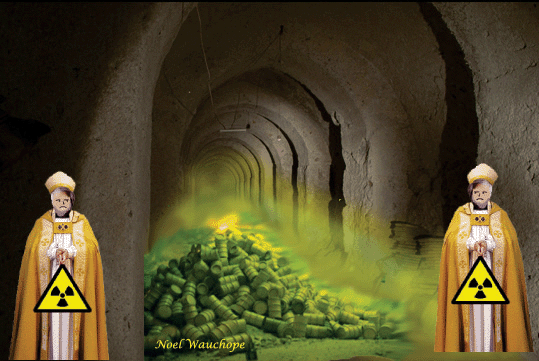
The latest news from Germany really shows up this problem. IF conditions are ideal – a decision on a site for Germany’s underground nuclear waste repository could be made by 2074.
- That’s – 50 years to find a site.
- Then 20 years to build the underground dump.
- Then many decades for transporting and storing thousands of casks .
That’s just for Germany, which took the courageous decision to just shut down this filthy industry. Germany is not creating any more radioactive trash!
This is a comforting situation for today’s “nuclear experts”
Why is it comforting? Well, because they don’t need to worry about producing ever more of this toxic trash. They’ll be dead and gone long before it all has to get fixed. They can flummox around bleating about the marvels of deep disposal, enjoying their fat salaries, and leave it all for future generations to face.

II have previously written about the concept of “rolling stewardship”, advocated by Dr Gordon Edwards. This is a system whereby high level nuclear waste is kept above ground, in very strong containers. The containers are sited away from waterways, and are regularly monitored and repaired. This system, combined with the closing down of all nuclear reactors, would be a practical and honourable way to address the global radioactive waste threat. Expensive? Yes. But no more expensive than the current grandiose “expert” plans for deep disposal.
Australia makes undisclosed ‘political commitments’ in new AUKUS deal on transfer of naval nuclear technology

ABC News, By defence correspondent Andrew Greene, 8 Aug 2024
In short:
AUKUS partners have struck a revamped agreement to allow the transfer of US and UK naval nuclear material to Australia.
Critics of the trilateral submarine project warn the new document could eventually see high-level radioactive waste stored locally.
What’s next?
The agreement between the US, UK and Australia will need to be ratified by each AUKUS partner before coming into effect.
Undisclosed “political commitments” have been made between the Albanese government and its AUKUS partners in a new agreement for the transfer of naval nuclear technology to Australia, which critics warn is likely to also allow radioactive waste to be dumped here.
The White House confirmed Australia, the United Kingdom and the United States had reached another significant “AUKUS milestone” that set up further trilateral cooperation that would be essential for this country to build, operate and maintain nuclear-powered submarines.
Under the AUKUS “optimal pathway” unveiled in San Diego last year, Australia will spend up to $368 billion over the next three decades to first purchase second-hand Virginia-class submarines and then develop a new SSN-AUKUS fleet using British technology.
In a letter to speaker the US House of Representatives speaker and the US Senate president, President Joe Biden urged Congress to give the revamped AUKUS agreement “favourable consideration”
Mr Biden’s letter explains that the new agreement would permit the continued communication and exchange of Naval Nuclear Propulsion Information (NNPI), including certain Restricted Data (RD), only previously shared between the US and UK…………………………………………………………………..
Concerns over radioactive waste ‘loophole’
AUKUS critics, including the Greens party, warn that the new agreement is likely to eventually allow high-level radioactive waste to be stored in Australia and for uranium enrichment to be undertaken locally, but the government insists that is not the case.
“A political assurance is there — a legal assurance, a legislative assurance, an institutional assurance is not. That gate needs to be closed, that loophole needs to be closed,” warns Dave Sweeney, a nuclear free campaigner from the Australian Conservation Foundation.
“And that’s one of many concerns and many options for interpretation of how AUKUS is operationalised that can add greater pressure, nuclear threat in our ports, in our harbours and waters and on land around the management of radioactive waste.” https://www.abc.net.au/news/2024-08-08/australia-makes-political-commitments-in-new-aukus-deal/104200814
Nuclear shift in updated AUKUS deal
InDaily, 10 Aug 24
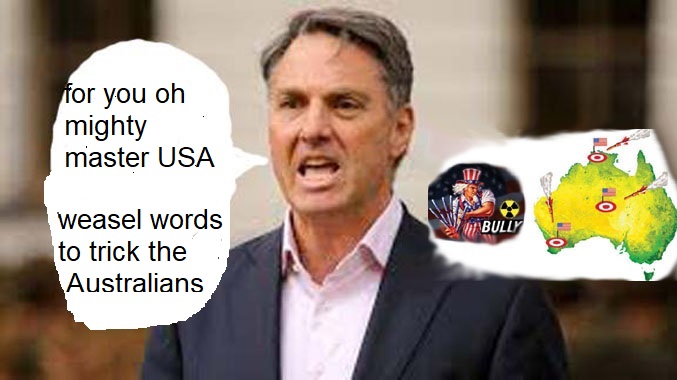
Australia’s acceptance of nuclear material from the US and UK has been officially approved as part of an updated AUKUS agreement.
The update to AUKUS was signed off during AUSMIN meetings in the US, the annual talks between Australian and US defence and foreign ministers.
Under the agreement, Australia will be formally permitted to take in nuclear material for the procurement of nuclear submarines.
The terms of the original deal, inked in March 2023, only allowed for the exchange of information about nuclear propulsion.
Defence Minister Richard Marles says the fresh agreement is a “foundational document” for the trilateral security pact……..
As part of the AUKUS agreement, Australia will acquire three Virginia-class vessels from the US before Australian-built nuclear submarines begin operating.
The $368 billion plan will bring eight nuclear-powered subs into service by the 2050s.
But the deal has come under renewed criticism from former prime minister Paul Keating, who says Australia is losing its autonomy by being part of it.
“AUKUS is really about, in American terms, the military control of Australia. I mean what’s happened? Our policy is likely to turn Australia into the 51st state of the United States,” he told ABC’s 7.30 program.
“The only threat likely to come for us is because we have an aggressive ally because of AUKUS.”………………………….
Australia would not be in a position to dispose of any nuclear material in the country until the 2050s, Marles said.
Details of the agreement were laid out in a letter to US Congress by President Joe Biden.
The agreement had also come under fire by Greens defence spokesman David Shoebridge, who said levels of secrecy about the terms of the deal was concerning.
“What is so damaging to the Albanese government with this new deal that it has to be kept secret from the Australian public?” he said.
“There are real concerns the secret understanding includes commitments binding us to the US in the event they go to war with China in return for getting nuclear submarines.”
It comes as opposition defence spokesman Andrew Hastie called for the WA government to include a minister dedicated to AUKUS in its cabinet. https://www.indaily.com.au/news/national/2024/08/09/australia-to-accept-nuclear-material-in-new-aukus-deal
Friends of the Earth Nuclear Free Art Auction 2024

The emblematic Friends of the Earth Nuclear-Free Art Auction this year is happening on Saturday August 31 at Catalyst Social Centre on 146 Sydney Rd, Coburg. We also have an onlne auction with some of the bigger works from August 16-30. The Art Auction has been an enormous support to keep our work going over the decades.
This coming year we have our plate full with Dutton’s delusional nuclear dreams and proposed nuclear power plant sites in every state, the AUKUS military deal with its nuclear submarines, its subsequent high level weapons-grade radioactive waste and new proposed uranium mines in SA. As always, the biggest burden will lie on First Nations communities, front-line communities and workers.
There will be an online auction via Gala-bid from August 16-30 with the bigger works. Please let your art collector/ gallery friends and friends with deep pockets know. A link to the catalogue will be put up shortly.
The in-person event on Saturday August 31 will feature music by Uncle Winiata 7.30pm. Live auction 8pm. Food by some of the lovely people at Food Not Bombs and drink at the bar.
We have a lot of art works this year and are extremely grateful for the generosity of the artists that have donated their work. And special gratitude to Jane Brownrigg, FOE lifetime member and general absolute legend, who has chosen to (re-)donate a large part of her collection to this years auction.
While Cumbrian MPs Blindly Agitate for More Uranium Mining to Feed More Nuclear New Build, Indigenous Australians are celebrating Halt to Poisoning of their Lands

On By mariannewildart, https://mariannewildart.wordpress.com/2024/08/07/while-cumbrian-mps-blindly-agitate-for-more-uranium-mining-to-feed-more-nuclear-new-build-indigenous-australians-are-celebrating-halt-to-poisoning-of-their-lands/
Here in Cumbria MPs, most especially the new MP for Sellafield (apologies, MP for Whitehaven and Workington, Josh MacAlister) are agitating for new nuclear build on the floodplain of the River Ehen next to the bursting at the seams Sellafield nuclear waste site. New nuclear, even the so called “Small Modular Reactors” (actually near the size of the original Calder Hall reactors) would require new uranium – this is not a “home grown” or “clean” industry as its cheerleaders claim, the profligate amounts of uranium, high tensile steel, copper and a whole smorgasbord of toxic chemicals are shipped in and they outstrip any other industry in quantities and toxicity.
The start of the toxic uranium fuel cycle begins on the lands of indigenous peoples worldwide. In Australia a battle has been raging to stop ever more uranium mining, this time at Jabiluka. Now that battle has been won but the MP for Whitehaven and Workington wants indigenous peoples worldwide to carry on paying the price of polluted waters, poisoned lands and damaged health in order to continue with nuclear business as usual despite the fact that nuclear power’s most long lasting legacy is not “free electricity” far from it, energy bills will go up because successive governments’ have had an obsession with funding the nuclear industry at any price even asking consumers now to pay the price before they recieve any electricity and for generations after to try and ‘keep the wastes safe’.
“The announcement has been made that the mining lease will not be extended and the process to get Jabiluka into world heritage and Kakadu National Park can begin. A big shout out to the Traditional Owners, the @Mirarr for standing strong for this for generations, and thousands of people around the country standing with them.”
Meanwhile here in Cumbria this is what the local press fizzingly tell us “Cumbrian leaders put pressure on NDA over land at Moorside for SMRs. A letter signed by more than 100 political, business and union leaders is calling for urgent action to resolve land issues at Moorside so that new nuclear power stations can be built. Whitehaven and Workington MP Josh MacAlister wrote the letter, which has been signed by fellow Cumbrian MPs Julie Minns and Markus Campbell-Savours, local members of the House of Lords, Cumberland Council leader Mark Fryer, trade union leaders in the nuclear industry and dozens of local business leaders. Mr MacAlister says that unless urgent action is taken to resolve issues about land use at Moorside, west Cumbria will lose out in a competitive process that is now underway. Mr MacAlister says GBN will only select sites that have enough land available and the NDA (who own Sellafield) want to use much of the Moorside site for other decommissioning purposes. This has resulted in an impasse that, if left unresolved, will leave Cumbria behind in the race for new nuclear. The NDA says it is working with the government to consider how the land at Moorside may be used to enable new nuclear energy facilities, while taking into account how it might need to utilise the land in order to successfully deliver its mission. Mr MacAlister said: “In my first few weeks as an MP I’ve met with ministers, the NDA, GBN and leading industry figures. It’s become clear that there’s been a conspiracy of silence for years over plans for new nuclear in our area.In Cumbria 7th Aug 2024 https://www.in-cumbria.com/news/24501223.cumbrian-leaders-put-pressure-nda-land-moorside-smrs/“
No doubt Josh MacAlister MP for Whitehaven and Workington will be absolutely delighted to hear that as is the way of all ruthless corporations, yesterday “Mining company Energy Resources Australia (ERA) has launched legal action against the Commonwealth and Northern Territory governments over a decision not to renew its lease over the Jabiluka uranium mine. Surrounded by Kakadu National Park, the site at Jabiluka is one of the world’s largest and richest uranium deposits.”
Josh Macalister MP is the smiling assassin agitating to rip uranium out of the earth to fuel new nuclear on land next to Sellafield (on the flood plain of the river Ehen). Nice!
EDF extends heat-related warning cuts at 3 nuclear plants

This warning from France is a warning to Australia, too. France, the poster boy for nuclear power, is being affected by global heating – making its nuclear reactors less effective and more expensive with rising temperatures.
Australia, a water-short continent, will be even more vulnerable to climate change affecting a nuclear industry
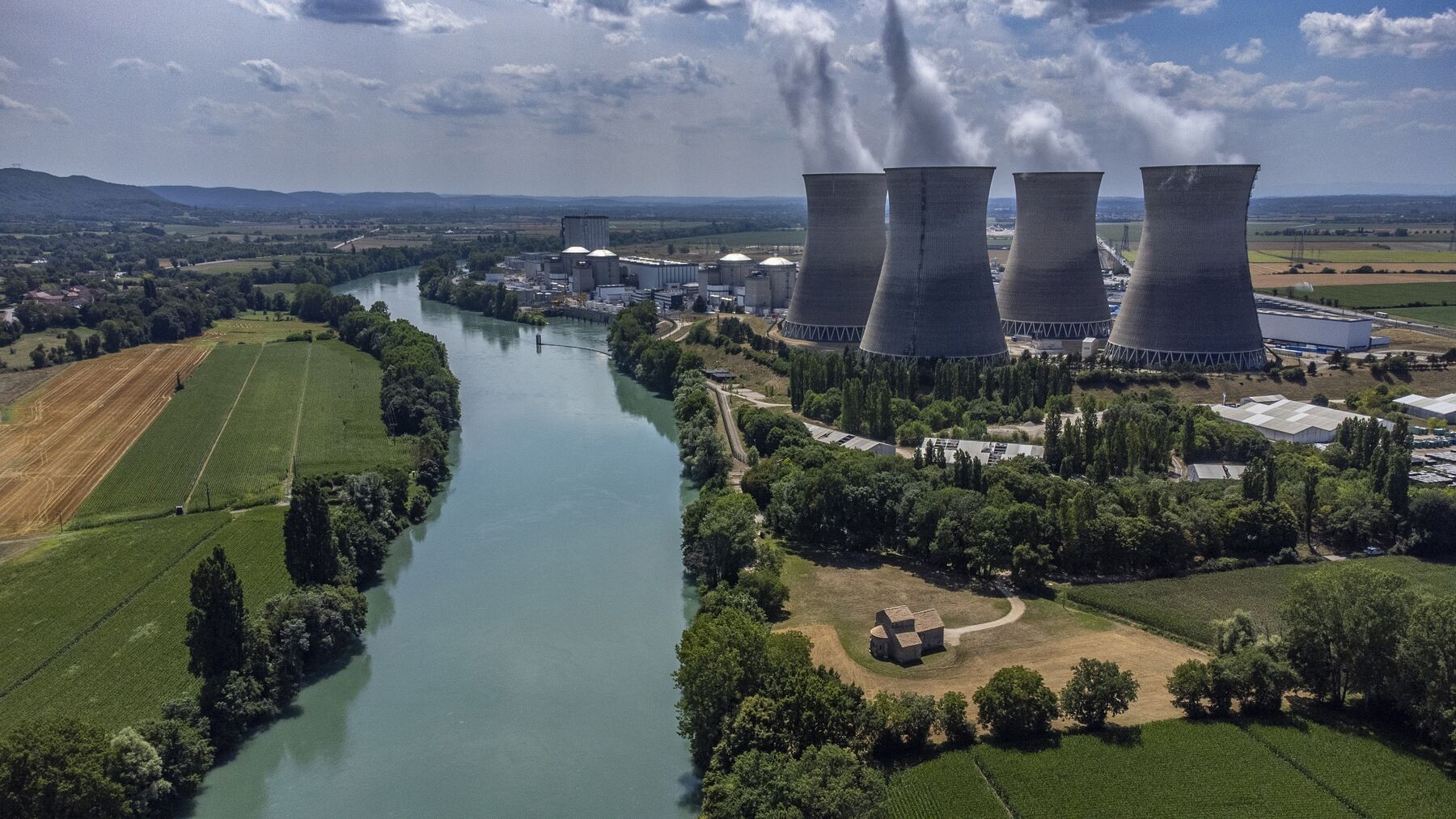
(Montel) French utility EDF has extended by two days a warning of power output curbs at three nuclear power plants – totalling 10 GW – along the river Rhone in southeastern France from tomorrow until Friday next week due to high temperatures.
Reporting by: Muriel Boselli, 08 Aug 2024, https://montelnews.com/news/f1e0a4b4-61b8-4d45-8027-d549192b910e/edf-warns-of-heat-related-cuts-at-3-nuclear-plants-10-gw
EDF could curb output at 3.6 GW Tricastin, 3.6 GW Bugey and 2.6 GW St Alban, the state-owned utility said on Thursday.
Weather service Meteo France has forecast temperatures to intensify in southeast France over the next few days, with peaks reaching 35C.
At some power plants, EDF uses river water to cool reactors. However, it could reduce output if river water temperatures or levels are too warm or too low.
Separately, EDF has extended a capacity cut warning at its 2.6 GW Golfech nuclear power plant in southwest France by three days to 17 August, due to warm temperatures.
Australian nuclear news headlines 8- 12 August
Headlines as they come in 8- 12 August
- The AUKUS operations are stalled because Australia cannot meet the nuclear waste disposal requirements of the non-proliferation treaty regime.
- Australia indemnifies US and UK ‘against any liability’ from nuclear submarine risks
- Australia, US, UK sign nuclear transfer deal for AUKUS subs – AUSTRALIA RESPONSIBLE FOR THE SPENT FUEL WASTES
- Nuked – The Submarine Fiasco that Sank Australia’s Sovereignty
- Call to end nuclear power ban brings heated reaction in Australia
- Peter Dutton’s nuclear lies
- Australian government would like the lucrative import of UK and USA nuclear waste ? But there’s a hitch
- Defence Minister Richard Marles insists AUKUS milestone won’t force Australia to accept foreign nuclear waste. https://www.youtube.com/watch?v=jjvsrgiY2b8
- Australia is still finding out what it doesn’t know about its secretive AUKUS deal.
- Buck-passing inside the murky arms trade
- Australia is still finding out what it doesn’t know about its secretive AUKUS deal
- Australia makes undisclosed ‘political commitments’ in new AUKUS deal on transfer of naval nuclear technology.
- Nuclear shift in updated AUKUS deal
- Australia’s acceptance of nuclear material from the US and UK has been officially approved as part of an updated AUKUS agreement.
- AUKUS Revamped: The Complete Militarisation of Australia
- Australia being turned into ’51st US state’ – ex-PM.
- Marles denies sinister meaning in AUKUS ‘political commitments’
- Lawyers for Peace Open Letter to the Prime Minister
- Friends of the Earth Nuclear Free Art Auction 2024
- While Cumbrian MPs Blindly Agitate for More Uranium Mining to Feed More Nuclear New Build, Indigenous Australians are celebrating Halt to Poisoning of their Lands
- A revised AUKUS agreement. Dunno what it means yet.
- Hidden in mainstream Olympic Games news – an incisive comment on nuclear costs!.
- Western Australia rules out uranium mining policy change amid nuclear energy push from Peter Dutton.
- Peter Dutton rules out Kalgoorlie-Boulder as potential nuclear reactor site in Coalition’s power plan.
- Peter Dutton’s ‘nuclear policy’: It’s ‘unclear’ at best
Western Australia rules out uranium mining policy change amid nuclear energy push from Peter Dutton

ABC Goldfields / By Jarrod Lucas, 8 Aug 24
In short:
WA Mines Minister David Michael has ruled out any change to the Cook government’s long-standing policy on uranium mining.
There is an effective ban on mining the mineral in WA, where only one uranium mine is permitted to operate.
Peter Dutton says the ban is “ideologically based” and should be overturned.
Western Australia’s mines minister has rejected calls from federal Liberal leader Peter Dutton to overturn the state’s long-standing ban on uranium mining and insisted that future energy needs will be met by renewable sources.
The state has had an effective ban on mining the nuclear fuel since Labor was swept to power in 2017, while Mr Dutton has made nuclear power development the centrepiece of the Coalition’s energy policy.
Speaking on the sidelines of this week’s Diggers and Dealers Mining Forum in Kalgoorlie-Boulder, Mr Dutton said the WA policy should be scrapped.
But WA Mines Minister David Michael, who attended the final day of the forum, poured cold water on the idea and said the state government’s stance on uranium would not be changing anytime soon.
“WA Labor, for two elections, has committed to not approving any uranium mines and there is no intention to change that policy,” Mr Michael said……………………………………………………………………………………..
Mr Michael said he spoke with officials from Deep Yellow at Diggers and Dealers and believed renewables such as wind, solar and battery storage were a safer bet than uranium.
“I think it’s more important to focus on critical minerals in terms of the renewable future,” he said.
“We know that renewable energy is what the world moves to sooner or later.
“We know that’s what we need to tool up for in WA, and we’re doing it.”…………………………………………………………. more https://www.abc.net.au/news/2024-08-08/wa-uranium-mining-policy-to-stay-despite-nuclear-energy-push/104196130
1 This month

of the week – Disrupting War & Militarism in Oceania. Active solidarity. Radical practice.
 Antinuclear