What happens to nuclear waste under Peter Dutton’s Coalition plan to build seven nuclear power reactors?

ABC Illawarra / By Nick McLaren, 21 Jun 2024
In short: Debate on Australia’s nuclear future will need to include clear information on the transportation and storage of nuclear waste.
Currently Australia doesn’t have a national storage facility, so low and medium level waste is kept at more than 100 locations around the country.
What’s next? As Australia debates nuclear power in the lead-up to the federal election, more answers will be needed about where to store radioactive waste and for how long.
…………………………………………………………………..”Each year Australia produces about 45 cubic metres of radioactive waste arising from these [research reactor medical and industrial”] uses and from the manufacture of the isotopes.”
This amounts to about 40 square metres of low-level waste and 5 square metres of intermediate waste, while the UK and France by comparison each produce about 25,000 cubic metres of low-level waste annually.
But of greater concern is the intermediate and high-level waste that will be produced by the seven nuclear reactors the Coalition plans to get up and running in Australia by 2050.
Peter Dutton in announcing the Coalition’s nuclear plan this week used a previously heard line that one standard-sized reactor produces just a handful of nuclear waste each year.
“If you look at a 450 megawatt reactor, it produces waste equivalent to the size of a can of Coke each year,” Mr Dutton said.
…………………..Simon Holmes a Court said the Coke can comment greatly underestimates the amount reactors generate.
“Even the small modular reactors would be 2,000 times as much, and that is just high-level radioactive waste alone,” he said.
“It is a lot more than he says ……………………………….
The waste storage site will be needed for waste from the AUKUS submarines regardless of the Coalition’s nuclear energy plans.
The AUKUS deal is bipartisan, so any change of government is unlikely to scuttle it.
Griffith University emeritus professor and energy specialist Ian Lowe told The Conversation that Australia will have to manage high-level radioactive waste when the submarines are decommissioned in 30 years time.
“So, when our first three subs are at the end of their lives – which, according to Defence Minister Richard Marles, will be in about 30 years time – we will have 600 kilograms of so-called ‘spent fuel’ and potentially tonnes of irradiated material from the reactor and its protective walls,” he said.
“Because the fuel is weapons-grade material, it will need military-scale security,” he said.
Currently Australia’s intermediate level nuclear waste generated at the Lucas Height reactor is taken overseas for processing then returned to Australia for storage.
Remaining unused uranium is removed from the fuel rods with the leftover radioactive waste broken up and mixed with molten glass, then solidified in steel canisters.
The last time this happened, in March 2022, it involved a shipment of radioactive waste brought back to Lucas Heights via a high security operation at Port Kembla in Wollongong.
“Four of those canisters, each containing 500 kilograms of vitrified waste that is radiologically equivalent to 114 rods sent to the UK in a shipment in 1996, were received back from the UK,” according to a statement from Australia’s Nuclear Science and Technology Organisation (ANSTO).
It was logistically a major operation carried out in relative secrecy in the middle of the night with confirmation only occurring afterwards.
Such shipments only tend to occur about once every 10 years, but this all could start to change if and when Australia moves towards embracing a larger role for nuclear. m https://www.abc.net.au/news/2024-06-21/what-happens-nuclear-waste-coalition-plan-/104003454
The cloud of coal has long hung over the Latrobe Valley. Now nuclear power is dividing it
Cait Kelly, Mon 24 Jun 2024 https://www.theguardian.com/australia-news/article/2024/jun/23/the-cloud-of-coal-has-long-hung-over-the-latrobe-valley-now-nuclear-power-is-dividing-it
No matter where you are in the Latrobe Valley, you can see the smoke haze. The transmission lines that punctuate the region’s dairy farms and clusters of blue gums all lead to some of the country’s biggest coal-fired power plants, where the plumes of smoke soar from smokestacks and steam from cooling towers.
This valley provides most of Victoria’s electricity, but it’s been on the edge of a precipice. Over the next 11 years, Loy Yang A and Yallourn are expected to be decommissioned. Residents know the writing is on the wall for coal, but confusion over what comes next is creating a deep chasm.
Now the valley’s communities – and those of six other locations around Australia – are on a new energy frontline. On Wednesday, the Coalition promised that, if elected to government, a part of the Loy Yang station would be one of seven sites to host a nuclear reactor.
The announcement spread quickly down the valley. Some welcome it, seeing it as a lifeline for their dying community. And then there are pockets of outrage.
Wendy Farmer is an unlikely advocate for renewables because coal is in her blood. She is a miner’s daughter; her father was a miner’s son. Her husband worked at the Hazelwood plant before it was decommissioned in 2017. The plant was infamous for two things – the 2014 fire that burned for 45 days and for being Australia’s dirtiest power station.
But Farmer is helping lead a group of advocates for a healthier and more sustainable valley – and she’s outraged by the nuclear proposal when “we have the technology we need to move forward without it”.
“It’s a slap in the face,” she says. “It’s them going, ‘You’re desperate, so you’ll take it’.”
There are many questions about the Coalition policy, including the cost, what to do about the waste, how the plants could be built and when, how many jobs would it actually create – and how geographically safe would it be to have a nuclear plant near a faultline.
“Why would you even consider putting nuclear on earthquake faultlines?” Farmer says.
“It doesn’t feel like it’s community-driven – no one in the community has been asked about it. They’ve just been told this is what our plan is.”
On Wednesday, Farmer led a snap protest outside the Gippsland National MP Darren Chester’s office. Chester has cautiously welcomed the nuclear policy, saying in a statement it could create “enduring social and economic benefits to our community”, before adding that “more detailed investigations will be required in the years ahead”.
‘Always looking for more jobs’
Traralgon is the biggest town in the valley and is wedged between the power plants and the big hole left by Hazelwood – between a brown coal past and Australia’s commitment to get to net zero emissions by 2050.
Of the 125,000 people who live in the valley, 26,000 call Traralgon home.
In the newsagent it’s buzzing. People are queueing for their Lotto ticket or a copy of the paper. The workers behind the counter won’t say much about nuclear – one thinks it’ll just get her in trouble and the other says she’s supportive but will grab the boss.
The boss is Gary Garth. He’s upfront with his opinion and cares about his community and the number of jobs. He loves the nuclear idea.
“I think there are a lot of hurdles, obviously, they’ve got to get through to do it. But I think the vision is good. And it would be great for the area,” Garth says.
“We are always looking for more jobs for locals and that’s probably the most important thing a society can have: people in employment.”
Decades ago, this area was booming – high-paying jobs created a cashed-up community. But coal is no longer king. The most recent census had unemployment sitting at 6.6%, higher than the Victorian average of 5%.
“If the governments can come up with a way of turning energy into nuclear where it’s safe, safe for the environment, safe for everyone, it’s very clean, so if it can be done, that would be a real benefit to the area,” Garth says.
In parts of the community, renewables are also seen as a threat. Garth describes windfarms as “a disaster for the environment” – he’s worried about the birds and what we do with the materials when they come to the end of their lifespan.
But it’s not a concern he holds for nuclear waste.
“Australia is a big place. They need to be able to come up with something – they seem to do in other countries around the world,” he says.
He thinks the community will vote for it and says the Coalition will have a mandate to proceed with it if it wins power – and that the state government would be foolish not to listen to the electorate.
Before the announcement, the Coalition reportedly polled each of the seven communities, with 55% of the Latrobe Valley respondents said to be supporting nuclear.
But on the streets of the valley, not everyone is convinced by the Coalition’s promise.
Ian, a former geologist, says the opposition leader, Peter Dutton, “hasn’t done his homework”.
But another resident, Jesse, thinks it will be a good creator of jobs.
“I think it’s a good thing, especially with all the coal shutting down,” Jesse says.
“I think the nuclear side of things will offer more ongoing jobs [than windfarms]. And we’ll have a stable power supply. Everyone needs the power to keep warm and cook and all that sort of stuff … We need to have a stable power supply.”
‘Softened up for nuclear’
Penelope Swales is sitting in a rare slither of winter sun on her organic farm at the bottom of the Strzelecki Ranges. It’s cut from a different cloth to Traralgon – there’s a rail trail, a brewery and a beloved community band. It lures former city slickers with its shaggy green hills and bush walks, and turns them into locals. Swales was a lawyer before she took up the plough.
“I feed 20 local families with this farm,” she says.
“That cloud between the two trees” – she points to the distance where the smoke is slowly filling the air, making a large cloud that drifts east towards Melbourne – “that’s Loy Yang. So pretty close.”
Swales is joined by her friends Marge Mackay and Lisa Mariah, who have also moved to the valley for its natural beauty and relaxed lifestyle. They don’t want nuclear.
“The demographic here is a little bit odd,” Swales says.
“While most people work in Morwell and Traralgon, progressive and pro-renewable voices don’t get a lot of a look in because most of us live up here in the Strzelecki corridor, which is bisected by the electoral boundary.
“So a bunch of us are on one side and a bunch of us are on the other side.”
She says that, over the past four years, the region has been “softened up for nuclear”. There has also been a bitter campaign over plans to build a windfarm in a pine plantation overlooking the former Hazelwood coal plant.
“People came in from outside, held public meetings, ran a very slick campaign telling people, ‘this is going to be bad for your community, this is going to destroy your community, this is going to ruin your property values, infrasound will keep you awake at night’,” Swales says.
The fight spread misinformation and put the sleepy community at loggerheads, she says.
“The more progressive people tend to keep their heads down,” she says. “There’s been some very vicious stuff going on. We’ve had vandalism. One of their friends had ‘sell-out’ sprayed on the footpath outside at home. You know, she’s a pensioner.”
The long campaign against renewables has created “fertile ground”, Swales says. If someone says “jobs”, they get the votes.
But the group of friends is determined to fight – they say they’ve done it before. Mackay jumps in and says her community was dumped with coal, was not supported after the Hazelwood fire and is now getting shunted with nuclear. She wants a different future.
“The valley has been the dumping ground for Victoria for a very long time,” she says.
“There is a lack of forward vision for future generations – this is your children and your grandchildren.
Peter Dutton’s nuclear power plans are an ironic backflip to nationalisation for the Liberal Party
With a mantra of small government and minimal interference in the economy, the Liberal Party has long stood for the rights of the individual and free enterprise.
Until last week.
If Dutton’s nuclear ambitions come to fruition, control of Australia’s energy market, will end up in the hands of the federal government.
https://www.abc.net.au/news/2024-06-25/dutton-nuclear-power-renewable-energy-liberal-party/104016288
By chief business correspondent Ian Verrender 25 June 24
Ben Chifley is considered one of the giants of Labor politics.
As treasurer, he guided the nation through the arduous task of financing World War II and later, after John Curtin’s death, went on to lead the country in the immediate post-war era.
But, in August 1947, concerned that rival banks would undermine the roles of the Commonwealth Bank and the federal government in operating monetary policy, he announced a plan to nationalise Australia’s banking system.
Politically, it was a disaster after the High Court ruled against it. From wartime hero, Labor was swept from power in the 1949 elections by the Robert Menzies-led Liberal Party and spent the next 23 years in the political wilderness.
With a mantra of small government and minimal interference in the economy, the Liberal Party has long stood for the rights of the individual and free enterprise.
Until last week. Rather than allowing market forces to dictate how Australia should respond to the global challenge of reducing greenhouse emissions, the Coalition under Peter Dutton has turned that ethos on its head with a plan to embark upon one of the biggest government-funded investment programs in history.
It is a radical plan that not only throws future private investment in the energy sector into a state of uncertainty, it threatens to undermine the value of privately owned renewable energy investment made during the past 15 years.
On some estimates, depending upon how big the nuclear rollout will be, a capital expenditure program of more than half a trillion dollars will be required to fund this sudden shift in energy policy.
To operate efficiently and to minimise cost, nuclear power plants need to be permanently going full pelt, leaving little room for any other source of power generation.
If Dutton’s nuclear ambitions come to fruition, control of Australia’s energy market, having been privatised largely under Coalition-run state governments since Jeff Kennett made the first move in Victoria, will end up in the hands of the federal government.
Who cares about cost?
It is not the first time the Coalition has up-ended its free-market ethos when it comes to energy policy.
Under Tony Abbott, Australia abandoned the carbon tax established under the Gillard government which put a price on carbon emissions. Instead, it was replaced by a direct subsidy program, the Emissions Reduction Fund, which allocated billions of taxpayer dollars to private enterprise.
Australia’s energy and climate policies have been a mess, the battleground of a bitter raging war between both sides of politics for most of the past 20 years. It has resulted in an underinvestment in new electricity generation as the industry has watched policy lurch between the two extremes.
While many senior Coalition members have openly questioned whether climate change exists with Abbott labelling climate science as “crap”, both sides of politics finally appeared to be on a unity ticket in November 2021 when then-prime minister Scott Morrison signed up to the Paris agreement on emissions reductions.
Since then, gas shortages, Russia’s invasion of Ukraine and the shutdown of our aging coal-fired generators have sent retail electricity prices soaring.
While Dutton claims the first nuclear station could be operational by midway through the next decade, realistically, they are likely to take far longer.
By that stage, however, almost all our coal-fired plants would have been retired, creating massive energy shortfalls in the meantime. Those supporting the opposition and its nuclear policy argue the coal generators’ life should be extended.
That means either building new ones or refurbishing the existing ones at enormous expense which would then detract from the economics of replacing them with nuclear. And our emissions reduction targets would be blown.
The French experience
Whenever any kind of debate on nuclear power plants erupts, France enters the conversation.
More than 70 per cent of France’s electricity is generated from nuclear power plants. And as the proponents will highlight, the French enjoy much lower power prices than most of their European neighbours who now rely on imported fossil fuels.
That’s because the vast bulk of them were built decades ago, they are all government-owned and their costs largely have been sunk.
France has more than 55 nuclear plants dotted around the country that are run by a government entity EDF.
They were built in reaction to the 1973 energy crisis under a plan put forth by then prime minister Pierre Messmer given the country had little if any fossil fuel resources.
Economists Steven Hamilton and Luke Heeney argue that France has made its nuclear system work largely because the technology dominates the power generation system and because it has neighbours that can absorb the excess.
“Countries like France can only make nuclear work by exporting large amounts of energy when it’s surplus to demand,” they wrote recently.
Almost half the plants are more than 40 years old and many are in need of upgrades, a process that has been delayed by debate about whether they should be decommissioned or their life extended.
In September 2022, more than 30 plants were shut because of technical or maintenance problems while the extended European drought created havoc with plant cooling facilities.
Water is essential for nuclear plants, a challenge the opposition appears to have overlooked in its plan to roll them out on the world’s driest continent.
Instead, it has opted to place them on the sites of retired coal-fired generators. But those sites were selected because they were close to coal fields.
Nuclear not compatible with renewables
For all the talk about the cost of building nuclear stations, the cost involved in running them has taken a back seat.
They are horrendously expensive to build. But, even if you don’t take the build cost into account, they are hugely expensive to run.
Even when they are running flat out, the cost of electricity generation is much higher than for renewables, according to the CSIRO and most reputable economists and analysts.
To maximise their efficiency, they need to be running full-time at maximum capacity. But the opposition has hinted nuclear power would somehow complement renewables, that they could switch on to fill the breach when renewables fall short.
As investment banker David Leitch argues, renewables flood the system during daylight hours, sending wholesale power prices to zero and even lower on many days, which would cripple the economics of nuclear power.
“Generation technology choices do not live in isolation from the system in which they operate,” he says.
“For those not already tired of the debate around small, modular reactors, the fact is they are not a technology designed to deal with the reality of a system that has lots of renewables and specifically lots of solar.”
That means much higher generation prices on top of an extraordinarily expensive and long build time that will come into effect long after our coal-fired generators have bitten the dust.
Chifley’s experience still looms large over Labor. So, for the next few years, prepare to be entertained by a Labor Party preaching market forces butting heads with a Coalition hell-bent on nationalising a key segment of the economy.
The irony.
Coalition’s taxpayer-funded nuclear con a road to ruin

We estimate that the fiscal damage would be in the order of a minimum $100 billion “nuke builder” tax, but likely considerably more given the international experience.
AFR Tim Buckley and Annemarie Jonson 25 June 24
We now know that if the federal opposition wins the next election, it proposes to gouge Australians to bankroll a national build-out of government-owned nuclear reactors across seven locations – because private capital won’t touch nuclear.
Coalition Leader Peter Dutton’s fact-free, 900-word press release on the topic – the totality of the Coalition’s policy announcement – failed to produce costings for what would be a long-term, multibillion-dollar “nuke builder” tax. We estimate that the fiscal damage would be in the order of a minimum $100 billion, but likely considerably more given the international experience…………………………………………… (Subscribers only)
Scary truths on civilian nuclear power are coming to the fore
Firstly, everyone agrees that climate breakdown will flip heretofore stable regions into unstable. Adding the reasons mentioned above, a proliferation of civilian nuclear power stations will give potential non-nuclear conflicts a new nuclear dimension. Add to that the cheaper, supposedly even sometimes mobile, small nuclear reactors that are seen as “dirtier” than existing NPPs.
It’s no surprise therefore that the civil nuclear lobby would rather not talk about it.
Bill Ramsay, The National 24 June 24
IT’S entirely natural that the UK civilian nuclear power lobby pitch is behind Labour.
Probably some who support Scottish independence think that the stance of the SNP on nuclear power is a marginal vote-loser. However, if looked at properly through a national security lens, it’s actually a vote-winner.
Occasionally, the threat of some limited non-state terrorist attack on a civilian nuclear facility gets an airing. The more important issue of the implication of the presence of civilian nuclear power stations in a war zone rarely does.
………………………………. the lack of discussion – in the public domain at least – of the implications of the presence of a civilian nuclear power station in a so-called non-nuclear conventional battlefield.
I did nothing more on the issue until my sort-of retirement from education as a senior official of the EIS aligned with the Russian invasion of Ukraine. Ukraine hosts Europe’s largest nuclear power station and some others. More than half of Ukraine’s electricity is generated by its nuclear power stations.
My first attempt at a paper was rather “undercooked” – as the rejection from the Royal United Services Institute (RUSI) rightly pointed out – but the final effort – after helpful further consultation with Paul Rodgers, emeritus professor of peace studies at Bradford University – is now available on the Scottish CND website.
In Castle Zaporizhzhia: War Fighting Implications Linked To The Proliferation Of Nuclear Power As Part Solution To Climate Chaos, I unpack the dangers that the nuclear lobby would rather not discuss.
I argue that from a purely military perspective, the occupying Russian forces – whose current, if not future, capabilities are far from overwhelming – will militarily milk the Zaporizhzhia NPP for all its worth and more.
Militarily, the intimidatory potential of the Zaporizhzhia NPP of today and future Zaporizhzhias are huge. Zaporizhzhia NPP performs a similar role for the Russian invaders of Ukraine that the motte-and-bailey castle did for the Norman invaders of England after 1066. These castles of wood then stone were designed to intimidate the Saxon natives.
Zaporizhzhia NPP does the same. Russia can use it as a base of operations from which it can project its power in the full knowledge that the Ukrainians cannot attack it without the risk of another Chornobyl nuclear disaster.
If they wished, the Russians could fire long-range ordnance from it, in the full knowledge the Ukrainians dare not fire back. Indeed, although Zaporizhzhia NPP was discussed at the Ukrainian summit held in Switzerland a few days ago, the bigger global security risks associated with civilian nuclear power production was not. Why? Because the civil nuclear lobby sees nuclear power as a clean alternative to fossil fuels.
In my view, civil nuclear power as a climate chaos mitigator is triply flawed.
Firstly, everyone agrees that climate breakdown will flip heretofore stable regions into unstable. Adding the reasons mentioned above, a proliferation of civilian nuclear power stations will give potential non-nuclear conflicts a new nuclear dimension. Add to that the cheaper, supposedly even sometimes mobile, small nuclear reactors that are seen as “dirtier” than existing NPPs.
It’s no surprise therefore that the civil nuclear lobby would rather not talk about it. Though, to be fair to RUSI, soon after the publication of my report by Scottish CND, RUSI published another which was followed up by a seminar and more recently it has established an ongoing project on strategic and security aspects of civil nuclear power.
Despite all this, the security aspects of civil nuclear power remain very much an elite issue with very little reportage in the mainstream media.
It’s a similar strategy to that employed by John Cleese’s hotelier character Basil Fawlty when faced by an influx of a coach-load of elderly German tourists to his establishment. Paranoid that his staff would make reference to the Second World War, he threatened them with dismissal if they did.
We would all like the war in Ukraine to end, not least because of the death and destruction. The nuclear lobby’s motives are rather less altruistic as the longer the war goes on, the more likely their so-called solution to climate chaos will be exposed to a more searching critique. https://www.thenational.scot/politics/24405095.scary-truths-civilian-nuclear-power-coming-fore/
Matt Kean to helm Climate Change Authority, says no to nuclear

Rachel Williamson, Jun 24, 2024, ReNewEconomy
The architect of New South Wales’ (NSW) renewable energy transition is set to be the next Climate Change Authority (CCA) chair, with Matt Kean stepping up to take on the job of advising on the options and pace of the national shift to decarbonisation.
The former NSW Liberal MP and state energy minister – who only stepped down from politics late last week – will combine decarbonisation with economic policy in his new role, a job whose importance is taking on an outsized importance in advance of an election set to be fought on how to get to net zero.
The CCA advises the government on climate change policy.
He then handled the NSW emissions reductions target of 70 per cent by 2035.
Today, Kean rejected nuclear as a solution the CCA will support, saying that his department looked into the energy source for NSW and advice was that it would take too long and be too expensive.
He says the advice was from professor Hugh Durrant-Whyte, who was responsible for the British government’s nuclear defence program and is one of the few people in Australia to have actually run a nuclear program.
Retiring chair Grant King restored the agency to “its proper role” supporting the government’s climate goals, says energy and climate change minister Chris Bowen.
“Good climate and energy policy is good economic policy – the Albanese government gets that and so does Matt Kean,” he said in a statement.
“Our ambitious but achievable policies are ensuring our approach is credible and delivers benefits for all Australians. The Climate Change Authority is critical to this agenda.
“Matt Kean’s time in public office was marked by reform and the ability to bring people from across the political spectrum with him for the good of the community.”…………………………………………………………………. more https://reneweconomy.com.au/matt-kean-to-helm-climate-change-authority-says-no-to-nuclear/
Peter Dutton says nuclear power plants “burn energy.” No they don’t

Giles Parkinson, Jun 25, 2024 https://reneweconomy.com.au/peter-dutton-says-nuclear-power-plants-burn-fuel-no-they-dont/
Opposition leader Peter Dutton has betrayed his complete ignorance about the nuclear technology he threatens to impose on the Australian population by a making a fundamental error: He thinks they burn fuel, or energy.
The comments were made in a heated Question Time in parliament house on the first day of the winter session which promises to be focused on energy and climate.
Opposition energy spokesman Ted O’Brien was ejected from the house by speaker Milton Dick, and Dutton ran close, earning the ire of the speaker on several occasions when he interjected as Labor ministers spoke.
At one point Dutton – trying to tie Labor up in knots over waste from a nuclear submarine, said this, according to Hansard:
Mr Dutton: It’s on relevance. And, perhaps, to be of assistance to the minister, the propulsion system burns energy—that’s how the system is working—and it’s stored in the—
The SPEAKER: Resume your seat.
Actually, they don’t burn fuel. That’s the point of them. If they did, they would likely create emissions, as defence minister Richard Marles explained.
Mr MARLES: Actually, it doesn’t burn any fuel, because burning is oxidisation, which is what happens in an internal combustion engine, which is exactly what happens when you use hydrocarbons. What this is is a nuclear reaction which gives rise to power. That is what happens inside the sealed nuclear reactor. The point is that the waste that will need to be disposed of …
And if he doesn’t accept Labor’s word on it, the Opposition leader could also read up on the website of the Nuclear Energy Institute:
“Nuclear plants are different because they do not burn anything to create steam. Instead, they split uranium atoms in a process called fission. As a result, unlike other energy sources, nuclear power plants do not release carbon or pollutants like nitrogen and sulfur oxides into the air.”
It reminds me of an encounter I had when I first started driving an EV. It was rubbished by a passer-by who suggested the car would be better off powered by nuclear. He seemed to think you could just shovel uranium into a boiler and off you go. Just top it up at the local refuelling station.
It could be that the aspiring prime minister thinks along the same lines. After all, we are constantly told we should mine Australia’s vast uranium reserves – heck, why not burn them like we do with coal.
It’s not the only major misunderstanding of nuclear by Dutton. He has suggested that what he defines as a small nuclear reactor, around 400 MW, would produce just a single can of coke as waste. It will need to be a very big can.
Emeritus Professor Ian Lowe, of Griffith University’s school of environment and science, told the SMH it was safe to say an SMR would generate many tonnes of waste per year, and it was likely that waste would be more radioactive than the waste from a large-scale reactor.
“For a 400-megawatt SMR, you’d expect that to produce about six tonnes of waste a year. It could be more or less, depending on the actual technology but certainly multiple tonnes a year,” he said. “They run on highly enriched uranium and produce a much nastier and a much more intractable set of radioactive waste elements that have to be treated.”
The Coalition’s entire nuclear push is based on lies and misconceptions, from their claim that wind, solar and storage can’t power a modern economy, that their plan needs no additional transmission, that its cheaper than renewables, and that it’s consistent with climate targets.
As virtually all experts have pointed out, with the exception of an heroic rear guard action on Sky News, the policy makes no sense economically, environmentally, or from an engineering point of view.
Perhaps Dutton needs to watch a few more episodes of The Simpsons. Or perhaps not.
‘Julian Assange Is Free’: WikiLeaks Founder Strikes Plea Deal With US
“We thank all who stood by us, fought for us, and remained utterly committed in the fight for his freedom,” said WikiLeaks. “Julian’s freedom is our freedom.”
COMMON DREAMS STAFF, Jun 24, 2024, https://www.commondreams.org/news/julian-assange-plea-deal
WikiLeaks founder Julian Assange on Monday reached a deal with the U.S. government, agreeing to plead guilty to one felony related to the disclosure of national security information in exchange for his release from Belmarsh Prison in the United Kingdom.
A related document was filed in federal court in the Northern Mariana Islands, a U.S. commonwealth. Under the plea agreement, which must still be approved by a judge, the Department of Justice will seek a 62-month sentence, equal to the time that the 52-year-old Australian has served in the U.K. prison while battling his extradition to the United States.
Assange faced the risk of spending the rest of his life in U.S. prison if convicted of Espionage Act and Computer Fraud and Abuse Act charges for publishing classified material including the “Collateral Murder” video and the Afghan and Iraq war logs. Before Belmarsh, he spent seven years in the Ecuadorian Embassy in London with asylum protections.
“Julian Assange is free,” WikiLeaks declared on the social media platform X, confirming that he left Belmarsh Friday “after having spent 1,901 days there,” locked in a small cell for 23 hours a day.
He was granted bail by the High Court in London and was released at Stanstead Airport during the afternoon, where he boarded a plane and departed the U.K.,” WikiLeaks said. “This is the result of a global campaign that spanned grassroots organizers, press freedom campaigners, legislators, and leaders from across the political spectrum, all the way to the United Nations.”
“He will soon reunite with his wife Stella Assange, and their children, who have only known their father from behind bars,” the group continued. “WikiLeaks published groundbreaking stories of government corruption and human rights abuses, holding the powerful accountable for their actions. As editor-in-chief, Julian paid severely for these principles, and for the people’s right to know. As he returns to Australia.”
The news of Assange’s release was celebrated by people around the world, who also blasted the U.S. for continuing to pursue charges against him and the U.K. for going along with it.
“Takeaway from the 12 years of Assange persecution: We need a world where independent journalists work in freedom and top war criminals go to prison—not the other way around,” the progressive advocacy group and longtime Assange supporter RootsAction said on social media.
Leftist Colombian President Gustavo Petro said in a statement: “I congratulate Julian Assange on his freedom. Assange’s eternal imprisonment and torture was an attack on press freedom on a global scale. Denouncing the massacre of civilians in Iraq by the U.S. war machine was his “crime”; now the massacre is repeated in Gaza I invite Julian and his wife Stella to visit Colombia and let’s take action for true freedom.”
Australian Greens leader Adam Bandt, who represents Melbourne in Parliament, said on social media that “Julian Assange will finally be free. While great news, this has been over a decade of his life wasted by U.S. overreach.”
“Journalism is not a crime,” Bandt added. “Pursuing Assange was anti-democratic, anti-press freedom, and the charges should have been dropped.”
The women-led peace group CodePink said in a statement:
Without Julian Assange’s critical journalism, the world would know a lot less about war crimes committed by the United States and its allies. He is the reason so many anti-war organizations like ours have the proof we need to fight the war machine in the belly of the beast. CodePink celebrates Julian’s release and commends his brave journalism.
One of the most horrific videos published by WikiLeaks was called “Collateral Murder,” footage of the U.S. military opening fire on a group of unarmed civilians–including Reuters journalists–in Baghdad. While Julian has been in captivity for the past 14 years, the war criminals that destroyed Iraq walked free. Many are still in government positions today or living off the profits of weapons contracts.
While Julian pleads guilty to espionage—we uphold him as a giant of journalistic integrity.
Vahid Razavi, founder of Ethics in Tech and host of multiple NSA Comedy Nights focusing on government mass surveillance, told Common Dreams that “they took a hero and turned him into a criminal.”
“Meanwhile, all of the war criminals in the files exposed by WikiLeaks via Chelsea Manning are free and never faced any punishment or even their day in court,” he added. “You can kill journalists with impunity, just like Israel is doing right now in Gaza.”
British journalist Afshin Rattansi said, “Let no one think that any of us will ever forget what the British state did to the most famous journalist of his generation.”
“They tortured him—according to the United Nations special rapporteur on torture—at the behest of the United States,” Rattansi noted.
Andrew Kennis, a professor of journalism and social media at Rutgers University, told Common Dreams that “Julian Assange is nothing less than the Daniel Ellsberg of our time.”
Nuclear lobby concedes rooftop solar will have to make way for reactors

Giles Parkinson, Jun 24, 2024, https://reneweconomy.com.au/nuclear-lobby-concedes-rooftop-solar-will-have-to-make-way-for-reactors/
The nuclear lobby in Australia has conceded one aspect of the nuclear power plan that the federal Coalition does not like talking about – that the rooftop solar embraced by households and businesses will have to make way for the Opposition’s planned reactors.
This is not actually a surprise to anyone associated with the energy industry, because it is quite clear that there is no room for an “always on” generator of any type – be it coal, gas or nuclear – in a grid dominated by variable wind and solar.
In Australia, this is particularly the case because of the continent’s magnificent solar resources, and the huge uptake of rooftop PV by consumers, which already stands at more than 20 gigawatts (GW) and is forecast to quadruple to more than 80 GW in coming decades.
In South Australia, rooftop solar has already met all local demand on occasions. The market operator predicts that this will occur in Western Australia within a few years, and in other bigger states on the eastern seaboard within a decade.
How do you jam nuclear reactors into this energy mix? Renew Economy has asked this question on several occasions – here and here in particular – and it now seems the nuclear lobby has finally fessed up to the solution: Switch off rooftop solar.
“I think what will happen is that nuclear will just tend to push out solar,” Robert Barr, a member of the lobby group Nuclear for Climate told the ABC in a story that addresses the issue.
Barr admitted that nuclear power plants have some flexibility, but not a lot. They could ramp down to around 60 per cent of their capacity, he says. But the reality is that the their economics – already hugely expensive – blow out even further if not running all the time. Solar panels would have to make way, he said.
“There’ll be an incentive for customers to back off,” he said. “And I think it wouldn’t be that difficult to build control systems to stop export of power at the domestic level. It’d be difficult for all the existing ones but for new ones, it just might require a little bit of smarts in them to achieve that particular end — it can be managed.”
Almost everyone involved in the Australian grid – be they developers, generators, network operators, investors, advisors or regulators – recognises that the system design is moving on from “base-load” and always on power to variable renewables and dispatchable power (mostly storage).
But this new reality this does not support the fossil fuel industry’s view of the world, not their economic and business models, and while the Coalition has made its position against large scale wind and solar clear, it hasn’t talked about the impact on rooftop solar, apart from saying it supports it in principle.
But how?
Some insight into what is shaping the Coalition’s thinking comes from testimony to parliamentary committee in 2021 by James Fleay, a former oil and gas executive and founder of the advocacy group Down Under Nuclear Energy (Dune), who serves as an advisor to Coalition energy spokesman Ted O’Brien.
Fleay told the parliamentary committee looking into future energy choices that “baseload” architecture had served Australia well for a century and should not be changed. “We have to make a decision about grid architecture,” he said.
“We cannot adapt our energy usage to accommodate the rising and setting of the sun or seasonal weather uncertainties without enormous human and economic costs,” Fleay said, before adding later: “I think that is possible and true only at the margins, but not in bulk.”
Basically Fleay admitted that it is a choice between models – baseload or renewable, and in various interviews has said Australia’s isolated grid as a reason not to go the wind and solar route because of the inability to export.
But that same isolation has an equal, or arguably greater impact on nuclear because of its dependence on high production rates, known as capacity factors. The French nuclear generators wouldn’t survive without the connection to other European grids and the ability to export to other countries.
To be sure, the Australian market operator is pushing hard to be able to “orchestrate” rooftop solar and other consumer energy resources as a way of managing the grid. But the extent it would need to do so with multiple gigawatts of “always on” nuclear would dramatically increase.
The energy industry knows this. The two – nuclear and rooftop solar – simply can’t go out on the same date. The Coalition, or at least its advisors, also appear to know this. But when will it be honest about this situation with the general public and the households and businesses with solar on their rooftops?
Giles Parkinson is founder and editor of Renew Economy, and is also the founder of One Step Off The Grid and founder/editor of the EV-focused The Driven. He is the co-host of the weekly Energy Insiders Podcast. Giles has been a journalist for more than 40 years and is a former business and deputy editor of the Australian Financial Review. You can find him on LinkedIn and on Twitter.
The insane amount it could cost to turn Australia nuclear – as new detail in Peter Dutton’s bold plan is revealed
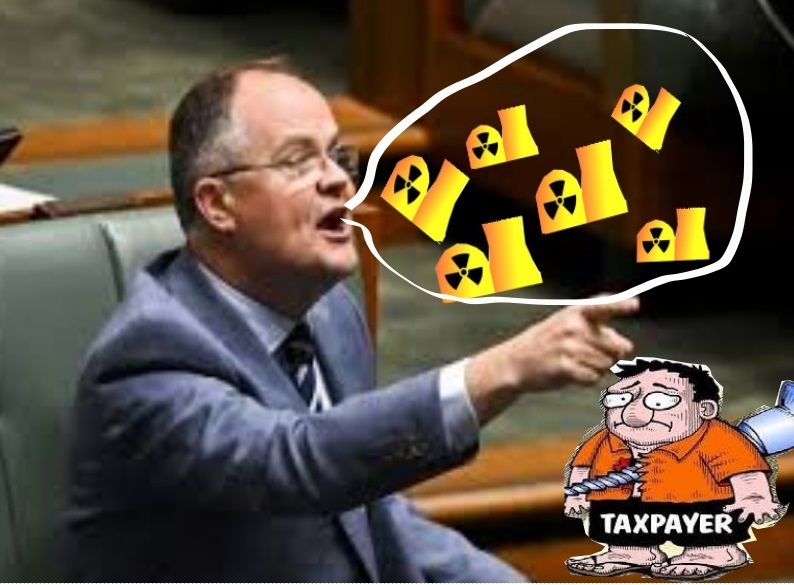
The large-scale and small modular generators would be Commonwealth-owned, similar to arrangements governing the Snowy Hydro 2.0 scheme, requiring a multibillion-dollar funding commitment from taxpayers.
- Peter Dutton nuclear plan slammed
- Proposal could cost $600billion
By JACK QUAIL FOR NCA NEWSWIRE and AUSTRALIAN ASSOCIATED PRESS 23 June 2024, more https://www.dailymail.co.uk/news/article-13559019/The-insane-cost-turn-Australia-nuclear-Peter-Dutton-slammed-completely-irrational-plan.html
Labor frontbencher Tanya Plibersek has added her voice to the tirade of criticism against the Opposition’s nuclear energy push, labelling the proposal as ‘completely irrational’ and ‘designed to be a distraction’.
Speaking on Sunday, the environment and water minister criticised the Coalition for its refusal to detail the estimated cost to add nuclear generation to the national electricity market in the biggest overhaul of energy policy in decades.
‘He’s saying to Australians: ‘I don’t trust you. I don’t trust you with the costing we’ve done,’ if he’s got costings,’ Ms Plibersek told Sky News.
According to analysis released by the Smart Energy Council using data from the latest GenCost report, Labor’s non-nuclear energy plan is estimated to cost $117bn through to 2050, while the Coalition’s pledge would cost upwards of $600bn.
Opposition energy spokesman Ted O’Brien has flagged an evolution in the Coalition’s nuclear power policy, revealing that each of the seven sites could host multiple reactors.
But in a major concession, Mr O’Brien said on Sunday the Coalition would not go to the election announcing the estimated generation capacity of its nuclear power plan, leaving this decision to an independent body until after the election.
‘One of the lessons we learned from overseas, in order to get prices down, you need multi-unit sites,’ Mr O’Brien told the ABC’s Insiders program.
‘Let’s say the small modular reactors … When you talk about a nuclear plant, these are modularised compartments. You can add another 300, add another 300.
‘You’re talking about multi-unit plants.’
An independent nuclear energy coordinating authority would make recommendations on the number and type of reactors per site, Mr O’Brien said, which would then determine the final generation capacity.
‘The independent body would look at each plant, and come up with a recommendation as to what sort of technology should be used,’ he said.
‘From there, it would be exactly what capacity based on that technology.
‘Only from there can you come down to a specific number of gigawatts’.
Last week Coalition unveiled plans to build seven nuclear power plants by 2050 with the first reactor slated to be operational in just over a decade in a move designed to deliver cheaper, zero-emissions and reliable power supply.
The large-scale and small modular generators would be Commonwealth-owned, similar to arrangements governing the Snowy Hydro 2.0 scheme, requiring a multibillion-dollar funding commitment from taxpayers.
The Coalition has proposed to locate the reactors in Queensland, NSW, Victoria, South Australia and Western Australia on the sites of former coal fired power stations, adding no more than 10GW to the power grid, meaning renewables will remain the vast majority of the energy mix.
Smart Energy Council chief executive John Grimes said Mr Dutton’s nuclear proposal would deliver ‘at best’ 3.7 per cent of the energy required at the same cost as the government’s current strategy.
‘In reality, current cost overruns happening right now in the UK could mean a $600 billion bill to Australian taxpayers, whilst delivering a small proportion of the energy that is actually required,’ he said.
Nuclear had no place in a country with cheap, reliable energy powered by the sun and wind and backed up by renewable energy storage, Mr Grimes said.
‘The most optimistic assessment of Peter Dutton’s nuclear proposal indicates it is a pale shadow of the reliable renewables plan outlined and costed by the Australian Energy Market Operator,’ he said.
The council has called on the opposition to release its analysis of the costings and generation capacity from the seven proposed nuclear reactor sites.
‘They need to explain how their forecasts contradict the experts at the CSIRO and AEMO,’ Mr Grimes said.
‘It is extraordinary that the details are being hidden from the Australian public.’
Separate analysis released by CSIRO put the cost of building a large-scale nuclear reactor at $8.6bn, bringing the total cost to approximately $60bn, however nuclear projects are often subject to hefty delays and soaring cost overruns.
Asked why Australia had eschewed nuclear power when many other advanced economies had adopted the technology, Ms Plibersek pointed to Australia’s comparative advantage in renewable power generation.
‘We’ve got the room, we’ve got the resources, we’ve got the critical minerals we need, battery manufacturing, we’re investing in green hydrogen,’ Ms Plibersek said.
‘We can be a renewable energy superpower and instead Peter Dutton wants to slam the brakes on, instead of leading the world with renewable energy investment.
‘He wants to fast track nuclear, and put us on the slow lane when it comes to renewables. It’s just mad.’
Coalition won’t say how much nuclear power its plan will generate until after an election
By political reporter Tom Crowley, 2024, ABC
https://www.abc.net.au/news/2024-06-23/coalition-wont-reveal-nuclear-power-generation-before-election/104012212
- In short: The Coalition is unable to provide details about the amount of power to be generated by its proposed nuclear reactors.
- Coalition energy spokesperson Ted O’Brien told the ABC’s Insiders that would be determined after the election, despite industry groups calling for more information to inform investments.
- What’s next? The Coalition says it will release information about the cost of its plans in future.
The Coalition is unable to say how much nuclear energy it plans to generate, its energy spokesperson says.
The amount of power is one of many details the opposition did not provide on Wednesday when it said it wanted to build seven nuclear plants across five states between 2035 and 2050. Other details include cost and precise timing.
But business and experts say the power generation figure is essential for energy investors to understand what balance of nuclear, renewables and gas the Coalition proposes for Australia, and plan their investments accordingly.
Energy spokesperson Ted O’Brien, who designed the plan, told the ABC’s Insiders the amount of energy generated would depend on the type and number of reactors built at each site, and that neither of those things could be known until a Coalition government could establish a nuclear expert agency to undertake studies.
“We would be leaving that to the nuclear energy co-ordinating authority,” he said.
“That independent body is to work out at each site what is the feasibility of certain technologies and only from there can you come down to a specific number of gigawatts.”
That is unlikely to satisfy the concerns of industry groups who point to Labor’s annually updated Integrated System Plan, which lays out its proposed energy mix in gigawatts.
Australian Industry Group chief Innes Willox said this was important for “certainty” and investor confidence.
But Mr O’Brien said gigawatts were “very specific” and the Coalition would instead offer its “assumptions” and provide a broad figure for “how much we believe there will be come 2050”.
“I’m a Liberal and I appreciate and respect that investors want to make money, but to be really clear our focus is on the Australian people that want to save money,” he said.
Mr O’Brien also revealed the Coalition planned to have multiple reactors on some sites, which would increase the amount of energy produced.
Estimates from experts have put the amount of power able to be generated by seven nuclear sites at about 10 gigawatts, or less than 4 per cent of Australia’s energy needs.
Mixed signals on renewables
The proposed energy contribution of nuclear is also relevant to the status of the renewables rollout and the extent to which the Coalition would seek to continue it in government.
Nationals leader David Littleproud has consistently framed the nuclear policy as an alternative to renewables and even suggested there would be a renewables “cap”.
But Mr O’Brien said on Sunday that was not the Coalition’s policy and the Coalition was “united around the idea by 2050 of a net zero power grid”.
Mr O’Brien added he did not believe renewable energy could be used as Australia’s “baseload” power source, labelling the government’s 85 per cent renewables target as unrealistic.
Asked what the Coalition would do about the looming short-term energy shortfall, given 90 per cent of coal power is set to exit the National Electricity Market within the next decade and before the first proposed nuclear plant would be built, Mr O’Brien said the answer was to “pour more gas into the market” but also said he would “welcome all renewables”.
“The government believes the aim of the game is to maximise the amount of renewables. We want the optimum amount.”
The government supports renewables through its Capacity Investment Scheme, which underwrites approved renewables projects to give investors a “revenue safety net”. The Coalition’s plans for that scheme in government are not clear, but Mr O’Brien promised renewable and gas projects would be forthcoming.
Environment Minister Tanya Plibersek said the Coalition’s plan threatened the progress of renewables in the short-term.
“You’re not going to see [a nuclear plant] for a decade at least. Australians want relief from their energy bills now,” she told Sky News on Sunday.
“We’re seeing renewables entering our energy market, bringing down the cost of energy. It’s already happening, and instead Peter Dutton’s got some plan he won’t tell you the cost of that might help in a decade’s time.
“We can be a renewable energy superpower and instead Peter Dutton wants to slam the breaks on, instead of us leading the world with renewable energy he wants to put us on the slow lane. It’s just mad.”
John Grimes, chief executive of the Smart Energy Council, said the Coalition policy was “a spoke in the wheel of progress” and was actively undermining renewables.
Mr Littleproud again on Sunday morning said the explicit intention of the nuclear policy was less renewables.
“That’s just math,” he told Sky News, saying there would be fewer transmission lines and less “tearing up [of] prime agricultural ground” under the Coalition.
While the Coalition has not yet revealed the cost, Mr Littleproud said the construction costs were “in the ballpark” of $8 billion per unit.
Asked about the higher cost of nuclear in most expert analysis, he said the government would “control” the plants and could run them in a way that would “drive down the cost”.
Mr O’Brien also flagged a plan for “market reform” to reduce prices, but did not elaborate.
Two years of community consultation to ‘make sure they understand’
Mr Littleproud and Mr O’Brien both flagged two and a half years of local community consultation would be needed before site details could be finalised, but that communities would not be given the opportunity to veto.
“That is not international best practice,” Mr O’Brien said.
“We are taking this to the Australian people, we are seeking a mandate.”
He added he did not expect that communities were likely to oppose the plants.
Mr Littleproud said he planned to “take the Australian people on a journey … [we would] start the two and a half year consultation process with those communities to make sure they understood”.
Dutton’s nuclear plan can only exist in a broken democratic system
By Klaas Woldring | 24 June 2024
Dutton’s nonsensical foray into nuclear energy reminds Australian voters again of the issues prevalent within this country’s Constitution and democratic institutions, Dr Klaas Woldring writes.
WE HAVE RECENTLY experienced the nonsense of the “No” vote by the official Opposition against the highly sensible proposal by the Albanese Government to introduce an Indigenous Voice in the archaic Australian Constitution.
The Dutton Opposition then made use of the staggering ignorance of the voters about the white Australian Constitution. Now it is preparing to drag Australia into the creation of unnecessary nuclear energy plants which would be developed in seven safe conservative electoral seats.
The use of the single-member electoral system is now planned for an energy system that is not supported by the majority and is indeed widely rejected for several important reasons. It should be noted now that the planned use of single-member districts for this purpose is, in fact, a further negative of that system.
The role of the Opposition Leader to develop opposing policies – the Westminster function of an Opposition leader – has now resulted in quite unnecessary threats to endanger society.
David Crowe in the Sydney Morning Herald has already pointed out ‘two black holes before getting to countless questions about secondary details’ — the cost to build them and to run them for decades, as well as design.
Above all, Australians surely can generate plenty of solar and wind energy. The need for nuclear power simply does not exist in Australia at all.
To try to use safe conservative seats for that negative purpose is to further abuse that electoral system. That two-party system is altogether no longer providing an effective democracy.
We have had a gut full of pork barrelling, of neglected safe seats and of the fact that only a handful of seats are decided on the first count, the rest on compulsory preferences. Let’s stop pretending that this is a fair system, nothing could be further from the truth.
Australian voters have already turned their back on the Liberal Party, voted strongly for Independent women and the Greens in 2022 and, by doing so, essentially said goodbye to the two-party system.
However, further reflection is needed as to what that means and what will replace it.
The major parties may be reluctant to replace the single-member electoral district system with a much more democratic system.
Although it had a marginally positive election outcome for the ALP in 2022, as it still delivered its majority government despite a very low primary vote of 32.6%, it is further proof that major electoral system change is in fact long overdue.
The single-member district system with compulsory preferencing has strongly, but quite unfairly, favoured the major parties. The outcome also still resulted in severe under-representation of the Greens in the House of Representatives even though they ended up with four seats.
Proportionally, they should have gained around 18 seats. A Proportional system naturally is based on multi-member seats. Still, the somewhat unusual 2022 Election outcome does not mean that the electoral system has changed at all.
The Oppositionist culture will continue — clearly a potential threat to unity and progress in Australia. However, this may not be the preferred way of Prime Minister Albanese either.
His stated preference is for cooperation — also for fairness and democratic representation. Really, here is his opportunity. The Westminster legacy of Australia’s inherited parliamentary and electoral systems is no longer really fit for the purpose intended.
Even in the UK and U.S., this is widely recognised. Certainly, the Greens and most – perhaps all of the Independents as well – will now reflect on campaigning for a more democratic electoral system.
For nearly half the voters – culturally diverse – the system is altogether of questionable value. Therefore, it is high time to move away from the two-party system and the single-member district electoral system that produces it.
Governance and political education have to be a much more prominent part of the longer-term reforms, but the electoral system can be changed straight away. A new electoral law can be developed right now. The Parliament has the constitutional power to make electoral reforms. That is stated in several clauses.
Multi-member electoral systems (MMP) could be 15 of, say, 10 MPs for the Federal House of Representatives. This would yield a national multi-party system and more Independents.
The nonsensical need for Opposition leaders to dream up unhelpful alternatives against the government party would disappear forever. The emphasis would be on cooperation rather than Opposition, a major step forward in the nation.
The recent political history in Australia demonstrates that the need for system change is urgent. The new electoral system should be national, not based on based on federal-state boundaries.
Of course, similar system changes should follow in the federal states as well.
This week’s countering the nuclear spin

Some bits of good news. Solar Power’s Giants Are Providing More Energy Than Big Oil. Clean-Energy Investment This Year To Be Twice That of Fossil Fuels, IEA Says. A River’s Rights: Indigenous Kukama Women Lead the Way with Landmark Legal Victory.
TOP STORIES. Blinken made secret weapons promise to Israel – Netanyahu. The US, Russia, and Ukraine: 75 Years of Hate Propaganda. Nuclear-armed countries spent $2,898 per second last year on nuclear weapons. We’ve barely scratched the surface of how energy efficiency can help the energy transition.
Climate. Extreme heat and flash floods: Scientists warn of hazardous summer weather in Europe. Climate Emergency strikes Islam’s Holy Ritual, with nearly 600 dead of Heat stroke at 124.24° F. in Mecca. Saudi Arabia shuts pilgrims out of air-conditioned areas as more than 1,000 die in extreme heat.
Nuclear. Overwhelmed with Australian stuff this week!
Noel’s notes. Nuclear culture wars – especially in Australia. What a disaster, if the anti-war movement brings Donald Trump back to the White House!
*****************************************************************
AUSTRALIA Keep up to date at this site:
Australia’s media quagmire on nuclear power.
Lockheed Martin, Australian Government: joined at the hip. Australian Futures:
Bringing AUKUS Out of Stealth Mode, and the true financial costs.
*****************************************************************
NUCLEAR ISSUES
ECONOMICS. Big Tech Wants Nuclear Power But
Doesn’t See Role as Investor. Australian Opposition Leader Peter Dutton’s nuclear plan could cost as much as $600bn and supply just 3.7% of Australia’s energy by 2050, experts say. Nuclear power’s financial problems exposed in new report. Very late and over budget: Why newest large nuclear plant in US is likely to be the last. UK’s nuclear plant will cost nearly three times what was estimated.
| ENERGY. Why we are heading for a globally connected electricity system based on renewable energy. | EVENTS. Veterans for Peace Golden Rule Project 2024: the Pacific Northwest. | ETHICS and RELIGION. Ten Holocaust survivors condemn Israel’s Gaza genocide. |
| HEALTH. Nuclear industry workers face significant, inevitable and unavoidable radiation health risks. | LEGAL. Sellafield operators plead guilty to criminal charges over security breaches. Veterans for Peace Golden Rule Project 2024: the Pacific Northwest. | MEDIA. Comments to The Times: Nuclear won’t fix our energy crisis |
OPPOSITION to NUCLEAR .
Kenya’s first nuclear plant: why plans face fierce opposition in country’s coastal paradise.
POLITICS.
- Senate Nuclear Fetishists Take Lid Off of Pandora’s Box.
- No more ‘endless’ payments to Zelensky – Trump.
- Prime Minister Rishi Sunak reinforced his party’s commitment to nuclear energy UK nuclear power plants rollout may be hit by planning hurdles. ALSO AT https://nuclear-news.net/2024/06/22/1-b1-uk-nuclear-power-plants-rollout-may-be-hit-by-planning-hurdles/ Nuclear black hole could deal a knock-out blow to UK Labour’s renewable targets.
- Over budget and plagued with delays: UK nuclear lessons for Australia.
- Scotland’s First Minister Swinney hits back at ‘hopelessly ideological’ attack from nuclear industry.
- U.S. Congress passes bill to jumpstart new nuclear power tech, but it may be too little, too late.
- Gavin Newsom’s $12 Billion Radioactive Diablo Scam Could Soon Be Twisting In The Wind.
- Norway To Consider Developing Nuclear Energy.
| POLITICS INTERNATIONAL and DIPLOMACY.Why ‘no’ to NATO? U.S. and China hold first informal nuclear talks in five years, France’s Orano loses operating licence at major uranium mine in Niger. | SAFETY. ‘Lax’ nuclear security leaving UK at risk of cyber attacks from hostile nations. | SECRETS and LIES. Leaked doc reveals Israeli military KNEW of Hamas plan to raid and take hostages 2 weeks before Oct 7, Israeli news reports. |
SPACE. EXPLORATION, WEAPONS The United Nations Security Council takes up Space Security – it might have been best if it had not.
| SPINBUSTER. Australia’s Nuclear debate is getting heated, but whose energy plan stacks up? | WASTES. Specialised device tried to recover highly radioactive melted fuel at Fukushima plant. |
TECHNOLOGY. Researchers have doubts, but Bill Gates is hyping his new liquid-sodium nuclear reactor.URANIUM.
Iran’s Nuclear Point Man : We Won’t Bow to Pressure.
WAR and CONFLICT. Can Israel defeat Hamas? Its own military doesn’t seem to think so, clashing with Netanyahu. Delusional Netanyahu joins delusional Zelensky in seeking total victory when none possible. Israeli ‘extremist’ tells Australian audience Gaza should have been reduced to ashes.
Ukraine, Continued Aid, and the Prevailing Logic of Slaughter.
What nuclear annihilation could look like.
WEAPONS and WEAPONS SALES.
- Corporations are influencing government policy on nuclear weapons, a damning report shows.
- Congress will hold a hearing about the Sentinel missile’s exploding budget, but is it too little, too late?.
- NATO chief says members considering deployment of more nuclear weapons, Kremlin warns it’s an ‘escalation of tension’
- Top lawmakers sign off on massive US arms sale to Israel. Chutzpah: Netanyahu demands Biden give him more genocide weapons “to finish the job a lot faster.” Former Official: Biden State Department Bending US Law to Send Israel Weapons.
- Sweden opens doors to possible US nukes deployment.
- US greenlights new arms sale to Taiwan.
- Vandenberg Conducts Test Launch for Development of New Weapon System.
Here’s how bad the climate crisis will get before Dutton builds his first nuclear reactor
Fires, droughts, dead reefs, rising sea levels and 1.5 degrees of global warming. It’ll all happen before Dutton’s first nuclear plant is even opened.
CAM WILSON, JUN 20, 2024
Setting aside the numerous other criticisms of Peter Dutton’s one-page, uncosted nuclear plan, it’s worth pointing out that it completely relies on a crucial, non-renewable resource: time.
The Coalition’s plan is to get one nuclear power plant up and running by 2035, with more to come soon after. Experts say this timeline is implausible. But even if we take the word of a politician promising to deliver an enormous and technically challenging project far in the future over the expertise of subject matter authorities, 2035 is still more than a decade away……………………………… (Subscribers only) https://www.crikey.com.au/2024/06/20/peter-dutton-nuclear-power-climate-change-timeline/
1 This month

of the week – Disrupting War & Militarism in Oceania. Active solidarity. Radical practice.
 Antinuclear