Labor’s new climate chief Matt Kean says nuclear not viable
Phillip Coorey Political editor AFR 24 June 24
The Albanese government’s surprise climate appointee Matt Kean has been accused of treachery after he poured cold water on Peter Dutton’s nuclear plans, saying he believed the energy source would be “far too expensive” and take “far too long”.
Mr Kean, who was treasurer and energy minister in the previous NSW Liberal government, and who was once positively disposed towards nuclear power, announced last week he was quitting politics……………………………………………….(Subscribers only) https://www.afr.com/politics/federal/labor-s-new-climate-chief-matt-kean-says-nuclear-not-viable-20240624-p5jo3u
Is rooftop solar a fatal flaw in the Coalition’s grand nuclear plans?

Unlike nuclear, solar is also extraordinarily cheap, at least up-front, and large-scale projects can be delivered for comparative peanuts — and with blinding speed.
There are now almost 4 million homes spread across the country with solar installations, and the electricity they generate accounted for about 12 per cent of Australia’s needs last year.
It’s a constituency that politicians would tackle at their peril.
By energy reporter Daniel Mercer, https://www.abc.net.au/news/2024-06-24/rooftop-solar-potentially-lethal-flaw-in-coalition-nuclear-plans/104008864—
Earlier this year, the Coalition made a curious, significant move.
David Littleproud, the leader of the National Party, broke cover and wholeheartedly threw his support behind rooftop solar and household batteries.
The Nationals, he said, were not against renewable energy, only large-scale projects such as wind farms and transmission lines that were “tearing up the environment”.
Quite the opposite — the National Party wanted as many Australian households to get solar and batteries as would have them.
The pitch, which was quickly backed by opposition leader Peter Dutton, evidently had a few purposes.
For starters, it clearly distinguished the opposition from the Labor government, whose plan to decarbonise the power system rests largely on big-ticket renewable energy and transmission items.
In one fell swoop, the Coalition was able to say it was pro-renewable energy while being able to attack the government’s own green plans as environmentally and economically dangerous.
What’s more, the shift was a clear nod — or a sop, depending on who you ask — to the enormous and growing political clout of Australia’s solar-owning class.
Lastly, as both Mr Littleproud and Mr Dutton have repeatedly since pointed out, rooftop solar was an ideal complement for the central plank of the Coalition’s energy plans — nuclear.
Dangers in the detail?
The thinking behind that pivot has been on full display in recent days after the Coalition finally unveiled the major details of its energy policy for the upcoming federal election.
Under the plans, Australia would get seven nuclear power plants by the middle of the century — five large-scale ones across New South Wales, Queensland and Victoria and two small ones across South Australia and Western Australia.
No longer would the renewable emphasis be on scores of new wind and solar farms in regional areas and the high-voltage power lines needed to plug them into the grid.
It would instead be directed towards people’s rooftops, “an environment that you can’t destroy”, according to Mr Littleproud.
But hiding behind this veil of logic from the Coalition, energy experts reckon, is a potentially fatal flaw.
Solar power and nuclear power don’t play nicely together.
“That’s another untested and questionable part of this whole strategy,” said Dylan McConnell, a senior researcher and energy analyst at the University of NSW.
“What happens if we look into a system that is largely dominated by … a significant proportion of … behind-the-meter solar?
“People are going to continue to install rooftop solar and, in fact, the Coalition is supportive of that.
At the heart of this tension are the differing — and some argue incompatible — characteristics of nuclear and solar power.
On the one hand, nuclear reactors are the quintessential base-load generators that can — and want to — run at or near full capacity all the time.
Not only are they well-suited to the task technically, nuclear plants also have an economic imperative to operate flat-out given their monumental development costs.
These development costs are typically exacerbated by very long lead times — lead times subject to significant blowouts — in which debts are incurred and eye-watering amounts of interest can accrue.
The hare and the tortoise
Paying off those debts is paramount for the owner of a nuclear plant.
Failure to do so can be financially ruinous.
And the way to do that is to produce and sell as much electricity as is technically possible.
By contrast, solar power — specifically from photovoltaic cells typical of suburban rooftops — are the archetypal source of variable renewable energy.
They produce the most power when the sun is shining during the day, none when it’s not, and their output can be highly variable depending on the conditions.
Unlike nuclear, solar is also extraordinarily cheap, at least up-front, and large-scale projects can be delivered for comparative peanuts — and with blinding speed.
For a household, the cost of a 10-kilowatt system — an installation capable of meeting much of an average customer’s needs — can be done for a few thousand dollars.
In other words, if nuclear power is the proverbial tortoise, solar is the hare.
None of which is to dismiss the technical and economic challenges that solar presents, namely, how to back it up when it’s not producing — a very big task indeed.
But there is another crucial way in which solar and nuclear — or any base-load power such as coal, for that matter — clash.
Solar generation, by its very nature, peaks in the middle of the day.
As ever-more Australians install seemingly ever-more solar panels on their roofs, that peak in solar output is becoming truly epic in its proportions.
Rooftop solar is a beast
or example, there are times in South Australia when rooftop solar alone can account for more than the entire demand for electricity in the state.
To ensure South Australia’s electricity system doesn’t blow up, virtually all other generators have to pare back their output to a bare minimum or switch off entirely.
And even then, South Australia’s surplus rooftop solar generation has to be exported to other states or wasted.
Rooftop solar can do this because it’s largely uncontrolled and flows simply by dint of the sun shining.
It was partly for this reason that South Australia’s only base-load coal plant retired in 2016.
Of course, there are many more times when rooftop solar provides precisely 0 per cent of South Australia’s power needs.
But it all goes to illustrate the very real challenges that base-load nuclear would face, and the very real trends that are unlikely to grind to a halt between now and 2035, by when the Coalition hopes to have the first of its nuclear reactors up and running.
A quick glance at the numbers will tell you all you need to know about the popularity — and power — of rooftop solar in Australia.
There are now almost 4 million homes spread across the country with solar installations, and the electricity they generate accounted for about 12 per cent of Australia’s needs last year.
Bruce Mountain, the director of the Victoria Energy Policy Centre, summed it up this way: “Rooftop solar has few opponents.”
“It’s the one thing that keeps on growing despite the impasse at a national level,” Professor Mountain said.
“And I think there’s much more to go to realise the potential for that, most notably on factory roofs.”
Something has to give
Professor Mountain said “I’m kind of open to the idea of nuclear”, noting that it was being taken seriously by many other developed countries seeking to decarbonise their electricity supply.
He also pointed out that Australia’s development of large-scale renewable energy projects and, particularly, the transmission lines needed to support them, had hardly been a glowing success to date.
In any case, Professor Mountain suggested the fact the Coalition was proposing to own and operate any nuclear power stations was an acknowledgement that there was no commercial case for the technology in Australia.
On that point, Dr McConnell from the University of NSW agreed.
Dr McConnell said the economic obstacles in front of nuclear in Australia were enormous, and a big one was rooftop solar.
He said that in the almost inevitable event that nuclear and solar power clashed, something would have to give.
“The way you might achieve that in a system with lots of rooftop solar is by curtailing [switching off] rooftop solar,” Dr McConnell said.
“And that may not be politically popular either.”
Robert Barr, a power industry veteran and a member of the lobby group Nuclear for Climate, did not shy away from the potential for future tensions, noting that coal was already getting squeezed out of the system by solar.
But Dr Barr said any clash could be easily managed through a combination of price signals that encouraged householders to use more of their solar power and export less, and new reactor technology that could ramp up and down more effectively.
You could probably drop down from 100 per cent down comfortably to like 60 per cent output and on a daily basis,” Dr Barr said of new nuclear technology.
Ultimately, however, Dr Barr argued it may need to be households with solar panels that gave way to nuclear energy for the greater benefit of the electricity system.
Don’t mention the solar wars
Right now, he said, renewable energy was benefiting from taxpayer-funded subsidies that allowed wind and solar projects to make money even when the price of power was below $0.
These subsidies applied to both utility-scale projects and rooftop solar panels, through the large- and small-scale green energy targets introduced by the Rudd Labor government.
They effectively allow such projects to sell their electricity for less than zero — up to a point — and still be in the money.
In the future, Dr Barr said, those subsidies would no longer exist and renewable energy projects would start to be penalised each time the price of electricity went negative.
“I think what will happen is that nuclear will just tend to push out solar,” he said.
“There’ll be an incentive for customers to back off.
“And I think it wouldn’t be that difficult to build control systems to stop export of power at the domestic level.
“It’d be difficult for all the existing ones but for new ones, it just might require a little bit of smarts in them to achieve that particular end — it can be managed.”
Much like the Coalition’s grand policy pitch, those comments might be considered bold given the political heft wielded by millions of solar households.
Last decade, politicians of all stripes got into all manner of trouble when they tried to wind back subsidies known as feed-in-tariffs, which paid customers for their surplus solar power generation.
Solar households, egged on by the industry, mobilised, went on the attack and in many cases forced governments to bend to their will.
And that was at a time when the number of households with solar was a fraction of what it is now.
It’s a constituency that politicians would tackle at their peril.
Nuclear debate is getting heated, but whose energy plan stacks up?

by Mike Foley, June 24, 2024, https://www.smh.com.au/politics/federal/nuclear-debate-is-getting-heated-but-whose-energy-plan-stacks-up-20240624-p5jo45.html
The Coalition’s nuclear power policy is less than a week old, but the political debate about Australia’s energy future has been raging since. The opposition’s claims about both its policy and the renewables-focused government plan have prompted plenty of questions about their veracity.
We take a look through the biggest of those talking points to see whether they stack up.
*** Labor’s ‘renewables-only’ plan will cost more than $1 trillion: False
The opposition says it will cost more than $1 trillion for the Albanese government to reach its target of boosting renewables to 82 per cent of the electricity grid by 2030. Currently, about 40 per cent of the grid is renewable electricity.
Nationals Leader David Littleproud on Sunday attributed the numbers to Net Zero Australia: a think tank of academics from University of Melbourne, University of Queensland and Princeton University.
The think tank calculated the estimated cost of reaching net zero across the entire economy, not just the electricity grid.
They found that it would cost more than $1 trillion by 2030 and up to $9 trillion by 2050, largely driven by private investment. The figure includes a range of actions, from integrating electric vehicles into the transport fleet to heavy industry, such as smelting switching from gas to electric power.
The Australian Energy Market Operator (AEMO) forecasts that the cost of reaching 82 per cent renewables, again largely driven by private investment in wind and solar farms and transmission lines, will cost $121 billion in today’s money.
The Albanese government has also committed $20 billion to underwrite transmission-line construction and has set up a fund called the Capacity Investment Scheme, estimated to be worth tens of billions of dollars. It will underwrite new renewable projects, and if private investors fail to achieve forecast returns, taxpayers could be on the hook to subsidise operations but will get a cut of the profits when they exceed a set threshold.
*** Nuclear energy will deliver cheaper power bills: False
Dutton said on Wednesday last week his plan would “see Australia achieve our three goals of cheaper, cleaner and consistent power”.
The opposition has committed to release the costings of their plan before the next election.
Many experts disagree, arguing nuclear power delivers the most expensive form of electricity.
The same report cited by the opposition for a $1 trillion cost of the renewables rollout said there is “no role” for nuclear power in Australia’s energy mix.
“We only see a potential role for nuclear electricity generation if its cost falls sharply and the growth of renewables is constrained,” Net Zero Australia’s report in July last year said.
Internationally recognised financial services firm Lazard also found renewable energy sources continued to be much cheaper than nuclear. It said onshore wind was the cheapest, with a cost between $US25 and $US73 per megawatt hour. The second cheapest was large-scale solar at between $US29 and $US92. Nuclear was the most expensive, at between $US145 and $US222.
The CSIRO found the cheapest electricity would come from a grid that draws 90 per cent of its power from renewables, which would supply electricity for a cost of between $89 and $128 per megawatt hour by 2030 – factoring in $40 billion in transmission lines and batteries to back up renewables.
CSIRO calculated that a large-scale nuclear reactor would supply power for $136 to $226 per megawatt hour by 2040.
** The renewables rollout needs 28,000 kilometres of transmission lines: False
“Labor has promised 28,000 kilometres of new poles and wires, there’s no transparency on where that will go, and we’ve been very clear about the fact that we don’t believe in that model,” Opposition Leader Peter Dutton said last week.
The AEMO releases a document each year called the Integrated System Plan, after consulting private industry, that details a road map of what the most efficient energy system will look like in coming years, including new infrastructure, up to 2050.
The Integrated System Plan includes directives set by policymakers, like the Albanese government’s commitment to reach 82 per cent of energy generation coming from renewables by 2030, and to hit net zero emissions by 2030.
The most recent plan, from January, says around 5000 kilometres of transmission lines are needed in the next 10 years to deliver the Albanese government’s goals, including 4000 kilometres of new lines and upgrading 1000 kilometres of existing lines. AEMO said 10,000 kilometres of transmission lines will be needed for Australia to reach net zero by 2050.
The 28,000-kilometre figure cited by the opposition resembles the 26,000 kilometres of transmission AEMO said would be needed by 2050 if Australia was to transform its economy to a clean energy export powerhouse, including large-scale production of green hydrogen and decarbonisation of other industrial processes.
*** The first reactor would be built before 2037: Questionable
The opposition says if elected, they would build a nuclear reactor and have it hooked up to the grid within 12 years of forming a government.
Its nuclear energy policy document, released last week, states that depending on what technology it chooses to prioritise, a large-scale reactor would start generating electricity by 2037 and a small modular reactor (SMR) by 2035. SMRs are a developing design not yet in commercial production.
This rollout would be as quick as anywhere in the world. The United Arab Emirates has set the global pace. It announced in 2008 that it would build four reactors under contract from Korean company KEPCO. Construction began in 2012, and the first reactor connected to the grid in 2020.
There are significant differences between the UAE and Australia. The former is a dictatorship without comparable labour laws or planning regulations that relies on cheap imported labour, whereas the latter has rigorous workforce protections, environmental laws and planning processes.
Opposition energy spokesman Ted O’Brien said a Coalition government would establish a Nuclear Energy Coordinating Authority that would assess each of the seven nuclear sites it has identified and determine what specific type of reactor would be built where, while also committing to two and half years of community consultation. A new safety and management regime would need to be developed, and parliament would have to repeal the current federal ban on nuclear energy within this timeframe.
If the Coalition forms government in May next year, following the consultation phase, it assumes construction could begin in late 2027 and would take 10 years for a large-scale reactor. That is far quicker than other Western nations have achieved recently.
The UK’s Hinkley Point nuclear plant began construction in 2018 and is not expected to be completed until at least 2030. The only reactor now under construction in France is the Flamanville EPR. Construction began in 2007 and is currently incomplete. A reactor at Olkiluoto Island, Finland, began in 2005 and was completed in 2022.
*** The annual waste from a reactor fits into a Coke can: False
Opposition Leader Peter Dutton’s claim that the annual waste generated by an SMR amounts to the size of a Coke can is incorrect, experts say, with such facilities likely to generate multiple tonnes of high-level radioactive waste each year.
“If you look at a 450-megawatt reactor, it produces waste equivalent to the size of a can of Coke each year,” Dutton said on Tuesday.
Multiple experts told this masthead a 450-megawatt reactor referenced by Dutton would generate many tonnes of waste a year.
Large-scale reactors, which have been deployed in 32 countries around the world, have a typical capacity of 1000 megawatts and generate about 30 tonnes of used fuel a year. This includes high-level radioactive waste toxic to humans for tens of thousands of years and weapons-grade plutonium.
SMRs are still under commercial development, and expert opinion is divided over whether they would produce more or less waste per unit of energy compared to a large reactor.
Emeritus Professor Ian Lowe of Griffith University’s School of Environment and Science said it was safe to assume an SMR would generate many tonnes of waste per year, and it was likely that waste would be more radioactive than the waste from a large-scale reactor.
“For a 400-megawatt SMR, you’d expect that to produce about six tonnes of waste a year. It could be more or less, depending on the actual technology, but certainly multiple tonnes a year,” he said.
Mike Foley is the climate and energy correspondent for The Age and The Sydney Morning Herald. Connect via email.
Keep up to date on Australia’s media quagmire on nuclear power
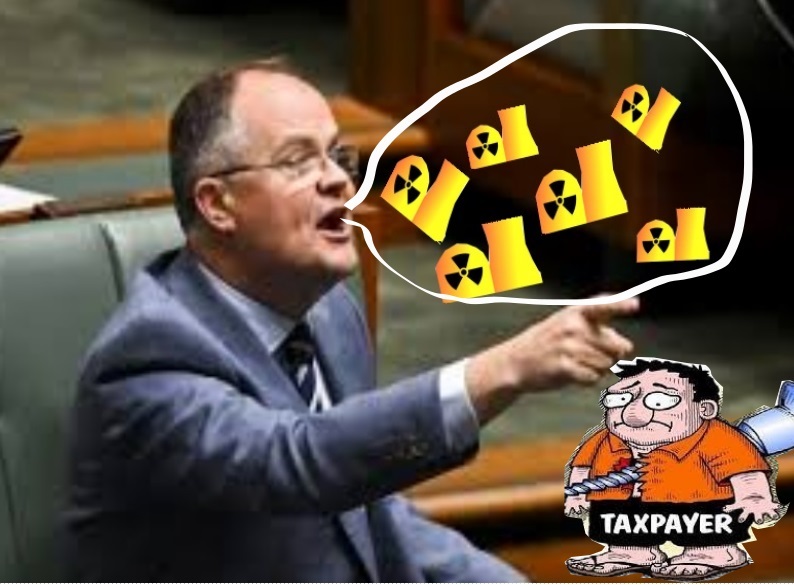
This is still the most interesting article of all
Patricia Karvelas: Peter Dutton’s nuclear energy plan breaks all the rules of policy making. Is it genius or career self-destruction?
Below is a list of news articles. Now I have not here included the pro nuclear propaganda ones, nor the ravings of the very right-wing shock jocks of commercial radio – such as Melbourne’s 3AW. But you can find all that stuff on mainstream, mainly Murdoch media. The ABC is doing its best to stay afloat and actually give the facts. I am sure that those brave female TV and radio voices are now under quite vicious attack – Patricia Karvelas, Sarah Ferguson and Laura Tingle
I will try to keep this list up-to date – it is a daunting task –
National politics Dutton’s plan to nuke Australia’s renewable energy transition explained in full . No costing, no clear timelines, no easy legal path: deep scepticism over Dutton’s nuclear plan is warranted Nuclear plan is fiscal irresponsibility on an epic scale and rank political opportunism. Dutton’s nuclear lights are out and no one’s home. Peter Dutton launches highly personal attack on Anthony Albanese, calling him ‘a child in a man’s body’ while spruiking his new nuclear direction. Peter Dutton vows to override state nuclear bans as he steps up attack on PM. Peter Dutton is seated aloft the nuclear tiger, hoping not to get eaten.
Local politics. Nuclear thuggery: Coalition will not take no for an answer from local communities or site owners.
Climate change policy. Here’s how bad the climate crisis will get before Dutton builds his first nuclear reactor. Labor’s new climate chief Matt Kean says nuclear not viable. Peter Dutton’s flimsy charade is first and foremost a gas plan not a nuclear power plan. Coalition’s climate and energy policy in disarray as opposition splits over nuclear and renewables.
Economics Peter Dutton’s nuclear plan could cost as much as $600bn and supply just 3.7% of Australia’s energy by 2050, experts say . The insane amount it could cost to turn Australia nuclear – as new detail in Peter Dutton’s bold plan is revealed. Nuclear engineer dismisses Peter Dutton’s claim that small modular reactors could be commercially viable soon. Wrong reaction: Coalition’s nuclear dream offers no clarity on technology, cost, timing, or wastes. ‘Peter Dutton’s nuclear plan is an economic disaster that would leave Australians paying more for electrici.ty’. Dutton’s nuclear thought bubble floats in a fantasy world of cheap infrastructure. UK’s nuclear plant will cost nearly three times what was estimated.
Energy, Coalition won’t say how much nuclear power its plan will generate until after an election. Is rooftop solar a fatal flaw in the Coalition’s grand nuclear plans? Nuclear lobby concedes rooftop solar will have to make way for reactors.
Health Nuclear industry workers face significant, inevitable and unavoidable radiation health risks
Indigenous issues, How a British nuclear testing program ‘forced poison’ onto Maralinga Traditional Owners.
Technology. Dutton’s plan to build nuclear plants on former coal sites not as easy as it seems Over budget and plagued with delays: UK nuclear lessons for Australia.
Sabotaging renewables. There’s one real Coalition energy policy now: sabotaging renewables.
Secrecy. Port Augusta mayor and local MP kept in the dark about Liberal Coalition’s plant to site nuclear reactors there.
Site locations for reactors. Peter Dutton reveals seven sites for proposed nuclear power plants. Coalition set to announce long-awaited nuclear details.
Safety. Nuclear debate is getting heated, but whose energy plan stacks up? Some of the Coalition’s proposed nuclear locations are near fault lines — is that a problem?
Spinbuster. It’s time to go nuclear on the Coalition’s stupidity. Ziggy Switkowski and another big nuclear back-flip . Does the Coalition’s case for nuclear power stack up? We factcheck seven key claims. A Coalition pie-in-the-sky nuclear nightmare.
Nuclear industry workers face significant, inevitable and unavoidable radiation health risks
By Tony Webb, 24 June 24, https://johnmenadue.com/nuclear-industry-workers-face-significant-inevitable-and-unavoidable-radiation-health-risks/
Nuclear industry workers face significant, inevitable and largely unavoidable radiation health risks which have so far not been addressed in the debate about Australia possibly buying into this industry.
In addition to the important arguments against the coalition policy that currently proposes building seven nuclear power plants to replace closing coal fired generators, notably that such:
will be likely cost about twice that of firmed renewable generation and take at least 15 years to build – and this in the context where most nuclear plant construction worldwide appears to routinely involve a doubling of both cost and time to build
– and so are dangerously irrelevant to meeting the existential challenge to reduce carbon and methane emissions that are driving climate change;
will require legislative changes at state and federal levels that are to say the least unlikely to be achieved;ignores the challenge of developing workforce skills to manage this technology;
ignores the as yet intractable if not insoluble problem of managing long lived nuclear wastes;
and poses significant risks to the public in the event of nuclear accidents as witnessed in the USA, Ukraine/former USSR, and Japan;
There is also an inevitable and unavoidable risk to workers in the industry and public ‘downwind’ from such reactors from routine exposure to ionising radiation.
This last has to date received little attention and whenever raised results in dismissive but misleading arguments from the nuclear industry advocates, notably that any such exposures to individuals are small and pose little, indeed ‘acceptable’ health risks compared to other risks faced in day to day living and working. Tackling this misinformation as part of the campaign has much to offer in convincing the nuclear target communities and the workers in these that might be seduced by prospects of employment in these facilities that the risks they face are far from insignificant – that, as a community they will face an increase in the incidence of fatal and ‘treatable / curable’ cancers, an increase in other, notably cardio vascular diseases and increased risk of genetic damage affecting children and future generations.
Allow me to introduce myself. I have been an active campaigner on the health effects of ionising radiation since the late 1970s. With two colleagues in 1978 I founded the UK based Radiation and Health Information Service that highlighted the evidence showing the risk estimates from radiation exposure, on which the national and international occupational and public exposure limits were based, grossly under-represented the actual risk.
This radiation-health argument was developed as part of a national campaign that resulted in a significant change of the, until then, pro-nuclear policies of UK unions with members in the industry and a review of Trade Union Congress policy in 1979. It was also an integral part of the union-led national Anti-Nuclear Campaign opposing the Thatcher government’s nuclear expansion – revealed in leaked cabinet minutes as part of the government strategy for undermining the power of the unions, particularly the National Union of Mineworkers (NUM), the Transport and General Workers Union, (T&GWU) and the General and Municipal, Boilermakers’ and Allied Trades union (GMBATU). In late 1980 I took this work on Occupational Radiation risks to the USA establishing the US Radiation and Health Labor Project, auspiced by the Foundation for National Progress / Mother Jones Magazine, that built union support across the country for AFL-CIO policy calling for a reduction in the occupational exposure limit.
Subsequently I worked as a consultant to the Canadian union (CPSU – local 2000) representing workers in the nuclear power industry and built a Canadian coalition of five Unions representing workers exposed to radiation on the job. Linking these North American union demands with those of UK and European unions (also similar concerns from unions in Australia following a 1988 organising tour) reinforced pressures from within the scientific community – notably the US Biological Effects of Ionising Radiation (BEIR) committee.
These sustained pressures led eventually to the International Commission on Radiological Protection (ICRP) reducing the recommended limits for permissible occupational (and public) exposures in 1991. Despite evidence that would have justified a ten-fold reduction (from the 50 mSv annual occupational limit to a limit of 5 mSv) the ICRP limit was only reduced by 40% (to 20 mSv a year but with individual exposures still permitted to 50 mSv in any year so long as the average over 5 years was no higher than 20 mSv).
Since then, a large-scale study of UK, EU, and US nuclear industry workers has shown radiation-induced cancer risks to be on average 2.6 times higher than the estimates used to set the ICRP limits. To put it in simple if statistical terms, the lifetime cancer risk for a worker exposed to the permissible annual dose of radiation over say a 25-year career would be of the order of 6.5% higher than normal. To this should be added the significant health effects of non-fatal cancers, an approximate doubling of the normal rate of cardio-vascular disease and a not insignificant increase in genetic damage to workers children and future generations. Nuclear industry workers face significant, inevitable and largely unavoidable radiation health risks which have so far not been addressed in the debate about Australia possibly buying into this industry.
What needs to be more clearly understood however is that the concern is not just in relation to risks faced by individuals exposed on the job, or from relatively small amounts of radiation released from routine operations of nuclear plants. What is of far greater public concern is the impact of the collective exposure. What is not fully appreciated is that there is simply no safe level of exposure – any dose however small may be the one that causes damage at cellular level in the human body that may show up years later as cancer, genetic damage or some other health effect. it is the total/collective dose that will determine the number of such health effects. Spreading the dose over a larger population will reduce the risk to any individual but not the total health effects. Indeed, it may increase it. An individual affected by cancer can only die once.
These arguments carry weight. They formed a significant part if the discussions within the 2016 South Australian government’s ‘Citizens Jury’ convened to consider proposals to import and store around a third of the world’s nuclear wastes. The concern about radiation and health received special note in the report of this jury to the SA Premier that a two-thirds majority said ‘no – under any circumstances’ to the radioactive waste proposal. The issues can also form the basis for increased collaboration between the trade union, environment, medical reform and public health movements as was the case in the mid 1990s when UK, Labour MP Frank Cook convened a Radiation Roundtable that brought together representatives of these constituencies.
So, within the current debate about a possible Australian Nuclear Power program – alongside the arguments already made about its excessive cost, extended construction time frame, ill-fit within an essential decentralised renewable energy program, risks of major accidents, and the intractable problems of multi-generation waste management, can we please add this concern over health effects that will inevitably result from occupational and public exposures to radiation. Can we particularly focus the attention of trade unions and their members in the seven former coal-fired generation-dependent communities on the effect of these exposures on health of workers who might seek to be employed in operating these facilities and on the health of their families, neighbours, and future generations.
A key demand from unions should be that the occupational limit for annual radiation exposures cbe reduced from the current ICRP level of 20 mSv to a maximum of 5 mSv a year with a lifetime limit of 50 mSV. This revision of standards would put real pressure on the nuclear industry – the current uranium mining and any future enrichment, fuel fabrication, nuclear generation, fuel reprocessing, and waste management – to keep such exposures as low as possible. In the unlikely event of any of the reactor proposals getting the go-ahead there should be baseline monitoring of the health of the community and any workers employed so that any detrimental increase in health effects can be detected early and possibly remediated in the future.
Peter Dutton’s nuclear plan could cost as much as $600bn and supply just 3.7% of Australia’s energy by 2050, experts say.

Coalition proposal would cost a minimum of $116bn – the same as Labor’s plan for almost 100% renewables by 2050, the Smart Energy Council says
Jordyn BeazleySun 23 Jun 2024 https://www.theguardian.com/australia-news/article/2024/jun/23/peter-duttons-nuclear-plan-could-cost-as-much-as-600bn-and-supply-just-37-of-australias-energy-by-2050-experts-say
The Coalition’s pledge to build seven nuclear reactors as part of its controversial energy plan could cost taxpayers as much as $600bn while supplying just 3.7% of Australia’s energy mix by 2050, according to the Smart Energy Council.
The analysis found the plan would cost a minimum of $116bn – the same cost as delivering the Albanese government’s plan for 82% renewables by 2030, and an almost 100% renewable energy mix by 2050.
The Coalition has drawn widespread criticism for not releasing the costings of the nuclear power proposal it unveiled on Wednesday as part of its plan for Australia’s energy future if elected. On Friday, the opposition leader, Peter Dutton, said the costings would come “very soon”, but did not confirm whether it would be days, weeks or months.
The Smart Energy Council came to the $116bn figure using data from the CSIRO and the Australian Energy Market Operator’s latest GenCost report. It factored in the Coalition’s proposed timeframe and the capital costs of replacing the 11 gigawatts of coal capacity produced on the seven sites with nuclear reactors.
But factoring in the experience of cost and timeframe blowouts in the UK, the refurbishment of coal-fired power stations, and Dutton’s plan to compensate the states, the Smart Energy Council found the cost could reach as much as $600bn.
The council found the large nuclear reactors – of which there will be five alongside two smaller reactors – would probably cost $60bn each and were unlikely to be built by 2040. Dutton has said that they plan for the reactors to be built and operational by the second half of the 2030s.
“At best, Peter Dutton’s nuclear proposal would deliver 3.7% of the energy required at the same cost as the government’s comprehensive strategy,” John Grimes, the chief executive of the Smart Energy Council, said.
“In reality, current cost overruns happening right now in the UK could mean a $600bn bill to Australian taxpayers, whilst delivering a small proportion of the energy that is actually required.
“The most optimistic assessment of Peter Dutton’s nuclear proposal indicates it is a pale shadow of the reliable renewables plan outlined and costed by the Australian Energy Market Operator (Aemo).”
The Smart Energy Council called on the opposition to immediately release its costings and the generation capacity of the proposed seven nuclear reactors.
“They need to explain how their forecasts contradict the experts at the CSIRO and Aemo. It is extraordinary that the details are being hidden from the Australian public,” said Grimes.
The CSIRO and Aemo have assessed the cost of different electricity sources and found nuclear generation would be the most expensive technology available for consumers.
It found that solar and wind backed by storage energy, new transmission lines and other “firming” – in other words, what the country is building now – were the cheapest option.
The Coalition’s promise has met widespread scepticism from Australia’s energy sector and industry groups, which have warned about the risks of cost blowouts and destroying private sector investment.
During an address to party officials in Sydney on Saturday, Dutton said his nuclear energy plan would cost a fraction of Labor’s renewable energy rollout, and would assist in achieving the party’s goal for “cheaper, cleaner and consistent power.
Ten Holocaust survivors condemn Israel’s Gaza genocide
Holocaust survivors say using the Holocaust to justify genocide in Gaza and repress student protest on college campuses is a complete insult to the Holocaust’s memory.
BY OPEN LETTER https://mondoweiss.net/2024/06/ten-holocaust-survivors-condemn-israels-gaza-genocide/
Below is a letter signed by ten Holocaust survivors condemning the genocide in Gaza and the misuse of antisemitism accusations by politicians.
The co-founder of Human Rights Watch, Aryeh Neier, has recently said that Israel is engaged in genocide in Gaza. He’s also said that using accusations of antisemitism to attack Israel’s critics “debases the whole concept of antisemitism.” As Holocaust survivors, we are writing to agree wholeheartedly with Professor Neier — who himself only survived the Holocaust by escaping Nazi Germany as a child in 1939.
At a recent Holocaust memorial, Netanyahu declared: “We’ll defeat our genocidal enemies. Never again is now!”
Meanwhile, at another memorial, Biden warned of a “ferocious surge of antisemitism” on college campuses.
In our opinion, to use the memory of the Holocaust like this to justify either genocide in Gaza or repression on college campuses is a complete insult to the memory of the Holocaust.
The dehumanization of Palestinians, describing them as “human animals,” the killing of tens of thousands of civilians, indiscriminate bombing, the destruction of universities and hospitals, and the use of mass starvation — these are clearly stages of ethnic cleansing and genocide. They cannot be defended any more than sending weapons to commit this genocide or refusing funding to UNRWA. With no better arguments, our politicians have resorted to misusing the memory of the Holocaust while claiming that protesting against Israeli genocide is somehow antisemitic.
As Holocaust survivors, we have no special authority on the Middle East but we do know about antisemitism. It’s simply wrong to claim that it’s antisemitic to oppose Israeli genocide. It’s also wrong to claim that calling for equal rights for Jews and Arabs “from the river to the sea” is antisemitic.
As Holocaust survivors, we are just a few individuals but we want to add our voices to the growing global movement to demand a permanent ceasefire, an Israeli withdrawal from Gaza, and for the West to stop arming and supporting genocide.
Signatories
Jacques Bude (Brussels Belgium), survived in hiding in Belgium, parents killed in Auschwitz.
Marione Ingram (Washington DC), survived in hiding in Nazi Germany.
Stephen Kapos (London UK), survived the Budapest ghetto.
H. Richard Leuchtag (Houston TX), escaped Germany in 1938.
Rene Lichtman (Southfield MI), survived in hiding in France.
Adam Policzer (Vancouver BC), survived in hiding in Hungary.
Lillian Rosengarten (Cold Spring NY), escaped Germany in 1936.
Suzanne Ross (New York), escaped Nazi-occupied Belgium
Suzanne Berliner Weiss (Toronto Ont.), survived in hiding in France, mother killed in Auschwitz.
Ervin Somogyi (Oakland, CA), survivor from Hungary.
Peter Dutton’s flimsy charade is first and foremost a gas plan not a nuclear power plan

Dutton’s nuclear castle is made of cardboard. Close questioning over the many months until election day will show that behind the costly facade, it’s not so much a nuclear plan, as a plan to give up on our climate targets, turn our back on a clean energy future and burn a lot more gas (and money).
Simon Holmes à Court, 21 June 24, https://www.theguardian.com/commentisfree/article/2024/jun/21/peter-dutton-nuclear-power-plan-gas-energy
Straight from the Donald Trump playbook the opposition leader left Australia with more questions than answers.
Finally, on Wednesday morning Peter Dutton announced his nuclear plan … well, it’s more a vibe than a plan – a flimsy announcement leaving us with more questions than answers.
If there’s any doubt that Dutton has internalised the Trump playbook, here’s an example of how he’s deployed the infamous Steve Bannon technique: “flood the zone with shit”.
The media conference was a stream of falsehoods, empty rhetoric and veiled swipes, deftly delivered with unwavering confidence.
As an energy nerd, there’s a lot I like about nuclear technology, and my long-held interest has led me to visit reactors in three countries. Last year I took a nuclear course at MIT and met nuclear developers, potential customers, innovators and investors, tracing many footsteps of the shadow energy minister, Ted O’Brien.
I strongly believe nuclear power is an important technology – but it has to make sense where it’s used and that requires close questioning. Here are some important questions, and what we know so far.
How to remove the current bans?
Nuclear is banned in Australia by two acts of parliament. Naturally, to repeal the ban the Coalition would need to win back control of the house – a daunting task when they are 21 seats shy of a majority – and control of the Senate, power it hasn’t held since the end of the Howard era.
Once the federal ban is lifted, Dutton needs a plan for lifting state bans in Victoria, New South Wales and Queensland.
The leaders of the Labor governments and their Coalition oppositions in each of these key states have expressed their clear opposition. Dutton rehashed the old quip that you wouldn’t want to stand between a state premier and a bucket of money, indicating that he thinks dangling commonwealth carrots will solve the issue.
They will not be cheap carrots!
Where will the reactors go?
The Coalition has named seven specific locations, two in Queensland, two in New South Wales and one each in Victoria, South Australia and Western Australia, all on sites of retired or soon-to-be-retired coal power stations.
One big problem – the commonwealth doesn’t own any of these sites, and in many cases the owners of the sites have plans to redevelop the sites, such as a $750m battery on the site of the old Liddell power station being built by AGL.
On Wednesday Dutton hinted that if the owners wouldn’t sell the sites, he had legal advice that the commonwealth could compulsorily acquire them. That’ll go down well.
How do we keep the lights on?
Australia’s 19 coal power stations generated 125 TWh of electricity last year. The Australian Energy Market Operator expects all will be retired by 2037. On top of that, our energy demand is expected to increase by more than 230 TWh by 2050. Over the next 25 years we need to build facilities that generate at least 355 TWh every year.
Dutton announced that the Coalition would build five large reactors and two small modular reactors by 2050. This would be about 6.5 GW of new capacity, which at best could be expected to generate 50 TWh a year – less than 15% of the new generation needed.
The Coalition has been quite clear that it wants to see renewable energy development slowed to a crawl. This would leave a massive hole in our energy supply, which could only be filled by extending the life of coal and a massive increase in gas power generation.
This is first and foremost a gas plan, not a nuclear plan.
What will it cost?
Gas is the most expensive form of bulk energy supply in the electricity market … at least until nuclear is available.
Replacing the cheapest form of energy – wind and solar, even including integration costs – with the two most expensive forms can only send energy prices higher.
The Coalition’s announcement is too vague to cost precisely and nobody really knows what SMRs will cost, but a reasonable estimate using assumptions from CSIRO’s GenCost would be in the order of $120bn, or to coin a new unit of money, one-third of an Aukus.
What does this mean for emissions?
An analysis by Solutions for Climate Australia, released before Wednesday’s announcement and which assumes a much more aggressive nuclear build, shows an aggregate increase in emissions by 3.2bn tonnes of carbon dioxide by 2050 – the emissions equivalent of extending the life of our entire coal fleet by 25 years.
While the Coalition has turned its back on Australia’s legislated 2030 target, their talking points say they’re still committed to net zero emissions by 2050. This does not compute. Dutton’s proposal would see high emissions in the electricity sector all the way to 2050 and beyond, blowing our carbon budget and every emissions target along the way.
What if locals object?
For years Coalition members have been running around the country fomenting then amplifying community concern around wind and solar farms. Genuine community consultation, which has sometimes been lacking, is the best antidote to opposition.
Yet the Coalition has made a massive blunder in telling communities exactly where they’ll go before any consultation. Worse, it has adopted a strong-man posture that communities will have to accept that the reactors are in the national interest. It will be fascinating to watch how the Coalition handles local opposition over the coming months.
How will they be built?
With a combination of astronomical costs and zero interest by energy companies, there only ever was one possible owner of a nuclear power station in Australia: the commonwealth government.
One of the biggest challenges will be locking in major contractors. With the high likelihood that a future Labor government would cancel any contracts, no contractor would proceed without very expensive cancellation protection.
When will the reactors come online?
We often hear that a nuclear reactor can be built in eight years. In reality it takes three to four years from signing the contract to completing the civil works to begin ‘construction’, and it would very optimistically take four years to complete site selection, planning, licensing, vendor selection and contracting. Add in the inevitable legal challenges and it’s highly unlikely a reactor could be delivered by 2035 – as Dutton claimed – let alone before the early 2040s.
The newest reactors in the United States took 18 years from announcement to commercial operation, while in the UAE, it took 13 years under an authoritarian regime … and I’m being kind by not mentioning contemporary projects in France, the UK, Finland and Argentina.
Dutton has said he favours the Rolls-Royce SMR, tweeting an artist’s rendering on Wednesday.
These SMRs exist only on paper, yet Dutton wants us to believe he can provide one by 2035. Remember, this is the mob that brought us the NBN and the Snowy 2.0 disaster. This is the team that couldn’t even build commuter car parks.
What about the water and the waste?
I think we can relax a little about water and waste. Yes, nuclear power stations generally require large volumes of water for cooling, but so do coal power stations. By choosing sites with existing access to cooling water, the Coalition has sidestepped this concern.
Public concern around nuclear waste is high, but ultimately the problem is manageable. The waste will be kept on site, likely in dry casks and eventually moved to wherever Australia decides to store its waste from the Aukus program. Nobody has ever been harmed by spent nuclear fuel.
Who will provide disaster insurance?
While serious nuclear accidents are very rare, their costs can be astronomical. The Japan Centre for Economic Research has estimated that total costs related to the 2011 Fukushima Daiichi nuclear accident may reach $350 to 750bn. The only viable solution is for the commonwealth to accept liability.
For a long time the Coalition’s nuclear plan sat beyond the horizon, to be unveiled before the election. But now Dutton’s built a castle and he has to defend it.
Dutton is still learning about nuclear. On Wednesday he said that an SMR would emit only a “coke can” of nuclear waste a year. In reality it would probably produce more than 2,000 times that.
Nuclear energy is complex. He and his team will keep making mistakes. Keith Pitt, a Nationals backbencher told RN Breakfast on the same day that the grid couldn’t handle more than 10% wind and solar power combined. Over the past year the grid has averaged 31% wind and solar.
Some people want to believe there are simple solutions to the complex solutions behind the cost of living crisis, and like his political forebear Tony Abbott, Dutton has a knack for delivering simple messages with cold competence.
But Dutton’s nuclear castle is made of cardboard. Close questioning over the many months until election day will show that behind the costly facade, it’s not so much a nuclear plan, as a plan to give up on our climate targets, turn our back on a clean energy future and burn a lot more gas (and money).
- Simon Holmes à Court is a Director of The Superpower Institute, the Smart Energy Council and convener of Climate 200. Contrary to Coalition belief, he is not a large investor in renewable energy.
Nuclear culture wars – especially in Australia
Australia IS special – the only continent that is one single political state. Although Australia is really very multicultural, its government and business are determinedly white English-speaking.
But the white anglophones who identify with the USA, Britain, and Canada – live far away from those “kindred spirits”. Nearest neighbours are yellow and brown people, who don’t even speak English!
So – Australia has the “cultural cringe” – aw gee we’re not as good as those other anglophones. Only at sport -and even there, we’re losing touch. We MUST become as good as them – TECHNOLOGICALLY. Oh I know – we’d better get Nuclear Power, instead of that girly stuff – renewable energy.
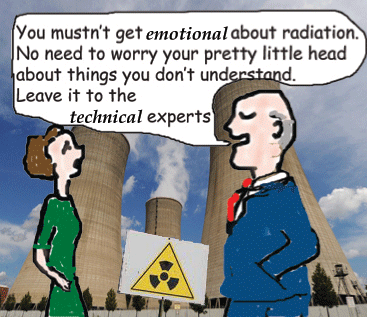
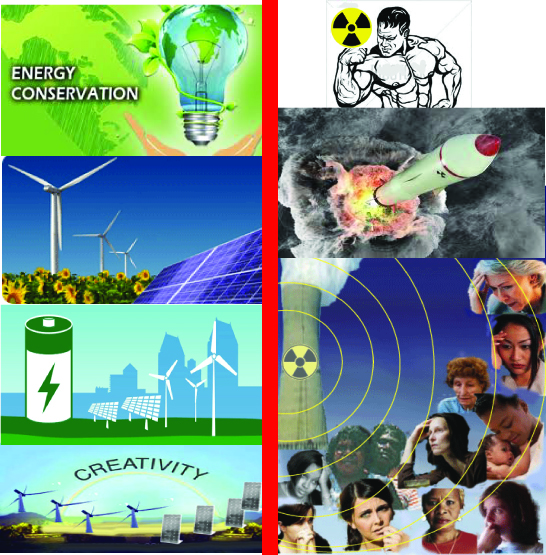
And I do mean “girly stuff”. Worldwide, it is a gender thing. Big strong men like nuclear power, weak uninformed women prefer energy conservation and renewable energy.
It really doesn’t matter which energy form is cheaper, more efficient, faster to implement, safer, cleaner …….. what is important is making Australia look important and technologically a leader, and also a strong opponent to China. We’re already a leader – in renewable energy – but that is sissy stuff, so it doesn’t count.
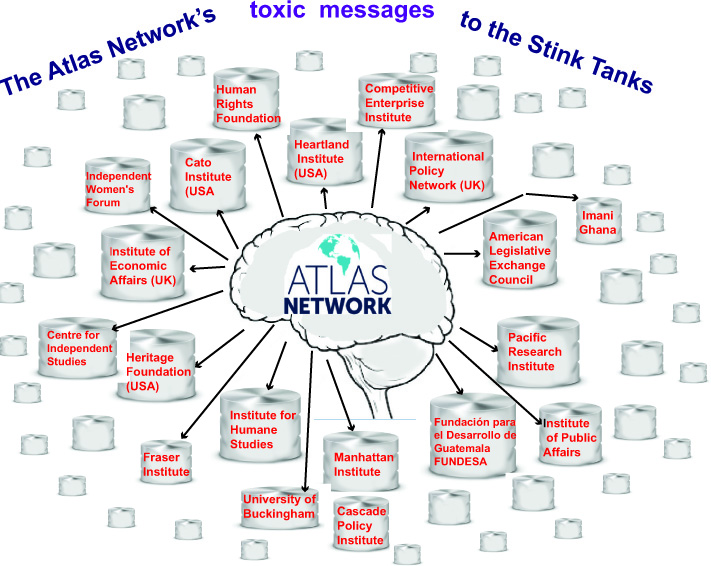
Now, there will need to be a grand propaganda campaign to get nuclear power into Australia. You see, we have compulsory voting here, which means that all those uniformed women will be voting. So it is going to be a big job to get nuclear into Australia. It will require all the skills of the Atlas Foundation, and its associated Think Tanks, to get the message across to the Australian public – including to wimpy-type men, as well as to women. But with the help of the Murdoch media, and social media – a good pro nuclear lobby should be up to it. Remember Australia’s referendum on an Aboriginal Voice to Parliament got defeated, with all that help last year.
Nuclear power exits Australia’s energy debate, enters culture wars
Jim Green, Jun 13, 2019, https://reneweconomy.com.au/nuclear-power-exits-australias-energy-debate-enters-culture-wars-47702/
What do these politicians and ex-politicians have in common: Clive Palmer, Tony Abbott, Cory Bernardi, Barnaby Joyce, Mark Latham, Jim Molan, Craig Kelly, Eric Abetz, and David Leyonhjelm?
Yes, they’re all men, and all so far to the right of the political spectrum that right-wing ideologues think they are right-wing ideologues.
And they all support nuclear power.
To the far-right, pro-nuclear luminaries listed above we could add the right-wing of the right-wing National Party (pretty much all of them), the Minerals Council of Australia (who lobby furiously for clean nuclear and clean coal), the Business Council of Australia ,media shock-jocks Alan Jones and Peta Credlin (and others), the Murdoch media (especially The Australian newspaper), the Citizens Electoral Council, and the Institute of Public Affairs and its front group the Australian Environment Foundation.
It’s no surprise that the far-right supports nuclear power (if only because the ‘green left’ opposes it).
But in Australia, support for nuclear power is increasingly marginalised to the far-right. Indeed support for nuclear power has become a sign of tribal loyalty: you support nuclear power (and coal) or you’re a cultural Marxist, and you oppose renewables and climate change action or you’re a cultural Marxist.
Support for nuclear power in Australia has ebbed in the aftermath of the Fukushima disaster, catastrophic costs overruns on reactor projects, and the falling costs of renewables.
Dr Ziggy Switkowski used to be nuclear power’s head cheerleader in Australia and he led the Howard government’s review of nuclear power in 2006. But he said last year that “the window for gigawatt-scale nuclear has closed” and that nuclear power is no longer cheaper than renewables with costs rapidly shifting in favour of renewables.
Peter Farley, a fellow of the Australian Institution of Engineers, wrote in RenewEconomy earlier this year:
“As for nuclear the 2,200 MW Plant Vogtle [in the US] is costing US$25 billion plus financing costs, insurance and long term waste storage. … For the full cost of US$30 billion, we could build 7,000 MW of wind, 7,000 MW of tracking solar, 10,000 MW of rooftop solar, 5,000MW of pumped hydro and 5,000 MW of batteries. … That is why nuclear is irrelevant in Australia. It has nothing to do with greenies, it’s just about cost and reliability.”
In January, the Climate Council ‒ comprising Australia’s leading climate scientists and other policy experts ‒ issued a policy statement concluding that nuclear power plants “are not appropriate for Australia – and probably never will be”.
The statement continued: “Nuclear power stations are highly controversial, can’t be built under existing law in any Australian state or territory, are a more expensive source of power than renewable energy, and present significant challenges in terms of the storage and transport of nuclear waste, and use of water”.
NUCLEAR COSTS INCREASE FOUR-FOLD, SEVEN-FOLD, TEN-FOLD
The 2006 Switkowski report estimated the cost of electricity from new reactors at A$40–65 per megawatt-hour (MWh). That’s roughly one-quarter of current estimates. Lazard’s November 2018 report on levelized costs of electricity gives these figures:
- New nuclear: A$161‒271 / MWh(US$112‒189)
- Wind: A$42‒80 / MWh(US$29‒56)
- Utility-scale solar: A$52‒66 / MWh(US$36‒46)
- Natural-gas combined-cycle: A$59‒106 / MWh(US$41‒74)
In 2009, Switkowski said that the construction cost of a 1,000 MW power reactor Australia would be A$4‒6 billion.
Again, that’s about one-quarter of all the real-world experience over the past decade in western Europe (and Scandinavia) and north America, with cost estimates of reactors under construction ranging from A$14‒24 billion.
The V.C. Summer project in South Carolina (two AP1000 reactors) was abandoned after expenditure of at least A$12.9 billion. The project was initially estimated to cost A$14.1 billion; when it was abandoned, the estimate was around A$36 billion. Largely as a result of the V.C.
Summer disaster, Westinghouse filed for bankruptcy and its parent company Toshiba almost went bankrupt as well.
The cost estimate for the Vogtle project in US state of Georgia (two AP1000 reactors) has doubled to A$38.8‒43.2+ billion and will increase further, and the project only survives because of multi-billion-dollar government bailouts.
In 2006, Westinghouse said it could build an AP1000 reactor for as little as A$2.0 billion ‒ that’s 10 times lower than the current estimate for Vogtle.
In the UK, three of six proposed reactor projects have been abandoned (Moorside, Wylfa, Oldbury), two remain in limbo (Sizewell and Bradwell) and Hinkley Point C is at the early stages of construction.
The estimated combined cost of the two EPR reactors at Hinkley Point, including finance costs, is A$48.7 billion (£26.7 billion ‒the EU’s 2014 estimate of £24.5 billion plus a £2.2 billion increase announced in July 2017).
A decade ago, the estimated construction cost for one EPR reactor in the UK was almost seven times lower at A$3.7 billion.
The UK National Audit Office estimates that taxpayer subsidies for Hinkley Point ‒ primarily in the form of a guaranteed payment of A$169 / MWh, indexed for inflation, for 35 years ‒ will amount to A$55 billion, while other credible estimates put the figure as high as A$91 billion.
Hitachi abandoned the Wylfa project in Wales after the estimated cost of the twin-reactor project had risen from A$26.4 billion to A$39.7 billion.
Hitachi abandoned the project despite offers from theUK government to take a one third equity stake in the project; to consider providing all of the required debt financing; and to consider providing a guarantee of a minimum payment per unit of electricity (expected to be about A$137 / MWh).
In France, one EPR reactor is under construction at Flamanville. It is seven years behind schedule (and counting) and the estimated cost of A$17.7 billion is more than three times the original estimate of A$5.4 billion.
In Finland, one EPR reactor is under construction. It is 10 years behind schedule (and counting) and the estimated cost of A$13.8 billion is nearly three times the original A$4.9 billion estimate.The A$13.8 billion figure was Areva’s estimate in 2012; true costs have likely increased
NUCLEAR EXITS AUSTRALIA’S ENERGY DEBATE, ENTERS CULTURE WARS
The far-right won’t let facts get in the way of their promotion of nuclear power. NSW Deputy Premier John Barilaro claims that nuclear power would probably be the cheapest power source for the average Australian household and is “guaranteed” to lower power bills.
The claim by the Institute of Public Affairs that 10 power reactors could be built for A$60 billion is out by A$100 billion or so. Jim Molan claims nuclear power is cheap and the cost is comparable to coal.
Clive Palmer claims that nuclear power is cheap and that the federal government should fund the construction of a nuclear power plant.
The far-right repeatedly claim that ‘small modular reactors’ (SMRs) will come to the nuclear industry’s rescue. But real-world experience with SMRs under construction suggests they will be hideously expensive.
According to a December 2018 report by the CSIRO and the Australian Energy Market Operator, the cost of power from SMRs would need to more than halve to be competitive with wind and solar PV even with some storage costs included (two hours of battery storage or six hours of pumped hydro storage).
Tony Abbott’s rationale for supporting nuclear power ‒ and repealing Howard-era legislation banning nuclear power plants ‒ is to “create a contest” with the unions, GetUp, the Greens and the Labor Party. Likewise, he said last year that promoting nuclear power “would generate another fight with Labor and the green left.”
Abbott ‒ and some others on the far-right ‒ would undoubtedly oppose nuclear power if Labor and the ‘green left’ supported it and they would be pointing to the A$14‒24 billion price-tags for new reactors in western Europe and north America.
Abbott seems to have forgotten the experience in John Howard’s last term as Prime Minister. Howard became a nuclear power enthusiast in 2005 and the issue was alive in the 2007 election contest.
Howard’s nuclear promotion did nothing to divide the Labor Party. On the contrary, it divided the Coalition, with at least 22 Coalition candidates publicly distancing themselves from the government’s policy during the election campaign.
The policy of promoting nuclear power was seen to be a liability and it was ditched immediately after the election.
LUNATICS IN CHARGE OF THE ASYLUM
Those of us opposed to nuclear power can take some comfort in its increasing marginalisation to the far-right. But there are far-right-wingers highly placed in the federal government and a number of state governments.
Right-wing National Party MPs are lobbying for a Senate inquiry and for a repeal of the legislation banning nuclear power. According to Greens Senator Sarah Hanson-Young:
“Talk of overturning the ban on nuclear power in Australia is crackpot stuff. Aside from being a dangerous technology, nuclear power is wildly expensive and would take a decade or more to build. It would be a funny joke if it wasn’t so embarrassing to have the Nationals, who are in government and who sit around the cabinet table, pushing for this. These people are meant to be in charge, and they’re running around like a bunch of lunatic cowboys.”
Senator James McGrath claims that many Nationals support nuclear power, hence the push for a Senate inquiry “to make informed decisions rather than allow the loons of Twitter to shout down this important discussion.”
On the subject of “loons”, as he describes them, McGrath’s pown erformance on ABC’s Q&A program in April was likened to a “one way trip to crazy town“.
It has the sense of a political set-piece: the far-right wins control of the numbers on a Senate inquiry and the government agrees with its pro-nuclear findings and repeals the legislation banning nuclear power.
But would Prime Minister Scott Morrison agree to repeal the ban given that there is no prospect of nuclear power being a viable option for Australia in the foreseeable future? Surely that would be an own goal, providing ammunition to political opponents and opening up divisions within the Coalition.
If Morrison agreed to repeal the ban ‒ and he says the government has no plans to do so ‒ it would presumably only be because he felt constrained to do so by far-right Coalition MPs and by non-government far-right Senators such as Pauline Hanson. (He is also dealing with the far-right push for government funding for a new coal-fired power plant.)
NSW Premier Gladys Berejiklian has the same calculation to make in response to the nuclear power push driven by right-wing Nationals (including Deputy Premier John Barilaro) and by One Nation’s Mark Latham (who introduced the Uranium Mining and Nuclear Facilities (Prohibitions) Repeal Bill 2019 to the NSW Parliament in May 2019).
ECOMODERNISTS
Of course, support for nuclear power in Australia isn’t exclusively limited to the far-right, although it is heading that way.
A tiny number of self-styled ‘pro-nuclear environmentalists’ or ‘ecomodernists’ continue to bang the drum. Ben Heard, for example, continues to voice his support for nuclear power ‒ his advocacy lubricated by donations and amplified by the right-wing media and by invitations to any number of nuclear-industry talk-fests.
Heard continues undeterred by the South Australian Nuclear Fuel Cycle Royal Commission’s clear acknowledgement that nuclear power is not economically viable in Australia or by its complete rejection of his ‘next generation’ nuclear fantasies.
But what impact could Heard’s nuclear advocacy possibly have in the current context, with fossil fuel interests fighting to protest their patch and to curb the growth of renewables, and with nuclear power being so exorbitantly expensive that isn’t part of any serious debate about Australia’s energy options?
Surely the only effect of nuclear advocacy in the current context is to muddy the debate about transitioning from fossil fuels to renewables and thus to shore up incumbent fossil fuel interests.
Australian economist John Quiggin discussed these issues last year:
“The problem is that nuclear fans like Ben Heard are, in effect, advocates for coal. Their line of argument runs as follows:
(1) A power source with the characteristics of coal-fired electricity (always on) is essential if we are to decarbonise the electricity supply
(2) Renewables can’t meet this need
(3) Nuclear power can
“Hence, we must find a way to support nuclear. The problem is that, on any realistic analysis, there’s no chance of getting a nuclear plant going in Australia before about 2040.
So, the nuclear fans end up supporting the Abbott crew saying that we will have to rely on coal until then. And to make this case, it is necessary to ignore or denounce the many options for an all-renewable electricity supply, including concentrated solar power, large-scale battery storage and vehicle-to-grid options.
As a result, would-be green advocates of nuclear power end up reinforcing the arguments of the coal lobby. … In practice, support for nuclear power in Australia is support for coal. Tony Abbott understands this. It’s a pity that Ben Heard and others don’t.”
Dr Jim Green is the editor of the Nuclear Monitor newsletter and national nuclear campaigner with Friends of the Earth Australia
Dutton’s plan to nuke Australia’s renewable energy transition explained in full
Giles Parkinson, Jun 21, 2024, https://reneweconomy.com.au/duttons-plan-to-nuke-australias-renewable-energy-transition-explained-in-full/
Opposition leader Peter Dutton has outlined his plan to bring the renewable energy transition in Australia to a halt, keep coal fired power stations open, build more gas and use taxpayer funds to build nuclear power plants in the 2030s and 2040s – if the Coalition wins the next election.
Here is an explanation of the plan as far as we know it.
What are the details?
There are not many, because the nuclear “policy” has been released in a one page press release. The Coalition says it wants to build seven nuclear power plants – all at the site of current or former coal fired power stations – in five states. It favours a mix of small modular reactors and large-scale nuclear. It wants the first reactor built by 2035.
Where exactly will they be built?
Two sites in NSW (Liddell in the Hunter and Mt Piper near Lithgow), two in Queensland (at the Tarong and Callide power plants), one in Victoria (Loy Yang in the Latrobe Valley), one in South Australia (Port Augusta), and one in Western Australia (Collie).
Are the site owners OK with that?
No, they say they haven’t been consulted and they say they have their own multi-billion dollar plans to build clean energy and industrial hubs. AGL CEO Damien Nicks says: “There is no viable schedule for the regulation or development of nuclear energy in Australia, and the cost, build time and public opinion are all prohibitive. ” However, the Coalition says if the site owners do not co-operate they will compulsory acquire the land needed.
Which technology will the Coalition use?
It’s not clear. Dutton wants to build small nuclear reactors at two sites, in South Australia and W.A. But SMRs do not exist yet, none have planning approval, and none even have licences to be built anywhere in the western world. Of the two large scale nuclear technologies cited, one (APR1400) has not been ordered anywhere in the world outside South Korea for 15 years. The other, the AP1000, sent its maker Westinghouse bankrupt in 2017 and was the technology used in the Vogtle reactor in the US whose massive delays and cost overruns might make it the last ever built in that country.
When is the timeline for the Coalition nuclear build?
The Coalition wants the first SMR up and running by 2035, and the first large-scale nuclear plant by 2037, with the rest in the 2040s.
Is that realistic?
No. SMRs – for all intents and purposes – haven’t been invented yet. There is no design in any western country that has even been licensed, let alone been given approvals or started construction. Globally, the industry is hopeful of getting the first up by the end of the decade. Even Canada, with a well established nuclear industry and an available site, says it is unlikely to have the second SMR up and running by 2035.
The timelines for large-scale nuclear are even longer. All four projects built or under construction in the last three decades in the US, France, Finland and the UK have suffered massive delays and cost over-runs. Australia has no regulatory platform, and no existing industry, apart from the small reactor at Lucas Heights in Sydney. Even pro-nuclear advocates like former chief scientist Alan Finkel say nuclear cannot realistically be delivered in Australia until the 2040s.
What are the costs?
The Coalition hasn’t said anything about costs, which is not surprising. SMRs have not been built and the only one that got close was cancelled by its would-be customers because it would have been hideously expensive. The Coalition’s timeline of 2035 means it wants to be an early adopter. The CSIRO puts the costs at more than $600/MWh, which might be palatable for a technology used only rarely for evening peaks, but such a price for “always on” power would be insane.
Would it lead to lower bills?
All Australian and international studies show that the Coalition’s choice of technologies – nuclear, gas and carbon capture – are by far the most expensive. See CSIRO, AEMO, Lazard, and BloombergNEF. Energy analysts say the growing reliance on gas power while renewables are stopped and coal kept on line would lead to soaring prices and an extra $1,000 on annual bills for the average household. The nuclear rollout will be entirely funded and subsidised by the taxpayer, which means that – as in France, Ontario and elsewhere – the costs of nuclear would be borne by the government and hidden from consumer bills.
What would happen to emissions?
Emissions will rise significantly if the Coalition puts its plan into action. One study suggests it would result in some 2.3 billion tonnes of additional carbon emissions over the Australian Energy Market Operator’s step change scenario.
What about Australia’s obligations to the Paris climate treaty?
The Coalition has made clear it will not seek to meet the current interim target of a 43 per cent cut in emissions. That means it is effectively ignoring the climate treaty, which requires no back-tracking on committed targets.
What about the net zero by 2050 target?
The Coalition says it still intends to meet that – but, by stopping wind and solar and building more gas, that target looks impossible under their plan.
The Coalition says the sites were chosen because they will not need new transmission. Is that true?
No. The site owners have their own plans. In Port Augusta, for instance, the grid capacity has already been mostly taken up by new wind, solar and batteries. “The myth that a nuclear reactor could just plug into the old Pt Augusta coal power station transmission lines is not true,” says South Australia energy minister Tom Koutsanstonis. “The transmission lines are already nearly full from new renewables. In truth, a nuclear reactor at Pt Augusta would need new transmission lines, the exact thing the LNP are complaining about.” And the large-scale nuclear reactors cited by Dutton will be twice the size of any existing unit in Australia, so it will need more grid infrastructure, and also more “back-up” in case those units fail.
The Coalition says the market operator has warned that the reliance on wind and solar will mean the lights will go out. Is that true?
No. The Australian Energy Market Operator says the biggest threat to energy reliability and security is the failure of ageing and increasingly unreliable coal fired generators.
The Coalition says wind and solar cannot power modern economies and businesses. Is that true?
No. The owners of Australia’s biggest smelters and refineries, including Rio Tinto and Ark Energy, are contracting multiple gigawatts of wind and solar to power their assets. South Australia says it has been flooded with inquiries from business with more than 2 GW of energy demand seeking to move to the state to access cheap wind and solar.
The Coalition says wind and solar cannot provide more than 10 per cent of the energy mix without causing problems. Is that true?
No. South Australia already enjoys a 75 per cent share of wind and solar, and the isolated W.A. grid has had 36 per cent wind and solar over the past year. The market operator says instantaneous levels of 100 per cent should be achieved in coming years.
The Coalition says the Labor government wants to build 28,000 km of new transmission lines by 2030. Is that true?
No. The market operator’s system plan envisages just over 5,000 km by 2030, one third of which have already been built, and some of the rest needed by growth in population and industry. The 28,000 km number comes from the “green export superpower” scenario and is for 2050. That assumes a switch from fossil fuel exports to green industries (steel, power, ammonia), and would likely be required whatever the technology.
Isn’t nuclear banned in Australia?
Yes, at federal and state levels. If the Coalition wants to repeal the laws it will need to get it through both houses of parliament, and who knows where the numbers will be after the next election, with the two-party preferred polls even stevens and any number of independents and minor parties also likely to emerge.
Do the states want nuclear?
No. The Labor governments in Queensland, NSW and Victoria have state laws against nuclear and intend to keep them. LNP Opposition leader David Crusafulli, favoured to take power in Queensland’s election in October, is also against nuclear. State governments in Western Australia, South Australia and even the Liberals in Tasmania are also opposed to nuclear, but legal experts say if the Commonwealth pulls rank, it is heading for the courts.
What if local communities object?
Nationals leader David Littleproud has spent the last few years defending the right of communities to oppose wind, solar, battery and transmission projects, and has demanded a pause and a “re-set.” But he says the Coalition will brook no opposition to its nuclear plans. If local communities don’t like it, tough luck. “We need strong leadership in this country, to have the courage of its convictions, to follow through and to make the tough calls in the national interest,” he told the ABC.
What will be the future of large-scale renewables under a Coalition government?
If the Coalition wins power, it won’t be good. Littleproud wants them stopped, and has vowed to rip up contracts written by the Commonwealth under the Capacity Investment Scheme, which could have 12 GW of capacity lined up over the next 12 months. States may plough on, but will face roadblocks and vetoes on projects. Investors say they need certainty.
So what is the real strategy here?
It’s pretty clear that the strategy is less about building nuclear and more about stopping renewables and protecting the fossil fuel industry, something that the Coalition has not been shy about for the last two decades. It will lead to higher costs, more emissions, squandered industry opportunities, and make the grid less reliable.
Will the strategy work?
Quite possibly. To people in the industry, pushing nuclear and walking away from Australia’s low cost wind and solar resources is nuts – from an engineering, economic and environmental point of view. But 95 per cent of people do not know, and are not interested in, the fine details of the complex energy system. They just want cheap power and the lights to stay on.
And to many of them the Coalition’s fear mongering may sound entirely plausible, particularly when the obvious misinformation is not contradicted by mainstream media – with a few notable exceptions such as The Guardian. See Trump, see Aboriginal voice referendum.
The fossil fuel industry is funding a massive campaign on social media to share simple and effective stories that make nuclear sound sensible and wind and solar as madness. They didn’t just think of this yesterday. If the renewable energy industry and Labor are not careful, they will lose this battle for hearts and minds.
Wow, that was exhausting. Do you need a lie down?
Yes.
Peter Dutton launches highly personal attack on Anthony Albanese, calling him ‘a child in a man’s body’ while spruiking his new nuclear direction

- Peter Dutton addressed party faithful in Sydney
- Painted PM Albanese as weak leader
By MICHAEL PICKERING FOR DAILY MAIL AUSTRALIA and WILLIAM TON and ANDREW BROWN FOR AUSTRALIAN ASSOCIATED PRESS, 22 June 2024
Opposition Leader Peter Dutton told Liberal Party faithful Prime Minister Anthony Albanese was ‘a child in a man’s body’ in a highly personal attack on Saturday.
Mr Dutton spoke to a federal council meeting of Liberal Party politicians, administrators and members in Sydney in which he painted Mr Albanese as ‘weak’ and a leader who told people ‘what they want to hear, not what needs to be said’.
‘He’s a man with a mind still captured in his university years; he’s a child in a man’s body,’ Mr Dutton said………. The opposition leader has cast the next federal election as defining Australia’s ‘future and fate’ with voters to decide the nation’s path forward on energy.
Australians will decide their energy future at the next election, says the opposition leader while slamming the government’s ‘reckless’ renewables policy and spruiking his nuclear pledge.
‘The next election will not only define the next political term, it will define the future and fate of this nation,’ he said.
Voters will have to choose the path they want to take including the nation’s energy future amid soaring power costs, Mr Dutton said.
‘A choice between Labor’s reckless renewables-only policy that will see the energy bills of Australians soar even more,’ he said.
‘Or the coalition’s plan for cheaper, cleaner and consistent energy, which includes our visionary plan to become a nuclear-powered nation and to do the right thing by the environment.’
It follows the coalition on Wednesday unveiling plans for seven nuclear reactors across five states on the sites of coal-fired power stations, should it win government.
The plan prompted safety concerns in regional areas where the reactors are due to be built, as well as criticism over the coalition not releasing any costings.
Prime Minister Anthony Albanese was panned for adhering to ‘unachievable’ renewable emissions targets, which the opposition said are blowing the budgets of Australians.
‘He’s more interested in appeasing the international climate lobby than sticking up for the interests of everyday Australians,’ Mr Dutton said.
‘I will be someone who doesn’t shirk the hard and necessary decisions which must be made in our national interest in these tough and precarious times.’
Opposition frontbencher Paul Fletcher dismissed fears the nuclear policy could make metropolitan electorates harder to win at the next election, saying it demonstrated the party’s commitment to achieving net zero by 2050.
The coalition faced significant challenges at the 2022 federal election in blue-ribbon, inner-city seats from teal independents, who pledged greater action on climate change.
While the reactors would be built in regional locations, Mr Fletcher said those in inner city areas would also embrace the idea of nuclear.
Under the plan, it would take until 2035 to 2037 at the earliest for the first facility to be built.
Assistant Climate Change and Energy Minister Jenny McAllister hit out at the nuclear policy which she said was expensive and risky.
‘Today Peter Dutton could’ve answered the many questions Australians have about his risky nuclear plan but all they got was more of the same nasty negativity and politics,’ she said.
‘Peter Dutton demands a mature debate but instead launches personal attacks. Peter Dutton demands lower power prices but opposes energy price relief and is unable or unwilling to say how much his nuclear plans will cost Australian taxpayers.
‘Australians deserve better.’
How a British nuclear testing program ‘forced poison’ onto Maralinga Traditional Owners
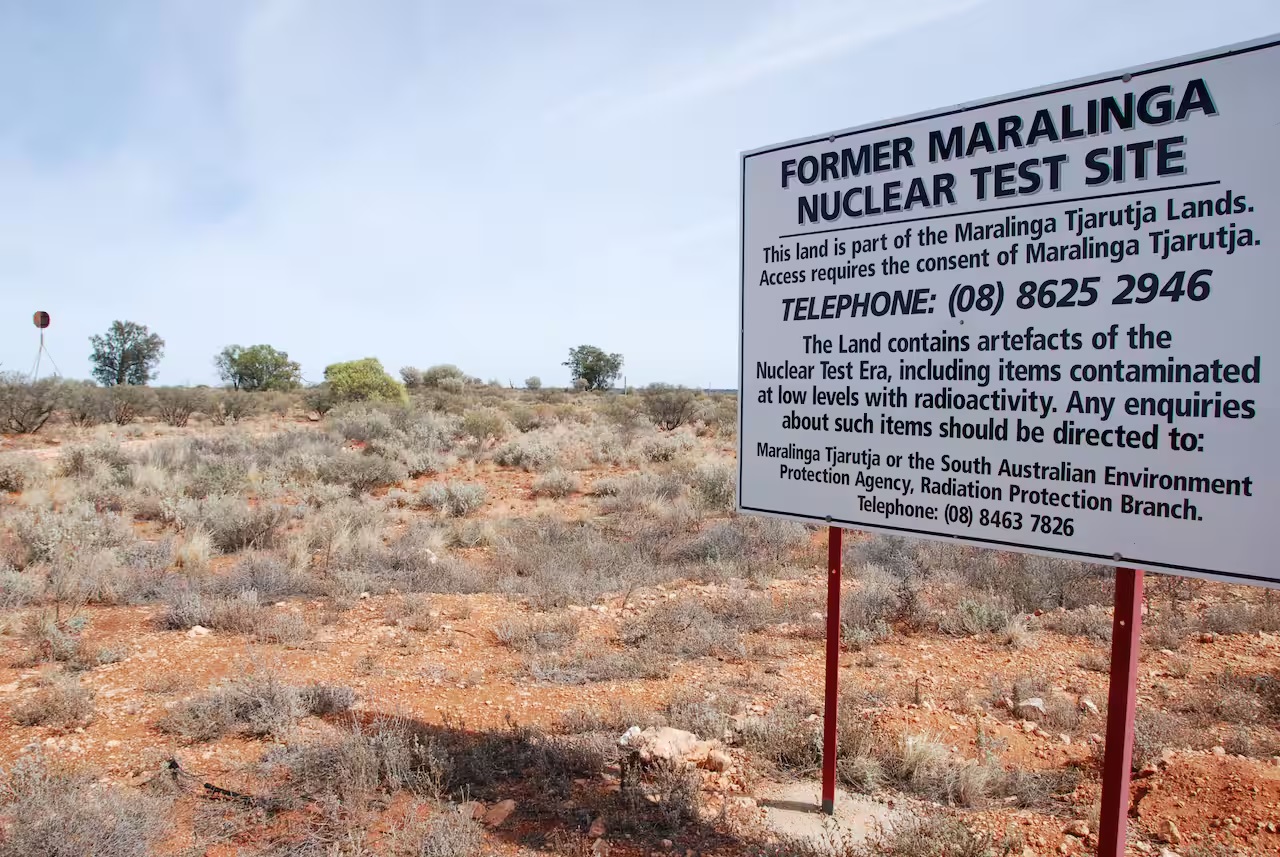
Indigenous Elders say they are once again being threatened by nuclear technology on their lands
SBS Sydney Lang, 20 June 24
Indigenous Elders are warning that their communities’ connections to sacred sites may be severed by nuclear power plants proposed by the Opposition.
Opposition leader Peter Dutton revealed earlier this week seven sites where the Coalition would seek to build nuclear power plants if elected.
One of the proposed sites is on Indigenous elder Aunty Janine Smith’s Country in Tarong, Queensland.
According to Smith, the proposal is a “death sentence to the land”.
Also responding to Dutton’s proposal, the Queensland Conservation Council’s Paul Spearim said: “White Australia has a shortsighted approach to Country”.
“You have forced poison onto the lands of Traditional Owners, and now Peter Dutton is proposing to create poisons that would last [hundreds of thousands] of years,” Spearim said.
First Nations and nuclear: A troubled history
Indigenous Australians’ fears about nuclear technology threatening their land and livelihoods are not occurring in a vacuum.
During the 1950s and 1960s,
the British government used the South Australian outback as a site for atomic bomb testing.
Keen to develop nuclear weapons of its own during the Cold War, the British government decided the remoteness of Maralinga and Emu Field made them ideal sites for nuclear weapon testing.
With agreement from the Australian government, the people living on Maralinga Tjarutja lands were relocated and told they could not return to their land. Many were rounded up and relocated to the Lutheran mission in Yalata, around 200km away.
The nuclear tests saw the wide-scale dispersion of radioactive material into the local environment.
Indigenous people living in and around the area, as well as British and Australian soldiers, were all exposed to radiation.
In the wake of the tests, there were many reports of cancer, blood diseases, eye problems, skin rashes, blindness, and vomiting — all of which are symptoms of radioactive poisoning.
It was not until 2009 that the land used for weapons testing was handed back to Traditional Owners…………………………………………………………………………………………………. more https://www.sbs.com.au/news/article/maralinga-how-australias-nuclear-testing-program-forced-poison-onto-the-lands-of-traditional-owners/zcuxce8o6
Israeli ‘extremist’ tells Australian audience Gaza should have been reduced to ashes
The Age, By Chip Le Grand, June 21, 2024
A former Israeli parliamentarian who once held a position in Benjamin Netanyahu’s government told an online gathering of Australian Jews this week that Israel should have abandoned adherence to international law and reduced Gaza to ashes.
In a series of incendiary claims, Moshe Feiglin, the leader of Israel’s far-right Zehut party, said there was no such thing as Palestinians, Palestinian statehood was the biggest lie of the 20th century and that Gaza should be resettled by Jewish Israelis and Arab families encouraged to leave.
“What Israel should have done to Gaza, on the 8th of October, was exactly what the British people did in Hamburg and Dresden, and exactly what the American people did in every Japanese city they could reach,” he told a Zoom meeting hosted by the Australian Jewish Association (AJA).
“They burnt them to ashes. No ridiculous humanitarian aid. They burnt those cities.
“If we had done that, we would have won the war in a few days and many of the hostages would be free today.”
The association’s invitation for Feiglin to speak, at a time when the war has bitterly divided Australian communities and unleashed antisemitic attacks on Jewish people, businesses and politicians, was condemned by Palestinian and Jewish community organisations……………………………………………………………………………………………………………………………..more https://www.theage.com.au/national/israeli-extremist-says-gaza-should-have-been-reduced-to-ashes-20240620-p5jnac.html
Over budget and plagued with delays: UK nuclear lessons for Australia
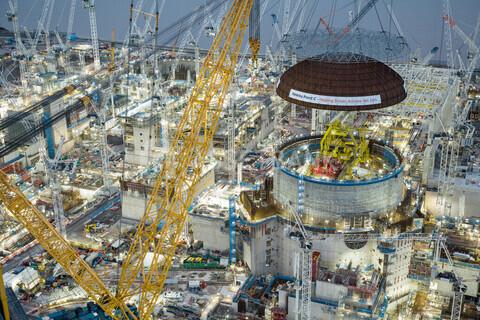
The big challenges facing nuclear power in Britain, both for large reactors and SMRs, are not technological or economic, but largely administrative and logistical.
AFR, Hans van Leeuwen, Europe correspondent, Jun 21, 2024 –
Behind the shore of England’s south-western county of Somerset lie the Quantock Hills – as perfect a landscape of lush rolling pasture and rugged heathland, laced with woodland groves and nestled hedgerows, as you could possibly imagine. It’s also home, incongruously, to a very, very large crane.
Big Carl, as it is known, is, in fact, the world’s largest. It is six kilometres long, 250 metres high and has 96 wheels. It has spent the past few years at Hinkley Point, on the Bristol Channel. Big Carl hit a mini-climax of hydraulic achievement just before Christmas last year, as it hauled a 14-metre tall, 245-tonne steel dome onto the top of a 44-metre nuclear reactor.
Progress at last. The reactor’s name is Hinkley Point C – which sadly doesn’t quite have the same folksy ring as “Big Carl”. Fifteen years have elapsed since French giant EDF and its Chinese partner began trying to build it, and rouse Britain from decades of nuclear slumber.
Lining up the regulators and the finance took seven years. Construction is in its seventh year, and might be only just past the halfway mark. There are 10,000 workers and 3500 British companies involved in pulling this off, at a cost that may end up topping £46 billion ($88 billion) – almost thrice the original estimate of £16 billion.
This is the kind of monumental scale of project that Opposition Leader Peter Dutton wants to bring to Australia. Alongside it, he also envisages small modular reactors (SMRs): more petite, but equally dully monikered, nukes that are thrown together in a factory and then operate from what is really little more than an industrial shed.
Britain wants to build those too, and is in the last throes of a competition to put taxpayer money behind at least one contender. But even the most advanced would-be manufacturer, Rolls-Royce, doesn’t appear to expect an SMR to actually be up and running until the start of the 2030s………………………………………………………………………………………………….
Why so long, and so costly?
Greatrex offers a warning to Australia: the big challenge facing nuclear power in Britain, both for large reactors and SMRs, but most clearly in evidence at Hinkley Point C, is not technological or economic, but largely administrative and logistical.
“Issues around bottlenecks in the planning system, the time it takes for permitting on various things, the issues around access to grid and grid connections, they’re all real factors,” he says.
“There are a whole number of issues around planning and permitting that seem to be taking more time to deal with than the actual construction period.”
This has left Greatrex and his organisation fighting a rearguard action against public and media perceptions that the industry is foundering – particularly as the flagship Hinkley Point C reactor project suffers repeated cost and deadline blowouts.
Although the government has this year doubled down on building large reactors to keep nuclear’s share of British electricity generation at about 25 per cent, the negative stories keep coming……………………………………………………………………………
For 35 years after the plant starts operating, taxpayers will fill any gap between that price and the going market rate, likely resulting in a subsidy far higher than that for offshore wind or solar. The government is also guaranteeing the debt funding of almost half the capital costs of building it.
The original estimated cost of Hinkley Point C was £16 billion, and the anticipated date to get it open and running was 2023. Now, it’s £35 billion in today’s prices, which could be £46 billion by the time the work is completed between 2029 and 2031.
EDF this year took a €12.9 billion ($20.8 billion) impairment charge on the project. The Chinese partner, having been frozen out of future nuclear projects in Britain for geopolitical reasons, has reportedly been withholding its own contributions this year.
The company has blamed the blowout on design changes enforced by the regulator, along with labour shortages and supply chain issues.
Going first to restart the nuclear construction industry in Britain after a 20-year pause has been hard,” Hinkley Point C boss Stuart Crooks said in a letter to staff earlier this year.
But the British government is still pushing on with a second reactor, the 3.2-gigawatt Sizewell C on the country’s east coast, which EDF will also build. This has taxpayer backing of £2.5 billion, and the government is on the hunt for £20 billion of private capital, supposedly by the end of the year………………………………………………………………………………
Rolls-Royce rollout starts at home
But even if the Coalition has to look elsewhere than Britain and Europe for its mega-reactors, energy spokesman Ted O’Brien has explicitly name-checked Rolls-Royce as a potential partner on SMRs………………………………………..
At any rate, Rolls-Royce has to crack its home market first. The government will next month decide which of six horses to back with taxpayer largesse. https://www.afr.com/companies/energy/over-budget-and-plagued-with-delays-uk-nuclear-lessons-for-australia-20240621-p5jnkq
1 This month

of the week – Disrupting War & Militarism in Oceania. Active solidarity. Radical practice.
 Antinuclear