AUDIO: The Malaysian fight will continue against Lynas rare earths processing plant
 Malaysian opponents of Lynas rare earths plant vow to fight on
http://www.radioaustralia.net.au/international/radio/program/asia-pacific/malaysian-opponents-of-lynas-rare-earths-plant-vow-to-fight-on/1043440 8 November 2012, Australian mining company Lynas has won a court battle against activists, to begin production at an $800 million rare earths facility in Malaysia, despite public concerns.
Malaysian opponents of Lynas rare earths plant vow to fight on (Credit: ABC) Lynas secured the operating licence in early September but the High Court in Pahang state, where the plant is based, put production on hold after an appeal by activists.
Malaysian opponents to the plant say the processing of rare earth ore imported from Australia, would release radioactive gases and waste like thorium and leak into the environment. The federal opposition MP for Kuantan has led protests against Lynas for over two years. Fuziah Salleh says the fight’s not over.
Presenter: Sen Lam @SLamEsq
Speaker: Fuziah Salleh, Parti Keadilan MP, Kuantan and opponent of Lynas rare earths plant
Unconvincing AUDIO about Queensland Government’s uranium implementation committee
Qld uranium chairman defends committee AUDIO http://www.abc.net.au/news/2012-11-02/uranium-chairman-defends-committee/4350974 ABC News Nov 2, 2012 Central Highlands Councillor Paul Bell will chair the Queensland Government’s uranium implementation committee, saying it will be balanced and thorough.Jessica van Vonderen Source: 7.30 Queensland | Duration: 5min 21sec
“I haven’t had any experience or knowledge prior to this role.in uranium mining, but I have worked in coal.and other areas of mining in Central Queensland.
See this graphic analysis of Australia’s top solar electorates
 http://sunwiz.com.au/index.php/resources/useful-info/239-solar-electorates.html Analysis of Australian Solar Electorates (Commonwealth) 5 November 12
SunWiz has performed analysis of Clean Energy Regulator data to identify the top solar electorates. Use the interactive explorer below to identify the number of solar systems in your electorate. This will help you identify how popular solar has already become in your electorate, or how popular it stands to become.
The interactive dashboard allows you to zoom in on a particular area. Hover over a sun icon to identify the electorate and its details. Hover over a name in the list of top electorates (by such measures as top # systems, and top penetration), and its location and other details will be highlighted in the other sheets. Each element can also be viewed in its own separate tab. Analysis methodology and static maps are also shown further down the page.
Award-winning book on Aboriginal land management
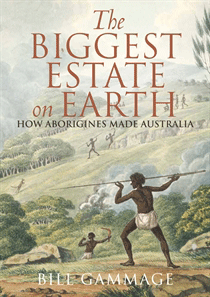 Gammage wins Vic Premier’s book award http://news.ninemsn.com.au/entertainment/2012/10/16/23/00/gammage-wins-vic-premier-s-book-award 9 news, October 16, 2012 Bill Gammage hopes that winning the Victorian Premier’s Literary Award will mean more Australians learn about the Aboriginal land management techniques before white settlement.
Gammage’s book The Biggest Estate on Earth: How Aborigines Made Australia has just earned him $100,000 – Australia’s richest single literary prize. “If this means more people will read it, I’m delighted about that of
course,” Gammage told AAP. “It took a long while and a lot of hard effort, 12 years (to write)
… 30 or 40 years of thinking before that, so the more people who read it the happier I am.”
The Canberra historian’s novel uses observation, historical accounts, botanical information and anthropology to argue Aboriginal people across Australia managed the land to encourage particular plants and landscapes in certain areas and attract animals for hunting. He also won the $25,000 award for non-fiction.
Review of Richard Broinowski’s new book “Fallout From Fukushima”
 New book reveals Fukushima disaster no accident, Green Left , November 1, 2012 By Phil Shannon Fallout From Fukushima By Richard Broinowski Scribe, 2012 The Fukushima nuclear disaster in Japan last year was no accident, says Richard Broinowski in Fallout from Fukushima. Sitting a nuclear reactor on an “active geological fault line where two of the earth’s tectonic plates collide” was courting catastrophe from an earthquake and tsunami like the one that duly hit the Pacific in March last year.
The powerful Japanese nuclear industry, immunised from critical scrutiny by the “cozy ranks of politicians, bureaucrats, academics, corporate players and their media acolytes”, ensured the Fukushima plant was under-prepared for foreseeable risks. Continue reading
Podcast: Radioactive Show on Queensland uranium, and the Australian Nuclear Free Alliance
 Radioactive Show | 28 Oct 2012 We speak with Robin Taubenfeld, nuclear free campaigner at Friends of the Earth Brisbane about the State Government’s recent reversal of the 30-year ban on uranium mining in the Sunshine State. We hear some voices from the Australian Nuclear Free Alliance 2012 in early October, specifically the introductions of Kado Muir, Martha Watts and Teresa, Sue Haseldine, Penny Phillips and Uncle Kevin Buzzacott.File Download (30:02 min / 14 MB)
Hear David Bradbury speaking about India’s repression of anti nuclear activisits
 Detained film maker speaks from India 30 October, 2012 http://www.abc.net.au/local/stories/2012/10/30/3621872.htm By Samantha Turnbull and Joanne Shoebridge North coast film maker David Bradbury speaks about his run-in with police in India
Wilsons Creek film maker David Bradbury is no stranger to controversy. His documentaries have covered political corruption in Argentina, nuclear waste from arms manufacturers, neo-Nazis, and the military dictatorship of Chile’s General Pinochet.
His latest project on nuclear power has taken him to India where he was detained last week in the southern state of Tamil Nadu. “I decided I’d slip down to the southern most region because there’s been a long ongoing protest for the last 10 years since two Russian-built nuclear power plants have been built,” he said.
“The local people don’t want the nuclear power plant to be open at all. “The power plants are built right on the ocean edge… they fear the same could happen to them as happened in Fukushima.”….
AUDIO: Aboriginal rights will be eroded as Queensland develops uranium mining
Uranium mining in Australia has removed Aboriginal rights in uranium States and territories. Queensland’s Aboriginals are next in line for this, as Newman government sets up a committee, with Aboriginal uranium lobbyist invited to join it.
 ‘Nuclear racism’ concern over Qld uranium mining http://www.sbs.com.au/podcasts/Podcasts/radionews/episode/239743/-Nuclear-racism-concern-over-Qld-uranium-mining 31 Oct 2012 By Stefan Armbruster Queensland Aboriginal groups are being warned their legal rights could be eroded as the state moves to resume uranium mining. Queensland Aboriginal groups are being warned their legal rights could be eroded as the state moves to resume uranium mining.
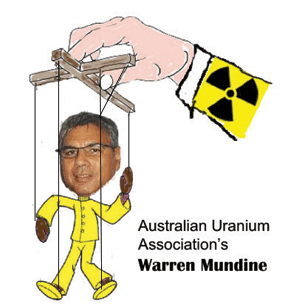 Last week the state’s Liberal National Party government said it would end the uranium mining ban introduced by Labor in 1989. The Queensland government has asked indigenous employment advocate and Australian Uranium Association director Warren Mundine to join a committee overseeing renewed mining.
In other states and territories, uranium mining has partial or total exemptions from Aboriginal land rights and heritage laws. Friends of the Earth’s national nuclear campaigner, Jim Green, told Queensland correspondent Stefan Armbruster it is a bad sign, given Australia’s past of so-called “nuclear racism”.
AUDIO: Robert Drewe’s new book about Montebello
AUDIO Drewe delves into our nuclear past http://www.abc.net.au/local/stories/2012/10/31/3622855.htm 31 October, 2012 By Joanne Shoebridge and Samantha Turnbull
North coast author Robert Drewe has a new book based on Australia’s nuclear history The release of Robert Drewe’s latest work couldn’t be more timely.
The Byron Shire author’s Montebello unearths a chapter of Australia’s nuclear past.
The book will be officially launched next week, unexpectedly on the back of Australia pushing forward with sales of its uranium to India. Montebello is the name of a group of islands off the West Australian coast where the British tested atom bombs in the early 1950s.
Drewe says many Australians aren’t aware of the history. “It was a time of ‘let’s keep our heads down and not rock the boat,'” he said.”The nation had just been through a war, 10 years before, and people just wanted to get on with it.”
Hear Joanne Shoebridge’s interview with Robert Drewe in the attached audio.
Audio: Donna Mulhearn tells the story of Fallujah
 Donna Mulhearn on her work to protect innocent Iraqi and Palestinian civilians from the ravages of war http://ifyoulovethisplanet.org/?p=6520 This week, Dr. Helen Caldicott speaks with Sydney-based peace activist Donna Mulhearn, an author, former journalist and political adviser. She was a human shield in the war in Iraq in 2003 and later returned to Iraq as a humanitarian aid worker. Mulhearn was part of an international team of volunteers that established a small NGO “Our Home – Iraq’ which set up a shelter for street kids in Baghdad, a center for traumatized children and provided emergency aid to displaced families. During this time she witnessed the massacre of Fallujah in April 2004, survived constant bombing, being kidnapped by fighters, and being shot at by American soldiers. In 2004- 2005, Mulhearn spent four months in the West Bank of Palestine as a volunteer with the International Solidarity Movement. During these years she continually wrote reports and reflections called pilgrim notes, which were distributed widely around Australia and the world.Listen to Dr. Caldicott’s June 2010 interview with Mulhearn.
Podcast: Western Australia uranium mining- far from becoming a reality
Radioactive Show | 12 Oct 2012 Western Australian Environment Minister Bill Marmion has signed off on the Toro Energy Wiluna Uranium Mine in the Goldfields Region of WA. However this is by far not a done deal; Kado Muir, Tradition Owner of the Goldfields region and Mia Pepper, nuclear-free campaigner with the Conservation Council of WA tell us why.File Download (25:13 min / 12 MB)
Hear this ABC radio broadcast on Solar Thermal Power
AUDIO http://blogs.abc.net.au/queensland/2012/10/what-is-solar-thermal-and-it-is-the-renewable-energy-source-of-the-future.html What is ‘solar thermal’, and it is the renewable energy source of the future? 23 October 2012 , 11:03 AM by Sally Rope We got talking about renewable energy sources yesterday – coming out of the news that Premier Campbell Newman has lifted the ban on uranium mining in Queensland.
We don’t use nuclear energy here in Australia, but it does have some appeal in that it’s a carbon free energy source, but many feel the risks are too great for us to go down that path.
So if coal and oil are on the way out, and nuclear is not an option – what else? Quite a few of our listeners called in to tell us about solar thermal power.
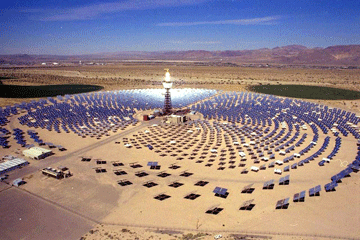
Matthew Wright is the Executive Director of the organisation ‘Beyond Zero Emissions’ who have put together a proposal called the ‘Zero Carbon Australia Stationary Energy Plan’, and solar thermal is an important part of that plan…
Listen to podcast – hypocrisy of Queensland Premier on uranium mining
AUDIO Letter shows Campbell Newman’s uranium backflip ABC radio AM 23 Oct 12 By Elise Worthington and Stephanie Smail The Australian Conservation Foundation says it received a letter from Queensland Premier Campbell Newman just days ago that stated the Queensland Government had no plans to approve uranium mining.
The State Government yesterday lifted a decades-old ban on uranium mining, setting up a three-member panel to make recommendations on how the change will be implemented.
But in a letter dated October 11, 2012, and sent to the head of the ACF, Don Henry, the Premier reaffirmed statements he made before the Queensland election saying there were no plans to lift the uranium ban Read the letter here
ACF spokesman Dave Sweeney said the decision to give the go ahead to uranium mining was “deeply disturbing,” and accused the LNP of breaking its election promise.
“They said that they were crystal clear that they had no plans or desire to approve or facilitate the development of uranium in Queensland,” he said.
“This is a massive and deeply disappointing about-face that completely lacks a basis in evidence and also runs against community promises and expectation.”… http://www.abc.net.au/news/2012-10-22/letter-shows-newman-uranium-backflip/4327902#letter
Don’t miss this excellent radio interview on the future of nuclear power

 Nuclear Energy Raises More Questions http://blogs.abc.net.au/nsw/2012/10/nuclear-energy-raises-more-questions.html ABC Radio 702 Sydney. Tim Holt interviews Derek Abbott, Professor of Electrical Engineering at the University of Adelaide, raises some very interesting practical considerations that will affect the future of this alternative source. 17/10/2012

PROF ABBOTT – Very hard to say how much nuclear industry is going ahead. Nuclear power – Some countries going ahead some countries pulling back. Not all so rosy in India.They are planning 60 nuclear stations. But In Tamil district 10,000 villagers demonstrating against local nuclear reactor, going on hunger strikes. Indian forces had to put out 4,000 security forces to control this problem. Needed large security force there.
My view is no. Nuclear power at the most could achieve only a very small slice of global energy pie. Can’t even supply half of the world’s needs.
Uranium gradually runs out – ore becomes more crude, harder to find uranium, and mining costs more. That’s one problem
Other problem actual metal you make the nuclear power stations out of / Nuclear power station isn’t just concrete and steel. Metals in nuclear power station – lots of exotic rare metals.Excessive energy given out, Prone to cracking, these exotic metals needed to prevent cracking are quite rare. Growth rate in consumption of these rare metals is huge , because used also in many modern technologies. Faster growth rate in consumption of these metals than the growth rate in oil. Likely to run out, even without nuclear. When would these metals run out? Add nuclear to the equation put on line hundreds of new nuclear stations.- eat into these rare metals and depleting them at a faster rate.
Problem with nuclear power – everything becomes non recyclable. What do you do with the nuclear station – you bury it for 10,000 years. Those metals become radioactive and you can’t re-use them. So – reducing world’s elemental diversity, supply of these rare metals.How many nuclear reactors would we need to supply all our energy needs from nuclear power? Something like 15,000 nuclear power stations to power the world presently. Completely unfeasible to scale up to some sort of nuclear utopia. We have problems with 430 reactors now.
Get any map of any country of the world – draw 100 dots on map as to where you could possibly put a new nuclear power station. Hard to put 10 nuclear power stations, let alone 100. Need to be away from populations, near water, where you won’t get lawsuits. USA would need 4000 nuclear stations – hard put to find 100 spots.
Yes, we should still research nuclear fusion. But to make that leap to a commercial fusion reactor- a big thing.But nowhere near commercial. Still the problems – high energy neutrons will crack the metal – same problems of rare metals – metals recycling problems again.
Renewables so relatively cheap and easy to lay on. Can build a modular solar farm using curved mirrors that focus sunlight . Mirror 10 metres in diameter – get 300-400 degrees Centigrade Can super heat water and run a steam turbine.- can set up in desert place relatively easily.
Sadly Australia has not taken bull by the horns. There are solar thermal projects in Australia. ANU in Canberra have had solar project for along time. Australia needs to take up solar. So much desert – the ideal country for solar.
Theoretically, If you powered an area size of Canberra with solar mirrors. – enough to power the whole of Australia.
Sun is a nuclear fusion reactor – it’s the obvious one to turn to.
Going back to your question about why Australia has not embraced solar power – Economics the reason and what we can afford to do. – we have a relatively small population. We are getting wakeup calls now with the changing climate. The rime is ripe now for Australia to change this

Ducking and weaving about India’s nuclear safety – Australian Safeguards and Non-Proliferation Office (ASNO)
Senator LUDLAM: …. Are you aware of the recent report by their Auditor-General that absolutely slams the industry?
Mr Shannon: Yes.
Senator LUDLAM: ……. if you are not convinced-as the Indian Auditor-General certainly isn’t-that those plants are being run to anything like world’s best practice, a sales agreement would not occur?
Ms Bird: These are all issues which will be worked through during the negotiating practice process.
 http://scott-ludlam.greensmps.org.au/content/estimates/australian-safeguards-and-non-proliferation-office-asno Australian Safeguards and Non-Proliferation Office (ASNO) 18 Oct 2012 | Scott Ludlam Supplementary Senate Estimates – Foreign Affairs Defence and Trade Committee – 18 October 2012 “Dr Kalish is the acting DG of ASNO……
Senator LUDLAM: … Can you tell us officially, from the point of view of ASNO, what the status is of the bilateral safeguards agreement with India?….
Dr Kalish: Negotiation has not commenced on that treaty.
Senator LUDLAM: Well, it has been announced to the entire planet that there will be an agreement. So ASNO has not yet begun work on any such agreement?
Dr Kalish: I believe what was announced was that negotiations would commence on an agreement.
Senator LUDLAM: Can you just sketch for us the process by which those negotiations will be conducted?
Mr Shannon:….. The agreement has been reached to start the negotiations, which was last night, our time. Advice is being
assembled for ministers to consider the mandate. …. We think it will take some time, maybe a year or two. We do not have a feel for it yet
Senator LUDLAM: It sounds like a big announcement has been made but actually there is nothing at all in terms of how these negotiations will progress or, from an Australian side, who the lead organisation will be, who our negotiators will be.
Mr Shannon: No. Those things have not yet been finally decided…… Continue reading
1 This month

of the week – Disrupting War & Militarism in Oceania. Active solidarity. Radical practice.
 Antinuclear