Film “Nuclear Nation” shows the lives of Fukushima’s radiation refugees
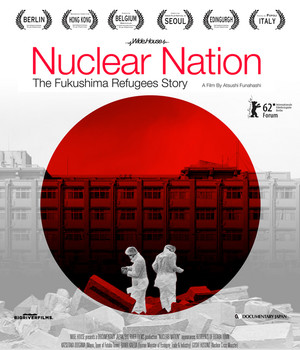 Film shows Japan’s nuclear nation http://www.greenleft.org.au/node/54786 August 17, 2013 By Alexander Brown, Sydney
This new documentary by Atsushi Funahashi explores the lives of refugees from Japan’s Fukushima nuclear disaster.
The film explores the lives of the residents of Futaba, a small town located next to the Fukushima Daiichi nuclear power plant. Following the explosion at the plant, the entire town was designated as an exclusion zone and 1400 residents were forced to evacuate to an abandoned high school about 250 kilometres from their hometown. The residents cannot legally return to their homes. The film shows the residents living in classrooms in the school as they struggle to rebuild their lives and wrestle with what they have lost.
In Japan, a Nagasaki Day commemoration was held in the south-western city to commemorate the victims of the second atomic bomb, dropped two days after the first atomic bomb at Hiroshima.
In his speech at the ceremony, Nagasaki’s mayor condemned Japanese Prime Minister Shinzo Abe for failing to endorse a statement during April negotiations for the next round of Nuclear Non-Proliferation talks, which rejected the use of nuclear weapons under any circumstances.
One atomic bomb survivor also criticised the government over its plan to restart Japan’s nuclear power plants which have been shut down after the Fukushima nuclear disaster.
Shohei Tsuiki, 86, said “it is obvious that nuclear power and human beings cannot coexist” and asked the government “to take action sincerely and proactively toward the elimination of nuclear weapons and nuclear power plants,” the Japan Times reported. The Sydney screening was organised by Uranium Free NSW and the Beyond Nuclear Initiative as a fundraiser for the Australian Nuclear Free Alliance.
Uranium Free NSW is a new group organised in response to NSW Premier Barry O’Farrell’s decision last year to overturn a 26-year moratorium on uranium exploration in NSW.
Australian uranium was used in the Fukushima Daiichi nuclear power plant.
[Uranium Free NSW meets fortnightly at the University of Technology Sydney at 6pm. The next meeting will be held on August 28. For more information contact hollycreenaune@gmail.com]
RADIO: Saturday 17 Aug – Ending Nuclear Deterrence – before it ends us
 10am Saturday on the Radioactive Show (855 on the AM dial) or listen at www.3cr.org.au.
– Richard Tanter (Nautilus Institute and University of Melbourne) explains the doctrine of extended nuclear deterrence and reveals our nuclear “umbrella” to be quite leaky. We explore why this doctrine, and the Australian Govt’s reliance on it is “absurd, obscene and reckless.”
– Bruce Gagnon of the Global Network Against Weapons and Nuclear Power in Space speaks about Australia’s role in the US war machine.
– We dip into an action held at the Future Fund’s Melbourne office on Nagasaki Day and hear music by the Hiroshima Junior Marimba Ensemble, performed at the recent Peace Concert at Federation Square.
Last week’s show (Japan Focus) is up online at www.3cr.org.au/radioactive if you missed it and want to listen!
 Radioactive Special: Fukushima, 2 Years On Released on 09 March 2013 Running time: 30 minutes
Synopsis: To mark the second anniversary of the Fukushima nuclear disaster in Japan we listen to a documentary written and narrated by Dave Sweeney and produced by Jessie Boylan, compiled of recordings and interviews that Dave collected on his visit to the region in August 2012. To give an insight into life in Fukushima today and to highlight the ongoing human and environmental impacts from this nuclear disaster, we hear from a range of local and international voices who are trying to offer support, and to pick up the pieces of the worst nuclear disaster since the 1986 Chernobyl meltdown. – See more at: http://www.3cr.org.au/radioactive#sthash.N0y1TnAd.dpuf
 About Radioactive Show An anti-nuclear program with up-to-date news and information on nuclear, peace and energy issues. It features interviews, news updates and on-the-spot action reports, with music breaks and insights from the presenters. The producers of the show are committed anti-nuclear activists with wide national and international experience. The Radioactive Show has been broadcast on Community Radio 3CR at the Saturday morning time slot for over 20 years.
This program is also broadcast to stations around Australia through the Community Radio Network, the satellite service of the Community Broadcasting Association of Australia, on Thursday evening at 18:04.
– See more at: http://www.3cr.org.au/radioactive#sthash.N0y1TnAd.dpuf
AUDIO: Hear Bill Gammage on Aboriginal Land Management
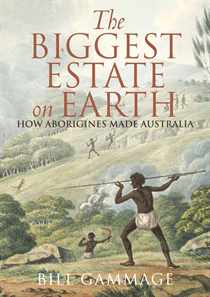
 Historian pays tribute to Aboriginal land management http://caama.com.au/historian-pays-tribute-to-aboriginal-land-management 13 Aug 13, Historian and adjunct professor in the Humanities Research Centre of the Australian National University (ANU), Bill Gammage, was in Alice Springs to delivery a presentation at the desertSMART EcoFair.
Author of The Biggest Estate on Earth: How Aborigines made Australia, a book which challenges the myth that pre-settlement Australia was an untamed wilderness, says the claim has nothing to do with what Aboriginal people know now. It is this knowledge that they should be allowed to share with others.
“And it’s what they (Aboriginal people) know now, that they can teach us, which will let us show more respect and let Aboriginal people express all the skills that they have for managing country, and surely we need it.”
Speaking with CAAMA Radio Professor Gammage says that Australia is already a world leader in species extinction and Aboriginal people are the way of the future by sharing their knowledge they’ve acquired over thousands of years.
Australia’s Future Fund should stop investing in nuclear weapons
Future Fund nuclear investments In May 2011 ICAN Australia revealed through freedom of information laws that the government-owned Future Fund had investments worth A$135.4 million in 15 foreign-owned companies involved in the manufacture of US, British, French and Indian nuclear weapons. Earlier that year, the Fund – which was established in 2006 to cover the pension costs of retiring parliamentarians, judges and public servants – announced that it had divested from 10 companies involved in the production of cluster munitions and land mines. But nuclear weapons companies still have not been excluded from its investment portfolio. http://www.icanw.org/campaign-news/australia/future-fund-nuclear-investments/#.UgxZC9Jwo6I
Nuclear bombs visit the Future Fund headquarters
AUDIO: Commentary on Energy Minister’s visit to planned nuclear waste dump area
 AUDIO Federal minister visits Muckaty Station http://caama.com.au/wp-content/uploads/2013/08/Lauren-Mellor-Penny-Phillips.mp3 http://caama.com.au/federal-minister-visits-muckaty-station
Yesterday, Federal Minister for Resources and Energy, Gary Gray met with Traditional Owners at the proposed nuclear waste facility at Muckaty Station, near Tennant Creek.
This is the first time a federal minister has visited the site and met with Traditional Owners at Muckaty.
Traditional Owner Penny Phillips welcomed the minister’s visit, but says the people were not invited to the meeting between the minister and Northern Land Council.
“I was happy for him to come, I went to Canberra and invited him to come but the Northern Land Council mob didn’t tell us he was coming to Muckaty, so we ended up going.”
Also in Muckaty was anti-nuclear campaigner Lauren Mellor, from the Environment Centre NT, who on behalf of the Traditional Owners put forth a new approach.
“There is a new approach, which is a national commission into radio active waste management options, that looks at all options, not just a remote dump site and investigates the best and safest way to actually manage Australia’s stock piles of waste.”
Listen below to the extended comments from Penny Phillips and Lauren Mellor.
AUDIO: how Aboriginals managed the Australian landscape
AUDIO: Bill Gammage on how Australia was the Biggest Estate on Earth Radio 702 ABC Sydney , 1 August, 2013 http://www.abc.net.au/local/stories/2013/08/01/3816338.htm?site=sydney
Richard Glover talks to author and historian Bill Gammage about how Aboriginal people cultivated Australia. Before white settlement Indigenous people had managed the Australian landscape to the point that it resembled an English estate, according to historian Bill Gammage.
Richard spoke about how Australia looked before settlement with the author of one his favourite books, ‘The Biggest Estate on Earth’, Professor Gammage, who also features in the ABC Mini-series, First Footprints.
Contrary to the belief that the Indigenous people of the period maintained Australia’s wilderness through “stepping lightly,” Professor Gammage argues “they were active interveners in the land.”
“If you let land go, sooner or later most of it is going to revert to trees and then thick trees and then impenetrable trees and bush, and that doesn’t suit animals that don’t like that country and it certainly doesn’t suit people, so they were constantly burning,” he says.
The title of Professor Gammage’s book comes from his discovery that English settlers all over Australia likened the land to the manicured estates of the mother country.
“There’s [a] painting in my book in which… people looking at it now would say, ‘well that’s open forest’, but the artist John Glover said ‘this typifies the thickly wooded part of the country, and yet for us it’s open. So if that was the thickly wooded; you’d imagine what the open and grassy country was like.”
Click on audio to listen to the interview in full.

The four part documentary series, First Footprints, wraps up this Sunday on ABC1.
AUDIO: Marshall Islands call on Australia for Climate Change support
 rising sea levels will create a humanitarian crisis in the region, with many people eventually seeking asylum in Australia.
“If you look further down the line there are two million people – potential refugees – from the Pacific should climate change continue the way it is now
The Marshallese Government has called on Australia to support its new global climate change initiative.
The Marshall Islands is hosting this year’s meeting of the 16-nation Pacific Islands Forum in September.
It wants leaders to agree to approve the Majuro Declaration for Climate Leadership, an initiative for urgent action on climate change.
Tony de Brum, the Minister in Assistance to the Marshall Islands President, is in Canberra to highlight the unprecedented droughts and floods that have hit his country and to seek support from the Australian Government ahead of the Pacific summit. Continue reading
AUDIO: Australia’s climate action has reduced greenhouse gas emissions
AUDIO http://www.abc.net.au/am/content/2013/s3812350.htm Climate initiatives working despite carbon controversy
Deborah Cornwall reported this story on Saturday, July 27, 2013 ELIZABETH JACKSON: Despite political uncertainty, the latest research indicates that Australia has managed to reduce greenhouse emissions levels to zero growth over the past decade.
The report – released today by independent research body, ClimateWorks Australia, says the findings demonstrate that Australia’s climate change initiatives are working, but they still need to be significantly ramped up to reach the five per cent reduction target by 2020.
Bikes Not Bombs – Nuclear Abolition Week in Melbourne
BIKES NOT BOMBS! Nuclear Abolition Week 2013 – Melbourne, http://www.youtube.com/watch?v=ccBVfU0XvmM 24 Jul 2013 During ICAN’s global Nuclear Abolition Week we hit the streets rolling in Melbourne. We collected signed Parliamentary Appeals from several politician’s offices, imagined the hypothetical effects of a modern-day nuclear weapon on the city of Melbourne and visited Serco and the Australian Government’s Future Fund. This video features the very awkward interaction we had with a Future Fund employee in their office when we delivered a petition of 13,675 signatures calling on them to divest public money from nuclear weapons companies. They were keen to show us where the door was…
Bikes Not Bombs Tour- 12th July 2013
Footage: Nancy Atkin
Production: Gem Romuld
Music: The Formidable Vegetable Sound System
Youtube: Dr Helen Caldicott speaking in Taiwan
Dr. Helen Caldicott Keynote Presentation at Mom Loves Taiwan Consortium – Nuclear Power, Radiations, & Our Health Forum, July 7, 2013 7-9PM @ Taipei, Taiwan. more Dr. Helen Caldicott interviews are also available at Mom Loves Taiwan Consortium’s Youtube website:http://www.youtube.com/user/MomLovesT…
AUDIO: Many old USA unexploded bombs lying on Great Barrier Reef
http://www.abc.net.au/pm/content/2013/s3808268.htm MARK COLVIN: A former Department of Defence director says four bombs dropped by the US Navy on the Great Barrier Reef are low risk compared to decades’ worth of old ordinance lost in the region.alls to find other unexploded bombs after emergency jettison
AUDIO: ABC Japan correspondent Mark Willacy tells the Fukushima story
http://www.abc.net.au/local/stories/2013/06/27/3790863.htm?site=conversations Mark Willacy tells the story of the massive 2011 tsunami that rocked Japan, and the resulting catastrophe at the Fukushima nuclear power station. He’s been the ABC’s North Asia correspondent for some years, and won his second Walkley for his coverage of the 2011 Japan tsunami and nuclear disasters.The earthquake on 11 March 2011 was one of the largest ever recorded, and the resulting massive tsunami killed nearly 20,000 people.

The waves rolled over the walls of the Fukushima nuclear reactor, and the result was a meltdown and the ejection of radioactive material into the air.Mark reveals in his new book Fukushima why the catastrophe should not have happened.
Australian interactive map shows you solar power numbers in your area
and the winner in terms of saturation is the electorate of Mayo in South Australia, with 25.43% of homes in that region having rooftop solar panel systems installed.
 Australia’s Top Solar Electorates Plus Interactive Map http://www.energymatters.com.au/index.php?main_page=news_article&article_id=3805 24 June 13, If you’ve ever wondered how many solar power systems are installed in your electoral region, this interactive map will tell you that and more.
Created by The Guardian’s Nick Evershed based on details from 100% Renewable’s Solar Scorecard project (which sourced its information from Australia’s Clean Energy Regulator), the interactive map displays the number of home solar installations by electorate, estimated capacity, carbon emissions reduction, electricity bill savings and installation cost.
Northern Territory – Lingiari Continue reading
AUDIO: Julian Assange speaks about whistleblower Edward Snowden
AUDIO http://www.abc.net.au/radionational/programs/breakfast/assange-wikileaks/4770642 Assange says Snowden leaks will boost Senate election chances 21 June 2013 Matt O’Neil It’s one year since Julian Assange sought asylum in the Ecuadorian Embassy in London to avoid extradition to Sweden. But the controversial WikiLeaks founder says he has a bigger battle to fight—his bid for the Australian Senate is building momentum, and he hopes recent leaks about government surveillance will bolster his party’s message…..
 ‘We now have a regime of secret deals between a national security agency and major organisations like Google and Microsoft and Apple.’
Speaking with Fran Kelly on RNBreakfast, Assange said that America’s surveillance policies ‘affect all Australians’—and he believes Canberra has a lot to answer for. ‘How are they involved in this? Does the Australian Government swap that information? Is the Australian Government using that information from the US government?’
‘All of that is being kept secret, and it’s completely unacceptable. What kind of world are we drifting into where we have a transnational surveillance apparatus, [with] different rules for people in that apparatus compared to the rest of society. It’s very dangerous.’ Continue reading
AUDIO: Obstacles in the way for Toro Energy’s Wiluna uranium project
Wiluna uranium mine not officially protested http://www.abc.net.au/local/stories/2013/06/19/3785317.htm By Glenn Barndon, Sarah Taillier, Chloe Papas
ABC’s Sarah Taillier spoke to Mia Pepper from the Conservation Council of WA. Have a listen to the interview
Toro Energy’s potential uranium mine at Wiluna has been the subject of much controversy – but was not officially appealed during the required period. So, what happens next?
Toro Energy’s plans to build a uranium mine in Wiluna have been the subject of considerable controversy since the $269 million project was proposed last year. Recently, the company announced that no appeals were launched during the four-week protest period allowed by the Federal government.
Though this takes the company one step closer to putting plans into action, Mia Pepper from the Conservation Council of WA told ABC’s Sarah Taillier that a formal appeal was not the only avenue of protest.
“The fight against the Wiluna uranium mine is definitely not over just because of not lodging one out of many possible appeals.” Pepper told the ABC that not only are there other ways to attempt to stop the mine, but the company may have bigger issues than a formal protest. “They’ve been trying to take it to market for a long time and haven’t been successful, and I think they’re using this event or non-event as a platform to try and fundraise for the project – which is and has been their main problem for a long time.”
1 This month

of the week – Disrupting War & Militarism in Oceania. Active solidarity. Radical practice.
 Antinuclear