Summary of Australian federal and state/territory nuclear/uranium laws and prohibitions.

Current prohibitions on nuclear activities in Australia: a quick guide
From Jim Green, 30 May 2024
https://www.aph.gov.au/About_Parliament/Parliamentary_departments/Parliamentary_Library/pubs/rp/rp2324/Quick_Guides/NuclearActivitiesProhibitions
PDF Version [564KB]
Dr Emily Gibson
Science, Technology, Environment and Resources; Law and Bills Digest Sections
This quick guide provides an overview of current prohibitions on nuclear activities under Commonwealth, state and territory laws. It considers the primary legislation most relevant to current policy debates about domestic nuclear energy only and consequently does not consider recent changes to Commonwealth law to facilitate Australia’s acquisition of conventionally-armed, nuclear-powered submarines under the AUKUS partnership.[1] It also does not include consideration of Australia’s international obligations in respect of nuclear activities, including the safeguarding of nuclear materials and the non-proliferation of nuclear weapons.
If a domestic nuclear energy industry were to progress, it is expected that a comprehensive framework for the safety, security and safeguarding of the related nuclear material would need to be legislated to accommodate such an industry.[2] Consideration of these issues is beyond the scope of this paper.
What are nuclear activities?
A nuclear activity is any process or step in the utilisation of material capable of undergoing nuclear fission; that is, any activities in the nuclear fuel cycle.[3] Nuclear activities therefore include:
- mining of nuclear or radioactive materials such as uranium and thorium milling, refining, treatment, processing, reprocessing, fabrication or enrichment of nuclear material
- the production of nuclear energy
- the construction, operation or decommissioning of a mine, plant, facility, structure, apparatus or equipment used in the above activities
- the use, storage, handling, transportation, possession, acquisition, abandonment or disposal of nuclear materials, apparatus or equipment.
Prohibitions on nuclear activities
Commonwealth
Nuclear activities are regulated under the Australian Radiation Protection and Nuclear Safety Act 1998 (ARPANS Act) and the Environment Protection and Biodiversity Conservation Act 1999 (EPBC Act).
Australian Radiation Protection and Nuclear Safety Act 1998
The ARPANS Act establishes a licensing framework for controlled persons (including a Commonwealth entity or a Commonwealth contractor) in relation to controlled facilities (a nuclear installation, a prescribed radiation facility, or a prescribed legacy site).[4] A nuclear installation includes a nuclear reactor for research or the production of radioactive materials for industrial or medical use, and a radioactive waste storage or disposal facility with an activity that is greater than the activity level prescribed by the Australian Radiation Protection and Nuclear Safety Regulations 2018.[5]
The ARPANS Act allows the CEO of the Australian Radiation Protection and Nuclear Safety Agency (ARPANSA) to issue licences for controlled facilities.[6] In issuing a facility licence, the CEO ‘must take into account the matters (if any) specified in the regulations, and must also take into account international best practice in relation to radiation protection and nuclear safety’.[7]
However, subsection 10(2) of the Act expressly prohibits the CEO from granting a licence for the construction or operation of any of the following nuclear installations: a nuclear fuel fabrication plant; a nuclear power plant; an enrichment plant; or a reprocessing facility.[8] This prohibition does not appear to apply to a radioactive waste storage or disposal facility.
Environment Protection and Biodiversity Conservation Act 1999
The EPBC Act establishes 9 matters of national environmental significance (MNES) and provides for the assessment and approval of these actions if the action has, will have, or is likely to have a significant impact on the MNES.[9] ‘Nuclear actions’ are one of the MNES.[10] Where a nuclear action is determined to be a controlled action (that is, one likely to have a significant impact and requiring assessment and approval under the Act), the assessment considers the impact of a nuclear action on the environment generally (including people and communities).[11]
The Act establishes offences for the taking of nuclear actions in those circumstances.[14]
Similarly, the Act provides that a relevant entity (as set out below) must not take an action (including a nuclear action) unless a requisite approval has been obtained under Part 9 of the Act or a relevant exception applies:
- a person must not take a relevant action on Commonwealth land that has, will have or is likely to have a significant impact on the environment[15]
- a person must not take a relevant action outside Commonwealth land if the action has, will have or is likely to have a significant impact on the environment on Commonwealth land[16]
- the Commonwealth or a Commonwealth agency must not take inside or outside the Australian jurisdiction an action that has, will have or is likely to have a significant impact on the environment inside or outside the Australian jurisdiction.[17]
The Act establishes offences and civil penalty provisions for the taking of an action in those circumstances.[18]
Subsection 140A(1) prohibits the Minister for the Environment from granting an approval for a nuclear action relating to specified nuclear installations. These installations are a nuclear fuel fabrication plant, a nuclear power plant, an enrichment plant, and a reprocessing facility.
Potential reform of the nuclear action trigger
The second independent review of the EPBC Act, completed in October 2020 by Professor Graeme Samuel (Samuel Review), recommended that the nuclear actions MNES be retained.[19] The review recommended that ‘the EPBC Act and the regulatory arrangements of [ARPANSA] should be aligned, to support the implementation of best-practice international approaches based on risk of harm to the environment, including the community’.[20]
In 2022, the Government’s Nature Positive Plan adopted this approach and stated, ‘[a] uniform national approach to regulation of radiation will be delivered through the new National Environmental Standards’.
In February 2024, a policy draft of the National Environmental Standard for Matters of National Environmental Significance indicates that ‘nuclear actions’ will be renamed ‘radiological exposure actions’ and states:
Relevant decisions must:
Not be inconsistent with the ARPANSA national codesfor protection from radiological exposure actions including in relation to:
- human health and environmental risks and outcomes; and. radiological impacts on biological diversity,
- the conservation of species and the natural health of ecosystems.[22]
States and territories
States and territories generally regulate nuclear and radiation activities through either the health or the environmental protection portfolios. The relevant legislation provides for the protection of health and safety of people, and the protection of property and the environment, from the harmful effects of radiation by establishing licensing regimes to regulate the possession, use, and transportation of radiation sources and substances.[23] Mining of radioactive materials is regulated through the resources portfolio.
In addition, as outlined below, the states and territories have legislation prohibiting certain nuclear activities or the construction and operation of certain nuclear facilities. Importantly, where permitted, nuclear activities (including mining) would also be subject to assessment and approvals under a range of other legislation, including planning and environmental impact assessment, native title and cultural heritage, and radiation licensing laws at the state or territory and Commonwealth level.
New South Wales
Exploration for uranium has been permitted under the Mining Act 1992 since 2012.[24] However, the mining of uranium is prohibited by the Uranium Mining and Nuclear Facilities (Prohibitions) Act 1986 (NSW Prohibitions Act).[25]
The NSW Prohibitions Act also prohibits the construction and operation of certain nuclear facilities, including uranium enrichment facilities, fabrication and reprocessing plants, nuclear power plants, and storage and waste disposal facilities (other than for the storage and disposal of waste from research or medical purposes, or the relevant radiological licensing Act).[26]
Northern Territory
The Atomic Energy Act 1953 (Cth) provides that the Commonwealth owns all uranium found in the territories.[27] Uranium exploration and mining in the Northern Territory (NT) is regulated under both NT mining laws (the Mineral Titles Act 2010 and the Mining Management Act 2001) and the Atomic Energy Act.[28] The Ranger Uranium Mine operated until 2021 and is now undergoing rehabilitation.[29]
The Nuclear Waste Transport, Storage and Disposal (Prohibition) Act 2004 (NT) prohibits the construction and operation of nuclear waste storage facilities, as well as the transportation of nuclear waste for storage at a nuclear waste storage facility in the NT.[30] Nuclear waste is defined as including waste material from nuclear plants or the conditioning or reprocessing of spent nuclear fuel.[31]
This Act also:
- prohibits public funds from being expended, granted or advanced to any person for, or for encouraging or financing any activity associated with the development, construction or operation of a nuclear waste storage facility
- would require the NT Parliament to hold an inquiry into the likely impact of a nuclear waste storage facility proposed by the Commonwealth on the cultural, environmental and socio‑economic wellbeing of the territory.[32]
Queensland
Exploration for and mining of uranium are permitted under the Mineral Resources Act 1989. However, it has been government policy to not grant mining leases for uranium since 2015.[33] The government policy ban extends to the treatment or processing of uranium within the state.[34]
The Nuclear Facilities Prohibition Act 2007, in similar terms to the NSW Prohibitions Act, prohibits the construction and operation of nuclear reactors and other nuclear facilities in the nuclear fuel cycle.[35]
Unlike other state and territory prohibition legislation, the Nuclear Facilities Prohibition Act would require the responsible Queensland Minister to hold a plebiscite to gain the views of the Queensland population if the Minister was satisfied that the Commonwealth Government has taken, or is likely to take, steps to amend a Commonwealth law or exercise a power under a Commonwealth law to facilitate the construction of a prohibited nuclear facility, or if the Commonwealth Government adopts a policy position of supporting or allowing the construction of a prohibited nuclear facility in Queensland.[36]
South Australia
The exploration and mining of radioactive material (including uranium) is permitted in South Australia (SA), subject to approvals under the Mining Act 1971 and the Radiation Protection and Control Act 2021 (RP&C Act).[37] For example, uranium is mined at Olympic Dam, Four Mile and Honeymoon. However, conversion and enrichment activities are prohibited by the RP&C Act.[38]
The Nuclear Waste Storage Facility (Prohibition) Act 2000 prohibits the construction or operation of a nuclear waste storage facility, and the import to SA or transport within SA of nuclear waste for delivery to a nuclear waste storage facility.[39]
The Nuclear Waste Storage Facility (Prohibition) Act prohibits the SA Government from expending public funds to encourage or finance the construction or operation of nuclear waste storage facilities.[40] The Act would also require the SA Parliament to hold an inquiry into the proposed construction or operation of a nuclear waste storage facility in SA authorised under a Commonwealth law.[41]
Tasmania
The exploration and mining of atomic substances (which includes uranium and thorium) is permitted under the Mineral Resources Development Act 1995 (Tas), subject to approval.
Victoria
The Nuclear Activities (Prohibitions) Act 1983 prohibits a range of activities associated with the nuclear fuel cycle, including the exploration and mining of uranium and thorium, and the construction or operation of facilities for the conversion or enrichment of any nuclear material, nuclear reactors and facilities for the storage and disposal of nuclear waste from those prohibited activities.[42]
Western Australia
Exploration for and mining of uranium is permitted under the Mining Act 1978. A state policy ban on mining approvals was overturned in November 2008;[43] however, this was reinstated in June 2017, with a ‘no uranium’ condition on future mining leases.[44] The ban does not apply to 4 projects that had already been approved by the previous government.
The Nuclear Activities Regulation Act 1978 aims to protect the health and safety of people and the environment from possible harmful effects of nuclear activities, including by regulating the mining and processing of uranium and the equipment used in those processes. The Nuclear Waste Storage and Transportation (Prohibition) Act 1999 also prohibits the storage, disposal or transportation in Western Australia of certain nuclear waste (including waste from a nuclear plant or nuclear weapons).[45]
Can the Commonwealth override a state ban on nuclear activities?
The Commonwealth Parliament only has the power to make laws in relation to matters specified in the Constitution of Australia, including in sections 51, 52 and 122. Assuming the Commonwealth has a sufficient head of power to legislate, section 109 of the Constitution specifically provides for circumstances in which there might be an inconsistency between Commonwealth and state laws:
When a law of a State is inconsistent with a law of the Commonwealth, the latter shall prevail, and the former shall, to the extent of the inconsistency, be invalid.
Therefore, even though some states have enacted prohibitions on certain nuclear activities within their jurisdictions, the Commonwealth Parliament could enact specific legislation in relation to nuclear activities so that such activities can take place within those jurisdictions. One such example is the National Radioactive Waste Management Act 2012 (Cth), which provides for the establishment of a national radioactive waste management facility at a site to be declared by the responsible Commonwealth Minister. Section 12 of that Act provides that state and territory laws have no effect in regulating, hindering, or preventing such a facility
Further information
- ‘Who we regulate’, ARPANSA
- ‘State & territory regulators’, ARPANSA
- ‘Uranium and thorium’, in Geoscience Australia, Australia’s Energy Commodity Resources, 2023 Edition, (Canberra: Geoscience Australia, 2023).
Nuclear issues turn Radio-Active dial up
Georgia Curry, August 5, 2023, https://canberraweekly.com.au/nuclear-issues-turn-radio-active-dial-up/
With Hiroshima Day this Sunday, 6 August, (and Nagasaki Day on 9 August) plus the cinema release of Oppenheimer, there’s no better time to highlight Australia’s longest running show about nuclear issues – Radio Active.
Canberra’s oldest community radio station, 2XXFM 98.3, airs the program every Sunday morning and, sadly, nuclear issues are just as topical now as they were when the show started in 1976.
According to the Doomsday Clock, which was created by the Bulletin of the Atomic Scientists (founded in 1945 by Albert Einstein and University of Chicago scientists who helped develop the first atomic weapons), it is 90 seconds to midnight.
The Doomsday Clock is set every year and has become a universally recognised indicator of the world’s vulnerability to global catastrophe caused by man-made technologies.
This ticking clock feeds the longevity of Radio-Active. Canberra’s 2XXFM is one of 20 community radio stations broadcasting the show around Australia for the past 47 years.
The show is produced at Melbourne’s community radio station 3CR by producer Michaela Stubbs.
“All of the show’s presenters are activists, which is probably why the show has gone on for so long because we have quite a big movement that is multi-generational and we’re really passionate about the issues,” Michaela says. “My mum was part of the peace and nuclear disarmament movement in the ‘80s so I had an awareness of Hiroshima Day.”
Michael has a vast archive of tapes to draw from and recently aired a show about “Down Winders”, people affected by the Trinity nuclear test site in New Mexico, USA, the site of the first detonation of a nuclear weapon.
“That was such an important story,” Michaela says. “They are the voices that don’t get heard.”
There are also old cassettes of protests such as Australia’s Jabiluka blockades in the ‘70s against the Jabiluka uranium mine in the Northern Territory.
Michaela recently interviewed an Indigenous woman whose family was affected by the British Government atomic tests at Emu Field, South Australia. This occurred 70 years ago this October and her family is still seeking reparations.
“We have always had a strong focus on amplifying the voices of people who are directly impacted by nuclear development,” Michaela says.
Australia’s longest running show on nuclear issues also focuses on peace and sustainability. Radio-Active is broadcast on Canberra community radio 2XXFM 98.3 every Sunday, 7.30am-8am.
Australian Capital Territory consumers reap rewards of 100 pct renewables as wind and solar farms hand back windfall profits.
The ACT is the only region of Australia’s main grid spared from sharp
increases in electricity bills, and its consumers can thank the shift to
100 per cent renewables and the structure of their deals with wind and
solar farms.
The ACT government has written contracts with 11 wind and
solar farms to provide the equivalent amount of electricity consumed by
homes and businesses in the ACT each year. The nature of these deals –
called contracts for difference (CfDs) – means that if the wholesale market
trades below the agreed strike price, the government (and consumers), top
up the difference to the wind and solar farms.
But if the wholesale prices are above the strike price – as they have been by a big distance over the
last six months – then the wind and solar farms must return these windfall
gains to ACT consumers. And in the last quarter, as wholesale prices soared
to record highs – and an average of more than $300/MWh in NSW – the wind
and solar farms paid back a total of $58 million to electricity consumers
in the ACT, shielding them from any significant bill hikes.
Renew Economy 22nd Sept 2022
Canberra Extinction Rebellion members convicted by ACT Magistrates Court for crimes during protests
Canberra Extinction Rebellion members convicted by ACT Magistrates Court for crimes during protests
Climate activists who admitted to offending during various protests earlier this month said they did so after exhausting legal avenues to avert the “already looming” threat of climate change that if not addressed would “kill the future of our children”.
In the Australian Capital Territory, (ACT), Labor to share power with The Greens
 Labor-Greens power-sharing deal set to be revealed on Monday, Canberra Times, Dan Jervis-Bardy, 30 Oct 20, Labor and the Greens are poised to unveil their power-sharing agreement for the next four years of government, following high-level talks between the two parties.
Chief Minister Andrew Barr and Greens leader Shane Rattenbury are aiming to finalise the new parliamentary agreement on Monday, ahead of a ceremonial sitting of the new ACT Legislative Assembly the following day.
Mr Barr and Mr Rattenbury, along with senior staff, have been locked in private talks throughout the week on the parliamentary agreement, thrashing out a list of shared priorities for the two parties and the terms under which the Greens will guarantee Labor’s hold on power……….. https://www.canberratimes.com.au/story/6992019/labor-greens-power-sharing-deal-set-to-be-unveiled-on-monday/?cs=14229
The Greens had a remarkable win in Australian Capital Territory elections
 The Green wave that swept the 2020 A.C.T. Election, Independent Australia, By Chris Mordd Richards | 26 October 2020, In a result almost none saw coming, the A.C.T. Greens have tripled their seat count in the A.C.T. Legislative Assembly following the Election on 17 October.
Going from two seats to six, stealing two seats each from A.C.T. Labor and the Canberra Liberals in the process……..
Clearly any party which manages to increase its representation by 300% in a single election has done an excellent job, appealing to the voters not only as a party but as credible individual candidates as well.
Newly elected MLA Johnathan Davis, who was in a very tight race for Brindabella but emerged the victor at the final count, had this to say on behalf of the Greens:
“The A.C.T. Greens are so grateful for the support we’ve received from Conder to Kippax, from Forde to Fraser. Every single Canberran is now represented by the Greens. We commit to working hard and honouring the support offered to us. Together, we’ll work every single day to build a better normal.”….
While Labor did reasonably well in retaining government, it was instead the Greens’ message which most struck a chord with a particular key segment of voters across the entire Territory this time. …….
The Australian Greens will certainly be examining in detail how the local party pulled it off to see how they might replicate this result in other parts of the country. For now, the A.C.T. is once more the greenest jurisdiction in Australia. https://independentaustralia.net/politics/politics-display/the-green-wave-that-swept-the-2020-act-election,14448
Climate change fuelled Australia’s devastating Black Summer – Climate Council Report
|
Climate Council of Australia Australia’s Black Summer of 2019-20 was characterised by catastrophic bushfires. The bushfire season started in winter and was the worst on record for New South Wales in terms of its intensity, the area burned, and the number of properties lost. It was also the worst season on record for properties lost in Queensland.
This report focuses on New South Wales and the Australian Capital Territory, because the effects of the bushfires were most severe in these areas, but we acknowledge that the bushfires affected Victoria, Queensland, South Australia, Western Australia and Tasmania. Key findings: Climate change fuelled Australia’s devastating Black Summer
Australia’s Black Summer was unprecedented in scale and harm. The bushfire season was the worst on record for New South Wales in terms of the scale of the bushfires, the number of properties lost and the amount of area burned. The bushfires are estimated to have spewed between 650 million and 1.2 billion tonnes of carbon dioxide into the atmosphere. That is equivalent to the annual emissions from commercial aircraft worldwide and is far higher than Australia’s annual emissions of around 531 million tonnes.
The summer of 2019-20 saw unprecedented climate impacts fuelled by the burning of coal, oil and gas.
|
|
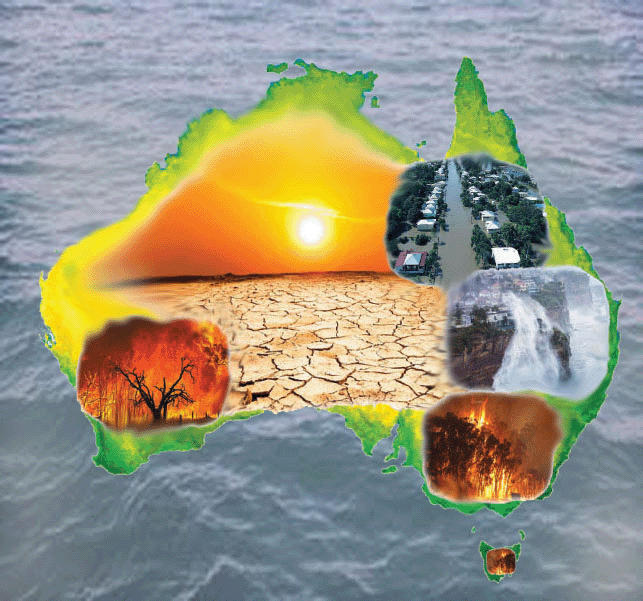
#ScottyFromMarketing ‘s bushfire inquiry studiously ‘ignores’ carbon emissions
 PM’s bushfire inquiry ‘ignores’ carbon emissions, Barr says, Canberra Times, Dan Jervis-Bardy 11 Feb 20, PM’s bushfire inquiry ‘ignores’ carbon emissions, Barr says, Canberra Times, Dan Jervis-Bardy 11 Feb 20,
Chief Minister Andrew Barr has criticised the scope of Scott Morrison’s proposed royal commission into the summer bushfire crisis, saying it overlooks the role that cutting carbon emissions plays in combating climate change and future fire threats.
How the Prime Minister responds to Mr Barr’s concerns will determine if the ACT supports the national inquiry. Mr Barr wrote to the Prime Minister on Tuesday with his feedback on draft terms of reference for the royal commission into the bushfire disaster.
The Chief Minister wants a national inquiry into the horror fire season, but has repeatedly said that any review would be inadequate unless it thoroughly examines the effect climate change has had on the length and ferocity of bushfire seasons…… In his letter to Mr Morrison, the ACT Chief Minister said the inquiry also needed to look at strategies to tackle climate change, such as cutting carbon emissions.
|
|
Bushfire state of emergency in Australian Capital Territory (ACT)
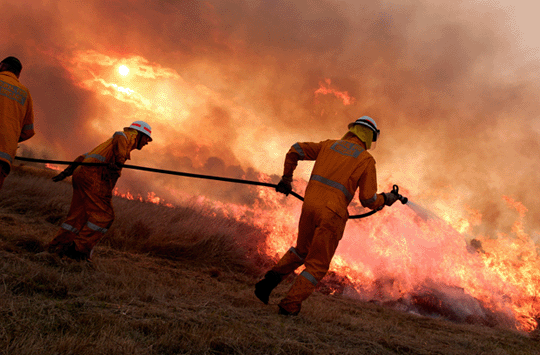
 Times 2nd Feb 2020, An inferno was raging near the Australian capital, Canberra, yesterday as a heatwave combined with high winds to prolong the country’s devastating bushfire season. The tiny Australian Capital Territory (ACT), between Sydney and Melbourne, declared a state of emergency as the fire, covering 140 square miles, threatened Canberra’s southern suburbs.
Drinking water threatened by forest fires
 As forests burn around the world, drinking water is
  at risk https://www.westhawaiitoday.com/2020/01/31/features/as-forests-burn-around-the-world-drinking-water-is-at-risk/
In Australia’s national capital of Canberra, where a state of emergency was declared on Friday because of an out-of-control forest fire to its south, authorities are hoping a new water treatment plant and other measures will prevent a repeat of water quality problems and disruption that followed deadly wildfires 17 years ago.
|
“The forest area burned in Australia within a single fire season is just staggering,” said Stefan Doerr, a professor at Swansea University in England who studies the effects of forest fires on sediment and ash runoff. “We haven’t seen anything like it in recorded history.” The situation in Australia illustrates a growing global concern: Forests, grasslands and other areas that supply drinking water to hundreds of millions of people are increasingly vulnerable to fire due in large part to hotter, drier weather that has extended fire seasons, and more people moving into those areas, where they can accidentally set fires. More than 60% of the water supply for the world’s 100 largest cities originates in fire-prone watersheds — and countless smaller communities also rely on surface water in vulnerable areas, researchers say. Continue reading |
Australian Capital Territory leads the nation in the climate emergency
 Canberra acts ‘first’ in the climate emergency, Canberra Times, Penny D Sackett , 16 Sept 19, On Monday, the ACT government released its Climate Change Strategy 2019-2025, just a few months after declaring a climate emergency in May, the first Australian state or territory to do so. The document contains several more Australian “firsts,” reflecting the government’s desire to lead climate action. Is this new strategy needed, and what does it mean for Canberrans?
Previous ACT climate strategy documents are out-of-date for three reasons: science, economics, and new legislated emissions targets.
Second, the rapid advance in new technologies such as battery storage and electric vehicles means that a wider variety of solutions is now economically viable, presenting new opportunities for local investment and job growth. Furthermore, because the monetary and human costs of inaction are so enormous, substantial near-term climate action is responsible both economically and socially.
Finally, the ACT government has recently brought forward its commitment to zero net emissions from 2050 to 2045, and put in place science-based interim emission targets for 2025, 2030, and 2040 to guide the way. These legislated targets, based on advice from the ACT Climate Change Council and in line with global carbon budget responsibilities to hold warming below 2 degrees celsius, are not only an Australian first for states and territories, but world-leading. A new plan is needed to realise the 2025 target of reducing ACT emissions by at least 50 per cent compared to 1990 levels, whilst collecting data that will be vital in meeting the next target in 2030.
So what does the plan hold in store for Canberra and Canberrans?
The starting point of the new strategy is the assumption that the ACT will effectively be powered by 100 per cent renewable electricity in 2020 – an expectation that will likely be met due to the territory’s previous investment in large scale solar and wind generation. Achieving that goal will result in a 40 per cent reduction of emissions from 1990 levels. The additional reduction required to meet the 2025 target will need to come primarily from the transport and gas sectors. After 2020, ACT transport emissions (which overwhelmingly come from private vehicles) will account for 60 per cent of Canberra’s emissions, with gas for heating and cooking making up another 20 per cent or so.
Substantial reduction in emissions from transport and gas use can only be achieved through a change in the choices made by Canberrans, at our work and businesses, and in our homes. Those low-emissions choices must be enabled and supported by government policies and regulations.
The new ACT climate strategy contains several realistic, forward-looking actions that begin to provide the magnitude of support and vision required in these sectors, and many are “firsts” among Australian states and territories. Among these are: ensuring that all new schools and government buildings are all-electric and appropriate for the changing climate; a commitment to maintain 100 per cent renewable electricity supply into the future; and a fossil-fuel-free bus fleet by 2040. …….https://www.canberratimes.com.au/story/6389173/canberra-acts-first-in-the-climate-emergency/?cs=14246
Good to see former Australian Chief Scientist Penny Sackett with the kids in Canberra climate march
‘More effective than UN’: Student climate strike draws thousands https://www.canberratimes.com.au/national/act/more-effective-than-un-student-climate-strike-draws-thousands-20190315-p514fx.html 16 Mar 19Students have skipped school and marched through Canberra in their thousands to demand federal government action on climate change.
“We’ll stop acting like adults if you stop acting like children,” students told crowds gathered in Garema Place for the “School Strike 4 Climate” rally on Friday.
We’re skipping school today to do some teaching, we’re teaching politicians about science. We’re teaching them that coal causes climate change. We’re teaching them what happens if they continue to do nothing.”
Organisers estimate 150,000 Australian students flocked to 50 rallies across Australia on Friday, part of a global movement spanning more than 100 countries that began in Sweden last year with teen activist Greta Thunberg.
Roads were closed off in parts of Civic as crowds marched to Glebe Park, holding high home-made signs declaring “Don’t burn our future” and “I can’t go to school today, I’m saving the planet”.
While the first school climate strike in November last year drew attention, this time around students wanted action. They came prepared with a list of demands (which they chanted down the line of Prime Minister Scott Morrison’s personal phone in Canberra) – an end to new fossil fuel projects, including the controversial Adani coal mine, and a shift to 100 per cent renewable energy in Australia by 2030.
George, 10, explained why he chose to skip school as he waited for a squadron of classmates cycling over from North Ainslie Primary.
“The earth is warming up and if adults aren’t going to do something about it, we sure are,” he said.
Parents, grandparents, activists and academics also joined the march, including Australia’s former chief scientist Penny Sackett. The reality is that the approach taken by adults so far isn’t working,” Professor Sackett said.
“School children striking around the world may be the beginning of a social movement more effective than 25 years of UN climate summits.”
Fourteen-year-old Maanha Manzur was one of about a dozen student organisers behind the event, coordinating security, land permits and public liability insurance in between classes.
She said the ACT turnout had greatly outstripped the first strike, which saw about 500 students brave the rain outside Parliament House. More than 3500 people poured into the city for Friday’s rally, she said, and at least 2000 of them were students.
Some said they had defied their schools by attending but many said they had been supported to head along, with parental permission. Most scoffed at criticism from federal ministers, including the prime minister’s calls for students to focus on learning not activism.
“We’re here because we’re almost out of time.”
Also among the crowd were federal candidates Tim Hollo from The Greens and Labor’s Alicia Payne, as well as ACT Minister for Climate Change Shane Rattenbury. Mr Rattenbury said he was inspired by the strikers and suggested those still denying the science of global warming should go back to school themselves.
Education Minister Yvette Berry also backed the protest as “learning in itself” and said students would not be penalised for attending.
But shadow education spokeswoman Elizabeth Lee questioned who was really behind the strike and suggested skipping school was not the best way for students to get their point across.
“I would hate for them to have been used as a political pawn in a matter as serious as climate change,” she said.
On Friday afternoon, students shrugged off the suggestion, collapsing gratefully in the shade of Glebe Park after months of hard work.
“We do have our own minds,” one laughed.
“But it’s motivating to see so many people behind us, even my grandma’s here.”
Canberra aware of climate change, but heatwave adds urgency
|
Climate change preparation key as Canberra beats heatwave record, Canberra Times, By Jasper Lindell, 18 January 2019 Canberra has experienced its longest run of days above 40 degrees, with the temperature hitting 40.1 at 3.41pm on Friday afternoon, while experts say the city needs to quickly adapt to more extreme heat driven by climate change.A cool change is expected to bring closer to average temperatures on Friday night or early on Saturday morning – but the capital still sweltered through four days at 40 degrees or above, the worst heatwave since January 1939.
Bureau of Meteorology Senior Climatologist Blair Trewin said the current heatwave was striking to people of his generation who grew up in Canberra and never experienced a day above 40 degrees…….. The heatwave placed higher demands on the ACT’s electricity grid this week, but supply shortfalls, which would have seen rolling blackouts in the capital on Friday to manage electricity demand, did not eventuate. The director of the Climate Change Institute at the Australian National University, Mark Howden, said a particular heatwave wasn’t a direct result of climate change, but climate change was embedded into all extreme weather events. Professor Howden said a small increase in the average temperature meant a higher likelihood of hotter temperatures. There was only a five degree average temperature difference between present climate conditions and the Ice Age, he said.
Canberra could expect extreme hot weather more frequently and in longer spells, along with a reduction in autumn, winter and spring rainfall, Prof Howden said. We’d also expect to see a lot more fires and fire frequency, and the fire season and the intensity of those fires going up.” “Canberra is probably one of the more climate change aware and climate change active cities and that’s particularly because the current government has been leaders in terms of climate change,” Professor Howden said. The ACT government’s 2016 Climate Change Adaptation Strategy requires the impacts of climate change to “mainstreamed” and incorporated into government, household and business practice. Dr Peter Tait, an Australian National University lecturer and general practitioner who spent 32 years in Alice Springs, said many of his Canberra patients didn’t have heatwave contingency plans and that needed to change as the city experienced more periods of extreme heat. But Dr Tait said the emphasis needed to be on building heat resilience into the “fabric of society”, including enforcing heat appropriate building codes. “We need to be doing that active infrastructure planning now,” he said…….https://www.canberratimes.com.au/national/act/climate-change-preparation-key-as-canberra-beats-heatwave-record-20190118-p50s66.html |
|
How Canberra can lead the way in cutting carbon emissions to zero
Can a growing city cut carbon emissions to zero? https://www.canberratimes.com.au/politics/act/can-a-growing-city-cut-carbon-emissions-to-zero-20190118-p50s9m.html,By Penny Sackett, Frank Jotzo & Will Steffen, 19 January 2019 How can Canberrans keep cutting their greenhouse-gas emissions as their city grows quickly and spreads out? And how will the ACT benefit from going low-carbon? Having adopted stringent emissions targets for 2025 onwards, these questions are becoming front of mind for the ACT government.
The new targets include net zero emissions on or before 2045, with interim targets of 50 to 60 per cent emissions reduction by 2025; 65 to 75 per cent by 2030; and 90 to 95 per cent by 2040, all compared to the ACT’s emissions in 1990. The 2020 target, which has been in place for several years, is a 40 per cent reduction.
Meeting an emissions trajectory like this would mean the ACT does its fair share to cut greenhouse-gas emissions in line with the Paris agreement of holding global warming below 2 degrees. The ACT would help lead the way in Australia by respecting the boundaries set by its “carbon budget”, and demonstrating how to make deep reductions in an urban economy.
The idea behind setting a clear trajectory to zero emissions is that business, government and the ACT community can invest in modern, low-emissions technology with confidence about the overall goal, knowing that policy will support the shift. Climate action is part of creating a healthier, better-connected, more resilient and prosperous city. Positive change can occur in nearly every aspect of life in Canberra.
As one of Australia’s richest communities, we should find it easier than elsewhere to invest in the necessary change. And taking a lead in climate-friendly modernisation helps attract highly skilled people to Canberra, which is what is needed for continued economic success in the ACT. Canberra has a national, and growing international, reputation for innovation in the low-carbon economy, and ACT energy and climate policy programs have already attracted global renewable-energy companies.
The targeted reductions are steep, but they can be achieved if government, businesses and the community all make a sustained effort.
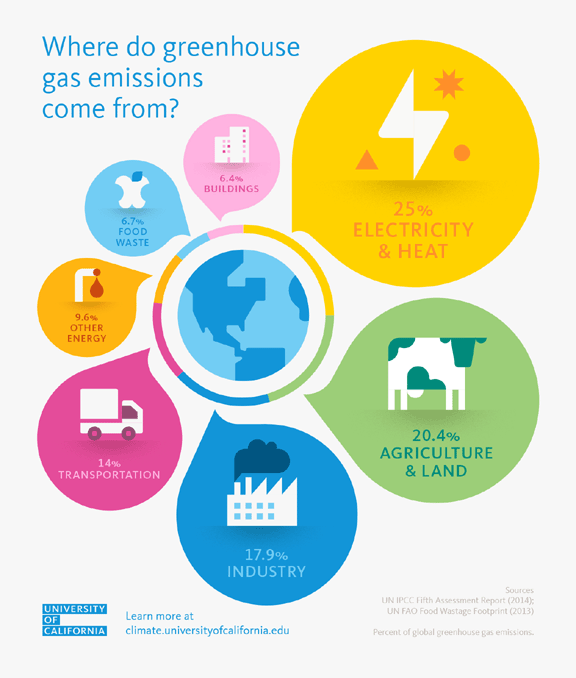
The ACT is on track to have 100 per cent of its electricity sourced from renewables by about 2020. This will make possible the targeted 40 per cent reduction in emissions (as they are accounted in the ACT). Carbon-free power supply gives us emission-free options for other sectors, notably transport – electric cars and buses, as well as light rail – and the use of electricity instead of gas for heating, cooking and in industry. This is critical because transport and natural gas use account for the lion’s share of Canberra’s direct emissions outside of electricity generation, at about 65 per cent and 20 per cent respectively.
The vision is clear: a transport system where public transport, as well as biking and walking, play a bigger role; where almost all cars, buses and trucks run on electricity or hydrogen; and where almost no gas is used. Quite aside from climate change, this means even cleaner air in Canberra and much less noise. The shift to higher-density living and the rapid progress with electric cars will help make it possible. Electric bicycles are already an alternative.
In all of this, the ACT government can and should lead by example. And climate policy must go hand-in-hand with social policy, ensuring that the shift to a truly clean city does not put some groups at a disadvantage. That means a keen eye on energy costs and the needs of commuters in the suburbs, and increased engagement by all of us during the transition.
Penny Sackett, an honorary professor at the ANU, is a former Australian chief scientist; Frank Jotzo is a professor at the ANU’s Crawford school of public policy; and Will Steffen, an emeritus professor at the ANU, is on the Climate Council of Australia. The authors are on the ACT Climate Change Council, an independent statutory body that advises the ACT government on emissions targets. This is the first of several articles exploring how Canberra can transition to carbon neutrality.
Australian Capital Territory’s energy policy could be damaged by Turnbull’s National Energy Guarantee
A National Energy Guarantee could be bad news for the ACT, Canberra Times, Katie Burgess , 24 Nov 17, A National Energy Guarantee could risk years of ACT energy policy and force Canberrans to pay more, ACT climate change minister Shane Rattenbury has warned.
The Greens minister met with his state and federal counterparts at the COAG Energy Council meeting in Hobart on Thursday and Friday.
Federal energy minister Josh Frydenberg had intended to ask state and territory leaders to give in-principle support to the energy guarantee, but instead sought approval to undertake further analysis of the proposal.
But Mr Rattenbury said he was concerned that the guarantee would “stymie” new sources of renewable energy, the emission targets were too low, the agreement too short and the modelling was tailored to “inflate the apparent cost-savings”.
He also said an “artificially suppressed” wholesale price would impact on the contract-for-difference model the ACT used as part of its plan to go 100 per cent renewable by 2020.
However when wholesale prices are higher than the feed-in tariff, the generator pays ActewAGL and the savings are passed onto customers.
That model has insulated Canberra customers from future price rises.
But if the wholesale price was pushed down, Mr Rattebury said the ACT could pay more.
“We are concerned it will suppress artificially prices in the wholesale market and we believe the wholesale market is an effective means of driving good energy outcomes so the transition across to a certificate-based approach we think distorts the price signalling effect the labour wholesale market is designed to operate,” Mr Rattenbury told a stakeholder meeting.
“As a jurisdiction it’s particularly problematic for us because we have set ourselves on a pathway that’s premised on having an effective wholesale price. For our consumers it’s going to represent a potentially significant cost increase because of the way our electricity contracts are set for the next 20 years.”………
The federal government chose not to adopt the Clean Energy Target recommended by Chief Scientist Alan Finkel, instead opting for a National Energy Agreement which would require energy retailers to meet a reliability and emissions guarantee.
The reliability guarantee compels retailers to make a proportion of electricity available from “dispatchable” sources like batteries, hydro or gas, that can be switched on when demand is high.
The emissions guarantee requires retailers to cut their greenhouse emissions by 26 per cent on 2005 by 2030.
The energy guarantee won’t apply to Western Australia and the Northern Territory, meaning those two jurisdictions will have no federal emissions reduction policy after the Renewable Energy Target is scrapped in 2020.
The ACT and South Australia called on the federal government to model the cost of a Clean Energy Target and a Renewable Energy Target as well but they refused.
Mr Rattenbury that was “deeply concerning”.
“We know the National Energy Guarantee is the fourth or fifth best choice because that’s what the backbench watered it down to.
“[The refusal to model other options] says to me it’s not going to stack up.” http://www.canberratimes.com.au/act-news/a-national-energy-guarantee-could-be-bad-news-for-the-act-20171123-gzryin.html
1 This month

of the week – Australians for War Powers Reform (AWPR)
To see nuclear-related stories in greater depth and intensity
 Antinuclear