Australia’s State governments fervently slashing renewable energy
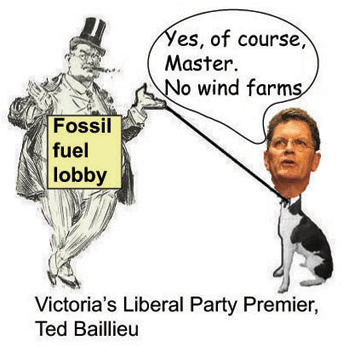 Not so fast to the green scheme graveyard Crikey, by Fergus Green, climate change lawyer and policy analyst, 2 May 12, Federalism of the co-operative and unco-operative variety is back in the news. As the July 1 start date for the federal government’s carbon pricing scheme looms, the uppity conservative state premiers’ league is out in force, crying foul about the “tax” and fervently slashing “redundant” and “costly” state-based climate change schemes. Meanwhile, federal programs such as the Renewable Energy Target are under the microscope, with the Coalition and big business calling for an end to this kind of “green tape”
Victoria’s Baillieu government recently accepted the recommendation  of a review of the Victorian Climate Change Act to scrap the state’s 20% emissions reduction target by 2020 — the latest in a long line of anti-environment, pro-fossil fuels policy developments during its first 16 months in office. Queensland’s newly elected Newman government has opted for a more expeditious approach, axing just about every Queensland government program with a tinge of green — from the $430 million Queensland Climate Change Fund (which provides $30 million a year for climate change initiatives) to the $50 million Smart Energy Savings Program (which helps businesses improve energy efficiency).
Amid this carnage, it is worth considering just what is the appropriate role of complementary state and federal policies in tackling climate change in the context of the new carbon price……
The federal cap only covers a limited number of emissions-producing sectors – notably energy generation, industrial processes, landfill waste and fugitive emissions (for example, methane released from coalmines). Sectors not covered by the scheme include agriculture, forestry and (via changes to the fuel tax and rebate regimes) parts of transport.* Any state or federal government policies that reduce emissions in these sectors will result in abatement beyond that brought about by the federal cap. As the PC points out in its Garnaut Review submission, policies to target these sectors make sense to the extent that they would reduce the costs of achieving an overall national emissions reduction target.
Emissions embodied in the fossil fuels we export, which far exceed our domestic emissions, are not subject to the carbon price either. This gives states (which largely control mining policy) a critical role in influencing global greenhouse gas emissions. http://www.crikey.com.au/2012/05/01/not-so-fast-to-the-green-scheme-graveyard/
Australia obliged to take back Lucas Heights nuclear waste – it will go to Lucas Heights
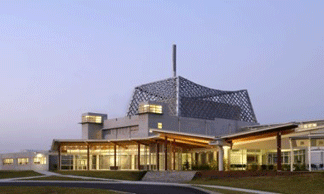 The Australian Greens want to close the Lucas Heights reactor and ban the import and export of nuclear waste …...
Nuclear waste will be stored in Sydney at Lucas Heights BY: IMRE SALUSINSZKY, NSW POLITICAL REPORTER The Australian May 01, 2012 NUCLEAR waste due to boomerang back to Australia in 2015 will be stored in metropolitan Sydney, after decades of political dithering over a national radioactive waste repository in the outback.
The Australian Nuclear Science and Technology Organisation will today launch its application for a licence to build an 800 sq m interim warehouse on the premises of the research reactor at Lucas Heights, which has generated the waste during the 50 years of its operation. Continue reading
The New South Wales Pacific Highway’s ‘toxic ditch’
Ben Colton said his uncle Robert Deards was one of the initial police officers called to the crash and handled the drums,  which “made him sick to the point he nearly died”. Mr Colton said his uncle and another officer spent 14 hours at the scene – and were later told to go for a swim to wash off any radioactive particles – but their complaints and recognition of their exposure fell on deaf ears.
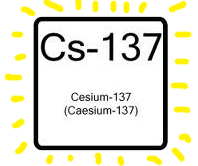 CAESIUM-137 A radioactive isotope formed as a by-product of nuclear fission usually involving uranium. It has a half-life of 30 years. It remains the main health risk and source of radiation around the Chernobyl nuclear power plant. Short term high-level exposure can produce nausea, vomiting, diarrhoea, head aches and blisters, which can return
up to weeks later in the body. It is also blamed for birth defects.
Lethal, toxic truth buried in a highway ditch Herald Sun, By Richard Noone and Neil Keene From: The Daily Telegraph April 19, 2012 WHY radioactive materials, a banned pesticide and food were on the same truck that crashed on the New South Wales Pacific Highway in 1980 is a mystery….. An ANSTO spokesman said the drums – one 60 litres and another smaller one – carrying the nuclear material were undamaged in the crash and later taken with the undamaged food to Brisbane. The rest, including the DDT, was believed to have been buried.
Despite full knowledge of its location the then RTA proceeded with the $60 million upgrade, awarded to BMD Constructions, in March last year without removing it first. Continue reading
Road workers recovered, mystery of 1980 toxic spill remains
 [ on December 4, 1980] The first two police officers on the scene were senior constables Robert Deards and Terry Clifton, who remained there for 12 hours, handling two drums of radioactive material, and handling burst bags containing DDT.
Mystery illness recalls 1980 toxic spill, SMH, Ben Cubby, Nick Ralston, April 19, 2012 FIVE road workers have recovered after exposure to a mystery toxic chemical they unearthed while building a new section of the Pacific Highway near Port Macquarie. The workers were struck by nausea, vomiting and sore throats after excavations uncovered a patch of greyish clay that became streaked with orange after it was exposed to the air.
The site, between Herons Creek and Stills Road near the town of Laurieton, is notorious as the location of one of Australia’s most controversial spills of toxic chemicals and radioactive material. In 1980 a truck rolled over while carrying several tonnes of the insecticide DDT, two drums of radioactive material and some other chemicals. Some of the DDT was apparently buried on site. It sparked a chain of events that saw allegations of a ”massive cover-up” by a local doctor who claimed 13 people involved in the clean-up fell ill, and a parliamentary investigation.
Although the affected workers were exposed nearly three weeks ago and have since returned to work, the cause of the illness remains unknown and a 50-metre exclusion zone has been imposed around the construction site, NSW Roads and Maritime Services said. The Roads Minister, Duncan Gay, said there was no sign of radioactivity, though further tests would be undertaken. Continue reading
ANSTO says not involved in 1981 truck’s toxic spill. Inquiry to be held
Nuclear agency distances itself from toxic scare ABC News, April 18, 2012 Australia’s peak nuclear agency says toxic material that has halted upgrade work of the Pacific Highway in New South Wales did not originate at its Lucas Heights facility…… a statement from the Australian Nuclear Science and Technology Organisation (ANSTO), says a review of records shows its predecessor, the Australian Atomic Energy Commission (AAEC), was not concerned with any aspect of the truck accident….
It went on to say that a report from April 1981 stated that “the sources were not the property of the AAEC nor were they being consigned to or from the AAEC”. “They were the property of a geophysical company and do not appear to have suffered any harm.” ANSTO says it has received advice from the Environmental Protection Agency that there is no indication of radioactive drums or canisters being located at the site……A federal parliamentary report into
hazardous materials in 1982 included details of the crash which Mr Higgins says is being checked in light of the sick workers….. http://www.abc.net.au/news/2012-04-18/ansto-distances-itself-from-radiation-scare/3958572
Minister calls for highway inquiry http://news.smh.com.au/breaking-news-national/minister-calls-for-highway-inquiry-20120419-1x83j.html April 19, 2012 NSW Roads Minister Duncan Gay says an independent inquiry will investigate how five road workers came to be exposed to potentially toxic material buried on the state’s mid-north coast. Continue reading
New South Wales: road workers made sick by ionising radiation?
 Workers sick amid highway radiation scare http://www.abc.net.au/news/2012-04-18/radioactive-discovery-halts-pacific-hwy-upgrade/3957168 April 18, 2012 Road workers were sent for medical treatment after vomiting when suspected nuclear material was unearthed during work on an upgrade to the Pacific Highway on the mid-north coast of New South Wales The materials, which include caesium, were buried north of Port Macquarie after a truck carrying radioactive isotopes from Sydney’s Lucas Heights nuclear reactor crashed in the area in 1980.
The isotopes were being taken to Brisbane, before being shipped to the United States. The upgrade’s project manager, Bob Higgins, says road workers fell ill after unearthing a strange clay-like material.
“As we’ve taken down the cutting there we exposed the face of the existing material (and) came across a clay material that when it’s exposed to air it gets an orange streak through it,” he said. “There were a number of workers that felt a little bit of nausea and there was a bit of vomiting when they were in close proximity. “[They went] off to the doctor, but obviously we need to be extremely careful here.”
The Environmental Impact Statement for the highway upgrade had noted some uncertainty about where exactly the containers were buried. Specialists are in the area assessing what to do with the radioactive materials, and if they pose any risk.
Radioactive transport accident New South Wales 1980
Let the Facts Speak: 1980, December 4 PORT MACQUARIE, AUSTRALIA
An accident near Port Macquarie involved a truck carrying a 60-litre drum labelled ‘danger radioactive – Americium 241’, plus a smaller container labeled ‘Caesium 137’ and foodstuffs. When Sydney police called the Atomic Energy Commission at Lucas Heights for advice, they were told to call back later ‘when the AEC opens’. Dr. John McKay of Port Macquarie claimed that 16 people who attended the accident are suffering from symptoms of radioactive poisoning.
Dr. McKay has accused the AEC of a cover-up regarding the dangers of the accident, and has claimed that this lack of concern may endanger the 8,000 people in nearby Laurieton if radiation poisons the town’s water supply. The NSW Minister for Public Health accused Dr. McKay of ‘causing public mischief’. The Minister said the Health Commission report had found that, although the protective containers of the radioactive material were damaged, both were considered to be safe with no spillage or leakage of radioactivity.
Sydney Morning Herald – 16 April 1981; Canberra Times – 11 March 1981; WISE Vol.3 No.3 June/July 1981 p.16; Canberra Times – 11 March 1981
Lucas Heights nuclear reactor’s slips and leaks
Radiation leak fear at Sydney’s Lucas Heights as four workmen contaminated, Linda Silmalis The Sunday Telegraph April 15, 2012 FOUR workmen at the Lucas Heights nuclear reactor suffered low-level radiation contamination late last year.
An investigation by the nuclear safety watchdog of the reactor log books to ensure it was meeting its licence conditions has found a rise in the number of contamination events recorded in November and December..
…Two reactor trips were also recorded, while “unusual” water leakage was identified coming from one of the control rods, the Australian Radiation Protection and Nuclear Safety Agency report said…. While the watchdog ticked off the 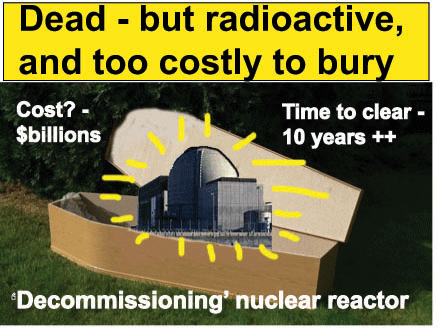 operations at the reactor as complying with safety regulations, it recommended the Australian Nuclear Science and Technology Organisation (ANSTO) consider increasing the level of detail it recorded for events.
It noted a number of events and items of interest that had been recorded in the Reactor Operation Event Management System and log book. “The number of minor contamination events at OPAL has increased recently,” it said..
… OPAL replaces the high flux reactor, which began a $50 million decommissioning phase in 2007. The process is expected to take 10 years, with dismantling of the structure only to begin in 2016 after short-lived radioactive materials in the reactor have decayed. http://www.dailytelegraph.com.au/news/sydney-nsw/radiation-leak-fear-in-sydney/story-e6freuzi-1226326493993
$Billions of investment money at risk, as New South Wales Liberal government calls for scrapping of renewable energy target
 Investment fears over ‘attack’ on green energy SMH Anna Patty April 14, 2012 THE NSW government’s decision to withdraw support from clean energy schemes was criticised yesterday as a retrograde step that would threaten billions of investment dollars.
The Energy Minister, Chris Hartcher, has said the government would not be supporting green schemes that require a subsidy and is calling for the closure of the federal government’s renewable energy target. He called for the closure of the renewable energy target – legislation that is supported by the federal opposition.
The NSW opposition spokesman for energy, Luke Foley, said yesterday the tribunal’s determination found that green energy schemes had not contributed to electricity price increases. Power bills are forecast to rise between $182 and $338 a year from July 1. Mr Foley said the state government had ended bipartisan support for the 20 per cent renewable energy target after calling for the target to be removed, despite adopting the target in its state plan released
last year. ”The O’Farrell government has launched a relentless attack on renewable energy, with chilling investment signals sent by the government throughout its first year in office,” he said.
”Solar in NSW has been stopped dead in its tracks. The draft wind guidelines are designed to chronically handicap the expansion of the wind industry.
”Renewable energy is already contributing to lower wholesale electricity prices. The Australian Energy Market Commission recently reported that new wind energy projects in Victoria will mean that increases to wholesale electricity prices in that state will be lower than in NSW. Rather than attacking wind farms, the O’Farrell
government should require its own planning review to come up with a sensible and workable planning regime for the development of the wind industry in NSW.”
The acting chief executive of the Clean Energy Council, Kane Thornton, said it was a “worrying sign that the NSW government would seek the removal of one of Australia’s most significant energy policies without considering the impact this would have on investors who have put billions of dollars into clean energy projects in NSW. The renewable
energy target is scheduled to run until 2030 and these projects would face collapse if it was removed.”
http://www.smh.com.au/environment/investment-fears-over-attack-on-green-energy-20120413-1wysv.html#ixzz1s3udpo35
Rural communities like Broken Hill keenly taking up solar energy
Broken Hill embraces solar power, Margaret Paul, ABC News, April 12, 2012 The peak body representing renewable energy in Australia says regional New South Wales is leading the way in terms of the number of households installing solar panels.
The Federal Government’s Renewable Energy Regulator office has released the latest figures which show 19 per cent of properties in Broken Hill have installed solar panels….. Russel Marsh, policy director with the clean energy council, says it is no surprise to see regional areas ranked highly. “Increasingly, the people and the households who are installing solar
panels are not those who live in the urban areas, but those who live in regional areas who tend to be on lower incomes.
“We think that’s because they have the most to gain from installing solar panels on their roof, in terms of the savings they can make on their electricity bill as a result of generating their own electricity from the sun.”….
http://www.abc.net.au/news/2012-04-12/solar-postcodes/3945504
Sydney to get low carbon electricity network – cogeneration for energy efficiency
 History made with Australia’s first low carbon energy network, Cogeneration and on site power production, Cospp.com, 05/04/2012 By Diarmaid Williams Sydney’s Lord Mayor Clover Moore has hailed the groundbreaking new district energy system, which will link Sydney in the country’s first citywide low carbon network, and says has the potential to make Sydney one of the world’s leading green cities. “Our trigeneration network will give consumers a cleaner and cost-competitive alternative to the rising price of electricity,” the Lord Mayor said.
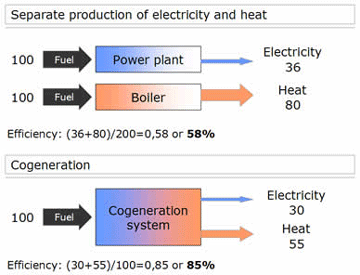
“This network could save NSW electricity consumers as much as $1.5 bn by 2030 in avoided or delayed spending on grid upgrades and new power stations. “It will help us deliver on our target to cut carbon emissions across the City of Sydney by 70 per cent by 2030 (on 2006 levels) – one of the most ambitious of any Australian government.” Continue reading
Liberal/National M.P. wants uranium mining in New South Wales – just not in his backyard
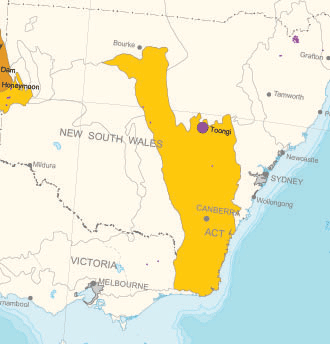
map shows uranium exploration areas in NSW
MP supports uranium exploration Northern Rivers Echo, Rebecca Masters | 30th March 2012 TWEED MP Geoff Provest has supported legislation changes that allow uranium exploration across the state but maintains he is still firmly against any form of mining on the Tweed..
… State Labor MP Walt Secord raised his fears in parliament this week that the legislation opened the door to uranium mining throughout the Clarence Moreton Basin on the north coast, potentially contaminating the environment and risking the health of communities in the Tweed.
“In 1986, in a spirit of bipartisanship, the NSW parliament agreed that the potential release of toxic elements could contaminate large areas of land and pollute our rivers,” Mr Secord said.
“They knew then, as Labor knows now, that there is still no failsafe way to transport and manage nuclear waste. “Make no mistake, the government’s decision to allow uranium exploration is a huge betrayal.”…….
Outside of parliament, Mr Provest has dismissed Mr Secord’s comments as “fear-mongering.”…….. “I will always be against any form of mining on the north coast, this is simply to give us an idea of what is in the ground.”
New South Wales Upper House passes uranium exploration legislation by 20 votes to 18
the Government had no mandate for uranium exploration……..Mr O’Farrell had declared to Parliament in August 2011 that the Government had no plans to allow uranium mining or exploration.
Uranium ban lifted by NSW Parliament, Herald Sun AAP March 28, 2012 LEGISLATION to repeal a ban on uranium exploration has passed through the NSW Parliament, with MPs in the state’s Upper House supporting it by 20 votes to 18. The legislation passed through the Legislative Council unamended today, despite opposition from Greens and Labor
MPs…
.. Separate legislation would be required to lift the NSW ban on uranium mining. Continue reading
NSW’s new uranium Bill extinguishes need for consent from Land Councils, and excludes uranium from Aborignal Land Rights Act
 Natalie Wasley, 29 March 12, New South Wales’ new Bill allowing fro uranium exploration alters a series of other legislation, including The Mining Act, Radiation Control Act, State Environment and Planning Act and Aboriginal Land Rights Act.
Uranium exploration in New South Wales? – call for inquiry into govt OK to this
Since Premier O’Farrell announced his intention to open up uranium exploration in this state, thousands of people have signed a petition calling on the government to maintain the uranium ban.
Inquiry should probe O’Farrell’s okay to uranium search – ecology groups, Cowra Community News,
http://cowracommunitynews.com/viewnews.php?newsid=142&id=4 28 March 12, STATE and national environment groups have called for an independent public review into uranium mining in New South Wales as legislation to allow exploration is due to be debated in parliament today (Wednesday).
Premier Barry O’Farrell has no mandate to change a long-standing and popular policy banning uranium projects in the state, the Nature Conservation Council of NSW, the Australian Conservation Foundation and the Beyond Nuclear Initiative say in a joint statement. The groups have criticised the lifting of the ban on uranium exploration, urging the State Government to set up a public inquiry into the uranium industry. Continue reading
1 This month
7 April – WEBINAR – Australia and the Doomsday Clock – Preventing nuclear war through NoFirstUse and other policies
Online | Tuesday April 7, 4:00-5:30pm, Australian Eastern Time / 8:00-9:30am Central Europe Time
– Access the registration link
15 April – Zoom –Nuclear Power is Not the Solution
Apr 15, 2026 01:00 AM in Canberra, Melbourne, Sydney

Join the International Physicians for the Prevention of Nuclear War (IPPNW) on Tuesday, April 14th for a timely webinar exploring the risks associated with nuclear power and challenging the myth that it offers a simple, safe, carbon-free solution to the climate crisis

21 April Webinar: No Nuclear Weapons in Australia
Start: 2026-04-21 18:00:00 UTC Canberra, Melbourne, Sydney (GMT+10:00)
End: 2026-04-21 19:30:00 UTC Canberra, Melbourne, Sydney (GMT+10:00)
Event Type: Virtual
A virtual link will be communicated before the event.
Host Contact Info: australia@icanw.org

of the week – Australians for War Powers Reform (AWPR)
To see nuclear-related stories in greater depth and intensity
 Antinuclear