Developing North Australia – at the expense of Aboriginal land rights?
 If governments want to work in a “full partnership” with Aboriginal people in The North then they must stop treating their interests in land as something to be dealt with for the convenience of those governments and the powerful interests behind them.
Abbott’s white paper for the black tropics: Boon or boondoggle? Crikey,
BOB GOSFORD | JUN 19, 2015 “………Aboriginal people are the fastest-growing demographic, at current rates of population growth, half of the North’s population will be blackfellows by 2050.
So how are Aboriginal interests treated in Developing North Australia? This is the ‘horrid’ part. At page 4 of Developing North Australia we are told that:
Developing the north will need to be done in full partnership with Indigenous Australians, with a focus on creating opportunities through education, job creation and economic development. These opportunities for Indigenous Australians will contribute to achieving the objectives of the Government’s Indigenous Advancement Strategy.
Noble sentiments but a reliance on the vexed Indigenous Advancement Strategy rings out some very loud warning bells. The first chapter is entitled “Simpler Land Arrangements to Support Investment” and some elements of the plan are welcome–particularly the fast-tracking of outstanding native title claims for resolution within the next ten years, increased funding for native title representative bodies and modest increased support for indigenous ranger groups and pastoral land use pilot projects. A streamlining of the needlessly complex native title Indigenous Land Use Agreements (ILUA) processes, which should be simplified to resemble the standard lease arrangements used widely by the NT land councils, is also welcome.
Overall though, the approach to Aboriginal land interests in Developing North Australia appears very much to be one of “you’ve got something and we want it back.”
This is particularly apparent in the emphasis on “township leasing” that will see control of Aboriginal land in townships–by far the most commercially valuable land in the Aboriginal estate–controlled of a Commonwealth bureaucracy and measures to “cut red tape” around hard-won cultural heritage protections. The old saw of “Aboriginal home ownership”–creating housing markets in communities largely reliant on welfare income and where no market exists–also gets a run. Continue reading
Investors flee Energy Resources of Australia as its uranium mining plans stop
 ERA shares in death spiral as prospects slashed, SMH, June 15, 20 Peter Ker The uranium miner operating beside Kakadu National Park may have zero chance of restarting mining at the site, according to UBS analyst Glyn Lawcock.
Speaking after shares in Energy Resources of Australia (ERA) lost more than 48 per cent of their value on Friday, Mr Lawcock said the decision to abandon plans for an expansion of the Ranger mine warranted a downgrading of the stock to a “sell” rating.
Many ERA shareholders were doing just that on Monday, with the stock falling a further 25.4 per cent or 17¢ to close at 50¢.
ERA shares were worth $1.29 at market close on Thursday, prior to ERA announcing that it would not go ahead with an underground expansion at the Ranger mine. That expansion, called “Ranger 3 Deeps”, was the only chance of future mining at Ranger, where mining of the third pit ceased in 2011……
Rio Tinto has offered to cover the shortage of funds to complete the rehabilitation, but it is believed that offer is conditional on ERA ruling out any further development at Ranger, something ERA is not yet willing to do……
The funding shortfall for the rehabilitation is believed to be close to $200 million, although Mr Drew speculated it could be as high as $500 million.
Uranium prices have been depressed since the Fukushima nuclear meltdown in March 2011, and that weakness was one of the major reasons why the underground expansion was abandoned….http://www.smh.com.au/business/mining-and-resources/era-shares-in-death-spiral-as-prospects-slashed-20150615-gho6jg.html
Rio Tinto will have to step in to fund rehabilitation of Kakadu’s uranium mining area
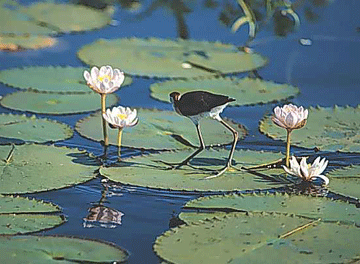 ERA cans Ranger uranium mine in Kakadu by: BARRY FITZGERALD , Resources Editor The Australian June 12, 2015 The crash in uranium prices in the wake of the 2011 Fukushima nuclear disaster in Japan has claimed the controversial Ranger mine inside the world heritage-listed Kakadu National Park in the Northern Territory as its latest victim.
Operated by the Rio Tinto-controlled Energy Resources of Australia (ERA), Ranger’s long-term future was to be secured by the development of an underground uranium resource known as Ranger 3 Deeps.
But ERA has canned the development, citing the “current operating environment”. The decision leaves ERA to process stockpiles from the previous open-cut operation which was dogged in recent years by water handling issues and process plant spills.
Shares in ERA plummeted after the announcement. At 2:10pm the shares were down 61c, or 47 per cent, to 69c each in trading on the Australian Securities Exchange.
Rio (RIO) owns 62 per cent of the ASX-listed ERA and said last night that it would likely take a $US300 million impairment charge on the investment — an acknowledgment that in the current environment, its investment is near worthless.
Rio could also be compelled to step in to ensure that in the event that Ranger’s life is not extended beyond the current treatment of stockpiles, ERA will be able to meet its rehabilitation costs of more than $600m…….
Despite seeming to baulk at having to help ERA at its annual meeting in April, Rio said last night that it recognised the “importance of ongoing rehabilitation work at the Ranger mine site”.
It said it was “engaged with ERA on a conditional credit facility to assist ERA to fund its rehabilitation program, should additional funding be required beyond ERA’s existing cash reserves and the future earnings from processing ore stockpiles”…. http://www.theaustralian.com.au/business/mining-energy/era-cans-ranger-uranium-mine-in-kakadu/story-e6frg9df-1227394169459
World will be watching how Australia manages Kakadu, now that uranium mining there has ended
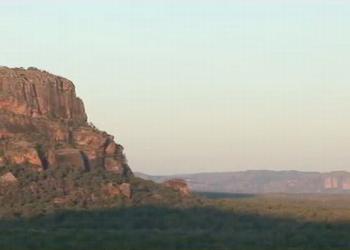 WWF welcomes cancellation of Kakadu uranium mine http://www.theadvocate.org.au/wwf-welcomes-cancellation-of-kakadu-uranium-mine/
WWF has welcomed the cancellation of a planned controversial underground uranium mine in Kakadu National Park.
Energy Resources of Australia, whose parent company is Rio Tinto, cancelled the Ranger 3 Deeps project in a statement to the Stock Exchange last night.
The proposed mine was in an area that had previously been excised from the Kakadu National Park and World Heritage Area.
WWF said the move was not only a victory for Australia’s environment, but also important for further economic empowerment of Indigenous communities.
WWF-Australia CEO Dermot O’Gorman backed calls by the Mirarr Traditional Owners to ensuring the permanent protection of the natural and cultural values for which Kakadu is inscribed World Heritage.
“Kakadu is one of Australia’s environmental treasures and this development presents an ideal opportunity for the area to be rehabilitated and incorporated into the Kakadu World Heritage Area,” said WWF-Australia CEO Dermot O’Gorman.
“Now that the mine will not go ahead, WWF looks forward to ERA and Rio Tinto accelerating the rehabilitation program, ensuring that it results in the full reinstatement of the internationally recognised outstanding natural and cultural values of this important site.
“With a World Heritage Committee meeting now less than a month away, the eyes of the world will be watching how the Australian Government and Rio Tinto manage the rehabilitation of Ranger.”
Uranium glut, Ranger shutdown, leave Rio Tinto with $300M writedown
 Rio Tinto mulls $300M writedown as uranium mine expansion cancelled, Mining.com Cecilia Jamasmie | June 12, 2015 Mining giant Rio Tinto (LON, ASX:RIO) is contemplating to take a writedown of about $300 million after its subsidiary Energy Resources of Australia (ASX:ERA) decided to cancel plans to expand a uranium mine.
ERA, in which Rio has a 68.4% stake, said on Thursday that it would not proceed with the final feasibility study of its Ranger 3 Deeps uranium project in Australia’s Northern Territory, citing weak market conditions.
The decision underscores the ongoing strains in the nuclear industry following the Fukushima meltdown in 2011, which prompted Japan to mothball its 43 operable reactors, causing uranium prices to drop as a result of a worldwide supply glut……..http://www.mining.com/rio-tinto-mulls-300m-writedown-as-uranium-mine-expansion-cancelled/
Mirarr Traditional Owners of the Ranger Uranium Mine area oppose any further uranium mining
Gundjeihmi Aboriginal Corporation, 12 June 15 The Mirarr Traditional Owners of the Ranger Uranium Mine area and the site of the proposed Jabiluka uranium mine release this statement following yesterday’s announcements by Energy Resources of Australia and Rio Tinto that ERA will not at this time proceed with the final feasibility study of the proposed Ranger 3 Deeps underground mine.
The Mirarr and the GAC welcome the clarity that yesterday’s announcements provide in terms of the present viability of the Ranger Three Deeps project. We are also pleased that both companies now publicly recognise the importance of adequately financing the rehabilitation of the Ranger site.
First and foremost in our minds is ensuring the permanent protection of the natural and cultural values for which Kakadu is inscribed World Heritage. We need to see a concrete and comprehensive commitment and plan for the clean-up of Kakadu; that commitment and planning needs to start today.
Mirarr have maintained ongoing dialogue with ERA and governments throughout this process and notwithstanding today’s announcement will continue to talk through all relevant issues as necessary. However, as things stand today we will not support any extended term of mining at Ranger beyond 2021.
We take this position because of our experience of 30 years of environmental and cultural impacts at Ranger and because in our talks with Rio Tinto and the Australian government we have been given no guarantee that Ranger will be the last uranium mine in Kakadu. The Mirarr remain fundamentally opposed to Jabiluka’s development – that opposition is intergenerational. We are concerned about the lack of adequate planning for Jabiluka’s final rehabilitation and its incorporation into Kakadu National Park. ____________________________________________________________________________________ For further information contact 08 8979 2200 / 0427 008 765
Ranger 3 Deeps cancellation should spell end of an ERA for uranium mining in Kakadu
Northern Territory and national environment groups have welcomed the announcement that a planned underground uranium mine in Kakadu – Energy Resources of Australia’s Ranger 3 Deeps project – has been cancelled.
“ERA’s move to abandon plans for an underground expansion at Ranger is an overdue acknowledgement that the underground mine plan lacked economic and environmental sense. It is also a significant step towards the end of uranium mining in Kakadu,” said Nuclear-Free campaigner Lauren Mellor.
Local and national environment groups have for long called for ERA and parent company Rio Tinto to commit to the rehabilitation of the Ranger site and have welcomed that ERA’s ASX announcement has now accepted it needs to secure adequate rehabilitation funding.
“We welcome the fact that ERA has sought an assurance from its parent company Rio Tinto that the required clean-up costs will come at the expense of the company and not the public,” said ACF spokesperson Dave Sweeney.
“ERA has lost around $1 billion on the under-performing Ranger project and has left its run too late in developing the Ranger 3 Deeps proposal – with the continuing low post-Fukushima commodity price the window for uranium mining at Ranger is closing and the operation has moved from dig up to clean up.”
The groups have called for all project applications and approvals to be withdrawn and for ERA to detail its closure and clean-up plan and costings.
*ERA ASX announcement available here: http://www.energyres.com.au/documents/Media_release_Ranger_3_Deeps_project_update.pdf
For further context and comment contact:
Lauren Mellor, Environment Centre NT on 0413 534 125
Dave Sweeney, Australian Conservation Foundation on 0408 317 812
Energy Resources of Australia(ERA) announces it is not proceeding with Ranger uranium min eexpansion
 Uranium miner Energy Resources Australia pulls plug on 3 Deeps expansion, ABC News 11 June 15 Uranium miner Energy Resources of Australia (ERA) will not proceed with its proposed 3 Deeps expansion project at the present time, the company has announced to the stock exchange.
In a statement, the company said the uranium market has not improved like ERA had previously expected and there is uncertainty as to what prices would do in the future.
The company also said the mine only had the authority to operate until 2021, and the economics of the project required certainty beyond that point. Those conditions meant ERA would not proceed to a final feasibility study at this time, the statement said. ERA will continue to “process stockpiles and meet obligations to its customers”, the statement said.
The 3 Deeps expansion would have seen the Ranger Uranium Mine commence underground operations for the first time. Its current operations are open-cut.
ERA said it had engaged its major shareholder, Rio Tinto, about funding to rehabilitate the mine site, which is completely ensconced by Kakadu National Park.
The company previously said rehabilitation was funded under its current business plan, but if the 3 Deeps expansion did not go ahead it would require another source of funding to pay for all of the rehabilitation works…… http://www.abc.net.au/news/2015-06-11/energy-resources-australia-pulls-plug-on-3-deeps-expansion/6540046
Northern Territory Mines Departments Credibility and ERA’s Contaminants both down the Creek
ENVIRONMENT CENTRE NT – AUSTRALIAN CONSERVATION FOUNDATION 5 JUNE 2015 On World Environment Day NT and national environment organisations have called on the NT Department of Mines to explain why Energy Resources of Australia, operator of the embattled Ranger uranium mine, should not be prosecuted over a major radioactive spill inside the boundaries of Kakadu National Park.

“Today – World Environment Day – marks twelve months since Energy Resources of Australia gained approval to restart processing at Ranger following a major radioactive spill from a collapsed leach tank in December 2013,” said Lauren Mellor from the Environment Centre NT.
“That a spill of over 1.3 million litres of radioactive slurry happened inside a World Heritage listed National Park is unacceptable: that we still don’t know why twelve months after operations have been resumed is derelict”.
Environment groups are concerned that a subsequent string of regulatory failures indicates that the NT Mines Department is ill-equipped to meet its responsibilities to protect the environment, workers and communities.
In the 12 months since the Ranger restart was approved DME has:
- Failed to release its report into the 2013 radioactive spill accident, even to other Investigative Taskforce member agencies or Traditional Owners.
- Failed to prosecute ERA for clear operational breaches under the Mines Management Act to improve safety and environmental protection at Ranger.
- Been unable to oversight ERA’s water monitoring due to staff shortages and deficient testing, meaning at some sites with contamination trends there was no independent oversight.
- Not implemented a key recommendation of the Independent Expert’s incident report into the leach tank failure and radioactive spill calling for a complete regulatory overhaul at Ranger.
- Failed to address contamination trends in Gulungul Creek, part of Kakadu National Park downstream from the mines leaking tailings dam. DME must apply statutory requirements to its deficient monitoring program as recommended by a 2003 Senate Inquiry into Ranger Uranium Mine. This is despite significant spikes of electrical conductivity indicating impacts from the mine are now being seen in Kakadu waters.
“The NT Mines Minister’s inaction on this major incident appears to be a case of prioritising the operations of Energy Resources of Australia above the protection of Kakadu National Park,” said ACF campaigner Dave Sweeney.
World Environment Day is a perfect time to send a clear message that poor mining practises are neither acceptable, nor above the law. Kakadu deserves better than complacency,” concluded Mr Sweeney.
Contact: Lauren Mellor, Environment Centre NT, 0413 534 125 Dave Sweeney, Australian Conservation Foundation, 0408 317 812
Northern Territory Government fails to act on radioactive spill by Energy resources of Australia
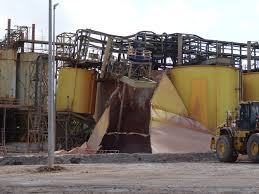 NT govt must end delay on Ranger action http://www.sbs.com.au/news/article/2015/06/05/nt-govt-must-end-delay-ranger-action It is “completely unacceptable” Ranger uranium mine operators have not been prosecuted over a slurry spill within Kakadu, traditional owners say.
The Northern Territory government is taking too long to punish those responsible for a radioactive spill on Aboriginal land in Kakadu, traditional owners say.
They have set their sights on the Department of Mines and Energy, which has investigated the 2013 spill of up to 1.5 million litres of acidic slurry from a collapsing leach tank at the Energy Resources of Australia operated Ranger uranium mine.
But the department is yet to share its report with stakeholders, despite a request six months ago from the Office of the Supervising Scientist.
The Gundjeihmi Aboriginal Corporation, which acts for the Mirarr traditional owners, says the delay is “completely unacceptable” especially given ERA was able to restart operations at Ranger a year ago.
“Members of the investigative taskforce as well as the general public are still waiting for the regulator to release its report, let alone prosecute the mining company,” corporation CEO Justin O’Brien said.
The traditional owners want the government to impose a fine, or declare an operational breach for the spill.
The Environment Centre NT claims ERA breached its operating conditions, and in particular a section of the Mine Management Act which requires “no unauthorised release of waste or contaminant”.
A department spokeswoman said the incident was still being investigated. Comment is being sought from ERA.
Despite the facts, Toro Energy’s Vanessa Guthrie optimistic about uranium market
Why believe Tor’s spin when:
Uranium prices have slumped again, with no recovery in sight?
Improved uranium price triggers drilling at a Central Australian prospect, ABC Rural, NT Country Hour 15 May 15 Nathan Coates “…….Drilling at the Wiso Project 150 kilometres north-west of Barrow Creek started this week and is expected to continue for two months.
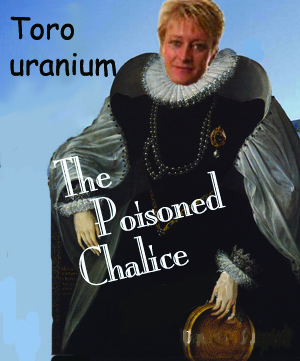 Managing Director of Toro Energy, Vanessa Guthrie, said the joint venture project with Areva Resources is the result of surveys co-funded by the Northern Territory government. “The work that has commenced this week is a drill program,” she said. “We are targeting a sandstone hosted uranium paleochannel.”………She said environmental approval to start exploring near Barrow Creek had two levels.
The uranium that we might produce would be likely to go to the growing Asian markets of China and India and the mature markets of Korea and Japan. “Of course we needed Traditional Owner agreement which we’ve secured,” she said. “We also have the mine and exploration plan which was required by the Northern Territory government.”
Ms Guthrie said Toro Energy had in the past gone through environmental approval processes and they were very similar to those in the Northern Territory.
She added that the approval processes for uranium mining in the Northern Territory were “well established and quite mature.”…….http://www.abc.net.au/news/2015-05-12/improved-uranium-price-triggers-drilling-in-central-australia/6463570
Aboriginal Land Councils distrust Northern Territory Government, reject it for running Indigenous outstation services.
‘Dysfunctional’ NT Government must not run Indigenous outstations, Northern Land Council and Central Land Council say ABC News 14 May 15 Two of Australia’s most powerful Indigenous land councils have labelled the NT Government “dysfunctional and welfare dependent” and “a failed state that is almost totally dependent on the Commonwealth” as they rejected an idea for the NT to take responsibility for Indigenous outstation services.
The federal budget made provisions for a one-off payment to the NT Government of $155 million in exchange for taking over municipal and essential services in remote outstations and communities.
But the Northern Land Council (NLC) and Central Land Council (CLC) have said the NT Government would not be able to adequately run the services and would result in community closures like those planned in Western Australia. Continue reading
Australian govt turns from Northern Territory in search for vulnerable communities to host nuclear wastes
Nuclear waste dump unlikely in NT after land councils, stations refuse to nominate site ABC News, 11 May 15, By Anthony Stewart The Northern Territory appears unlikely to house the Federal Government’s proposed radioactive waste dump after major land holders fail to nominate a site.
The Federal Government began a renewed searchfor a site to store Australia’s intermediate-level nuclear waste and dispose of low-level waste in March this year. A formal application process closed on the May 5.
The ABC confirmed the Northern Land Council, Central Land Council, and Northern Territory Government had not nominated any land. Gilnockie and Supplejack Downs Stations also decided against participating in the process.
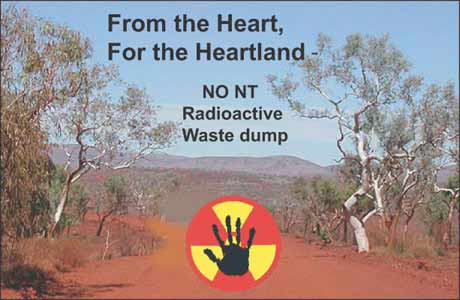
In a statement, the Federal Government refused to confirm whether any other organisation had nominated land.
“Details on nominations will be made public following the close of the nomination process and consideration by the Minister for Industry and Science. On current timeframes, this is expected in July 2015,” the statement read………
Anti-nuclear campaigner Lauren Mellor said it was the end of a long fight against nuclear waste in the Territory. “It’s very good news. We have spent the last decade with residents and traditional owners of the Northern Territory fighting a nuclear dump process,” she said. “The Federal Government has pulled out of the trenches in the Northern Territory.”
She said the fight had been pushed to other parts of Australia. “Unfortunately our concern is they will go and target another vulnerable community as they’ve done many times before to try and push them to house a national or even international dump,” Ms Mellor said.
Several organisations in both South Australia and the Western Australia have indicated they have nominated land under the process. http://www.abc.net.au/news/2015-05-11/nuclear-waste-dump-unlikely-in-nt/6461078
Rio Tinto and ERA passing the buck to each other on who pays for Ranger uranium clean-up
As Ranger approaches its end of mine life the stark question of which company bears responsibility for the costly, complex and technically challenging rehabilitation effort is increasingly being asked. ERA says it doesn’t have the funding capacity and Rio Tinto claim it hasn’t the legal responsibility.
Rio Tinto and ERA are playing a game of corporate convenience and the stakes are very high as the miners are required by law to bring the former mineral lease to a standard whereby it can be incorporated into the surrounding Kakadu National Park.
 Rio Tinto and Energy Resources of Australia: Uranium Uncertainty and Radioactive Responsibility, Environment Centre NT 22 Apr 15 “The fate of Energy Resources Australia hangs in precarious balance with majority-owner Rio Tinto growing increasingly uncertain about the competitive economics and investment risk of a life-sustaining underground expansion” Financial Review, April 2015
Rio Tinto owns 68 per cent and is the parent company of Energy Resources of Australia, an Australian-listed uranium miner who’s only operating asset is the troubled Ranger mine in Kakadu – a 30-year-old mine with a long history of accidents, spills and security breaches.
Mining at Ranger’s open pit ceased over two years ago and production is currently sustained by processing stockpiles. All mining and mineral processing at the site must end in January 2021, to be followed by a mandated five year rehabilitation period.
But as the window on mining at Ranger closes there is growing concern that Rio Tinto may seek to avoid its near $700 million rehabilitation responsibilities and leave a lasting radioactive hole in the heart of Kakadu National Park.
RIO HOLDING THE REINS AT RANGER Continue reading
Media gagged: Energy resources of Australia can’t afford to rehabilitate Ranger uranium mine?
 Media banned from Rio Tinto’s ERA AGM after concerns about uranium mine rehabilitation, ABC News By Joanna Crothers 14 Apr 15 Media outlets have been banned from the annual general meeting of a Rio Tinto-owned company that operates the Ranger Uranium Mine in the Northern Territory amid concerns the company does not have enough money to rehabilitate the site once it finishes production.
The mine, near Jabiru which is surrounded by Kakadu National Park, 230 kilometres east of Darwin, is run by Energy Resources of Australia (ERA).
ERA is majority-owned by mining giant Rio Tinto. Ranger Uranium Mine is one of Australia’s three operating uranium mines.
On Monday, the NT Environment Centre said it had “major concerns” ERA would no longer be able to afford the full cost of rehabilitation, estimated at $512 million, due to suffering substantial losses over the past few years.
The company reported a $136 million loss for the 2013-14 financial year which was an $83 million improvement on the previous year.
ERA has said rehabilitation is funded under its current business plan, but if a proposed underground mine known as Three Deeps is not developed it may require another source of funding to pay for all of the rehabilitation works.
Environment Centre spokeswoman Lauren Mellor said she would raise these concerns at ERA’s AGM being held in Darwin today. Media have been told they cannot attend the meeting, even without recording devices, despite journalists having been able to attend previous ERA AGMs.
Speeches from the AGM have been published on the ERA website.
On Monday, Ms Mellor said she wanted to know whether parent company Rio Tinto would cover costs of rehabilitation should ERA be unable to pay.
“We’ll be asking to board of ERA whether they believe that the parent company, who does have the financial capacity to achieve rehabilitation, should be held responsible in the event that ERA no longer has the money to achieve this huge cyclical challenge of rehabilitating Kakadu National Park.
“What we’ve been seeing is Rio Tinto as a major shareholder, which is certainly not short of cash in the way that ERA is, trying to deflect criticism and attention and its corporate ties to this particular project and sidestep that responsibility.”……..http://www.abc.net.au/news/2015-04-14/concerns-rio-tinto-era-wont-pay-for-ranger-mine-rehabilitation/6390600
1 This month

of the week – Australians for War Powers Reform (AWPR)
To see nuclear-related stories in greater depth and intensity
 Antinuclear