REHABILITATION: The only future for Ranger uranium mine
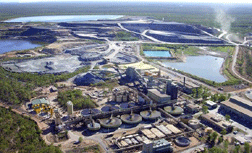 9 April 13, Kakadu uranium miner Energy Resources of Australia’s (ERA) is expected to announce a financial loss at its Annual General Meeting in Darwin tomorrow.
The AGM comes only months after open cut mining ended at the troubled Ranger site and only a month after the end of plans for uranium mining at the nearby Koongarra region.
“Now is the time to draw a line for uranium mining in Kakadu and to end plans for a new underground mine at Ranger – called the Ranger 3 Deeps project,” said Environment Centre NT spokeswoman Cat Beaton.
“The Ranger and Jabiluka leases need to go the way of Koongarra and the chapter closed on uranium mining in the Kakadu National Park region”.
The federal government has determined that ERA’s proposed 3 Deeps underground uranium mine plan requires a full Environmental Impact Statement and there is much scepticism about whether any underground mine could meet the mine lease closure date of 2021.
“Both the profitability and social license for uranium mining in Kakadu have faded and we are urging ERA to now clean up, rehabilitate and exit the Ranger lease.
There is no economic or environmental rationale for taking the Ranger operation underground and any move to do so will be actively contested,” concluded Ms Beaton.
Toro Energy’s uranium to be moved through Northern Territory and South Australia
New mine to ship uranium through NT, SAhttp://www.skynews.com.au/businessnews/article.aspx?id=860386 April 4, 2013 A new West Australian mine will likely ship uranium concentrate through two other states.
The federal government on Tuesday approved Toro Energy’s $269 million Wiluna uranium project, 30km south of the Wiluna township and about 960km northeast of Perth.
Toro managing director Vanessa Guthrie says shipping is likely to start from 2015 using existing rail lines between South Australia and the Northern Territory.
‘We would take it to Port Adelaide then rail through to Darwin as currently happens with the other co-shippers,’ she told ABC Radio.
The Wiluna mine will become Australia’s sixth producer of uranium and the first in Western Australia.
AREVA was not able to bribe Jeffrey Lee, and Koongarra is safe from uranium minng
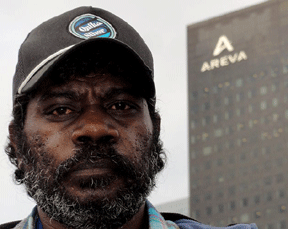 Australia: Koongarra is now permanently protected from uranium companies INTERCONTINENTAL CRY, BY JOHN AHNI SCHERTOW • MAR 18, 2013 The Australian government finally made good on its word. On 6 February, 2013, Environment Minister Tony Burke introduced the “Completion of Kakadu National Park (Koongarra Project Area Repeal) Bill” signalling an end to one of three long standing struggles against uranium mining within the Alligator Rivers Region of Australia’s Northern Territory.
Just a few short days ago, Australia’s senate passed the Bill, ensuring once and for all that Koongarra is permanently protected.
“This is a great day for me, my country and my culture. My mind is at peace now that I know that there will be no mining at Koongarra and that Djok lands will be protected forever in Kakadu National Park,” said Jeffrey Lee, Djok Senior Traditional Owner and the Custodian of Koongarra, in a written statement. Continue reading
Northern Territory’s uranium industry in the doldrums
 Time the NT got resourceful, ABC Rural By Caddie Brain , 19 March 2013 “……..Uranium exploration projects seem to be struggling to raise capital more than any other resource, with investment down by 70 per cent.Oil, gas and petroleum on the other hand is booming, with an unprecedented 9 per cent of the Territory now subject to petroleum licences or licence applications…..
the Northern Territory Government says it’s concerned that so few projects have made the transition from exploration to mining over the past decade. The last mine was opened in 2006, and there’s been no major greenfield sites developed in the last 20 years.
In his opening remarks, Mines and Energy Minister Willem Westra Van Holthe said while it will support further minerals and petroleum exploration, it’s likely that major projects will rely on foreign investment to get off the ground….. http://www.abc.net.au/rural/content/2013/s3719273.htm
Ranger and Jabiluka – the continuing fight against uranium mining
 Australia: Koongarra is now permanently protected from uranium companies INTERCONTINENTAL CRY, BY JOHN AHNI SCHERTOW • MAR 18, 2013 “……..Koongarra wasn’t the only area that was excluded from the National Park. The government also left out the “Ranger” and “Jabiluka” sites, both of which are owned by another mining giant, Rio Tinto. Currently, only the Ranger site is being actively exploited.
The Ranger mine is a massive controversy onto itself. Ever since the mining operation began, there have been more than 100 environmental errors and breaches leading to the unintentional release of approximately 12 million liters of contaminated water, as Mirarr Elder Yvonne Margarula explained in a 2011 letter to UN Secretary-General Ban ki-Moon. Despite the concerns, Rio Tinto–through its subsidiary, Energy Resources of Australia (ERA)–wants to expand the Ranger mine.
The Jabiluka site is a very different story. Exploitation of this deposit was halted in 1998, following an eight-month blockade that involved thousands of indigenous and non-indigenous protesters. As a result of that effort, Rio Tinto eventually came to sign the “Jabiluka Long-Term Care and Maintenance Agreement” which guaranteed that the Mirarr would have veto rights over any future ‘development’ at Jabiluka.
However, that’s just not good enough for the Mirarr. Like with the Koongarra site, they want to bring Jabiluka and Ranger into the National Park. Continue reading
Inclusion of Koongarra the first step towards a non uranium mining Kakadu National Park
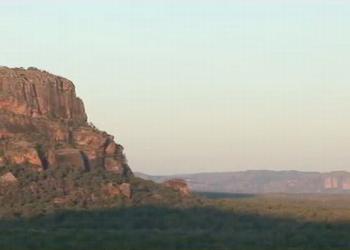 Koongarra’s inclusion welcome, but Kakadu remains incomplete. 14 March, 2013. The Greens today welcomed the inclusion of the Koongarra mineral lease in Kakadu National Park, but said Kakadu would remain incomplete until the Jabiluka and Ranger mineral leases are returned.
Greens Senator Scott Ludlam praised the efforts of Traditional Owner Jeffrey Lee, who had been in the public gallery when the Bill was introduced in early February.
“When Mr Lee came to Canberra a few weeks ago to witness this Bill being introduced, he said ‘Money comes and goes but the land is always here… If we look after it, it will look after us.’ …It’s difficult to comprehend the pressure Mr Lee withstood so we could get to this point, but I want to pay tribute to this fine and courageous man, a softly spoken and gentle man, who stood up to some of the most powerful interests on earth, and won,” Senator Ludlam told the Senate. Continue reading
Mirarr welcome close scrutiny for Kakadu uranium mine
 Gundjeihmi Aboriginal Corporation (GAC) has today welcomed Environment Minister Tony Burke’s announcement that Energy Resources of Australia’s proposal to build an underground uranium mine, the so-called Ranger 3 Deeps, will be subject to a full Federal Environmental Impact Statement (EIS).
GAC – the organisation established and run by the Mirarr Traditional Owners of the Ranger uranium mine site, where the underground operations are planned, as well as much of Kakadu National Park – called for this level of assessment. The proposal affects a number of Matters of National Environmental Significance as it is a Nuclear Action occurring within a World Heritage listed Wetland of National Significance.
Kakadu experiences high rainfall and insufficient research has been done to be to predict the effect that underground operations will have on the surrounding wetlands.
“The Mirarr welcome the Minister’s decision. The Ranger 3 Deeps proposal is an entirely new method of mining within the bounds of Kakadu National Park and must therefore be subject to a high level of scrutiny. Energy Resources of Australia (ERA) has no experience with underground mining and the potential for water management or other environmental issues within the World Heritage area demand close examination,” said Justin O’Brien, Executive Officer of Gundjeihmi Aboriginal Corporation.
ERA currently has approval to mine on the Ranger Project Area until 2021 and has not publicly confirmed if it intends to seek a new mining approval beyond that date.
For further information or comment contact Justin O’Brien: 0427 008 765
A win win situation – carbon economy enables conservation, with early fire practices in Australia’s Northern Territory
There is little doubt that the new carbon economy is transforming fire and biodiversity management across northern Australia. Many areas managed for biodiversity conservation can now generate a substantial income beyond the public purse. This will surely allow the further privatisation of biodiversity conservation, at a time when non-government organisations are already playing an increasingly central, and indeed successful, role in conservation in northern Australia.
Implementing biodiversity-friendly fire regimes remains an enormous management challenge in the north. Although the carbon economy is unlikely to be a panacea, it certainly provides a much-needed income stream for sustainable land management, especially for the vast lands outside of the traditional conservation estate.
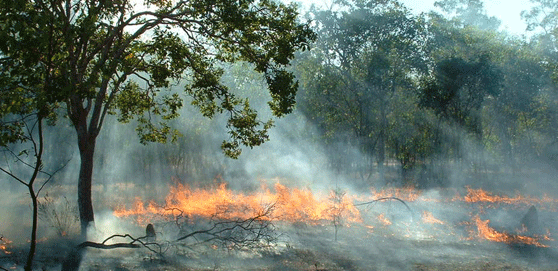
 Savanna burning: carbon pays for conservation in northern Australia http://theconversation.edu.au/savanna-burning-carbon-pays-for-conservation-in-northern-australia-12185 22 Feb 13, Fire and biodiversity have a complex relationship in northern Australia. Tim Flannery and others blame the current northern biodiversity crisis, at least in part, on changed fire regimes. Improving fire management is critical to conserving savanna landscapes – but who pays for it? A new funding model, tapping into the carbon economy, has emerged in the far north and is rapidly transforming fire management and biodiversity conservation.
A new funding model for fire management
The idea that land management could be funded by carbon credits emerged from Aboriginal-owned Arnhem Land in the Northern Territory. By the 1990s it was clear that the region’s enormous biodiversity values were being eroded by frequent, intense late dry season fires.
To address this problem, a trailblazing group of Western scientists and land managers, and Aboriginal Traditional Owners developed a program of prescribed burning early in the dry season to pre-empt large, intense wildfires late in the dry season.
The most innovative part of their work was to link improvements in fire management to reductions in greenhouse gas emissions. They also realised that this emissions reduction (or abatement) could be used to secure resources for land management. The abatement occurs because early dry season fires tend to be patchier and less intense than late season fires, and therefore burn less fuel. Because less fuel is burnt, fewer emissions are produced.
The project that resulted from this early work – the 28,000 km²West Arnhem Land Fire Abatement project – has operated since 2005 and is funded by one of the world’s largest energy companies, ConocoPhillips. They provide $1 million annually in return for an abatement of greenhouse gases equivalent to 100,000 t of CO₂. Continue reading
Arnhem Land traditional owner opposes fracking on his land
“In many ways, it’s an uncontrolled experiment on the Australian environment”
The meeting was told that about 80 per cent of Territory land and 90 per cent of its coastline are subject to mining exploration applications of some kind.
Shale gas ‘fracking’ fractures views in Top END By Andrew Thompson | ABC , 22 Feb 13, The head of an anti-fracking community group based in the eastern states has warned against the development of the shale gas industry in the Northern Territory.Farming, fishing, pastoral and environmental groups were among those represented at a Darwin meeting to discuss the controversial underground mining technique known as hydraulic fracturing, or fracking. Continue reading
Koongarra permanently protected from uranium mining
GUNDJEIHMI ABORIGINAL CORPORATION 7 Feb 13 Mirarr Traditional Aboriginal Owners today welcomed Environment Minister Tony Burke’s introduction of a bill which clears the way for the incorporation of the Koongarra area into Kakadu National Park. This move recognises the long held Aboriginal aspiration to protect this unique area from the threat of uranium mining.
The introduction of the Completion of Kakadu National Park (Koongarra Project Area Repeal) Bill was also welcomed by the Djok Senior Traditional Owner of the Koongarra area, Jeffrey Lee AM. Mr Lee was in the Federal Parliament to witness the introduction of the bill, accompanied by a delegation representing the Mirarr. Jeffrey Lee was awarded the Order of Australia in 2012 in recognition of his work to protect his country and gift it to the nation. He has firmly opposed uranium mining on his country on the grounds of the deep cultural significance of Koongarra to its Traditional Owners and concerns about the dangers of uranium.
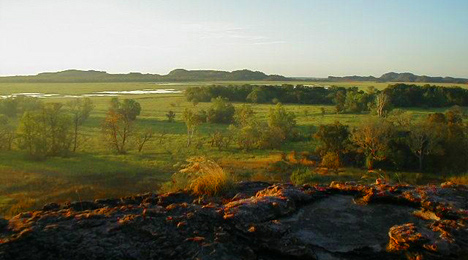
In his long struggle to protect his country Mr Lee has drawn inspiration from Yvonne Margarula, the Senior Traditional Owner of the neighbouring Mirarr people. Since the 1990s Yvonne Margarula has led the Mirarr opposition to the proposed Jabiluka mine, north of Koongarra and the existing Ranger uranium mine also on Mirarr land. Ms Margarula spearheaded the international campaign against mining at Jabiluka. Her resolve and leadership guided the campaign and prompted a special UNESCO mission, resolutions in the European Parliament and US Congress and several Australian parliamentary inquiries. In the late 1990s Ms Margarula won several prestigious international awards in recognition of her work to protect her country.
In 2001, the Rio Tinto majority owned mining company Energy Resources of Australia acknowledged the opposition of the Mirarr traditional owners and agreed to halt work at Jabiluka.
Ms Margarula said, “Traditional Owners must be allowed to make their own decisions about development on their country. Jeffrey has been speaking out to protect his country and we support him. He has always said no to mining at Koongarra and we support him when he says he wants to see that country put into the National Park. We want to see the same protection for Mirarr country.”
The Mirarr people have this month executed a renegotiated agreement for the existing Ranger mine, which was imposed on them in 1978. This agreement, along with provisions of the federal Atomic Energy Act, provides for the Ranger area to also be included into Kakadu National Park as the mine is rehabilitated.
The executive officer of Gundjeihmi Aboriginal Corporation, Justin O’Brien, said, “This action by the government is to be applauded, although the name of the bill incorrectly implies that this completes the national park. There is further work to be done and we still look forward to the day when all of Kakadu is included in the National Park and adequately protected from unwanted industrial development.”
A WRITTEN STATEMENT FROM MR LEE IS ATTACHED TO THIS STATEMENT Continue reading
Jeffrey Lee – Aboriginal elder who put his country before $millions – saving Koongarra from uranium mining
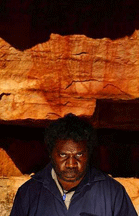 Aboriginal elder spurns million dollar offer from uranium minershttp://www.mining.com/aboriginal-elder-spurns-millions-of-dollars-from-uranium-miners-58963/Marc Howe | February 6, 2013 An elder from the Djok aboriginal community has hailed a move by the federal government to prevent the mining of uranium on his ancestral lands.
On Wednesday the federal government introduced a bill to incorporate 1228 hectares of the Koongarra, the traditional land of the Djok people, into the Kakadu National Park, thus preventing efforts by uranium mines to develop the area’s resources.
Jeffrey Lee, an elder of the Djok people, welcomed the decision after fighting for over three decades to prevent uranium extraction in the area, as well as spurning million dollar offers from miners.
“I have said no to uranium mining at Koongarra because I believe that the land and my cultural beliefs are more important than mining and money,” said Mr. Lee.
A French company reportedly offered Mr. Lee $5 million to withdrawn his opposition to uranium development plans.
Although Koongarra lies within the Kakadu area, a ruling in 1979 prevented its inclusion in the park, in order to leave open the possibility of development of its uranium resources, estimated to stand at around 14,000 tonnes.
Former Prime Minister Bob Hawke as well as Federal Environment Minister Tony Burke joined Mr. Lee to make the announcement as well as hail the government’s decision.
In depth look at plan for Ranger 3 Deeps Underground Mine- submission from Environment Centre Northern Territory
 A case in
 Submission to Ranger 3 Deeps Project underground uranium mine referral
Energy Resources of Australia Ltd/Mining/at existing Ranger uranium mine in Alligator
Rivers Region/NT/Ranger 3 Deeps Underground Mine
Reference Number: 2013/6722
31 January 2013
Prepared by
Stuart Blanch, Director, Environment Centre NT, Darwin, coordinator@ecnt.org / 0448 887 303.
The Environment Centre NT welcomes the opportunity to provide comment on the referral.
We make the following comments:
1. The Ranger 3 Deeps Project is proposed by Energy Resources of Australia (ERA) to be built inside
the World Heritage listed Kakadu National Park and surrounding internationally recognised
Ramsar wetlands of the Alligators Rivers Region. By its very nature is is a highly risky project over
the long term, given the need to manage radioactive contamination for thousands of years. The
Ranger Uranium Mine has already created very substantial long term waste management issues
over the past three decades of operation, and remains a highly controversial project in the eyes
of many Territorians and Australians.
The proposed mine is a nuclear action under the Environment Protection and Biodiversity
Conservation Act (Cth) (EPBCA). However it also poses a risk to various other Matters of National
Environmental Significance including 14 threatened species, 20 migratory species and a National
Heritage Place. ERA’s view that only one MNES, namely nuclear actions, are likely to be impacted
is fanciful and disingenuous (p81). Clearly the existing water management issues caused by three
decades of mining, let alone an even larger process water inventory, pose a significant risk to
downstream Ramsar wetlands and World Heritage values should there be an uncontrolled
discharge into Magela Creek or ongoing lateral spread of the groundwater plume underneath the
tailings dam.
Full EIS’s are regularly conducted under the EPBCA for mines that entail much less risk to species,
places and values which are legally recognised under federal environmental law and attract
protection under international agreements.
2. Underground mining at Ranger has never been subject to an EIS, and was not addressed in the
ERA’s uranium plan: Ranger 3 Deeps deposit beneath Pit 3 – could they diddle the Aborigines?
Christina Macpherson 25 Jan 13, It all looks good, that the Mirrar Aboriginal people people have at last got a fairer deal with ERA concerning their long struggle, first against, uranium mining at the Ranger site, and then to get a better deal.
The senior traditional owner of the Mirarr clan, the very highly respected Ms Yvonne Margarula, has welcomed the agreements.
These agreements do not include ERA’s new project , underground mining at Ranger 3 Deeps deposit beneath Pit 3.
This situation needs careful watching. Is the new agreement part of a softening up process by the uranium mining company, as they plan to get acquiescence from the Aboriginal people for the this next project.
It has been done before – that uranium miners have chosen to mine underground, in order to avoid the responsibility of native title issues on the surface. When they do a big shaft entry, they expand underground without involving the native title holders. a big shaft entry, they expand underground without involving the native title holders. They have been able to convince the Aboriginal owners that “the crown owns the minerals”.
ERA has recently been dealing with 30 years accumulation of radioactive waste water, at Ranger.
ERA could be a bit desperate – as recent economic history has not been kind to them In 2012 “From a share price of $18.22 in May 2009, the stock lost more than 90 per cent of its value to be languishing at $1.15 earlier this year, with the company’s future being seriously questioned. …. The goal of turning ERA into an underground miner won’t come to fruition before late 2015, and there will be myriad environmental, indigenous, government and company approvals to satisfy before then. ” http://www.smh.com.au/business/kakadus-miner-for-all-seasons-20120427-1xqg2.html#ixzz1tNGNVJGh
Mirrar Aboriginal agreement on Ranger uranium mine does not include new underground mine
Ranger uranium mine agreement updated, Gundjeihmi Aboriginal Corporation, 25 Jan 13,
The Mirarr traditional Aboriginal owners of the Ranger uranium mine area welcome the
settlement today of the long-running renegotiation of the 1978 Ranger mining agreement.
The execution today of a number of agreements and associated correspondence between
the Gundjeihmi Aboriginal Corporation (GAC), the Australian Government, miner Energy
Resources of Australia (ERA) and the Northern Land Council signals the formal conclusion of
a 14-year process of renegotiation.
Importantly, the agreements cover existing operations on the Ranger Project Area. They do
not deal with future mining beyond the existing Ranger Authority or underground mining at
the so-called Ranger 3 Deeps deposit beneath Pit 3.
The senior traditional owner of the Mirarr clan, Ms Yvonne Margarula, welcomed the end of
negotiations about the original Ranger mine. “We Mirarr are happy that today, after so long,
we have a fairer agreement for mining at Ranger,” she said. “My father never agreed to
Ranger. Our right to stop the mine was taken away by the government. It is good that after all
these years we have a better agreement for Mirarr. This will help all Bininj [Aboriginal people]
in the region.” Continue reading
ERA still planning an underground uranium mine for Northern Territory Ranger site
ERA beings approvals process for Ranger 3 Deeps uranium mine http://www. miningaustralia.com.au/news/era-beings-approvals-process-for-ranger-3-deeps-ur 16 January, 2013 Cole Latimer
Energy Resources of Australia has formally begun its statutory approvals process for the proposed Ranger 3 Deeps underground uranium mine.
It today lodged a referral with the Commonwealth Department of Sustainability, Environment, Water, Population and Communities (SEWPaC) as well as with the Northern Territory government.
It comes after the miner was accused of expanding said operations without environmental assessments.
ERA is investing around $120 million to construct an exploration decline to define its existing resource.
Construction of the decline began in May last year, with closed space drilling scheduled to commence in quarter three of this year.
The miner has also allocated an additional $57 million for a prefeasibility study into the development of an underground mine.
1 This month
7 April – WEBINAR – Australia and the Doomsday Clock – Preventing nuclear war through NoFirstUse and other policies
Online | Tuesday April 7, 4:00-5:30pm, Australian Eastern Time / 8:00-9:30am Central Europe Time
– Access the registration link
15 April – Zoom –Nuclear Power is Not the Solution
Apr 15, 2026 01:00 AM in Canberra, Melbourne, Sydney

Join the International Physicians for the Prevention of Nuclear War (IPPNW) on Tuesday, April 14th for a timely webinar exploring the risks associated with nuclear power and challenging the myth that it offers a simple, safe, carbon-free solution to the climate crisis

21 April Webinar: No Nuclear Weapons in Australia
Start: 2026-04-21 18:00:00 UTC Canberra, Melbourne, Sydney (GMT+10:00)
End: 2026-04-21 19:30:00 UTC Canberra, Melbourne, Sydney (GMT+10:00)
Event Type: Virtual
A virtual link will be communicated before the event.
Host Contact Info: australia@icanw.org

of the week – Australians for War Powers Reform (AWPR)
To see nuclear-related stories in greater depth and intensity
 Antinuclear