|
 Clean energy found to be a ‘pathway to prosperity’ for Northern Territory, Renewable energy is not only a money-spinner for the NT, it can also help mining industries expand, a new report says, Guardian, Adam Morton@adamlmorton 20 Jun 2019 Energy development in the Northern Territory is a typically Australian story: it is backing fossil fuels – in this case gas – when it could, as one of the sunniest places on Earth, be reaping economic and environmental benefits from renewable energy. Clean energy found to be a ‘pathway to prosperity’ for Northern Territory, Renewable energy is not only a money-spinner for the NT, it can also help mining industries expand, a new report says, Guardian, Adam Morton@adamlmorton 20 Jun 2019 Energy development in the Northern Territory is a typically Australian story: it is backing fossil fuels – in this case gas – when it could, as one of the sunniest places on Earth, be reaping economic and environmental benefits from renewable energy.
|
|
June 20, 2019
Posted by Christina Macpherson |
energy, Northern Territory |
Leave a comment
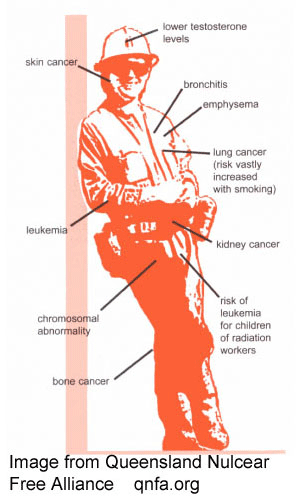 Well -they carefully haven’t kept health records, have they?
OCCUPATIONAL HEALTH AND SAFETY, Parliament of Australia
4.1 The perception that uranium mining has not led to ill health effects in workers has been created through the lack of comprehensive studies on worker health and the failure of Governments to establish a national registry for health workers. …..
Uranium mining, however, presents unique risks over other mining operations. Because of the presence of radioactive elements, uranium miners are at risk not only of immediate health problems, but of delayed fatal effects such as cancer. There is also the potential for radiation exposure to lead to illness and defects in the offspring of uranium miners
RADIATION EXPOSURE FOR URANIUM MINERS. The potentially serious effects of radiation on workers has been shown by previous mines in Australia. Evidence was given to the Committee that 40% of underground workers at the Radium Hill mine in South Australia have died of lung cancer [12]. Even with more recent mining operations it was clear that worker health and safety was not given the priority it deserves. On a trip to the closed Narbarlek mine, the Committee saw worker health records and files left scattered on the floor of an abandoned administrative building. When the Committee visited WMC’s Olympic Dam mine, it saw workers who were not wearing the Thermoluminescent Dial (TLD) badges which register their exposure to radiation. https://www.aph.gov.au/Parliamentary_Business/Committees/Senate/Former_Committees/uranium/report/d05#10
Kirsten Johnson
kirstjohn@aapt.net.au I have a father, uncle and two aunts who all worked at Rum Jungle in the 1960’s. My father and uncle passed away in their 60’s due to lung cancer. My aunt in her 60’s due to breast cancer and my other aunt who is still with us today has also had breast cancer. Surely this cannot be a coincidence and I would like to know if there is information with regards to the health impact that the Rum Jungle uranium mine has had on past workers.
Janet Dickinson nee Litchfield
dickinsonjanet@hotmail.com – I am Kirsten Johnson’s aunt, and sister to Judy, Peter and Kevin Litchfield who passed away with cancer. all having worked at Rum Jungle in the 50’s. My father in law also passed away in 1979, aged 70 from lung cancer, he worked at Rum Jungle for 20 years from 1958. I have just recently been diagnosed with inoperable lung cancer.
 Health effects on Aboriginal people near Ranger uranium mine.
….Since 1981, three years after mining began, at least 120 ‘mishaps’ and ‘occurrences’ — leakages, spillages of contaminated water, and breaches of regulations — have occurred. The Office of the Supervising Scientist has consistently claimed no harm to either the environment or human health — a claim difficult to substantiate. Since completion of the AIATSIS social impact monitoring report in 1984, there has been no monitoring of the social and physical impact on Aboriginal health and well-being, and no agency has specifically investigated the impacts on Aboriginal health.
Exploratory research undertaken in 2005 and 2006 has found a significant overall increase in the incidence of cancer among Aboriginal people in the Kakadu region — some ninety per cent greater than would be expected. We could not determine possible effects on maternal and child health because data on congenital malformations and stillbirths were not available. …. https://aiatsis.gov.au/sites/default/files/products/discussion_paper/dp20-aborigines-uranium-monitoring-health-hazards_0.pdf
June 8, 2019
Posted by Christina Macpherson |
aboriginal issues, Christina themes, health, Northern Territory |
Leave a comment

Unfinished business: Kakadu needs a new approach to cleaning up an old mine, https://www.acf.org.au/unfinished_business_kakadu_needs_a_new_approach 7 May 19, How well the Ranger uranium mine is cleaned up is key to the long-term health of Kakadu.
 A new report has found Australia’s largest national park is at long-term risk unless the clean-up of the Ranger uranium mine in Kakadu is done comprehensively and effectively.
Unfinished business, co-authored by the Sydney Environment Institute (SEI) at the University of Sydney and the Australian Conservation Foundation (ACF), identifies significant data deficiencies, a lack of clarity around regulatory and governance frameworks and uncertainty over the adequacy of current and future financing – especially in relation to future monitoring and mitigation works for the controversial mine site.
Mine operator Energy Resources of Australia (ERA) and parent company Rio Tinto are required to clean up the site to a standard suitable for inclusion in the surrounding Kakadu National Park, dual-listed on UNESCO’s World Heritage list.
“No mine in the world has ever successfully achieved this standard of clean up,” said report co-author Dr Rebecca Lawrence from SEI.
“Rehabilitating what is essentially a toxic waste dump is no easy task. Rio Tinto faces a complex and costly rehabilitation job.
“The challenge is not to simply scrape rocks into holes and plant trees, it is to make sure mine tailings, radioactive slurry and toxic by-products of mining are isolated from the surrounding environment for 10,000 years.
“To ensure this in a monsoonal environment, such as Kakadu, which is already being impacted by climate change, raises enormous environmental and governance challenges.
“For the rehabilitation process to even have a chance at success, the existing opaque and complex regulatory regime needs an urgent overhaul,” Dr Lawrence said.
Tailings, the waste material remaining after the processing of finely ground ore, are one of the serious environmental risks outlined in the report. The report examines how ERA and Rio Tinto intend to deliver on the federal government’s requirement to protect the Kakadu environment by isolating any tailings and making sure contaminants do not result in any detrimental environmental impacts for at least 10,000 years.
“Long after the miners have gone this waste remains a direct human and environmental challenge,” said report co-author Dave Sweeney from ACF.
“This issue is key to the long-term health of Kakadu but there is insufficient evidence and detail on how this work will be managed and assured in the future. Without this detail there will be a sleeping toxic time bomb deep inside Kakadu.
“At its London AGM last month Rio again committed to make sure ERA has the financial resources to deliver its rehabilitation obligations, however the financial mechanism to do so remains undisclosed.
“The community and environment of Kakadu need certainty and a comprehensive clean up.
“This work is a key test of the commitment and capacity of Northern Territory and Commonwealth regulators as well as the mining companies.”
The report makes recommendations to improve the chances of a successful clean-up at Ranger. It calls for increased transparency, public release of key project documents, a better alignment of research and operations and open review processes for key decision points.
The full report is here.
May 7, 2019
Posted by Christina Macpherson |
environment, Northern Territory, uranium |
Leave a comment
NT moves to clarify offshore oil, gas industry’s nuclear waste obligations http://m.miningweekly.com/article/nt-moves-to-clarify-offshore-oil-gas-industrys-nuclear-waste-obligations-2019-02-15
15th February 2019 BY: ESMARIE IANNUCCI CREAMER MEDIA SENIOR DEPUTY EDITOR: AUSTRALASIA PERTH – The Northern Territory has passed the Nuclear Waste Transport Storage and Disposal (Prohibition) Amendment Bill, providing the offshore oil and gas industry with a blueprint of their obligations around the management of nuclear waste.
The nuclear waste covered by the Bill included naturally occurring radioactive materials (NORMs) that could be incidentally generated from offshore oil and gas activities and subsequently brought into the Northern Territory, Environment and Natural Resources Minister Eva Lawler said.
“The Bill demonstrates the Northern Territory government’s commitment to protecting the Territory’s environment, while listening to and responding to concerns raised by the offshore oil and gas industry about the ambiguities in the regulatory environment.
“The Amendment Bill addresses ambiguities in exemptions for nuclear waste, including NORMs that may be created as a by-product of industry activities.”
NORMs are widespread in sands, clay, soils and rocks and many ores and minerals, commodities, products and by-products.
Lawler said that the amendments to this Bill became necessary after uncertainties were raised by industry about whether NORMs were exempt from the Act. The Amendment Bill reframes the exemptions while maintaining the Parliament’s original intention when passing the original Act.
She noted that the Northern Territory maintains a strong environmental stance against nuclear waste being dumped in the Territory, and from becoming a nuclear waste dump for the rest of Australia.
“Jobs are the number one priority for the Territory Labor government and we believe that good environmental policy makes good economic sense,” Lawler added.
February 16, 2019
Posted by Christina Macpherson |
legal, Northern Territory, politics |
Leave a comment
 Climate change eats away at Torres Strait islands, prompting calls for long-term solutions, ABC Far North
By Anna Hartley 8 Feb 19, Rising sea levels, coastal erosion, unpredictable winds and destructive king tides are increasing problems in the Torres Strait, with roads, buildings and even cemeteries being washed away in recent years.
A flood prevention method that withstood wild weather this week may be rolled out to other vulnerable Torres Strait communities, including Yam Island where families were left homeless after king tides last year.
Torres Strait Island Regional Council deputy mayor Getano Lui said geotextile sandbags were used for the first time in the Torres Strait this week when abnormally high tides impacted Poruma Island, a cultural hub home to just 200 people.
“It’s getting worse every year,” he said.”Climate change is really having a detrimental effect on all the communities.
“When I was growing up the elders could predict the weather but right now it’s unpredictable.
“The worst is yet to come this year, the king tides are predicted [on February 19] and anything could happen, we could end up with the same catastrophe as Yam Island last year.”
Connection to land, culture under threat
Research from the Torres Strait Regional Authority shows sea levels are rising by 6mm each year — double the global average.
“If this trend continues, relocation is an option many of those on the Torres Strait’s 200 islands and coral cays may be faced with,” Mr Lui said.
“What is instilled in us and our ancestors is if the Torres Strait sinks, we’ll sink with it.
“We would be very reluctant to be relocated.
“Most of us would refuse to leave.”
Torres Shire Council mayor Vonda Malone said the region’s two councils would now look at installing the sandbags on other vulnerable islands such as Yam Island, Masig Island and Boigu.
“The weather over the last two weeks has been unpredictable; it has been full on,” she said…..
Sinking cemeteries a concern for State MP
….https://www.abc.net.au/news/2019-02-09/call-for-increased-flood-protection-in-torres-strait/10794696
February 8, 2019
Posted by Christina Macpherson |
climate change - global warming, Northern Territory |
Leave a comment
Ranger mine closure costs to hit more than $800m NT News, 18 Jan 19, The Northern Territory’s Ranger mine is counting the millions — more than $800 million to be exact — to move the mine, which is surrounded by Kakadu National Park, towards full closure…. (subscribers only)
January 19, 2019
Posted by Christina Macpherson |
Northern Territory, uranium |
Leave a comment
|
  Maryfield Station’s land-clearing permit becomes first in NT to face legal challenge over climate change, ABC News, 8 Dec 18 Maryfield Station’s land-clearing permit becomes first in NT to face legal challenge over climate change, ABC News, 8 Dec 18
By Jaqueline Breen Potential greenhouse gas emissions from the Northern Territory’s largest-ever land-clearing project were not weighed because their impact on global warming could not be measured, the head of an environmental watchdog says.
Key points:
- A permit was approved in 2017 to clear more than 20,000 hectares of native vegetation at Maryfield Station
- The EPA did not request an environmental impact assessment before awarding the permit
- This decision is facing a legal challenge over potential climate change impacts
Paul Vogel gave evidence this week in a landmark challenge brought against the EPA’s decision to not require an environmental impact assessment of a proposal to clear 20,000 hectares at the Maryfield cattle station south of Darwin.
The case is considered to be the first in the Northern Territory to challenge the approval of land clearing on the basis of climate change impacts.
Lawyers for the Environmental Defenders Office NT argued the authority was wrong in regarding itself unable to consider the impact of the clearing’s emissions because the Northern Territory had no climate policy and because the emissions would not have a nationally significant environmental impact.
The Supreme Court heard that estimates of the likely emissions were not provided to EPA members in the briefing papers prepared for them, despite officers from the Department of Environment and Natural Resources calculating an estimate of 2.3 megatonnes or 18.5 per cent of the NT’s total annual emissions for 2015.
Dr Vogel said while the EPA seeks to ensure that proponents keep emissions as low as possible, the impact of activities from individual projects on climate change is not measurable………..
Proposal raised ‘flashing red’ concerns: EPA member
The Environmental Defenders Office (EDO) lawyers also argued the authority’s decision was invalid because the EPA had not followed its own meeting procedures nor voted on the final decision.
Emails discussed in court between the EPA decision-makers, who mostly live outside the Territory, revealed concerns raised by a number of members.
“For many projects with a much smaller area involved we have required extensive flora and fauna surveys.”
Mr Wallis said the land-clearing proposal should be exposed to public scrutiny through an assessment process.
Another EPA member suggested the authority clear the project for approval only on the basis that it ensure recommended conditions were met.
Recommendations were made but some of the conditions were then rejected by the Pastoral Land Board, which ultimately approved the clearing.
The matter will return to court later in December. https://www.abc.net.au/news/2018-12-08/nt-land-clearing-climate-change-legal-stoush-supreme-court/10590808
|
|
December 10, 2018
Posted by Christina Macpherson |
climate change - global warming, legal, Northern Territory |
Leave a comment
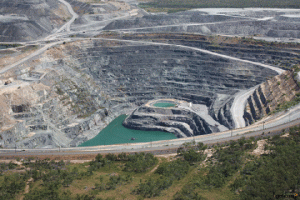 World Nuclear News 7th Dec 2018 The estimated rehabilitation costs for the Ranger Project Area inAustralia’s Northern Territory have increased from AUD512 million (USD370
million) to AUD808 million, Energy Resources of Australia (ERA) has
announced. The estimate is based on preliminary findings from a feasibility
study which will be finalised in early 2019.
http://www.world-nuclear-news.org/Articles/ERA-updates-Ranger-rehabilitation-costs
December 10, 2018
Posted by Christina Macpherson |
business, Northern Territory, uranium |
Leave a comment
Jabiru native title claim victory for Mirarr traditional owners https://www.abc.net.au/news/2018-11-09/mirarr-country-jabiru-native-title-determination-nt/10479708
Traditional owners in Jabiru, 300 kilometres east of Darwin, are celebrating after their native title rights and interests were successfully recognised under Australian law.
Key points:
- Native Title application first lodged on behalf of the Mirrar people in 1998
- Determination gives native title parties security to ensure their rights are protected
- As mining interests leave, traditional owners hope to revitalise the struggling town
Generations of Mirarr people have lived traditionally and used the land within the World Heritage-listed Kakadu National Park for thousands of years.
In 2017, researchers uncovered a wealth of artefacts on Mirarr country which indicated humans reached Australia at least 65,000 years ago — up to 18,000 years earlier than archaeologists previously thought.
Today, a special on-country hearing will be held to present the Mirarr native title holders, led by five senior women, with hard copies of the native title determination over areas of the Jabiru township. Continue reading →
November 9, 2018
Posted by Christina Macpherson |
aboriginal issues, Northern Territory |
Leave a comment
 Rio Tinto offloads NT uranium asset to Laramide, Australian Mining Ewen Hosie
November 7, 2018 Rio Tinto has finalised its sale of the Murphy uranium tenements in the Northern Territory to Canadian company Laramide Resources.
The Murphy uranium tenements, located near the Queensland-NT border, were responsible for the production of high-grade uranium in the 1950s but have not seen much exploration since the 1970s. The tenements are contiguous to Laramide’s Westmoreland project in northwest Queensland.
The acquisition comprises the EL 9319 and EL 9414 exploration licences and several other applications across 683 square kilometres.
Laramide has paid Rio the first of three $150,000 cash payments to Rio Tinto as laid out in the terms of the agreement announced in July this year…….https://www.australianmining.com.au/news/laramide-completes-acquisition-rio-tinto-uranium-tenements-nt/
November 8, 2018
Posted by Christina Macpherson |
business, Northern Territory, uranium |
Leave a comment
16 October 2018 ‘A group of Traditional Owners from the Northern Territory are in Sydney this week
to challenge Origin Energy over claims it has consent for controversial gas fracking plans
across some of the Northern Territory’s most pristine
landscapes, waterways and iconic tourism regions.
‘Traditional Owners, the Protect Country Alliance and supporters will address
a press conference prior to the AGM, coinciding with the launch of a national campaign
calling on Origin to drop plans to frack the Northern Territory. …
‘Stuart Nuggett [TraditionalOwner] has travelled from the remote township of Elliott
to attend the AGM on behalf of his community, a region at the heart of Origin’s fracking permit acreage:
‘“Our communities haven’t been given enough information about what Origin is planning for our region.
We are worried about the risks fracking brings.
I have concerns over what the impact could be on water. Water is life.
I want the company to listen to our concerns and act on them.”
‘May August is an Alawa grandmother and Traditional Owner
for land under the Origin exploration permits:
‘“We don’t want fracking to start in our area because we have seen
the damage Origin and other companies have done elsewhere in Australia. … ‘
dontfracktheterritory.org/media-release-native-title-holders-launch-campaign-challenging-origin-energy-over-nt-fracking-consents/
October 23, 2018
Posted by Christina Macpherson |
aboriginal issues, environment, Northern Territory |
Leave a comment
ABC, By Jane Bardon 16 Oct 18 A group of Indigenous traditional owners from remote parts of the Northern Territory will travel to Origin Energy’s annual general meeting in Sydney on Wednesday to tell shareholders they have not given permission for the company to frack their land for gas.
Key points:
- A group of Indigenous traditional owners will soon tell Origin Energy shareholders they did not give consent for its planned developments
- They will ask the company to review consent agreements
- But the company is confident traditional owners already gave consent
Origin Energy gained official approvals for gas exploration, including test fracking, in the gas-rich Beetaloo Basin, both from traditional owners through the Northern Land Council, and the Northern Territory Government.
But some of the traditional owners plan to tell the shareholder meeting they oppose fracking, and did not give their “free, prior and informed consent”.
They hope to tell the meeting when permission for fracking was sought by Origin Energy, they did not fully understand the company’s explanations of processes, or the potential size of developments potentially numbering hundreds of wells.
“The letter that we’re bringing up to Origin, we want that to be recognised, and to be respected for who we are,” Alawa traditional owner Naomi Wilfred said.
The Alawa traditional owner, whose country includes Nutwood Downs in the northern part of Origin Energy’s EP98 permit area, said she is worried about potential environmental impacts if production goes ahead……..http://www.abc.net.au/news/2018-10-16/indigenous-traditional-owners-origin-energy-fracking-consent/10379162
October 16, 2018
Posted by Christina Macpherson |
aboriginal issues, Northern Territory |
Leave a comment

Kakadu at a crossroads: Traditional owners welcome call to restore park to its former glory http://www.abc.net.au/news/2018-06-29/kakadu-at-a-crossroads:-traditional-owners-tourism/9921510 By Felicity James
Calls to restore Kakadu National Park to its former glory have come as “music to the ears” of some of its traditional owners.
On Thursday, a joint standing committee on Northern Australia released more than 30 recommendations to improve tourism in remote parts of the Northern Territory, Queensland and Western Australia.
Among those, it called for investment in infrastructure and access to Kakadu National Park, about 150 kilometres south-east of Darwin.
It also called for airports at Jabiru and Cooinda to be upgraded.
Visitation numbers to the dual World Heritage-listed park have dropped by more than 40,000 since 2008, according to data from Parks Australia.
The Gundjeihmi Aboriginal Corporation — representing the traditional owners for parts of Kakadu National Park, the Mirrar clan — has been working on a related master plan for the nearby mining town of Jabiru.
“This report is music to our ears,” said Justin O’Brien, Gundjeihmi’s chief executive.
The committee also recommended the Federal Government set up a peak body for Indigenous tourism operators, working with the Northern Territory, Queensland, and Western Australia.
“For places like Kakadu to be genuine and to be durable, you need genuine relationships and partnerships with Aboriginal people,” Mr O’Brien said.
“For too many years Kakadu’s been unloved, infrastructure’s slipped back, the marketing distribution model has never been properly revised.
“Why not do that now? If mining is leaving, we need to transition.”
Mr O’Brien said he and former NT chief minister Clare Martin met with Federal Government politicians, advisers and bureaucrats in Canberra this week about the future of Jabiru as a Kakadu tourism hub.
He said there was now “in principle” support for the idea after several positive meetings.
“We have in principle support for a strong future for the town, for the town to play a pivotal role in the development of Indigenous tourism across the area,” he said.
“Hopefully we’ll be in a position to announce some great news about Jabiru in the next few months.”
Kakadu ‘tired’ for decades: Tourism body
Tourism Top End, a peak body for tourism businesses in the NT, said the industry had been pushing for upgrades for the “tired” Kakadu National Park for decades.
“It’s been on everyone’s lips in the tourism industry for a very long time,” general manager Trevor Cox said.
“The toilets, the shower blocks, but also getting to our attractions, so the roads infrastructure needs upgrading, the signage needs upgrading, interpretations need upgrading.
“Those sort of things that just put the edge on a visit to a destination — they’re the things that are lacking.”
Kakadu Tourism told the inquiry visitor numbers to the national park had decreased “over recent years” and despite an “encouraging turnaround” in 2016, there was still a “declining trend”.
“So it’s really now up to the Federal Government to roll the sleeves up, release some funding to Parks Australia so we can get Kakadu up to speed,” Mr Cox said.
June 29, 2018
Posted by Christina Macpherson |
environment, Northern Territory |
Leave a comment
‘Chief minister says ‘nothing is on or off the table’ for new treaty agreement signed in Barunga’
Lorena Allam Sat 9 Jun 2018
‘Gunner told the crowd he was proud to have signed the memorandum of understanding,
calling it “the most significant Aboriginal affairs reform in the NT this generation”. … ‘
‘The chairman of the Northern Land Council, Samuel Bush-Blanasi,
said it was “momentous.”
‘“We’ve got a big journey ahead of us.
The MOU gives us high hopes about the future, and
I hope the government stays true to the spirit of the MOU.”
‘That note of hope was echoed by the chairman of the Central Land Council, Francis Jupurrurla Kelly.
‘“I hope a treaty will settle us down together and bring self-determination.
‘“Today we bounced the ball,” Jupurrurla Kelly said,
“but we don’t want to stay the only players in the game.
The next steps must be led by Aboriginal people across the Territory so that
… everyone can have their say.”
‘Tiwi Land Council’s Gibson Farmer Illortaminni was more cautious.
“We’ve got to be careful and understand each other about what we want,
because we don’t want to have the same problems we’ve had in the past.
The MOU is a good start, but we’ve got a long way to go.”
‘The treaty agreement kicked off the annual Barunga festival.
Read more:
www.theguardian.com/australia-news/2018/jun/09/historic-northern-territory-treaty-agreement-means-the-old-way-is-finis
June 10, 2018
Posted by Christina Macpherson |
aboriginal issues, Northern Territory |
Leave a comment
Northern Land Council, 5 June 2018 The Northern Land Council and Gundjeihmi Aboriginal Corporation welcome today’s public release of the Ranger Mine Closure Plan by Energy Resources of Australia. The plan is decades overdue and critical to the company meeting the objectives of rehabilitation.
The NLC and GAC, representing the Mirarr Traditional Aboriginal Owners of the mine site, will now review the plan and engage with stakeholders as part of the approval process. While not part of a public environmental impact statement process, the public release of the plan does provide the broader community with an opportunity to comment on the plan to the Australian government.
The Mine Closure Plan is of a very high level and even though Ranger’s closure is imminent, a significant amount of detailed planning and supporting studies remain outstanding. ERA and its parent company Rio Tinto must clearly demonstrate that they have sufficient resources devoted to mine closure to provide stakeholders with confidence that the objectives outlined in the closure plan can be met.
The Ranger plan remains unenforceable until it is approved by the federal Minister for Resources. The mine’s operational life must cease by January 2021, ahead of five years’ rehabilitation. The future of Aboriginal communities downstream of the mine and the World Heritage listed values of Australia’s largest national park are at stake.
ERA and Rio Tinto’s rehabilitation obligations include remediation of the site such that it can be incorporated in the surrounding Kakadu National Park. The final determination as to whether the area can be incorporated into the World Heritage area sits with the UNESCO World Heritage Committee, on advice from its expert advisory bodies the International Union for Conservation of Nature (IUCN) and International Council on Monuments and Sites (ICOMOS).
NLC contact: Martha Tattersall 0427 031 382 GAC contact: Kirsten Blair 0412 853 641
http://gac-v3.katalyst.com.au/media/W1siZiIsIjIwMTgvMDYvMDQvM3plYWpidjJ1al8yMDE4MDQwNl9HQUNfTkxDX3JlX0VSQV9SVU1fTUNQXzVfSnVuZV8yMDE4LnBkZiJdXQ/20180406%20GAC%20NLC%20re%20ERA%20RUM%20MCP%205%20June%202018.pdf
June 6, 2018
Posted by Christina Macpherson |
Northern Territory, uranium, wastes |
Leave a comment








 Antinuclear