Financiers shun nuclear, upbeat on climate investment
By Marion Rae, March 25 2024 https://www.canberratimes.com.au/story/8566564/financiers-shun-nuclear-upbeat-on-climate-investment/
Nuclear energy is last on the list of technologies that investors want exposure to, according to a survey of big institutions.
The vast majority of investors do not see nuclear power as a good investment, with less than one in 10 exploring this technology, the survey released on Monday found.
Opposition Leader Peter Dutton is spruiking nuclear reactors as an option for Australia’s future low-carbon economy although the energy source is illegal under existing laws and Labor has ruled it out.
Renewable energy is tipped to deliver the best long-term financial returns, with half the investors surveyed exploring opportunities to invest.
Investors have also become more confident about Australian climate policy under the Albanese government, according to the survey by the Investor Group on Climate Change.
“Investors have given the government a pretty good report card,” the group’s policy chief Erwin Jackson said.
But Australia will need globally competitive, targeted incentives to suit the nation’s economic strengths and values to stop “ongoing capital flight” to the United States and Europe where there are more generous tax breaks.
Clear timelines for the phase-out of fossil fuels by 2050 would also help investors manage transition risks and remain invested in the Australian economy, according to the group.
This year’s data includes 63 superannuation funds as well as other asset owners and managers, with more than $37 trillion in assets under management globally. Their beneficiaries include more than 15 million Australians.
Emerging priorities include clear timelines for phasing out coal, oil and gas and clear policies to build resilience and adapt to physical damage from climate change.
Opinions citing policy and regulatory uncertainty as a barrier to clean economy investment in Australia have changed dramatically, supported by four out of 10 investors compared with 7 out of 10 in 2021.
Renewable energy (47 per cent) was picked as the best option for long-term climate solutions, followed by nature-based schemes including biodiversity projects (34 per cent).
But investors are still in the dark on the federal government’s sector-by-sector decarbonisation plans for heavy polluters such as the energy, transport, agriculture and resources industries – and on the scope of the 2035 emissions reduction target.
“Credible and clear sector by sector decarbonisation plans to achieve a 2035 target with the highest possible level of ambition are critical for investment and it is critical to build on the steps already taken,” Mr Jackson said.
Climate Change and Energy Minister Chris Bowen has said the 2035 target will be “ambitious and achievable”, with advice to come from Australia’s recently beefed-up Climate Change Authority.
The sectoral review by the authority has an August 1 deadline, and will be released shortly afterwards.
Australian Associated Press
Sinking billions: undergunned and overpriced

Missing records, billions in over-runs, conflicts of interest, and flawed ships. How the Defence Department’s new frigates project is a boondoggle for a British weapons-maker.
MICHELLE FAHY, JUL 3, 2023, https://undueinfluence.substack.com/p/sinking-billions-undergunned-and?utm_source=post-email-title&publication_id=297295&post_id=132705738&isFreemail=true&utm_medium=email
Part one of a two-part series.
In this two-part investigation, Declassified Australia examines the flawed contracting process that led to a $46 billion naval ship-building deal that has been found to be suffering what an investigative audit described as ‘corruption vulnerabilities’.
The company at the centre of the scandal, UK arms giant BAE Systems, is revealed to have lied to Australia’s Defence Department about the planned ship’s design.
Crucial departmental records of key decision-making meetings have gone missing, while no overall assessment of whether the selected BAE design was value for money was ever made.
The Australian National Audit Office (ANAO) reported in May its findings on the multi-billion dollar contract Australia signed in December 2018 with BAE Systems to build nine Hunter-class frigates.
The ANAO found that BAE had overstated – bureaucratic language for lied – the level of development of the frigate’s design, which meant cost inflation and schedule slippage were severely under-estimated.
BAE exaggerated the maturity of its design to get around a key government objective requiring the ship to be based on an existing military-off-the-shelf design with a minimum level of change.
Defence selected the BAE Systems frigate even though the two other ships on its shortlist were considered the two most viable designs.
Business as usual
Conflicts of interest, secret consulting deals, and revolving door appointments all undermine democracy, yet this is business-as-usual at the Defence Department, the nation’s biggest procurement agency.
Former senior BAE executives have been placed at the heart of Australia’s naval procurement. They have helped write government shipbuilding policy, overseen the navy’s largest tenders, and have even been hired by the government to negotiate on its behalf with their former employer on a deal now found to be riddled with probity concerns.
Granting preferential access to certain arms industry insiders escalated under previous Liberal-National coalition governments and since 2022 has continued under the Albanese Labor government, making this a story about state capture as well, when a corporation has the power to bend governments to its will.
When combined with departmental corruption or incompetence, or both, the result is defence procurement projects that are billions of dollars over budget and running years late. As a result, the navy is facing massive capability gaps.
Continue reading this story at Declassified Australia…
Nuclear energy debate ‘many years’ away: Qld Deputy Opposition leader
Queensland Deputy Opposition leader Jarrod Bleijie claims the nuclear energy debate is “many years” away as he focuses on lowering power prices in the immediate future.
Mr Bleijie said he is focusing on making sure energy is affordable and reliable as the Opposition pushes to bring its coal power stations back online.
“There is a lot of water to go under that bridge before that is the case and I suspect we will be at an election before our federal counterparts,” Mr Bleijie told Sky News Australia.
“I stood at the booths in Ipswich West and Inala and every second person was talking about the cost of living crisis in Queensland now.
“People are hurting, they need to see their electricity bills reduced now and that has to be our priority.”
NUCLEAR POWER STATIONS ARE NOT APPROPRIATE FOR AUSTRALIA – AND NEVER WILL BE

Climate Council, 15 Mar 24
The prospect of nuclear power in Australia has been a topic of public debate since the 1950s. While Australia has never had a nuclear power station, we do have 33% of the world’s uranium deposits and we are the world’s third largest producer of it. Periodically, as with the changing of the seasons, various individuals appear in the media singing the virtues of nuclear energy – claiming it is the only option for clean and reliable electricity in Australia.
In fact, over one third of Australia’s electricity is already powered by renewables, and new initiatives like the Capacity Investment Scheme are set to push us towards 82% renewable energy by the end of this decade. While the move to clean energy is still not happening fast enough, it is underway and starting to speed up. We do not need distractions like nuclear to derail our progress now, so let’s set the record straight.
Why doesn’t nuclear power make sense for Australia?
1. Nuclear power stations can’t be built anywhere in Australia.
They are banned in every state, and in every territory. Such bans were introduced because of community concerns about the health and environmental risks. Many parliamentary inquiries at a federal and state level – see this Victorian Inquiry, this Federal Inquiry, and this South Australian Inquiry for instance – have been held into nuclear energy, and all have concluded that it makes no sense in Australia.
2. Nuclear power stations are expensive and take too long to build.
Australia’s independent science information agency, CSIRO, has found that solar and wind are by far the cheapest ways of producing electricity(even when factoring in storage). In contrast, the cost of building and operating nuclear in Australia remains prohibitively high.
Analysis conducted by the nuclear industry itself shows nuclear power stations take an average of 9.4 years to build – compared to 1–3 years for a major wind or solar project. Australia needs to replace its ageing coal-fired power stations as quickly as possible to rapidly reduce emissions this decade. As shown in the Australian Energy Market Operator’s Integrated System Plan, by far the cheapest and quickest way to do this is to ramp up renewable energy paired with storage like pumped hydro, and batteries.
3. Nuclear power poses significant community, environmental, health and economic risks.
Radiation from major nuclear disasters, such as Chernobyl in 1986 and Fukushima in 2011, have impacted hundreds of thousands of people and contaminated vast areas that take decades to clean up. Even when a nuclear power station operates as intended, it creates a long-term and prohibitively expensive legacy of site remediation, fuel processing and radioactive waste storage.
4. Nuclear power is not renewable, and it is not safe.
Uranium is a finite resource just like coal, oil and gas. It needs to be mined and, just like mining coal, oil and gas, this carries serious safety concerns, including contaminating the environment with radioactive dust, radon gas, water-borne toxins, and increased levels of background radiation. On the other hand, energy generated from the sun and wind releases no pollutants into the air and is overwhelmingly considered to be safe.
There you have it: nuclear power is expensive, illegal, dangerous and decades away from powering our homes and businesses. It makes no sense. On the other hand, energy from the sun and wind is cheap, abundant, safe and available now. So, let’s get on with building more renewable energy!
What is a nuclear power station?…………………………………………………
Unlike coal and gas, no greenhouse gas pollution is created in the operation of the nuclear reactor. However, all other steps involved in producing nuclear power – from mining, to construction, decommissioning and waste management – result in greenhouse gas pollution.………………………….
Case Study 1: Hinkley Nuclear Power Station, United Kingdom………………………
Case Study 2: NuScale Power, United States of America……………………………..
Meeting the climate challenge means taking bold and decisive action this decade with the technologies that are ready to go in Australia today. The significant limitations nuclear energy faces means that there is no real prospect of it playing a role in reducing Australia’s emissions.
Reversing Europe’s and Australia’s slide into irrelevance & insecurity – National Press Club of Australia speech- Yanis Varoufakis

First, Australia must restore a reputation tainted by blindly following America into lethal adventures in Iraq, Afghanistan and, today, via its active and crucial complicity in Israel’s deliberate war crimes in Gaza, East Jerusalem and the West Bank.
Children are not starving in Gaza today. No, they are being deliberately starved. Without hesitation or remorse. The famine in Gaza is no collateral damage. It is an intentional policy of starving to death thousands until the rest agree to leave their ancestral homeland.
Second, Australia has a duty to de-escalate the New Cold War. To understand that this can only be done if Australia ends its servility to a United States’ actively creating the threats that they then make us pay through the nose to protect us from.
Imagine an Australia that helps bring a just Peace in Ukraine, as opposed to a mindless forever war. A non-aligned Australia that is never neutral in the face of injustice but, also, not automatically aligned with every warmongering adventure decided in Washington.
Imagine an Australia which, having re-established its credentials as a country that thinks and acts for itself, engages with China in the spirit of peaceful cooperation – a far better way of addressing Beijing’s increasing authoritarianism toward its own peoples than buying useless, hyper-expensive submarines that only succeed in forcing China’s political class to close ranks around a more authoritarian core.
Imagine a truly patriotic Australian Prime Minister who tells the American President to cease and desist from the slow murder of Julian Assange for the crime of journalism – for exposing American war crimes perpetrated behind the back of US citizens in their name.
To conclude, if Europe and Australia are to escape gross irrelevance, we need separate but well-coordinated European and Australian Green New Deals.
DiEM25, our paneuropean movement, is working toward this goal.
Yanis Varoufakis – 14/03/2024
Europe and Australia are facing a common existential threat: a creeping irrelevance caused, on the one hand, by our failure properly to invest and, on the other hand, by our ill-considered slide from a strategic dependence on the United States to a non-strategic, self-defeating servility to Washington’s policy agenda.”
Yanis Varoufakis’s address at the National Press Club in Canberra on Wednesday 13 March, 2024
…………………………………. The three post-war phases that shaped Australia’s and Europe’s habitat
Our present moment in Europe and in Australia has been shaped by three distinct postwar phases.
The first was the Bretton Woods system. America exited the war as the only surplus, creditor country. Bretton Woods, a remarkable recycling mechanism, was, in effect, a dollar zone built on fixed exchange rates, sustained by capital controls, and erected on the back of America’s trade surplus. With quasi-free trade as part of the deal, Washington dollarised Europe, Japan and Australia to generate aggregate demand for the products of its factories – whose productivity had skyrocketed during the war. Subsequently, the US trade surplus sucked the exported dollars back into America. The result was twenty years of high growth, low unemployment, blissfully boring banking and dwindling inequality. Alas, once the United States lost its trade surplus, Bretton Woods was dead in the water.
The second phase was marked by the violent reversal of this recycling mechanism. The United States became the first hegemon to enhance its hegemony by boosting its trade deficit. Operating like a powerful vacuum cleaner, the burgeoning US trade deficit hoovered up the world’s net exports. And how did America pay for them? With dollars which it also hoovered up from the rest of the world as German, Japanese and later Chinese capitalists sent to Wall Street 70% of dollar profits made from their net exports to the US. There, in Wall Street, these foreign capitalists recycled their dollar profits into Treasuries, real estate, shares and derivatives.
This audacious inverted recycling system, built on US deficits, required ever increasing American deficits to remain stable. In the process, it gave rise to even higher growth than the Bretton Woods era, but also to macroeconomic and financial imbalances as well as mind-numbing levels of inequality. The new era came complete with an ideology (neoliberalism), a policy of letting finance rip (financialisation), and a false sense of dynamic equilibrium – the infamous Great Moderation built on hugely immoderate imbalances.
Almost inevitably, on the back of the perpetual tsunami of capital rushing in from the rest-of-the-world to Wall Street, financiers fashioned gigantic pyramids of complex wagers – Warren Buffet’s infamous Weapons of Mass Financial Destruction. When these crashed, to deliver the Global Financial Crisis, two things saved Wall Street and Western capitalism:
- The G7 central banks, that printed a total of $35 trillion on behalf of the financiers from 2009 to last year – a peculiar socialism for bankers. And,
- China, which directed half its national income to investment, thus replacing much of the lost aggregate demand not only domestically but also in Germany, Australia and, of course, in the United States.

The third period is more recent. The era of technofeudalism, as I call it, which took root in the mid-2000s but grew strongly after the GFC in conjunction with the rapid technological change that caused capital to mutate into, what I call, cloud capital – the automated means of behavioural modification living inside our phones, apps, tablets and laptops. Consider the six things this cloud capital (which one encounters in Amazon or Alibaba) does all at once:

- It grabs our attention.
- It manufactures our desires.
- It sells to us, directly, outside any actual markets, that which will satiate the desires it made us have.
- It drives and monitors waged labour inside the workplaces.
- It elicits massive free labour from us, its cloud-serfs.
- It provides the potential of blending seamlessly all that with free, digital payments.
Is it any wonder that the owners of this cloud capital – I call them cloudalists – have a hitherto undreamt of power to extract? They are, already, a new ruling class: today, the capitalisation of just seven US cloudalist firms is approximately the same as the capitalisation of all listed corporations in the UK, France, Japan, Canada and China taken together!
Continue readingDutton’s blast of radioactive rhetoric on nuclear power leaves facts in the dust

Graham Readfearn, Guardian, 14 Mar 24
Coalition’s claim of cheap power and quickly built reactors is at odds with real world experience of other countries.
We may not yet be entering a nuclear age in Australia, but we would all be best advised to handle the rhetoric around the issue as carefully as we would radioactive waste.
This week opposition leader Peter Dutton said an annual CSIRO report that had included estimates of costs for small modular reactors – which are not yet available commercially – was “discredited” because it “doesn’t take into account some of the transmission costs, the costs around subsidies for the renewables”.
Dutton is referring to a report known as GenCost, which calculates the cost of generating electricity from different technologies when fuel, labour and capital are included. This metric is known as the levelised cost of electricity.
Despite Dutton’s claim, the most recent GenCost report does include the cost of integrating renewables such as solar and wind into the electricity grid. That is, it includes the cost of building new transmission lines and energy storage such as batteries.
The most recent GenCost report estimates a theoretical small modular reactor built in 2030 would cost $382 to $636 per megawatt hour. It says this is much more expensive than solar and wind, which it puts at between $91 and $130 per MWh even once integration costs are included.
The calculations in GenCost don’t include subsidies for any generating technologies – including renewables or future SMRs.
The cost estimates for SMRs are challenging because no commercial plant has been built. But the closest a project has got to existing – the Carbon-Free Power Project in Utah – was cancelled late last year primarily because the cost of the power would have been too high. And that project was given more than $2bn from the US Department of Energy.
Mycle Schneider is an independent nuclear expert and coordinator of the annual World Nuclear Industry Status report that tracks nuclear power development around the globe. He points to research from US financial group Lazard that says in the US, the costs of unsubsidised solar and wind including firming costs, such as batteries, range from US$45 to $141 per MWh compared to new-build nuclear at US$180 per MWh.
Ramping up the nuclear rhetoric
On Tuesday, Dutton said he would soon reveal six potential sites for nuclear reactors around Australia – likely to be close to, current or retiring coal-fired power stations.
Shadow energy minister Ted O’Brien claimed this week Australia could have nuclear power “up and running” within a decade.
“Nuclear ‘up and running within a decade’ does not fit with the experience we have seen elsewhere,” said Prof MV Ramana, a nuclear expert at the University of British Columbia and a contributor to the nuclear industry status reports.
Ramana points to Finland that has operated reactors since the 1970s, where parliament voted in 2002 to add a fifth reactor to the country’s fleet. Work started in 2005 but the reactor didn’t connect until 2022 “almost exactly 20 years after the parliamentary vote,” he said.
“We can see similar long periods of time between decisions to build reactors and when they start operating, again in countries that already have nuclear plants, in countries like the United States and the United Kingdom.”
Dutton and O’Brien have both said there are 30 economies around the world using nuclear and “50 more” that want to.
But Schneider says there are actually 32 countries with nuclear reactors, “but the top five generators produced 72% of the nuclear electricity in the world.”
“Over the past 30 years, only four countries started nuclear programs (Romania, Iran, Belarus, UAE) and three phased out their programs (Kazakhstan, Lithuania, Germany). There are reactors under construction in three more newcomer countries (Bangladesh, Egypt, Turkiye). Most other ‘plans’ are vague.”
The UAE – a model case study?
On Sky News, O’Brien pointed to the United Arab Emirates as a country that had commissioned South Korea’s Kepco to build four reactors of the size that could be considered for Australia in less than a decade.
In fact, each of the 1.4GW UAE plants was expected to be delivered in five years, but took eight, according to the industry status report. And it took 12 years from the announcement of the plan in 2008, to the first unit coming online in 2020.
The problem with using the UAE as a case study is that it is not a democracy, but an autocracy.
“The UAE is not a good model for Australia,” Ramana said………………………………………..
Reactor reactions
Experts have told the Guardian that even if Australia were to remove its federal and state bans on nuclear energy, it would be unlikely to see reactors generating power until the 2040s – at which point most, if not all, of Australia’s coal-fired power will have been turned off years earlier. One nuclear advocate questioned whether Australia could actually find a company to build reactors.
This week one political journalist said on Sky that “Canada is about to put in small modular reactors” and had selected a site in Ontario.
While Ontario Public Generation does plan to build a fleet of four small modular reactors, the company doesn’t yet have a licence to construct them.
If it does go ahead, OPG has said it doesn’t expect the first-of-its-kind unit – each about one-tenth the size of Australia’s biggest coal-fired power plant – to be working commercially until the end of 2029.
Expertise needed to make giant leap
O’Brien and Dutton have rejected the notion that Australia would be “starting from scratch” on nuclear, citing the existence of the tiny reactor at Lucas Heights near Sydney, the country’s existing reserves of uranium and the agreement to buy nuclear-powered submarines in the future.
Glenne Drover, the secretary of the Victorian branch of the Australian Institute of Energy and a broad supporter of nuclear power, said it was “quite a step up” from the 20MW Lucas Heights research reactor “to 1,000MW+ and to build, own and operate a pressure reactor”………………………more https://www.theguardian.com/environment/2024/mar/14/peter-dutton-nuclear-power-comments-csiro-small-modular-reactors
Australia’s biggest smelter to launch massive wind and solar tender, says nuclear too costly

Giles Parkinson, Renew Economy, Mar 13, 2024
A massive tender for wind and solar projects is to be launched next week to help repower Australia’s biggest aluminium smelter Tomago, near Newcastle, with its majority owner saying nuclear is out of the question because it is too slow and too expensive.
The tender will be a landmark event for the Australian renewable energy transition, because the Tomalgo smelter – with annual demand of more than 8 terawatt hours, is the biggest single energy consumer in the country.
Majority owner Rio Tinto this year has already announced two record-breaking contracts for wind and solar farms in Australia to provide power for its Boyne Island smelter in Gladstone, Queensland, and its two alumina refineries in the same port city.
Those contracts included one for the first gigawatt scale solar project in Australia, the 1.1 GW Upper Calliope solar project in central Queensland, and the 1.4 GW Bungapan wind project to be developed by iron ore billionaire Andrew Forrest’s majority owned Windlab.
In an interview on Renew Economy’s popular and weekly Energy Insiders podcast this week, the head of Pacific Repowering in Rio Tinto’s energy and climate division, Vik Selvaraja, says the first steps towards a new tender will be launched next week.
“Next week, we’re launching an RFP (request for proposals) for Tomago,” Selvaraja told the podcast.
“And we are very, very keen to go down a very similar process of assessing what projects exist in New South Wales that we can partner with to bring to the market.”………………………………..
The switch from fossil fuels to renewables for the country’s biggest consumers of energy makes a nonsense of the claims that such facilities can only prosper on so-called “base-load” power, a claim the federal Coalition uses to justify its plans to extend the life of coal fired generators and replace them with nuclear.

Opposition energy spokesman Ted O’Brien has been claiming that while nuclear is expensive to build, it is somehow cheap to consume. But that too is a nonsense claim, and only made possible in some countries by government ownership and massive subsidies.
Asked about the nuclear option, Selvaraja said: “As far as we can see … all validated and independent data that exists on costs say that it (nuclear) is a very expensive source of energy. And I think in Australia, certainly, we’ve got low cost wind and solar, and we were going to run with that.”
Rio Tinto, it should be noted, was once one of the major producers of uranium, but no more following the closure of the Ranger mine in the NT, owned by Energy Resources of Australia.
You can listen to the full interview with Selvaraja here, along with our weekly commentary of all things energy. You can find past episodes of the Energy Insiders and other RenewEconomy podcasts here. https://reneweconomy.com.au/australias-biggest-smelter-to-launch-massive-wind-and-solar-tender-says-nuclear-too-costly/
Nuclear slow and expensive, renewables fast and cheap: Bowen slaps down Coalition “fantasy”
Giles Parkinson, Mar 7, 2024, https://reneweconomy.com.au/nuclear-slow-and-expensive-renewables-fast-and-cheap-bowen-slaps-down-coalition-fantasy/—
Federal climate and energy minister Chris Bowen has again slammed the federal Coalition’s “nuclear fantasy”, describing it as a deliberate distraction and the latest “desperate effort” to keep the culture war over energy and climate alive.
“(They say) renewable energy is all too hard, we’ll just have to go nuclear,” Bowen said in comments at the Smart Energy Council conference in Sydney, adding that the technology is “utterly uneconomic.”
Bowen was asked why the government would not support a lifting of the ban against nuclear power and allow – as the Coalition and others suggest – to let the “market decide.” He pointed to the fact that it would take a decade to develop a regulatory regime, and three states also had their own bans in place.
“They say ‘lift the ban’ and the market will sort it,” Bowen said.
“Well, the market hasn’t sorted it out anywhere else in the world, there is not a market in the world where nuclear isn’t subsidised substantially by government. So this idea that we lift the ban and all these foreign investors are going to suddenly come to help Australia’s nuclear sector is just fantasy.”
Bowen said three states would also have to lift their bans, and only then could a regulatory process be put in place which he said would require at least 10 years, before deciding on location, environmental approvals and the question of subsidies.
“It would be a massive distraction,” Bowen said. “And it would send the signal somehow to the market that Australia and the Australian Government are interested in nuclear, when we’re not because it uneconomic, utterly uneconomic.
Coalition leader Peter Dutton and energy spokesman Ted O’Brien had favoured small modular reactors, and dismissed large “Soviet era” reactors, but appear to have now changed their mind and flipped back towards large scale nuclear after the only prospective SMR in the western world was cancelled because of soaring costs.
Bowen says the push to nuclear is simply an extension of the culture war over climate and energy issues.
“We know the sorts of arguments they run. It’s a desperate effort to keep the culture war alive. Renewable energy is all too hard. We’ll just have to go nuclear.”
Federal Labor has adopted a target to reach 82 per cent renewables by 2030, and most energy experts suggest all remaining coal fired power stations would be closed by around 2035.
Nuclear is seen as impossible to deliver in Australia before 2040, notwithstanding its costs, and energy experts question how an essentially “baseload” energy supply can be jammed into what will by then be a grid dominated by wind and solar, and particularly rooftop solar, which will require storage and flexible capacity.
The federal government’s Capacity Investment Scheme is likely to seek 10 GW of new wind and solar capacity in a series of auctions in 2024, and likely a similar amount in 2025, along with at least 3 GW of long durations storage in each of the next three years.
Bowen said a formal announcement is expected soon. He said the result of the first CIS auction, for 600 MW of long duration storage (defined as a minimum four hours) had elicited a very good response and the results would be announced in coming months.
Market has ‘made its decision’ about nuclear energy being too expensive
Labor MP Andrew Charlton says the market has “made its decision” about nuclear energy being too expensive.
Mr Charlton joined Sky News Australia to discuss the latest developments in nuclear energy across the world.
“We saw recently the small nuclear reactor in Idaho was cancelled because of rising costs – that was a market decision to say no to nuclear,” he said.
“Let’s remember, this small nuclear reactor in Idaho is the one that the Liberal Opposition called the future of clean energy – it’s now being cancelled, it’s being scrapped.
“The truth is that the market has made its decision about nuclear energy; it knows that nuclear energy is by far the most costly type of new energy that we could add into the grid, and that’s why it’s not part of the government’s plan.”
Top scientist explains nuclear process and risks: Sunshine Coast previously considered for facility
Sunshine Coast News, STEELE TAYLOR, 6 MARCH 2024
A leading local academic has detailed the risks posed by nuclear power, amid revelations the Sunshine Coast was, in 2007, put on a shortlist of possible sites for a facility.
Emeritus Professor Ian Lowe says there are multiple problems with nuclear energy, including high costs, lengthy builds, health threats and international tension.
Professor Lowe explained the process of nuclear energy production, and the potential for accidents.
“In a nuclear reactor, the process of fission (breaking up of unstable large atoms like uranium) releases heat energy, which is used to boil water,” he said.
“It is basically just a more complicated way of boiling water than burning coal or gas.
“The steam produced by the boiling water is used to turn a turbine and generate electricity.
“In normal operation, nuclear reactors have a good safety record but there have been a series of large-scale accidents like the Windscale fire, the Three Mile Island meltdown, the Chernobyl explosion and the destruction of the Fukushima reactor by a tsunami.
Those accidents have made people nervous about living near a nuclear power station.
“In the cases of Chernobyl and Fukushima, whole regions have been made permanently uninhabitable because the radiation levels are not safe for people to live there.
“As well as the small but non-zero risk of serious accidents, nuclear reactors produce radioactive waste that will need to be safely stored for thousands of years.
“This is a problem that is causing real headaches for all the countries that have nuclear power stations, with only one – Finland – being on the path to a solution.”
Professor Lowe says nuclear energy production has multiple requirements, and locations for power plants have been considered.
“If we were to build a nuclear power station in Australia, the need for massive amounts of cooling water would demand a coastal site,” he said.
“It would also need to be connected to the electricity grid and ideally be near a major power user like a capital city.”
The Australia Institute used a checklist of the needs to produce a shortlist of possible sites for nuclear power plants, for a research paper that was produced in late 2006 and released in early 2007.
The Sunshine Coast, where Professor Lowe has lived for the past 20 years, was among the locations named.
“In a nuclear reactor, the process of fission (breaking up of unstable large atoms like uranium) releases heat energy, which is used to boil water,” he station.
“In the cases of Chernobyl and Fukushima, whole regions have been made permanently uninhabitable because the radiation levels are not safe for people to live there.
“As well as the small but non-zero risk of serious accidents, nuclear reactors produce radioactive waste that will need to be safely stored for thousands of years.
“This is a problem that is causing real headaches for all the countries that have nuclear power stations, with only one – Finland – being on the path to a solution.”
Professor Lowe says nuclear energy production has multiple requirements, and locations for power plants have been considered.
“If we were to build a nuclear power station in Australia, the need for massive amounts of cooling water would demand a coastal site,” he said.
“It would also need to be connected to the electricity grid and ideally be near a major power user like a capital city.”
The Australia Institute used a checklist of the needs to produce a shortlist of possible sites for nuclear power plants, for a research paper that was produced in late 2006 and released in early 2007.
The Sunshine Coast, where Professor Lowe has lived for the past 20 years, was among the locations named.
“It is worth adding that the tsunami of panic among sitting members of parliament when that list was released had to be seen to be believed,” he said.
“But we do now have a local member (Fairfax MP Ted O’Brien), promoting nuclear energy with great enthusiasm.”
There is no indication that the Sunshine Coast is on a current shortlist of possible sites………..
Mr O’Brien has previously said, via ABC Radio National, that he would welcome a nuclear facility in his electorate or any other electorate, “where it is proven to be technologically feasible, has a social licence and is going to get prices down”.
But he also told Sunshine Coast News that a nuclear facility would probably be better placed somewhere other than the Coast………………..
Legalities and history
Professor Lowe says there would be legal hoops to jump through to make nuclear power production possible in the country.
“Nuclear power is not legal in Australia. To get support for its Environmental Protection and Biodiversity Conservation Act in 1999, the Howard government included clauses that specifically prohibit uranium enrichment, fuel fabrication and the building of power reactors,” he said.
“So, any proposal for nuclear power would require repealing that prohibition.
“The current government has no interest in doing that; neither did the Coalition at any point in their nine years in office.
“Since the 2007 report, no Australian government – national or state, Coalition or ALP – has shown any serious interest in nuclear power………… there is certainly enough opposition to make any politician very nervous about the chances of the community supporting it.”…………………………………………….. https://www.sunshinecoastnews.com.au/2024/03/06/academic-outlines-risks-of-nuclear-power-coast-on-shortlist/?fbclid=IwAR2I76u7tz5tjM31QVgAq3P_UBlTk8qySjV7dflzmrLmWai10-bUq65Cq9Q—
MP says coalition ‘must’ explain plan for nuclear power near Anglesea on the Victorian Surf Coast
March 3, 2024 by Tim Lamacraft, https://www.bay939.com.au/local-news/mp-says-coalition-must-explain-nuclear-coast-plan/—
The federal member for Corangamite says the coalition needs to explain where it would build a nuclear reactor on the Surf Coast.
It follows suggestions from Liberal leader Peter Dutton the former Anglesea power station would be a suitable location for nuclear power generator.
Anglesea was in Labor MP Libby Coker’s seat of Corangamite before it moved into the electorate of Wannon for the 2022 election, held by senior Liberal MP Dan Tehan who’s now seeking to downplay nuclear talk there.
Asked last week if Anglesea could host a small modular reactor (SMR) as suggested by his leader, Mr Tehan said Alcoa’s former coal mine and power generator there was already earmarked for an eco-tourism site by the UK based Eden Project.
“Planning is already taking place, and we’re looking at the first small modular nuclear reactor occurring in 2035, obviously the community and everyone hopes that the Eden Project will be up and running by that stage,” he said.
The Eden Project is facing increasing pushback from the Surf Coast community, including from the local shire where the deputy mayor is opposed to it.
“There are a lot like me who are wary of the proposal and definitely question the need, probably very, very sceptical about their being a need for it,” Cr Mike Bodsworth said, who also represents the Anglesea ward.
When asked by Geelong Broadcasters what he thought the chances of nuclear reactor going into Anglesea were, Dan Tehan said he was “on the record as supporting the Eden Project.”
“The community strongly supports the Eden Project, like I do,” Mr Tehan said.
“As we continue to investigate sites around the country, there’ll be other sites which will tick the box more so than Anglesea, where there is already – I think – a very worthwhile proposal.”
Libby Coker remains unconvinced, and says the opposition is yet to outline much of the detail behind its push for nuclear power, including the disposal of spent fuel.
“Peter Dutton and the Coalition must tell us where on the Surf Coast they’re planning to build this nuclear reactor and put its waste,” she said.
Peter Dutton won’t back down on the Coalition’s desire to take its nuclear energy policy to the next election.
news.com.au, Eleanor Campbell, 5 Mar 24
Peter Dutton has doubled down on the Coalition’s decision to push ahead with a nuclear power policy, saying it’s the only ‘credible pathway’ to net zero.
The Opposition Leader has unveiled a draft of his energy policy to take to the next election that proposes to replace existing coal-fired power generators with a mix of small and large scale nuclear reactors to use for net-zero power sources.
He also indicated where the nuclear reactors could be located.
Mr Dutton said nuclear reactors would provide a more reliable and cheaper source of clean energy.
“The Prime Minister’s had an opportunity to put forward a plan,” the Opposition Leader said.
“He doesn’t have the guts to stand up and make the decision that our country needs made and we do need to look at the best technology, zero emissions.
“I think it’s the only credible pathway we have to our international commitment to net zero by 2050.
But his plans have been ridiculed by the Albanese government, which argues it would take “decades” to build and delay Australia’s transition to clean energy.
’Cruel hoax’: Picture has state up in arms
‘Bulldust’: Twiggy lampoons nuclear push
Why this photo sent suburb into meltdown
Peter Dutton has doubled down on the Coalition’s decision to push ahead with a nuclear power policy, saying it’s the only ‘credible pathway’ to net zero.
The Opposition Leader has unveiled a draft of his energy policy to take to the next election that proposes to replace existing coal-fired power generators with a mix of small and large scale nuclear reactors to use for net-zero power sources.
He also indicated where the nuclear reactors could be located.
“If there’s a retiring coal fired generator that’s already got an existing distribution network, the wires and poles are already there to distribute the energy across the network into homes and businesses, that’s really what we’re interested in,” Mr Dutton said
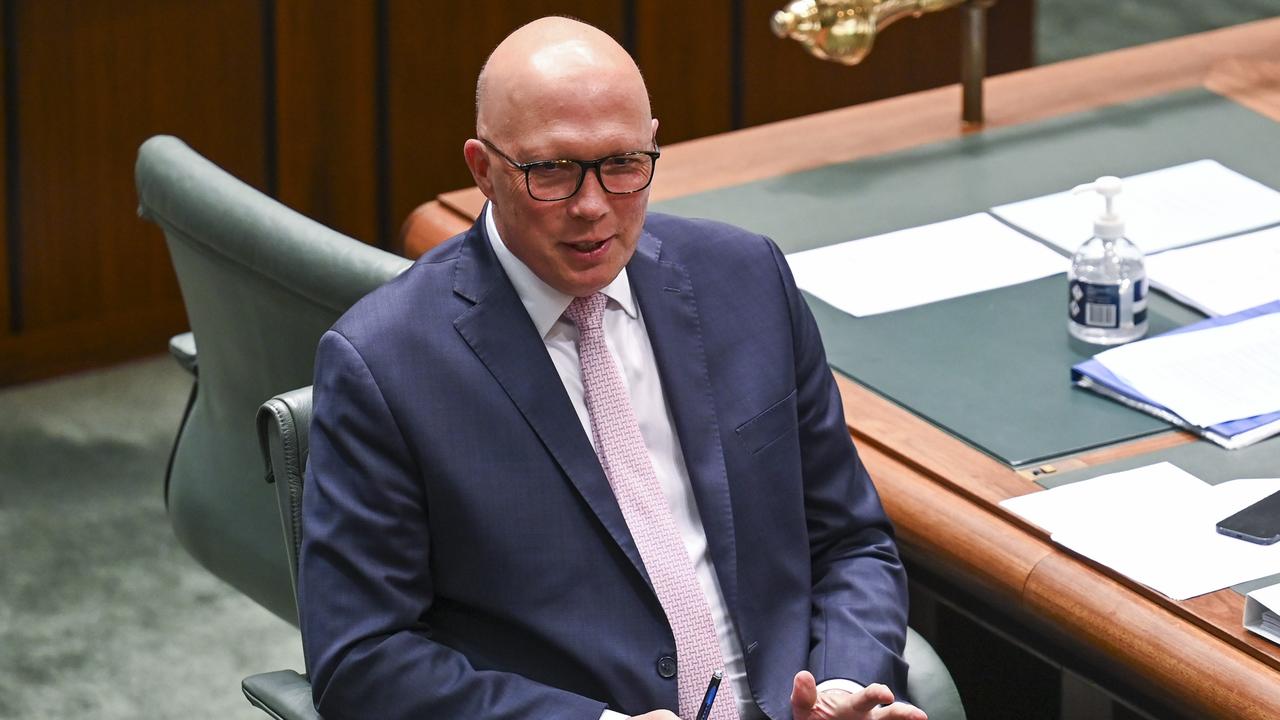
Opposition Leader Peter Dutton says nuclear power is the ‘only credible’ way to net zero. Picture: NCA NewsWire / Martin Ollman
Mr Dutton said nuclear reactors would provide a more reliable and cheaper source of clean energy.
“The Prime Minister’s had an opportunity to put forward a plan,” the Opposition Leader said.
“He doesn’t have the guts to stand up and make the decision that our country needs made and we do need to look at the best technology, zero emissions.
“I think it’s the only credible pathway we have to our international commitment to net zero by 2050.
But his plans have been ridiculed by the Albanese government, which argues it would take “decades” to build and delay Australia’s transition to clean energy.
“I look forward as well to [Mr Dutton] arguing where the financing will come for such reactors, whether taxpayers will be expected to pay for this, because we know the cheapest form of energy in Australia is renewables,” Mr Albanese said.
“Every ten years there are these proposals … what never comes is any investment, because it simply doesn’t stack up commercially.”
Treasurer Jim Chalmers blasted Mr Dutton’s “nuclear fantasy”, saying his plans to overturn laws to build nuclear module reactors would cost taxpayers hundreds of billions of dollars and set the country back in its efforts to reach net zero.
“It’s no surprise to anyone that Peter Dutton has gone for the most expensive option, the most divisive option and longest to build,” the Treasurer said on Tuesday.
“That’s because he’s more interested in cheap and divisive politics than cheap and reliable power. We see that in this more or less culture war over nuclear energy. This a nuclear fantasy.”
Mr Dutton said the technology was “unbelievable” compared with the 1950s and said rerouting the nation’s net-zero path towards nuclear would lead to greater financial relief for households.
Nuclear energy has been banned in Australia since laws were introduced in 1983.
A senate committee was told last year that if a ban on nuclear energy were to be overturned, it would take at least 10 to 15 years to have an operational nuclear power plant in Australia.
Nationals MP Bridget McKenzie said the opposition had anticipated pushback ahead of the announcement.
Independent MP Monique Ryan said the Coalition’s nuclear plan was unrealistic.
“Basically, what the Liberal National Party is doing is kicking the can down the road on the transition because they want to keep in with their friends. The big, you know, coal and gas suppliers because there is not a small functional small modular reactor in the world,” she said.
“I think it’s time that we acknowledge the fact that this is not a realistic plan.”…………………………………. more https://www.news.com.au/technology/environment/sustainability/treasurer-jim-chalmers-rips-into-opposition-leader-peter-duttons-nuclear-energy-plans/news-story/4eb130a74b64224f103e6841ed2a4283
Coalition MPs open to nuclear in their electorates
ABC News, 5 Mar 24
“…………………………………………………………………………………………. The electorates containing coal plants scheduled to close are held almost entirely by Liberal and National MPs, with the exception of Hunter MP Dan Repacholi.
Nationals MP Colin Boyce said the Callide Power Station could be a good option for a nuclear plant, if the community supported it.
“Absolutely on face value I would be supportive of looking at those options. The Callide Power Station at Biloela in central Queensland is number one on the list for closure according to the current Queensland government, so that site there, all the infrastructure that’s already there, the transmission lines, the water supplies, that would be somewhere to me that would be a reasonable outcome,” Mr Boyce said.
“I would suggest that site is a possible site for a possible nuclear small modular reactor, or something similar.
“Having said that we would have to take that to the community and gauge their thoughts on it before any decisions were made.”
He added that safety concerns held by some communities were valid, and that was why an honest conversation to address those concerns was necessary.
Nationals MP Darren Chester, who represents the seat of Gippsland where the Yallourn coal fired plant is scheduled to close, told the ABC last year he would consider a nuclear reactor in the Latrobe Valley if it made sense.
“If a potentially suitable site was identified for a nuclear power station in my electorate, it should be considered in a transparent manner with widespread consultation and an explanation of the potential costs and benefits,” Mr Chester said.
“If it was in the national interest and there were social, economic and environmental benefits, I’m sure that Gippslanders would be willing to have a constructive conversation about nuclear energy.”
Mr Chester told The Australian yesterday any government wanting to introduce nuclear would first have to reassure host communities safety concerns had been managed.
Nationals leader David Littleproud told Perth radio station 6PR yesterday he was ready to lead the way on the prospect of nuclear power in his electorate.
“I’ve got four coal fired power stations [in my electorate], I’ve made it very clear. I’m prepared to lead my community in that discussion,” he said.
“And we’ve got time, we don’t have to do all this by 2030.”
Liberal MP Rick Wilson said it would be premature to speculate on sites, but was open to the idea of a nuclear site in O’Connor.
Communities such as Collie in my electorate, which have experience hosting power stations, have high energy-IQ and their existing infrastructure and workforces could make them potential candidates to host a next-generation nuclear plant in the future,” Mr Wilson said.
He said like any major project, it would need the backing of the community.
Dan Repacholi, whose electorate contains plants scheduled for closure, has been contacted for comment. https://www.abc.net.au/news/2024-03-05/coalition-nuclear-plan-identifies-retiring-coal-likely-sites/103545440
Western Australia’s Premier Cook goes nuclear on Dutton’s ‘simplistic, ridiculous’ power plan
SMH, Hamish Hastie, March 5, 2024 —
A Coalition proposal to build nuclear power stations at the sites of retired or retiring coal stations is ridiculous and a distraction from efforts to reach net zero using renewables, West Australian Premier Roger Cook has said.
Opposition leader Peter Dutton floated the idea of building nuclear power stations on sites of retired coal stations – which could include the South West town of Collie – as a zero-emissions solution to the nation’s energy woes.
Cook blasted the Coalition proposal that federal Nationals leader David Littleproud was spruiking in WA this week as a fantasy.
“The rollout of small nuclear reactors or modular reactors in other countries has been halted because it’s not commercial, it’s not viable,” he said.
“In addition to that, Australia has no experience in nuclear power generation so we don’t have the workforce, we don’t have the know-how to be able to bring them in.
“You simply cannot plonk these things into a landscape and plug it into the grid. These simplistic sort of ideas are ridiculous.
“What we need to do is accept that climate change is a reality and move to exploit the abundance of wind and solar that we have at our disposal.
“There’s no quick fix here, you’ve got actually do the hard work and this is simply a sound grab by the Nationals to distract people from the real hard work which is being done.”……………………………………………………… https://www.smh.com.au/politics/western-australia/cook-goes-nuclear-on-dutton-s-simplistic-ridiculous-power-plan-20240305-p5fa0r.html
Dutton wants a ‘mature debate’ about nuclear power. By the time we’ve had one, new plants will be too late to replace coal

If Dutton is serious about nuclear power in Australia, he needs to put forward a plan now. It must spell out a realistic timeline that includes the establishment of necessary regulation, the required funding model and the sites to be considered.
John Quiggin, Professor, School of Economics, The University of Queensland, 29 Feb 24, https://theconversation.com/dutton-wants-a-mature-debate-about-nuclear-power-by-the-time-weve-had-one-new-plants-will-be-too-late-to-replace-coal-224513
If you believe Newspoll and the Australian Financial Review, Australia wants to go nuclear – as long it’s small.
Newspoll this week suggests a majority of us are in favour of building small modular nuclear reactors. A poll of Australian Financial Review readers last year told a similar story.
These polls (and a more general question about nuclear power in a Resolve poll for Nine newspapers this week) come after a concerted effort by the Coalition to normalise talking about nuclear power – specifically, the small, modular kind that’s meant to be cheaper and safer. Unfortunately, while small reactors have been around for decades, they are generally costlier than larger reactors with a similar design. This reflects the economies of size associated with larger boilers.
The hope (and it’s still only a hope) is “modular” design will permit reactors to be built in factories in large numbers (and therefore at low cost), then shipped to the sites where they are installed.
Coalition enthusiasm for talking about small modular reactors has not been dented by the failure of the only serious proposal to build them: that of NuScale, a company that designs and markets these reactors in the United States. Faced with long delays and increases in the projected costs of the Voygr reactor, the intended buyers, a group of municipal power utilities, pulled the plug. The project had a decade of development behind it but had not even reached prototype stage.
Other proposals to build small modular reactors abound but none are likely to be constructed anywhere before the mid-2030s, if at all. Even if they work as planned (a big if), they will arrive too late to replace coal power in Australia. So Opposition Leader Peter Dutton needs to put up a detailed plan for how he would deliver nuclear power in time.
So why would Australians support nuclear?
It is worth looking at the claim that Australians support nuclear power. This was the question the Newspoll asked:
There is a proposal to build several small modular nuclear reactors around Australia to produce zero-emissions energy on the sites of existing coal-fired power stations once they are retired. Do you approve or disapprove of this proposal?
This question assumes two things. First, that small modular reactors exist. Second, that someone is proposing to build and operate them, presumably expecting they can do so at a cost low enough to compete with alternative energy sources.
Unfortunately, neither is true. Nuclear-generated power costs up to ten times as much as solar and wind energy. A more accurate phrasing of the question would be:
There is a proposal to keep coal-fired power stations operating until the development of small modular reactors which might, in the future, supply zero-emissions energy. Do you approve or disapprove of this proposal?
It seems unlikely such a proposal would gain majority support.
Building nuclear takes a long time
When we consider the timeline for existing reactor projects, the difficulties with nuclear power come into sharp focus.
As National Party Senate Leader Bridget McKenzie has pointed out, the most successful recent implementation of nuclear power has been in the United Arab Emirates. In 2008, the UAE president (and emir of Abi Dhabi), Mohamed bin Zayed Al Nahyan, announced a plan to build four nuclear reactors. Construction started in 2012. The last reactor is about to be connected to the grid, 16 years after the project was announced.
The UAE’s performance is better than that achieved recently in Western countries including the US, UK, France and Finland.
In 16 years’ time, by 2040, most of Australia’s remaining coal-fired power stations will have shut down. Suppose the Coalition gained office in 2025 on a program of advocating nuclear power and managed to pass the necessary legislation in 2026. If we could match the pace of the UAE, nuclear power stations would start coming online just in time to replace them.
If we spent three to five years discussing the issue, then matched the UAE schedule, the plants would arrive too late.
It would take longer in Australia
Would it be possible to match the UAE schedule? The UAE had no need to pass legislation: it doesn’t have a parliament like ours, let alone a Senate that can obstruct government legislation. The necessary institutions, including a regulatory commission and a publicly owned nuclear power firm, were established by decree.
There were no problems with site selection, not to mention environmental impact statements and court actions. The site at Barakah was conveniently located on an almost uninhabited stretch of desert coastline, but still close enough to the main population centres to permit a connection to transmission lines, access for workers, and so on. There’s nowhere in Australia’s eastern states (where the power is needed) that matches that description.
Finally, there are no problems with strikes or union demands: both are illegal in the UAE. Foreign workers with even less rights than Emirati citizens did almost all the construction work.
Despite all these advantages, the UAE has not gone any further with nuclear power. Instead of building more reactors after the first four, it’s investing massively in solar power and battery storage.
Time to start work is running out
The Coalition began calling for a “mature debate” on nuclear immediately after losing office.
But it’s now too late for discussion. If Australia is to replace any of our retiring coal-fired power stations with nuclear reactors, Dutton must commit to this goal before the 2025 election.
Talk about hypothetical future technologies is, at this point, nothing more than a distraction. If Dutton is serious about nuclear power in Australia, he needs to put forward a plan now. It must spell out a realistic timeline that includes the establishment of necessary regulation, the required funding model and the sites to be considered.
In summary, it’s time to put up or shut up.
1 This month
17 October, Free Public Talk on Nuclear Issues in South Australia
David Noonan will speak on public interest concerns over the new Roxby Downs Indenture Act 2026 on BHP copper-uranium mining and ore processing in SA, and on how AUKUS may face SA with a High-Level nuclear waste agenda.
Dr Jim Green will discuss international developments in the field of nuclear power including ‘small modular reactors’ and Generation 4 ‘advanced’ nuclear reactor concepts.


Help Aunty Sue Protect Her Land and Sacred Sites From Destructive Rocket Testing.
.

Australians deserve the truth
about
AUKUS – https://aukuspublicinquiry.com/

PETITION – To: Prime Minister Anthony Albanese and the Australian Labor Government

of the week – Australians for War Powers Reform (AWPR)
To see nuclear-related stories in greater depth and intensity

