Andrew Forrest and Peter Dutton are on a collision course over Nuclear Power
National Times 26 Feb 24
Andrew ‘Twiggy’ Forrest labels Coalition push for nuclear energy ‘bulldust’ and a ‘new lie’ ( Paul Karp Chief political correspondent for The Guardian)
Mining billionaire says cost of nuclear will be four to five times that of renewables and opposition’s policy is ‘an excuse for doing nothing’
The mining billionaire Andrew “Twiggy” Forrest has labelled the Coalition’s push for nuclear energy “bulldust” and a “new lie” that would delay the clean energy transition and harm regional Australia.
The executive chair and founder of mining company Fortescue and the renewable energy investor Tattarang on Monday urged the opposition to stop advocating expensive and unfeasible alternatives to renewables.
The Coalition is yet to produce a costed energy policy, despite arguing to lift Australia’s ban on nuclear energy and recent comments from the Nationals leader, David Littleproud, that expanded rooftop solar could be rolled out instead of large-scale renewables.
The Liberals and Nationals have complained that large-scale renewables and transmission projects will ruin agricultural land, despite experts debunking the extent of this claimed impact.
Forrest told the National Press Club that “even the fossil fuel industry has taken responsibility” for global heating, and that “doing nothing” is not an option, with Australia to face tariffs from the European Union if it doesn’t reduce emissions.
Forrest told politicians who “claim to represent the bush” – a reference to the Nationals – to “stop dividing us with the false hope that we can cling to fossil fuels for ever … We can’t. So, please stop betraying the bush.”
“If we swallow this new lie that we should stop the rollout of green energy and that nuclear energy will be our fairy godmother, we will be worse off again,” he said.
Forrest said it was “hopeless” that politicians are asking Australians “to wait for new technology in 20 years’ time that may never happen”.
“It’s just an excuse for doing nothing. This is the straight admission that fossil fuels have to go, but their solutions risk leaving us destitute.”
According to energy department estimates for the Albanese government, replacing Australia’s coal power plants with nuclear would cost $387bn.
Forrest said he had “done the numbers” and nuclear will cost four to five times more than renewables, which can reduce emissions within a few years.
“A leader will remind the farming community offline that global warming is real and that all their customers are taking it very seriously,” he said.
“Instead of knocking a slow-moving, gracious wind turbine, try a nuclear power plant or a belching coal plant next door.
“The fact that we can feel climate change already despite the ocean soaking up most of out heat-generated emissions means Australia has finally run out of time.
“We get the next few years wrong and Australia’s economy and the rest of us cook. We get it right, and Australia enjoys decades of economic growth, full employment and reinvigoration of its natural environment.”
Forrest backed the proposal for a carbon solutions levy to raise $100bn, advanced by Ross Garnaut, a leading economist during the Hawke government, and Rod Sims, a former head of the competition watchdog.
Forrest also called for a green hydrogen tax credit to grow the industry, on top of the $2bn hydrogen head start fund, and a climate trigger to block approval of major projects if they contribute to global heating.
Forrest announced that Squadron, his renewable energy venture, will create an industry fund for decommissioning wind turbines so landowners can have “peace of mind” that the landscape will not be harmed if turbines are not renewed and extended.
Sarah Hanson-Young, the Greens environment spokesperson, said that “business leaders like Forrest can see that, for the sake of our environment and economy, we need to stop expanding fossil fuels”.
“Forrest backed the growing call for a climate trigger in environment law and I hope that Labor were listening.”
Earlier on Monday the shadow energy and climate change minister, Ted O’Brien, told reporters in Canberra there was “no doubt that the experts are advising us that one of the best places to locate zero-emissions nuclear reactors would be where coal plants are retired”.
O’Brien accused Labor of “steamrolling regional communities” to build renewables, but could not say what the Coalition would do if communities around existing coal power stations objected to nuclear power.
O’Brien was unable to say how much nuclear power would cost, responding that “a lot of questions that can only be answered once we release our policy”.
“We have been formulating an all-of-the-above [technologies], balanced policy for Australia’s future energy mix.”
No nuclear option for $275m green-manufacturing and innovation grants
Sam McKeith, Feb 26, 2024, https://reneweconomy.com.au/green-manufacturing-gets-275m-boost-with-launch-of-innovation-grant-scheme/
Grants from a NSW $275 million green manufacturing fund will not go towards nuclear projects as the state says the technology is not part of its plans to reach net-zero emissions.
Under the Net Zero Manufacturing Initiative program, announced on Monday, businesses can access grants for manufacture of renewable energy systems, low-carbon products and clean-technology innovation.
The program is part of the state’s legislated pledge to cut greenhouse gas emissions to 50 per cent of 2005 levels by 2030 and hit net zero by 2050.
But Climate Change Minister Penny Sharpe ruled out any grants going to projects such as the development of small modular nuclear reactors, despite a Newspoll on Monday showing two-thirds of younger Australians backed the technology.
“We’re looking at, even if you wanted to start today … a 14-year horizon to get it in the ground, which we don’t actually have,” she told reporters.
“The second point that I make is that nuclear energy is 350 per cent more expensive than renewables.”
Premier Chris Minns said the grants would bolster local manufacturing in the renewable and clean-technology industries, especially among small and medium-sized firms.
“The thing I like about this so much is that it enhances what is taking place in our research universities in the state as it currently stands,” he said.
The initiative will focus on lab-proven tech and the build of “market-ready products” ready to be scaled up and rolled out in NSW, the government says.
It comes as the state scrambles to replace ageing coal power stations with renewable energy to meet its emission targets, while also trying to keep a lid on power prices and maintain capacity.
Proponents of nuclear power are peddling hot air
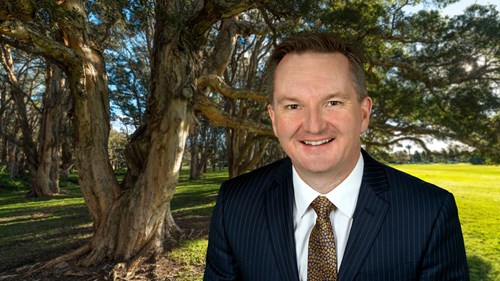
Chris Bowen, Minister for Climate Change and Energy, Australia
Chris Bowen, 24 February 2024. https://minister.dcceew.gov.au/bowen/media-releases/opinion-piece-proponents-nuclear-power-are-peddling-hot-air
Opponents of cleaner, cheaper renewables have used a particularly spectacular contortion of logic to claim the recent catastrophic storms in Victoria and the resulting power outages as evidence of the folly of acting on climate change and boosting renewables.
Predictably, nuclear energy advocates seized on the Victorian events and temporary power outage to re-energise their campaign for Australia to start a nuclear energy industry.
Let’s be clear upfront. Nuclear is not being pushed as a genuine alternative to renewables. It’s being used as a distraction and a delaying tactic.
It’s also quite the feat to assert that had it been nuclear rather than renewables, a coal-fired electricity generator in Victoria wouldn’t have shut itself down as protection against surges from storm-damaged transmission. It’s an even greater leap essentially to assert that a grid under the LNP would involve no distribution – given the vast majority of outages were caused by extreme damage to the distribution network – including from the half a million lightning strikes in eight hours.
Will nuclear powered electricity be transmitted by osmosis? By Bluetooth? By a vibe? Whether your energy comes from coal, nuclear, gas or renewables, if poles and wires are down, electricity won’t get where it needs to go.
The pro-nuclear argument is two-pronged. That the world has realised the perils of renewables and is experiencing a nuclear renaissance, and Australia is missing out.
And that nuclear is much cheaper than renewable energy, once upgrading and expanding the grid is factored in.
Both these arguments collapse faster than a tree in a lightning strike when exposed to the facts.
Global investment in renewable energy sources constitutes three quarters of all power generation investment.
Take just solar, for example. Last year, the world installed 440GW of renewable capacity. This is more than the world’s entire existing nuclear capacity built up through decades of investment. By early 2025, renewable energy will surpass coal as the planet’s largest source of energy, while coal, gas and nuclear will all shrink their market share.
Nuclear and coal combined, however, account for only 16 per cent of new global power investment. In 2005, electricity companies in the US pledged to build more than 30 reactors. Only four ever commenced construction. Two were abandoned due to massive cost and time delays.
The alleged boom in Small Modular Reactors is also a mirage. China and Russia are the only two countries to have installed them. The US has now abandoned its “flagship” commercial-scale pilot SMR (promised back in 2008), wearing 70 per cent cost blowouts without having started construction on a single reactor.
We know the Russian SMRs have extraordinarily low load factors and that nuclear waste from the SMR process is disproportionate to their output. The Chinese data is more opaque, but given SMRs generate about 300MW (compared to a coal-fired power station at 2000MW), we have no reason to believe there is anything approaching a serious contribution to China’s energy demand from their two units.
My shadow minister predicted that last year’s Dubai COP would be remembered as the “nuclear COP”. Not so much. Twenty three countries have pledged to triple nuclear energy by 2050, while 124 countries pledged to triple renewable energy investment within the next six years, before the nuclear dream even gets started.
Then there is cost. Contrary to myth, GenCost does include the cost of transmission and storage, and the CSIRO-AEMO GenCost conclusions about the chasm between nuclear and renewables costs could not be clearer.
But if you don’t want to accept eminent and independent practitioners at those organisations, then you can have a look at the Bulletin of Atomic Scientists, which estimates it will cost $US15 trillion to triple nuclear capacity. Or University College London, which recently found that “new nuclear capacity is only cost effective if ambitious cost and construction times are assumed”.
And if you don’t like University College London’s research, ask the merchant bank Lazard, which shows levelised cost of nuclear to be four times higher than utilityscale solar and wind.
Then look at how many nuclear projects are falling over because of cost and time overruns. The UK’s Hinkley C nuclear plant was promised to be “cooking Christmas turkeys by 2017”. It’s yet to warm a single drumstick, with latest costings at more than $86bn. Who in Australia does the opposition energy spokesman expect will be footing those kind of bills?
Like many things in the climate debate, the push for nuclear power has taken on a singular importance in the culture wars. It’s striking that a party that once prided itself on economic rationalism could embrace a frolic so spectacularly uneconomic. This is the triumph of culture wars over climate pragmatism in the alternative government.
The LNP has been promising to reveal the details of its long nuclear fairytales soon. It can’t come soon enough.
No plan for nuclear power in Australia will survive contact with reality. The Australian people deserve more than hot air to power their homes and businesses.
The Victorian towns where Peter Dutton is considering going nuclear

Josh Gordon and Benjamin Preiss, February 25, 2024, https://www.theage.com.au/politics/victoria/the-victorian-towns-where-peter-dutton-is-considering-going-nuclear-20240223-p5f7a3.html
The Coalition is leaving the door open to building nuclear reactors in the Latrobe Valley and Anglesea using land from retired coal-fired power stations as a solution to Victoria’s energy troubles.
But locals warn there would be significant opposition to nuclear reactors being built in their towns, even if the huge legal hurdles to constructing and running them could be overcome.
With Victoria’s energy security under scrutiny after a wild storm earlier this month left hundreds of thousands of homes without power and triggered the shutdown of the state’s largest coal-fired generator, the federal opposition has confirmed it is now in the “advanced stages” of developing an energy policy. Nuclear is set to be a key part of the mix.
Opposition energy spokesman Ted O’Brien told The Age potential locations remained a “work-in-progress”, but he had been advised that “communities with experience hosting coal plants could be ideal potential hosts for zero-emissions nuclear plants”.
That leaves Victoria’s three remaining coal-fired power plants, plus the now decommissioned site of the Hazelwood mine and power station, as strongly preferred locations – with existing connections to the energy grid, and a ready-made workforce preparing for the end of coal-fired generation over the next 15 years.
“We have been very transparent about the fact we are considering zero-emissions nuclear energy as part of Australia’s future energy mix, and we will remain open about the details of our policy when it is announced,” O’Brien said.
The state opposition remains more cautious about the prospect of nuclear in the Latrobe Valley, but it too is not ruling out the idea. Asked about using retired coal-fired power stations as sites for nuclear energy, Opposition Leader John Pesutto said a commonsense approach was needed.
“But for any new industry to succeed it would first need detailed inquiries and thorough examination,” Pesutto told The Age. “It would also require bipartisan support, as this is crucial for investment certainty and to eliminate sovereign risk.”
Other sites in Victoria have also been flagged. Federal Opposition Leader Peter Dutton recently hinted at the possibility of a small modular reactor on the Surf Coast at Anglesea, on the site of Alcoa’s former mine and power station.
“It’s zero emissions, you can put it into an existing brownfield site, so when the coal-fired generation comes to an end, you can put the nuclear modular reactors into that facility,” Dutton said in September.
The argument for nuclear is that plugging into existing infrastructure would be significantly cheaper and would reduce the need for thousands of kilometres of new transmission lines needed to connect wind and solar energy dotted across the grid.
O’Brien has previously pointed to a September 2022 study for the US Department of Energy that found using the infrastructure of an existing coal plant could reduce a nuclear plant’s capital costs by up to 35 per cent. He suggested Australia should look to the US state of Wyoming, which is planning to replace its coal-fired generators with nuclear by about 2030.
But any move towards nuclear power in Victoria would likely encounter strong resistance from communities worried about safety, waste disposal and the cost.
Voices of the Valley president Wendy Farmer said nuclear power would face major opposition from communities worried about the risks.Farmer said residents in the Latrobe Valley had already suffered the consequences of the Hazelwood mine fire in 2014, which burned for 45 days and caused health concerns for those living amid the smoke.
“I would be surprised if there would be any enthusiasm for a reactor,” she said.
Deputy Mayor Mike Bodsworth, who represents the Anglesea ward, said residents were excited by the potential for renewable power generation at the former Alcoa site.
“But nobody I know has ever mentioned nuclear,” he said. “Knowing the general preferences of the local population, I doubt it would be supported.”
The Coalition has been talking up the potential to use small-scale modular reactors to generate power, and argue this, along with gas, will be a key part of Australia’s future energy mix to provide so-called base-load generation along with variable renewables.
In May last year, US company Westinghouse released plans for a small modular reactor. Reuters reported Westinghouse planned to begin building the reactor by 2030.
But many experts say this approach would be prohibitively expensive in Australia, particularly if forced to compete against lower-cost renewable wind and solar generators now being installed at a rapid rate across the country.
The CSIRO’s best guess is that in 2030 the capital cost of a small modular reactor will be $15,844 per kilowatt of electricity generated, compared to $1078 for solar and $1989 for wind.
That suggests replacing Victoria’s three remaining coal-fired plants, which combined to produce up to 4730 megawatts of electricity, with nuclear would involve a capital cost of about $74.9 billion, before even considering the ongoing running, maintenance and waste disposal costs.
The Coalition would also need to get the numbers in state parliament to repeal existing state and federal laws, including Victoria’s Nuclear Activities (Prohibitions) Act of 1983, which bans the construction and operation of nuclear facilities in Victoria.
Victorian Energy Minister Lily D’Ambrosio said nuclear energy was “toxic, risky, will take years to develop and [is] the most expensive form of energy there is”.
“Not only are the sites of our former coal plants privately owned, but there is currently no regulatory framework for approving a nuclear power plant in Australia, there are no nuclear waste storage sites in Australia, and no modular nuclear reactors have made it past the trial phase,” she said.
Federal Energy Minister Chris Bowen said claims of a boom in small modular reactors was a myth, and suggested Dutton should explain to the people around Gippsland why they should accommodate multiple reactors “for no good reason”.
“Anyone who has done their homework knows nuclear is not viable,” Bowen said. “The alleged boom in small modular reactors is a furphy. It’s striking that a party that once prided itself on economic rationalism could embrace a frolic so spectacularly uneconomic.”
In the US, a project run by NuScale Power to build the first commercial small modular reactor was scrapped last year because of soaring costs, leaving taxpayers facing a significant bill. Other projects promising commercially competitive nuclear energy have similarly failed to materialise.
Billionaire mining magnate Andrew Forrest lampoons Coalition’s nuclear push as ‘bulldust’

A push by the Coalition to develop nuclear energy generation in Australia has been slammed by mining magnate Andrew “Twiggy” Forrest.
Jack Quail, February 26, 2024 – https://www.news.com.au/technology/environment/climate-change/billionaire-mining-magnate-andrew-forrest-lampoons-coalitions-nuclear-push-as-bulldust/news-story/048f9a45dbb31091a4ed313479922288
Billionaire mining magnate Andrew “Twiggy” Forrest has rubbished a push to develop a local nuclear energy industry, even as fresh polling showed growing voter support for the proposal.
Dr Forrest took a veiled swipe at the opposition over its soon-to-be-unveiled nuclear energy policy, saying its push was “misinformed”, would act to sustain coal and gas powered generation for another two decades, and ultimately would lead to higher power prices.
“If we swallow this new lie that we should stop the rollout of green energy and that nuclear energy will be our fairy godmother, we will be worse off again,” the chair of mining and green energy firm Fortescue told the National Press Club on Monday.
“These misinformed, unscientific, uneconomic, plucked-out-of-thin-air, bulldust nuclear policies of politicians – masquerading as leaders – help no one.”
Dr Forrest, who in 2023 ranked as Australia’s third richest person, made his billions mining iron ore but in more recent years has aggressively pursued investments in renewable energy technologies and fuel, particularly green hydrogen.
Claiming he was “agnostic” on nuclear energy, Dr Forrest said the economics of such a proposal did not stack up when compared with renewable generation.
“Who is going to pay their nuclear electricity bill when it is 4-5 times more expensive than the renewables next door, even ignoring the decade plus it takes to develop nuclear?” Dr Forrest asked.
“With wind and solar, you’re up and running, lowering electricity costs and eliminating pollution within one to three years.”
The Coalition is yet to release a costed nuclear energy policy but has committed to do so ahead of the next federal election, due by May 2025 at the latest.
A Newspoll released by The Australian on Monday revealed 55 per cent of Australians support the replacement of coal-fired power plants with small modular nuclear reactors.
However, such technology is still in development, is yet to prove commercially viable, and would not be deliverable until the mid-2030s at the earliest.
The Albanese government has similarly disparaged the Coalition’s nuclear push, and has retained a ban on nuclear power and banking.
In his address, Dr Forrest also advocated for a “renewable energy-led economy”, recommending the government establish a “climate trigger” to assess the impact of carbon pollution in granting environmental approvals, rapidly expand firmed renewable energy, and introduce a levy on carbon emissions extracted from mining or imported into Australia.
“If we make the right decisions today, it will deliver the most profound and enduring economic growth opportunities ever seen, particularly in regional Australia,” he said.
Calling out the diesel fuel rebate, which costs the federal budget billions annually, Dr Forrest said the subsidy towards mining and fossil fuel companies should be scrapped.
“Massive taxpayer-funded financial support for huge mining companies, including Fortescue, to use imported diesel is indefensible,” Dr Forrest said.
Last week, Fortescue – of which Dr Forrest and his family own a 33 per cent stake – reported a 41 per cent increase in its first-half profit, beating analysts’ estimates and bucking a growing trend of sliding profitability among other major mining firms.
Australian defence: from self-reliance to subsidising US war with China
Pearls and Irritations, By Mike GilliganFeb 23, 2024
Our leaders have rendered us America’s pawn, contractually. Australia has abrogated the right to choose peace with China. Dumbly. Unnecessarily. Deceitfully. For political ends. We once had a leader who put Australia’s security before the desires of a distant, powerful protector. What is the prospect of chancing upon another of Curtinian quality?
Periodically, it is fashionable among Australia’s geostrategic glitterati to ask what to do about America, as if that’s never really been addressed. Of course, the question has dogged Australian governments and officialdom at least from the day Foreign Minister Percy Spender signed the ANZUS treaty in San Francisco in 1951. Having obtained a treaty we then wondered what it meant?
As a face-saver America agreed to a “treaty” with a non-committing clause – to “consult” should one or other party be threatened. But ever alert to political opportunity, PM Menzies acclaimed ANZUS to the Australian public as if it contained NATO’s Article 5 security for Australia. The bluster and deceit has been maintained by Australian governments and media to this day. Today most Australians believe that the US guarantees our security.
At the time even the hard-heads in Defence and Foreign Affairs were hopeful that the treaty might be interpreted generously by the Americans. But it didn’t take long for that optimism to evaporate. Repeatedly, over the first twenty years, America made it clear that it saw the treaty running in its direction. On issues with Indonesia (eg konfrontasi) Australia had unambiguous signals that we were expected to deal with regional issues independently. Meanwhile we were sending our forces into faraway situations created by the US, suffering heavy consequences viz Korea, Vietnam.
The unlikely choice of self reliance
Then in 1969 President Nixon announced the Guam doctrine – each US ally nation in Asia was considered by the US to be in charge of its own security. After two decades of Australia faffing over ANZUS, clarity emerged. The major political parties were at one that Australia should take responsibility for its own defence.
Looking back, that was an extraordinary step for Australia. We acted promptly by restructuring the defence assets – the three military arms were folded into a Defence Force with the organisation overseen jointly by a civilian and military head. Which portended a revolution in thinking.
By 1976 a comprehensive blueprint was ready. Australia’s first ever White Paper on Defence spelt out the intellectual, practical and financial basis for an Australia secured by self-reliant defences:
“A primary requirement is for increased self reliance… we no longer base our policy on expectation that Australia’s forces will be sent abroad to fight as part of some other nation’s force.
we believe that any operations are much more likely to be in our own neighbourhood than in some distant or forward theatre… we owe it to ourselves to be able to mount a national defence effort that would maximise the risks and costs of any aggression.“
For the transformation to work clarity was necessary around America’s role. Our concepts would be directed to defence of Australia. Our scarce resources would not be applied to anyone else’s priorities. It was agreed that American forces would have no operational role in our defence planning. Should America request armed assistance from us and it was judged in our interest, any contribution would be drawn from assets acquired for our own defences. But only after any competing Australian needs were met.
America fully supported this regime throughout the decades.
Australia’s defence policy unambiguously pursued self- reliance over many and varied governments. The objective was articulated in every government review and white paper – until the ascent of PM Abbott. ………………………………………………………………………………………….
Donate »
AUKUS, DEFENCE AND SECURITY, INTERNATIONAL RELATIONS, POLITICS, TOP 5
Australian defence: from self-reliance to subsidising US war with China
Our leaders have rendered us America’s pawn, contractually. Australia has abrogated the right to choose peace with China. Dumbly. Unnecessarily. Deceitfully. For political ends. We once had a leader who put Australia’s security before the desires of a distant, powerful protector. What is the prospect of chancing upon another of Curtinian quality?
Periodically, it is fashionable among Australia’s geostrategic glitterati to ask what to do about America, as if that’s never really been addressed. Of course, the question has dogged Australian governments and officialdom at least from the day Foreign Minister Percy Spender signed the ANZUS treaty in San Francisco in 1951. Having obtained a treaty we then wondered what it meant? It fell short of what we asked for, which was one just like NATO’s with Article 5, please. But what Spender obtained was most unlike NATO. ANZUS holds no assurance that America will assist with armed force if Australia is attacked. It was no oversight. America tenaciously rebuffed such commitment.
As a face-saver America agreed to a “treaty” with a non-committing clause – to “consult” should one or other party be threatened. But ever alert to political opportunity, PM Menzies acclaimed ANZUS to the Australian public as if it contained NATO’s Article 5 security for Australia. The bluster and deceit has been maintained by Australian governments and media to this day. Today most Australians believe that the US guarantees our security.
At the time even the hard-heads in Defence and Foreign Affairs were hopeful that the treaty might be interpreted generously by the Americans. But it didn’t take long for that optimism to evaporate. Repeatedly, over the first twenty years, America made it clear that it saw the treaty running in its direction. On issues with Indonesia (eg konfrontasi) Australia had unambiguous signals that we were expected to deal with regional issues independently. Meanwhile we were sending our forces into faraway situations created by the US, suffering heavy consequences viz Korea, Vietnam.
The unlikely choice of self reliance
Then in 1969 President Nixon announced the Guam doctrine – each US ally nation in Asia was considered by the US to be in charge of its own security. After two decades of Australia faffing over ANZUS, clarity emerged. The major political parties were at one that Australia should take responsibility for its own defence.
Looking back, that was an extraordinary step for Australia. We acted promptly by restructuring the defence assets – the three military arms were folded into a Defence Force with the organisation overseen jointly by a civilian and military head. Which portended a revolution in thinking.
By 1976 a comprehensive blueprint was ready. Australia’s first ever White Paper on Defence spelt out the intellectual, practical and financial basis for an Australia secured by self-reliant defences:
“A primary requirement is for increased self reliance… we no longer base our policy on expectation that Australia’s forces will be sent abroad to fight as part of some other nation’s force.
“we believe that any operations are much more likely to be in our own neighbourhood than in some distant or forward theatre… we owe it to ourselves to be able to mount a national defence effort that would maximise the risks and costs of any aggression.“
For the transformation to work clarity was necessary around America’s role. Our concepts would be directed to defence of Australia. Our scarce resources would not be applied to anyone else’s priorities. It was agreed that American forces would have no operational role in our defence planning. Should America request armed assistance from us and it was judged in our interest, any contribution would be drawn from assets acquired for our own defences. But only after any competing Australian needs were met.
America fully supported this regime throughout the decades.
Australia’s defence policy unambiguously pursued self- reliance over many and varied governments. The objective was articulated in every government review and white paper – until the ascent of PM Abbott. With bipartisan acceptance, even though it meant hard, big decisions from governments. The Hawke government scrapped Navy’s aircraft carrier, to reorient our focus to land-based defences. Large expenditures went preferentially to new equipment, infrastructure and bases across the north. Our ports were a focus for anti-mining measures. We developed a peculiar hybrid of technology which overcame the tyranny of vast maritime surrounds making them a singular strength -our over- the- horizon radar network is unique, unmatched anywhere. Our confidence in detecting air movements all across our northern approaches and beyond went from zero to 95%. Similar numbers apply to ships. A profound increment in the fundamentals of maximising risk for any aggressor, with pervasive synergies.
Three decades after embarking on the self-reliance journey Australia had created a formidable capacity to “maximise the risks and costs of any aggression”. We did it our way, overcoming seemingly insurmountable barriers. With political unity generally.
Sadly, no Defence Minister ever took the trouble to explain to Australians what had been achieved – how and why we should be confident of our security without American forces.
Receding self reliance
Things changed abruptly with the Obama presidency, and its geostrategic “tilt to Asia”. President Obama’s visit here in 2010, grasped as electorally advantageous by the waning Gillard government, put an end to pursuit of self- reliance. The principles of our hard-won independence were eroded almost overnight. Unsaid. Infused with political gratuity. Obama was applauded by our Parliament in announcing that henceforth the US would rotate marine soldiers through northern Australia in increasing numbers.
At the time it looked like a US attempt to turn Australia to joining US competition with China. Ever since it has looked more and more exactly that. We are now fourteen years on from the Gillard capitulation. That period has seen continual sly, escalating obeisance to Americas objectives against China. With no heed to the contradiction that while America identifies China as its chief strategic opponent, it is both the centre of our region and Australia’s foremost trading partner.
In 2014 Foreign Minister Julie Bishop signed a “Force Posture Agreement” (FPA) with US Secretary of State John Kerry, who dines on foreign ministers. The FPA permits US naval and air forces to be based in Australia, to mount operations into our region. At America’s discretion and sole direction, with token consultation. The obvious object being China. The stationing of B52 bombers at Tindal equipped with long stand-off nuclear tipped cruise missiles (near impossible to intercept), makes the devastation of China’s big eastern cities achievable any day, by lunchtime, with confidence, on a signal from Washington.
China must now see that Australia is a permanent threat to its existence, and we have no say in that role. Because America can attack China freely from our shores the FPA effectively means that if US operations are mounted against China, from anywhere, Australia will find itself automatically at war with China.
The Abbott government knew what it was conceding to America in the FPA. Peter Dutton later as a minister of the Morrison government observed that it would be “inconceivable” for Australia not to join a US conflict against China. Yet not a murmur was heard from our Parliament following Bishop signing away our sovereignty. Or even since, ten years on. PM Albanese recently made virtue of the acquiescence saying national security was purposely quarantined from criticism when Labor was in opposition.
A profound blunder by Abbott and Bishop, impossible to overstate. Compounded by a decade of Parliamentary ignominy.
No longer is our defence spending solely for Australia’s priorities. Increasingly since the Obama visit, funds appropriated for Australia’s defence have been directed towards subsidising US confrontation with China. Alongside American staff being internalised here.
The zenith of our conservative governments’ distorting profligacy is the nuclear submarine of AUKUS. Designed to attack China’s nuclear submarines in and around its waters, it is said that PM Morrison created the arrangement in order to “make a meaningful contribution” to US operations against China. All of this project is madness- most obviously the cost borne by us. The project could only be confected by an authentic fool. Any number of credible authorities condemn it. See Hugh White recently
The Albanese government’s Defence Strategic Review (DSR) was drafted by a US- educated academic without experience of Australia’s defence or its intellectual capital. Necessarily delivering a view built on books and American perspective; now at the United States Studies Centre at Sydney University, underwritten by our Defence outlays and US patronage.
That DSR recommended that our Army be developed for amphibious attack operations -such as is embedded in US plans for combat in the Island Chain off China with US marines. One wonders how Australia’s Army greets this role- itself deeply encultured with the primacy of the direct defence of Australia.
Minister Marles then appointed a former US admiral to further review Australia’s naval future. The criteria are withheld but it’s a sound bet that the China strategy of the Pentagon was more a factor than was Australia’s self- defence. That report is in and only just responded to by government.
One could go on. Enough has been said to demonstrate that every Australian government since Gillard’s has led Australia into an embrace of US Indo- Pacific re-posturing against China – quietly, slyly, progressively conceding sovereignty and diverting effort and scarce resources from our own hard-won and capable sovereign defence prowess. Without ever frankly saying that the days of self- reliance are over: ie that Australian defence policy is now consumed by something else, contradictory to the policy of preceding decades, which essentially we have no control over……………………………………………………………………….
Australia’s leaders have deceived us into America’s service. Dumbly. Unnecessarily. For political ends. We once had a Prime Minister who, against formidable might, put Australia’s interests before the desires of a distant, powerful protector. John Curtin knew when a new time had to come. What is the prospect of Australia finding another of Curtinian quality? Able to discern and protect Australia’s interest above all others’, against the tide. The rest would follow.
(Postscript: I had the privilege of a working career in the body created to steward the transformation of the 1976 White Paper, “Force Development and Analysis Division” in Defence.) https://johnmenadue.com/australian-defence-from-self-reliance-to-subsidising-us-war-with-china/?fbclid=IwAR0fPj_1371XgvhwCoMD5-mqO8TFydpNE6a84LWapaC94FV27vJlyBOZLTM
Why Australia should ditch the AUKUS nuclear submarine and-pivot-to-pitstop-power
Dr Elizabeth Buchanan is an expert associate of the ANU National Security College. This is an excerpt from the latest issue of Australian Foreign Affairs.
There is an elephant in the room, even though it is not a concern for current AUKUS leaders and key backers because it won’t need attention for a decade or so.
Nonetheless, the quandary exists, and we should acknowledge it: the SSN-AUKUS probably won’t materialise. Domestic tensions in both the US and UK are simmering away, with Washington already stating it has no plans to ever operate the boat.
Pillar One does have elements worth salvaging. The sale by Washington to Canberra of at least three Virginia-class SSNs from as soon as the early 2030s is reasonable. As is the exchange of expertise through the embedding of personnel and injection of capital into shipyard infrastructure. Increasing SSN visits to Australian ports by our UK and US partners via the Submarine Rotational Force West is also sensible. Indeed, the SRF-W should be put on steroids.
But the design and attempted construction of a future submarine – the SSN-AUKUS – should be scrapped. This would save us time and money, given the high likelihood the SSN-AUKUS won’t eventuate. With the US not intending to operate the SSN-AUKUS and committing to the SSN-X instead, Canberra is left to rely on London. This is precarious to say the least.
Canberra should focus its efforts on interoperability with the US in our maritime backyard. After all, Washington is geographically wedded to the same Pacific arena. It is clear our long-term regional maritime interests align more with Washington than with London.
We should acquire as intended the three Virginia-class subs and get behind the US’s SSN-X. If the UK fulfils the ambitious SSN-AUKUS project, it will likely share similar elements to the SSN-X in any case – not least the weapons and propulsion systems. Theoretically, Australia would provide maintenance and support for the UK’s SSN-AUKUS via SRF-W, as we will for the Virginia-class subs and probably for the SSN-X too.
This more sensible AUKUS pathway takes advantage of Australia’s pit-stop power. Our value proposition to partners is our enhanced ability to maintain and host their SSN capabilities, while also bringing our own capabilities to the table. Come 2030 and through to the 2040s, Australia’s SRF-W is likely to contain no less than five different submarine classes. We could see our trusty but aged Collins-class aside a single visiting British Astute, up to nine Virginias, as well as the SSN-X and, of course, the mystical SSN-AUKUS.
This is surely more submarine capability housed in the Indo-Pacific than the AUKUS partners could poke a stick at, which is good news for Canberra. Keeping the waters of the Indo-Pacific free from coercion and potentially armed conflict is a binding mutual interest for Australia, the US and the UK. This is also true for Australia’s global partners and allies, as maritime security challenges originating in the Indo-Pacific ripple across the globe. Of course, our competitors – and states we don’t see eye to eye with – also want the continued facilitation of maritime trade throughout the world. But the capabilities to marshal and control the world’s seas are strengthening and not necessarily in our favour, with vast military modernisation processes under way in our neighbourhood.
In the wise words of Sean Connery’s naval captain in The Hunt for Red October, “one ping” tells us only part of the picture. The optimal pathway tabled by AUKUS leaders is merely one approach to SSN capability for Australia. There are many options for achieving the right capability. We’ve committed to a pathway that has welcomed extremely limited consultation or public debate. One ping, one approach, offers only part of the picture.
Defence acquisition is an enduring process, involving constant review and revision. But even a capability novice must accept that pursuing a “Frankenstein” approach to delivering an SSN is beyond the pale in terms of risk. This is not a call to walk back on the plan to acquire nuclear-powered submarines.
As the island continent smack bang in the middle of the Indian and Pacific Ocean theatres, Australia cannot bunker down and avoid the fallout of sharpening competition on its doorstep. But nor should Canberra expect to sidestep the competition. As a net beneficiary of the extant rules-based order, secured and administered primarily by our partners, namely Washington, Australia ought to be providing security too.
For our allies and partners, Australia’s geography is unbeatable in an era of Indo-Pacific strategic competition. Our pit-stop power is a potential solution to a glaring problem: the SSN-AUKUS might not ever eventuate. While this would not necessarily be detrimental to Australia, we need an SSN capability. We can arrive at one by putting SRF-W at the centre of AUKUS, making the most of our pit-stop power to support the enhanced operation of partner SSN presence in our backyard, while continuing efforts to acquire and operate our own SSN capability. Any optimal pathway surely needs to be sensible too.
Wind and solar are delivering an energy transition at record speed
As Australia’s federal Coalition and the Murdoch media intensify their
calls for nuclear to replace the country’s ageing coal fired generators,
thereby ensuring that the switch to renewables is halted and climate action
delayed, it is worth reminding ourselves exactly how quickly wind and solar
can do the job.
As RenewEconomy has noted, South Australia has shone the
light for the rest of the country on the path to renewables, achieving an
average 82 per cent share for wind and solar over the entire December
quarter. That’s a world record share for a grid of this size, and an
achievement that proves the technology doubters wrong. If it can be done at
gigawatt scale, it can be done elsewhere.
Renew Economy 16th Feb 2024
Parliament votes in favour of bringing Assange home
By John Jiggens | 15 February 2024 https://independentaustralia.net/politics/politics-display/parliament-votes-in-favour-of-bringing-assange-home,18333—
In a historic vote, parliamentarians have shown unprecedented support for the return home of imprisoned journalist Julian Assange. Dr John Jiggens reports.
WEDNESDAY 14 FEBRUARY turned out to be an unanticipated Happy Valentine’s Day for Julian Assange supporters. The Australian House of Representatives passed a motion introduced by Tasmanian Independent Andrew Wilkie, on behalf of the Parliamentary Friends of Julian Assange, urging the U.S. and the UK to bring their prosecution of the WikiLeaks founder to a close and allow him to return to his family and home in Australia.
The vote was 86 for Yes (ALP, Greens and Independents) and 42 for No (mostly Liberal and National).
In an unprecedented show of parliamentary support for Assange, two-thirds of the lower house voted for the motion. It was not unanimous because Coalition members overwhelmingly chose to support the U.S. and UK in what the former UN Rapporteur on Torture, Nils Melzer, described as the torture of an Australian journalist.
Greens leader Adam Bandt appealed to the Coalition to support the motion. Assange has become symbolic of journalists around the world who face attacks on press freedom, he argued, ranging from political prosecutions through to murder.
Assange’s prosecution set a chilling precedent for journalists about their ability to hold governments to account and to tell the truth without facing imprisonment and without facing a risk to their own lives.
Bandt said:
“If governments think that participation in the AUKUS agreement and alliance is so critical, surely part of that should be the insistence on human rights and the proper treatment of our citizens — of Australian citizens. If we are sitting around a table with these governments, we should be able to insist that Julian Assange is brought home.”
His appeal fell on deaf ears — it remained AUKUS regardless of any cost.
For Assange, the situation is still perilous. He remains incarcerated in HM Prison Belmarsh in the UK, where he has spent the last five years, locked down for 23 hours each day in a three-metre by two-metre cell, unconvicted of any charges, an innocent man in a living hell, like Dylan’s ‘Hurricane’. Like Nelson Mandela, he walks his long walk to freedom around that tiny cell every day.
In one week, the UK High Court will decide whether he has exhausted all his legal appeals to prevent being extradited to the USA where he would face charges that could see him imprisoned for 175 years under their notorious 1917 Espionage Act for publishing material, which revealed shocking evidence of misconduct by U.S. forces.
As Senator David Shoebridge tweeted on the day of the vote:
‘There are real concerns that if Julian loses next week he will be immediately extradited.’
In this epic David versus Goliath mismatch, one lone Australian journalist pitted against the world’s greatest empire, it was rare good news. Members and supporters of the Parliamentary Friends of Julian Assange tweeted happily.
Andrew Wilkie, Convenor of the Parliamentary Friends of Assange:
‘I successfully moved a motion to recognise the importance of bringing Julian Assange’s extradition to an end. The Govt voted for it in an unprecedented show of political support for Julian. The US must heed these calls & drop the extradition. #FreeAssangeNOW #auspol #politas.’
Adam Bandt, Leader of the Greens:
‘Today – for the first time – the House voted to call on the UK & the USA to bring Julian Assange home. His family, the people and this Parliament want him home.
PM — it’s time we make this a reality.’
Dr Monique Ryan, Independent member, Kooyong:
‘A powerful moment. Today the Government and crossbench called on the United States and the United Kingdom to stop prosecuting Julian Assange so he can come home. This is the ultimate test of our nations’ friendship and I sincerely hope it is heard.’
David Shoebridge, Greens Senator:
‘Today the House of Representatives has voted in favour of a motion from my Parliamentary Friends of Assange colleague @WilkieMP on the need to bring Julian home. This is a genuinely historic moment and a testament to the work of so many for so many years. 86-42 vote.’
Australia’s nuclear future and the legal ramifications of ratifying the Treaty on the Prohibition of Nuclear Weapons (TPNW)
BY CAT WOODS – FEB 15, 2024
5 March marks the International Day for Disarmament and Non-Proliferation Awareness, LSJ speaks to Melissa Parke, Executive Director of the International Campaign to Abolish Nuclear Weapons (ICAN) about the reasons Australia has not signed the Treaty on the Prohibition of Nuclear Weapons (TPNW), and what the consequences may be.
In February 1970, Australia signed the Treaty on the Non-Proliferation of Nuclear Weapons (NPT), committing not to acquire nuclear weapons, and to adhere to strong non-proliferation obligations. It is one of 70 nations that are signatories to the treaty.
Over 40 years later, and despite assurances from the Albanese government that it would do so, Australia has not ratified the Treaty on the Prohibition of Nuclear Weapons (TPNW).
Australia’s history and ratification of treaties
Australia has signed up to both the 1968 Nuclear Non-Proliferation Treaty and the 1986 Rarotonga Treaty.
Further, Australia and Japan jointly established the Non-Proliferation and Disarmament Initiative (NPDI) in July 2010 with the key objective of promoting the implementation of this action plan. The NPDI is a cross-regional group of 12 countries: Australia, Canada, Chile, Germany, Japan, Mexico, Nigeria, the Netherlands, the Philippines, Poland, Türkiye and the United Arab Emirates.
The Treaty on the Non-Proliferation of Nuclear Weapons (NPT) prohibits the manufacture, production or acquisition of nuclear explosive devices; research and development relating to their manufacture or production; the possession or control over such devices; the stationing of nuclear explosive devices in their territories; and testing of nuclear devices.
The NPT requires nuclear weapon states who are signatories of the treaty (US,
The NPT requires nuclear weapon states who are signatories of the treaty (US, Britain, China, Russia and France) not to pass nuclear weapons or technology to non-nuclear weapons states. However, as per Article 4 of the treaty, this requirement specifies a prohibition on the use of nuclear materials associated with nuclear weapons. It makes allowances for the provision of nuclear materials for “peaceful purposes” which is how Australia is defending its AUKUS plan to purchase, build and maintain a fleet of nuclear submarines.
Progress and promises falter
At the United Nations in October 2022, Australia ended a 5-year period of voting in opposition to the 2017 Treaty on the Prohibition of Nuclear Weapons (TPNW) in favour of abstaining to vote, so it was far from endorsing the treaty which ensures a framework of verification and enforcement of the NPT.
Australia’s fence-sitting position had mixed responses. While Indonesia and New Zealand governments praised the end to Australia’s opposition to the treaty, the US claimed that Australia was risking the existing and prospective defence agreements, deemed necessary “for international peace and security”.
The choice to abstain aligned with the Labor Party’s commitment to sign and ratify the TPNW during its national conference in 2018, a resolution made by Anthony Albanese that he reasserted in 2021. When Labor parliamentarian Susan Templeman attended the first meeting of states parties to the TPNW in June 2022, she was galvanised by a joint letter from former Australian ambassadors and high commissioners to the prime minister in support of signing and ratifying the TPNW.
Nevertheless, Australia has not ratified the treaty based on its excuse that the government is continuing to consult with partners and stakeholders while it examines and gathers information. It is a position that jars with the many organisations and political parties advocating for ratification of the TPNW. These include the Australian Red Cross, the Australian Medical Association, the Australian Council of Trade Unions, and more than 40 councils from cities including Brisbane, Canberra, Hobart, Melbourne, and Sydney.
China claimed that the AUKUS deal will eventuate in “the illegal transfer of nuclear weapon materials, making it essentially an act of nuclear proliferation”
The AUKUS plan for nuclear submarines
In February 2023, consequent to the AUKUS plan, Australia announced the deal to purchase three Virginia-class nuclear-powered, conventionally-armed submarines before the 2030s, and plans for Australia to build nuclear-powered submarines aided by US nuclear technology by the 2050s. Australia is the first party to the NPT to own and maintain nuclear submarines beyond the weapons states (US, Russia, China, Britain and France).
The AUKUS plan had already raised alarm both domestically and within the Pacific region.
China claimed that the AUKUS deal will eventuate in “the illegal transfer of nuclear weapon materials, making it essentially an act of nuclear proliferation” in a position paper sent to International Atomic Energy Agency (IAEA) member states during the September 2022 quarterly meeting of the IAEA’s 35-nation Board of Governors.
Australia responded that the fuel in its nuclear submarines could not be used to make nuclear weapons, since this would require chemical processing facilities that Australia was unable and unwilling to accommodate. Australia has defended its position on owning nuclear submarines as a party to the NPT based on an allowance for marine nuclear propulsion where necessary arrangements are made with the IAEA.
The 1986 Rarotonga Treaty which Australia is party to requires that no “nuclear explosive devices” can enter the nuclear-free zone within the South Pacific. It specifies limitations on the distribution and acquisition of nuclear fissile material. While New Zealand does not allow vessels carrying nuclear weapons to visit its ports, Australia does allow this, which the treaty has provisions for.
ICAN perspective
Established in 2007, the International Campaign to Abolish Nuclear Weapons (ICAN) represents a coalition of non-governmental organisations that advocate for adherence to the United Nations nuclear weapon ban treaty.
In September 2023, Melissa Parke commenced her role as Executive Director. Parke is a former United Nations legal expert and Australian government minister with over two decades of experience in international development, human rights, law, and politics. In her capacity as an ICAN Australia ambassador, she campaigned for Australia to ratify the TPNW. She was the former Minister for International Development and former Member of Parliament for the Labor Party for Fremantle between 2007 and 2016. Prior to entering parliament, Parke served as an international lawyer with the United Nations in Kosovo, Gaza, New York and Lebanon between 1999 and 2007…………………………………………………………………………………………………………………………………………
Australia’s nuclear future
Parke says, “I think Australia can play a really important role, as it has in the past, in nuclear disarmament. It’s in a key position to do so. Australia already has a legal obligation in the 1968 NPT to never acquire nuclear weapons and it’s also accepted the Treaty of Rarotonga requirement never to allow another state to carry nuclear weapons into this territory. The 2017 TPNW contains broader prohibitions. Most notably, upon becoming a party Australia would need to refrain from allowing any other state to use, threaten to use, or possess nuclear weapons.”
She continues, “In order to comply with this prohibition, changes would be needed to Australia’s military cooperation arrangements with the United States, because the US possesses more than 5000 nuclear weapons. For example, the joint US-Australian military and intelligence facility at Pine Gap near Alice Springs could not be used for nuclear targeting and Australia could not allow visits to its territory by US aircraft or submarines carrying nuclear weapons. In addition, Australia could not continue to claim protection from the so-called US ‘nuclear umbrella’ because maintaining a military doctrine that envisages the possible use of nuclear weapons by the US on its behalf would be incompatible with the TPNW. Extended nuclear deterrence, which is the doctrine that Australia relies upon, is simply the threat to have the United States murder millions of innocent people indiscriminately. So, that’s not acceptable legally, or morally. In addition to the fact that it’s very unlikely that the United States would sacrifice Los Angeles for Sydney.”
Further, Australia would be required to provide financial assistance to victims of past nuclear testing if it signed the TPNW.
“There are no obstacles to Australia signing the TPNW,” states Parkes. “It was negotiated in 2017, adopted with the support of 122 countries. The US vocally discouraged allies from joining the treaty under the Trump administration, and while Biden has maintained opposition, the US is no longer telling countries not to sign it, according to US state department.”
She adds, “Nothing in ANZUS would prevent Australia becoming party to the treaty, nor would AUKUS. We’ve raised proliferation concerns relating to AUKUS but it doesn’t conflict with TPNW as long as nuclear powered submarines never carry weapons or contribute to the making of such weapons.”
As far as threatening the US alliance with Australia, Parke says that history would suggest that our two nations can have contrasting attitudes to treaties on weapons without damage.
“We have already ratified the 1996 Comprehensive Nuclear-Test-Ban Treaty (CTBT), the Convention on Cluster Munitions, and the 1997 Ottawa Treaty which prohibits anti-personnel mines. We don’t have to mirror the US.”………………………………………………………. more https://lsj.com.au/articles/australias-nuclear-future-and-the-legal-ramifications-of-ratifying-tpnw/
When Times Were Better: Victoria’s Ties with Israel’s Defence Industry
But now, of course, there’s a live domestic debate about the war, and … most people are concerned about civilian casualties.”………… Israel’s predatory policies towards Palestinians since 1948 can be dismissed as peripheral and inconsequential to the current bloodbath (?)
Given the federal government’s brusque termination of previous agreements entered into by Victoria with purportedly undesirable entities, the Albanese government has a useful precedent.
Complicity with genocide – actual, potential or as yet unassessed by a court – can hardly be in Canberra’s interest. Over to you, Prime Minister Anthony Albanese.
February 9, 2024 Dr Binoy Kampmark, https://theaimn.com/when-times-were-better-victorias-ties-with-israels-defence-industry/
Times were supposedly better in 2022. That is, if you were a lawmaker in the Australian state of Victoria, a busy Israeli arms manufacturer, or cash counting corporate middleman keen to make a stash along the way between the two. That view is premised on the notion that what happened on October 7, 2023 in Israel was stunningly remarkable, a historical blot dripped and dribbled from nothingness, leaving the Jewish state vengeful and yearning to avenge 1200 deaths and the taking of 240 hostages. All things prior were dandy and uncontroversial.
Last month, word got out that the Victorian government had inked a memorandum of understanding (MoU) with the Israeli Defence Ministry in December 2022. “As Australia’s advanced manufacturing capital, we are always exploring economic and trade opportunities for our state – especially those that create local jobs,” a government spokesperson stated in January. It’s just business.
No one half observant to this should have been surprised, though no evidence of the MoU, in form or substance, exists on Victorian government websites. (It is, however, listed on the Australian government’s Foreign Arrangements Scheme register.) For one thing, Israel’s Ministry of Defense had happily trumpeted it, stating that its International Defense Cooperation Directorate (SIBAT) and the Victorian statement government had “signed an industrial defense cooperation statement” that December. Those present at the signing ceremony were retired General Yair Kulas, who heads SIBAT and Penelope McKay, acting secretary for Victoria’s Department of Jobs, Precincts, and Regions.
That an MoU should grow from this was a logical outcome, a feature of the State’s distinctly free approach to entering into agreements with foreign entities. In April 2021, the previous Morrison government terminated four agreements made by the Victorian government with Iran, Syria and China. The agreements with Iran and Syria, signed in November 2004 and March 1999 respectively, were intended as educational, scientific and training ventures. The two agreements with China came in the form of an MoU and framework agreement with the National Development and Reform Commission of the PRC, both part of Beijing’s Belt and Road Initiative (BRI).
The Israeli arms industry has taken something of a shine to Victoria. One of its most aggressive, enterprising representatives has been Elbit Systems, Israel’s prolific drone manufacturing company. Through Elbit Systems of Australia (ELSA), it established a Centre of Excellence in Human-Machine Teaming and Artificial Intelligence in Port Melbourne after announcing its plans to do so in February 2021.
Continue readingThe Politics of Nuclear Waste Disposal: Lessons from Australia

22 Jan 2024 | Jim Green and Dimity Hawkins, https://www.apln.network/projects/voices-from-pacific-island-countries/the-politics-of-nuclear-waste-disposal-lessons-from-australia
Click here to download the full report.
In this report, Jim Green and Dimity Hawkins explore Australia’s long and complex engagement with nuclear waste issues. With the failure to remediate atomic bomb test sites, and repeated failures to establish a national nuclear waste repository, the approaches of successive Australian governments to radioactive waste management deserve close scrutiny.
A recurring theme is the violation of the rights of Aboriginal First Nations Peoples and their successful efforts to resist the imposition of nuclear waste facilities on their traditional lands through effective community campaigning and legal challenges. Green and Hawkins argue for the incorporation of the UN Declaration on the Rights of Indigenous Peoples into Australian law, and amendments to the National Radioactive Waste Management Act to remove clauses which weaken or override Indigenous cultural heritage protections and land rights.
In addition, they highlight the need for studies, clean-up and monitoring of all British nuclear weapons test sites in Australia in line with the positive obligations in the Treaty on the Prohibition of Nuclear Weapons (TPNW). In light of the failure to manage existing radioactive waste management challenges, it must be questioned whether the Australian government can successfully manage the challenges of high-level nuclear waste management posed by the AUKUS defence pact and the plan to purchase and build nuclear-powered submarines.
This report was produced as part of a project on Nuclear Disarmament and the Anthropocene: Voices from Pacific Island Countries, sponsored by Ploughshares Fund.
Race of the Century: Australia is in the box seat on climate and finance, here is the blueprint for victory

Michael West Media, by Tim Buckley | Jan 23, 2024
The global energy transition is the race of this century. The rewards are enormous. The risks too. This is an edited version of the submission by Tim Buckley and the Climate Capital Forum on how Australia can tackle the race to electrification and a clean economy.
The world is currently in a technology, trade and finance race as the global energy transition takes hold and we grapple with the growing impacts of climate change and climate risk.
For Australia, this is one of the biggest investment, employment and net export opportunities this century, but only if we proactively build a strategic national response proportional to the investment opportunity.
With China’s huge technology leadership and the US Inflation Reduction Act (IRA) providing upwards of a trillion dollars of incentives, “free global markets” are being heavily and rapidly disrupted. To avoid remaining a zero value-add “dig and ship” country servicing China and greater Asia, Australia must pivot quickly to investing in our own development, in partnership with global technology leaders.
This would require a major similar public policy shift at scale, the likes of which has not been seen in decades. It would not only set the right market signals but also strategically leverage the national balance sheet, and selectively provide public budget support to unlock and crowd-in private capital to enable large-scale investment to meet the challenge.
It is already possible to see the impacts and benefits of the IRA in the US: it is driving the energy transition across the country using a mix of policy initiatives – grants, loans, rebates, incentives, and other investments. Central are tax provisions with the dual function of saving families money on their energy bills while also building demand that accelerates the roll out of clean energy, clean vehicles, clean buildings, and clean manufacturing – all opportunities available to Australia with the right investment.
Petro-state Australia: risks of inaction
We know the growing risks associated with inaction. As one the three largest petro-states globally, Australia’s existing, outdated industry profile means failure to overcome the inertia of relying on fossil-fuels will undermine our economic security and sustainable growth.
Two likely consecutive budget surpluses have demonstrated this government’s financial credentials, accompanied by the rolling out of innovative and strategic building blocks, such as: the Safeguard Mechanism; the $20bn Rewiring the Nation fund; the $15bn National Reconstruction Fund (NRF); $4bn into the Critical Minerals facility; establishing the Net Zero Authority and the Climate Act 2023; and the 32GW Capacity Investment Scheme (CIS). And with the fossil-fuel hyper commodity price rises of 2022 slowly fading, general inflation in Australia is starting to moderate, as is the cost of living crisis.
The time is right for the government to broaden its focus to the electrification of everything across the economy and to strategically stimulate onshore value-adding of our resources; to process and build domestically and then export products with embodied decarbonisation to a growing global market. Australia has world leading and affordable renewable energy, and this creates a massive global competitive advantage, if we can harness this cost advantage to build out our capacity and help diversify global supply chains in zero emissions industries of the future.
The global competitors
Globally, multiple economies have released substantial government-backed fiscal packages to shore up their own industries. The US has laid out a massive trillion dollar subsidy through the Inflation Reduction Act (IRA) resulting in the crowding-in of up to US$3 trillion in private investment, the EU has a immense subsidy program in its Net Zero Industry Act (NZIA) and policies such as its Carbon Border Adjustment Mechanism (CBAM) to build domestic EU supply chains, Korea has its massive battery and EV public-private partnership program, Japan has its GX Roadmap and India has its Production Linked Incentive (PLI) funding.
This is all taking place alongside China’s finely-honed strategy to fund R&D and investment at an unprecedented pace and scale with a lack of regard for near term profitability at the individual sector level; this on top of it being the biggest buyer in the world of lithium, rare earths, iron ore, copper and nickel. And at the same time, it is in China’s national interest to flood in new global supply and push down imported commodities prices – those same commodities that Australia produces.
Decarbonising is also an energy security necessity. With next to zero domestic stockpiles of diesel and oil and increasing global supply chain challenges, Australia’s national security is best served by building local supply chains and renewable energy and non-fossil fuelled transport as well as to ensure decarbonised products have the right price signal in both local and international markets.
Profound economic reform and modernisation in Australia is needed, as is international collaboration.
Doing so will ensure that Australia is not just in the race, but that we are a front runner, leveraging our global competitive advantage of the rich natural resources, low population density and world-class renewables, the smarts of our people, the power of our world leading A$3.5 trillion superannuation base, the stability of our political system and our position as a trusted supplier of commodities at global scale.
CCF submission
The Federal budget position today is in rude financial health. After a decade of deficits under previous governments, careful and prudent management – and some good luck on international markets – the Australian government has delivered a very welcome massive fiscal surplus in 2022/23, which is set to be repeated again in 2023/24.
Building on the policy initiatives announced in 2023, we encourage the government to continue to develop programs such as the Capacity Investment Scheme – a clever and innovative low risk response that underwrites cash flows that will crowd-in A$40-50bn of private investment and leverage many state government programs already in place.
This submission builds upon previous recommendations in Climate Capital Forum’s September 2023 Discussion Paper – An Australian Response to the US IRA.
We provide recommendations for the May 2024 Budget by arguing for a strategic public interest response to the global economic changes commensurate with the massive opportunities in front of Australia; one that outlines how we can leverage our own decarbonising actions, illustrate the growing capacity across the economy, and help drive the global move to renewable energy and energy storage, consistent with the COP26 pledge to triple renewables and double energy efficiency by 2030 and the massive uplift in momentum the IEA Renewables 2023 details, noting China’s growing dominance in all these measures.
By making available an additional A$100bn investment of public capital and budget support over the coming decade well over A$200-300bn of private capital can be crowded in – through debt, infrastructure and equity, both domestic and via collaborative partnerships with strategic international technology and industry leaders. We need a “uniquely Australian” response to “complement not copy the priorities and plans” of the US IRA and other nations, as Treasurer Jim Chalmers said.
Provide capital funding that supports the public interest
Focus strategic investment through the development of a package of funding that builds an Australian renewable energy industry – including a value-adding critical minerals industry development package…………………………………………………………………………………………………………………………………………………………………………………………………………………………………….
About Capital Climate Forum
The Climate Capital Forum was established in December 2022. It brings together the investment, decarbonising, and philanthropy sectors as well as climate finance experts and NGOs to work with government, industry and stakeholders to advocate for ambition in Australia’s drive to become a renewable energy superpower. https://michaelwest.com.au/australia-climate-finance-race/
Nuclear goes backwards, again, as wind and solar enjoy another year of record growth

Jim Green 21 January 2024, https://reneweconomy.com.au/nuclear-goes-backwards-again-as-wind-and-solar-enjoy-another-year-of-record-growth/
The nuclear renaissance of the late-2000s was a bust due to the Fukushima disaster and catastrophic cost overruns with reactor projects. The latest renaissance is heading the same way, i.e. nowhere. Nuclear power went backwards last year.
There were five reactor start-ups and five permanent closures in 2023 with a net loss of 1.7 gigawatts (GW) of capacity. There were just six reactor construction starts in 2023, five of them in China.
Due to the ageing of the reactor fleet, the International Atomic Energy Agency (IAEA) anticipates the closure of 10 reactors (10 GW) per year from 2018 to 2050.
Thus the industry needs an annual average of 10 reactor construction starts, and 10 reactor startups (grid connections), just to maintain its current output. Over the past decade (2014-23), construction starts have averaged 6.1 and reactor startups have averaged 6.7.
The number of operable power reactors is 407 to 413 depending on the definition of operability, well down from the 2002 peak of 438.
Nuclear power’s share of global electricity generation has fallen to 9.2 percent, its lowest share in four decades and little more than half of its peak of 17.5 percent in 1996.
Over the two decades 2004-2023, there were 102 power reactor startups and 104 closures worldwide: 49 startups in China with no closures; and a net decline of 51 reactors in the rest of the world.
In China, there were five reactor construction starts in 2023 and just one reactor startup. Put another way, there was just one reactor construction start outside China in 2023. So much for the hype about a new nuclear renaissance.
Small modular reactors and ‘advanced’ nuclear power
Small modular reactors (SMRs) are the subject of endless hype but there were no SMR construction starts or startups last year. The biggest SMR news in 2023 was NuScale Power’s decision to abandon its flagship project in Idaho despite securing astronomical subsidies amounting to around US$4 billion (A$6.1 billion) from the US government.
The pro-nuclear Breakthrough Institute noted in a November 2023 article that efforts to commercialise a new generation of ‘advanced’ nuclear reactors “are simply not on track” and it warned nuclear advocates not to “whistle past this graveyard”:
It wrote:
“The NuScale announcement follows several other setbacks for advanced reactors. Last month, X-Energy, another promising SMR company, announced that it was canceling plans to go public. This week, it was forced to lay off about 100 staff.
“In early 2022, Oklo’s first license application was summarily rejected by the Nuclear Regulatory Commission before the agency had even commenced a technical review of Oklo’s Aurora reactor.
The nuclear renaissance of the late-2000s was a bust due to the Fukushima disaster and catastrophic cost overruns with reactor projects. The latest renaissance is heading the same way, i.e. nowhere. Nuclear power went backwards last year.
There were five reactor start-ups and five permanent closures in 2023 with a net loss of 1.7 gigawatts (GW) of capacity. There were just six reactor construction starts in 2023, five of them in China.
Due to the ageing of the reactor fleet, the International Atomic Energy Agency (IAEA) anticipates the closure of 10 reactors (10 GW) per year from 2018 to 2050.
Thus the industry needs an annual average of 10 reactor construction starts, and 10 reactor startups (grid connections), just to maintain its current output. Over the past decade (2014-23), construction starts have averaged 6.1 and reactor startups have averaged 6.7.
The number of operable power reactors is 407 to 413 depending on the definition of operability, well down from the 2002 peak of 438.
Nuclear power’s share of global electricity generation has fallen to 9.2 percent, its lowest share in four decades and little more than half of its peak of 17.5 percent in 1996.
Over the two decades 2004-2023, there were 102 power reactor startups and 104 closures worldwide: 49 startups in China with no closures; and a net decline of 51 reactors in the rest of the world.
In China, there were five reactor construction starts in 2023 and just one reactor startup. Put another way, there was just one reactor construction start outside China in 2023. So much for the hype about a new nuclear renaissance.
Nuclear decline vs. record renewables growth
The International Energy Agency (IEA) has just released its ‘Renewables 2023’ report and it makes for a striking contrast with the nuclear industry’s malaise.
Nuclear power suffered a net loss of 1.7 GW capacity in 2023, whereas renewable capacity additions amounted to a record 507 GW, almost 50 percent higher than 2022. This is the 22nd year in a row that renewable capacity additions set a new record, the IEA states. Solar PV alone accounted for three-quarters of renewable capacity additions worldwide in 2023.
Nuclear power accounts for a declining share of share of global electricity generation (currently 9.2 percent) whereas renewables have grown to 30.2 percent. The IEA expects renewables to reach 42 percent by 2028 thanks to a projected 3,700 GW of new capacity over the next five years in the IEA’s ‘main case’.
The IEA states that the world is on course to add more renewable capacity in the next five years than has been installed since the first commercial renewable energy power plant was built more than 100 years ago.
Solar and wind combined have already surpassed nuclear power generation and the IEA notes that over the next five years, several other milestones will likely be achieved:
— In 2025, renewables surpass coal-fired electricity generation to become the largest source of electricity generation
— In 2025, wind surpasses nuclear electricity generation
— In 2026, solar PV surpasses nuclear electricity generation
— In 2028, renewable energy sources account for over 42 percent of global electricity generation, with the share of wind and solar PV doubling to 25 percent
Tripling renewables
The IEA states in its ‘Renewables 2023’ report that:
“Prior to the COP28 climate change conference in Dubai, the International Energy Agency (IEA) urged governments to support five pillars for action by 2030, among them the goal of tripling global renewable power capacity. Several of the IEA priorities were reflected in the Global Stocktake text agreed by the 198 governments at COP28, including the goals of tripling renewables and doubling the annual rate of energy efficiency improvements every year to 2030. Tripling global renewable capacity in the power sector from 2022 levels by 2030 would take it above 11 000 GW, in line with IEA’s Net Zero Emissions by 2050 (NZE) Scenario.
“Under existing policies and market conditions, global renewable capacity is forecast to reach 7300 GW by 2028. This growth trajectory would see global capacity increase to 2.5 times its current level by 2030, falling short of the tripling goal.”
In the IEA’s ‘accelerated case’, 4,500 GW of new renewable capacity will be added over the next five years (compared to 3,700 GW in the ‘main case’), nearing the tripling goal.
Tripling nuclear?
The goal of tripling renewables by 2030 is a stretch but it is not impossible. Conversely, the ‘pledge’ signed by just 22 nations at COP28 to triple nuclear power by 2050 appears absurd.
The Labor federal government signed Australia up to the renewables pledge but not the nuclear pledge. The Coalition wants to do the opposite, and also opposes the Labor government’s target of 82 per cent renewable power supply by 2030.
One of the lies being peddled by the Coalition is that nuclear power capacity could increase by 80 percent over the next 30 years. That is based on a ‘high case’ scenario from the IAEA. However the IAEA’s ‘low case’ scenario — ignored by the Coalition — is for another 30 years of stagnation.
So should we go with the IAEA’s high or low scenarios, or split the difference perhaps?
According to a report by the IAEA itself, the Agency’s ‘high’ forecasts have consistently proven to be ridiculous and even its ‘low’ forecasts are too high — by 13 percent on average.
Nuclear power won’t increase by 80 percent by 2050 and it certainly won’t triple; indeed it will struggle to maintain current output given the ageing of the reactor fleet and recent experience with construction projects.
Comparing nuclear and renewables in China
China’s nuclear program added only 1.2 GW capacity in 2023 while wind and solar combined added 278 GW. Michael Barnard noted in CleanTechnica that allowing for capacity factors, the nuclear additions amount to about 7 terrawatt-hours (TWh) of new low carbon generation per year, while wind and solar between them will contribute about 427 TWh annually, over 60 times more than nuclear.
Barnard commented:
“One of the things that western nuclear proponents claim is that governments have over-regulated nuclear compared to wind and solar, and China’s regulatory regime for nuclear is clearly not the USA’s or the UK’s. They claim that fears of radiation have created massive and unfair headwinds, and China has a very different balancing act on public health and public health perceptions than the west. They claim that environmentalists have stopped nuclear development in the west, and while there are vastly more protests in China than most westerners realize, governmental strategic programs are much less susceptible to public hostility.
“And finally, western nuclear proponents complain that NIMBYs block nuclear expansion, and public sentiment and NIMBYism is much less powerful in China with its Confucian, much more top down governance system.
“China’s central government has a 30 year track record of building massive infrastructure programs, so it’s not like it is missing any skills there. China has a nuclear weapons program, so the alignment of commercial nuclear generation with military strategic aims is in hand too. China has a strong willingness to finance strategic infrastructure with long-running state debt, so there are no headwinds there either.
“Yet China can’t scale its nuclear program at all. It peaked in 2018 with 7 reactors with a capacity of 8.2 GW. For the five years since then then it’s been averaging 2.3 GW of new nuclear capacity, and last year only added 1.2 GW …”
Dr. Jim Green is the national nuclear campaigner with Friends of the Earth Australia and a member of the Nuclear Consulting Group.
Perth nuclear waste storage facility planned for AUKUS submarines at HMAS Stirling on Garden Island
ABC, By Rebecca Trigger and Isabel Moussalli,18 Dec 2023
Low-level radioactive waste generated by nuclear-powered submarines stationed in Perth could be stored elsewhere, WA’s Premier says, despite new documents revealing plans for a local waste facility.
Key points:
- The ABC has revealed AUKUS nuclear waste will be stored at HMAS Stirling
- WA’s Premier believes it could still be sent elsewhere
- Experts say they aren’t overly concerned, but community perception may be negative
Federal government AUKUS briefing notes obtained by the ABC reveal details of a nuclear waste storage facility being planned as part of general infrastructure works at the HMAS Stirling defence base on Garden Island, south of Perth.
The notes, made public through a Freedom of Information application, say the radioactive material will at least be temporarily stored in WA from 2027.
But WA Premier Roger Cook said where the waste ultimately goes remained unclear.
“Around the issue of low-level radioactive waste, well obviously we have significant capability in that, particularly in South Australia, but that will be an issue that will be decided into the future,” he told reporters on Monday.
Greens Senator Sarah Hanson-Young said any plans for a nuclear waste management facility in Western Australia wouldn’t be popular among the community.
“Australians are vehemently opposed to nuclear waste being stored in Australia, in particular international nuclear waste,” she said.
“We know the South Australian community have been very opposed to this for a long time, our cousins in WA are not going to look on this fondly, either.”
A South Australian government spokesperson said it would listen to advice on the best place to store the waste……………………………………..
he question of what to do with the nuclear waste is an ongoing debate, with a dedicated national agency to manage the subs only created in July………………………………….
However when nuclear-powered subs are decommissioned it will create intermediate and high-level waste that will need to be closely managed as it is weapons-grade material.
Federal government plans for a dump near the South Australian town of Kimba were scrapped earlier this year after traditional owners, the Barngarla people, mounted a Federal Court challenge.
Is there any cause for concern?
Griffith University emeritus professor Ian Lowe said low-level radioactive waste was usually relatively benign but communities have historically rejected proposals to store it in their region.
“We still have no system for managing our low-level radioactive waste let alone the much more intractable waste from nuclear submarines,” he said.
“I wouldn’t be particularly concerned about low-level waste, because if that’s under a couple of metres of earth the radiation at the surface isn’t much more than the background radiation to which we’re all exposed.
“What I would be worried about is that this might be the forerunner to a proposal to store the used reactors from nuclear submarines there, and that’s very nasty waste that I certainly would not want either in my backyard or within 20 kilometres of where I live.”
Professor Lowe, also a past president of the Australian Conservation Foundation, said once the most recent proposal to store low-level radioactive waste at Kimba in South Australia, the federal government then said it would be used to store intermediate-level waste.
“If I were in the environs of this proposal in Western Australia I’d be worried that the same thing might happen,” professor Lowe said……………………………………. https://www.abc.net.au/news/2023-12-18/aukus-submarine-nuclear-waste-disposal-in-perth-hmas-stirling/103242730
1 This month
17 October, Free Public Talk on Nuclear Issues in South Australia
David Noonan will speak on public interest concerns over the new Roxby Downs Indenture Act 2026 on BHP copper-uranium mining and ore processing in SA, and on how AUKUS may face SA with a High-Level nuclear waste agenda.
Dr Jim Green will discuss international developments in the field of nuclear power including ‘small modular reactors’ and Generation 4 ‘advanced’ nuclear reactor concepts.


Help Aunty Sue Protect Her Land and Sacred Sites From Destructive Rocket Testing.
.

Australians deserve the truth
about
AUKUS – https://aukuspublicinquiry.com/

PETITION – To: Prime Minister Anthony Albanese and the Australian Labor Government

of the week – Australians for War Powers Reform (AWPR)
To see nuclear-related stories in greater depth and intensity

