Karina Lester speaks out: ”Traditional owners’ voices not heard and rights stripped over nuclear waste dump”
”Traditional owners voices not heard and rights stripped over nuclear waste dump”
 Extract:
Chairperson of Yankunytjatjara Native Title Aboriginal Corporation (YNTAC) Karina Lester says, “The two key issues that I’m quite concerned about are the lack of consent from the traditional owners; and that they want to take away judicial review. No Barngarla person or anyone in that Kimba region can take it to the courts for it to be properly heard. That’s a given right for any Australian; to take an issue through a judicial process and they’re now trying to shift the goalposts away from Aboriginal people and people from the Kimba region so it can’t be challenged.”
Four Aboriginal groups submitted their concern about the lack of Indigenous community engagement in the consultation and selection process, as well as potential violation of those communities’ rights, these were the Yankunytjatjara Native Title Aboriginal Corporation (YNTAC), Tjayuwara Unmuru Aboriginal Corporation (TUAC), De Rose Hill-Ilpalka Aboriginal Corporation (DRHIAC) and the First Nations of South Australia Aboriginal Corporation (FNSAAC).
They acknowledged that the specified site has significance for a wider group of Aboriginal People than just the Barngarla, and that the proposed use is a matter of significance for Aboriginal People right across the state.
“They’ve been saying that this is just a Barngarla issue, just a Kimba issue – but it’s not. No, this is an issue for First Nations people everywhere. We need to stand in solidarity and send a strong message as the First Nations people of South Australia to say that no dump is wanted in our state,” said Ms Lester, who is the daughter of anti-nuclear and Indigenous rights advocate, Yami Lester.
“We have been pressured to be the ‘solution’ to waste management; it’s not been clear why the Federal Government keeps coming back to our state. I think that’s part of the problem.
“The process has been flawed from the very beginning. The risk is that if we open the door to this, we could well be opening the door to a permanent solution here in SA. Why put a temporary solution here when the facility says they can keep storing it at Lucas Heights in Sydney?
“There’s so much history of Aboriginal people’s activism against this in South Australia. For it to come back to our state, after leaving our state so many years ago, it feels like an ongoing generational battle for us to put an end to this issue in South Australia.”
Sneator Sam McMahon going all out for Small Nuclear Reactors

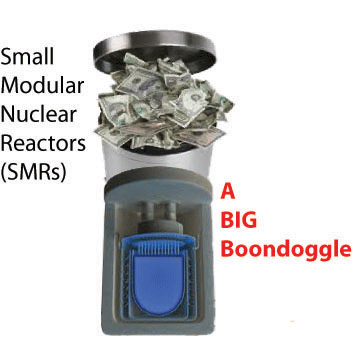
Senator McMahon is looking beyond currently commercialised nuclear technology, to Small Modular Reactors (SMRs). None of these exist in service anywhere in the world and as the WNISR2020 report points out, will cost more per kilowatt than conventional nuclear energy – and beyond a few prototypes SMRs are unlikely to come into play.
So, as renewables are perceived to be expensive when backed by storage, the solution is to shoot for a technology that may never hit prime time and even if it does, will be even more expensive than conventional nuclear, push up energy prices and erode carbon mitigation outcomes?
Perhaps channelling Senator Matt Canavan, this is some of what the senator had to say about renewables in late October:
“Renewables are the dole bludgers of the energy mix,” said Senator McMahon. “They are a great hoax perpetrated by the industry on the gullible.” Continue reading
Previous Chief Scientist not a fan of Small Nuclear Reactors
 Dr Finkel said it was “hard to see” small nuclear modular reactors being ready before 2040, and even after that Australia would have to monitor commercial installations overseas before allowing the technology.
“So, is it something we should be looking at hard at the moment? I am certainly not looking at it intensely at the moment,” he said. https://www.smh.com.au/politics/federal/gas-critical-for-renewable-energy-future-chief-scientist-says-20200212-p54026.html?fbclid=IwAR00ucWlw1Lsq_gNEPkPQ8ru301_hEmu9gXMxdG3CunZHBXyf_zE4E9QB3E
Since Penny Sackett, Australia’s Chief Scientists have moved further towards the extractive industries

above – new Chief Scientist Cathy Foley
Penny Sackett, Chief Scientist 2008 – 2011, was the first and clearest voice to speak out on climate change.
Then we had Ian Chubb, who was a lot quieter about this.
Then we got Alan Finkel, – who agreed that climate change was a threat, but thought that gas was a big solution. However, he was very luke warm about nuclear power
Now we get Cathy Foley, a physicist with a background in the minerals industries, who talks about “no single solution” and ”a “whole range” of solutions ”. Could that mean carbon capture, and small nuclear reactors? Watch this space.
Why this site will now stick to examining NUCLEAR issues
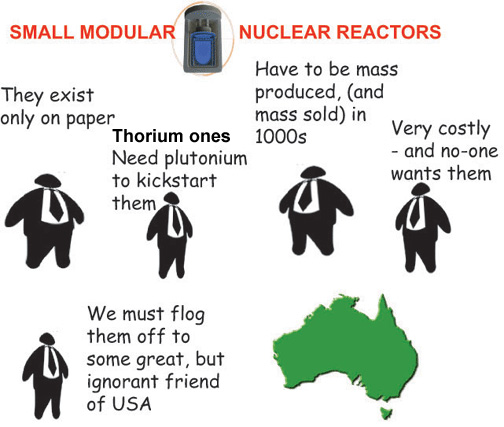
So much is happening – under the radar – in nuclear issues.
Although I recognise the huge importance of thr coronavirus pandemic, and of global heating (and Australia is the canary in the global cage), I have decided to restrict my posts from now on pretty much to nuclear news.
Why? because many others are covering climate and clean energy issues so well.
But there is very little awareness of the nuclear global threat.
We are at a critical time regarding nuclear weapons – the U.N. Treaty on the Prohibition of Nuclear Weapons will soon come into force – already nuclear weapons do not have the ”respectability” that the nuclear nations claim that they have.
Then the ”peaceful” nuclear reactors come into question. The global industry is busting to establish ”small” nuclear reactors world-wide. Though they’re super-expensive, useless against climate change, unsafe, produce toxic wastes – they are the desperately needed salvation. The costs of weapons development can be hidden, and transferred to consumers and tax-payers via these new white elephants.
And Australia – with its scientifically ignorant politicians, and its media Murdochracy, is a sitting duck for the pro nuclear propaganda.
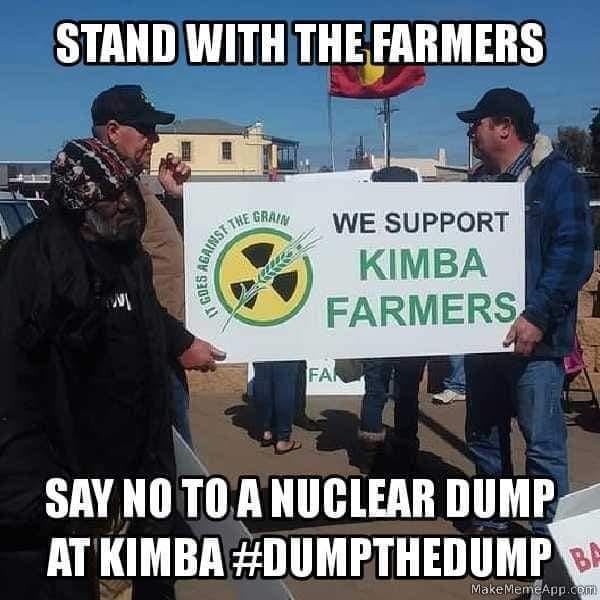
Uncertainty over Kimba nuclear waste dump as farmers go to Canberra to oppose it
|
Kimba nuclear debate set to continue, Eyre Peninsula Tribune, Alisha Fogden, 9 Nov 20,
A group of Kimba farmers and community members travelled to Canberra this week to meet with the Labor Party, The Greens and cross-bench Senators “to put a face to those directly impacted by the proposed legislation to name Kimba as the site for Australia’s radioactive waste dump”.
No Radioactive Waste on Agricultural Land in Kimba or SA Committee secretary Toni Scott said the government process to site the facility in Kimba over the past five years had been “unfair, manipulative and completely lacking in transparency”. “We are extremely concerned that the government’s proposed legislation, currently awaiting Senate consideration, intentionally removes our right to contest the decision and denies basic protections,” she said.
“Productive farming land in Kimba is not the best, or even the right, place for our nation’s radioactive waste. We urge the federal government to review their selection process, rather than trying to force this decision through parliament.” The trip follows a visit by Federal Resources Minister Keith Pitt to the Kimba region last week, where he said he remained confident the federal government would get their legislation for the facility through the upper house when the Senate resumed this week. This is despite Labor withdrawing its support for the bill at the ‘eleventh hour’ and further dissenting reports from The Greens and Independent Senator Rex Patrick………https://www.eyretribune.com.au/story/7005850/group-push-nuclear-rethink/ |
|
|
Senator Sam McMahon enthuses about Generation IV nuclear reactors for the Northern Territory
“In fact, when it comes to emissions, reliability and power output, nuclear is a clear winner.
“These facts are true of existing nuclear power stations, however, it is the emerging Generation IV nuclear reactors that I believe should be given greater consideration.”…….
“Currently, there are no SMR’s in service anywhere in the world but there are several projects being developed in Europe, China and the USA. The Australian Nuclear Science and Technology Organisation monitors advances in the various technologies and regularly reports on its findings. Australia is in a position to not only observe and learn, but also to contribute to this growing body of knowledge and technology.
“The NT is uniquely positioned to benefit from a nuclear industry in Australia, should we decide to go down that path.” https://www.goulburnpost.com.au/story/7004671/nuclear-must-be-part-of-debate-on-australias-future-energy-needs-mcmahon/?cs=9397
Australian government ponders nuclear submarines
Why indeed! I would venture that there hasn’t been a detailed discussion of nuclear propulsion around the Australian cabinet table since the nuclear crisis in ANZUS in 1984, in which New Zealand cast away the alliance over the vastly improbable risk that a US warship might sneak a nuclear weapon into Auckland Harbour. I was closely involved in the defence white papers produced in 2000 and 2016 and had a ringside seat at the 2009 white paper. To my knowledge, nuclear propulsion wasn’t part of any formal cabinet consideration. The 2009 white paper quickly dismissed any interest—‘The Government has ruled out nuclear propulsion for these submarines’—at the same time as it stressed the importance of range and ‘prolonged covert patrols over the full distance of our strategic approaches and in operational areas’.
At a major maritime conference in 2019, the chief of navy, Vice Admiral Mike Noonan, tentatively ventured the thought that a slow build of 12 boats might allow nuclear propulsion to be considered at a later stage (‘A change in the propulsion system for the Attack-class submarines; it’s something that will no doubt be discussed over the next 30 years, bearing in mind that by the time we deliver No. 12 it will be 2055’), but the government quickly said that this wasn’t under consideration. In fact, there doesn’t appear to be a strong constituency for nuclear propulsion inside the navy, which is still culturally an organisation built around surface ships. The wider defence organisation has the Attack-class project to deliver, which is complex enough without adding a major new challenge to master nuclear propulsion.
Parliament is filled with many MPs on both sides of politics who will privately advocate for nuclear propulsion but publicly shy away from discussing the capability. The fear is that it isn’t possible to build a bipartisan consensus for nuclear propulsion in ways that prevent one side of politics rejecting the idea, leaving the other side with a potential political liability.
That was certainly the outcome of the 2019 House of Representatives Standing Committee on the Environment and Energy review of the future of nuclear technology in Australia. Government members of the committee recommended ‘adopting a strategic approach to the possibility of entering the nuclear energy industry’. This was countered with a Labor Party dissenting report claiming that ‘There is simply no case for wasting time and resources on a technology that is literally the slowest, most expensive, most dangerous, and least flexible form of new power generation.’
Nuclear propulsion for submarines wasn’t considered, but it’s clear at least in the short term that there’s no prospect for bipartisan cooperation on this issue………
The strategic ground is changing quickly under our feet, and those developments might, in future, force a more urgent government consideration of the submarine capability Australia needs. The 2016 white paper pointed to the need to keep the submarine capability under examination, stating that a review would be needed ‘in the late 2020s to consider whether the configuration of the submarines remains suitable or whether consideration of other specifications should commence’…….. https://www.aspistrategist.org.au/why-didnt-australia-consider-nuclear-propulsion-for-its-new-submarines/
Australia’s freedom of information system hides climate documents
 Australia’s government agencies increasingly refusing environment-related FOIs, audit finds . Australian Conservation Foundation also finds growing delays in processing requests by departments and agencies. Guardian, Christopher Knaus, 9 Nov 20,Australia’s freedom of information system is increasingly hiding documents about climate and other environmental issues from the public, a trend driven by skyrocketing refusal rates, widespread delays and rising costs, an audit has found.
The audit, conducted by the Australian Conservation Foundation (ACF), examined five years of FOI requests for environment-related documents across federal and state departments and agencies.
It found the number of outright refusals for environment-related documents has more than doubled, from 12% to 25%, while the number of requests granted in full has dropped from 26% to 16%.
Delays in processing environment-related FOI requests were widespread, the audit found, with 60% of requests late by more than a month and 39.5% by more than two months.
The cost of processing environment-related FOIs was double the average, and lengthy review processes, which often took more than a year to complete, were becoming “a key tool for denying access to information”.
“It appears from our audit that environmental information is even more odiously inaccessible than other information subject to the [Freedom of Information] Act,” the ACF’s audit said.
ACF’s democracy campaigner, Jolene Elberth, said the findings of the audit should be a “wake-up call” to anyone who cares about transparency.
“Serious systemic flaws in our system are frustrating efforts to protect our precious natural ecosystems and tackle the climate crisis,” Elberth told the Guardian………
The Office of the Australian Information Commissioner’s (OAIC) latest annual report shows delays, complaints and refusals are all increasing over time.
Complaints about the FOI system increased by 79% in a single year, according to the OAIC’s annual report.
Practical refusals – used if a request is deemed to take too much time or effort to process or if documents cannot be found – went up by 71% in 12 months.
Delays are growing more protracted.
Last financial year, about 79% of all FOIs were processed in the time required by law. The year before it was 83% and in 2017-18 it was 85%.
In some government agencies, only 50% of FOI requests are being processed within the lawful timeframe, including the prime minister’s office, the office of the environment minister, the Australian Radiation Protection and Nuclear Safety Agency, the Australian Sports Anti-Doping Authority, Sports Australia, the Australian federal police, the Australian Broadcasting Corporation, the office of the infrastructure minister and Norfolk Island Regional Council.
Delays at the Department of Home Affairs, which receives by far the most FOI requests, have also increased…… https://www.theguardian.com/australia-news/2020/nov/09/australias-government-agencies-increasingly-refusing-environment-related-fois-audit-finds
New chief scientist says climate change has “no single solution” — RenewEconomy

This is a real worry. Cathey Foley has a background in the minerals industry. The ”no single solution” could be code for including gas, carbon capture, nuclear….
Australia’s new chief scientist, Cathy Foley, says climate change is a problem with “no single solution,” and one of the world’s greatest challenges. The post New chief scientist says climate change has “no single solution” appeared first on RenewEconomy.
New chief scientist says climate change has “no single solution” — RenewEconomy

Farmers to Canberra, to protest the law that forces a nuclear dump on Kimba’s agriculutral land
 We are members of the Kimba community and proud and productive grain farmers who have travelled to Canberra to meet with Labor, Green and cross-bench Senators to put a face to those directly impacted by the proposed legislation to name Kimba as the site for Australia’s radioactive waste dump.
In our view the process the Government has employed to site this facility in Kimba over the last five years has been unfair, manipulative and completely lacking in transparency.
We are extremely concerned that the Governments proposed legislation currently awaiting Senate consideration intentionally removes our right to contest the decision and denies basic protections .
It is clear that productive farming land in Kimba is not the best, or even the right place for our nations radioactive waste. We urge the federal government to step back and review their selection process rather than continue trying to force this decision through via Parliament.
Quotes can be attributed to Toni Scott – Secretary, No Radioactive Waste on Agricultural Land in Kimba or SA Committee Media Contact – Kellie Hunt – 0428 572 411
Jo Biden’s win leaves Scott Morrison looking pretty silly on climate policy
 Biden win leaves Australia ‘isolated’ and lagging on climate goals, New Daily, Josh Butler 8 Nov 20, A Biden presidency will put an increasingly “isolated” Australian government under immense pressure to adopt strong environment and emissions policies, leading climate voices say, as the United States looks to again assume a global leadership role.It comes as former prime minister Malcolm Turnbull ridicules Scott Morrison’s plans for a ‘gas-led recovery’ as “BS” and “political piffle”, in calling for his former colleagues to back more ambitious climate targets……. Biden win leaves Australia ‘isolated’ and lagging on climate goals, New Daily, Josh Butler 8 Nov 20, A Biden presidency will put an increasingly “isolated” Australian government under immense pressure to adopt strong environment and emissions policies, leading climate voices say, as the United States looks to again assume a global leadership role.It comes as former prime minister Malcolm Turnbull ridicules Scott Morrison’s plans for a ‘gas-led recovery’ as “BS” and “political piffle”, in calling for his former colleagues to back more ambitious climate targets…….
President-elect Biden spoke of “the battle to save our planet by getting the climate under control”, while vice president-elect Kamala Harris also prominently mentioned the need “to combat the climate crisis” in her speech. Ambitious climate agendaMr Biden will reinsert the US into the Paris climate agreement on his first day in office. He pledged “to get every major country to ramp up the ambition of their domestic climate targets”, and will move to get the US power grid using 100 per cent clean energy by 2035. Crucially, he will commit the US to a policy of net-zero emissions by 2050. This change, Australian experts say, will leave Mr Morrison’s federal government out in the cold as the only one of our major trading partners without a similar target. “This will have huge ramifications in increasing action around the world,” Amanda McKenzie, CEO of the Climate Council, told The New Daily. “Australia will look isolated. Most countries have a net-zero target, many are looking more ambitious than that. Australia’s ‘climate-lite’ approach, of not doing a lot but claiming we are, won’t cut it.” All of Australia’s most important partners – the United Kingdom, Japan, South Korea, China, India, Canada, and now the US – have committed to concrete net-zero targets in coming years, meaning a balance between emissions produced and emissions removed. Last month, British PM Boris Johnson told Mr Morrison of the need for “bold action to address climate change” and “the importance of setting ambitious targets to cut emissions and reach net zero”. However, Mr Morrison has only committed Australia to the goal “in the second half of this century”. The federal government has also come under fire for the controversial plan to use ‘carryover credits’ from the previous Kyoto climate agreement to count against commitments under the Paris agreement. On Sunday, Mr Morrison said he looked forward to working with Mr Biden to lower emissions worldwide……… Pushing beyond net zeroRichie Merzian, climate and energy program director at The Australia Institute, said a Biden win will further pressure the federal government. “We could always hide behind the US when they were a laggard on climate, but no more. Biden will bring that pressure to bear on Morrison,” Mr Merzian told TND……. He added that Australia should scrap its reliance on Kyoto credits and pledge stronger action. “The most important period for climate action is the next 10 years … [a Biden win] does raise this and put this back as a front and centre issue,” Mr Merzian said. Australia Institute polling from last year found 62 per cent of Australians would back a net-zero target by 2050, or even earlier……. https://thenewdaily.com.au/news/2020/11/09/joe-biden-climate-change/ |
|
The plan to use nuclear bombs for fracking in Western Australia
Most recently, his dives into the archives led him to a largely forgotten episode in Western Australia’s past — the serious discussions that took place about using a nuclear weapon to create a deep harbour at Port Hedland in the state’s north.
The discussions were between the WA Government, United States nuclear scientists, and mining companies.
In 1961, the US Government began Operation Plowshare, a program investigating using atomic technology for civil purposes.
“[The US] had the bomb at the end of the war and they were looking for ways to get some value back out of it after all the money they had spent developing it,” Mr Clancy said.
The original fracking was atomic fracking. But it was too strong for that. It was doing too much damage underground.”
Various Plowshare ideas floated included using atomic bombs to cut a highway through southern California or duplicate the Panama Canal in Nicaragua, but they were deemed too big and too risky.
“They’d have needed 30 or 40 bombs to do that,” he said.
“There would have been too much leftover waste and they didn’t quite know what a big concentration of it in one place would end up doing.”
His interest in the connection to WA was first roused years ago on a trip to the United States.
“You can do a public tour of the Nevada [nuclear] Test Site (NTS), and I did that,” he said.
“They had one particular test that they (the NTS) had set up with Port Hedland in mind, seeing how much dirt they could shift with one blast and how big the hole would be. That’s the first I heard of this.”
Recently, his online research led to an array of documents held in the State Records Office including reports, correspondence, and newspaper clippings about the plans during the 1960s.
“I never thought there would be this much information on it,” he said.
The files reveal numerous discussions the State Government, north-west mining companies, and nuclear scientists had around using nuclear technology in the Pilbara.
At the same time, the discovery of vast iron ore deposits in the Pilbara meant that the region was rapidly opening up to mining and industrial development.
A port was needed to ship million of tonnes of iron ore offshore.
Mr Clancy said the project in Australia’s remote north-west, requiring only one or two bombs, would have seemed an ideal first project.
“The Plowshare operation was quite prominent, they were shopping around anywhere they could for someone that was interested,” he said.
“While this was going on, they were still doing underground testing in America, they were gathering information all the time.
“They [Operation Plowshare] were open to anything.”……….
While it’s not entirely clear who first suggested it, the flurry of correspondence between the Western Australian government, engineering firms and mining companies throughout the 1960s shows the idea was firmly on the drawing board.
In one letter to Charles Court, a former premier and minister for regional development and the north-west from 1959 until 1971, an engineering firm wrote they had met with Australia’s atomic energy attache at the embassy in Washington and were eager to proceed:……..
A report of a visit by Australian Atomic Energy officers to BHP’s Deepdale iron ore development, dated February 1, 1966, gives some hint of the magnitude of the political challenge faced.
It also raised the inconvenient problem of the existence of the Test Ban Treaty:
The report goes on to discuss how an exemption may have been possible, but it would have required the Australian Government to be the first in the world to propose changing the treaty.
Mr Clancy also suspects the fallout from the British tests on the Montebello Islands in Western Australia’s north-west and in Maralinga in South Australia also played a part in why the ideas came to nothing.
By 1971, the Liberal government under Premier David Brand had been defeated and the records come to an end.
In 1977, the United States Government formally ended Operation Plowshare, never having found a site for the peacetime application of nuclear weapons……..https://www.abc.net.au/news/2020-11-08/documents-reveal-plans-to-use-nuclear-bombs-in-port-hedland/12848004
Out of site out of mind – Australian govt has NO PLAN for nuclear waste disposal.
Divisive campaign on South Australian facility highlights urgent need for long term nuclear waste management plan, Croakey, 6 Nov 20, Tillman Ruff
“……..No long term management plan for nuclear waste
Australia needs to develop a plan for long-term management and disposal of long-lived intermediate level nuclear waste, which must be kept strictly isolated from people and the environment for 10,000 years.
More than 90 percent of Australia’s radioactive waste comes from nuclear reactors managed by the Australian Nuclear Science and Technology Organisation (ANSTO) at Lucas Heights in southern Sydney. This waste is stored there in a dedicated Interim Waste Store facility at Australia’s principal nuclear facility, with the best expertise and capacity in the country to manage this safely, monitored 24/7 by the Australia Federal Police.
A serious, open, transparent, evidence-based process is required to carefully consider the options, and develop the most responsible plan for ongoing long-term management and disposal of this waste.
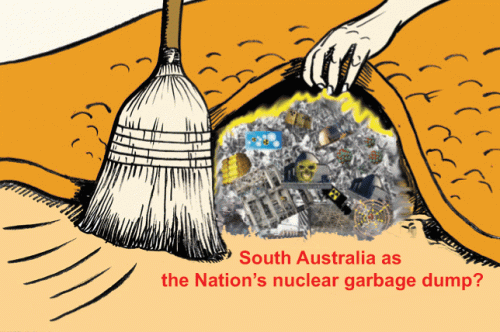
nstead, successive governments — both Coalition and Labor — have sought to impose a succession of ill-considered waste dump plans on SA and NT remote communities. All have previously failed because of deeply flawed processes and strong community opposition.
Transport, taxpayer burdens absent health need
The risks of accident or theft are greatest during transport of nuclear materials. Kimba is 1,700 km from Lucas Heights. Road or sea transport of radioactive waste would involve lengthy routes potentially traversing many communities in multiple states.
The nuclear regulator, the Australian Radiation Protection and Nuclear Safety Agency (ARPANSA) has recently confirmed to a Senate inquiry that Lucas Heights has the capacity to safely store Australia’s radioactive waste for several decades, and that there is no urgent need to relocate it.
The Senate Inquiry last month recommended the South Australian plan go ahead, but there was a split among the committee membership, with Senators Jenny McAllister (Labor), Sarah Hanson-Young (Greens) and Rex Patrick (Independent) dissenting.
The government’s repeated claim that an immediate interim radioactive waste dump is needed to ensure the continuation of nuclear medicine in Australia is false.
Every sizeable hospital currently manages their radioactive waste on a ‘delay and decay’ basis on site; the residual waste rapidly loses its radioactivity and is stored on-site until it has decayed and can be discarded with normal waste. This doesn’t need to and won’t change.
The emotive but fallacious claim that provision of nuclear medicine services needed for diagnosis and treatment of cancer will be jeopardised if a new nuclear waste dump is not urgently progressed is being dishonestly but persistently promoted.
To support passage of the government’s amendments, Federal Resources, Water and Northern Australia Minister Keith Pitt is believed to be planning a “nuclear medicine roundtable” at Parliament House on Monday 9 November.
The true driver of increasing need for waste management is ANSTO’s institutional nuclear ambitions, reflected in its current massive ramp-up of production of medical isotopes for export — from around one percent to a target of 25-30 percent of global supply over the next several years.
Not only are we left with the waste legacy of this expanding isotope export business, Australian taxpayers also pick up the bill, paying $400 million for the Lucas Heights OPAL reactor, and subsidising ANSTO on an annual basis for its nuclear operations.
ANSTO received $313.8 million in 2019-20, and was given an additional $238.1 million over 4 years in last month’s Budget.
Cost analyses in several other countries have found that medical isotope sales usually only recover 10-15 percent of the true cost of production once waste, decommissioning, insurance and other costs are factored in.
ANSTO’s export expansion push is increasing domestic nuclear waste pressures, and this is happening without proper public and parliamentary accountability and scrutiny………..
Out of sight, out of mind
The government’s approach, codified in the proposed amendments, would see long-lived radioactive intermediate level nuclear waste transported long distances from the best and most secure site to manage radioactive waste in Australia, to a distant site in South Australian farming country with no current expertise, facilities or experience in securely managing long-lived hazardous radioactive waste.
Effectively, this “temporary” storage facility for waste that must be kept safe from the environment for over 10,000 years will be a large shed.
There is currently no plan and no process to develop a plan for the long-term management and eventual disposal of this waste. Therefore the intermediate level waste will likely languish indefinitely above ground in a facility inadequate for safe long-term storage or disposal, but out of sight and out of mind from Canberra or Sydney.
Australia needs an open, transparent, evidence-based and independent review of Australia’s current and projected radioactive waste production. This review should examine and make recommendations on the best practice long-term management of Australia’s radioactive waste production and disposal.
It should be conducted independently of ANSTO, given their role as proponent of the current proposal and plans to significantly increase nuclear waste production over the next decade for reasons which are not based on the health or other needs of Australians.
It should be open to input from Indigenous organisations, civil society organisations, experts and the public, and be undertaken before any soil is turned for a dump in Kimba and before any waste is moved from Lucas Heights. We have ample time to do this properly.
Tilman Ruff AO is Associate Professor at the Nossal Institute for Global Health, University of Melbourne. He is Co-President of International Physicians for the Prevention of Nuclear War, and co-founder and founding chair of the International Campaign to Abolish Nuclear Weapons, both Nobel Peace Prize laureate organisations. https://www.croakey.org/divisive-campaign-on-sa-facility-highlights-urgent-need-for-long-term-nuclear-waste-management-plan/
Australian govt will feel the heat when a Biden administration rejoins the Paris climate agreement
 Biden says the US will rejoin the Paris climate agreement in 77 days. Then Australia will really feel the heat, The Conversation Christian Downie, Australian Research Council DECRA Fellow, Australian National University, November 6, 2020 When the US formally left
the Paris climate agreement, Joe Biden tweeted that “in exactly 77 days,  a Biden Administration will rejoin it”.
The US announced its intention to withdraw from the agreement back in 2017. But the agreement’s complex rules meant formal notification could only be sent to the United Nations last year, followed by a 12-month notice period — hence the long wait.
While diplomacy via Twitter looks here to stay, global climate politics is about to be upended — and the impacts will be felt at home in Australia if Biden delivers on his plans.
Biden’s position on climate change
Can he do it under a divided Congress?
While the votes are still being counted — as they should (can any Australian believe we actually need to say this?) — it seems likely the Democrats will control the presidency and the House, but not the Senate.
This means Biden will be able to re-join the Paris agreement, which does not require Senate ratification. But any attempt to legislate a carbon price will be blocked in the Senate, as it was when then-President Barack Obama introduced the Waxman-Markey bill in 2010.
What’s needed are ambitious targets and mandates for the power sector, transport sector and manufacturing sector, backed up with billions in government investment.
Fortunately, this is precisely what Biden is promising to do. And he can do it without the Senate by using the executive powers of the US government to implement a raft of new regulatory measures.
Take the transport sector as an example. His plan aims to set “ambitious fuel economy standards” for cars, set a goal that all American-built buses be zero emissions by 2030, and use public money to build half a million electric vehicle charging stations. Most of these actions can be put in place through regulations that don’t require congressional approval.
And with Trump out of the White House, California will be free to achieve its target that all new cars be zero emissions by 2035, which the Trump administration had impeded.
If that sounds far-fetched, given Australia is the only OECD country that still doesn’t have fuel efficiency standards for cars, keep in mind China promised to do the same thing as California last week.
What does this mean for Australia?
For the last four years, the Trump administration has been a boon for successive Australian governments as they have torn up climate policies and failed to implement new ones.
Rather than witnessing our principal ally rebuke us on home soil, as Obama did at the University of Queensland in 2014, Prime Minister Scott Morrison has instead benefited from a cosy relationship with a US president who regularly dismisses decades of climate science, as he does medical science. And people are dying as a result.
For Australia, the ambitious climate policies of a Biden administration means in every international negotiation our diplomats turn up to, climate change will not only be top of the agenda, but we will likely face constant criticism.
Indeed, fireside chats in the White House will come with new expectations that Australia significantly increases its ambitions under the Paris agreement. Committing to a net zero emissions target will be just the first.
The real kicker, however, will be Biden’s trade agenda, which supports carbon tariffs on imports that produce considerable carbon pollution. The US is still Australia’s third-largest trading partner after China and Japan — who, by the way, have just announced net zero emissions targets themselves……
With Biden now in the White House, it’s not just global climate politics that will be turned on its head. Australia’s failure to implement a serious domestic climate and energy policy could have profound costs.
Costs, mind you, that are easily avoidable if Australia acts on climate change, and does so now. https://theconversation.com/biden-says-the-us-will-rejoin-the-paris-climate-agreement-in-77-days-then-australia-will-really-feel-the-heat-149533
1 This month
17 October, Free Public Talk on Nuclear Issues in South Australia
David Noonan will speak on public interest concerns over the new Roxby Downs Indenture Act 2026 on BHP copper-uranium mining and ore processing in SA, and on how AUKUS may face SA with a High-Level nuclear waste agenda.
Dr Jim Green will discuss international developments in the field of nuclear power including ‘small modular reactors’ and Generation 4 ‘advanced’ nuclear reactor concepts.


Help Aunty Sue Protect Her Land and Sacred Sites From Destructive Rocket Testing.
.

Australians deserve the truth
about
AUKUS – https://aukuspublicinquiry.com/

PETITION – To: Prime Minister Anthony Albanese and the Australian Labor Government

of the week – Australians for War Powers Reform (AWPR)
To see nuclear-related stories in greater depth and intensity

