More serious governance failures in Defence contracting
The pattern of poor governance by Defence has been further exposed following disturbing revelations in yet another contract.
MICHELLE FAHY, DEC 23, 2023 https://undueinfluence.substack.com/p/more-serious-governance-failures?utm_source=post-email-title&publication_id=297295&post_id=140001297&utm_campaign=email-post-title&isFreemail=true&r=1ise1&utm_medium=email
It was revealed this week that Defence Department officials congratulated themselves for not recording minutes of a critical meeting in which the work of consultants it had hired was being checked against the contract.
Incredibly, the failure to record minutes was noted as a positive in a post-implementation review of the project, with the only negative point listed being that the donuts arrived too early in the meeting.
This serious accountability failure is a breach of Defence’s contracting rules and the Commonwealth Procurement Rules, adherence to which is fundamental to good governance.
The failure to keep minutes of the key meeting means there’s no official record of who attended the meeting, in what capacity, and what contribution they made.
It was just one of a raft of irregularities found in a $100 million contract between the Defence Department and KPMG, which is part of the One Defence Data program, following a damning review by external consultants, Anchoram Consulting.
Some of the irregularities described in the review bear striking similarities to those found in Defence’s controversial Hunter Class frigate procurement from BAE Systems, Australia’s largest ever surface warship acquisition, which has been referred to the National Anti-Corruption Commission following a scathing report by the auditor general.
One of the grounds for the corruption referral was the absence of a number of important accountability documents, including minutes of key decision making meetings, related to the Hunter Class frigate procurement process. (Read full story on the $46 billion frigate procurement here and here.)
The Australian National Audit Office report on the frigates noted that the Defence Department was a serial offender when it came to deficient record-keeping. The auditors footnoted a comment from the Commissioner for Law Enforcement Integrity that a “lack of record keeping can create corruption vulnerabilities within an Agency”.
A lack of record keeping can create corruption vulnerabilities
Another revelation in the Anchoram review was that Defence had made “a six-figure payment” to KPMG “for work the government knew had not been delivered”.
Similarly, as the audit office revealed in May, during the frigate procurement process the Defence Department made milestone payments to BAE Systems even though BAE had missed the milestones.
Anchoram revealed that the KPMG project was plagued by a “lack of accountability” and “real and perceived conflicts of interest”. Core governance documents were not signed off and key requirements of KPMG’s contract were diluted from “mandatory” to “desirable”, sometimes in consultation with KPMG itself, despite Defence requirements stating explicitly that mandatory items cannot be changed.
Furthermore, Anchoram concluded that “the Commonwealth has a significant risk that it absolved [KPMG] from its commercial obligations and consequently transferred delivery risk from [KPMG] to the Commonwealth.”
The review said the Commonwealth’s ability to govern the One Defence Data program’s financials and ensure value for money had been “significantly compromised”.
Similarly, with the frigate procurement process, Defence sidelined the central procurement rule of achieving value for money. Numerous conflicts of interest and revolving door appointments, including the secretive involvement in the frigate tender evaluation process of people formerly employed by BAE Systems (as I reported exclusively in July) prefigure the serious governance issues exposed by Anchoram in Defence’s cosy arrangement with KPMG.
The Anchoram Consulting report, dated April 2022, has been released publicly this week following an order from independent senator David Pocock to the Defence Department.
Meanwhile, the Parliamentary Joint Committee of Public Accounts and Audit is conducting an inquiry into Defence’s frigate procurement process.
Labor MP Julian Hill, the chair of the committee, has stated: ‘It does feel like someone has back-engineered a decision and gone, “we want to go with BAE”…’.
The Anchoram Consulting report on the One Defence Data program can be downloaded here.
A Merry AUKUS Surprise, Western Australia!
December 20, 2023, by: Dr Binoy Kampmark, https://theaimn.com/a-merry-aukus-surprise-western-australia/
The secretive Australian government just cannot help itself. Clamouring and hectoring of other countries and their secret arrangements (who can forget the criticism of the Solomon Islands over its security pact with China for that reason?) the Albanese government is a bit too keen on keeping a lid on things regarding the withering away of Australian independence before a powerful and spoiling friend.
A degree of this may be put down to basic lack of sensibility or competence. But there may also be an inadvertent confession in the works here: Australians may not be too keen on such arrangements once the proof gets out of the dense, floury pudding.
It took, as usual, those terrier-like efforts from Rex Patrick, Australia’s foremost transparency knight, forever tilting at the windmill of government secrecy, to discover that Western Australians are in for a real treat. The US imperium, it transpires from material produced by the Australian Department of Defence, will be deploying some 700 personnel, with their families, to the state. And to make matters more interesting, Western Australia will also host a site for low-level radioactive waste produced by US and UK submarines doing their rotational rounds under the AUKUS arrangements.
The briefing notes from the recently created Australian Submarine Agency reveal that the Submarine Rotational Force-West (SRF-West) will host as many as four US nuclear submarines of the US Navy Virginia-class at HMAS Stirling and one UK nuclear-powered boat from 2027. As part of what is designated the first phase of AUKUS, an Australian workforce of some 500-700 maintenance and support personnel is projected to grow in response to the program before Australia owns and operates its own US-made nuclear-powered boats. Once established and blooded by experience, “This workforce will then move to support our enduring nuclear-powered submarine program and will be a key enabler for SRF-West.”
The ASA documents go on to project that “over 700 United States Personnel could be living and working in Western Australia to support SRF-West, with some also bringing families.” The UK will not be getting the same treatment, largely because the contingent from the Royal Navy will be moving through on shorter rotations.
The stationing of the personnel in question finally puts to rest those contemptible apologetics that Australia is not a garrison for the US armed forces. At long last Australians can be reassured, if rather grimly, that these are not fleeting visits from great defenders, but the constant, and lingering presence of an imperial power jealously guarding its interests.
The issue of storing waste will have piqued some interest, given Australia’s current and reliably consistent failure to establish any long-term storage facility for any sort of nuclear waste, be it low, medium or high grade. But never fear, the doltish poseurs of the Defence Department are always willing to please and, as the department documents show, learn in their servile role.
As Patrick reveals, the documents released under FOI tell us that “operational waste” arising from the Submarine Rotational Force operation at HMAS Stirling will include the storage of low to intermediate level radioactive waste on Australian defence sites. One document notes that, “The rotational presence of United Kingdom and United States SSNs in Western Australia as part of the Submarine Rotational Force – West (SRF-West) will provide an opportunity to learn how these vessels operate, including the management of low-level radioactive waste from routine sustainment.”
The ASA also confirms with bold foolhardiness that, “All low and intermediate radioactive waste will be safely stored at Defence sites in Australia.” The storage facility in question is “being planned as part of the infrastructure works proposed for HMAS Stirling to support SRF-West.”
The Australian Defence Minister Richard Marles has retained a consultant, Steve Grzeskowiak, to the remunerative value of AU$396,000 from February to December this year to identify a suitable site on land owned by the Commonwealth. Absurdly, the same consultant, when Deputy Secretary of Defence Estates, conducted an analysis of over 200 Defence sites in terms of suitability for low-level waste management, finding none to pass muster.
In a troubling development, Patrick also notes that the Australian Naval Nuclear Power Safety Bill 2023, in its current form, would permit the managing, storing or disposing of radioactive waste from an AUKUS submarine, which would include UK or US submarines. Importantly, that waste could well be of a high-level nature. “While the Albanese Government has made a commitment that it will not do so, the Bill leaves the legal door open for possible future agreement from the Australian Government to store high-level nuclear waste generated from US or UK nuclear-powered submarines.”
To round matters off, Australia’s citizenry was enlightened to the fact that they will be adding some $US3 billion (AU$4.45 billion) to the US submarine industrial base. In the words of the ASA, “Australia’s commitment to invest in the US submarine industrial base recognises the lift the United States is making to supporting Australia’s acquisition of nuclear-powered submarines.” This will entail the pre-purchase of “submarine components and materials, so they are on hand at the start of the maintenance period” thereby “saving time” and “outsourcing less complex sustainment and expanding planning efforts for private sector overhauls, to reduce backlog.”
Decoding such naval, middle-management gibberish is a painful task, but nothing as painful as the implications for a country that has not only surrendered itself wholly and without qualification to Washington but is all too happy to subsidise it.
Opposition need to explain whether they’ll will stick with their ‘nuclear fantasy’
Climate Change and Energy Minister Chris Bowen says the Opposition has some explaining to do about whether they’ll stick with their “nuclear fantasy”.
“So, of course, projects will encounter some challenges – Snowy 2.0 has encountered delays and cost increases,” he said during a media conference on Thursday.
“That’s just one example.
“Nevertheless, it remains a very important project.
“Renewable energy, in all the evidence independently examined by the CSIRO and AEMO, is the cheapest form of energy.”
Cost update blasts nuclear out of energy mix
Canberra Times, By Marion Rae, December 21 2023
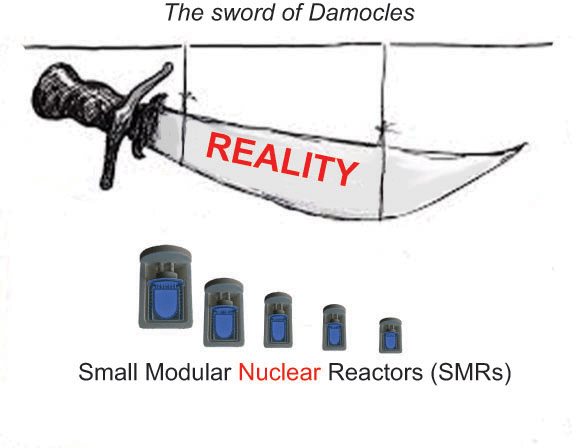
A surge in the cost of small nuclear reactors has forced the national science agency to change its calculations for Australia.
The latest modelling of all energy sources, released by CSIRO on Thursday, includes data from a recently scrapped project in the United States that was showcasing nuclear small modular reactors (SMRs) as a way to fight climate change.
The draft GenCost 2023-24 report, out for consultation over summer, shows that while inflation pressures are easing there has been a recalculation on SMRs that puts them out of reach.
Real data on a high-profile six-reactor power plant in the United States has confirmed that the contentious technology costs more than any energy consumer wants to pay.
Project costs for the Utah project were estimated at $18,200 per kilowatt, but the company has since disclosed a whopping capital cost of $31,100/kW, prompting its cancellation in November.
In contrast, under existing policies the cost of new offshore wind in Australia in 2023 would be $5545/kW (fixed) and $6856/kW (floating), while rooftop solar panels are calculated at a modest $1505/kW………………………………………………………………………………………………………………..
A small but vocal group of industry backers have been calling for nuclear SMRs for some years, citing the emerging low-emission technology as being suitable for Australia’s vast and geologically stable landmass.
The coalition recently pledged to reopen the nuclear debate in Australia, where laws ban any research or use of nuclear energy despite the country having the world’s largest uranium reserves.
Regulators estimate it would be around 15 years to first production from a decision to build nuclear SMR in Australia, given the scale of legislative change required.
But even if a decision to pursue a nuclear SMR project in Australia were taken today, with political backing for new laws, it is “very unlikely” a project would be up and running as quickly as 2038, CSIRO said.
Further, CSIRO warned nuclear electricity costs put forward by proponents may be for technology that is not appropriate for Australia, or calculated from Russian and Chinese government-backed projects that don’t operate commercially. https://www.canberratimes.com.au/story/8467236/cost-update-blasts-nuclear-out-of-energy-mix/
Busting the government spin about “radioactive waste management” at Garden Island, Western Australia.

The claim that planning has begun for a “low-level radioactive waste management”
facility at HMAS Stirling as part of the AUKUS arrangements must surely be the worst of
political spin as Garden Island by its geological and topographical settings is both
completely unsuitable and highly dangerous for that purpose.
What is more it will be be difficult to separate the nuclear waste generated through the
use of Stirling into the levels of low and intermediate classifications – and there will be
some of intermediate level generated – for storage or other means of management of
the resulting nuclear waste.
Besides its relatively small size Garden Island is comprised of porous limestone
covered by a thin layer of sand making it unsafe even by extensive engineering from
harmful contamination through leakages of nuclear waste which occur regularly at
above the ground nuclear waste installations
Why does the federal government in its various guises fail to avail itself of the Azark
Project underground nuclear waste facility at Leonora in Western Australia which is
regarded internationally as the best and safest possible for the permanent disposal of
nuclear waste
The Garden Island proposal reeks of the same incompetence as with the choice of
Kimba in South Australia for the national waste facility where the government was
spared by the recent judicial decision against that choice the embarrassment of having
it rejected under international prescriptions for its unsuitable and unsafe nature.
It should be clearly understood that none of the operations of AUKUS can be
implemented until Australia has a proper means for the safe disposal of the resulting
nuclear waste.
Renewables cheaper than nuclear, coal now and into the future: CSIRO

By Mike Foley, December 21, 2023 https://www.smh.com.au/politics/federal/renewables-cheaper-than-nuclear-coal-now-and-into-the-future-csiro-20231219-p5esga.html
Electricity produced by renewables is cheaper than fossil fuels and nuclear power and is expected to remain the lowest cost power source for decades to come, according to findings from the top science agency which challenge the federal opposition’s campaign against the government’s climate policy.
The new findings were published in released in CSIRO’s GenCost report on Thursday, which includes projections that an electricity grid dominated by 90 per cent renewables would deliver considerably cheaper power to households compared to fossil fuel and nuclear alternatives.
Opposition Leader Peter Dutton and his climate change and energy spokesman, Ted O’Brien, are calling for the government to halt the rollout of new energy transmission lines amid a farmer backlash over land access. The Coalition has mounted a campaign for nuclear power to be added to the nation’s energy mix.
Nuclear advocates have criticised previous CSIRO reports for not incorporating the costs of tens of billions of dollars of transmission lines needed to link the growing fleet of wind and solar farms across the country into population centres.
However, CSIRO has now included more than $30 billion of new transmission lines and projects to provide back up power when the wind isn’t blowing and the sun isn’t shining – such as the $12 billion Snowy 2.0 pumped hydro dam.
Its findings still showed that renewables were cheaper than nuclear, coal and other fossil fuels.
The report said that small modular reactors (SMR), a nascent technology not yet in commercial use but favoured by the opposition, would be far more expensive than coal and gas plants as well as renewables.
How did CSIRO calculate the costs?
GenCost uses the metric known as the levelised cost of electricity. This is how much it costs for a power plant to generate electricity, which includes capital expenditure as well as the revenue required to create a return on investment.
The report showed that a mix of wind and solar power in 2023 would generate electricity for $90 to $134 per megawatt hour.
This cost range is projected to fall to a $70 to $100 by 2030 – with renewables generating 90 per cent of the grid’s electricity. The Albanese government has set a target for renewables to reach 82 per cent of the energy mix by 2030.
CSIRO found coal generation is more expensive, even without the cost of transmission lines to link the power stations to the grid. Coal electricity generation costs between $110 and $220 per megawatt hour in 2023. This price drops slightly to a range of $85 to $135 in 2030.
The nuclear option
Dutton is calling for Australia to join a global “nuclear renaissance”, which would require removing the 1998 ban on nuclear energy and building small modular reactors on the site of retired coal-fired power plants.
US company NuScale was developing the world’s most advanced commercial SMR project in Utah, but the project was abandoned in November due to a 70 per cent blowout in project costs.
Using the NuScale project as a guide, CSIRO found that were SMR technology available today it would generate electricity at a cost of $380 to $640 a megawatt hour. This marked an increase from its July projections for SMRs to generate electricity at between $200 and $350 per megawatt hour.
CSIRO said SMR costs would fall as the technology develops, with a projected cost of $210 to $350 a megawatt hour of electricity generation in 2030.
NuScale’s development in Utah was expected to take at least 15 years to switch on, and CSIRO said this was a reasonable time frame to assume for Australia – if the current legislative ban on nuclear energy was removed and the necessary political support was in place.
Over 700 American AUKUS personnel to be based in Western Australia, with radioactive storage facility also planned
by defence correspondent Andrew Greene, https://www.abc.net.au/news/2023-12-18/aukus-americans-western-australia-radioactive-storage-facility/103239924
Defence expects more than 700 American personnel could live in Western Australia to support up to four US nuclear submarines being stationed at HMAS Stirling, where a “low-level radioactive waste management” facility is also being planned.
Key points:
- Western Australia will host the first submarines from 2027
- British personnel are also expected to join rotations but without families
- Radioactive waste will be stored at Defence sites including a new management facility in Perth
The projections are contained in comprehensive briefing notes prepared by the newly created Australian Submarine Agency (ASA) which also detail how a one-off Australian government payment of $US3 billion ($4.45 billion) will be spent by the United States.
Under the optimal pathway announced by AUKUS leaders earlier this year, the Submarine Rotational Force – West (SRF-West) would first begin hosting Royal Navy Astute-class and US Navy Virginia-class submarines at HMAS Stirling from 2027.
A Virginia-class submarine carries a crew of 132 according to the US Navy, while an Astute-class boat deploys with almost 100 Royal Navy submariners on board.
“This workforce will then move to support our enduring nuclear-powered submarine program and will be a key enabler for SRF-West,” the ASA states in documents obtained under Freedom of Information by former Senator and submariner Rex Patrick.
“In addition to these 500-700 Australians at its height, we estimate that over 700 United States Personnel could be living and working in Western Australia to support SRF-West, with some also bringing families,” the ASA predicts.
According to the ASA, SRF-West will be established as early as 2027 and expand in subsequent years to support up to four US and one UK nuclear-powered submarine, with the Australian government investing $8 billion to expand HMAS Stirling outside Perth.
The ASA notes there will also be “a small United Kingdom contingent living in Perth” but most British personnel supporting SRF-West “will be in Australia for shorter rotations, meaning they will not be bringing families with them”.
Planning begins for low-level radioactive waste management
Decisions on where Australia will eventually dispose of its nuclear submarine reactors are not expected for many years, but planning has begun for “low-level radioactive waste management” at HMAS Stirling to support SRF-West.
“Expertise to manage low-level operational waste arising from nuclear-powered submarine operations and sustainment will be an important part of Australia building the necessary stewardship capability to operate and maintain its own submarines.”
More details emerge on Australia’s multi-billion dollar payment
Inside the almost 200 pages of ASA briefing notes are further details of how a $US3 billion ($4.45 billion) Australian contribution to the US submarine industrial base will be spent, including on enhancing facilities and pre-purchasing components and materials.
“Australia’s commitment to invest in the US submarine industrial base recognises the lift the United States is making to supporting Australia’s acquisition of nuclear-powered submarines.”
“Pre-purchasing submarine components and materials, so they are on hand at the start of the maintenance period – saving time” and “outsourcing less complex sustainment and expanding planning efforts for private sector overhauls, to reduce backlog”.
Flirting With Nuclear Energy Down Under

December 15, 2023, by: Dr Binoy Kampmark, https://theaimn.com/flirting-with-nuclear-energy-down-under/
It was a policy that was bound to send a shiver through the policymaking community. The issue of nuclear energy in Australia has always been a contentious one. Currently, the country hosts a modest nuclear industry, centred on the Australian Nuclear Science and Technology Organisation (ANSTO), nuclear medicine and laboratory products. But even this has created headaches in terms of long-term storage of waste, plagued by successful legal challenges from communities and First Nation groups. The advent of AUKUS, with its inane yet provocative promise of nuclear-powered submarines for the Royal Australian Navy, adds yet another, complicating dimension to this fact. Without a clear idea of a site, a vital part of the nuclear dilemma remains unresolved.
Broadly speaking, the nuclear issue, in manifold manifestations, has never entirely disappeared from the periphery of Australian policy. The fact that Australia became a primary testing ground for Britain’s nuclear weapons program was hardly something that would have left Canberra uninterested in acquiring some nuclear option. Options were considered, be they in the realm of a future weapons capability, or energy generation.
In a June 29, 1961 letter from Australian Prime Minister Robert Menzies to his counterpart in the UK, Harold Macmillan, concerns over the impediments imposed by a potential treaty that would impose limitations on countries the subject of nuclear testing were candidly expressed. Were that treaty to go ahead, it “could prove a serious limitation on the range of decisions open to a future Australian Government in that it could effectively preclude or at least impose a very substantial handicap on Australia’s acquisition of nuclear weapons.”
Menzies put forth a suggestion that was ultimately never pursued – at least officially. An arrangement deemed “more practical,” suggested the Australian PM, might involve “the supply of ready-made weapons” at the conclusion of such a treaty.
A sore point here were efforts by the Soviets to insist that countries such as Australia be banned from pursuing their own nuclear program. Menzies therefore wished Macmillan “to accord full recognition of the potentially serious security situation in which Australia could find herself placed as a result of having accommodated United Kingdom testing.”
Australia eventually abandoned its nuclear weapons ambitions with the ratification of the Treaty on Non-Proliferation of Nuclear Weapons (NPT) in February 1970, preferring, instead, the nuclear umbrella of extended deterrence offered by the United States. (The nature of that deterrence has always seemed spectacularly hollow.) Domestically, nuclear technology would be sparingly embraced. Nuclear power stations, however, were banned in every state and territory, a policy left unchallenged by a number of parliamentary inquiries.
The quest of meeting emissions reduction targets during the transition to the goal of net zero was bound to refocus interest on the nuclear power issue. The Liberal-National opposition is keen to put the issue of nuclear power back on the books. It is a dream that may never see the light of day, given, according to the chief government scientific body, the CSIRO, its uncompetitive nature and the absence of “the relevant frameworks in place for its consideration and operation within the timeframe required.”
Australian politicians have often faced, even when flirting with the proposition of adopting nuclear power, firm rebuke. South Australian Premier Malinauskas gave us one example in initially expressing the view late last year that “the ideological opposition that exists in some quarters to nuclear power is ill-founded.” It did not take him long to tell the ABC’s 7.30 program that he did not wish “to suggest that nuclear should be part of the mix in our nation.” Australia had to “acknowledge that nuclear power would make energy more expensive in our nation & [we should] put it to one side, rather than having a culture war about nuclear power.”
Opposition Leader Peter Dutton has been by far the boldest, pitching for a gentler exit from the fossil-fuel powered nirvana Australia has occupied for decades. Australia, he is adamant, should join “the international nuclear energy renaissance.” Of particular interest to him is the use of Small Modular Reactors (SMRs), which might be purposefully built on coal generator cites as part of the general energy package alongside renewables. SMRs, as Joanne Liou of the International Atomic Energy Agency explains, “are advanced nuclear reactors that have a power capacity of up to 300 Mw(e) per unit, which is about one-third of the generating capacity of traditional nuclear power reactors.”
The heralded advantages of such devices, at least as advertised by its misguided proponents, lie in their size – being small and modular, ease of manufacture, shipping and installation. They also offer, according to the International Atomic Energy Agency, “savings in cost and construction time, and they can be deployed incrementally to match increasing energy demand.”
For all these benefits, the cold reality of SMR designs is how far they have yet to go before becoming viable. Four SMRs are currently in operation, though these, according to Friends of the Earth Australia’s lead national nuclear campaigner, Jim Green, hardly meet the “modular definition” in terms of serial factory production of components relevant to such devices.
Russia and China, despite hosting such microreactors, have faced considerable problems with cost blowouts and delays, the very things that SMRs are meant to avoid. Oregon-based NuScale has tried to convince and gull potential patrons that its small reactor projects will take off, though the audience for its chief executive John Hopkins is primarily limited to the Coalition and NewsCorp stable. The company’s own cost estimates for energy generation, despite heavy government subsidies, have not made SMR adoption in the United States, let alone Australia, viable.
In his second budget reply speech in May, Dutton showed little sign of being briefed on these problems, stating that “any sensible government [in the 21st century] must consider small modular nuclear as part of the energy mix.” Labor’s policies on climate change had resulted in placing Australia “on the wrong energy path.”
Such views have not impressed the Albanese Government. Energy Minister Chris Bowen insists that counterfeit claims are being peddled on the issue of the role played by nuclear energy in Canada along with false distinctions between the costs of nuclear power and renewable energy.
“If they are serious about proposing a nuclear solution for Australia, the simplistic bumper stickers and populist echo chamber has to come to an end. Show the Australian people your verified nuclear costings and your detailed plans about where the nuclear power plants will go.”
Such verification will be a tall order indeed. As the CSIRO concedes, “Without more real-world data for SMRs demonstrating that nuclear can be economically viable, the debate will likely continue to be dominated by opinion and conflicting social values rather than a discussion on the underlying assumptions.”
Nuclear energy is not viable for Australia, for a number of reasons
By John Grimes, Saul Griffith, Tim Buckley, Blair Palese, Janaline Oh, John Hewson, Mara Bun, https://www.canberratimes.com.au/story/8456455/debating-viability-of-nuclear-power-in-australia/ December 13 2023
The prospect of nuclear power generation in Australia is now a live debate. There are a number of barriers that make nuclear unviable as a solution for Australia’s energy transition in a timeframe necessary to respond to the climate, energy and cost-of-living crisis. We outline these below.
We need energy, decarbonisation and cost of living solutions this decade. The Intergovernmental Panel on Climate Change recommends a 50 per cent emissions reduction by 2030. As former Chief Scientist Dr Alan Finkel has noted, It is hard to imagine first operation of small modular reactor (SMR) technology before 2040.
SMR technology, advocated by proponents of nuclear energy in Australia, is not commercial. There are no SMRs in operation outside of Russia and China, and none under construction in Europe or North America, meaning there is no evidence of their safe and consistent operation, or viability. In November, the only SMR development in the US was terminated.
Nuclear power is prohibited in Australia under federal legislation, with similar legislation in the states and territories.
To overturn these bans and establish the new regulatory and compliance regime would take years and would only be the start of the process of developing a nuclear industry. Sites for reactors would need to be identified, and social licence secured. Rigorous approvals processes would need to run their course. A skilled specialist local workforce would need to be trained and deployed. Robust arrangements would need to be made to manage waste and to mitigate risk. Legal challenges and civic protest would arise.
All of the above means nuclear would not be ready to deploy in a climate-necessary timeframe in Australia.
Therefore, we must continue to deploy the commercially viable and proven zero-emissions technologies of firmed solar and wind power as rapidly as possible.
Further, the cost of nuclear power generation is much higher than its low-cost alternatives.
The 2022 World Nuclear Industry Status Report (WNISR) notes that between 2009 and 2021, unsubsidised costs for solar PV declined from US$359 to US$36 per megawatt hour (MWh), a fall of 90 per cent, and for wind from US$135 to US$38 per MWh, a 72 per cent fall, while nuclear power costs rose from US$123 to US$167 per MWh, up 36 per cent. This gap is widening.
The CSIRO/Australian Energy Market Operator May 2023 GenCost report found that: “A review of the available evidence makes it clear that nuclear power does not currently provide an economically competitive solution in Australia – or that we have the relevant frameworks in place for its consideration and operation within the timeframe required.”
The Investor Group on Climate Change, which represents investors with $30 trillion in assets under management, says there is no interest among investors in nuclear, when nuclear has “project time blowouts of anything from seven to 15-plus years and cost blowouts in the tens of billions, and lowest-cost technologies, renewables, batteries and so on, are available to deploy now”.
The 2023 WNISR notes that in 2022, “total investment in renewable electricity capacity reached a new record all-time high of US$495 billion (up 35 per cent), 14 times the reported global investment decisions for the construction of nuclear power plants”.
The climate and energy price crises require Australia to accelerate the decarbonisation of its electricity system and economy toward zero-emissions this decade.
Australia enjoys the global advantage of superabundant solar and wind resources.
Unlike some economies where nuclear energy is established, Australia also has available landmass for renewables infrastructure and the opportunity to share the benefits with communities.
We urge the federal government to maintain its policy and investment focus on the proven technology of low-cost, deflationary firmed renewables and “electrification of everything”, and to accelerate deployments, as it has done with its recent landmark boost to the Capacity Investment Scheme (CIS) bolstered by its pledge at COP28 to triple renewables by 2030.
When announced last year, the federal government said the first iteration of its CIS would drive around $10 billion of investment in clean dispatchable power.
Climate Energy Finance estimates the recently announced turbocharging of the CIS will see a four-fold lift in firmed clean energy investment across Australia.
The fastest-to-deploy and most popular renewable energy option for Australia is rooftop solar, the world’s cheapest energy source, because it eliminates transmission and distribution costs.
Mass solar electrification of households should be central to our clean energy transition plans.
Electrification of communities and commercial operations in Renewable Energy Zones will improve equity and build social licence for large-scale energy infrastructure, as it enables decarbonisation of industry.
These complementary actions will permanently reduce greenhouse emissions and energy prices, enable Australia to deliver on its climate commitments, and catalyse our generational opportunity to position Australia as a zero-emissions trade and investment leader.
Australia has no time to lose. The rise of renewables offers us a chance to reinvent Australia’s economy.
We can ill afford the opportunity cost of delay to our renewables transformation.
John Grimes is CEO of the Smart Energy Council. Dr Saul Griffith is co-founder and chief scientist of Rewiring Australia. Tim Buckley is a director of Climate Energy Finance. Blair Palese is founder of the Climate Capital Forum. Janaline Oh is executive director of Diplomats for Climate and a former senior diplomat. Dr John Hewson AM is a professor at the ANU Crawford School of Public Policy. Mara Bun is a company director and former president of the Australian Conservation Foundation.
Oxfam welcomes Prime Minister Albanese’s call for a “sustainable ceasefire” and Australian vote for immediate ceasefire at UNGA
December 13, 2023, The AIM Network https://theaimn.com/oxfam-welcomes-prime-minister-albaneses-call-for-a-sustainable-ceasefire-and-australian-vote-for-immediate-ceasefire-at-unga/
Oxfam Australia has welcomed a joint statement signed by Prime Minister Albanese and the Prime Ministers of New Zealand and Canada calling for “urgent international efforts towards a sustainable ceasefire”, as well as Australia’s vote in support of an immediate ceasefire at the UN General Assembly.
The PMs’ statement calls for Israel to respect international law and describes Israeli settlements and settler violence in the West Bank as “serious obstacles to a negotiated two-state solution”.
Oxfam Australia Chief Executive Lyn Morgain said the statement and the successful vote were important steps.
“It is clear that this carnage has gone on for far too long and, as the statement says, 18,000 lives is far too high a price to pay. Civilians, including children, should never be punished for crimes committed by their leaders.
“For months now, Australians in their many thousands have been taking to the streets, signing petitions and actively campaigning for our leaders and government to do what it can to put an end to this senseless humanitarian catastrophe.
“The Prime Minister must continue to do all in his power to ensure this ceasefire happens, and that these issues aren’t forgotten once the fighting ends, so Palestinians have a real chance to live in a sustainable peace in their own state.”
Labor’s new AUKUS bill declares Osborne in SA, Stirling in WA as nuclear zones.
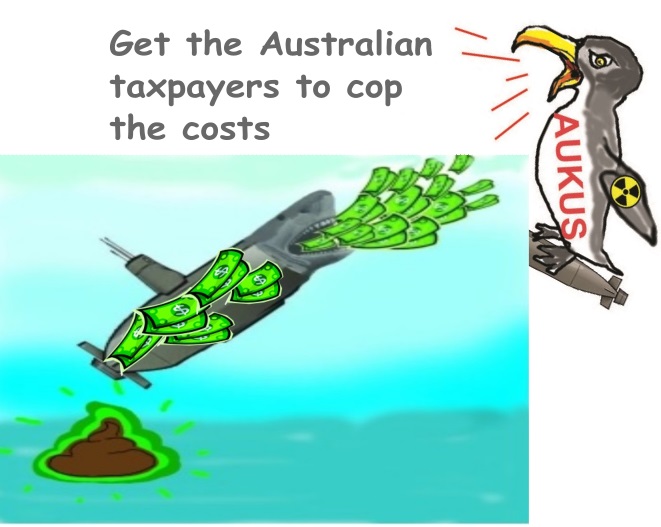
AUKUS’ claims of “nuclear stewardship” with US nuclear submarines and retaining the US origin high-level nuclear wastes are a farce.
The US has been unable to dispose of its own high-level wastes.
David Noonan, Kaurna Yerta/Adelaide, December 12, 2023, Issue 1396 https://www.greenleft.org.au/content/labors-new-aukus-bill-declares-osborne-sa-stirling-wa-nuclear-zones
Labor introduced a bill on November 16, which cites Osborne as the first designated zone for the AUKUS nuclear-powered submarines.
The Australian Naval Nuclear Power Safety (Transitional Provisions) Bill 2023 allows for naval nuclear reactors at Port Adelaide under a new “Australian Naval Nuclear Power Safety Regulator”. That entity is to report directly to Minister for Defence Richard Marles.
Nuclear submarines have never used this port.
Alarmingly, Section 132 of the bill over-rides the Australian Radiation Protection and Nuclear Safety Act 1998 and the military regulator is given powers over the civilian Nuclear Safety Agency ARPANSA.
The Medical Association for Prevention of War has sounded the alarm. “Naval nuclear reactors — like all nuclear reactors — pose potentially serious risks for people and the environment. But unlike other reactors, most information about naval reactors is kept classified, and it can be difficult to say how safe they are.

Marles told parliament he will hold the power to direct the military nuclear regulator during a “national security” emergency.
Stirling Naval Base, near Fremantle in Western Australia, is the second nuclear zone to be declared in this bill.
The South Australian and Port Adelaide communities have the right to have a say on nuclear safety and the risks in bringing naval nuclear reactors into the port.
Key public interest questions are yet to be answered.
They include: Will communities be consulted on accident response plans? What is the existing radiation emergency capability in current and proposed nuclear sub port sites? Will local health and medical services be consulted? How will communities be properly informed about the risks of naval nuclear reactors? How will safety issues be monitored and communicated? How will the public interest in safety issues be protected? When will accident scenarios for nuclear subs at base be modelled and made public? How can the public verify the quality of emergency management plans and systems? How can authorities demonstrate their capacity to respond to radiation emergencies, and other accident scenarios?
The bill has now gone to a Senate Foreign Affairs, Defence and Trade Legislation Committee inquiry, which is open for public submissions and is due to report next April.
The bill proposes to override state laws.
Section 135, “Operation of State and Territory laws”, states: “If a law of a State or Territory, or one or more provisions of such a law, is prescribed by the regulations, that law or provision does not apply in relation to a regulated activity.”
The bill provides for regulated activities in “nuclear waste management, storage and disposal” at AUKUS facilities in future nuclear zones, to be authorised under Section 135.
According to media reports in August, the Woomera rocket range is understood to be the “favoured location” for the storage and disposal of submarine nuclear waste.
If the federal government wants to locate an AUKUS nuclear waste dump in South Australia, it will have to over-ride existing law to impose this.
This AUKUS bill is a threat to the people of SA. AUKUS locks Australia into buying existing US military nuclear reactors in second-hand 10-12 year old submarines, loaded with intractable US-origin weapons grade high-level nuclear wastes.
US Vice Admiral Bill Houston has said in-service Virginia class submarines would be sold in 2032 and 2035 and a newly-produced submarine in 2038.
AUKUS’ claims of “nuclear stewardship” with US nuclear submarines and retaining the US origin high-level nuclear wastes are a farce. The US has been unable to dispose of its own high-level wastes.
Marles said in March there would be an AUKUS announcement by early 2024 on a process to manage high-level nuclear waste and to site a waste disposal facility.
The storage and disposal of nuclear wastes compromises the safety and welfare of the people of SA. That is why it is prohibited by the state’s Nuclear Waste Storage (Prohibition) Act 2000.
This law covers public interest issues, including health, safety and welfare as well as “to protect the environment in which they live by prohibiting the establishment of certain nuclear waste storage facilities in this State”.
The import, transport, storage and disposal of high-level nuclear reactor waste is prohibited in SA.
This AUKUS bill must be challenged. The SA Premier is yet to say if he will support an Indigenous right to say “No” to an AUKUS dump. South Australians have a right to decide their own future and to say “No”.
[Dave Noonan is a long-term anti-nuclear campaigner. For more information see the Medical Association for Prevention of War’s Safety Brief. Contact the Committee Secretariat on 02 6277 3535 or email fadt.sen@aph.gov.au. Upload your submission here.]
Going nuclear would be a costly mistake
Graeme Lechte, The Age, 12 Dec 23
The article ″Coalition MP talks up triple nuclear option at climate summit″ (11/12) raises disturbing issues in regard to Australia’s future energy production and our pathway to net zero. A group of Coalition MPs have backed a pledge to increase nuclear energy output and overturn the current policy of no nuclear energy in Australia. If the Coalition is returned, its energy policy will flip the focus from renewables to nuclear. After all the hard work and investment to establish a secure power system based around renewables, under a Coalition government, renewables would play second fiddle to establishing an expensive nuclear industry that would take at least 10 years to come on line. Aside from the safety issues and emissions from mining uranium, this policy would see renewables sidelined and the path to net zero become a confusion of opposing strategies.
Labor’s attempts to base our energy supply around renewables would be in tatters under a future Coalition government and our path to net zero even more difficult – not to mention the huge costs associated with establishing a fledgling nuclear industry.
Radiation leaked from cancer treatment room at Monash Medical Centre in Melbourne, documents reveal
ABC By Danny Tran,8 Dec 23
- In short: Monash Medical Centre discovered a cancer treatment room did not have adequate shielding to prevent radiation exposure to staff
- It self-reported to the Victorian health department, which told the hospital it had provided misleading information about the thickness of the concrete slabs separating the building’s floors
- What’s next? A doctor has raised concerns about radiation risk to hospital staff, however the health department says radiation levels are too low to be of concern
……………………………………………………………………………………………more https://www.abc.net.au/news/2023-12-08/monash-medical-centre-radiation-leak-cancer-treatment-room/103201728
Australia backs Cop28 promise to triple renewables but not nuclear capacity pledge
More than 115 countries vow to triple renewable energy capacity by 2030 – though not China and India
Adam Morton and Katharine Murphy, Guardian, Sun 3 Dec 2023
Australia has backed a pledge at Cop28 climate summit to triple global renewable energy capacity and double the annual rate of energy efficiency improvements by 2030.
The climate change minister, Chris Bowen, said the Albanese government had joined 117 other countries in making the pledge, reiterating an agreement reached by G20 countries in September.
The renewable energy agreement was one of a series of headline declarations made as more than 100 global leaders arrived in the United Arab Emirates for the opening days of the two-week conference.
Anthony Albanese is not attending, and Bowen is not due to fly to Dubai until later this week for the event’s final week, when ministers will attempt to wrangle a consensus position on how to lift action to tackle the climate crisis in the face of rising geopolitical tensions. Australia was represented at the opening plenary by its climate change ambassador, Kristin Tilley.
Bowen said Australia had joined other major energy exporters, including the US, Canada and Norway, in supporting the renewables and energy efficiency push.
“We know that renewables are the cleanest and cheapest form of energy, and that energy efficiency can also help drive down bills and emissions,” he said in a statement. “For emissions to go down around the world, we need a big international push. Australia has the resources and the smarts to help supply the world with clean energy technologies to drive down those emissions while spurring new Australian industry.”
The renewable energy pledge was welcomed by climate campaigners and analysts. Tim Buckley, director of the independent think tank Clean Energy Finance, said it was excellent to see Australia backing the commitment. He said falling costs had made the transition to renewables “an entirely economically sensible and viable commitment”………………………………………………………………………..
Australia is the chair of the “umbrella group” of countries at the talks, which includes the US, UK, New Zealand, Canada, Ukraine, Israel and Norway. Bowen said he intended “to be quite an active chair” and that meant “bringing other countries with us” to help reach a consensus.
An initial draft Cop text released on Saturday listed included a range of expressions to be debated, including that either fossil fuels or coal should be “phased out” or “phased down”. The same applied to fossil fuel subsidies. Saudi Arabia, China and India have previously resisted calls to agree that all fossil fuels should be phased out.
Australia was also among more than 100 countries to back declarations pledging to strengthen climate action in healthcare and farming. It did not sign up to a commitment by 22 countries, including the US, Canada, Japan and Britain, to triple nuclear energy capacity by 2050.
The Albanese government is hoping to win support for Australia to host Cop31 in 2026 with Pacific countries, but it is unclear whether a decision will be made in Dubai. The UN climate process faces a more pressing decision on where next year’s annual summit will be held. It is due to be hosted in eastern Europe but Russia has blocked agreement on which country will take the reins.
Sovereignty Surrendered: Subordinating Australia’s Defence Industry
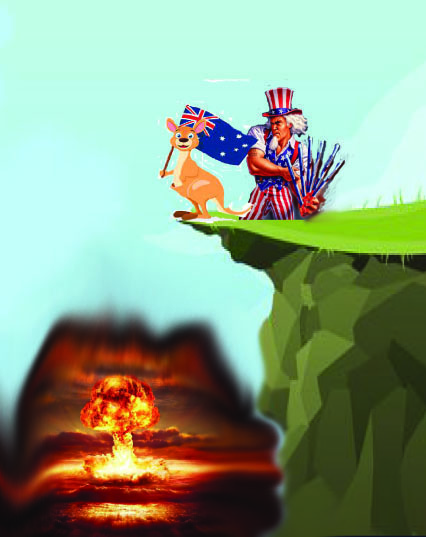
Bureaucratic red tape will be slashed – for the Australian Defence industry and the AUKUS partners.
the broader object here is unmistakably directed, less to Australian capabilities than privileged access and a relinquishing of control to the paymasters in Washington.
“Whenever it cooperates with the US Australia will surrender any sovereign capability it develops to the United States control and bureaucracy.”
November 30, 2023, Dr Binoy Kampmark, https://theaimn.com/sovereignty-surrendered-subordinating-australias-defence-industry/
One could earn a tidy sum the number of times the word “sovereignty” has been uttered or mentioned in public statements and briefings by the Australian Prime Minister, Anthony Albanese.
But such sovereignty has shown itself to be counterfeit. The net of dependency and control is being increasingly tightened around Australia, be it in terms of Washington’s access to rare commodities (nickel, cobalt, lithium), the proposed and ultimately fatuous nuclear-propelled submarine fleet, and the broader militarisation and garrisoning of the country by US military personnel and assets. (The latter includes the stationing of such nuclear-capable assets as B-52 bombers in the Northern Territory.)
The next notch on the belt of US control has been affirmed by new proposals that will effectively make technological access to the Australian defence industry by AUKUS partners (the United States and the United Kingdom) an even easier affair than it already is. But in so doing, the intention is to restrict the supply of military and dual-use good technology from Australia to other foreign entities while privileging the concerns of the US and UK. In short, control is set to be wrested from Australia.
The issue of reforming US export controls, governed by the musty provisions of the US International Trade in Arms Regulations (ITAR), was always going to be a feature of any technology transfer, notably regarding nuclear-propulsion. But even before the minting of AUKUS, Canberra and Washington had pondered the issue of industrial integration and sharing technology via such instruments as the Defense Cooperation Treaty of 2012 and Australia’s addition to the National Technology and Industrial Base in 2017.
This fundamentally failed enterprise risks being complicated further by the latest export reforms, though you would not think so, reading the guff streaming from the Australian Defence Department. A media release from Defence Minister Richard Marles tries to justify the changes by stating that “billions of dollars in investment” will be released. Bureaucratic red tape will be slashed – for the Australian Defence industry and the AUKUS partners. “Under the legislation introduced today, Australia’s existing trade controls will be expanded to regulate the supply of controlled items and provision of services in the Defence and Strategic Goods List, ensuring our cutting-edge military technologies are protected.”
Central to the reforms is the introduction of a national exemption that will cover trade of defence goods and technologies with the US and UK, thereby “establishing a license-free environment for Australian industry, research and science.” But the broader object here is unmistakably directed, less to Australian capabilities than privileged access and a relinquishing of control to the paymasters in Washington. A closer read, and it’s all got to do with those wretched white elephants of the sea: the nuclear-powered submarine.
As the Minister for Defence Industry, Pat Conroy, states, “This legislation is an important step in the Albanese Government’s strategy for acquiring the state-of-the-art nuclear-powered submarines that will be key to protecting Australians and our nation’s interests.” In doing so, Conroy, Marles and company are offering Australia’s defence base to the State Department and the Pentagon.
With a mixture of hard sobriety and alarm, a number of expert voices have voiced concern regarding the implications of these new regulations. One is Bill Greenwalt, a figure much known in the field of US defence procurement, largely as a prominent drafter of its legal framework. He is unequivocal in his criticism of the US approach, and the keen willingness of Australian officials to capitulate. “After years of US State Department prodding, it appears that Australia signed up to the principles and specifics of the failed US export control system,” Greenwalt explained to the Australian Broadcasting Corporation. “Whenever it cooperates with the US it will surrender any sovereign capability it develops to the United States control and bureaucracy.”
The singular feature of these arrangements, Greenwalt continues to elaborate, is that Australia “got nothing except the hope that the US will remove process barriers that will allow the US to essentially steal and control Australian technology faster.”
In an email sent to Breaking Defense, Greenwalt was even more excoriating of the Australian effort. “It appears that the Australians adopted the US export control system lock, stock and barrel, and everything I wrote about in my USSC (US Studies Center) piece in the 8 deadly sins of ITAR section will now apply to Australian innovation. I think they just put themselves back 50 years.”
The paper in question, co-authored with Tom Corben, identifies those deadly sins that risk impairing the success of AUKUS: “an outdated mindset; universality and non-materiality; extraterritoriality; anti-discrimination; transactional process compliance; knowledge taint; non-reciprocity; and unwarranted predictability.”
When such vulgar middle-management speech is decoded, much can be put down to the fact that dealing with Washington and its military-industrial complex can be an imperilling exercise. The US imperium remains fixated, as Greenwalt and Corben write, with “an outdated superpower mindset” discouragingly inhibiting to its allies. What constitutes a “defence article” within such export controls is very much left to the discretion of the executive. The archaic application of extraterritoriality means that recipient countries of US technology must request permission from the State Department if re-exporting to another end-user is required for any designated defence article.
The failure to reform such strictures, and the insistence that Australia make its own specific adjustments, alarms Chennupati Jagadish, president of the Australian Academy of Science. The new regulations may encourage unfettered collaboration between the US and UK, “but I would require an approved permit prior to collaborating with other foreign nationals. Without it, my collaborations could see me jailed.” The bleak conclusion: “it expands Australia’s backyard to include the US and UK, but it raises the fence.” Or, more accurately, it incorporates, with a stern finality, Australia as a pliable satellite in an Anglo-American arrangement whose defence arrangements are controlled by Washington.
1 This month

of the week – Australians for War Powers Reform (AWPR)
To see nuclear-related stories in greater depth and intensity
 Antinuclear