Doubts that a Kimba nuclear dump will really bring jobs to the area
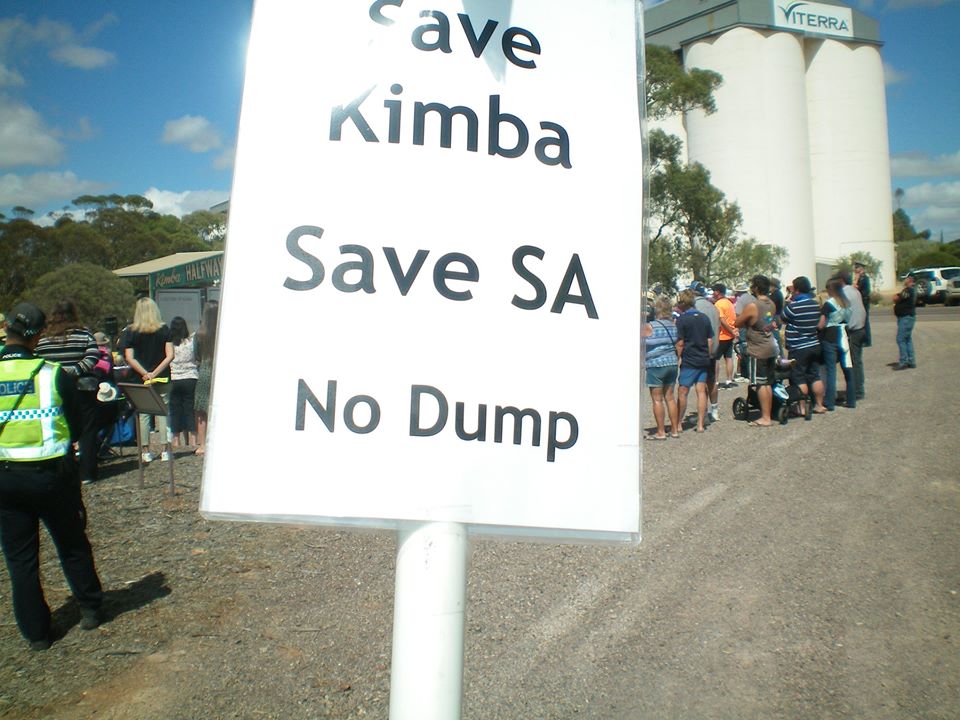 Kimba jobs a hot topic, Whyalla News, Louis Mayfield, 29 July 20,
Debate has ensured over the federal government’s promise of bringing 45 jobs to Kimba with the establishment of a nuclear dump at Napandee, after the latest Senate inquiry revealed there is no legislative requirement to continuously staff a low-level radioactive waste facility.
The Senate Inquiry into the federal government’s Nuclear Radioactive Waste Management Facility (NRWMF) met on Tuesday, with Centre Alliance Senator Rex Patrick reading the following statement from ARPANSA:
“There is no explicit requirement in the ARPANSA or ANSTO legislation or guidance that prescribes that a low-level radioactive waste disposal facility requires continuous presence of staff for either security or safety purposes.”
Senator Patrick was questioning the agency over whether the NRWMF at Kimba could be run remotely.
The federal government has long promised that the facility will create 45 jobs, and while Senator Patrick does not dispute the idea that the jobs will be available, he doubts they will last.
“The CEO of the site may end up being repatriated back to the Australian Radioactive Waste Agency in Adelaide, and I think some of the other roles may be pulled back and the site will turned into a remote facility two or three years down the track,” Senator Patrick said.
“Kimba locals should look at how the government is willing to shift 700 submarine jobs from Adelaide to Perth on a political whim.
“Having seen federal and state government services evaporate from country towns time after time, we know governments can’t be trusted to keep their promises.
“The writing is on the wall, and the wall hasn’t even been built yet.”
Senator Patrick believes this will be a likely course of action for the government because it’s a way to trim costs and achieve savings.
“They will look at those ARPANSA rules and say ‘this is not a bad option,'” he said……. https://www.whyallanewsonline.com.au/story/6855823/kimba-jobs-a-hot-topic/Debate/?fbclid=IwAR0KJkx1ynVTY_3MxehtRridHdfIu0G5eJYhurXHE6eunG7AdtHgbst2IOs
ABC Radio interview focusd on Kimba nuclear waste dump plan
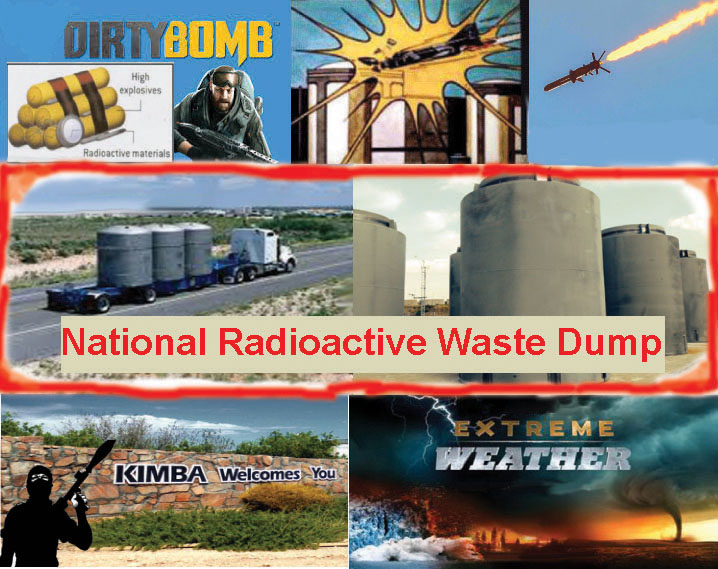 Evenings With Peter Goers ABC radio pm ABC Radio South Australia 30 July
Peter Goer first interviewed Keith Pitt, Minister for Resources. Pitt was confident about the Kimba nuclear waste dump plan. He stressed that it is essential for Australia’s medical care. He claimed strong community support for the plan, and said that it “meets all the technical requirements”. ” My advice is that the temporary waste can’t stay at Lucas Heights.” “The Kimba facility is a critical national infrastructure” “Necessary for people who receive cancer care”.
Peter Goer : “Strange that you have approved this new Adelaide agency whiled the matter still being discussed in the Senate.
Keith Pitt: “It will take time to put together the necessary team. It will take overseas and domestic research”.
Goer: “Have you read all the submissions to the Senate Inquiry?
Pitt avoided the question, and returned to the medical theme – “2 out of 3 of every Australian will utilise that type of technology, will need the Lucas Heights reactor”
Goer: It’s the temporary storage of ILW [Intermediate Level Waste] that worries people.
Pitt: ” Very small amounts. If we accept that we want to use nuclear medicine, then we must manage the by-product”
Peter Goer then interviewed Eddie Hughes, Labor federal member from South Australia
Hughes. We’ve had 3 separate Ministers. Sites that were nominated were all in the seat of Grey. First Rowan Ramsey offered his land – conflict of interest? Then another Liberal politician offered his land, did not consult local community, nor Aboriginal groups.
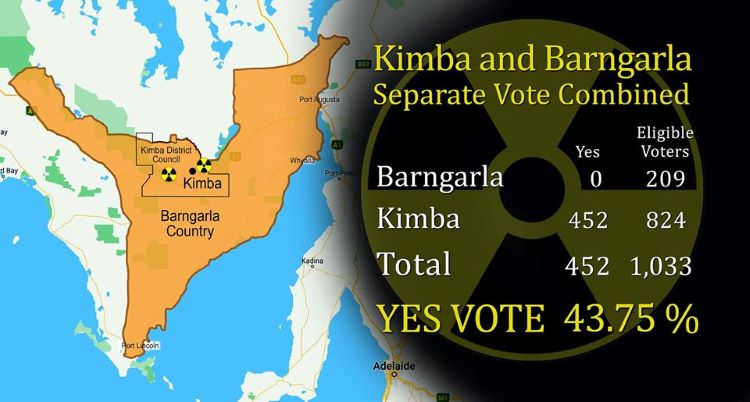
Aboriginal community- Barngarla not eligible to vote.They conducted their own vote, unanimoously against.
Not essential for a nuclear waste facility to be at this location. Medical waste doesn’t need to be transported to a national facility.
Goers. ILW [Intermediate Level Wastes) we are leaving that problem to our grandchildren.
Hughes. The ILW. This process should have been discussed broadly, including Aboriginal community.
Senate Inquiry going on,, but govt is pushing ahead with this plan, Kimba is not necessarily the solution
Calls. Bob from mid-north said that the vast majority of medical waste is very short-lived. There are also nuclear materials used in industry, universities. At Woomera there are 44 gallon drums rotting, materials transported from Fishermens Bends. Legacy waste from the cold war. Ws don’t know what is in it.
Goers – concern that this might led to importing nuclear waste.
Hughes – I don’t imagine this. Facility at Kimba is above ground, not suitable for deep geological disposal.
Jay Weatherill’s government gave space for Aboriginal people, gave power of veto. In the present case Barngarla people have been treated with contempt.
Goers. Kimba known as a nice little town. Will become known as the “dump town’
Hughes. I understand that people see the business activity. But I don’t think that 45 jobs will eventuate. Some overseas dumps have much smaller number of workers.
Goer. Rural communities are shrinking. Has Kimba been bribed?
Hughes. A lot of money has been put on the table for facilities – a big effort to get people onside. Sad that the only way a town can get the needed services is to offer itself for a nuclear dump. Federal govt hasn’t addressed the far more important issue of shortage of doctors across regional South Australia. Medical treatment will continue whether or not the dump goes ahead
Goers. Rowan Ramsey has the view that the local people are the best educated about this. Keith Pitt has a similar view. Seems to be a distrust of anyone who’s not local to Kimba.
Hughes. This is a South Australian issue. Very arrogant to say that only local people can have an opinion. Liberal govt ruled it out, and that legislation still stands. We need to go back and look at this whole process. Both those in favour or against this plan agreed that we need to deal with radioactive wastes in a responsible way.
Many texts received. – Reconciliation with Aboriginals – only lip service. Medicalisotopes can be made with cyclotrons – nuclear reactor not necessary. ANSTO could have promoted synchrotons producing isotopes for Australian use.- instead opted for building an export business from Lucas Hreights nuclear reactor.
The Australian government continues its war on the national broadcaster, the ABC
OFFICIAL AUSTRALIAN state policy since 2014 on its public broadcaster, the ABC, has been to throttle it through withdrawing its budget by stages while abusing it with propaganda through Liberal-linked commercial media — News Corp newspapers, 2GB radio network and Sky News pay television. There is also a subplot that involves, while the ABC survives, pressing it to deliver positive messaging for the government of the day.
It is a changed scene since broadcasting regulations providing oversight or program guidelines were dropped from the 1980s, the same as with the former Federal Communications Commission standards in America. The present-day barrage of extravagant opinion-making on commercial media is one result — different to the ABC, which being publicly-owned has to retain standards of accountability and fairness.
ABC broadcasters know they have formidable public support. Audience research over the decades shows that high proportions of the population from all walks of life use the service, depend on it, like it and respect it. It is sometimes conditional support; they do not like everything, but it gives the ABC, despite the six years of official abuse, breathing space to fall back on prepared positions as it has done through crises past.
………. the continuing pattern of the ABC. It provides service on many fronts, often service the commercials will never give, provided by broadcasters consulting their professional values, like the journalists guided by received news values — new and interesting, important and informative with no snide agendas.
Hatred?
So why this hatred of it? The answer is that a political and financial ideology which preoccupies certain people is obstructing the rest of us just getting a good range of services from the ABC — value for money, Australian culture first.
On one hand, the government of the day believes in privatising economic life to the direct benefit of wealthier constituents so it foregoes revenue – as with the scheme to cut company taxes – and will sell off public assets where it can. Some might watch and listen to the ABC, but that clearly gets outweighed by loyalty to party, money and power, so selling off is on the books.
Secondly, government trades favours with corporate backers, in the case of media indulging the demands of commercial broadcast interests for market protection, by pushing down the ABC — “people’s choice” not coming into it.
The relationship is being demonstrated by the trend for conservative ministers to make declarations or announcements through 2GB or Sky, where they can get the easiest, most matey, often fawning form of interview. The ABC is much less favoured, as it is independent and still does critical interviews; they look for the new information, hold the speaker to account, don’t run it on-and-on.
It does itself have a small co-operative part in this game by giving away slavish credits. Where ministers will only talk with 2GB or Sky, the audio or vision has to be recorded for replay and credited to them by name; they get a free ad on ABC. That goes against the alternative, that often if you take an allowable short excerpt – and copyright laws give fair leeway on this – you say it was “on radio”, or “on commercial television”……. https://independentaustralia.net/business/business-display/the-war-on-the-abc-and-its-options-for-survival,14161
Nuclear waste for Napandee: transport, double handling, safety? Should South Australians get a vote on this?
 Jobs, safety and transport in the spotlight in Senate committee probe of Kimba waste plan, Michelle Etheridge, Regional Reporter, The Advertiser, July 28, 2020
Concerns about maritime workers facing safety risks and the Kimba community losing jobs promised for the local area have been raised before a Senate committee probing plans for a radioactive waste site.
Under the Federal Government’s project, low-level radioactive waste would be stored permanently at farming property Napandee, near Kimba, with intermediate-level waste stored there for several decades.
No long-term plan for intermediate-level waste has been set out – an issue raised by speakers during Tuesday’s committee meeting, which is looking into legislation the government says paves the way for the storage site.
Maritime Union of Australia (SA branch) secretary Jamie Newlyn said the Government should eliminate double-handling of the waste, also citing concerns for Whyalla-based members.
“Whyalla port has been considered … to take nuclear processing waste,” Mr Newlyn said.
“What they’re handling is 130-tonne casks of intermediate-level waste. That presents a massive risk.” A 2018 Federal Government technical report on Napandee said there was potential to ship waste from Port Kembla, NSW, to “port locations such as Whyalla, Port Pirie and Port Lincoln”.
Senator Rex Patrick also questioned whether the 45 long-term jobs promised to Kimba would stay there, now a Australian Radioactive Waste Agency has been announced for Adelaide.
A Kimba Council vote last year found 62 per cent of respondents supported the plan. Traditional landowners voted against it in a separate ballot.
Napandee owner Jeff Baldock said it was “time to accept the decision by the people of Kimba and move forward”.
“(The project) … has the potential to provide a lifeline to our community for decades to come,” Mr Baldock said.
Agriculture would benefit from the plan, he said, through a planned research and development centre.
Mr Baldock said it would also provide a much-needed new industry for the region.
This followed automation in farming and withdrawal of government agencies, which had led to a declining local population.
Wesley Schmidt, of Kimba-based Agsave Merchandise, said opposition to the project was coming from a “vocal minority”.
“We’re currently facing the third year running of drought conditions in Kimba. It’s more important than ever to establish another industry in our district,” he said.
Former Grey MP Barry Wakelin, based in the town, said the area had much to lose from picking up “something that nobody else in Australia wants”.
“Many people have said, why can’t we have an SA vote, at least, about this,” he said.
The Australian Conservation Foundation’s Dave Sweeney said: “In the absence of a clear, long-term approach for intermediate level waste, the best place to store this is at ANSTO (Australia’s Nuclear Science and Technology Organisation, in NSW).”
The Senate committee will report back by August 31.
A spokesman for the Australian Radioactive Waste Agency said the Government would consult on transport options with communities near potential routes and transport operators.
“The newly created Australian Radioactive Waste Agency will lead the separate process to site a facility to permanently dispose of Australia’s intermediate level waste,” he said.
He said the 45 jobs included security, administration, environmental monitoring and health and safety roles.
“The facility will need these onsite roles to ensure that the facility is managed safely and securely.” michelle.etheridge@news.com.au
Nuclear waste dump site selection process has made the Barngarla people “aliens in their own country”
 Barngarla continue fight against plan to dump nuclear waste on Country, https://www.sbs.com.au/nitv/article/2020/07/29/barngarla-continue-fight-against-plan-dump-nuclear-waste-country Barngarla mob say they were not properly consulted by federal government for plans to store radioactive waste on Country at Kimba in SA, and that their concerns continue to be ignored. By Royce Kurmelovs, NITV News 29 July 20
The 50-year-old Barngarla woman is talking about the enduring connection she has to Kimba when she tells how on the day she was born, her parents had been waiting for an ambulance that never came.
Forced to make their own way to the hospital, she says her mum made it as far as the tree outside before giving birth.
“So I’m born on Country,” she says.
Though she may not live there today, Jeanne says a part of her has never left. It is a detail that underscores the significance of the moment she learned Kimba was being considered as a dump for radioactive waste.
“I used to be a carer for my mum. When I first heard [about the facility], I told her. She goes: ‘no, no, no’ and got angry,” Jeanne says. “She said; ‘we don’t want it there’. She said to me: ‘you got to fight for this. You got to fight for it, we can’t have that place there. It’s a special place for us.’”
Most among the Barngarla have a similar story about the shock and confusion at learning their traditional Country was under consideration as part of a proposal to build a nuclear waste storage facility that would take in samples from 100 sites across the continent.
No one, they say, from the federal government contacted them beforehand to talk about the proposal, leaving most to find out through the news media or word of mouth.
Instead it was up to the Barngarla themselves, through the the Barngarla Determination Aboriginal Corporation (BDAC) to take the initiative and write to the government in April 2017 to find out what was going on.
‘Wasn’t interested in our views’
That first letter would plunge them into a fight that has so far lasted three years, until it entered a new phase in February when former Industry Minister Matt Canavan announced – a day before he resigned – that he had selected a site just outside of Kimba to situate the nuclear waste facility.
The location he chose was called Napandee, a slice of farmland about 25 kilometres west of Kimba. The precise area had been carved out of a 7500-hectare cereal and sheep property owned by the Baldock family and when built the facility promised to create 45 jobs and bring in $31 million to the community.
Over the course of its operating lifetime, the site would house low-to-intermediate level nuclear waste made up of medical waste drawn from 100 sites across the country. This material would include medical waste, but also the more serious TN81 canisters – casks of material once exposed to high levels of radiation that require containment for several hundred years.
If supporters of the proposal celebrated the financial windfall it would bring, critics worried the decision represented the thin end of a wedge that would eventually see the site expand to house higher-level toxic waste.
For the Barngarla people, however, the proposal represented something more significant: yet another decision where they have been overlooked, ignored and overruled in a process they describe as “divide and rule”.
“It’s like the government’s not listening to us,” Jeanne says. “It’s like if the government picks a place where they want to put rubbish like that, they’ll just go and do it and they don’t care what the people think. And that’s wrong. They should be listening to what the people want too.”
“I know there were people in Kimba that wanted it. We definitely know. We got the looks. We didn’t care. I didn’t care. This is something I believe in strongly and that’s why we don’t want it there, because of my strong beliefs and my family’s beliefs.”
After their early efforts to find out more, the Barngarla say they were stonewalled from the very beginning by both the Department of Industry, Science, Energy and Resources, and the Australian Radioactive Waste Agency (ARWA). That stance would become a pattern.
At first it began with the department initially dismissing the possibility that Aboriginal heritage sites may exist in the area and ignoring requests from the Barngarla for a meeting.
It took a year – until February 2020 – before the department offered to meet with the Barngarla people, though by the time the first and only meeting took place the government was already forging ahead to measure community support through a voting process.
In organising the vote, the local council limited those who could participate to ratepayers within the township, and provided a ballot with a single question: “Do you support the proposed National Radioactive Waste Management Facility being located at one of the nominated sites in the community of Kimba?”
Outraged by what they say was a clear act of voter suppression – a strategy common in the US where procedural tactics are used to discourage or prevent people from voting – the Barngarla took their fight to the courts.
They argued that the vote breached the Racial Discrimination Act by excluding the Traditional Owners who were openly opposed to the proposal. The matter would go all the way to the Federal Court, where it was ultimately dismissed on appeal.
Though the court found the local council had not excluded the Barngarla people on the basis of their ethnic identity, BDAC Chairperson Jason Bilney says the court did acknowledge the council had discretion about who to include in the vote, and they had deliberately chosen to exclude native title holders.
They basically created hurdles,” Bilney says. “The catchphrase was ‘rateable property’ – that’s white man’s terms ‘rateable property’. We’re the native title holders. That holds more weight than ‘rateable property’, so we should have been included.”
Around the time the Barngarla filed their lawsuit to challenge the vote, the first meeting with the department took place in August 2018 – a moment Bilney recalls with frustration.
He says Mr Canavan spoke for fifteen minutes before he left, taking all the government representatives with him.
“That’s it,” Bilney says. “He wasn’t interested in our views, he just wanted us to hear what he had to say.”
When the poll of Kimba residents was counted, it returned a result that saw 61.6 per cent of 824 participants vote in favour of the proposal.
BDAC responded by organising is own poll, asking its 209 members the same question that was asked of the broader Kimba residents.
The result would be a unanimous “No” from the 83 participants – a turnout figure explained by cultural and logistical factors that make it difficult to gather in any one place.
The Barngarla delivered the result to the department in November last year on the understanding Mr Canavan had promised to consider them together.
“Canavan said he would put the two together. He never did because if you put the two together there was clearly no broad community support,” says Bilney.
In its submissions to the senate, the department denies it agreed to incorporate the two votes, but says it only agreed to “consider” their outcomes.
Aliens in our own country’
What happens now is up to the Senate economics reference committee and a clutch of Labor, Greens and independent senators.
The Barngarla say the recent approach of the federal government – to legislate the precise location of the site – represents a new twist as it departs from the process established by the Gillard government under the National Radioactive Waste Management Act 2012.
Worse still, the Barngarla say the provisions of the bill will stymie their rights to seek a judicial review of the minister’s decision in the courts. The Parliamentary joint committee on human rights also raised concerns about the bill in April this year that it says may extinguish Native Title.
“In relation to any cultural and spiritual significance attaching to the land itself, it remains unclear how this would be protected once a radioactive waste facility is operational on the site. Further, it is unclear how Indigenous people will be able to access sites of cultural significance, should they be determined to exist,” the report said.
When NITV News contacted the Australia Radioactive Waste Agency for comment about the process to date, a spokesperson said in a statement the government is seeking to consult with the BDAC going forward.
“Napandee is privately owned, has no Native Title and has been used for agricultural purposes for 80 years. Preliminary assessments have identified no registered cultural heritage at the site,” the spokesperson said.
“Further ground cultural heritage surveys with Traditional Owner consultation are planned, to determine cultural heritage values at the site.
“That said, we have approached the Barngarla through BDAC numerous times during the past years to work together to identify heritage, without resolution.”
In addition, the federal government is seeking to establish a Barngarla economic plan backed by $3 million in government funding, employment opportunities at the site and a cultural heritage management plan.
The Barngarla view this as a bribe when for them it isn’t a matter of money, but one of self-determination concerning what happens on their Country, set against a much deeper history.
So far it has taken two decades for the Barngarla to have their Native Title claim to a 45,000 square kilometre stretch of the Eyre Peninsula recognised by the courts – a process during which they were once informed that they did not exist as a people.
Neither have they forgotten the horror at Maralinga when the British army tested nuclear weapons after falsely declaring there were no Aboriginal people in the area.
To the Barngarla, the government has only decided to talk after the big decisions have been made.
“We’re still flora and fauna to these people,” Bilney says. “They should have included us from the start. We heard about it on the news. We weren’t included in the vote.
“You know, the Barngarla [native title] claim was basically an unwinnable case, they said. It’s taken us 21 years. Twenty-one years to win Native Title under white man’s law. And yet we’re still classed as second-class citizens? Flora and fauna.
“We’re basically aliens in our own Country.”
Reflection on Jeff Baldock’s presentation to the Senate Hearing on Napandee Radioactive waste Dump plan
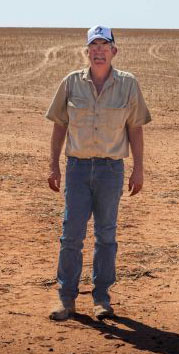 Jeff Baldock is the farmer who is selling a portion of his land near Kimba, for four times its market value, to the Federal Government for the site of a nuclear waste dump. He thinks he is benefiting the local community. He could be right, in that they will be showered by he Fed govt with services and facilities that they SHOULD HAVE GOT ANYWAY, without need of being bribed. Baldock has no concept of the long term effect, and later consequences for South Australia.
He made a brave effort at the hearing, to portray this as a community benefit. He struggled a bit, but was helped by plenty of “Dorothy Dixer” questions from the Chairman.
Listening to Jeff Badock on the Senate Committee hearings, I am struck by the naivety and ignorance of the man. He really thinks that farming life will go on just the same in Kimba. With the guarded radioactive waste dump, with dirty great trucks under heavy police guard arriving periodically, and with roadworks, and port works at Whyalla, and the whole disruption of the area Probable loss of population, but Baldock expects a new boom in agriculture and population there. Expects big professional jobs there – hell – those will all be in Adelaide, at best – could be Sydney or Canberra!
Black lives DO matter, but not apparently, to ANSTO and Australia’s nuclear lobby
The systematic racist behaviour by your Government is a stain on the collective consciousness of this country.’
the Senate Inquiry Committee decided not to hold a hearing in SA. Instead it will be a phone/video hearing — a disappointing decision for those far more at ease in face-to-face meetings even if most of the Senators involved were themselves on video.
Much at stake for Barngarla Country, Country, https://www.eurekastreet.com.au/article/much-at-stake-for-barngarla-country?utm_medium=email&utm_campaign=Eureka%20Street%20Daily%20-%20Tuesday%2028%20July%202020&utm_content=Eureka%20Street%20Daily%20-%20Tuesday%2028%20July%202020+CID_a705bb9962677d9379d61686e520c4ca&utm_source=Jescom%20Newsletters&utm_term=Much% Michele Madigan, 28 July 2020
- In the present world wide climate of Black Lives Matter when some governments/states are changing significant processes for the betterment of all, how is our own country fronting up when it comes to competing interests regarding land and culture? ‘Quite badly’ is the assessment that comes to mind in examining Barngarla Peoples’ recent reply to the Department of Resources, the federal department charged by government with the establishment of the national radioactive waste dump/facility (NRWMF).
Their letter of reply, publicly released July 23rd lays it down:
‘As you would likely be aware the Parliamentary Joint Committee on Human Rights (Human Rights Committee) has confirmed, in their Human Rights Scrutiny Report — Report 4 of April 2020, that the proposal to place a NRWMF at Napandee is a violation of the Barngarla People’s Human Rights. This is clearly the case, given just some of the matters below…?’
The letter goes on to list how, as Traditional Owners, they were refused the right to vote, forcing them to organise their own official ballot with its unanimous ‘no’ vote which was then ‘entirely ignored by the Minister.’
Shamefully, the Barngarla further identify the final determination of government to crush First Nations and any other group seeking to use the democratic processes of the nation: ‘Those terrible failures in process would have been subject to judicial oversight had the Minister made a declaration under section14 of the existing National Radioactive Waste Management Act 2012 (Cth). However, being fully aware of this, the Minister is now seeking to remove the Barngarla People’s legal rights to judicial review by using Parliament to legislate the location directly.’
Yes, the gloves are certainly off in the long running saga of the federal government’s latest effort to offload the nation’s nuclear waste — this time on Barngarla Country.
The Coalition seems to be banking on the certainty that everyone’s energy about national matters is focused on the Covid-19 emergency. The Guardian reports the plan to rush through new conservation laws even before even Prof. Graeme Samuel’s Environment Protection and Biodiversity Conservation (EPBC) final report is written:
‘The EPBC Act Interim Report (released July 21st) ) unsurprisingly includes the reprimand that the federal government’s framework environment legislation ‘reflects an overall culture of tokenism and symbolism, rather than one of genuine inclusion of Indigenous Australians’.
At the same time, with the Radioactive Waste Management Amendment Act 2020 yet to pass the Senate, on 21st July Resources Minister Pitt announced his own kind of pre-emptive strike. His joint media release announced a ‘new agency to safely and securely manage Australia’s radioactive waste’ by the establishment of ‘a dedicated agency’ based in Adelaide which will be ‘responsible for all functions of the National Radioactive Waste Management Facility including engagement with the Kimba community.’
This is notwithstanding that the Senate Inquiry Committee is presently examining the actual issue and so of course Senators have not yet voted on the Bill, which confirms the selection of the Nappanee site in SA’s Kimba, Eyre Peninsula. The Minister’s apparent certainty of the outcome by announcing a ‘dedicated agency’ responsible for the entire matter, seems to take no account of these inconvenient facts. Is the Senate seen as irrelevant?
The bill itself narrowly passed the House of Representatives last month with opposition from Labor, the Greens and most of the Independents to whom it was clear that the rights of the Traditional Owners and other groups similarly opposed had been cast aside. MPs were aware that the process attempts to create a serious precedent. As Dave Sweeney ACF summarises: ‘the Parliament precluding the Courts.’
It is possible to turn around injustice: the Human Rights Committee’s report cited above was unanimous and was endorsed by Liberal and National Party members. With the Senate vote perhaps in September, it is to be hoped that federal Labor with its key South Australian Senators like Penny Wong and Don Farrell will follow the precedent set by their Lower House colleagues.
As well as the Greens, there are those other Senate crossbenchers who support farming communities. In the Kimba district and more widely in SA’s entire Eyre Peninsula, there are food producers disturbed by threats, whether by image or actuality, to their food production — the safety of which is more important than ever in these COVID-19 times.
A week out from the long awaited July 28th public hearing, the Senate Inquiry Committee decided not to hold a hearing in SA. Instead it will be a phone/video hearing — a disappointing decision for those far more at ease in face-to-face meetings even if most of the Senators involved were themselves on video.
But the Barngarla are clear. After refusing the funds offered to ironically ‘support their cultural heritage’ comes their letter’s devastating conclusion: ‘Your email indicates that the Government wants “to form a long term relationship with the Barngarla community based on mutual respect”. This is clearly an insincere statement given the complete violation of our rights to date. …The systematic racist behaviour by your Government is a stain on the collective consciousness of this country.’
There’s a long way to go for the Coalition to change from ‘its business as usual’ performance in this as in many other matters. We can all play our part, however, in encouraging Senators to stop another sizable wind back in the nation’s democratic processes. If the Senate defeats this Radioactive Waste Management Bill then the Barngarla and others can, as in any democratic country, take to court the minister’s processes.
There is much at stake.
Notes on Barry Wakelin, speaking to the Senate Inquiry on Napandee nuclear waste dump plan
A student is suing the government over the financial risks of climate change
 ‘A wake-up call’: why this student is suing the government over the financial risks of climate change, The
  Conversation
July 27, 2020 Jacqueline Peel Professor of Environmental and Climate Law, University of Melbourne, Rebekkah Markey-Towler, Research assistant, University of MelbourneAs the world warms, the value of “safe” investments might be at risk from inadequate climate change policies. This prospect is raised by a world-first climate change case, filed in the federal court last week.
Katta O’Donnell – a 23-year-old law student from Melbourne – is suing the Australian government for failing to disclose climate change risks to investors in Australia’s sovereign bonds.
Sovereign bonds involve loans of money from investors to governments for a set period at a fixed interest rate. They’re usually thought to be the safest form of investment. For example, many Australians are invested in sovereign bonds through their superannuation funds.
But as climate change presents major risks to our economy as well as the environment, O’Donnell’s claim is a wake-up call to the government that it can no longer bury its head in the sand when it comes to this vulnerability.
O’Donnell’s arguments
O’Donnell argues Australia’s poor climate policies – ranked among the lowest in the industrialised world – put the economy at risk from climate change. She says climate-related risks should be properly disclosed in information documents to sovereign bond investors.
O’Donnell’s claim alleges that by failing to disclose this information, the federal government breaches its legal duty. It alleges the government has engaged in misleading and deceptive conduct, and government officials breached their duty of care and diligence.
This is a standard similar to that owed by Australian company directors. Analysis from leading barristers indicates that directors who fail to consider climate risks could be found liable for breaching their duty of care and diligence.
O’Donnell argues government officials providing information to investors in sovereign bonds should meet the same benchmark.
Climate change as a financial risk….… https://theconversation.com/a-wake-up-call-why-this-student-is-suing-the-government-over-the-financial-risks-of-climate-change-143359
Today -public Australian Senate hearings on Kimba nuclear waste plan and changed federal laws

the next Senate hearing into the proposed Kimba radioactive waste plan and the changed federal laws to facilitate this is taking place today.
Try listening -follow the link at this site https://www.aph.gov.au/news_and_events/watch_parliament
Today’s session will hear from supporters of the planned facility as well as critics, including the MUA/Unions SA’s Jamie Newlyn, former federal member Barry Wakelin and myself/ACF.
Details of the program are below and info on how to access the event is available at:
11.00 am Wesley and Lisa Schmidt (Submission 75) 11.30 am Mr Barry Wakelin (Submission 46) 12.00 pm Mr Jeff Baldock (Submission 42) 12.45 pm Australian Conservation Foundation (Submission 97) 1.15 pm Maritime Union of Australia (Submission 19) 1.45 pm Adjournment
Spinbusting the extraordinarily inept nuclear waste media release from 3 Australian MPs.
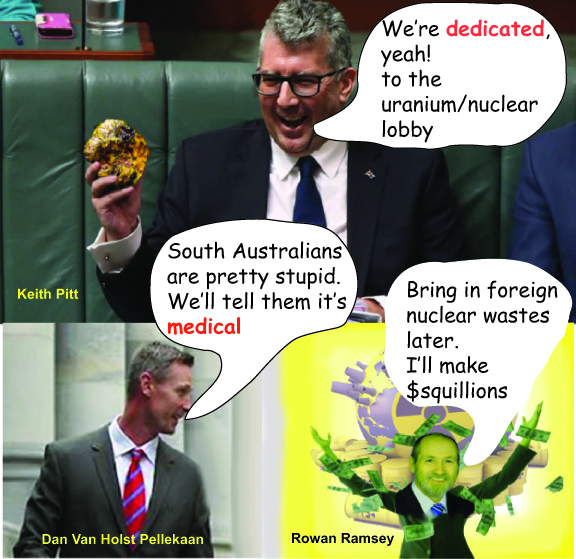
27 July 20, On 20th July, MPs Keith Pitt, Rowan Ramsey and Dan van Holst Pellekaan issued a joint media release, which announced the establishment of a new agency in Adelaide to manage Australia’s nuclear waste. The agency was to start that same day (even though they would be advertising for staff and a CEO) . It was obviously written in a hurry, and raised amazement among those who follow the ongoing drama of the Australian government’s attempt to impose a nuclear waste dump on a rural region. Amazement at the questions that remain unanswered.
Peter Remta critiques the statement, and raises some of those embarrassing questions:
The joint media release is inconsistent within itself and with other previous reports and is surely an embarrassment to the two ministers while confirming the long-held partiality of the local member , Rowan Ramsey.
It is badly composed with meaningless statements and lacks any precise reasons and explanations for what should be the creation of a major and nationally important organisation
The establishment by other countries of entities with similar objectives (even though it is hard to ascertain what they are in the case of this new Australian agency) has invariably involved lengthy and detailed planning including the views and suggestions of various members of the community together with commercial interests and other government agencies.
A most pertinent example is the Reset Initiative of the United States of America as to the management of its nuclear waste which was undertaken by the well known Stanford and George Washington Universities which are regarded as world leaders in that field.
The recommendations under the Initiative should have been followed in Australia as they are imperative for the proper and safe management of nuclear waste and it is surprising that none of the submissions or evidence by ANSTO and ARPANSA and also by the Department of Industry Science Energy and Resources made any mentioned of this well-known and internationally recognised study.
It is hoped that ANSTO will not be relying on this rather meaningless and inconsistent release as part of its submission requirements for ARPANSA which in turn should immediately as the regulatory and licensing authority require a full explanation of the reasons behind the release.
ARPANSA must not on this occasion hide behind its licensing independence in refraining from strong comment as the release could be viewed to be an attempt to usurp its status and functions which are recognised internationally,
Announcing this agency before the government has final parliamentary approval smacks of arrogantly taking both
the Senate and ARPANSA for granted
It also shows a cavalier attitude to proper governing to be committing taxpayers’ money before all approvals are in
place.
Even with the vagueness of the release the government should be seriously considering and examining the Azark
Project facility at Leonora which besides being considered as one of the best in the world would overcome or avoid
many of the problems inherent with the Napandee proposal It would also be a major financial saving for the government
Why has there not been any previous mention of this new agency?
How will it manage Australia’s radioactive waste?
How will it bring together this responsibility and expertise since it seems currently to be lacking the expertise and from past experience the responsibility?
“The Australian Radioactive Waste Agency (ARWA) will be based in Adelaide and be responsible for all functions of the
National Radioactive Waste Management Facility (the Facility), including engagement with the Kimba community.”
Why will it be located in Adelaide which has no history of competence or knowledge in this area despite the Scarce
Royal Commission and uranium mining in South Australia ?
How will it engage with the Kimba community and in what respect since it seems that the battle lines are well and truly
drawn in a seriously divided community.
Will it be replacing ANSTO as the operator of the facility at Napandee?
How will the new agency develop Australia’s radioactive waste management solutions and capabilities as neither the
government nor ANSTO has any realistic knowledge in this area?
Is not this another instance of rushed planning without a proper understanding and consideration of the factors
including the regulatory regime?
Will it not be an unnecessary duplication of the existing functions of ANSTO?
Is the agency going to assume or usurp some of the functions of ARPANSA in the regulatory context?
How will the agency’s location in Adelaide enhance the operations at Napandee as it was understood that this had
already been established through prior planning?
Parts of Victoria’s Bellarine Peninsula, Melbourne suburbs, at risk from sea level rise
important for local communities to know whether they were at risk so they could decide whether to invest in adaptation strategies, such as infrastructure, to protect the coastline, or simply retreat from the danger zone.
 How coastal communities on Victoria’s Bellarine Peninsula are dealing with the reality of sea level rises, ABC, By Nicole Mills, 26 Jul 20, As Vicki Perrett plays with her granddaughter Rachel on the beach in front of her home on Victoria’s Bellarine Peninsula, she knows she has to cherish these moments.Key points: How coastal communities on Victoria’s Bellarine Peninsula are dealing with the reality of sea level rises, ABC, By Nicole Mills, 26 Jul 20, As Vicki Perrett plays with her granddaughter Rachel on the beach in front of her home on Victoria’s Bellarine Peninsula, she knows she has to cherish these moments.Key points:
And not just because children grow up so fast. She also knows the beach they play on may not be there forever. “The beach is coming closer towards us, towards the road and towards our property,” Ms Perrett says. “It’s very prone to sea level rise here and to storm surges.” This stretch of coastline at Indented Head has already been earmarked as at risk of going underwater by 2100. Ms Perrett’s house is also in the danger zone………… Councils ordered to plan for sea level risesThe Victorian Government has instructed all councils to plan for a 0.8m sea level rise by the year 2100. That figure is based on a 2007 report from the United Nations Intergovernmental Panel on Climate Change, which agreed on the projected rise, but could not rule out larger increases. Although the worst impacts of sea level rises may still be decades away, this bayside community, about an hour-and-a-half south of Melbourne, has already had a taste of what is to come………. Dr McInnes leads the CSIRO’s climate extremes and projections group, which has contributed to the mapping of high-risk areas. Publicly available mapping tools, such as Coastal Risk Australia, allow anyone to find out how their local area would fare under different sea-level rise scenarios. Dr McInnes said it was important for local communities to know whether they were at risk so they could decide whether to invest in adaptation strategies, such as infrastructure, to protect the coastline, or simply retreat from the danger zone. “Land subject to inundation is land that is low-lying, that is potentially at risk from inundation during extreme sea-level events or even potentially high-tide events in the future,” Dr McInnes said. Dr McInnes says while the worst impacts will be felt during storm surges, there might be some areas that will suffer more permanent flooding. “If [the land] is low enough, it could be permanently inundated,” she said. “Parts of Swan Bay [on the Bellarine Peninsula] could potentially become quite affected by inundation, certainly high-tide inundation, in the future.” And it’s not just regional areas. Dr McInnes says Melbourne suburbs such as Elwood, Aspendale and Mordialloc are also at risk of more-regular flooding in future……….. https://www.abc.net.au/news/2020-07-26/climate-change-sea-level-rises-prompt-action-in-coastal-towns/12383968
|
|
Despite Minerals Council lobbying, Australia’s Environmental Law prohibits nuclear and limits uranium mining
K-A Garlick, Nuclear Free WA, 22 July 20, This week, the interim report of the review into the Environmental Protection Biodiversity Conservation (EPBC) Act – Australia’s federal environmental laws was released. This found that the Federal government should maintain the capacity to intervene in uranium mining and that there be no change to the existing prohibition on nuclear activities, including domestic nuclear power.
Environment groups have given a cautious welcome to this continuation of the status quo, especially in the face of lobbying by the Mineral Council of Australia to weaken nuclear protections and scrutiny. This outcome is a tribute to the efforts of those who have worked hard over years to highlight the deep community concerns with the nuclear industry.
While no amount of regulation can make uranium mining socially or environmentally acceptable, it can reduce the impacts. The reports sensible approach means it is now incumbent on both State and Federal government to ensure the highest standards or rigour, transparency and public interest.
The nuclear power ban has been retained despite years of concerted effort by the Mineral Council of Australia and pro-nuclear lobbyists to have this removed. Again, this is testimony to the power, importance and effectiveness of sustained community advocacy and action.
In future updates, there will be more information on further developments and action to take, but in the meantime zip over to the excellent resource page, Don’t Nuke the Climate, Australia for all information and myth-busting to keep sharing that nuclear power cannot solve the climate crisis. Click on website link https://dont-nuke-the-climate.org.au/
Australian govt trying to keep its $1.3bn arms purchase a secret, a dangerous precedent
Coalition says making public parts of $1.3bn Thales arms deal audit would penalise weapons company
Australian government claims disclosure would damage chances of multinational Thales to sell Hawkei combat vehicle to other countries, Guardian Christopher Knaus, The Australian government is arguing parts of an audit of a $1.3bn arms purchase must be kept secret because a multinational weapons company Thales would have trouble selling its product if they were disclosed.But the administrative appeals tribunal has heard that such an argument if allowed to stand would have a “devastating effect” on the auditor general’s ability to transparently and publicly criticise other government purchases.
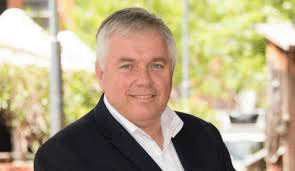 The tribunal is hearing a case between the Department of Prime Minister and Cabinet and crossbench senator Rex Patrick, who is fighting through freedom of information for full release of a 2018 audit report examining the government’s acquisition of the $1.3bn Hawkei combat vehicle fleet from French-based manufacturer Thales.
After representations from Thales, the attorney general, Christian Porter, made an extraordinary and largely unprecedented intervention to redact sections of the audit on the grounds they unfairly prejudiced Thales’s commercial interests and threatened Australia’s national security and defence.
The Guardian has since revealed the redacted material included a cost-comparison suggesting that Australia could have saved money by purchasing a different vehicle – the joint light tactical vehicle – from the United States……. https://www.theguardian.com/world/2020/jul/23/coalition-says-making-public-parts-of-13bn-thales-arms-deal-audit-would-penalise-weapons-company
Australia should join regional nations in signing and ratifying the Treaty for the Prohibition of Nuclear Weapons (TPNW)
 Push to join nuclear weapons banm https://www.afr.com/politics/federal/letters-push-to-join-nuclear-weapons-ban-20200719-p55dhy Daryl Le Cornu, Member of the board of ICAN Australia 22 July 20, It was good to read William Stoltz’s ‘‘How Australia can help the world avoid nuclear war’’ (July 17) about the diplomatic initiative to push for a treaty of no-first-use based on the Chinese model.
His argument that Australia may be the only country that could lobby the US to agree to the principle of no-first-use has merit.
Furthermore, Stoltz argues that it is only through the ‘‘strength of principled examples and ambitious diplomacy that responsible nations can hope to make the legacy of Trinity and the nuclear threat to civilisation a thing of the past’’.
However, there is another potentially more effective ‘‘ambitious diplomacy’’ that Australia could pursue. This would be to join with the majority of the nations in the world and a majority of the people in the world in signing and ratifying the Treaty for the Prohibition of Nuclear Weapons (TPNW) that was created at the United Nations on July 7, 2017.
New Zealand has already done so, as have most of our regional neighbours. The Labor Party at its December 2018 national conference committed a future Labor government to such a diplomatic initiative. Furthermore, the organisation whose 10-year global campaign led to the creation of the TPNW – the International Campaign to Abolish Nuclear Weapons (ICAN) – was born in Australia in 2007 and launched by former Liberal prime minister Malcolm Fraser, who became ICAN’s first patron. With only 10 more ratifications for the TPNW to come intoforce in international law, it is surprising that Stoltz did not devote some time in his article reflecting on the 75th anniversary of the Trinity test to this citizen-initiated global campaign.
1 This month
17 October, Free Public Talk on Nuclear Issues in South Australia
David Noonan will speak on public interest concerns over the new Roxby Downs Indenture Act 2026 on BHP copper-uranium mining and ore processing in SA, and on how AUKUS may face SA with a High-Level nuclear waste agenda.
Dr Jim Green will discuss international developments in the field of nuclear power including ‘small modular reactors’ and Generation 4 ‘advanced’ nuclear reactor concepts.


Help Aunty Sue Protect Her Land and Sacred Sites From Destructive Rocket Testing.
.

Australians deserve the truth
about
AUKUS – https://aukuspublicinquiry.com/

PETITION – To: Prime Minister Anthony Albanese and the Australian Labor Government

of the week – Australians for War Powers Reform (AWPR)
To see nuclear-related stories in greater depth and intensity

