Letter to Australia’s Senators – alarm over proposed National Radioactive Waste Amendment Bill
Dear Senator
When the National Radioactive Waste Amendment (Site Specification, Community Fund and Other Measures) Bill 2020 comes before the senate in August 2020, I/we would like you to consider the serious nature of the information in this letter and to reject this Bill.
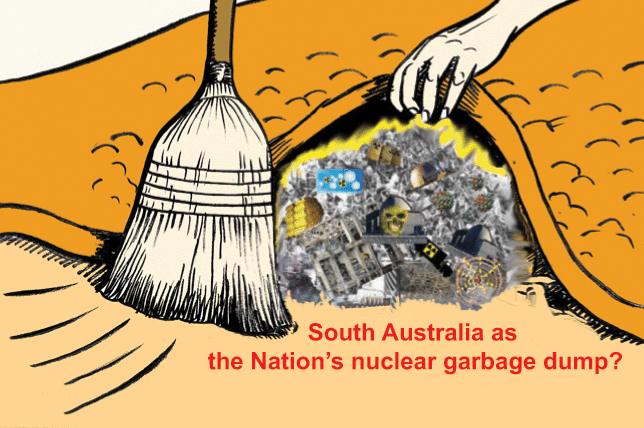
The proposed dump on a farm (Napandee) near Kimba SA has been promoted as a permanent low level waste (LLW) dump to be managed for 300 years, necessitated by nuclear medicine. This lie by omission has been repeated ad nauseam by the National Radioactive Waste Management Taskforce; government agencies tasked with dealing with the waste, namely ANSTO and ARPANSA; government ministers (state and federal); the local Liberal MHR Rowan Ramsay and business associations. This rationale for the dump has been directed to two very small rural communities, while the remainder of the state and the nation have been ignored, in spite of the repeated message that this is an issue of national significance. (The Australian Radioactive Waste Management Framework 2018 states
that the general public should be actively engaged in implementing its aims for nuclear waste disposal.)
Following the debacle of the SA Nuclear Fuel Cycle Royal Commission 2015-2016 (RC) initiated by your colleague, then, Premier Jay Weatherill, its recommendation to more fully explore the possibility of SA becoming a dump for international high level waste (HLW) was rejected
Until then, the current national dump proposal (running in parallel with the RC and supported by it) had been overshadowed by public outrage over the RC’s recommendation re international waste. Most South Australians had no idea that, once again, SA was being primed as a dumping ground for
the nation’s waste.
In 2000, the SA Olson Liberal government enacted the Radioactive Waste (Prohibition) Act; later strengthened by the Rann Labor government, it was amended during 2015 because the RC was not in compliance with the Act! Following the conclusion of the RC, the Act was fully reinstated.
n spite of this, both Labor and Liberal state politicians overwhelmingly have remained mute, lacking the courage to either openly support the national dump plans or to criticise them. Their silence, their unwillingness to defend and uphold the Act is a betrayal of the South Australian public.
In claiming majority support for its dump plans in the Kimba vote, the federal government ignores its failure to include the Barngarla traditional owners, and the bitterly divided community which remains.
The federal government’s PR exercise has failed to satisfactorily explain the sources or composition of the waste planned for Napandee; for example the majority of the waste (by quantity) is currently stored at Woomera, much of it waiting for categorisation and repackaging, as the drums containing
it are in poor condition. This material is legacy waste; the result of research conducted during the Cold War, when Australia worked in close collaboration with UK’s nuclear weapons programme.
Currently there exists no facility at Woomera for repackaging this waste.
While endeavouring to maintain the justification for the national dump i.e. LLW waste necessitated by nuclear medicine, the planned temporary, above ground storage of reprocessed spent fuel and other sources of high level waste have been largely ignored. By labelling these wastes as intermediate level (ILW) the federal government has sought to downgrade the level of concern. IAEA advice for the final disposal of radioactive waste does not differentiate between ILW and HLW; so let us call reprocessed spent fuel for what it is – HLW.
One of the greatest concerns about the dump is the removal of HLW from temporary storage at Woomera, and in the case of reprocessed spent fuel or other high level isotopes, from temporary storage at Lucas Heights to another temporary storage site at Napandee, with NO plans for permanent disposal. Surely, this is not international best practice!
The packaging drums (TN81) for reprocessed spent fuel returning from France and the UK have an anticipated life of 40 years. Given that there are no long-term plans for this waste and that it is envisaged that management of its temporary storage could be for 100 years, it is, therefore, highly
probable that repackaging would be required. There are, however, no plans for providing repackaging facilities at Napandee.
Due to Australia’s relatively small quantities of HLW, the IAEA notes the difficulty we would face in developing a permanent, deep geological repository for its disposal. Given the lack of any long-term plan for this waste; the inability of any other country to permanently dispose of its intractable wastes; and the enthusiasm that still persists in some quarters for hosting an international waste dump, (including amongst the SA government’s top advisers) the IAEA’s comments should ring alarm
bells.
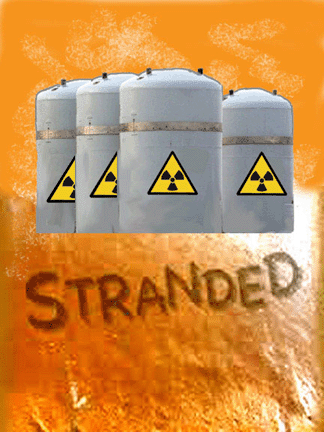
The nation’s HLW becoming stranded indefinitely at the Napandee site, where it could also become a stepping stone to an international waste dump, is not only a nightmarish scenario; it is a realistic possibility.
The federal government’s plans are deeply disturbing. The public has been kept in the dark, or entirely misled. I/We, therefore, request you consider this letter when voting on the forthcoming Bill.
Hope for a nuclear weapons free world
 Hope for a nuclear weapons free world https://www.echo.net.au/2020/07/hope-for-a-nuclear-weapons-free-world/#comment-3006538 Mick & Deborah Stacey, Ballina
The 16 July, 75 years ago, was the date of the first atomic weapons test code named ‘Trinity’, at Alamogordo, New Mexico, USA, (part of the Manhattan Project). This led to the bombings of Hiroshima and Nagasaki on the 6 and 9 August, and over 2000 additional tests worldwide, exposing people and nature to deadly toxic radioactive particles.
Today, there are over 13,890 nuclear weapons worldwide, all far more powerful than the ones used on Japan.
But there is hope, thanks to an Australian initiated campaign ICANW (International Campaign to Abolish Nuclear Weapons), we now have 40 countries, Botswana being the latest, that have ratified the treaty in the United Nations, with 10 more required to make nuclear weapons, illegal under International Law.
Thanks to the dedicated people who work tirelessly to make this happen. We can help by making a donation at ICANW, and encouraging your council to sign up to the ICAN Cities Appeal. There are now 28 Australian councils signed up, Adelaide being the latest.
So if local Councils could take some time out from being developers, just like Ballina Council they could add their support.
There is no future in a world, held to ransom by these horrendous weapons of mass destruction.
People should be appalled by the governments’ announcement to spend $270 billion on so called defence. Love is the answer.
Doubts on the independence of the reiew of Australia’s national environmental laws
 Frustration grows over delayed release of review into Australia’s environmental laws
‘Questions naturally arise’ about review’s independence, environmental group says, Guardian, Lisa Cox 17 Jul 20, Environment groups are increasingly anxious and frustrated as they wait for the release of an interim report from a review of Australia’s national environmental laws.
The review’s chair, the former competition watchdog head Graeme Samuel, handed his report to the environment minister, Sussan Ley, almost three weeks ago.
It had been due for release shortly after that but the government pushed back its publication, which is now expected sometime next week.
“When the review was announced, Minister Ley was very clear that this was meant to be an independent report. But when the report is delayed by government, questions naturally arise about how independent that process is,” said Suzanne Milthorpe, the national environmental law campaign manager at the Wilderness Society.
“If they are serious about this, they should release it so that all Australians can see and engage with the findings of this report.”
The review of Australia’s Environment Protection and Biodiversity Conservation Act is a once-in-a-decade statutory requirement. It has the potential to shape policy for the next 10 years in an area that is highly politicised.
The interim report and its recommendations will inform the next period of public consultation before Samuel delivers a final report in October.
In submissions to the review, environmental and industry groups have put forward proposals that involve the development of national environmental standards.
They agree Australia’s environment is in decline, but they hold different views on what a set of national standards might look like.
Industry continues to advocate for reductions in environmental regulation, while conservationists have called for stronger protection and an independent national environmental authority.
Just this week, Australia’s oil and gas lobby, APPEA, called for regulatory reform, and in particular the cutting of so-called environmental “green tape”, to support economic recovery from the coronavirus pandemic. …..
James Trezise of the Australian Conservation Foundation said a recent national audit office report that examined the assessment and approval of projects under the act had identified serious failures in governance.
That included findings that the government had been ineffective in managing risks to the environment and had failed to ensure developers were meeting the environmental conditions of their project approvals.
Trezise said reforms were needed to ensure Australia’s laws were better focused on delivering outcomes for the environment and that one way of achieving that was “through setting clear national standards” for environmental protection…….
James Trezise of the Australian Conservation Foundation said a recent national audit office report that examined the assessment and approval of projects under the act had identified serious failures in governance.
That included findings that the government had been ineffective in managing risks to the environment and had failed to ensure developers were meeting the environmental conditions of their project approvals.
Trezise said reforms were needed to ensure Australia’s laws were better focused on delivering outcomes for the environment and that one way of achieving that was “through setting clear national standards” for environmental protection……… https://www.theguardian.com/environment/2020/jul/17/frustration-grows-over-delayed-release-of-review-into-australias-environmental-laws
Australia wants to build a huge concrete runway in Antarctica. Here’s why that’s a bad idea
July 17, 2020 Shaun Brooks, University Associate, University of Tasmania, Julia JabourAdjunct Senior Lecturer, University of Tasmania A ustralia wants to build a 2.7-kilometre concrete runway in Antarctica, the world’s biggest natural reserve. The plan, if approved, would have the largest footprint of any project in the continent’s history………
Australia: an environmental leader?
Australia has traditionally been considered an environmental leader in Antarctica. For example, in 1989 under the Hawke government, it urged the world to abandon a mining convention in favour of a new deal to ban mining on the continent.
Australia’s 20 Year Action Plan promotes “leadership in environmental stewardship in Antarctica”, pledging to “minimise the environmental impact of Australia’s activities”.
But the aerodrome proposal appears at odds with that goal. It would cover 2.2 square kilometres, increasing the total “disturbance footprint” of all nations on the continent by 40%. It would also mean Australia has the biggest footprint of any nation, overtaking the United States.
Within this footprint, environmental effects will also be intense. Construction will require more than three million cubic metres of earthworks – levelling 60 vertical metres of hills and valleys along the length of the runway. This will inevitably cause dust emissions – on the windiest continent on Earth – and the effect of this on plants and animals in Antarctica is poorly understood.
Wilson’s storm petrels that nest at the site will be displaced. Native lichens, fungi and algae will be destroyed, and irreparable damage is expected at adjacent lakes.
Weddell seals breed within 500 metres of the proposed runway site. Federal environment officials recognise the dust from construction and subsequent noise from low flying aircraft have the potential to disturb these breeding colonies.
The proposed area is also important breeding habitat for Adélie penguins. Eight breeding sites in the region are listed as “important bird areas”. Federal environment officials state the penguins are likely to be impacted by human disturbance, dust, and noise from construction of the runway, with particular concern for oil spills and aircraft operations.
The summer population at Davis Station will need to almost double from 120 to 250 during construction. This will require new, permanent infrastructure and increase the station’s fuel and water consumption, and sewage discharged into the environment……... https://theconversation.com/australia-wants-to-build-a-huge-concrete-runway-in-antarctica-heres-why-thats-a-bad-idea-139596
40th ratification of the Treaty on the Prohibition of Nuclear Weapons

Thanks to Botswana, the Treaty on the Prohibition of Nuclear Weapons has now reached 40 states parties. After just 10 more ratifications, it will enter into force. Botswana deposited its instrument of ratification with the UN Secretary-General, António Guterres, on 15 July, the anniversary of the entry into force of the Treaty of Pelindaba, which established the whole of Africa as a nuclear-weapon-free zone.
In case you missed it, our neighbouring Fiji also ratified the ban treaty last week. You can read about the significance of this step and Fiji’s long history of activism against the bomb in the Guardian, thanks to Dr Vanessa Griffen and Talei Luscia Mangioni.
The 40th ratification is a significant milestone, dispelling any doubts over the treaty’s inevitable entry-into-force. The Australian Government simply cannot ignore the ban forever.
In more good news, on Tuesday night the City of Port Adelaide Enfield became the first South Australian council to endorse the ICAN Cities Appeal. There are now 28 Australian councils that call for the federal government to sign and ratify the Treaty on the Prohibition of Nuclear Weapons. Congratulations Port Adelaide and thanks to the SA campaigners that made this happen!
Today is the 75th anniversary of the first nuclear explosion, code-named “Trinity”. This event has significance for all people impacted by nuclear weaponry worldwide, including in Australia. Nuclear explosions don’t stay in the past, the effects of radiation continue through the decades and generations. In just a couple of hours we’ll begin our special Trinity video panel with three incredible women who are fighting against the bomb. Check the details and get the Zoom link here, or watch it later from the ICAN Australia Facebook page.
Remote community loses their court fight to get uranium-free drinking water
Key points:
- The tribunal ruled drinking water uranium levels were not the housing department’s responsibility
- The residents were seeking compensation over the contamination and also tap filters to bring their water in line with guidelines
- The tribunal has called for further submissions relating to claims about housing conditions and repairs
Data compiled by the NT’s Power and Water Corporation had shown there were 0.046 milligrams of uranium per litre (mg/L) in the town’s water supply — close to three times the level recommended in national guidelines.
According to Australia’s national guideline, published by the National Health and Medical Council, uranium levels in drinking water should not exceed 0.017 milligrams per litre.
Residents of Laramba, north-west of Alice Springs, lodged a legal case against the landlord, which in this case is the NT’s Department of Housing.
The case was submitted to the NT Civil and Administrative Tribunal (NCAT) in November last year, highlighting problems with not only residents’ drinking water but also housing repairs and conditions in the town.
Residents sought compensation over the uranium contamination and also asked for a filter system on at least one tap in their household kitchens to bring uranium levels in line within Australia’s drinking water guidelines.
But in the NTCAT’s ruling against the residents, the tribunal member Mark O’Reilly said the uranium in the water was not the responsibility of the landlord.
“In my view the landlord’s obligation for habitability is limited to the premises themselves,” the decision read…….
Appeal of NTCAT decision ‘likely’
Daniel Kelly, lawyer assisting for Australian Lawyers for Remote Aboriginal Rights said the result was disappointing and an appeal was likely.
“We’re in the process of speaking to our clients, but our view is — and the views that we’ve been able to garner from our clients are — that we should seek to have this decision reviewed,” Mr Kelly said.
“The decision leaves the question well who is responsible? Because these people have been exposed to uranium in the drinking water for over 10 years.”
“The Department of Housing is doing nothing about it, Power and Water is doing nothing about it and the Northern Territory Government is doing nothing about it.”
In a statement to the ABC, the NT Department of Housing said it would not be providing comment as proceedings were ongoing.
In relation to the rest of the Laramba case, involving housing conditions and repairs, the tribunal has called for further submissions. https://www.abc.net.au/news/2020-07-14/nt-community-laramba-lose-legal-battle-over-uranium-in-water/12454206?fbclid=IwAR2Vb6AHk4MlypQI-_s8MMuWSLFCVQOViknD4nXc52RY4-i5NyA767hOHYk
Global heating – Farmers can’t afford the higher insurance premiums. Fossil fuels killing agriculture
 Climate change-driven disasters making insurance premiums too dear for farmers, ABC News, Vic Country Hour, By Jane McNaughton 16 July 20
Australian farmers are facing increasingly frequent droughts, floods, hailstorms and bushfires, resulting in insurance premiums rising to the point where cancelling or underinsuring are the only options.
Key points:
- A NSW farmer says the fossil fuel industry is effectively killing the agriculture sector
- Insurance premiums are being driven to unaffordable levels by the impacts of climate change
- The Insurance Council of Australia says 80 per cent of Australian homes are underinsured — and that figure’s likely higher in the bush
Climate change has already cost farmers more than $1 billion since 2000, according to ABARES.
Third-generation lamb and cropping farmer Peter Holding said government inaction on global warming could have disastrous flow-on effects to the agriculture industry.
“Climate change poses a cataclysmic set of challenges for farmers,” the Farmers for Climate Action member said.
“It’s pretty severe and it’s getting worse…………
Fossil fuels ‘undermining’ agriculture
Financial strain is not the only issue climate change has delivered to farmers.
“Unfortunately we’re getting less good years and a lot more variability,” Mr Holding said.
“There’s a lot of impacts and I can’t see it stopping any time soon.
“The droughts are just continuing, since the turn of the century we’ve had [so many years] of drought, interlaced with floods.”…….
“The fossil fuel industry is creating emissions and that is slowly but surely making agriculture unviable.
“We’ve cut the emissions from livestock probably in half, farmers in cropping areas have done all sorts of things to reduce the use of diesel and better use fertilisers.
“So farmers are working on all of these problems to cut their own emissions, but we definitely need some quick action to reduce the emissions of fossil fuel.”
Australia’s Liberal Coalition climate deniers are at it again
 COALITION DENIERS AT IT AGAIN, MARK BUTLER. July 15, 2020
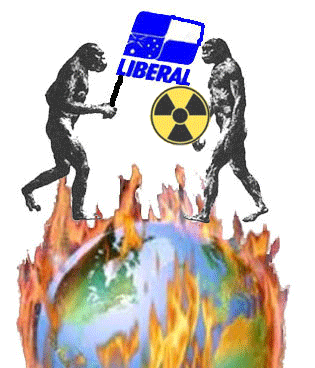
Coalition MP Craig Kelly has mounted an extraordinary attack on the Bureau of Meteorology in a Facebook post shared more than one thousand times in 36 hours.
Coalition MP George Christensen was among those who shared the post, saying: “Craig Kelly is in detective mode. Crooks within data-altering government agencies should be worried. Very worried.”
Does the Environment Minister Sussan Ley agree with these attacks on the Bureau of Meteorology? Does the Assistant Minister, Trevor Evans?
What about Mr Kelly and Mr Christensen’s backbench colleagues like Ross Vasta, Tim Wilson, Dave Sharma, Fiona Martin or Katie Allen?
If they don’t agree, what are they doing about the fact that their colleagues are using social media to spread disinformation in an attempt to discredit a government agency and undermine action on climate change?
This is beyond a joke. The Government needs to take responsibility for the actions of its own backbench.
Links to Mr Kelly and Mr Christensen’s posts:
https://www.facebook.com/CraigKellyMP/photos/a.251794581681850/1553197208208241/
https://www.facebook.com/CraigKellyMP/photos/a.251794581681850/1555461397981822/
https://www.facebook.com/gchristensenmp/posts/2988498467871728?__tn__=-R
George Gear submits on Radioactive Waste Bill – that Kimba site is totally unsuitable
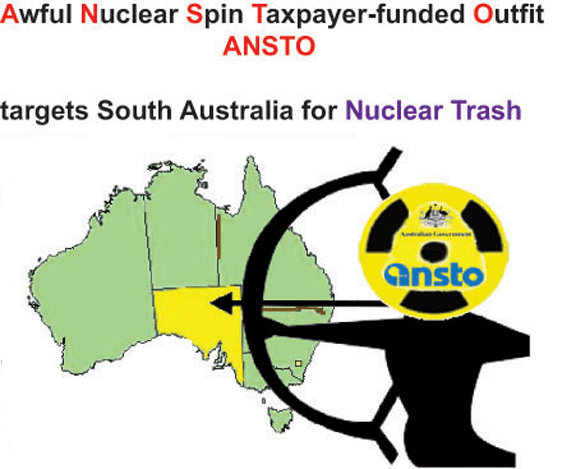
George Gear to Senate Economics Committee on NATIONAL RADIOACTIVE WASTE MANAGEMENT AMENDMENT (SITE SPECIFICATION, COMMUNITY FUND AND OTHER MEASURES) BILL 2020 [PROVISIONS] Addition to my submission. I have attached [on original] two short articles on radioactive storage which will be of assistance to the committee. As you will see the proposal by the government will not be licensed for storage in Australia. It fails to reach the International Atomic Energy Agency (IAEA) standards for the storage of Intermediate Level Waste (ILW).
Accordingly your committee must inform the senate that the Kimba proposal in the bill does not meet IAEA standards and should be withdrawn.
The first is written by Aurora who are the only company operating a (low level ) radioactive storage facility in Australia.
In it they draw attention to the following factors which are relevant to Kimba:
1. The buffer zone is inadequate, it is measured in hectares instead of kilometres. Leonora has a buffer zone of 15 kms.
2. The site should be at a location where there are “few active land uses” on surrounding land. As you know the Kimba site is in the middle of a prime wheat growing area. The site at Leonora is remote, nothing grows there and nobody goes there.
3. When the governments proposed site is finished with in 30 years and a new underground site has been established the redundant Kimba site will have to be managed (at taxpayer expense ) for 300 years.
4. Based on their experience none of the sites in SA would have been considered if it were not for the expression of interest model chosen by the government.
5. The Kimba site is unsuitable.
6. The decision to site the facility at Kimba is a political one and not based on technical or scientific considerations.The second article is by the AINS Group who are a specialist group in storing radioactive waste. They are based in Helsinki and this article is specific to the decision to establish the facility at Kimba. The main points of the article are:
1. Intermediate Level Waste (ILW) should be stored at intermediate level geological disposal. The Department already knows this. The quote below is taken straight from the “ National Radioactive Waste Management Facility Project” (NRWMFP) Facebook home page (attached). The statement that it will take several decades to site and build is wrong and they know it. The Leonora site can store the ILW at depth within a year and the NRWMFP have known this for 3.5 years.
Kimba “interim” nuclear waste site – bad news, uncannily like the misguided New Mexico waste plan
KIMBA GOVERNMENT PROPOSALS, by Peter Remta, 11 July 20 Is not the newspaper article below describing practically the same situation as with the Kimba proposals?
Should not the Australian government learn from this and the other unsatisfactory experiences overseas of which France is a main one despite being used as a successful example by the government for Kimba of community consent.
The author of this article and the former chair of the Nuclear Regulatory Commission of the USA (who incidentally has been to Kimba) would both be prepared to give evidence and their opinions to the Senate committee inquiry by video link.
However this article shows the effects of inept and incomplete planning as is the case with Kimba.
New Mexico nuclear facility is bad news, Las Vegas Sun, By Judy Treichel Monday, July 6, 2020, It may seem like good news in Nevada that an effort is underway in New Mexico to build a private storage facility for nuclear waste there.
But don’t be mistaken: This facility wouldn’t be an alternative to the disastrous Yucca Mountain nuclear waste repository. In fact, its existence depends on Yucca Mountain becoming an operating repository. That’s unacceptable, because the Nevada facility poses far too many risks for our state.
The license application for the New Mexico facility calls for it to operate over 40 years, after which the waste stored in it would go to Yucca Mountain….. today those Yucca Mountain deliberations are on an indefinite hold.
Now comes the New Mexico license application to the Nuclear Regulatory Commission, which in the opinion of the Nevada Nuclear Waste Task Force the commission should not have accepted with the assumption that Yucca Mountain would be an operating repository.
During all of the time that Nevada has been fighting the Yucca Mountain proposal, we were repeatedly assured that we could place our trust in the commission because before any license was granted for construction or operation, a thorough and unbiased process would fully play out. We were told there was no reason for questioning the fairness of the commission’s licensing process…….
Any siting of a facility that creates risk for the community should require informed consent, and the people of New Mexico do not consent.
What we see happening with this so-called interim site is that it does not solve the nuclear waste problem. In fact it increases the risks by putting the waste on the roads and rails, and requiring it to be loaded and unloaded multiple times and transported more than once. Additionally, the only way a site can be considered “interim” is to know that the waste will leave, and the assumption here is that it will leave New Mexico and come to Nevada.
The incentive for the company proposing to build the facility is purely financial — specifically, it’s to gain access to the $42 billion in the federal nuclear waste fund. An interim site does not increase or improve public safety, but rather does just the opposite. It creates one more nuclear waste site and provides more room at reactor sites for more waste. And it moves the waste closer to Nevada.
A national high-level nuclear waste repository at Yucca Mountain is an overwhelmingly unsafe idea. Nevada residents, elected officials and people across the country living near transport routes know it. For 20 years, the Department of Energy studied the site and discovered — or were forced to admit — that there were conditions present that, according to their own guidelines, disqualified the site.
If the licensing process ever restarts, how could we trust the Nuclear Regulatory Commission to fairly judge the science when it has previously assumed a licensed and operating repository at Yucca Mountain? Congress needs to reverse the action it took naming Yucca Mountain as the only site to be considered for a national repository, and take a fresh and fair look at nuclear waste disposal.
Initiatives like the interim storage site in New Mexico are simply misguided and misleading diversions.
Judy Treichel is executive director of the Nevada Nuclear Waste Task Force
Foreign nuclear waste headed to Australia
 Yes, this article is nearly 2 years old, but, sadly it is so relevant today!
Fears for indigenous lands as foreign nuclear waste headed our way, Weekend Australian, JACQUELIN  MAGNAY, LONDON
The Australian can confirm that the waste will be temporarily stored at Lucas Heights in Sydney, until the contentious new nuclear waste management centre is built, possibly at the South Australian sites of Hawker or Kimba.
But the waste will not be material from Australian spent fuel rods from the decommissioned High-Flux Australian Reactor at Lucas Heights (which was originally generated from British-sourced uranium) and reprocessed at Dounreay, Scotland, in 1996.
Instead it is considered too expensive to move that low-level waste from Dounreay, and so the nuclear waste to be transported to Australia will be “substitution waste’’ from Sellafield in England, but of a higher radioactive level.
Glasgow environmental activist Gary Cushway, who helped stop a nuclear storage plant near Coober Pedy, said there was increased awareness in Scotland that Australia didn’t have adequate storage for intermediate-level waste. He said there were fears that the new nuclear waste management facility, said to be for low-level waste, would be recategorised retrospectively to handle the intermediate-level waste.
“Once the storage facility is built for the low-level, where will they put the intermediate-level waste? It has to go somewhere and many Aboriginal owners think it will be temporarily stored with the low-level waste until that temporary status becomes permanent,’’ he said. While the Australian radioactive waste in Dounreay is believed to total about 76 tonnes and is rated low level, the grading of the waste that will be shipped to Australia is of intermediate level, but there will be less of it. It is slated to be transported by 2022 at the latest.
Britain’s parliamentary undersecretary for business, energy and industrial strategy, Richard Harrington told Parliament – “……The radioactive waste, which arose from the processing (of the Australian fuel), comprises several tens of drums of cemented waste. The substituted radioactive waste will be in the form of four vitrified residue containers holding waste that falls within the activity levels of intermediate-level waste.’’
He said the waste would be stored at Lucas Heights and then temporarily “co-located’’ at the new nuclear storage centre.
Australia accepted a 130-tonne “TN81 cask’’ of reprocessed intermediate-level waste from France in December 2015, which required extensive road closures for its transport from Port Kembla to Lucas Heights. It also required special government dispensation for the Lucas Heights centre to temporarily store the intermediate-level waste…….
ANSTO anticipates that four to five casks of intermediate-level waste will need storing in Australia in the next 40 years, much of which will be the return waste from France of reprocessed spent fuel rods of the current OPAL reactor at Lucas Heights. About 7500 200-litre drums of low-level waste is also currently stored at Lucas Heights. ….. https://www.theaustralian.com.au/nation/foreign-affairs/fears-for-indigenous-lands-as-foreign-nuclear-waste-headed-our-way/news-story/21a1027bafda79992897b676db2e71ed?fbclid=IwAR24ceIPdDhe0KCFKC_HKZwxHPkKjoAvB1yq53BCcK7v3DTVKd8qHeRQjxo
In contradiction to Angus Taylor, Australia’s Minister On Behalf of Polluting Industries, the States are leading on clean energy
 How Australia’s state energy ministers are turning the tables on Angus Taylor, Guardian Simon Holmes à Court The state energy ministers still need to deliver on their promises, but imagine if any of them held the federal portfolio @simonahac, Sat 11 Jul 202 Sometimes it just takes a bit of leadership.
Former prime minister Malcolm Turnbull likes to say that we must choose “engineering and economics” over “idiocy and ideology”. The New South Wales energy minister, Matt Kean, has been making the right choices.
In December 2018 I singled out NSW for its reckless lack of energy policy. The state, reliant on an ageing coal fleet for 80% of its power, had been shunned by energy investors……..
NSW is blessed with high-quality wind and solar resources, but lacks transmission lines between the best wind and solar areas and the state’s major population and industrial centres. In 2018, only one-in-20 proposed renewable energy projects could be accommodated into the weak grids in the west of the state, and developers were forced to turn their attention to the other states.
In a landmark speech late last year, Kean, the newly minted energy minister, made it clear his government would respond to the climate science and embrace the opportunities presented by decarbonising the economy.
“To those vested interests and ideologues who want to stand in the way of this transition, I say enjoy your Kodak moment,” he said.
Undeterred by attacks from the Murdoch media and even the prime minister, Scott Morrison, over the following months, Kean set about turning the tables in NSW……….
What’s stunning is how much ambition has shifted, and how it’s being driven by the states. Just two years ago the modelling for Josh Frydenberg’s failed national energy guarantee predicted that NSW wouldn’t build a single wind or solar farm from 2021 to 2030. Now Kean has a plan to build as much large-scale renewable energy this decade in NSW as all of Australia built over the past 20 years. …….
The Australian Energy Market Operator and CSIRO have determined that the cheapest way to “firm” the huge amounts of renewable energy is a relatively modest mix of better interconnections with neighbouring states, batteries and pumped hydroelectricity – Snowy 2.0 project and multiple smaller projects. On economic grounds alone, fossil gas is unlikely to play an increased role.
The Rezs will also open up opportunities for energy intensive industry. Flexible demand, such as hydrogen production, can help balance the grid. Instead of fracking the Pilliga forest to produce fertiliser with a huge carbon footprint, business could build a zero-carbon factory in the New England region, making fertiliser from renewable energy.
Angus Taylor, the federal minister for energy and emissions reductions, is famously no fan of renewable energy or of setting meaningful emissions reduction targets. On electricity, the state energy ministers – right across the political spectrum – are charging ahead without him, which is perhaps as it should be, given that electricity is the states’ responsibility…….
Every state and territory has now formally signed on to a net-zero emissions target by no later than 2050, a target backed by business, unions and the opposition – yet the federal government and its donors stand in the way.
Australia has three Liberal state energy ministers. South Australia’s Dan van Holst Pellekaan wants to see his state hit 100% renewables by 2030. His Tasmanian counterpart, Guy Barnett, is gunning for 200% renewables and Kean has outlined a plan for NSW to be an energy superpower.
Sure, these energy ministers still need to deliver on their promises, but imagine if any one of them held the federal portfolio. https://www.theguardian.com/environment/2020/jul/11/how-australias-state-energy-ministers-are-turning-the-tables-on-angus-taylor?utm_term=Autofeed&CMP=soc_568&utm_medium=Social&utm_source=Twitter#Echobox=1594424036
Australia a big world player in producing greenhouse gas emissions
 Australia: an emissions super-power https://apo.org.au/node/306756, 9 JUL 2020
Not only is Australia a laggard in meeting its UN Paris emission reduction targets, it is now the world’s largest exporter of coal and gas. In fact, the emissions from Australia’s exported fossil fuels are now greater than Germany’s domestic emissions (Hein, Peter & Graichen, 2020).
Despite federal government claims that our national emissions have only a minimal impact on the global climate, Australia is, in fact, a major contributor to global climate change. The massive emissions that result from our fossil fuel exports are not counted in Australia’s national carbon budget under our UN climate obligations, nor do we take responsibility for the impact these emissions are having globally.
Key facts:
- Australia’s exported emissions have increased 4.4% between 2018 and 2019.
- In 2019, the emissions from Australian fossil fuel exports were 1.4 times greater than Germany’s domestic emissions.
- In 2019 Australia’s exported emissions were 1.4 times greater than all the CO2 emissions produced by the 2019/2020 summer bushfires.
- Every Australian is paying $1,832 per year for fossil fuel subsidies, compared to the one-off payment of around $78 for bushfire relief.
Keep Australia’s nuclear prohibition laws: it appears that nuclear is no part of climate action, not necessary

The most important group of nuclear power advocates who have consistently promoted concerns about climate change as the main reason for their advocacy have been the self-described ‘eco-modernists’. The main organizational focus of ecomodernism is the
 Breakthrough Institute, established by Michael Shellenberger and Ted Nordhaus in 2003.
Australia now the biggest exporter of global heating- the Saudi Arabia of coal and gas
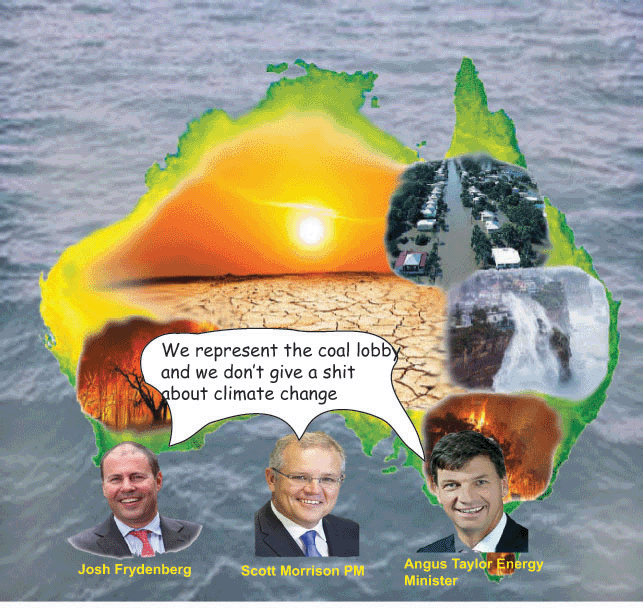 Passing the pollution: Australia becomes world’s biggest exporter of fossil fuels, https://thenewdaily.com.au/news/2020/07/09/australia-export-fossil-fuels/ Cait Kelly, Australia is now the biggest exporter of climate change, leading the world in selling fossil fuels, a new report reveals.Emissions from nations which bought our gas, coal and oil increased by 4.4 per cent between 2018 and 2019, with Australia now the world’s biggest fossil fuel producing country, the report from UNSW says. Passing the pollution: Australia becomes world’s biggest exporter of fossil fuels, https://thenewdaily.com.au/news/2020/07/09/australia-export-fossil-fuels/ Cait Kelly, Australia is now the biggest exporter of climate change, leading the world in selling fossil fuels, a new report reveals.Emissions from nations which bought our gas, coal and oil increased by 4.4 per cent between 2018 and 2019, with Australia now the world’s biggest fossil fuel producing country, the report from UNSW says.
Our exported emissions are now greater than the domestic pollution of Germany, Canada, Turkey and the UK. “Not only is Australia a laggard in meeting its UN Paris emission reduction targets, but it is also now the world’s largest exporter of coal and gas,” the authors wrote. “In fact, the emissions from Australia’s exported fossil fuels are now greater than Germany’s domestic emissions.” Australia has been on track to become the world’s bigger carbon dioxide polluter for a while, with a report from The Australian Conservation Foundation last year warning we would hit the milestone soon. Russia and Saudi Arabia were both above Australia as recently as August last year. Using new data from the Office of the Chief Economist, emissions from exported fossil fuels were 1.2 times greater than global aviation emissions in 2018 and 1.4 times greater than all the CO2 emissions produced by the summer bushfires in 2019. When Australian fossil fuels are burned overseas, the amount of carbon dioxide they produce is higher than the exported emissions of the world’s biggest oil and gas-producing nations, like Iraq and Kuwait. “Despite Federal Government claims that our national emissions have only a minimal impact on the global climate, Australia is, in fact, a major contributor to global climate change.” “The massive emissions that result from our fossil fuel exports are not counted in Australia’s national carbon budget under our UN climate obligations, nor do we take responsibility for the impact these emissions are having globally.” Australia is the world’s biggest exporter of coal and our exported emissions should be counted towards our overall emissions footprint, said lead researcher and professor of political philosophy Jeremy Moss. “We’re the Saudi Arabia of coal and gas. That’s not a good situation to be in,” he told The New Daily. “People say we’re not responsible for exports, the government spends a billion dollar to recycle our waste which otherwise would have gone to other countries. These emissions are also our problem. “Responsibility doesn’t stop at the border. We have the same view about plastic waste, uranium and live sheep exports.” The report calls for fossil fuel non-proliferation treaty, removal of the $47 billion worth of subsidies for the fossil fuel industry and phasing out production constant with climate goals,” Professor Moss said. “At least two-thirds of the known reserves of fossil fuels must be left in the ground if climate targets are to be met (IEA, 2012). “Production of fossil fuels must, therefore, be phased out rapidly. Countries such as Australia should not get a free pass to produce and export as much fossil fuels as they are able to.” The report follows the announcement that the COVID-19 economic recovery committee has made recommendations that the government underwrite a massive gas industry expansion. Australia’s Energy Minister, Angus Taylor, is proposing a gas led recovery out of the pandemic-induced recession. But a report from the Australia Institute revealed last week that fossil fuel was the worst-performing sector in the ASX 300 over the last decade. “The poor performance of fossil fuel companies is probably surprising to most Australians, who are routinely told by industry and political leaders that coal is the “bedrock” of Australia’s prosperity, or that gas will “fire” the recovery from COVID19,” it read. |
|
1 This month
17 October, Free Public Talk on Nuclear Issues in South Australia
David Noonan will speak on public interest concerns over the new Roxby Downs Indenture Act 2026 on BHP copper-uranium mining and ore processing in SA, and on how AUKUS may face SA with a High-Level nuclear waste agenda.
Dr Jim Green will discuss international developments in the field of nuclear power including ‘small modular reactors’ and Generation 4 ‘advanced’ nuclear reactor concepts.


Help Aunty Sue Protect Her Land and Sacred Sites From Destructive Rocket Testing.
.

Australians deserve the truth
about
AUKUS – https://aukuspublicinquiry.com/

PETITION – To: Prime Minister Anthony Albanese and the Australian Labor Government

of the week – Australians for War Powers Reform (AWPR)
To see nuclear-related stories in greater depth and intensity

