Minerals Council of Australia wants radiation risks to be discounted in Environmental Protection and Biodiversity Conservation Act
 Coronavirus: cut green tape delay on projects, miners say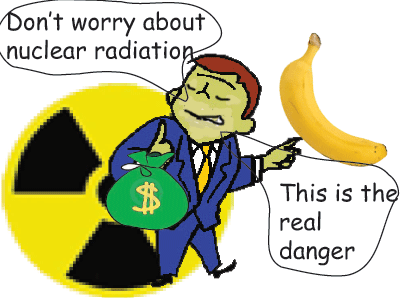
Australia’s six peak mining and resources groups are pushing for a major overhaul of environmental laws, calling for the removal of “unnecessary duplication and complexity” to provide greater certainty for businesses.
In a joint submission to the independent review of the Environment Protection and Biodiversity Conservation Act, led by former Australian Competition & Consumer Commission chair Graeme Samuel, the mining sector warns companies are facing delay costs of up to $1m a day.
Minerals Council of Australia chief executive Tania Constable said Australia was facing an unprecedented economic and social threat from the COVID-19 pandemic, arguing reforms of the EPBC Act would help reduce delays in project approvals and fast-track projects.
Environment Minister Sussan Ley last month flagged reforms to the EPBC and the government’s commitment to cut green tape to “get rid of unnecessary delays”.
Professor Samuel will deliver an interim report by June and a final report by October. “We are getting congestion out of the system and we will continue to do so as the economy comes through the COVID-19 crisis,” Ms Ley said.
The MCA submission, co-signed by the NSW Minerals Council, Queensland Resources Council, the Chamber of Minerals and Energy of Western Australia, South Australian Chamber of Mines and Energy and the Tasmanian Minerals, Manufacturing and Energy Council, suggest four key points to improve the EPBC.
These include eliminating or reducing duplication and ensuring consistency between federal and state-territory processes, reducing delays in assessment and approval processes, improving certainty for businesses and ensuring better “fit-for-purpose regulation”.
Assessing regulatory duplication and uncertainty, the ’ submission ranks NSW and Victoria lower than less mature mining jurisdictions, including PNG and the Democratic Republic of Congo.
Ms Constable said “pragmatic and considered policy reform can build a stronger minerals industry for a faster and more durable post-COVID-19 recovery”.
“When mining projects can take more than a decade to deliver, it’s clear better regulation can help deliver Australia’s economic recovery without compromising our precious environment,” she said.
“Reform to the act is long overdue to address unnecessary duplication and complexity.”
Ms Constable said a one-year delay to a project can reduce its net present value by 10 to 13 per cent per year. “For large mining projects (with a value from $3bn to $4bn), delay costs can be up to $1m per day,” she said. “Significant growth in regulation across all levels of government including the EPBC Act has not led to better environmental outcomes.”
The groups want uranium mining, milling decommissioning and rehabilitation removed from the definition of nuclear actions under the act, to help unlock the mineral sands industry. The EPBC trigger has captured non-uranium projects, including mineral sands, rare earths and base metals, where naturally occurring radioactive material may be present.
Ms Constable said Australia had the world’s largest mineral sands deposits, offering significant “opportunities for growth and jobs”. “Heavy mineral sands such as rutile, ilmenite (titanium) and zircon are essential inputs to everyday life including paint, medical implants and ceramics.”
“Many of Australia’s mineral sands deposits also contain monazite and xenotime, which are sources of the rare earth elements used in smart phones and computers, as well as medical devices.’’
Film Maralinga Tjarutja premieres on ABC Sunday 24 May
 Maralinga Tjarutja premieres on ABC, South Australian Film Corporation 29 April 2020 ABC has today announced that the inspiring SAFC supported documentary Maralinga Tjarutja will premiere on Sunday 24 May at 7.40pm on ABC and iview.Maralinga Tjarutja shines a spotlight on the people who have lived on their lands for over 60,000 years. While it’s a story of deep tragedy, it also celebrates their incredible resilience. Maralinga Tjarutja premieres on ABC, South Australian Film Corporation 29 April 2020 ABC has today announced that the inspiring SAFC supported documentary Maralinga Tjarutja will premiere on Sunday 24 May at 7.40pm on ABC and iview.Maralinga Tjarutja shines a spotlight on the people who have lived on their lands for over 60,000 years. While it’s a story of deep tragedy, it also celebrates their incredible resilience.
Many Australians would be unaware that the Maralinga Tjarutja land in regional South Australia was the location for the British Nuclear Test Program between 1953 and 1963. The Maralinga Tjarutja people have fought for the clean-up of contamination, for compensation and in 2009, for the handback of the Maralinga Village and test sites. They have gone on to rebuild traditional communities into vibrant, creative cultural communities that will ensure Maralinga Tjarutja custodianship of their lands into the future. Jeremy LeBois, the Chair of the Maralinga Tjarutja Trust says “This documentary is important to the Maralinga people because it gives us a voice to tell the real story of what really happened to the people who walked, lived and hunted on this land for thousands of years.” Writer and director Larissa Behrendt says “This is an extraordinary story and it is a privilege to bring it to the screen. The red earthed country that stretches under blue skies provides a cinematic backdrop to the story of a community that has rebuilt itself to be vibrant, strong and proud of its culture. It is a story that deserves to be told through the voices and art of the people who lived it.” Maralinga Tjarutja celebrates the people, their tenacious spirit and cultural strength through which they fight to retain their country………. https://www.safilm.com.au/latest-news/maralinga-tjarutja-premieres-on-abc/?fbclid=IwAR2N2Q6mWcRdE4MNgrGWe0mkxQOpbRtKsJoVXeVs0JkVCP7ZE9XarQsF0R4 |
|
|
‘under cover of coronavirus’ New South Wales govt approves US company to mine coal beneath a Sydney drinking water dam
|
Woronora reservoir, an hour’s drive south of the CBD, is part of a system which supplies water to more than 3.4 million people in Greater Sydney. The approval will allow Peabody Energy to send long wall mining machines 450 metres below the earth’s surface to crawl along coal seams directly below the dam. Dr Kerryn Phelps says the fact the decision was made “under the cover of coronavirus” is “unfathomable”. NSW has spent 12 of the last 20 years in drought, with record low rainfall plunging much of the state into severe water shortage last year. “We know about the potential for catastrophe,” Dr Phelps told 9News.com.au. “We just cannot let this [decision] go unchallenged.” The former president of the Australian Medical Association may seem an odd figure to lead opposition to a mining project, but Dr Phelps takes what she calls a broad view on health. She grew up on Sydney’s North Shore when koalas still lived in family backyards and has witnessed firsthand the affects human populations have on the natural world. She has also seen, as a doctor, how the degradation of the nature impacts human health. In her role as City of Sydney councillor, Dr Phelps introduced a motion to the council calling on the NSW Minister for Planning and Public Spaces, Rob Stokes, to reverse the approval. “We can’t simply risk the water supply in one part of Sydney, without considering the repercussions for the rest of the state and country,” Dr Phelps said. “We have to make a stand now. If not now, then when?” Chain reactionOn the evening of April 6 this year, the City of Sydney council almost unanimously passed Dr Phelp’s motion calling for the approval to be reversed, prompting mayor Clover Moore to send Mr Stokes a strongly worded internal letter. In it, she described the minister’s decision as “scandalous”. Sutherland Labour Party councillor Ray Plibersek says the move also led Sutherland Shire Council to pass a similar motion urging the decision be reconsidered. “We’re very concerned,” Cr Plibersek told 9News.com.au. “There’s been evidence of damage to the water table… and despite assurances from mining companies, there is a threat to a crucial resource – water.” Sutherland Shire and Wollongong, which both have more than 200,000 residents, share the Woronora special catchment area, the rivers and rivulets passing from one jurisdiction to the next. They share the water within it too – the reservoir supplies 100 per cent of the drinking water……….. https://www.9news.com.au/national/coal-mine-under-greater-sydneys-woronora-drinking-water-reservoir-approved-during-coronavirus-pandemic/d3e51de8-f370-4fcf-b4f8-7f62be1c24c7
|
|

Colleen Grantham spells it out on Kimba nuclear waste dump- NO Broad Community Consent, NO Transparency
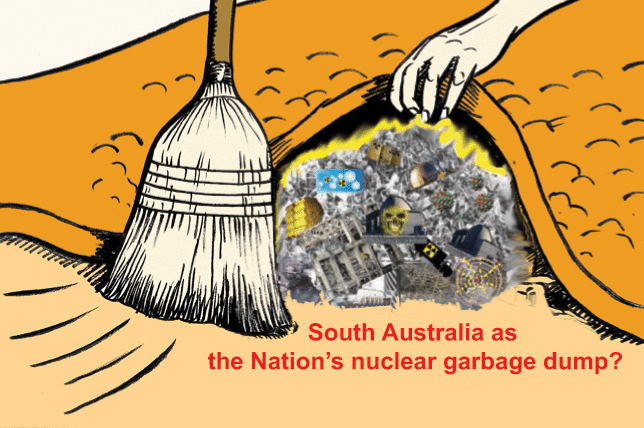
I am appalled to learn that the Native Title awarded to the Bungarla People of this District has been
dissolved on the property in question, thus providing an “out” for the Government to need to
consider their views on this issue.
we need to protect our country’s HEALTH and our
ECONOMY and I struggle to see how this facility in this location will do anything but destroy both.
Colleen Grantham Submission 89 to Committee Secretariat, Senate Standing Committees on Economics
Re – Proposed National Radioactive Waste Management Facility
Dear Committee
Thank you for taking the time to consider this submission of opposition to the establishment of a
National Radioactive Waste Management Facility on FARMING land known as ‘Napandee’ in the
District Council of Kimba.
I grew up the daughter of a farmer in the District Council of Wudinna which is a neighbouring council
precinct to Kimba. No one in this council district has had an opportunity to be heard or to influence
the outcome of the CLOSED voting on this facility, yet some of its farming residents live much closer
to the proposed site than those people residing in the township of Kimba. PLEASE PROVIDE AN
EXPLANATION HOW THIS OUTCOME CAN POSSIBLY BE CONSIDERED FAIR OR REASONABLE given the
potential direct NEGATIVE impacts such a facility could have on their future livelihoods and those of
the generations to come.
The Government and its Agencies have continued to widely publish via all mediums that the facility
in question has received “Broad Community Support” for its establishment at the Napandee site,
HOWEVER, not one of the FIVE Ministers who have held this portfolio during the FIVE years of
consideration of this project has EVER been able to publicly quantify or provide a decent description
of what BROAD COMMUNITY SUPPORT would entail. Instead it appears that those in power are just
making up a number as it suits their purpose, thus FORCING this project ahead DESPITE a huge
number of people both inside and outside the District Council of Kimba being OPPOSED to its
establishment.
The process to date has already, metaphorically speaking, exploded a nuclear bomb in the town and
wider district. A once tight knit, cohesive community is now so far divided that people are not
shopping locally or supporting other community activities because they feel unsafe in their own
town.
Given the far reaching implications that such a facility would have on the whole of Eyre Peninsula, I
would have thought it PRUDENT that any Government consider the thoughts and impacts on the
WHOLE OF EYRE PENINSULA and not just one single Council district consisting of approximately 800-
900 people. This is a NATIONAL issue, bringing with it serious potential risks which should absolutely
NOT be decided on the thoughts of one small community of this size.
FARMING land in South Australia represents 4.5% of the state’s total land mass. I CANNOT
understand how any responsible Government would willingly sacrifice and put at risk productive
agricultural land that makes a huge contribution to the economy of this state and therefore this
nation! Continue reading
Shirley Inglis – 5th generation Kimba resident – on hasty nuclear waste legislation – this plan has really hurt people
Shirl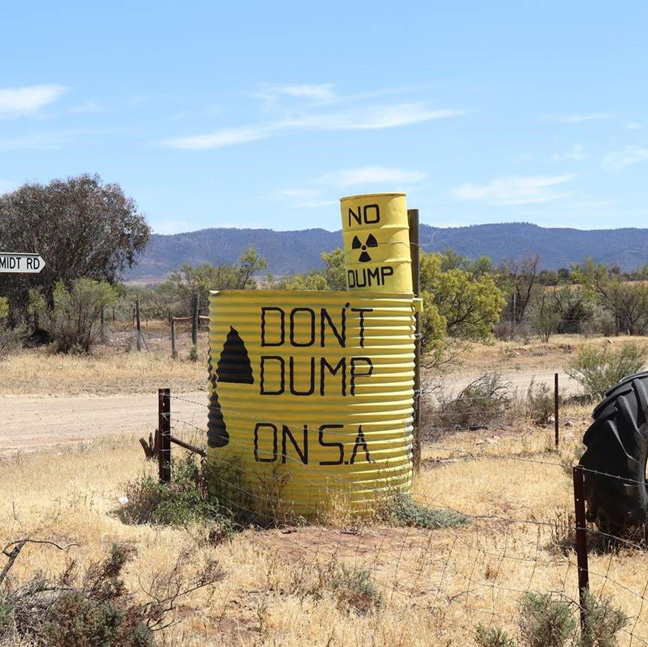 ey Inglis – Submission to Sentae Committee re National Radioactive Waste Management Amendment (Site Specification, Community Fund and Other Measures) Bill 2020 [Provisions] Submission 88
I have found it difficult to understand why a radioactive waste facility needs to be placed amongst farmlands in Kimba. The community I grew up in has seen many changes, growth and struggles over time, but has survived. Much smaller communities than ours continue to soldier on despite hardships and adapted to these circumstances.
Only Kimba has been chosen to host a facility after Rowan Ramsey thought it was a good idea back in 2015 to nominate his land. What has happened since is continued stance that this must be accepted at all cost. I have a lack of trust in what the government proposes and how this has continually changed just like this amended Bill.
As I see out my twilight years that has seen five generations of family live in this community, it is saddening to think of how this has really hurt people.
People must be comfortable with such a proposal, and the best possible solution for Australia’s radioactive waste must be the government’s priority to take the time to get it right..
I hope that your Committee can recommend a better process to be found that respects all Australians to find the right outcome, and not this one.
Assange unwell, stuck in solitary confinement while court hearing delayed till September
In his fight against extradition to the US, where he faces 175 years in prison and being subjected to harsh conditions under “Special Administrative Measures”, Assange is rendered defenseless. He is in effective solitary confinement, being psychologically tortured inside London’s maximum-security prison. With the British government’s refusal to release him temporarily into home detention, despite his deteriorating health and weak lung condition developed as consequences of long detention, Assange is now put at risk of contracting coronavirus. This threatens his life.
Now, as the world stands still and becomes silent in our collective self-quarantine, Assange’s words spoken years ago in defense of a free internet call for our attention from behind the walls of Belmarsh prison:
“Nuclear war, climate change or global pandemics are existential threats that we can work through with discussion and thought. Discourse is humanity’s immune system for existential threats. Diseases that infect the immune system are usually fatal. In this case, at a planetary scale.”
 Assange’s US extradition, Threat to Future of Internet and Democracy, CounterPunch by NOZOMI HAYASE 8 May 20 On Monday May 4, the British Court decided that the extradition hearing for WikiLeaks publisher Julian Assange, scheduled for May 18, would be moved to September. This four month delay was made after Assange’s defense lawyer argued the difficulty of his receiving a fair hearing due to restrictions posed by the Covid-19 lockdown. Monday’s hearing at Westminster Magistrates’ Court proceeded without enabling the phone link for press and observers waiting on the line, and without Assange who was not well enough to appear via videolink.
Sunday May 3rd marked World Press Freedom Day. As people around the globe celebrated with online debates and workshops, Assange was being held on remand in London’s Belmarsh prison for publishing classified documents which exposed US war crimes in Iraq and Afghanistan. On this day, annually observed by the United Nations to remind the governments of the importance of free press, Amnesty International renewed its call for the US to drop the charges against this imprisoned journalist.
The US case to extradite Assange is one of the most important press freedom cases of this century. The indictment against him under the Espionage Act is an unprecedented attack on journalism. This is a war on free speech that has escalated in recent years turning the Internet into a battleground.
Privatized censorship Continue reading
The Liberal coalition government killing the ABC by 1000 cuts – but a possible way exists to save it
 With luck the ABC can be saved , Crispin Hull, 8 May 20, This week’s report on ABC funding should alarm Australians.
The death by a thousand cuts of the ABC and the slow strangulation of Medicare have become woven into in Liberal Party’s DNA since John Howard turned Robert Menzies’ broad church of a liberal-conservative Liberal Party into a purely conservative one by shutting out almost everyone left of the nave.
A different liberal-conservative Liberal Party, on the other hand, would have recognised them as essential Australian institutions to be nurtured and supported. After all, the ABC has been around since 1932 and Medicare (in one form or another) since 1973.
The Liberal Party’s desired outright abolition of both has been impossible because of the two institutions’ ingrained popularity. So the onslaught has to be cunningly dressed up as measures to “improve” Medicare and to voice support for the independence of the ABC and promise “no cuts” while ever trying to bully the ABC; sway its board to the right; and to apply cuts to stifle its voice.
This week’s report by the independent think tank Per Capita says that the ABC has lost $783 million in funding since the Coalition came to power in 2013, starting with $245 million in the 2014 Budget, despite Tony Abbott’s promise before the 2013 election that he would not cut the ABC.
More cuts in staff and programming will come before the end of this financial year. They follow seven years of program and staff slashing, critically a 50 per cent cut in the hours of scripted Australian drama.
The Per Capita report concludes that real funding per year since 1985-86 is down 30 per cent or $370 million. Per head of population, the ABC’s funding has been halved in that time. The cuts have come despite the ABC having to provide extra services to keep up with the digital age.
Very likely the Government will cut more as it seeks to claw back from the Covid-19 crisis, even though the ABC – especially the excellent Dr Norman Swan – did so much to inform Australians about the pandemic, as it always does in times of crisis.
What can be done? The ABC itself is down to the bone, though perhaps it could cut out all sport which the commercials to well enough. It is doubtful a Coalition Government would ever increase real funding for the ABC. Perhaps the best we can hope for is that Labor makes some suggestions that the Coalition feels obliged to match or that they become reality with a Labor Government (whenever that might be). ……..
funding solution used in Britain, New Zealand, and only Western Australia among the Australian states to fund culture which could help fund the ABC – a lottery. The Federal Government should set up its own national lottery to boost ABC funding……..
The BBC is well-funded and broadcasters throughout the world line up to pay for its product. The result is a lot of soft-power dividend for Britain. Australia, too, would get a lot of benefit from properly funding the ABC, not least a better-informed community.
Silly me. It’s that last bit the Coalition detests more than anything. http://www.crispinhull.com.au/2020/05/08/with-luck-the-abc-can-be-saved/?utm_source=mailpoet&utm_medium=email&utm_campaign=crispin-hull-column-16-nov-2019_99
Australian government stops listing major threats to species under environment laws
|
Australian government stops listing major threats to species under environment laws
Documents show department has stopped recommending assessment of ‘key threatening processes’ affecting native wildlife Lisa Cox ,Guardian 8 May 2020 The federal government has stopped listing major threats to species under national environment laws, and plans to address listed threats are often years out of date or have not been done at all. Environment department documents released under freedom of information laws show the government has stopped assessing what are known as “key threatening processes”, which are major threats to the survival of native wildlife. Conservationists say it highlights the dysfunctional nature of Australia’s environmental framework, which makes aspects of wildlife protection optional for government. The Environment Protection and Biodiversity Act is being reviewed, a once-a-decade requirement under the legislation, and there are calls for greater accountability rules to be built into Australia’s environmental laws. It follows longstanding criticism that the act is failing to curb extinction. ‘An unacceptable excuse’In a series of reports since 2018Australia has uncovered multiple failures including delays in listing threatened species and habitats, threatened species funding being used for projects that do not benefit species, critical habitat not being protected, and recovery actions for species not being adopted or implemented. The act lists threats such as feral cats, land clearing and climate change as key threatening processes that push native plants and animals towards extinction. Once a threat is listed, the environment minister decides whether a plan – known as a threat abatement plan – should be adopted to try to reduce the impact of the threat on native species. Advertisement
But a 2019 briefing document shows the department has stopped recommending the government’s threatened species scientific committee assess new key threatening processes for potential listing……… ‘It’s shocking really’Further government data shows that of the 21 listed major threats, only three of those were listed in the last decade of the act, the most recent was in 2014…… The process for listing threats can also take years and is subject to ministerial discretion. Major alterations to the flow of river systems – caused by industry and dams – was accepted by the department for assessment in 2016 but removed from the list by the then environment minister, Josh Frydenberg. The only major threat currently under assessment – “fire regimes that cause biodiversity decline” – has been on the assessment list since 2008 and remains incomplete 12 years later. Its deadline is listed as August 2013. Fire regimes that cause biodiversity decline refers to changes in the frequency and scale of fire due to human influence. Every state of the environment report identifies changed fire patterns as a major threat to the survival of native wildlife. “They haven’t even listed it as a threat, let alone done something about it. It’s shocking really,” Andrew Cox, the chief executive of the Invasive Species Council, said. ……. ‘The system’s broken’Environmental organisations and the threatened species scientific committee have highlighted the weaknesses of the KTP system in submissions to the EPBC review, chaired by Graeme Samuel. ‘The system’s broken’Environmental organisations and the threatened species scientific committee have highlighted the weaknesses of the KTP system in submissions to the EPBC review, chaired by Graeme Samuel……… “It’s all optional. That’s the problem,” James Trezise, a policy analyst at the Australian Conservation Foundation, said. “A threat abatement plan is this optional thing where it’s optional to establish them, it’s optional to implement them, there’s no system for tracking them and there’s not enough resources available.”…. https://www.theguardian.com/environment/2020/may/08/australian-government-stops-listing-major-threats-to-species-under-environment-laws |
|
Australian Renewable Energy Agency funds end in 2022 – a major blow for solar research
 ‘Major blow’ looms for top Sydney solar research unit as funds wither, SMH. By Peter Hannam, May 8, 2020 The future of a leading research centre whose designs power $50 billion in solar systems globally is at risk because of the uncertain future of the federal government agency that funds it.Richard Corkish, a senior lecturer at the University of NSW’s School of Photovoltaic and Renewable Energy Engineering, said as much as 80 per cent of his section’s money is provided by the Australian Renewable Energy Agency (ARENA) which is due to run out of funds in 2022. ‘Major blow’ looms for top Sydney solar research unit as funds wither, SMH. By Peter Hannam, May 8, 2020 The future of a leading research centre whose designs power $50 billion in solar systems globally is at risk because of the uncertain future of the federal government agency that funds it.Richard Corkish, a senior lecturer at the University of NSW’s School of Photovoltaic and Renewable Energy Engineering, said as much as 80 per cent of his section’s money is provided by the Australian Renewable Energy Agency (ARENA) which is due to run out of funds in 2022.
We’ll get significantly smaller unless something positive comes along,” said Dr Corkish, who is also chief operating officer of the UNSW-based Australian Centre for Advanced Photovoltaics. “It’s a major blow for us.” His school has already begun turning away prospective PhD students who would otherwise have contributed to multiple lines of scientific inquiry aimed at improving the efficiency and performance of solar cells, their integration into power networks and other renewable energy developments. …… Mark Butler, Labor’s climate spokesman, said “letting ARENA’s resourcing lapse is a devastating self-inflicted wound for Australia’s clean energy future that exposes the Liberals anti-renewable and anti-climate action ideology”. “Scott Morrison should be looking for a COVID-19 recovery plan which brings forward investment in new renewable projects which would create tens of thousands of new jobs, stimulate regional economies, and deliver cheaper power prices,” Mr Butler said. Mark Butler, Labor’s climate spokesman, said “letting ARENA’s resourcing lapse is a devastating self-inflicted wound for Australia’s clean energy future that exposes the Liberals anti-renewable and anti-climate action ideology”. “Scott Morrison should be looking for a COVID-19 recovery plan which brings forward investment in new renewable projects which would create tens of thousands of new jobs, stimulate regional economies, and deliver cheaper power prices,” Mr Butler said……. https://www.smh.com.au/environment/climate-change/major-blow-looms-for-top-sydney-solar-research-unit-as-funds-wither-20200507-p54r3j.html |
|
Kerri-Ann Garlick – Lucas Heights is the correct place for Australia’s nuclear waste. The Kimba dump plan is unfair, undemocratic and dangerous.
 Kerri-Ann Garlick Submission 99 to Senate Committee on National Radioactive Waste Management Amendment (Site Specification, Community Fund and Other Measures) Bill 2020 [Provisions]
The National Radioactive Waste Management Amendment Bill amends the National Radioactive Waste Management Act to specify a site near Kimba in South Australia for a nuclear waste ‘facility’ ‒ a repository for low-level waste and an above-ground ‘interim’ store for long-lived intermediate level waste.
I have deep concerns about the federal government’s proposed changes to the National Radioactive Waste Management Act. They are unfair, undemocratic and dangerous.
The government has no valid case on safety or security grounds and not made a clear case about the need for the planned national nuclear waste facility at Kimba.
The necessary infrastructure, resources and expertise for nuclear operations and waste management are all located at Lucas Heights and transferring the waste component of the system to a remote location at Kimba is a recipe for disaster in the medium and long term – up to 10,000 years from now, in the case of intermediate waste.
The whole process has been restricted and inadequate. The traditional owners of the land were disrespected and excluded from the purportedly public and democratic approval process. All citizens of Australia have a stake in the successful resolution of our national nuclear waste problems yet we were not consulted either.
The Bill is deeply flawed and should be rejected.
In particular, I am concerned that the planned changes:
- restrict or remove options for judicial review of the government’s site selection under
current laws, - unreasonably reduce the rights and options of the Barngarla Traditional Owners and other
directly impacted parties and have not been made with proper consultation, - exempt key environmental and cultural heritage protection laws from being usedfail to make any clear or compelling radiological or public health case for doubling handling the long-lived intermediate level waste (ILW) at significant public expense
- do not provide any certainty about the long-term management of Australia’s radioactive
waste, - are not consistent with international best practice in relation to siting, community
consultation or procedural fairness around radioactive waste, - do not recognise or respect long standing South Australian legislation prohibiting any federal
radioactive waste facility.Against the current context of uncertainty and disruption due to the impact of Covid 19 the further
uncertainty and contest generated by the federal government’s approach to radioactive waste is not
helpful or justified.
Western Australian uranium projects floundering, as Cameco’s Kintyre environmental approval lapses
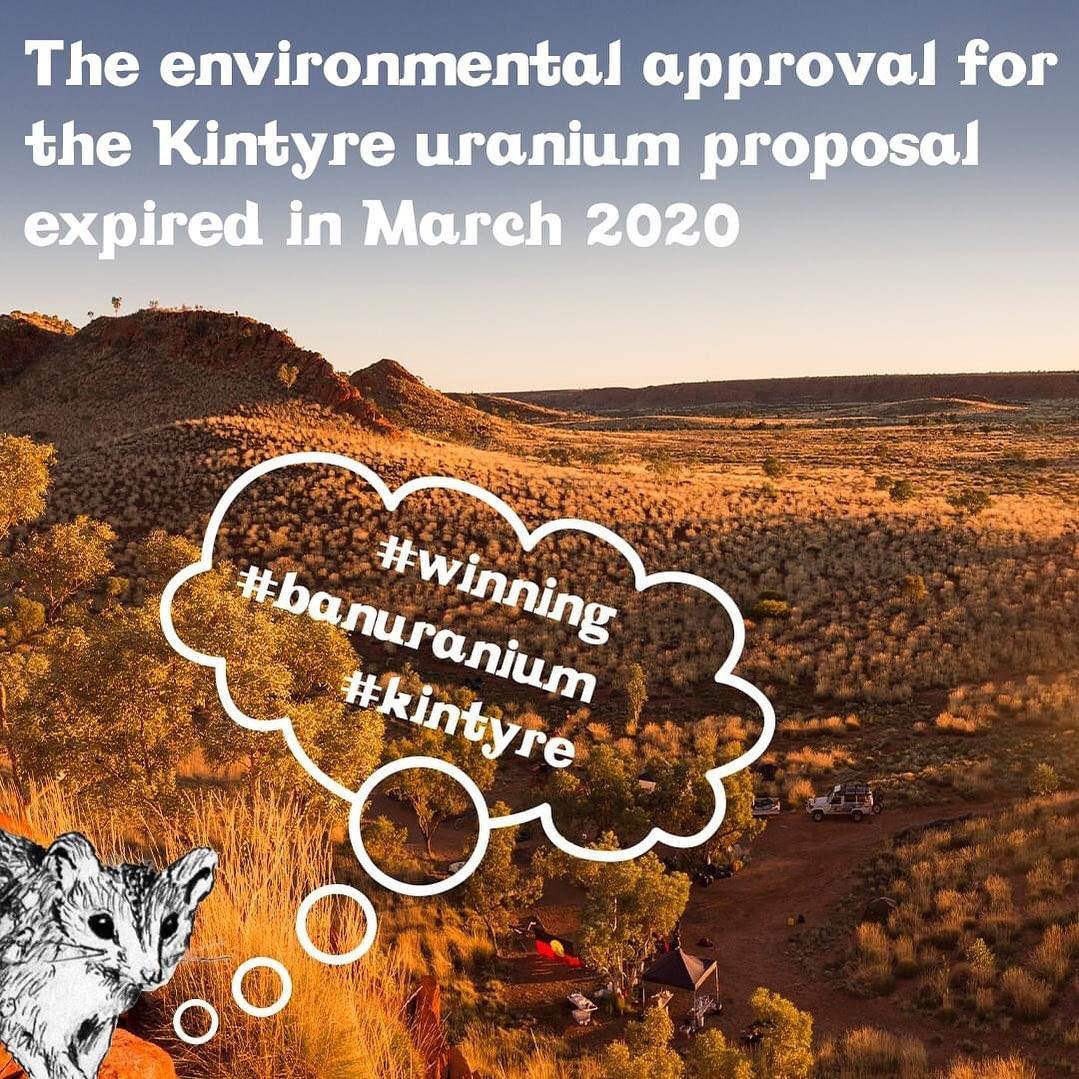 K-A Garlick at Nuclear Free WA, 6 May 20 The environmental approval for the Kintyre uranium project expired in March this year. So there is no valid environmental approval for Cameco. There can be no mining without changing or getting new environmental approval. This is great news for the campaign and shows the uncertainty of the uranium industry and Cameo who had applied for an extension but latter withdraw their application. It is great for the Martu community who have held strong and resisted over these many years. Let’s hope their beautiful country will one day be given back!
Keeping a track on all four projects and the process of asking questions on notice through State Parliament, we have found that Toro Energy, have failed to submit their annual environment reports on the Wiluna uranium project. This matter is now being pursued by the Department of Mines, Industry Regulation and Safety to ensure the report and plans are provided and any appropriate compliance action is taken.
Further good news, Yeelirrie is getting some really good attention with some upcoming media from the Freedom of Information process that has been investigated through the Australian Conservation Foundation that found an alarming lack of transparency in the Federal approvals process. The documents show that Cameco lobbied the former Federal resource Minister, Matt Canavan to fast track the approvals process and to change the conditions. If you haven’t seen the presentation from ACF, please click here.
We are excited organising a series of webinar nuclear talks that will focus on local, national and international impacts of Australian uranium industry. We will announce next week further details, but lock in Wednesday 10 June 5.30pm – 7 pm (tbc).
Radioactive Waste Management Taskforce pitching an old Community Benefit Program as something new
 Kazzi Jai Fight To Stop A Nuclear Waste Dump In South Australia, 7 May 20, What is old becomes new again it seems! This “new” Community Benefit Program is actually the “old” 2019 Community Benefit Program – which was announced by Matt Canavan on October 8th, 2019…. which just “conveniently” coincided with the posting out by Kimba Council of postal votes on October 3, 2019. (Hawker/Quorn ballot was held a month later due to a SWOT analysis being requested by Flinders Ranges Council as a stipulation to the ballot voting proceeding)>
This Community Benefit Funding is not an “extra” but was part of the agreement to remain in Phase 2 of the process in 2019 and was actually “owed” to both Communities (…as much as “bribe” money can be owed, but that is another story…)
Spin, spin, spin… https://www.facebook.com/groups/941313402573199/
Coronavirus shows that international co-operation is essential, as it is for climate action
 Coronavirus hasn’t killed globalisation – it proves why we need it The
  Conversation Sunil Venaik Associate Professor of International Business, The University of Queensland, May 6, 2020 “………………… One person practising social distancing during the pandemic might think their effect is negligible. But coronavirus is highly infectious: on one estimate, a single person with coronavirus could eventually infect 59,000 others.
Similarly, many countries seek to avoid responsibility for taking climate action by claiming their contribution to the global problem is small. The Australian government, for example, repeatedly points out it contributes just 1.3% to the world’s emissions total.
But on a per capita basis, Australia is one of the world’s highest emitters. And as a rich, developed nation, we must be seen to be taking action on cutting emissions if poorer nations are expected to follow suit. So actions Australia takes will have major global consequences.
Act quickly
In the two months it took the virus to spread from China and become a global pandemic, other nations could have readied themselves by amassing test kits, ventilators and personal protective equipment. But many nations did not adequately prepare.
Of course the world has had a far longer time to adapt to and mitigate climate change. The time lag between emissions and their consequences is years, even centuries. There has been ample opportunity to take progressive and thoughtful corrective action against climate change. Instead, the crisis has been met with complacency.
Challenges ahead
As others have noted, a major supplier of swabs used for coronavirus testing is based in Italy, and a German company is a primary supplier of chemicals needed for the tests. Many counties rely on foreign suppliers for ventilators, and an Indian firm – the world’s largest vaccine manufacturer – says once a COVID-19 vaccine is ready for mass production, it will supply large volumes to the world, at low cost.
It’s clear that international cooperation is critical for effective mass testing and treatment for the virus. Nations must work together to improve production and distribution, and resources must be shared.
So too is cooperation needed to deal with the worldwide economic downturn. The global recovery will be long and slow if nations adopt sovereign mindsets, putting up barriers to protect their own economies.
With the coronavirus as with climate change, working together is best way to secure humanity’s safety, health and well-being. https://theconversation.com/coronavirus-hasnt-killed-globalisation-it-proves-why-we-need-it-135077
Investors urge governments to go green for coronavirus recovery
 Investors urge governments to go green for coronavirus recovery, The Age ,By Mike Foley, May 4, 2020 Major investors, Australian superannuation funds and the International Energy Agency are urging governments to seize the green opportunity to drive economic growth after the coronavirus pandemic and avoid the risks they see in high carbon emitting projects.“Recovery plans that exacerbate climate change would expose investors and national economies to escalating financial, health and social risks in the coming years,” said a statement from the Investor Agenda group – an international coalition of institutional investors and asset managers whose members hold more than US$80 trillion under management. Investors urge governments to go green for coronavirus recovery, The Age ,By Mike Foley, May 4, 2020 Major investors, Australian superannuation funds and the International Energy Agency are urging governments to seize the green opportunity to drive economic growth after the coronavirus pandemic and avoid the risks they see in high carbon emitting projects.“Recovery plans that exacerbate climate change would expose investors and national economies to escalating financial, health and social risks in the coming years,” said a statement from the Investor Agenda group – an international coalition of institutional investors and asset managers whose members hold more than US$80 trillion under management.
Large-scale energy generators such as coal and gas fired power plants and their heavy duty transmission networks, as well as gas powered manufacturing facilities, are built to deliver a return on investment over decades. Investors argue international commitments to tackle climate change and reduce emissions such as the Paris Agreement create an unacceptable risk for long-term investment in emissions intensive projects…… The Clean Energy Council, which represents renewable energy companies that employ more than 28,000 workers said governments had “an opportunity to transform Australia forever”. In its Clean Recovery report released on Tuesday the Council said wind and solar projects totalling 30 gigawatts energy capacity, which already have development approval, would generate $50 billion in investment across the supply chain 50,000 construction jobs and 4000 permanent positions. The Council also said support for large and small-scale renewables, such as rooftop panels, and an accelerated roll-out of batteries would create a “smart energy system” that could deliver flexibility and lower costs for consumers with low-emissions. This week, the International Energy Agency, an intergovernmental energy forecast adviser, highlighted opportunities in the energy sector in the wake of COVID-19. Global energy demand is forecast to fall a whopping 6 per cent this year, seven times more than during the global financial crisis….. The Council also said support for large and small-scale renewables, such as rooftop panels, and an accelerated roll-out of batteries would create a “smart energy system” that could deliver flexibility and lower costs for consumers with low-emissions. This week, the International Energy Agency, an intergovernmental energy forecast adviser, highlighted opportunities in the energy sector in the wake of COVID-19. Global energy demand is forecast to fall a whopping 6 per cent this year, seven times more than during the global financial crisis…. Emma Herd, chief executive of the Australian Investor Group on Climate Change, said “government policy that spurs fresh private investment in clean energy … will lead to much needed jobs and economic growth”. “The Australian government should be looking to integrate recovery plans with its technology investment roadmap, long-term emissions reduction strategy, grid modernisation planning and bushfire recovery to build greater resilience and reduce climate risk,” Ms Herd said. https://www.theage.com.au/politics/federal/investors-urge-governments-to-go-green-for-coronavirus-recovery-20200504-p54pmu.html |
|
|
NO RADIOACTIVE WASTE ON AGRICULTURAL LAND IN KIMBA OR SOUTH AUSTRALIA

RECOMMENDATIONS ……That the National Radioactive Waste Management Amendment (Site Specification, Community Fund and Other Measures) Bill 202 be withdrawn, and an independent inquiry into the management of Australia’s radioactive waste be commissioned.
There are many examples of how this is process has been unfair and wrong…… COMMUNITY CONSULTATION……DEFINITION OF ‘NEIGHBOURS’…… ‘INFORMED CONSENT’…… Community Benefit Packages…… Siting on Agricultural Land….. Double handling of Intermediate Level Waste…. Declaration and Legislation of Selected Site
No Radioactive Waste on Agricultural Land in Kimba or SA Committee ,Submission No 80
“To campaign against any nuclear radioactive waste management facility in South Australia’s agricultural land
and in particular the District Council of Kimba
SUBMISSION TO THE SENATE INQUIRY INTO THE NATIONAL RADIOACTIVE WASTE MANAGEMENT
AMENDMENT
The No Radioactive Waste on Agricultural Land in Kimba or SA Committee was established in 2016 to represent the members of the Kimba, Eyre Peninsula and SA community who are opposed to the siting of the National Radioactive Waste Management Facility on Farming land in South Australia.
As both a committee and individuals we have been heavily involved in the 5 year process the Federal
Government has undertaken to site the National Radioactive Waste Facility in Kimba and we would like to thank the Committee for their time and efforts in undertaking this inquiry.
As the Senate Committee would be well aware, the process which led to this point has been long and arduous,
particularly for those who do not support the siting of the facility in the Kimba district. We have had no goal or
prize in sight, only the onerous task of proving our opposition.
The proposal has caused, and continues to cause, significant division within our community, which has been
fuelled by the actions of the Department in their quest to establish support for the facility. There are many
examples of how this is process has been unfair and wrong, and we appreciate the opportunity to put forward
some important facts from our perspective.
COMMUNITY CONSULTATION
The finding by former Minister Matthew Canavan that broad community consent for this facility exists in Kimba,
a basis on which this Bill rests, is tenuous at best. The path that the Federal Government took to making this
finding has been a long road of propaganda, manipulation and promises, and is now completely lacking
justification at its conclusion for the decision made.
The Hawker site was removed from the process due to lack of support as shown in the result of the ballot.
However, there is every probability this same finding would have been made in Kimba had the voting rules been equitable. Continue reading
1 This month
.

Australians deserve the truth
about
AUKUS – https://aukuspublicinquiry.com/

PETITION – To: Prime Minister Anthony Albanese and the Australian Labor Government

of the week – Australians for War Powers Reform (AWPR)
To see nuclear-related stories in greater depth and intensity

