Australia’s political revolving door between military industry and government – Reynolds and Reith
Senator the Hon Linda Reynolds CSC
MILITARY INDUSTRY REVOLVING DOOR, MichaelWest.com 15 Apr 20
The “spruiker-in-chief” of defence industry has been involved with promoting military industry interests since the late 1980s when she co-founded the WA Defence Industry Council. Reynolds combined a career in the army reserves with political staffing roles for the Liberals, and a stint with industry giant Raytheon, before becoming a senator for WA in 2014. From 2 March 2019, she served as Minister for Defence Industry before being promoted to Defence Minister on 29 May 2019…….. https://www.michaelwest.com.au/linda-reynolds/
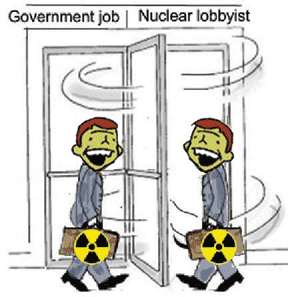
The Hon Peter Reith AM
MILITARY INDUSTRY REVOLVING DOOR
Former Howard government defence minister Peter Reith created a storm of protest when he quit politics and started work within a day or two for Tenix Defence (now BAE Systems Australia) as a consultant on government relations. Tenix Defence was Australia’s largest military industry corporation and a significant contractor to the department over which Reith had just had oversight. ……..more https://www.michaelwest.com.au/peter-reith/ …… https://www.michaelwest.com.au/linda-reynolds/
Study finds that New South Wales rivers, lakes and lagoons are warming twice as fast as ocean
 NSW rivers, lakes and lagoons warming twice as fast as ocean, finds 12-year study ABC NSW rivers, lakes and lagoons warming twice as fast as ocean, finds 12-year study ABC
By Amy Greenbank 16 Apr 20, Dominic Boyton’s Merimbula oyster farm in southern NSW has been in the family for four decades.
His father passed it onto him seven years ago but he’s worried about its future viability given the latest findings from the University of Sydney (USYD). Key points:
Researchers discovered the state’s coastal rivers, lakes and lagoons were warming twice as fast as the ocean. The average temperatures in those marine ecosystems were up 2.16 degrees Celsius, making breeding harder for some aquatic life. “Warmer waters could mean we’ll see oysters disappearing up the coast or a new outbreak of algae blooms and disease we haven’t seen before,” Mr Boyton said. Oysters, he said, were sensitive to heat and because they were difficult to relocate it put growers like him in a vulnerable position. The world-first study also posed a big problem for the state’s multi-million-dollar fishing and aquaculture industry, which underpinned the economies of many coastal towns. Marine biologist Elliot Scanes analysed 12 years of data from 166 NSW estuaries and found the composition of those waterways was shifting. “We didn’t expect it to be so fast,” he said.
Acidity also rose in all waterways and at the same time creeks and lagoons were becoming less salty. “This study is the first major evidence we have to show estuaries are changing on this scale,” Dr Scanes said. The marine biologists said coastal ecosystems were being forced to adapt and there would be winners and losers. While some species of fish and prawns are likely to be more resilient, shellfish like oysters could be badly affected…… https://www.abc.net.au/news/2020-04-14/nsw-inland-water-ways-warming-twice-rate-of-ocean-study-finds/12147462 |
|
While we focus on coronavirus, the planet is still heating
 All eyes are on coronavirus… but what about the planet? With COVID-19 all anyone is talking about at the moment, we take a look at where that leaves the environment, Pro Bono Australia, 14th April 2020 Maggie Coggan As many countries shut their borders, impose heavy-duty lock down laws, and scramble to deal with the financial and social implications of coronavirus, the climate crisis has shifted out of focus.
But environmental advocates warn that just because attention is elsewhere it doesn’t mean the environment isn’t suffering, or that action to mitigate the impacts of climate change should come to a grinding halt.
The crisis is still happening
At the end of March, the Great Barrier Reef experienced its third major bleaching event in the last five years.
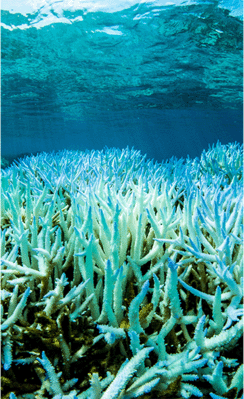 The Great Barrier Reef Marine Park Authority confirmed soon after that the bleaching was caused by warming waters associated with climate change.
Nathaniel Pelle, a senior Greenpeace campaigner, told Pro Bono News that while the reef could recover, it needed drastic emission reductions globally and in Australia.
He said something that wouldn’t help was the fossil fuel industry actively trying to weaken environmental protections, attracting corporate subsidies from government stimulus packages and forging ahead with mining projects.
“We’ve seen the petroleum exploration licence fees suspended in South Australia and a lot of oil and gas companies calling for assistance as well,” Pelle said.
“Controversial coal and gas projects like the Metropolitan mine, the Vicary Coal Mine, the Glendale mine, and the Narrabri Mine are continuing apace, even while communities don’t have the opportunity to participate, while expert witnesses aren’t necessarily going to be available and scientific investigation is impossible.”
The Victorian Premier Daniel Andrews, also recently came under fire for lifting the ban on onshore gas exploration in mid-March, a move environment groups warned could lead to worse bushfires and droughts.
Gavan McFadzean, the Australian Conservation Foundation climate change program manager, also said it was critical that a close eye was kept on the fossil fuel industry.
“These are times often when the fossil fuel sector may attempt to entrench its longevity as an economic powerhouse,” McFadzean told Pro Bono News.
“They have been ramping up their political donations federally in recent years and have the kind of political access that could shape economic reform as we come out of this crisis.”
He added that the postponement of climate talks such as the United Nations Intergovernmental Panel on Climate Change and the Cop26 in Glasgow meant that global targets and action would have to hold off until at least 2021.
He said while it was understandable the events were postponed, it was critical that once the virus was under control climate action once again took centre stage.
“The Cop26 event was going to be the most important conference since Paris in 2016… it was the conference where countries were going to be setting targets,” McFadzean said.
“It’s going to be really important that climate issues return to the national stage as COVID-19 gets under control, because climate change is also a central threat to society and the global economy as we know it.”
Emissions are going down – But not for long …….
Pelle said that if Australia and the rest of the world emerged from the crisis looking towards the energy solutions of the 21st century then the globe could see a recovery that worked for everyone.
“We could see a recovery that works for communities, that works for people, that makes people’s lives better and tackles the climate crisis at the same time, instead of a deliberate economic contraction and disruption to everyone’s lives,” he said.
A chance to start again
McFadzean said while the COVID-19 crisis was far from over, it was a good time to start imagining what a different kind of economy and climate future might look like if things were done differently.
“This means positioning ourselves to be an exporter of renewable energy to the world as we strive to make our future energy needs from low emission sources, recover our transport sector and move towards lower emissions vehicles, stronger pollution standards and electric vehicles,” he said………
https://probonoaustralia.com.au/news/2020/04/all-eyes-are-on-coronavirus-but-what-about-the-planet/
National Radioactive Waste Facility has strong community opposition – says Public Health Association of Australia
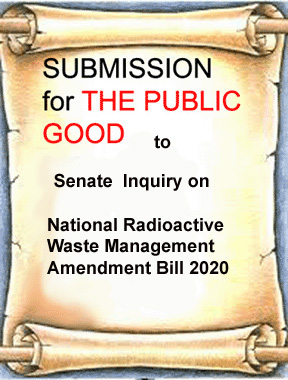
Uniting Church, South Australia, rejects National Radioactive Waste Bill as discriminatory against Aboriginal people
|
Uniting Church of Australia
Synod of South Australia Submission No.11
Submission to the Senate Economics Legislation Committee – RE: Inquiry into National Radioactive
Waste Management Amendment (Site Specification, Community Fund and Other Measures) Bill On behalf of the Uniting Church in South Australia, we make this submission to express our views
regarding the National Radioactive Waste Management Amendment Bill. The Uniting Church in South Australia stands proudly in covenantal relationship with the Uniting Aboriginal Islander Christian Congress (UAICC). The UAICC have expressed distress for the National Radioactive Waste Management Act to specify a site near Kimba for a nuclear waste facility. Our paramount concern is the lack of consultation by the federal government with the Barngarla people, the Traditional Owners of the site. ***
The explanatory memorandum of the Bill states, “The Commonwealth engaged extensively with
communities and undertook an evidence-based approach to gathering and analysing the available information about each of the shortlisted sites to consider various aspects of site suitability and identify key risks.” The notion that the Commonwealth engaged extensively with the community regarding the facility in Kimba is not adequate truth telling. The federal government excluded Barngarla Traditional Owners from a ‘community ballot’ in 2019. The Barngarla Determination Aboriginal Corporation initiated a separate, confidential postal survey of Traditional Owners, conducted by Australian Election Company. This resulted in 100% of respondents voting ‘no’ to the proposed nuclear facility. The Uniting Church in South Australia stands against the oppression of First People. We urge the Commonwealth to truly engage with the Barngarla people and hear their voices. ***
The longstanding relationship between the Uniting Church in South Australia and the UAICC has been
life giving. Uniting Church personnel have learnt to see beyond earthly possessions. Likewise, to truly respect the relationship between First People and their Country. We lament the historical wrongs done to First People such as the dispossession of land. We stand in solidarity with First People against stopping such inequalities. We urge the Commonwealth to empower First People by listening to their voices. ***
We recommend that:
1. The Senate Economics Legislation Committee should recommend the withdrawal or rejection of the
National Radioactive Waste Management Amendment Bill 2020 (in which case a number of following recommendations are redundant) and repeal of the National Radioactive Waste Management Amendment Act. ***
2. The Committee should recommend repeal of the NRWM Act 2012 Section 12(1)(c) & 13(1), and of the Bill’s sections 34GA(1)(c) and 34GB(1), as unacceptable draconian overrides of existing State and Commonwealth legal protections for Indigenous people’s heritage and traditions. ***
3. The Committee should undertake a review of the potential impact of the existing Act, the proposed
amendments and the proposed nuclear waste facility on Aboriginal rights, interests and traditions …..
***
4. The Committee should assess the compatibility of the Act, the Bill with the UN Declaration on the Rights
of Indigenous People, in particular the right of free, prior and informed consent..
***
5 The Committee should recommend that the federal government adopt the proposal from the then
South Australian Premier Jay Weatherell, in 2017, that traditional owners should have a right of veto
over any proposed nuclear waste facility on their lands…….
***
6. The Committee should recommend withdrawal or rejection of the Bill on the grounds that the
government’s own benchmark for broad community support has not been met (43.8% support
among eligible voters in the combined ballots)
***
7. The Committee should recommend that the Bill is withdrawn, and the federal government’s nuclear
waste agenda put on hold, until such time as public opinion among other relevant stakeholders is
determined (including state-wide opinion in South Australia, and opinion along potential transport corridors
|
|
A flawed process- National Radioactive Waste Management- Submission from David Noonan
 The Bill entrenches proposed untenable indefinite above ground storage and unnecessary double /
dual handling of ANSTO nuclear fuel wastes and Intermediate Level Wastes (ILW).
against the express will of the Barngarla People, compromising their Indigenous rights and interests
nuclear waste storage compromises Safety & Security and Rights & Interests in SA.
Dear Committee Chairperson
failures of best practice and shortcomings of the Federal gov. process on these issues to date.
nuclear waste state and Napandee near Kimba as an above-ground interim Nuclear Waste Store.
dual handling of ANSTO nuclear fuel wastes and Intermediate Level Wastes (ILW). The nuclear
regulator ARPANSA states these wastes require radiation shielding, safe handling and security, and
require isolation from people and from the environment for over 10,000 years.
(NSC) to the regulator ARPANSA and arguably compromises safety and security in South Australia.
granted to the proposed Nuclear Store, leaving an amended Act stranded with a specified failed site.
thereby intended to be imposed onto the community of SA contrary to our Parliament’s express will.
community on core plans to ship nuclear fuel waste to a Port in SA and to transport ILW across SA.
The Bill’s proposed specification of Napandee as a Nuclear Store effectively targets the Whyalla Port.
***
named Whyalla Port to take shipments of nuclear fuel wastes, in the event Napandee is specified.
thereby intended to be imposed onto the community of SA contrary to our Parliament’s express will.
casks, within the first two years of operations of a Nuclear Waste Store at Napandee (p.152).
Some 100 x B-double 50 tonne loads of Intermediate Level Wastes (ILW) are also intended in the
first four years of Nuclear Store operations at Napandee (p.152). The Report (p.157-158) states:
“It may be possible to have these containers shipped from Port Kembla to ports such as Whyalla”
these Federal plans and now face potential serious reputational risks and material impacts.
Whyalla is targeted for nuclear waste shipments and should have a right to refuse untenable plans.
letter to APRANSA CEO Dr Carl-Magnus Larsson (Nov 2016), NSC Chair Dr Tamie Weaver stressed the
“ongoing requirement to clearly and effectively engage all stakeholders, including those along
transport routes”, with the NSC stating such engagement “is essential”.
International Best Practice” and “also has implications for security” and for safety.
against the express will of the Barngarla People, compromising their Indigenous rights and interests.
in Bill. Then Premier of SA Jay Weatherill (Oct 2017) argued for recognition of an Aboriginal People’s
‘right of veto’ over proposed nuclear waste storage and disposal on their traditional lands.
and presents a reputational and material impact risk to their livelihood and community cohesion
Co-location of an above ground Nuclear Store alongside a Low-Level Waste Disposal Facility may fail.
***
Nuclear Store and for the Low-Level Waste Disposal Facility. The Federal gov. must not pre-empt nor
take for granted the outcome of this separate ARPANSA Licensing process for a Nuclear Store in SA.
The Nuclear Store in SA is unnecessary given ANSTO capacity for Extended Storage at Lucas Heights.
based in Adelaide over 1996 to 2011, including 5 years on the prior Federal attempt to impose a nuclear waste facility in SA (over 1998 to 2004) – another flawed process that had to be abandoned.
Committee Inquiry on the Findings of the Nuclear Royal Commission, held in 2016.
Nov 2018), provided a range of Briefing materials (see Attach’s 1 & 2), and given media comments.
Please feel free to contact regarding any aspect of this public submission, by Mobile, Text or E-Mail.
Yours sincerely
Mr David J Noonan B.Sc., M.Env.St.
Independent Environment Campaigner
Coronavirus action: Australia’s moment to change course for a clean environment, slowing global heating

 Climate scientists say coronavirus could be Australia’s golden opportunity, https://www.sbs.com.au/news/climate-scientists-say-coronavirus-could-be-australia-s-golden-opportunity Climate experts say the way Australia chooses to rebuild its economy after the COVID-19 pandemic will seal its climate change fate. BY CLAUDIA FARHART, 10 Apr 20,
Australian climate scientists are urging the government to recognise the similarities between the COVID-19 pandemic and climate change, arguing they could be the key to stopping global warming.
Professor Matthew England from the University of New South Wales’ Climate Change Research Centre said acting early, listening to expert advice and adaptation were the keys to solving both crises.
While the coronavirus is posing a serious risk to millions of lives right now, Mr England said climate change will threaten even more lives over the next five decades.
“We’ve seen all around the world that the nations ignoring the best advice of their scientists are suffering the most, and climate change is no different,” he told SBS News.
“We have expert reports that have been tabled for the last three or four decades, but many nations are ignoring those, so I think that COVID-19 provides a wake up call for what happens if you do ignore the best scientific advice.”
Revealing the possibilities
Emissions around the globe are already dropping significantly as the world stays home and production grinds to a halt, with China already recording a 25 per cent drop in emissions in the first quarter of 2020.
Photographs of smog-free Los Angeles skies, crystal clean canals in Venice and clear views of the snow-capped Himalayas from India have circulated online, showing visible improvements.
While these significant improvements in air and water quality are showing people around the globe what is possible when emissions are reduced, Mr England said it is not time to celebrate yet.
Instead, he says Australia needs to recognise the opportunity COVID-19 presents to rebuild in a more environmentally friendly way.
“This is going to be a major stall in the global economy, but out of this pandemic we’re certainly going to see a huge economic boom and it’s going to be a real chance to make that boom a low-carbon boom,” he said.
“To solve climate change, we actually need large scale innovation and the huge economic boom that is poised to happen out of this pandemic.”
‘Fight or flight’
While COVID-19 has already killed at least 90,000 people, the World Health Organisation has warned that climate change will kill as many as 250,000 people per year by 2030.
Professor Mark Howden of the Climate Change Institute said governments’ differing approaches to the two crises was as simple as how our brains are wired.
“The coronavirus is appealing to our hindbrain, our fight or flight responses, rather than our forebrain, our planning and strategic responses,” he told SBS News.
“Humans are much more attuned to responding to the short-term rather than the long-term.”
While Mr Howden is expecting to see a drop in Australian carbon emissions of roughly five per cent due to COVID-19, he said this will not be the first time such a drop has occurred.
Australia’s emissions saw a similar drop during the global financial crisis of 2009, but were back to their normal levels within two years.
“This is simply because we’re much less active economically, and emissions are fairly closely tied to GDP, so the big challenge will be what happens after the coronavirus,” he said.
However, unlike during the GFC, Mr Howden said coronavirus has now given governments the proof that a health crisis can be halted by an all-in effort.
“Coronavirus has meant that governments have ditched often long-held ideologies and been forced into very pragmatic responses,” he said.
“I think climate change actually needs that – it needs to move away from ideological positions into responses which are informed by the evidence, the science.”
SBS News contacted the Department of Industry, Innovation and Science for comment but did not receive a response.
Conservation Council of Western Australia stresses importance of submissions to strengthen environmental protection


K-A Garlick Nuclear Free WA Campaigner, 10 Apr 20, The webinar, Yeelirrie – A Case for Environmental Law Reform was a great success, with a wealth of information from our four stellar speakers, on the urgent need for improved environmental laws using Yeelirrie as a case study for environmental law reform. We reviewed the Yelirrie uranium mine assessment process and how we can improve the agility in the Commonwealth environment department to identify and classify threatened and endangered species.
If you missed the webinar or would like to see the highlights again ~ click here for some great information to help you form your submission to the EPBC Act review.
Keynotes from the webinar, include;
- The importance of retaining the prohibition of nuclear power and the retention of uranium exploration and mining and the inclusion of nuclear actions as a matter of national environmental significance (MNES) under the EPBC Act,
- Environmental protection laws should protect against the extinction of species,
- Opportunity to introduce a merits review in a reformed EPBC Act as an independent, expert court or tribunal to ensure worlds best practice for community participation, accountability and environmental protection,
- We need an independent authority to administer the EPBC Act,
- We need increased open and transparent assessment processes, and
- We need a national EPA as there is no equivalent body at the federal level. A national EPA could undertake independent and technically expert assessments of projects, ensuring that the scientific evidence is put into focus.
The push for the nuclear industry and the Minerals Council of Australia to remove the prohibition on nuclear power and to remove the trigger for uranium mining is a serious push and real threat.
To retain these parts of the EPBC Act we encourage you to write a submission.
The new dont-nuke-the-climate website is a great tool to help you understand the nuclear issues and threat. There is a really useful nuclear ban page, to support your submission writing.
Submissions are due 17 April 2020.
Make a submission to the The Independent Review of the Environment Protection and Biodiversity Conservation Act 1999
- Via the Department: make a submission using the online form here.
- Via email: epbcreview@environment.gov.au
- Via post: EPBC Act Review Secretariat, Department of the Environment and Energy. GPO Box 787, CANBERRA ACT 2601
The committee ask that you complete and submit this cover page with any submission via e-mail or post. All submissions that include this cover sheet will be considered by the review.
Bob Phelps’ submission: There is no valid case for the planned national nuclear waste facility at Kimba
Bob Phelps, 9 Apr, 20 The federal government’s proposed changes to the National Radioactive Waste Management Act are unfair, undemocratic and dangerous.
There is no valid case on safety or security grounds for the planned national nuclear waste facility at Kimba. The necessary infrastructure, resources and expertise for nuclear operations and waste management are all located at Lucas Heights and transferring the waste component of the system to a remote location at Kimba is a recipe for disaster in the medium and long term – up to 10,000 years from now, in the case of intermediate waste. Synroc failed and there is no credible alternative disposal proposal.
The traditional owners of the land were also disrespected and excluded from the purportedly public and democratic approval process. All citizens of Australia have a stake in the successful resolution of our national nuclear waste problems yet we were not consulted either.
My objections to the proposed Bill and its proposed changes to the Act specifically include that it would:
o compromise judicial review of the government’s site selection plans currently available
o enable unfair and undemocratic ‘consultations’ that reduce the rights and options of Barngarla Traditional Owners’ and other directly impacted parties
o render key environmental, cultural and heritage protection laws irrelevant to the decisions
o make no clear or compelling case for transferring long-lived intermediate level waste (ILW) from secure to insecure storage, at substantial additional public expense
o provide far less certainty about the final fate and long-term management of Australia’s radioactive waste
o be inconsistent with international best practice for containment, siting, transport, and temporary storage of radioactive wastes
o ignores long-standing South Australian laws that prohibit a federal radioactive waste facility
Nuclear waste containment continues to fail globally and there are no safe, secure or permanent repositories for nuclear waste anywhere. There is no justification at all for taking such wastes out of Lucas Heights, where they continue to be produced. It is also the best repository for lower level created in hospitals and other facilities nationally.
The Kimba nuclear waste dump and temporary storage, with no future plan, is a short term and fatally flawed proposal that does not serve the public interest.
I ask the Committee to reject the proposed changes to the current Act and to recommend a complete review of all nuclear waste and related operations, to best achieve robust and sustainable radioactive waste management for Australia, for the long-term future.
Josephite South Australia Reconciliation Circle’s advice to the Senate Inquiry on Radioactive Waste Bill
It’s not too late to send in your submission, closing date is 9 April. Submissions can be sent by following simple steps on the link below. Also on this link are published some of the submissions received.
THIS EXCELLENT SUBMISSION COVERS ALL IMPORTANT ASPECTS.  I publish it in full, and urge you to read it all
on Kaurna Land Submission No. 7
Solidarity, Justice, Advocacy, Reconciliation
The Secretary
Senate Standing Economics Legislation Committee of Inquiry
National Radioactive Waste Management Amendment Bill 2020
c/o economics.sen@aph.gov.au
1. Introduction and Summary The Josephite SA Reconciliation Circle is an advocacy group based in
Australia and elsewhere and a long time involvement and concern for environmental matters. Under the
leadership of our mentor and Chairperson, the late Kaurna/Narrunga Elder Dr Alitya Wallara Rigney, and
together with other Aboriginal South Australians, as a group of Josephite, Carmelite Sisters and Associates
we have worked together as a social justice group for 16 years regarding political structures,
environmental concerns and cross-cultural awareness.
significance of the words and phrases – controlled; and safely and securely managed:
(1) The object of this Act is to ensure that controlled material is safely and securely managed by
providing for:
(a) the specification of a site for a radioactive waste management facility; and
(b) the establishment and operation of such a facility on the site specified.
(2) By ensuring that controlled material is safely and securely managed, this Act, among other
things, gives effect to certain obligations that Australia has as a party to the Joint Convention,
in particular, Australia’s obligations under Chapters 3 and 4 of the Joint Convention.
waste can be ‘controlled’ and ‘safely and securely managed’ in Australia is for it to presently remain in
the federal facility at Lucas Heights where the nuclear experts are and where the necessary safety
measures and skilled personnel are at optimum levels. We question the sense, the expense and the risks
of transporting long lived intermediate nuclear waste (LLILW) from where it is temporarily housed at
Lucas Heights with the nuclear experts, 1700 kilometres across the country to be temporarily stored in a
regional, yet to be built, facility. We submit that this proposal is the antithesis of safe and secure
management. Given that most of Australia’s intermediate level nuclear waste comes from Lucas Heights
we believe that it should be kept there, at least until a final disposal solution is established. Short term
proposals for the storage of Australia’s nuclear waste will leave insoluble problems for present and future
generations. There are no present plans for its permanent disposal.
contain the LLILW nuclear waste component of this proposed project.
fails to represent International Best Practice, 4. The Nuclear Medicine debate wrongly used to justify the
need for a NRWM Facility, 5 Kimba as an international grain farming area, 6.The Restrictive Voting Area, 7.
The Flawed Consultation processes, 8.The Need for Consultation in the chosen Port and along Transport
routes, 9 State legislation to be overriden. 10. Conclusion. 11. Recommendations.
impose nuclear waste against the express will of the Barngarla People, compromising their Indigenous
rights and interests. The broad Australian community has an obligation to respect and to protect
Aboriginal rights and interests. This must be reflected in the Senate Inquiry’s considerations, Report and
Findings. In addition to their express opposition, the Barngarla People’s heritage, Song Lines & Story Lines,
are protected by the SA Aboriginal Heritage Act 1988 as Indigenous cultural values.
Barngarla Traditional Owners, native titleholders over the area. Excluded from the Kimba ballot last year,
Barngarla people engaged the Australian Election Company to conduct a confidential postal ballot. Not a
single Barngarla Traditional Owner voted in favour of the dump.The Barngarla initiated a legal action
ignored on our traditional lands and unheard and unrecognised by the Kimba Council,’ said Mr Jason
Bilney, chairperson of the Barngarlaarla Determination Aboriginal Corporation. Mr Bilney said the land
and waterways held storylines with significant connections to Barngarla people.1
to wonder at the standing human rights legislation has in our nation when such rights can be so easily be
legislated away without redress. As Barngarla Traditional Owner Jeanne Miller laments, Aboriginal people
with no voting power are put back 50 years, ‘again classed as flora and fauna.’2 If the results of the two
ballots are combined, the overall level of support falls to just 43.8% of eligible voters (452/824 for the
government-initiated ballot, and 0/209 for the Barngarla ballot) ‒ well short of the government’s
benchmark of 65% for ‘broad community support’.3
Management Act 2012 (NRWM Act) to over-ride both Federal and State Aboriginal Heritage Acts. Sections
12 & 13 of the NRWM Act state that: “the significance of land in the traditions of Indigenous people … has
no effect to the extent that it would regulate, hinder or prevent” actions that are authorised by Section 11
Selecting the site for a facility.4
Indigenous people’s traditions, rights and interests, as set out in and protected by any State law: On the
contrary Federal claims to “not impose a facility on an unwilling community” 5,should exclude sites where
the Native Title representative body opposes siting of nuclear waste facilities on their traditional lands.
We call on Inquiry members and after that our Australian Senators to refuse to take such action
‘authorised ‘ by overriding human rights. We agree that such is unacceptable in a modern era.
show special care for Indigenous communities and their cultural traditions. They are not merely one
minority among others but should be the principal dialogue partners…When they remain on their land,
they themselves care for it best. Nevertheless in various parts of the world, pressure is being put on them
to abandon their homelands to make room for agricultural or mining projects which are undertaken
without regard for the degradation of nature and culture.’ Pope Francis Laudato Si 6
The NRWM Facility plan for “indefinite storage” of ANSTO nuclear fuel wastes and Intermediate Level
Wastes is not consistent with longstanding advice of the regulator ARPANSA, Radiation Health & Safety
Advisory Council and of the Nuclear Safety Committee (NSC) on International Best Practice (p.16).
We note also that the Nuclear Safety Committee (NSC) has advised (2013) that dual handling transport
for interim storage as named in our Introduction above “does not represent International Best Practice”
and “also has implications for security” and for safety. 7
The nuclear regulator ARPANSA states these wastes require radiation shielding, safe handling and
security, and isolation from people and from the environment for over 10,000 years.
an above-ground interim Nuclear Waste Store. However for the past four years no other states have been
under consideration for the deposition of Australia’s most toxic material. From the original 26 nominated
sites, the final three selected were all from South Australia. Surely a political rather than a scientific
decision.
(IWS) at Lucas Heights with a conservative design operating life of 40 years to take reprocessed nuclear
fuel waste shipments from both France and the UK. The IWS received the French waste in Dec 2015 and
can take the UK waste due in 2020’s. The regulator ARPANSA has said it expects separate Licence
Applications for the above ground Nuclear Store and for the Low-Level Waste Disposal Facility.8
Applications for the above ground Nuclear Store and for the Low-Level Waste Disposal Facility.8
The “National Radioactive Waste Management Facility” (NRWMF) is really two dumps in one with a Low-
Level radioactive waste disposal site (including wastes that require isolation for up to 300 years) which is
also primarily over 95% for Federal gov. wastes.
for the less toxic low level waste has been submitted, it is astonishing to our members that the federal
government and its department officials have shown and continue to show scant regard for these safety
and security values in practice by the startling failure to provide any planned facility design for the
deposit of the far more dangerous LLILW. We wonder if all Members and Senators voting on the Bill
realise that this is the case.
imposed on to SA. It is a main thrust of our submission – to regularly transport 1700 kms and then simply
store the nuclear waste, toxic for 10,000 years, above ground in a yet to be designed facility in regional SA
– that this ‘plan’ is unconscionable and must change. Waniwa Lucy Lester Yankunyjatjara Elder brings
attention to Intergenerational justice: Do we have the right to condemn future generations to poisoning
the land?9
on in this process, federal government officials and representatives have increasingly ramped up the
government’s nuclear medicine defence for the NRWM Facility.
1)Dr Bill Williams, Medical Association for the Prevention of War “As health organisations, we are appalled
that access to nuclear medical procedures is being used to justify the proposed nuclear waste dump. Most
waste from these procedures break down quickly and can be safely disposed of either on site or locally.10
2)Nuclear Radiologist Dr Peter Karamoskos. “Linking the need for a centralized radioactive waste storage
facility with the production of isotopes for nuclear medicine is misleading. The production of radioactive
isotopes for nuclear medicine comprises a small percentage of the output of research reactors. The
majority of the waste that is produced in these facilities occurs regardless of the nuclear medicine isotope
production.” 10
misunderstanding about the most dangerous intermediate level nuclear waste (LLILW) destined for the
proposed NRWMF (National Radioactive Waste Management Facility) continues. The use of nuclear
medicine in hospitals does not produce any nuclear waste that will go to a NRWMF.The ‘Australian
Radioactive Waste Management Framework’ shows that at January 2018 the volumes of ILW to be stored
at a NRWMF to be1771 m3. Of this just 13m3 (less than 1%) comes from ‘Industry, hospitals, universities’,
in all states and territories. Little if any LLILW is stored in hospitals…The use of nuclear medicine produces
only low level waste which sits a while then goes to the usual (non radioactive) waste streams. The
manufacture of nuclear medicine produces LLILW and LLW (Low level waste ) but that happens and stays
at Lucas Heights. X-rays and CTs produce no radioactive waste. The ‘heads’ of radiotherapy devices will
National Radioactive Waste Management Amendment (Site Specification, Community Fund and Other Measures) Bill 2020
[Provisions] be radioactive waste but the modern ones need to be returned to the manufacturer when obsolete and
all manufacturers are overseas.’11
Australia’s just 4.5 per cent agricultural cropping land. This flawed Federal government process has
seriously divided and damaged the Kimba agricultural and town community and presents a reputational
and material impact risk to their livelihood and community cohesion.
*Kimba farmer James Shepherdson names the long term implications of the one off federal government
promise of payment: ‘Farmers are under scrutiny and at the beck and call of buyers and brokers, and to
risk what is an $80m income for this district every 12 months, for a one-off $20m payment, that’s
absurd.The people in favour (of the facility being built), I can see it from their point of view, they want
financial prosperity for the town and area, but to risk it all just for a bit of prosperity is madness.
“Seeing as this is the entire nation’s waste, and we all share the responsibility of nuclear medicine, why
shouldn’t it be a national decision? 12
*Farmer Peter Woolford, President of No Radioactive Waste Dump on Agricultural Land in Kimba or SA
summarises the seriousness of the local divisive campaign: ‘if you want to know what intimidation is, you
stand between people and money.’13
*Tom Harris who has been farming in Kimba for over 50 years has named with some distress the current
doubt by insurance agents regarding his insurance viability because of its proximity of his farm to the
nuclear storage site; this may jeopardise his sons’ succession.13
*Barry Wakelin, the retired Coalition federal member, is another of the farmers fiercely opposing the plan
and the danger to the Kimba international grain markets. In the face of groundwater, transport and
serious, hugely long-term safety risks, Wakelin insists, ‘This is a national issue, not something that a
regional community should be left to deal with.’14
central Kimba Council. As well as the Barngala people being excluded many farmers were also.James
Shepherdson notes, ’We’ve got people who are closer to the site than the township of Kimba is, but aren’t
in the council boundary, who did not get a vote.’16 One farming couple opposed to the facility were denied
a vote even though just a road separates their farm from the proposed site
restricted vote: ‘Both nominated sites near Kimba are closer to the council boundary than the Kimba
township or the centre of the district. I live at Cootra which shares councils. Our farm is 8 km from the
waste site and I did get a vote but my immediate neighbors don’t. If the 50 km radius was applied at
Kimba like it is at Hawker the vote would fail at these waste sites. Our neighborhood is split in half by the
vote here. Volunteers from our neighbourhood that are members of the local fire service attend incidents
around the waste dump site area and yet most didn’t get a vote. We have already been through this once
already where everyone was on equal terms. The minister at the time has already ruled there was not
broad community support. However the landholder that nominated his land the first time then
renominated a different part of his farm and his friends and family within the Kimba council moved for a
vote of only the council area. The community funding has now been restricted to the Kimba council area
only. Because of this people are looking at the large inducement not the radioactive waste issues.’ 17
declares ‘At the least, the entire Eyre Peninsula should have been consulted. It’s not only the grain
exports, you’ve got to realise there’s the fishing industry at Port Lincoln, there’s oysters out of Cowell. The
Eyre Peninsula is isolated, but it’s a very healthy, productive area for South Australia and creates a lot of
wealth. A lot more wealth than any waste dump could ever provide for SA. ‘!
there were ‘years of consultations’ with the stakeholders in the Kimba locality. Unfortunately as our members
proposed SA regions opposed to the project, the consultations were, in fact, only in the form of
information about already decided government plans with a determined resistance to hear considered
and factual genuine objections from those opposed.
Our Josephite SA Reconciliation Circle in fact had personal experience of this approach.Following our
letters of concern about the whole issue to the then Minister, a meeting was convened by Minister
Canavan with our own members and two members of the relevant government department. A
consistent line of dismissal of our informed comments and objections by members was the pattern of the
meeting. As one member recalled, ‘ I remembered the emphasis seemed to be on avoiding or stalling
replies to our comments and questions. I also remember one man actually speaking over us when we
made comments. I thought then it was a “political” meeting to find out more about us and with attempts
to influence us to withdraw our objections.‘19
government within their departmental documentation named Whyalla or Port Pirie as required nuclear
waste ports facing decades of shipments of ANSTO reprocessed nuclear fuel waste imports to SA: Two
shipments of nuclear fuel waste in 130 tonne TN-18 casks are intended in the first 2 years of operations
including a shipment of reprocessed nuclear fuel wastes from UK in the early 2020’s and a shipment from
Lucas Heights, then multiple future shipments direct from France. 20
The affected Eyre Peninsula, Whyalla and transport route communities have been denied a say on these
Federal plans and now face potential serious reputational risks and material impacts. The Whyalla City
Council states there has had no advice from Federal or SA governments on use of the Port. Whyalla is
targeted for nuclear waste shipments and should have a right to refuse untenable plans.
(LLILW) are also to be trucked into SA, primarily from Lucas Heights, in the first four years of Nuclear
Store operations in SA. 21 That there has been no consultation at all to those communtities along the
transport routes mean that Federal government processes are a direct breach of advice from the Nuclear
Safety Committee. In a letter to ARPANSA CEO Dr Carl-Magnus Larsson (Nov 2016), Nuclear Safety
Committee Chair Dr Tamie Weaver stressed the “ongoing requirement to clearly and effectively engage all
stakeholders, including those along transport routes…such engagement “is essential”. 22
Waste Facility (Prohibition) Act, introduced by the SA Liberal Government in the year 2000 and
strengthened by the SA Labor Government in 2002. The federal government is expected to take the
draconian and unacceptable step of using regulations to specifically override the SA Nuclear Waste Facility
(Prohibition) Act. South Australians are opposed to the proposed nuclear waste facility: a 2015 survey
found just 15.7% support for a nuclear waste dump, and a 2018 survey found that those who strongly
agreed with stopping the dump outnumbered those who strongly disagreed by a factor of three (41:14).
Submission 7
of the planet and its peoples is in unprecendented crises. In this scenario our members, many of whom
have spent a lifetime in the education of young people declare It is unconscionable that the present
federal government by proposing an interim storage above ground facility in country South Australia
should be passing the responsibility and bestowing high risk down the road for next generations to deal
with. Now is the time for a genuinely safe plan for Australia’s long term intermediate nuclear waste. The
time for cavalier action in the face of real evidence and human and environmentally linked risk is over.
This is a project full of huge risks in an unprecendented time of enormous risks. It must not go ahead.
Recommendation
National Radioactive Waste Management Amendment Bill 2020 and repeal of the National
Radioactive Waste Management Amendment Act.
1 The Committee should assess the compatibility of the Act, the Bill and the proposed nuclear waste
facility with the UN Declaration on the Rights of Indigenous Peoples, in particular the principle of free,
prior and informed consent.
2. Given that the government has consistently failed to provide any logical justification for doublehandling
of intermediate-level waste, the Committee should recommend that intermediate-level waste
stored at ANSTO’s Lucas Heights site should remain there until a long-term solution is realised.
3.The Committee should recommend that the Bill is withdrawn, and the federal government’s nuclear
waste agenda put on hold, until such time as public opinion among other relevant stakeholders is
determined (including state-wide opinion in SA; and opinion along potential transport corridors).
Michele Madigan for the Josephite SA Reconciliation Circle
25th March 2020
Footnotes as requested
1. Jason Bilney Chair BDAC Sarah Martin The Guardian 26th February 2020
2. Jeanne Miller video link : https://vimeo.com/382855709
3. Kim Mavromatis general email 6/2/20
4. NRWM Act Section 12 and 13 and Section 11
5. Frequent saying of former Minister Canavan quoted in notes and audios of various consultations
eg Hawker SA, Kimba SA Quoted in M Madigan Eureka Street Marchers Unite against federal
nuclear dump 27/8/2018
6. Pope Francis Laudato Si An Encyclical Letter on Ecology and Climate 2015
7. Nuclear Safety Committee International Best Practice p 16 2013
8. David Noonan Briefinf document email 27/2/20
9. Waniwa Lucy Lester, Josephite SA Reconciliation Circle meeting convened with Department
representatives. Bethany, St Joseph’s Convent Kensington SA 2018
10. Bill Williams and Dr Peter K Friends of the Earth Friends of the Earth Nuclear medicine and the
proposed national radioactive waste dump
11. Dr Susi Andersson email to Michele Madigan Quoted in 23rd November 2019 Responses to
Farmers and Traditional Owners decry SA nuclear vote 20th November Eureka Street
12. James Shepherdson Stock Journal February 6, 2020
13. Peter Woolford Speech at Kimba SA Rally Feb 2nd 2020 M Madigan notes
14. Tom Harris Speech at Kimba SA Rally Feb 2nd 2020 M Madigan notes
15. Barry Wakelin Speech at Kimba SA Rally Feb 2nd 2020 M Madigan notes
16. James Shepherdson Stock Journal February 6, 2020
17. Terry Schmucker, December 5, 2019 Written Response to M Madigan Eureka Street article
Farmers and Traditional Owners decry SA nuclear vote November 20th 2019
18. Tom Harris as above
19. Josephite SA Reconciliation Circle member email 20/2/20 in preparation for Circle submission
20. Department of Industry, Innovation and Science Government 18 page Information document
researched by David Noonan
21. David Noonan Briefing document https://nuclear.foe.org.au/wpcontent/
uploads/Transport-Napandee-Nuclear-Store-targets-Whyalla-Port-Feb2020.pdf
22. NSC Chairperson Dr Tamie Weaver Letter to Dr Carl- Magnus Larsson CEO ARPANSA November
The importance of strengthening the Environment Protection and Biodiversity Conservation Act (EPBC)
 On April 2, environmentalists across Australia met online, in a webinar focussed on the EPBC Act. The federal government is holding a Review of the Environment Protection and Biodiversity Conservation Act , with Submissions due 17 April The Conservation Council of Western Australia, and Nuclear Free WA hosted the webinar. The case of the Yeelirrie uranium project was discussed, as a case especially relevant to the EPBC Act. As it turns out, the EPBC is weak, in relation to having power over this project. It relies on the Western Australian EPA for the relevant decision. Extraordinarily, in this case, the EPA advised against the project. However, the Environment Minister at the time, overrode this advice, and approved the project anyway.
Piers Verstagen, of CCWA, outlined the history of CCWA’s work in holding the Wester Australian EPA’s assessments to account. The Yeelirrie uranium project would threaten the extinction of up to 11 stygofauna, which are tiny groundwater species. The EPA therefore did not recommend the project. However, in approving the project , the Minister also inserted a clause into the legislation, which now will allow the extinction of any species. CCWA has challenged that approval. The project has not proceeded.
But – this Yeelirrie case is a fine example of the reasons why the EPBC Act needs to be strengthened, not weakened. Weakening the Act is the goal of the Mining Council and others, who seek unfettered development of mining and other polluting projects.
Ruby Hamilton pointed out the need for Australia’s Environmental Protection Act to relate to international treaties on environment.
ACF’s Environmental Investigator described ways in which the Act should be strengthened, emphasising that:
- We need to keep the right for 3rd parties to challenge bad decisions.
- We need an independent authority to administer the EPBC Act.
- WE need way more transparency in the way that the Act is used
Outlandish claims made by Byron Shire Councillors, (Greens!!) promoting mobile Small Nuclear Reactors

What a strange article! The claims made about these “mobile small nuclear reactors” are completely fanciful. These reactors do not exist,  are just in the planning stage for use by U.S. military. Even more fanciful , the article’s claim – “the pilot scheme, which will attract multi-million dollar grants.”. Just where are these grants to come from? The cash-strapped Australian government? The Russians? The Americans? The Chinese? This entire magical unicorn the Small Nuclear Reactor business is quite unable to attract investors. It’s only hope is to be funded by the tax-payer. I note these unnamed Green proponents talk about “spreading the risk fairly among the population” – and still think it’s just fine. So they understand that there’s a risk of dangerous radiation – a very strange attitude for a supposedly environmental group.
What could go wrong? https://www.echo.net.au/2020/04/what-could-go-wrong/ April 1, 2020 | by Echonetdaily, Mobile 100MW nuclear power plants have been proposed by the NSW National Party.
The latest miniaturisation technology that has seen electronic circuitry reduced from physical nodes to nanoscale impulses in quantum space has had astounding impacts on the relatively macroscale equipment needed to generate nuclear power. Such equipment has become so small it is now possible to build bus-sized nuclear reactors that can be deployed, as needed, to address gaps in the power grid.
Byron’s Greens councillors have indicated support for the proposal, and hope to involve the Shire in the early stages of the pilot scheme, which will attract multi-million dollar grants. A spokesperson for the local Greens said nuclear plants are not only less polluting than coal fired power stations, but being mobile means they spread the risk fairly among the population.
State and federal Greens later issued a statement disassociating themselves, ‘as always’, from Byron Shire councillors.
Climate threat underlies the pandemic emergency
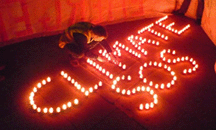 Beneath the virus lurks a bigger emergency, but the world is distracted from the climate threat, SMH, Bob Carr 2 Apr 20, What did our battered old planet do to bring this run of wretchedly bad luck? Just before the 2008 Wall Street disaster, Washington was about to force emitters to pay for the privilege of dumping carbon waste in the upper atmosphere. Congress approved a cap and trade scheme so its economy could trade its way to a low carbon future. In a similar spirit the Rudd government was legislating its own carbon trading model. Beneath the virus lurks a bigger emergency, but the world is distracted from the climate threat, SMH, Bob Carr 2 Apr 20, What did our battered old planet do to bring this run of wretchedly bad luck? Just before the 2008 Wall Street disaster, Washington was about to force emitters to pay for the privilege of dumping carbon waste in the upper atmosphere. Congress approved a cap and trade scheme so its economy could trade its way to a low carbon future. In a similar spirit the Rudd government was legislating its own carbon trading model.
Then the financial crisis knocked everyone sideways. The carbon lobby in both countries was able to talk job losses and higher taxes. The propaganda was a pushover. Legislation died in the US and Australian senates. And the world kept warming.
Last month the temperature on the Antarctic peninsular hit 65 degrees Fahrenheit, beating all previous records. For the globe, 2019 was the second hottest year on record, and the hottest without the contribution of a big El Nino. The coming decade may be our last chance to contain the chaos driven by humankind’s craziest experiment: the idea that carbon can be stored in the thin filigree of air around the planet. The Paris Agreement provides a road map and the falling price of renewables a market impulse. …. In the middle of the coronavirus crisis, The Sydney Morning Herald and The Age, to their credit, still find space to record the conclusion of leading reef scientist, Terry Hughes, that there is a third major bleaching of the Great Barrier Reef now under way. This follows the bleachings of 2016 and 2017. This is every bit a climate event as were the mega fires over Christmas. Yet the irrevocable loss of healthy coral may not galvanise the way fires did….. Meanwhile, the pandemic emergency may kill off the Glasgow conference on climate planned for November. The UN event is aimed at averting runaway climate change by keeping the temperature rise to 1.5 degrees. …… if the breaking up of permafrost in the Arctic circle assumes an extra ferocity. That would release plumes of methane, 30 times more lethal at trapping heat than carbon, but on a scale to blow apart every calibration of how fast climate is shifting. For Australia, Black Swan climate events could include a cyclone beyond what we have seen before, hitting the Queensland coast. Experts say there is still enough unburnt bush to give us a fire season as bad as the last, even next season – if we suffer the same malevolent mix of heat, low humidity and strong wind…… Beneath news of virus and slump there simmers an even bigger story. The planet keeps warming. And there’s no guarantee the rate may not pick up alarmingly. ……https://www.smh.com.au/environment/climate-change/beneath-the-virus-lurks-a-bigger-emergency-but-the-world-is-distracted-from-the-climate-threat-20200328-p54et4.html |
|
Big swings to the Greens in Brisbane wards elections
Cr Sri said the shutdown of ordinary life due to the coronavirus pandemic meant the Greens could no longer doorknock, their most effective campaign strategy, and had to rely on telephoning prospective voters instead. …. https://www.brisbanetimes.com.au/national/queensland/greens-celebrate-record-swings-in-brisbane-wards-20200330-p54fbb.html
Nuclear front group Energy Policy Institute joins with NuScam to promote Small Nuclear Reactors to Australia

A top Trump administration official has urged Australia to join the US in researching and building small “modular” nuclear reactors.Suzanne Jaworowski, chief of staff and senior adviser at the US Department of Energy, said about 45 companies in the US were working on small modular reactors and one could be built in Australia by the mid-2020s
“You could have up to 12 reactor modules each producing 60MW, even more reliably than coal and gas,” she told The Weekend Australian, recommending business and government work with NuScale Power, which is building an SMR in Idaho.
“They are at a point where they could work with a country like Australia,” she said.
Australia’s prohibition on nuclear energy, in force since the late 1990s, was “unfortunate”, she said. The growing push for zero emissions by mid-century could only be achieved with nuclear power, on current technology……
A federal inquiry into nuclear power suggested a partial reversal of the 1998 legislative ban on nuclear energy late last year. In NSW, state One Nation leader Mark Latham and state Nationals leader John Barilaro are pushing to dump a similar state ban.
Ms Jaworowski, who had to cancel a planned trip to Australia this year because of the coronavirus, said nuclear energy faced a “perception problem”. …… Ms Jaworowski said nuclear energy in the US could be supplied from small modular reactors at about $55 a MwH, “which is very competitive with other forms of energy”.
Liddell coal power station in NSW, with 2000MW capacity, is scheduled to close in 2023. The federal government, which has said lifting the nuclear ban would require bipartisan support, is putting together a “technology road map” to ensure large cuts in carbon emissions by 2050.
Ms Jaworowski said nuclear energy in the US could be supplied from small modular reactors at about $55 a MwH, “which is very competitive with other forms of energy”.
The Energy Policy Institute said the US, Russia and China were in a three-way contest to dominate the global nuclear generation market with SMRs. “The nuclear competition will be good for Australia because we need greater energy security than we’ve got at present,” institute executive director Robert Pritchard said. https://www.theaustralian.com.au/world/us-urges-australia-to-consider-nuclear/news-story/f555996beccc347f6b57bb9d1c126f77
1 This month


Help Aunty Sue Protect Her Land and Sacred Sites From Destructive Rocket Testing.
.

Australians deserve the truth
about
AUKUS – https://aukuspublicinquiry.com/

PETITION – To: Prime Minister Anthony Albanese and the Australian Labor Government

of the week – Australians for War Powers Reform (AWPR)
To see nuclear-related stories in greater depth and intensity

