Greens Senator Hanson-Young calls for Senate Nuclear Waste Inquiry to meet in Whyalla, South Australia
 Nuclear bill referred to inquiry https://www.whyallanewsonline.com.au/story/6653019/nuclear-bill-referred-to-inquiry/?cs=1550&fbclid=IwAR3AvrninZlnLmX8r79QDkQopkBb5hXoWhguw106lCyiisCDdmWMy714MPM, Louis Mayfield 27 Feb 20, Nuclear bill referred to inquiry https://www.whyallanewsonline.com.au/story/6653019/nuclear-bill-referred-to-inquiry/?cs=1550&fbclid=IwAR3AvrninZlnLmX8r79QDkQopkBb5hXoWhguw106lCyiisCDdmWMy714MPM, Louis Mayfield 27 Feb 20,
The formal process for the federal government’s push for a nuclear waste dump in Kimba will be put under the microscope by the Senate Economics Committee, with a Greens Senator calling for hearing in Whyalla. On Thursday the Greens announced they would be referring the government’s legislation for the Nuclear Radioactive Waste Management Facility to a Senate Inquiry for ‘scrutiny of the laws and the process that led to this point’. South Australian Greens Senator Sarah Hanson-Young requested that the committee organise a public hearing in Whyalla and a visit to the federal government’s chosen site for the facility at Napandee.
“I have requested a hearing in Whyalla because it shouldn’t be left to the suits in Canberra to decide, anything less would be offensive to the communities involved,” she said. Senator Hanson-Young also claimed the site selection for the facility had been ‘dodgy from the start’.
“It’s ripped small communities apart and Traditional Owners have vehemently objected to the proposal,” she said. “It’s clear there isn’t broad community support for a nuclear waste dump in Kimba, despite what former Minister Matt Canavan would have everyone believe.”
“Port Augusta, Whyalla, Port Pirie and Port Lincoln and every town living along potential transportation route, should have been consulted and given an opportunity to have their say,” she said. “The Greens aren’t leaving it to the community of Kimba to hold the line on their own. A Senate Inquiry will give the entire proposal the scrutiny it needs.” The committee has resolved to report on the legislation in June, submissions to the committee are now open and will close at the end of March. |
|

THE AUSTRALIAN newspaper joins in right-wing media reactions and conspiracy theories surrounding coronavirus
- The Australian, a national newspaper part of Rupert Murdoch’s News Corp., published an anti-trans article on February 9 that compared coronavirus to a “global epidemic” of transgender teens. The outlet has a history of anti-trans reporting and spreading misinformation about trans youth.
A guide to right-wing media reactions and conspiracy theories surrounding coronavirus, MEDIA MATTERS BY KAYLA GOGARTY & COURTNEY HAGLE RESEARCH CONTRIBUTIONS FROM NOOR AL-SIBAI, ALEX KAPLAN, NIKKI MCCANN RAMIREZ & MADELINE PELTZ 02/28/20
-
As the lethal outbreak of coronavirus continues to spread around the world and the U.S. government warns that it will almost certainly also spread within the United States, right-wing media outlets and online accounts are spreading misinformation and conspiracy theories which could have deadly consequences.
The strain of novel coronavirus known as COVID-19 is a respiratory disease that was first detected in the city of Wuhan, China. It swiftly spread and has now been detected in 53 countries, including the United States. So far, the outbreak has led to nearly 3,000 deaths and more than 82,000 cases worldwide, according to The New York Times.
The Centers for Disease Control and Prevention describes the disease behind the current outbreak as part of “a large family of viruses that are common in many different species of animals, including camels, cattle, cats, and bats.” The CDC adds that “rarely, animal coronaviruses can infect people and then spread between people.” Earlier patients in the COVID-19 outbreak appeared to have a link to seafood and animal products, but the virus has since been shown to spread person-to-person.
On January 30, the International Health Regulations Emergency Committee of the World Health Organization declared the outbreak a “public health emergency of international concern,” and on January 31, Health and Human Services Secretary Alex Azar declared a public health emergency in the United States.
As the impact of coronavirus continued to be reported, concerns began to arise that it was driving xenophobic attacks toward people of Asian descent. In New York City, a man assaulted a woman wearing a face mask while calling her a “diseased b****.” On a Los Angeles subway, one man declared that “every disease has ever came from China.” In another incident, a Costco worker in Washington state told an 8-year-old child to “get away” because she believed he may be “from China.” Across the country, there has been an uptick in physical and verbal attacks toward Asian Americans.
In addition to xenophobic sentiments, conspiracy theories and agenda-driven narratives began to arise on the internet and throughout right-wing media, adding more panic and confusion to an already chaotic situation. These conspiracy theories include claims that the Chinese government created coronavirus at a lab in Wuhan; that the United States is using the virus to attack and undermine China from within; and that coronavirus was previously created and patented by former Microsoft CEO Bill Gates.
The virus has also triggered anti-Semitic sentiments, medical and scientific disinformation, and fearmongering from the religious right about the end of the world. In the United States, President Donald Trump and his allies in right-wing media have also absurdly argued that Democrats and the media are politicizing coronavirus for their own gain to make him look bad and cause panic in the stock market, which has plunged in reaction to the potential pandemic. Continue reading
#ScottyFromMarketing a ‘predatory’ centrist on climate policy with no plans for meaningful emissions reduction
 Wayne Swan Morrison a ‘predatory’ centrist on climate policy with no plans for meaningful emissions reduction, says Swan Wayne Swan Morrison a ‘predatory’ centrist on climate policy with no plans for meaningful emissions reduction, says SwanLabor president says party must work against PM’s PR strategy and get on with ‘solving the bloody problem’, Katharine Murphy Political editor, Sun 1 Mar 2020
Labor federal president Wayne Swan says Morrison does not have a serious climate policy ‘but as you would expect from a marketing guy, [he has] a clearly articulated PR strategy to use climate as a wedge. Labor’s federal president Wayne Swan will accuse Scott Morrison of engaging in “predatory centrism” on climate policy by styling himself as the pragmatist between the extremes of climate emergencies and denialism, when the government has no intention of driving meaningful emissions reduction. In a speech to be delivered on Sunday, Swan will argue Labor will only win the decade-long climate wars if it approaches the challenge with “pragmatic policy and ruthless organisation”. According to speech notes, Swan will say Labor needs to articulate a roadmap for the domestic coal powered industry “which manages its decline”……. https://www.theguardian.com/world/2020/mar/01/morrison-a-predatory-centrist-on-climate-policy-with-no-plans-for-meaningful-emissions-reduction-says-swan |
|
Global heating, rising seas, and the plight of Torres Strait Islanders
It’s our right to be here’: the Torres Strait Islanders fighting to save their homes from a rising sea
An entire way of life is under threat in the Torres Strait, where locals have taken their case to the United Nations, Guardian Jack Banister, 1 Mar 20
Kabay Tamu slows his dusty white ute to walking speed on the dirt road that runs along the south-western shoreline of Warraber, a tiny coral cay in the Torres Strait that is home to about 250 people.
“This was the best spot for a day out,” 28-year-old Tamu says, recalling his childhood.
Most of the beach where Tamu used to play is gone, along with several enormous wongai trees that were a barrier of sorts, protecting the dirt road and the nearby dam, which supplies the island’s drinking water, from the sea.
Warraber is just 1.4km long, and half as wide, but shrinking fast. Some data suggests that sea levels in the Torres Strait could be rising at twice the global rate.
Now, Islanders dump their green waste to hold back the rising sea. The Intergovernmental Panel on Climate Change (IPCC) estimates that by 2100 tides will rise 30–60cm with immediate cuts to carbon emissions, and 61-110cm without…….
The Billy family also live on nearby Poruma island, where Danny spent part of his childhood. Just a 15-minute flight away, Poruma is smaller and thinner. On the western shore, a road and buildings are threatened, and 250 coconut trees – a source of food, shelter and leaves used in traditional ceremonies – have already been washed away.
Local man Phillemon Mosby feels that loss keenly. The picturesque plantation should be a place to share with children and grandchildren, who would ordinarily take over the nurturing of the site.
“That experience was taken away because of climate change, because of the rising sea levels. We’ve seen areas where we used to go fishing that are no longer there. We’ve seen rocks where people used to go diving that are covered.”…….
Tamu, Billy, and Uncle Frank’s cousin, Nazareth Fauid, are among the eight Torres Strait Islanders who lodged a complaint last May with the United Nations human rights committee against the Australian government, alleging that its failure to reduce emissions, or pursue proper adaptation measures across the region impedes their human rights, to culture and life.
Sophie Marjanac, a lawyer with environmental non-profit ClientEarth, is representing the group, who want the government to meet its targets under the Paris Agreement, to reach net zero emissions by 2050 and to phase out thermal coal.
In December, the federal government matched an earlier commitment of $20 million from the Queensland governmentto build new seawalls. But there is widespread scepticism among Islanders about when the new walls will be constructed.
Other islands including Boigu, Masig, and Iama need new seawalls. It is unclear which islands will be prioritised, and if the new funding will cover them all.
Tamu is quick to point out that “sea walls are only to buy us time” – the best fix is emissions reduction.
“The thing that got me was [the federal government] didn’t announce [the new funding] as seawalls to combat climate change. They said it was ‘an infrastructure development in the community’. They’re still trying to cover up climate change and the rising sea levels here.”
Tamu gained international headlines when he asked prime minister Scott Morrison to visit Warraber during the UN climate summit in New York last September. He maintains that the damage visible on Warraber and other islands would shock them into action on climate and coal…….
The invitation was rejected via email in November, and Tamu says that the government is still “hearing, but not listening” when it comes to nationwide pleas for climate action. ……
While the UN complaint won’t be settled until 2021, Danny Billy says islanders won’t stop making noise until Australia finally offers global leadership on climate change…https://www.theguardian.com/australia-news/2020/mar/01/its-our-right-to-be-here-the-torres-strait-islanders-fighting-to-save-their-homes-from-a-rising-sea
Darebin Council, Melbourne – a world first on Climate Emergency
 This Melbourne council declared the world’s first climate emergency – now 28 countries are on board, Local and national governments in 28 countries have declared climate emergencies since Melbourne’s Darebin Council in 2016. Many now hope after this summer’s bushfires, Australia may declare a national emergency. SBS, BY EVAN YOUNG 1 Mar 20, On 5 December 2016, Melbourne’s Darebin Council made history.
Councillor Trent McCarthy put forward a motion that the council vote on declaring a state of climate emergency.
Though it would be merely symbolic, it was thought a declaration could still have practical use.
“Before the vote, residents were very much telling us climate change mattered more than anything else to them,” Darebin Mayor Susan Rennie told SBS News……..
Since 2016, Ms Rennie said Darebin Council has begun work on a number of green initiatives, including programs to subsidise solar panels for residents and businesses, working to make all council operations carbon-neutral, introducing a food waste recycling program and resurfacing roads with recycled material.
Making the declaration in 2016 “set the council on a path” to develop a climate plan, she said.
“Staff in all different parts of the organisation understand that looking at their work through the lens of a climate emergency is critical and it’s a core part of their jobs.”
“Our community expects action … so we also invite them to be much more vocal in what responses they want to see.”……
Where have climate emergencies been declared?
Ninety-four Australian jurisdictions have declared a climate emergency, according to Climate Emergency Declaration and Mobilisation in Action (CEDMA).
The ACT parliament declared a climate emergency in May 2019, becoming the first Australian state or territory to do so, while South Australia’s Upper House followed suit four months later.
More than 800 million citizens across 28 countries are estimated to live in jurisdictions that have declared climate emergencies, according to CEDMA.
Britain, France, Portugal and Argentina are among the national governments to make climate emergency declarations.
Pope Francis also made a declaration in June 2019, while in November, more than 11,000 scientists around the world signed a scientific paper stating that the planet was facing a climate emergency, “clearly and unequivocally”.
Could Australia declare a national climate emergency?
In October 2019, an e-petition calling on the federal government to declare a national climate emergency reached a record-breaking 404,538 signatures.
It received more than three times the number of signatures on a petition which held the previous record, calling for the removal of GST on menstrual products.
The same month, Greens MP Adam Bandt brought a vote to the House of Representatives on whether to declare a national climate emergency. His motion was defeated 72-65, with Emissions Reduction Minister Angus Taylor labelling it a “grand symbolic gesture”…….HTTPS://WWW.SBS.COM.AU/NEWS/THIS-MELBOURNE-COUNCIL-DECLARED-THE-WORLD-S-FIRST-CLIMATE-EMERGENCY-NOW-28-COUNTRIES-ARE-ON-BOARD
Keeping Australia nuclear-free: national campaign meeting in Melbourne
 29 February, Melbourne. Anti nuclear campaigners from South Australia, Western Australia, Queensland, New South Wales, Northern Territory and Victoria met today, to discuss the progress of the movement. The Australian Conservation Foundation and Friends of the Earth were prominently represented, among other environmentalists, and representatives from indigenous groups, churches, human rights, and medical organisations.
There was an atmosphere of quiet optimism. The Federal Government, in its Inquiry into nuclear power, has concluded that conventional nuclear reactors are definitely not an option for Australia. Due to their escalating costs, and long delay in building, they are recognised now as a failed technology.
Another encouraging factor for the nuclear-free movement is the fact that Western Australian uranium projects at Kintyre and Yeelirrie are at a standstill, with little likelihood of going ahead.
The federal government’s plan for a radioactive waste facility at Napandee, South Australia faces hurdles, with its plan for dual facilities . Low level waste burial and above-ground temporary storage of intermediate level wastes do not meet standards for international best practice.
Participants returned to their home States with renewed confidence in their work of informing and encouraging local communities in seeking a clean, nuclear-free environment.
In Victoria the goal of the nuclear lobby is to remove Victoria’s Nuclear Activities (Prohibitions) Act
Nuclear lobby takes aim at Victoria to tackle prohibitions, Michael West Media, by Noel Wauchope | Feb 26, 2020 Having dithered on real action to tackle global warming, some in the Coalition are now taking a keen interest in solving it — by going nuclear. Noel Wauchope investigates what’s behind the sudden push to overturn legislation prohibiting the exploration and mining of thorium and uranium and puts a definitive case against a nuclear industry in Australia.
A batch of Coalition MP’s are pushing nuclear power as Australia’s answer to climate change. The group includes Katie Allen inner-city Melbourne Liberal, Ted O’Brien, Queensland LNP, Trent Zimmerman, North Sydney Liberal, Bridget Archer Tasmanian Liberal, David Gillespie Nationals NSW, Rick Wilson West Australian Liberal, and Keith Pitt, LNP from North Queensland, who was this week promoted to cabinet as Resources Minister. Former deputy prime minister and Nationals leader, Barnaby Joyce, is also a staunch proponent of nuclear power.
Arguing that nuclear power is the answer to bushfires and a heating climate when these are conversely nuclear’s greatest threat is akin to an argument by the Mad Hatter and the March Hare. The US National Academies Press compiled a lengthy and comprehensive report on risks of transporting nuclear wastes. They concluded that among various risks, the most serious and significant is fire. And indeed, climate change, in general, carries serious threats to nuclear reactors and the entire nuclear fuel chain.
But any port in a storm when you’re trying to sell a product that is expensive, unpopular, illegal in Australia and has the problem of long-lasting toxic wastes.
The Australian public’s renewed enthusiasm for action on climate change was timely. The nuclear lobby had, coincidentally already geared itself up for a campaign to overturn Australia’s State and Federal nuclear prohibition laws. The current Victorian inquiry is the latest in a spate of Parliamentary Inquiries aimed at removing these laws. Submissions are due by this Friday, 28 February.
The Inquiry’s Terms of Reference (TOR) are narrow:……..
It is clear the goal is to remove Victoria’s Nuclear Activities (Prohibitions) Act 1983. The very first TOR makes the mining of uranium and thorium as the prime concern. Given Victoria could run a nuclear power station with uranium/thorium sourced from elsewhere, it is clear that, after years of pressure by thorium lobbyists, the underlying goal of this inquiry is to overturn the legislation prohibiting the exploration and mining of thorium and uranium in Victoria.
The Victorian legislation was brought in to protect this State’s precious agricultural land and iconic ocean coast from polluting mining industries. South Gippsland is particularly rich in thorium.
Nuclear lobby tries to water down Victorian prohibition
The Terms of Reference are overtly biased: with no qualification, they promote the nuclear industry as undoubtedly beneficial to Victoria. This is ludicrous, as the global nuclear industry is in a state of decline.
Meanwhile, the renewable energy technologies of wind, solar and storage are now recognised by CSIRO and the Australian Energy Market Operator as, by far, the cheapest form of low carbon options for Australia, and are likely to dominate the global energy mix in coming decades
This first Term of Reference assumes that the “exploration and production” will result in nuclear power plants for Victoria, otherwise why do it? It also assumes that nuclear power will be effective in lowering C02 emissions.
However, there is no point in this “exploration and production” as it has been repeatedly demonstrated that nuclear power is no solution to climate change as in Dr. Paul Dorfman et al’s response to James Hansen on 20 December 2019 in the Financial Times.…….
The Terms of Reference are overtly biased: with no qualification, they promote the nuclear industry as undoubtedly beneficial to Victoria. This is ludicrous, as the global nuclear industry is in a state of decline.
Meanwhile, the renewable energy technologies of wind, solar and storage are now recognised by CSIRO and the Australian Energy Market Operator as, by far, the cheapest form of low carbon options for Australia, and are likely to dominate the global energy mix in coming decades
This first Term of Reference assumes that the “exploration and production” will result in nuclear power plants for Victoria, otherwise why do it? It also assumes that nuclear power will be effective in lowering C02 emissions.
However, there is no point in this “exploration and production” as it has been repeatedly demonstrated that nuclear power is no solution to climate change as in Dr. Paul Dorfman et al’s response to James Hansen on 20 December 2019 in the Financial Times.……… .https://www.michaelwest.com.au/nuclear-lobby-takes-aim-at-victoria-to-tackle-prohibitions/
Legislation banning nuclear power in Australia should be retained
| Jim Green, Online Opinion, 27 Feb 2020, https://onlineopinion.com.au/view.asp?article=20758&page=0
Nuclear power in Australia is prohibited under the Environmental Protection and Biodiversity Conservation (EPBC) Act 1999. A review of the EPBC Act is underway and there is a strong push from the nuclear industry to remove the bans. However, federal and state laws banning nuclear power have served Australia well and should be retained.
There are many other examples of shocking nuclear costs and cost overruns, including: * The cost of the two reactors under construction in the US state of Georgia has doubled and now stands at A$20.4‒22.6 billion per reactor. * The cost of the only reactor under construction in France has nearly quadrupled and now stands at A$20.0 billion. It is 10 years behind schedule. * The cost of the only reactor under construction in Finland has nearly quadrupled and now stands at A$17.7 billion. It is 10 years behind schedule. * The cost of the four reactors under construction in the United Arab Emirates has increased from A$7.5 billion per reactor to A$10‒12 billion per reactor. * In the UK, the estimated cost of the only two reactors under construction is A$25.9 billion per reactor. A decade ago, the estimated cost was almost seven times lower. The UK National Audit Office estimates that taxpayer subsidies for the project will amount to A$58 billion, despite earlier government promises that no taxpayer subsidies would be made available. Nuclear power has clearly priced itself out of the market and will certainly decline over the coming decades. Indeed the nuclear industry is in crisis ‒ as industry insiders and lobbyists freely acknowledge. Westinghouse ‒ the most experienced reactor builder in the world ‒ filed for bankruptcy in 2017 as a result of catastrophic cost overruns on reactor projects. A growing number of countries are phasing out nuclear power, including Germany, Switzerland, Spain, Belgium, Taiwan and South Korea. Rising power bills: Laws banning nuclear power should be retained because nuclear power could not possibly pass any reasonable economic test. Nuclear power clearly fails the two economic tests set by Prime Minister Scott Morrison. Firstly, nuclear power could not possibly be introduced or maintained without huge taxpayer subsidies. Secondly, nuclear power would undoubtedly result in higher electricity prices.
Former US Vice President Al Gore summarised the proliferation problem: “For eight years in Too slow: Expanding nuclear power is impractical as a short-term response to climate change. An analysis by Australian economist Prof. John Quiggin concludes that it would be “virtually impossible” to get a nuclear power reactor operating in Australia before 2040. More time would elapse before nuclear power has generated as much as energy as was expended in the construction of the reactor: a University of Sydney report concluded that the energy payback time for nuclear reactors is 6.5‒7 years. Taking into account planning and approvals, construction, and the energy payback time, it would be a quarter of a century or more before nuclear power could even begin to reduce greenhouse emissions in Australia (and then only assuming that nuclear power displaced fossil fuels).
Water consumption of different energy sources (litres / kWh): * Nuclear 2.5 * Coal 1.9 * Combined Cycle Gas 0.95 * Solar PV 0.11 * Wind 0.004 Climate change and nuclear hazards: Nuclear power plants are vulnerable to threats which are being exacerbated by climate change. These include dwindling and warming water sources, sea-level rise, storm damage, drought, and jelly-fish swarms. Nuclear engineer David Lochbaum states. “I’ve heard many nuclear proponents say that nuclear power is part of the solution to global warming. It needs to be reversed: You need to solve global warming for nuclear plants to survive.”
By contrast, the REN21 Renewables 2015: Global Status Report states that renewable energy systems “have unique qualities that make them suitable both for reinforcing the resilience of the wider energy infrastructure and for ensuring the provision of energy services under changing climatic conditions.”
To give one example (among many), the National Radioactive Waste Management Act dispossesses and disempowers Traditional Owners in many respects: the nomination of a site for a radioactive waste dump is valid even if Aboriginal owners were not consulted and did not give consent; the Act has sections which nullify State or Territory laws that protect archaeological or heritage values, including those which relate to Indigenous traditions; the Act curtails the application of Commonwealth laws including the Aboriginal and Torres Strait Islander Heritage Protection Act 1984 and the Native Title Act 1993 in the important site-selection stage; and the Native Title Act 1993 is expressly overridden in relation to land acquisition for a radioactive waste dump. No social license: Laws banning nuclear power should be retained because there is no social license to introduce nuclear power to Australia. Opinion polls find that Australians are overwhelmingly opposed to a nuclear power reactor being built in their local vicinity (10‒28% support, 55‒73% opposition); and opinion polls find that support for renewable energy sources far exceeds support for nuclear power (for example a 2015 IPSOS poll found 72‒87% support for solar and wind power but just 26% support for nuclear power). As the Clean Energy Council noted in its submission to the 2019 federal nuclear inquiry, it would require “a minor miracle” to win community support for nuclear power in Australia. The pursuit of nuclear power would also require bipartisan political consensus at state and federal levels for several decades. Good luck with that. Currently, there is a bipartisan consensus at the federal level to retain the legal ban. The noisy, ultra-conservative rump of the Coalition is lobbying for nuclear power but their push has been rejected by, amongst others, the federal Liberal Party leadership, the Queensland Liberal-National Party, the SA Liberal government, the Tasmanian Liberal government, the NSW Liberal Premier and environment minister, and even ultra-conservatives such as Nationals Senator Matt Canavan.
Australia can do better than fuel higher carbon emissions and unnecessary radioactive risk. We need to embrace the fastest growing global energy sector and become a driver of clean energy thinking and technology and a world leader in renewable energy technology. We can grow the jobs of the future here today. This will provide a just transition for energy sector workers, their families and communities and the certainty to ensure vibrant regional economies and secure sustainable and skilled jobs into the future. Renewable energy is affordable, low risk, clean and popular. Nuclear is not. Our shared energy future is renewable, not radioactive. More Information * Don’t Nuke the Climate Australia, www.dont-nuke-the-climate.org.au * Climate Council, 2019, ‘Nuclear Power Stations are Not Appropriate for Australia – and Probably Never Will Be’, https://www.climatecouncil.org.au/nuclear-power-stations-are-not-appropriate-for-australia-and-probably-never-will-be/ * WISE Nuclear Monitor, 25 June 2016, ‘Nuclear power: No solution to climate change’, https://www.wiseinternational.org/nuclear-monitor/806/nuclear-power-no-solution-climate-change Dr. Jim Green is the national nuclear campaigner with Friends of the Earth Australia. |

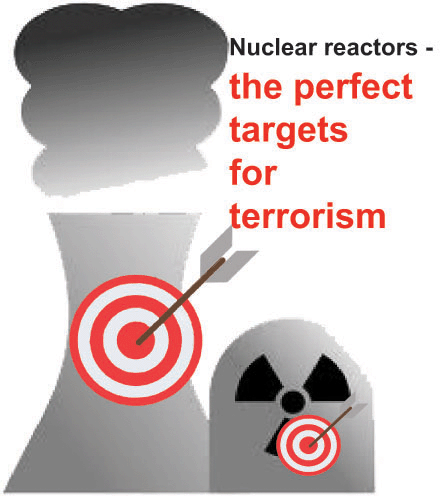


Nuclear power, climate change and water use
 Nuclear lobby takes aim at Victoria to tackle prohibitions, Michael West Media, by Noel Wauchope | Feb 26, 2020 “…………Nuclear power is vulnerable to climate change. Increasing temperatures can result in reduced nuclear reactor efficiency by directly impacting nuclear equipment. It is uniquely vulnerable to increasing temperatures because of its reliance on cooling water to ensure operational safety within the core and spent fuel storage. As the most water-intensive energy generation technology, nuclear reactors are located near a river or the ocean to accommodate hefty water usage, which averages between 1,101 gallons per megawatt of electricity produced to 44,350 gal/MWh depending on the cooling technology.
Inland reactors that use rivers as a source for cooling water are the most at risk during heat waves, which according to the Intergovernmental Panel on Climate Change (IPCC) are “very likely” to occur more often and last longer in the coming decades.
In view of Australia’s growing bushfire threats, the introduction of nuclear power technology of any type is questionable. The safety of the Lucas Heights nuclear reactor was cause for concern when bushfires occurred in its vicinity. The transport of nuclear wastes would also be threatened by bushfires .
Whilst the operation of nuclear reactors themselves release few greenhouse emissions, nuclear power plants require huge amounts of water to prevent fission products in the core and spent nuclear fuel from overheating. Nuclear is the most water intensive energy source in terms of consumption and withdrawal per unit of energy delivered. Unlike thermal power plants, solar and wind power can help alleviate water stress……https://www.michaelwest.com.au/nuclear-lobby-takes-aim-at-victoria-to-tackle-prohibitions/
Barngarla Aboriginal Corporation lobby Senators- to oppose Bill to set up Kimba nuclear waste dump
|
Native title holders will travel to Canberra to lobby senators against the dump, saying they were excluded from community vote on the facility, Guardian, Sarah Martin Chief political correspondent @msmarto, Wed 26 Feb 2020 03.30 The government is pushing ahead with the legislation, despite the ballot being challenged in the federal court by the Barngarla native title holders, who were excluded from the vote because they are not ratepayers. Jason Bilney, chairman of the Barngarla Determination Aboriginal Corporation, said the 200 local native title holders were excluded from the Kimba community ballot despite repeated requests to both the council and the federal government to be included. The corporation is challenging the ballot in the federal court, claiming their exclusion is a breach of the racial discrimination act. The full court of the federal court heard the matter last Friday. “It is a simple truth that had we, as the first people for the area, been included in the Kimba community ballot rather than unfairly denied the right to vote, then the community ballot would never have returned a yes vote,” Bilney told Guardian Australia ahead of a visit to Canberra next month. “Many of our people were born in Kimba, and we have significant native title land near the proposed facility. This native title land allows us to live on and use the land. However, because it is not rateable, we were excluded from the Kimba community ballot on a technicality,” he said. The Barngarla claim the Coalition’s bill has been introduced to make it impossible to challenge the decision to locate a facility at Kimba, even if the court appeal is successful, effectively removing the protections of the Race Discrimination Act. “These amendments would entirely remove any court oversight, right in the middle of existing federal court proceedings. This would entirely deprive any protections for our people,” Bilney said. The group is expected to meet with crossbench senators in Canberra in the current session of parliament, explaining their concerns about the ballot process and pushing for the legislation to be blocked. Centre Alliance has already expressed reservations about supporting the legislation, saying Canavan had not been upfront about what constituted “broad community support” before the results of the ballot were known. “No one goes into a vote without understanding what the pass criteria is,” SA senator Rex Patrick told Guardian Australia. “I support the need for a national facility, but it should only be located where there is broad community support.” Labor discussed the party’s position regarding the legislation in a caucus meeting on Tuesday, with MPs resolving to wait until the bill had been considered by the senate economics committee and until the federal court decision had been handed down. A final decision will then be considered by the shadow cabinet and caucus and will also go through the First Nations caucus committee. Labor’s shadow industry minister, Brendan O’Connor, is expected to outline the party’s concerns when debate gets under way in the House of Representatives on Wednesday, but told MPs that there was a need for Australia to establish a national radioactive waste management facility. ….. https://www.theguardian.com/australia-news/2020/feb/26/south-australia-nuclear-waste-dump-could-face-roadblock-in-senate
|
|

How would nuclear benefit Victoria?
|
Nuclear lobby takes aim at Victoria to tackle prohibitions, Michael West Media, by Noel Wauchope | Feb 26, 2020 “…………..The Terms if Reference ask for the “economic, environmental, and social benefits to Victoria.” Victoria is moving towards a renewable energy revolution, with a significant uptake of renewable technology by the State Government. Victoria has set a renewable energy target of 50% by 2030 and Melbourne’s iconic tram network is to be powered by solar energy. The Norwegian Radiation Protection Authority (NRPA) revealed that thorium-based nuclear energy plants – once vaunted as a clean alternative type of nuclear energy – is not an environmentally safe alternative. Thorium leads to highly radioactive nuclear waste. Consequently, the risk of accidents will always be present the report said. Uranium mining has widespread effects, contaminating the environment with radioactive dust, radon gas, water-borne toxins, and increased levels of background radiation. As to the “social benefits”, the introduction of any part of the nuclear fuel chain into Victoria would particularly impact rural Victorians. The effect on tourism and farming industries has not yet been adequatley analysed, whereas solar and wind technologies can be developed alongside agriculture and tourism. Economist John Quiggin told Michael West Media last week that he’d support the removal of Australia’s ban in exchange for the establishment of a carbon price. Quiggin believes that this would put the nuclear proponents on the spot and open up the subject of the poor economics of the nuclear industry. You can read Quiggin’s submission here. This Victorian Parliamentary Inquiry may not succeed in promoting the thorium or the pro nuclear cause. However, it is part of what looks to be a co-ordinated national attack on nuclear prohibition laws. The mainstream media, particularly the Murdoch press, seems to toe the nuclear industry line that the way to fix global warming is to go nuclear. This Victorian Parliamentary Inquiry may not succeed in promoting the thorium or the pro nuclear cause. However, it is part of what looks to be a co-ordinated national attack on nuclear prohibition laws. The mainstream media, particularly the Murdoch press, seems to toe the nuclear industry line that the way to fix global warming is to go nuclear. Nuclear power is not supported by either Labor or the Greens.https://www.michaelwest.com.au/nuclear-lobby-takes-aim-at-victoria-to-tackle-prohibitions/ |
|
Bridgat McKenzie fires up for nuclear
McKenzie fires up for nuclear THE AUSTRALIAN 26 Feb 20 Former Nationals deputy leader Bridget McKenzie has thrown her support behind nuclear and hydrogen energy….(subscribers only)
Australia could soon export sunshine to Asia via a 3,800km cable
|
It might sound ‘batshit insane’ but Australia could soon export sunshine to Asia via a 3,800km cable , The Conversation , 26 Feb 20, John Mathews, Professor of Strategic Management, Macquarie Graduate School of Management, Macquarie University. Elizabeth Thurbon, Scientia Fellow and Associate Professor in International Relations / International Political Economy, UNSW. Hao Tan, Associate professor, University of Newcastle, Sung-Young Kim, Senior Lecturer in the Department of Modern History, Politics & International Relations, Macquarie University
Australia is the world’s third largest fossil fuels exporter – a fact that generates intense debate as climate change intensifies. While the economy is heavily reliant on coal and gas export revenues, these fuels create substantial greenhouse gas emissions when burned overseas.Australia doesn’t currently export renewable energy. But an ambitious new solar project is poised to change that.
The proposed Sun Cable project envisions a ten gigawatt capacity solar farm (with about 22 gigawatt-hours of battery storage) laid out across 15,000 hectares near Tennant Creek, in the Northern Territory. Power generated will supply Darwin and be exported to Singapore via a 3,800km cable slung across the seafloor. Sun Cable, and similar projects in the pipeline, would tap into the country’s vast renewable energy resources. They promise to provide an alternative to the export business of coal, iron ore and gas.
To export renewable energy overseas, a high-voltage (HV) direct current (DC) cable would link the Northern Territory to Singapore. Around the world, some HVDC cables already carry power across long distances. One ultra-high-voltage direct current cable connects central China to eastern seaboard cities such as Shanghai. Shorter HVDC grid interconnectors operate in Europe. The fact that long distance HVDC cable transmission has already proven feasible is a point working in Sun Cable’s favour. The cost of generating solar power is also falling dramatically. And the low marginal cost (cost of producing one unit) of generating and transporting renewable power offers further advantage.
The A$20 billion-plus proposal’s biggest financial hurdle was covering initial capital costs. In November last year, billionaire Australian investors Mike Cannon-Brookes and Andrew “Twiggy” Forrest provided initial funding to the tune of up to A$50 million. Cannon-Brookes said while Sun Cable seemed like a “completely batshit insane project”, it appeared achievable from an engineering perspective. Sun Cable is expected to be completed in 2027. Bringing in businessThe proposal would also bring business to local high-technology companies. …….. https://theconversation.com/it-might-sound-batshit-insane-but-australia-could-soon-export-sunshine-to-asia-via-a-3-800km-cable-127612
February 26, 2020
|
|
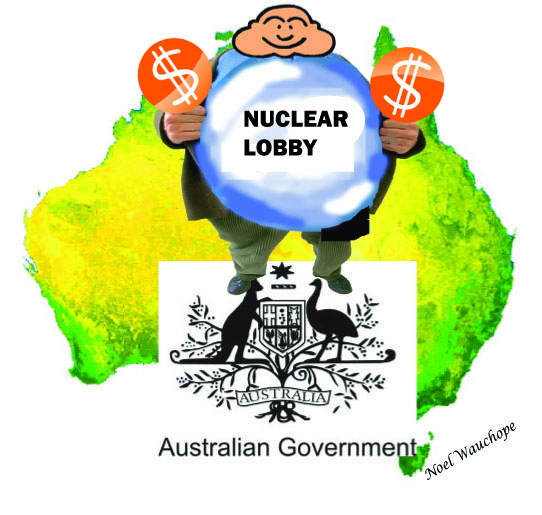
Kimba nuclear waste dump – a total mishandling of the truth from Australian government.
|
IN DAILY – YOUR VIEWS – 25TH FEBRUARY 2020 Fight To Stop Nuclear Waste In The Flinders Ranges
 Leon Ashton, When will the Federal Government finally acknowledge publicly that their process to establish a nuclear waste dump has not worked.? All that they have done to date is to destroy the community bond which is the glue that holds any small community together. Leon Ashton, When will the Federal Government finally acknowledge publicly that their process to establish a nuclear waste dump has not worked.? All that they have done to date is to destroy the community bond which is the glue that holds any small community together.They have portrayed the dump to the key communities as a win-win for all.
This they can do easily because they have only told half the story. The good bits.
They have the money to do this as its taxpayers’ money. If the people of South Australia only delved a bit deeper into the nuclear issue, they would soon discover a total mishandling of the truth from our government.
A few unanswered concerns are:
1) Why won’t the department tell the people of Kimba what the CEO of Lucas Heights told the doctor from Hawker in May 2018 that we are lucky to now be receiving intermediate-level waste, because without it there are very little economic benefits to any community.
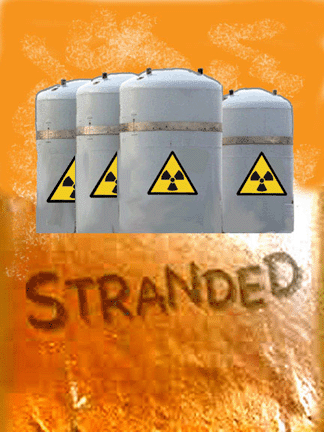 2) The department will not tell the community how long the highly dangerous intermediate nuclear waste will be temporarily stored. There are no such plans in place at the present to permanently bury this waste as it is too cost prohibitive to do so. This could easily end up stranded for hundreds of years to come in the centre of Eyre Peninsula. If the government watchdog ARPANSA agrees that it is to remain at Lucas Heights, where does that leave the community. 2) The department will not tell the community how long the highly dangerous intermediate nuclear waste will be temporarily stored. There are no such plans in place at the present to permanently bury this waste as it is too cost prohibitive to do so. This could easily end up stranded for hundreds of years to come in the centre of Eyre Peninsula. If the government watchdog ARPANSA agrees that it is to remain at Lucas Heights, where does that leave the community.3) Why won’t Sam Chard (Your views, February 19) tell the communities that once legacy waste is collected and stored at the dump, then there will only be about two and a quarter containers annually of low-level waste delivered provided every one chooses to use the dump. This will never provide 45 jobs.
4. A parliamentary enquiry in 2004 in NSW acknowledged it was misleading to the public by ANSTO, rebadging the high-level waste being returned from France and England as intermediate waste.
If Australia has to have a single waste dump for our low and intermediate-level waste then all Australians need to be involved. Not just kept low key on the few hundred citizens that are at present bulldozed into the decision that needs a national answer. https://www.facebook.com/groups/941313402573199/
|
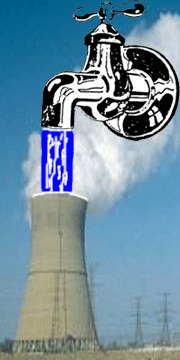
The Kimba nuclear waste dump will take a huge toll on the Murray River’s water
 Annette Ellen Skipworth No Nuclear Waste Dump Anywhere in South Australia, 25 Feb 20
I spent some time as a remote road contractor and I learnt a little bit about roads and site works.
To take the weight of the truck load, a road has to be compacted to gain the strength to take the semi plus the load on the tray.
From asking questions and scouring internet sites, I have found out, the casks containing the high grade nuclear waste.. excuse me ..the intermediate nuclear waste are very very heavy.
It wasn’t advisable to use water that is very salty.. it rises to the top and makes the road slippery.
As Kimba’s only water supply comes from the precious Murray River, and the local underground water is salty and unusable.. where is the water needed coming from?
1 This month
.

Australians deserve the truth
about
AUKUS – https://aukuspublicinquiry.com/

PETITION – To: Prime Minister Anthony Albanese and the Australian Labor Government

of the week – Australians for War Powers Reform (AWPR)
To see nuclear-related stories in greater depth and intensity

