Australia’s Environment Is The Enemy – Sussan Ley faithful to Scott Morrison’s priority
 Sussan Ley’s environmental law circus, Independent Australia By Sue Arnold | 5 November 2019 Vulnerable species like the koala – and the environment in general – are the losers, while developers reign supreme in Environment Minister Sussan Ley’s environmental law “review”. Sue Arnold reports.
In July, Sussan Ley sent out a statement indicating that as Minister for the Environment, she would
… commence a ten-year statutory review of the [Environment Protection and Conservation] Act by October this year. And it is the right time to have a conversation about the best ways we can ensure strong environmental and biodiversity protection measures that encourage people to work together in supporting the environment.
All Australians will have a chance to share their ideas as part of the next statutory review of the EPBC Act, due to commence by October 2019.
Exactly why Ley waited another three months before commencing the review is unclear. In a follow-up press release, she announced that former competition regulator Professor Graeme Samuel would head the year-long review, ‘to tackle green tape and deliver greater certainty to business, farmers and conservation groups‘.
Missing from Ley’s pronouncements are key issues relevant to one of the most critical problems — self-referral by developers. Under the current scenario, a developer whose project is likely to destroy or severely impact koala habitat makes the decision whether or not to “refer“ the development to the Federal government as a matter of national environmental significance (MNES), under the provisions of the EPBC Act 1999.
As the koala is listed as “vulnerable” under the EPBC, the referral should never have been reduced to the responsibility of a developer — referral to the Federal government should have been made a mandatory requirement.
A referral is designated as a “controlled action” if the result of a scorecard available from the Government’s ‘EPBC Act referral guidelines for the vulnerable koala’ reaches a certain level. Then the project is assessed by the Federal Department of the Environment and Energy and the minister makes the decision whether to approve the project. Documents relevant to the project are published on the EPBC referral list website and open to public comment — including environmental impact assessments paid for by the developer.
Once the project is approved, a “koala management plan” (KMP) must be provided by the developer before the project commences. However, this is where the proverbial hits the fan as there is no requirement for any public comment, nor any access to the plan.
One of the most important koala management plans has been on Sussan Ley’s desk since July. This is the Lendlease plan for southwest Sydney koalas at their Mt Gilead, now renamed “FigTree Hill” urban project for 1700 residences. This is a project mired in controversy and public outrage because of the risks to the largest expanding healthy koala colony in the Sydney Basin.
IA has been following up this issue with the only section of the Department of the Environment and Energy (DEE) that responds in a timely manner — the Communications and Engagement Branch Media (CEBM) team. ……….
The bottom line to this Monty Python circus is not only the Lendlease koala plan of management which is being withheld, but any developer who has self-referred has no requirement by the environment minister to publish the plan other than “on the developer’s website”.
Given that this would require a large staff to check the multiple developer projects impacting koala habitat throughout Queensland and New South Wales on a daily basis, a new definition of “mission impossible” arises.
Essentially, any koala management plan may be approved. There are no published standards or requirements — much less compliance or monitoring.
A review by some of Australia’s leading ecologists sums up the catastrophic situation facing koala survival.
Some 85 per cent of land-based threatened species experienced habitat loss. The iconic koala was among the worst affected. More than 90 per cent of habitat loss was not referred or submitted for assessment, despite a requirement to do so under Commonwealth environment laws.
Our research indicates the legislation has comprehensively failed to safeguard Australia’s globally significant natural values, and must urgently be reformed and enforced.
Sussan Ley’s priorities in a review of the EPBC Act reflect those of the Prime Minister: the environment is the enemy. https://independentaustralia.net/politics/politics-display/sussan-leys-environmental-law-circus,13279
Nuclear waste containers in transit to South Australian dump, could be vulnerable to bushfires.
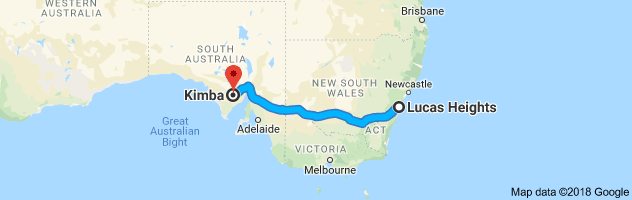
“The Fire Brigade Union contradicted this view stating that everything burns under the right conditions and that an accident, particularly with a fuel tanker, could generate enough heat to burn concrete and steel containers and vaporise the waste. This would transform the waste into a form in which it presents the greatest risk to human health.
“Concrete burns, it spalls, it expands and it explodes. That is what happens to it if it is subject to fire for long enough. You can put it in concrete and you can have steel mesh holding the whole thing together, but when you apply heat, the granules grow and things start spalling, just throwing out bits of itself everywhere until, in the end, that concrete or the integrity of the structure that encases it is broken.
Podcast: Australia’s nuclear bomb lobby
 The Bomb Lobby, ABC Radio The History Listen 29 Oct 19 There was a time when Australia seriously considered having ‘the bomb’. For two decades a small but powerful group of politicians and bureaucrats lobbied for Australia to have nuclear weapons. They became known as the ‘Bomb Lobby and by the late 1960s they had their wish. As the Cold War deepened, the Australian Government took the first steps down the path a nuclear weapons program. …. The Bomb Lobby, ABC Radio The History Listen 29 Oct 19 There was a time when Australia seriously considered having ‘the bomb’. For two decades a small but powerful group of politicians and bureaucrats lobbied for Australia to have nuclear weapons. They became known as the ‘Bomb Lobby and by the late 1960s they had their wish. As the Cold War deepened, the Australian Government took the first steps down the path a nuclear weapons program. ….In the eyes of the Bomb Lobby, Australia was at its most vulnerable just as communist states in the region were considering atomic weaponry. The red tide of communism was spreading through South East Asia and before long, if not checked, could be on Australia’s doorstep armed with atomic weapons. Add to that their argument that Australia could no longer rely on her traditional allies and you have a heady mix of fear and fission.
To mark the 30th anniversary of the end of the Cold War, this program recounts a little known chapter in Australia’s history told by the people involved. Using archival recordings from the ABC, declassified cabinet papers, and the National Library of Australia’s Oral History Collection, James Vyver brings us the story of how the Bomb Lobby gained and wielded its power.https://www.abc.net.au/radionational/programs/the-history-listen/the-bomb-lobby/11243856?fbclid=IwAR3hpoRvV4Uhepv4R0bYg6vrpBTiMg1RWpLj_TOdzauFU_Bts9XqN97CYTU
|
|
Is climate change playing a role in Australia’s drought?
 How bad is this drought and is it caused by climate change?
How do we define drought? What causes them? And are they getting worse?, Brisbane Times, By Peter Hannam , NOVEMBER 3, 2019
“………..Is climate change playing a role?
If droughts can be hard to pin down, explaining their connection to climate change adds to the complexity.
The facts are that scientists cannot say definitively that a specific drought is caused by climate change, but they can say definitively that climate change makes the effects of droughts stronger and more damaging.
Andy Pitman, director of the ARC Centre of Excellence for Climate Extremes, recently ignited a brief firestorm over his comment to a business forum that “there is no link between climate change and drought”.
Some media jumped on his views, prompting his centre to issue a belated correction saying he erred by leaving out one word, as in “there is no direct link between climate change and drought”.
The indirect links, though, should be cause enough for concern in a country with Australia’s variable rainfall……..
Climate change is blamed for accelerating the winds that circle around Antarctica, drawing storm tracks further south so some miss the mainland.
By contrast, for some areas in southern Australia, rainfall is increasing during the warmer months. That shift, though, comes as little consolation for farmers now reliant on winter harvests……
While it’s not clear how annual rainfall totals will change in a warming world, future droughts will be hotter when they do arrive, says Ben Henley, a climate researcher at the University of Melbourne.
“We’re really quite concerned in southern Australia,” he says. “Even if we get the same degree of annual rainfall, if that’s falling in the hot time of the year, that’s more likely to be evaporated off.” …..
Is this the new normal?
Cutting-edge research includes work to investigate whether droughts such as the current one are likely to become more prolonged and more frequent…..
One smoking gun is that rainforests are now burning.
“By June 2018, they reported that all types of trees were dying, leaving a desert-like landscape of sand dunes replacing the normally vegetated scene,” the paper says.
As plants dry or die,the risk of major bushfires increases. And, as plants also help moderate the local climate through a process called evapotranspiration, when they die another hand brake on the heat is removed.
Some researchers believe the ambient conditions that led to the Millennium Drought have not yet broken down, says Greg Holland, an emeritus senior scientist at the US National Center for Atmospheric Research and formerly with the bureau.
“It’s quite possible … we never came out of it,” he says, adding a couple of wet years in 2010 and 2011 may have been “a bit of an hiatus in the middle”.
Indeed, while drought is measured against historical averages, it may be time to redefine what we considered as normal. “One smoking gun is that rainforests are now burning,” he says…….https://www.brisbanetimes.com.au/environment/climate-change/how-bad-is-this-drought-and-is-it-caused-by-climate-change-20191024-p533xc.html
A NATIONAL APPROACH TO A NATIONAL RIVER SYSTEM
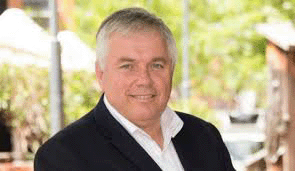 Senator Rex Patrick 3 Nov 19, I’m sick and tired of the NSW Government threatening to pull out of the Murray-Darling Basin Plan every time they get upset about something happening on the river.
It’s been threatened at least 4 times since February 2018, when the Senate was debating whether or not to allow an extra 70GL of extraction from the Norther Basin (Centre Alliance voted against extra extraction).
NSW pulling out of the Basin Plan would not be in its own interests. There are a number of significant NSW river projects that are or will be funded by the Basin Plan, but won’t be if NSW were to pull out.
The Murray-Darling is a national river that needs to be managed accordingly. If NSW took its bat and ball home, there would be little choice but for the Federal Government to take control, either using existing Commonwealth powers or by supporting a constitutional amendment handing powers to the Federal Parliament. Centre Alliance already has a Constitutional Alteration Bill before the Parliament that seeks to do this.
NSW Nationals MPs have cried wolf on pulling out of the plan so often now that it’s becoming meaningless. They would be better off focussing their efforts on reigning in over-extraction, but that would involve acting in the national interest, not in the Nationals’ interests.
STAND UP TO NUCLEAR WASTE DUMP BULLIES
Kim Mavromatis No Nuclear Waste Dump Anywhere in South Australia
 The Federal Liberal Govnt Nuclear Waste Dump Process is subjecting people to intimidation, insults, threats and bullying. The Federal Liberal Govnt Nuclear Waste Dump Process is subjecting people to intimidation, insults, threats and bullying.The Federal Liberal Govnt process has been appalling and is feeding the bad behaviour of pro nuclear waste dump bullies. The Federal Liberal Govnt nuclear waste dump process has fractured the communities in the Flinders Ranges and Kimba regions (near the proposed nuclear waste dump sites) and has encouraged intimidation, insults, threats and bullying. Why on earth would the Federal Liberal govnt want to dump nuclear waste in the Flinders Ranges, on a floodplain, in a seismically active region, bordered by natural springs, in an iconic tourism destination, or on Eyre Peninsula farmland, near Kimba and next to Lake Gilles Conservation Park????? https://www.facebook.com/groups/1314655315214929/ |
|
||||||||

Gross injustice: the relentless destruction of Julian Assange
The charge against Julian is very specific; conspiring with Chelsea Manning to publish the Iraq War logs, the Afghanistan war logs and the State Department cables. The charges are nothing to do with Sweden, nothing to do with sex, and nothing to do with the 2016 US election; a simple clarification the mainstream media appears incapable of understanding.
The campaign of demonization and dehumanization against Julian, based on government and media lie after government and media lie, has led to a situation where he can be slowly killed in public sight, and arraigned on a charge of publishing the truth about government wrongdoing, while receiving no assistance from “liberal” society.
Unless Julian is released shortly he will be destroyed. If the state can do this, then who is next?
 The Annihilation of Julian Assange, https://www.truthdig.com/articles/the-annihilation-of-julian-assange/, Craig Murray “In Defense of Julian Assange,” edited by Tariq Ali and Margaret Kunstler, is now available for OR Books.
I was deeply shaken while witnessing yesterday’s events in Westminster Magistrates Court. Every decision was railroaded through over the scarcely heard arguments and objections of Assange’s legal team, by a magistrate who barely pretended to be listening.
Before I get on to the blatant lack of fair process, the first thing I must note was Julian’s condition. I was badly shocked by just how much weight my friend has lost, by the speed his hair has receded and by the appearance of premature and vastly accelerated aging. He has a pronounced limp I have never seen before. Since his arrest he has lost over 15 kg in weight.
But his physical appearance was not as shocking as his mental deterioration. When asked to give his name and date of birth, he struggled visibly over several seconds to recall both. I will come to the important content of his statement at the end of proceedings in due course, but his difficulty in making it was very evident; it was a real struggle for him to articulate the words and focus his train of thought.
Until yesterday I had always been quietly skeptical of those who claimed that Julian’s treatment amounted to torture – even of Nils Melzer, the UN Special Rapporteur on Torture – and skeptical of those who suggested he may be subject to debilitating drug treatments. But having attended the trials in Uzbekistan of several victims of extreme torture, and having worked with survivors from Sierra Leone and elsewhere, I can tell you that yesterday changed my mind entirely and Julian exhibited exactly the symptoms of a torture victim brought blinking into the light, particularly in terms of disorientation, confusion, and the real struggle to assert free will through the fog of learned helplessness. Continue reading
Nuclear weapons and Australia’s hypocrisy about them
 from congratulating ICAN for the first Australian-born Nobel Peace Prize. While a childish move, this only served to highlight the government’s discomfort with the treaty and its clear challenge to Australia’s position on nuclear weapons. As the signatures and ratifications continue to stack up and the treaty nears entry-into-force, this challenge persists.
Financial institutions are divesting from nuclear weapon producers, citing the treaty as their reason for doing so even though it has yet to enter into force. These include ABP, the largest Dutch pension fund, and Norway’s trillion-dollar sovereign wealth fund. Cities and towns are declaring their support for the treaty, including Paris, Berlin, Geneva, Washington DC, Toronto, Sydney and Melbourne.
This year’s Nobel Peace Laureate, Ethiopian Prime Minister Abiy Ahmed Ali, has been rewarded for formalising a peace agreement between Ethiopia and Eritrea. For ICAN, the Nobel Peace Prize served a directive upon all nations to sit up and pay attention to the fresh 10-page nuclear weapon ban treaty. We know that we’re up against powerful nations, a lucrative industry and deeply entrenched modes of thinking. The real prize will be the total elimination of nuclear weapons, and we have the tools to get there. It’s up to all people, civil society and governments to turn the tide of history. Our collective security depends on it.
- Gem Romuld is the Australian director of the International Campaign to Abolish Nuclear Weapons and a recipient of the 2017 Nobel Peace Prize. https://www.canberratimes.com.au/story/6442739/nuclear-hypocrisy-cant-continue/?cs=14246
Scott Morrison doesn’t like even the “quiet people” speaking up
 Morrison doesn’t like it when the quiet Australians start to speak up, Canberra Times, Ebony Bennett , 2 Nov 19,
In his government’s latest free-speech crackdown, Prime Minister Scott Morrison has vowed to outlaw civil society groups campaigning against Australian businesses that work with companies with dubious environmental, human rights or ethical records.
The bank ruled out lending to Adani, as did other banks – in part because AYCC’s Dollarmite protests were a real risk to their brand (this was before the banking royal commission tanked it) but also because Adani’s coal mine is a dud project that has failed to secure finance from virtually any bank or investor, except for billionaire Gautam Adani himself.
Scott Morrison says this style of campaigning “is a potentially more insidious threat to the Queensland economy and jobs and living standards than a street protest”.
That was in 2014, when former prime minister Tony Abbott proposed a ban on secondary boycotts. Australia’s competition laws already restrict secondary boycotts – but that is mostly targeted at unions, with exemptions for campaigns run by environmental and consumer groups……
Scott Morrison doesn’t like it when quiet Australians break their silence and take aim at dodgy companies or those who choose to provide services to them – especially when they’re in his favoured industries, like the coal industry. While the Coalition government rolls out the red carpet for the coal industry, it can’t pull up the drawbridge fast enough when it comes to renewables.
If the Minerals Council says jump, the federal government (and NSW and Queensland governments) say “how high?” Whereas the Coalition government has done its level best to kill off the renewables industry. Thankfully, in the long term they have been about as effective at killing off renewables as they have been at cutting emissions: hopeless.
The Morrison government regularly boasts about Australia’s record on renewables, but the fact is it is single-handedly destroying the holy trinity of renewable energy policy: the Renewable Energy Target (RET), the Australian Renewable Agency (ARENA) and the Clean Energy Finance Corporation (CEFC).
Collectively, the RET, ARENA and the CEFC are responsible for unleashing $23.4 billion worth of investment in renewable energy over a five-year period (2013-18). But there’s nothing the Coalition loves more than throwing sand in the gears of the success of the renewables industry.
Looking ahead, the RET has been exhausted, ARENA is running out of money and the last bastion of renewable energy investment, the CEFC, is now being bastardised to fund fossil-fuel projects……..
Prime Minister Scott Morrison has gone to great pains to talk up renewables, but the truth is that the PM is quite happy to wreck the renewables revolution. He labels those who protest companies wrecking our environment as “selfish and indulgent”, but the truth is that under Scott Morrison, free speech is reserved only for people with paid jobs, and protests are only to be tolerated at convenient times, in convenient places.
If you don’t like it, shut up – or Scott Morrison will make you shut up.
How good is Australia?
- Ebony Bennett is deputy director at independent think tank the Australia Institute. Twitter: @ebony_bennett. https://www.canberratimes.com.au/story/6470618/morrison-doesnt-like-it-when-the-quiet-australians-start-to-speak-up/?cs=14246
Scott Morrison delivers a speech that sounds very like an attack on democracy

|
Scott Morrison threatens crackdown on protesters who would ‘deny liberty’ https://www.theguardian.com/australia-news/2019/nov/01/scott-morrison-threatens-crackdown-on-secondary-boycotts-of-mining-companies?CMP=share_btn_tw
PM signals action on secondary boycotts of resources companies and says progressives want to tell Australians ‘what you can say, what you can think’ Paul Karp @Paul_Karp Fri 1 Nov 2019 Scott Morrison has branded environmental protesters “anarchists” and threatened a radical crackdown on the right to protest in a speech claiming progressives are seeking to “deny the liberties of Australians”.In a speech to the Queensland Resources Council on Friday, the prime minister said a threat to the future of mining was coming from a “new breed of radical activism” and signalled the government would seek to apply penalties to those targeting businesses who provide services to the resources industry. Civil society groups, including the Human Rights Law Centre and Australian Conservation Foundation, and the Greens immediately attacked the proposal as undemocratic and a bid to stifle a social movement fighting for Australia to take action on climate change. Morrison told Australian corporations to listen to the “quiet shareholders” and not environmental protesters, who he suggested could shift targets from coal companies to all carbon-intensive industries including power generation, gas projects, abattoirs and airlines. In a speech proposing limits on free speech advocating boycotts against polluting companies, Morrison said progressives wanted to tell Australians “what you can say, what you can think and tax you more for the privilege of all of those instructions”. He claimed that “progressivism” – which he labelled a “new-speak type term”, invoking George Orwell – intends “to get in under the radar, but at its heart would deny the liberties of Australians”. “Apocalyptic in tone, it brooks no compromise,” Morrison said. “It’s all or nothing. Alternative views are not permitted.” He pointed to the “worrying development” of environmental groups targeting businesses or firms involved in the mining sector with “secondary boycotts”, such as businesses refusing to provide banking, insurance or consultancy services. “They are targeting businesses of all sizes, including small businesses, like contracting businesses in regional Queensland.” “Let me assure you this is not something my government intends to allow to go unchecked. “Together with the attorney general, we are working to identify mechanisms that can successfully outlaw these indulgent and selfish practices that threaten the livelihoods of fellow Australians.” But Morrison admitted the government “can’t force one Australian company to provide a service to another”. The Greens were quick to reverse the charge of intolerance and level it at Morrison, with acting leader Adam Bandt labelling him “a direct threat to Australian democracy and freedom of speech”. “The prime minister’s commitment to outlaw the peaceful, legal protest of Australian individuals and community groups reads like a move straight from the totalitarian’s playbook,” he said. |
It’s time that the Australian government declared a water emergency
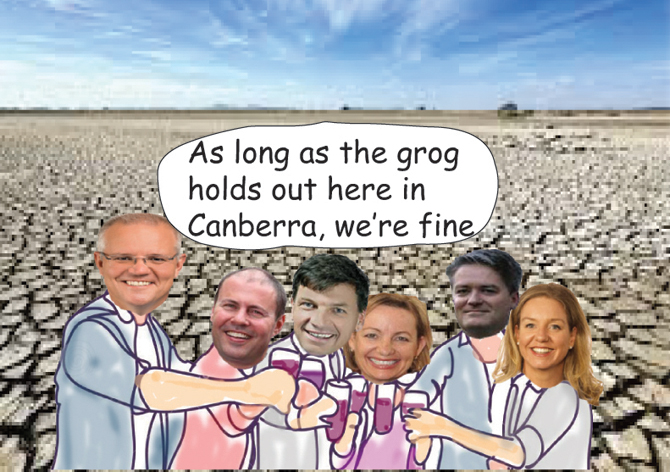
Declaring a water emergency means putting people before profit, mo https://www.michaelwest.com.au/declaring-a-water-emergency-means-putting-people-before-profit/by Quentin Grafton and John Williams — 1 Nov 19, The current drought in Eastern Australia has focused the attention of all Australians on water but effective policy responses are missing in action. Isn’t it time to call it a water emergency? Quentin Grafton and John Williams report.
The dictionary defines an emergency as “a serious, unexpected, and often dangerous situation requiring immediate action”. If there is a climate emergency – and 330,000 Australians have already signed a petition to the Australian Government to declare a climate emergency – then surely there must also be a water emergency here, right now, in Australia. As in any emergency, it requires that we be told the truth and, importantly, act on the truth.
Political leaders, however, prefer the word ‘drought’ because Australia has experienced it in the past and it is ‘solved’ when the rains come. Politicians cannot be blamed for acts of nature. ‘Drought relief’ also gives politicians the opportunity to pretend to fix the problem while showing compassion for those doing it tough.
Income support in the form of a farm household allowance for eligible households with less than $5 million in assets, and that pays more than $30,000 per farming couple per year for up to four years, is, no doubt, very welcome to those who qualify. Unfortunately, it does not solve our water emergency. In this make-believe narrative, all blame accrues to the heavens.
The current drought began in 2017, and came less than 10 years after the Millennium Drought ended. Yet the nation’s elected leaders are surprised by another major drought. Like rabbits on the road facing the full beam of an approaching vehicle, they seem unable to move beyond last century solutions to respond to this water emergency.
Instead, they announce multi-billion dollar commitments of taxpayer money for dams, many of which won’t be completed for years and would never fill until the drought ends. Water extracted from the dams would also be subject to water extraction limits under the Basin Plan.
So why do Australian political leaders support dam building as a solution knowing that dams don’t make it rain or snow? Is it because they are stuck in the past, trapped in myths or delusions, or asleep at the wheel?
If only this were true. Australia could then solve the water emergency by simply ‘briefing’ the Prime Minister, Premiers, and Water Ministers about the 21st Century solutions to the water emergency.
They could be informed of solutions like comprehensive water accounting so that everyone knows who has the water and what it is being used for. Other solutions include water planning that leaves sufficient water in the dams for people to drink by setting enough water aside for the worst droughts, and water recycling and reuse by communities to reduce extraction. Or even managed aquifer recharge to reduce surface water evaporation, and dynamic water pricing that increases the volumetric price paid when dams have less water — the list goes on.
So what is getting in the way of implementing these solutions? Money, power, and influence. Both rent-seeking and regulatory capture, represent the demand for and the supply of water respectively, and are affecting decision-making that benefits particular interests, rather than the broader public interest.
Rent-seeking is when actions are undertaken by people and organisations outside of government to influence decision-making for self-interest, rather than for the sake of improving the decision. Many forms of rent-seeking are legal in Australia, including lobbying — a multi-billion-dollar business.
Rent-seeking allows privileged access to our elected leaders and advisors to those with the means to get it. For example, between 2014 and 2018 the NSW Irrigation Council had more than 25 water-related meetings with New South Wales Ministers, yet many non-industry and non-irrigation entities had only one meeting. All combined, Indigenous, catchment, and environment entities had just 20 per cent of the total number of ministerial meetings given to irrigation and industry entities in the period.
So what does privileged access mean? Decision-making that the NSW Natural Resources Commission has described, in relation the Barwon-Darling River Water Sharing Plan, that has
“…increased allowance for extractive use at lower flow classes that are critical to the environment. These provisions benefit the economic interest of a few upstream users over the ecological and social needs of the many”.
This decision-making contributed to the dire situation in the Murray-Darling Basin and the massive fish kills along the Darling River in January 2019. Sadly, it is just one of many examples of water decision-making not made in the public interest, and described by the South Australian Murray-Darling Basin Royal Commission in January this year as “gross maladministration”.
Billions of dollars in expenditure on irrigation infrastructure, including the construction of private dams, highlighted in the ABC’s Four Corners program in July 2019 Cash Splash, and supported by evidence in peer-reviewed academic research, shows that such subsidies are likely to reduce return flows from irrigators’ fields to groundwater, streams, and rivers.
Yet, the Australian Government has spent some $4 billion on subsidising irrigation infrastructure in the Murray-Darling Basin without any cost-benefit analysis or even comprehensive measures of the impacts on stream flows.
To add to our water woes, more billions of dollars have been allocated to further subsidise water infrastructure, including dams, and announced as a ‘solution’ to the water emergency. Such spending is highly unlikely to generate a net public benefit.
As Rome burns, people in towns like Wilcannia on the lower Darling get their drinking water from 10 litre cartons delivered from the back of trucks. In a desperate cry of help, and defiance, one Barkandji Elder from Wilcannia, Kerry ‘Sissy’ King, has a message for politicians to
“Come out here and see how you feel about living [with no water]. They’ve taken it from the nation that lives off the river system. Come and sit in the gutter with us.”
Australia must stop blaming the river and recognise that capture by special interests has led to this water emergency. It is not simply an act of God; it has arisen from a lack of planning and decision-making that benefit the few at the expense of the many. Neither drought relief nor dams are solutions. Instead, Australia needs its political leaders to lead, to put the national interest first, and to make decisions that place people before profit.
Australian film-makers to join in 10th Uranium Film Festival in Rio de Janeiro May 2020
 Marcia Gomes de Oliveira shared a link. 2 Nov 19
These filmmakers and producers have already agreed to come to Rio 2020: Peter Kaufmann (Australia), Kim Mavromatis (Australia), Laura Pires (Brazil), Angelo Lima (Brazil), Miguel Silveira (USA/Brazil), Cris Uberman (France), Marcus Schwenzel (Germany), Rainer Ludwigs (Germany), Michael von Hohenberg (Germany), Peter Anthony (Denmark), Michael Madson (Denmark), Lise Autogena (Denmark), Masako Sakata (Japan), Maurizio Torrealta (Italy), Alessandro Tesei (Italy), Amudhan R.P. (India), Tamotsu Matsubara (Japan), Tamiyoshi Tachibana (Japan), Tineke Van Veen (Netherlands), Mafalda Gameiro (Portugal), James Ramsay Cameron (Scotland), José Herrera Plaza (Spain), Marko Kattilakoski (Sweden), Edgar Hagen (Switzerland),Tetyana Chernyavska (Ukraine), Brittany Prater (USA), Ian Thomas Ash (Japan/USA).
Rio’s 10th International Uranium Film Festival is scheduled for May 21st to 31st. Do not miss it!
Climate change is bringing more extreme weather events to Sydney and Melbourne
 Hail, cyclones and fire: Extreme weather risks on the rise, SMH, By Peter Hannam, November 1, 2019, Sydney and Melbourne will most likely be exposed to more intense hailstorms, tropical cyclones will track further south and bushfire risks will increase in most of Australia as the climate warms, new research shows.The modelling based on a 3 degree temperature rise is contained in a severe weather report to be released on Friday by IAG, the country’s largest general insurer, and the US National Centre for Atmospheric Research.
“Climate change is not just about the future,” the report states. “There is already solid evidence that there have been measurable changes to weather and climate extremes with the [1 degree of] warming to date.”
Changing insurance claims data are among the indications that major damaging hail events for Perth, Adelaide and Melbourne have already been increasing in the past decade……
Insurance and other financial firms have been reassessing their risks to climate change, prodded in part by international groups such as the Task Force on Climate-related Financial Disclosures.
IAG managing director Peter Harmer said there was “an urgent need for Australia to prepare for and adapt to climate change”.
“[It] is critical there is a co-ordinated national approach from governments, industries and businesses to build more resilient communities and reduce the impact of disasters.”
Executive manager of natural perils at IAG Mark Leplastrier said that, apart from reducing greenhouse gas emissions, communities had two main tools to shape the future risk profile: the tightening of land planning and improving building codes.
“There’s a huge opportunity to adapt,” he said……..https://www.smh.com.au/environment/climate-change/hail-cyclones-and-fire-extreme-weather-risks-on-the-rise-20191031-p536aw.html
December 2-13 UN Climate Summit in Madrid (Scott Morrison is supposed to attend?)
|
UN climate talks to take place in Madrid https://www.heraldsun.com.au/news/breaking-news/un-climate-talks-to-take-place-in-madrid/news-story/49630507277946754406e42af4685d2c, Australian Associated Press
November 2, 2019, The United Nations has confirmed Spain will host the organisation’s annual climate conference after Chile pulled out following weeks of violent unrest.
UN Climate Change head Patricia Espinosa said in a statement that the conference, known as COP25, will now take place in Madrid on the same dates – December 2-13. Weeks of violent unrest led Chile to cancel the COP25 and its hosting of the APEC trade talks that Prime Minister Scott Morrison was due to attend in mid-November. The high-profile climate summit is slated to finalise negotiations around rules for the Paris emissions reduction targets – to which Australia has agreed. Countries were going to be encouraged to improve their pollution reduction goals. |
|
Coal from six biggest miners in Australia produces more emissions than entire economy
 Big emitting companies should be held responsible for the burning of their coal overseas, report says Adam Morton Environment editor, Guardian, @adamlmorton, Fri 1 Nov 2019 Coalmining in Australia by the nation’s six biggest coal producers ultimately results in more greenhouse gas emissions each year than the entire domestic economy.In the latest report to estimate the role fossil fuel businesses play in driving the climate crisis, researchers from the University of New South Wales calculated the total emissions from the coal and gas produced by Australia’s top carbon companies, from extraction to the resources being burned for energy, mostly overseas.
They found the top six coal producers – BHP Billiton, Glencore, Yancoal, Peabody, Anglo American and Whitehaven – were in 2018 linked to 551m tonnes of carbon dioxide released into the atmosphere. Total emissions from all activity within Australia were 534m tonnes.
When the list was expanded to include Australia’s 10 biggest carbon producers, adding Chevron, Woodside, ExxonMobil and Santos, the combined emissions from their products was found to be 670m tonnes a year, equivalent to that from about 75% of global air traffic.
The UNSW report follows the Guardian’s global series The Polluters, which revealed 20 fossil fuel companies including BHP could be directly linked to more than one-third of all greenhouse gas emissions in the modern era. In Australia, it found a wave of planned developments by major fossil fuel companies across the north would significantly increase the amount of coal and gas the country planned to sell into Asia and could push the Paris climate agreement goals further beyond reach.
The report’s lead author, Jeremy Moss from the UNSW Practical Justice Initiative and a professor of political philosophy, said there was a clear case that big emitting companies, which the report calls “carbon majors”, should be held responsible for the consequences of their products……. https://www.theguardian.com/australia-news/2019/nov/01/six-biggest-coalminers-in-australia-produce-more-emissions-than-entire-economy
1 This month
.

Australians deserve the truth
about
AUKUS – https://aukuspublicinquiry.com/

PETITION – To: Prime Minister Anthony Albanese and the Australian Labor Government

of the week – Australians for War Powers Reform (AWPR)
To see nuclear-related stories in greater depth and intensity

