BHP’s Olympic Dam uranium mine: tailings dump to larger than Adelaide and up to 30 metres high

All BHP Olympic Dam radioactive toxic mine tailings waste must be isolated from the environment for over 10,000 years…
Please consider making a submission to the federal government who are inviting comments on the BHP Olympic Dam Tailings Storage Facility (TSF) 6 project – but only up to cob Friday 28th June, with no extensions (scroll down for info). Tell the fed’s they must not just approve this TSF 6 on the basis of the vested interest BHP Referral documents.
Key Recommendations are provided along with two Briefing papers prepared for Friends of the Earth Australia (FoEA) and available on-line:
“BHP seek a Toxic Tailings Expansion without a full Safety Risk Assessment” (DN, June 2019, 3 pages)
https://nuclear.foe.org.au/wp-content/uploads/ODM-Tailings-Briefing-22June2019.pdf
and
“Migratory Birds at Risk of Mortality if BHP continues use of Evaporation Ponds” (DN, June 2019, 3 pages)
https://nuclear.foe.org.au/wp-content/uploads/ODM-Migratory-Birds-BHP-Evaporation-Ponds-22June2019.pdf
A set of Key Recommendations on these issues to put to the federal government:
1. The Olympic Dam operation be assessed in its entirety with the full range of project impacts subject to public consultation
Given that uranium mining at Olympic Dam is a controlled “nuclear action” and Matter of National Environmental Significance (NES) under the federal Environment Protection and Biodiversity Conservation Act 1999 (EPBC Act), the integrity of environmental protection requires that the entire Olympic Dam operation be subject to impact assessment so that regulatory conditions can be applied “to consider impacts on the whole environment”. Continue reading
The reason Australia doesn’t have nuclear power: the workers fought back
The movement’s real strength always depended on its grassroots – on the willingness of activists to defy the rightwingers in Labor and the unions, even to the extent of facing arrest.
The reason Australia doesn’t have nuclear power: the workers fought back https://www.theguardian.com/environment/commentisfree/2019/jun/24/the-reason-australia-doesnt-have-nuclear-power-the-workers-fought-back Jeff Sparrow Workers have been fighting uranium mining for decades – the environment needs mass civil disobedience @Jeff_Sparrow 24 Jun 2019
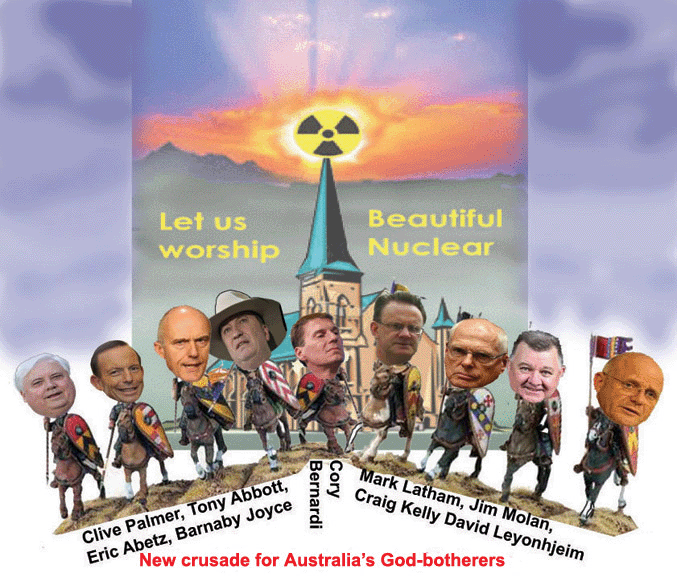
What do Clive Palmer, Tony Abbott, Cory Bernardi, Barnaby Joyce, Mark Latham, Jim Molan, Craig Kelly, Eric Abetz and David Leyonhjelm have in common?
No doubt many answers will come to to mind. But whatever else unites them, they all support nuclear power.
Jim Green from Friends of the Earth Australia, which compiled the above list, says that nuclear energy now functions more as a culture war troll than a serious policy, not least because the people who want atomic solution to climate change are usually the same people (as the group above illustrates) who don’t believe climate change requires a solution at all.
Despite the best efforts of Queensland conservatives, Australia will not go nuclear. The former chair of Uranium King, Warwick Grigor, says flatly: “No one is going down that path in the foreseeable future.” Even industry boosters see nuclear power stations as feasible only if the government introduces, um, a carbon tax, a proposal to which the culture warriors would react like vampires to garlic.
Nevertheless, progressives should discuss nuclear energy and climate change, if only because the campaign we need against coal can learn from the historic struggle against a different mineral. Continue reading
Production at Australia’s only nuclear medicine facility halted after ‘safety incident’
Production at Australia’s only nuclear medicine facility halted after ‘safety incident’ Production has ceased and an urgent investigation has been launched after two employees at a newly opened Australian nuclear medicine facility at Lucas Heights were exposed to an unsafe dose of radiation late last week.Just two weeks after it was granted a licence to enter into full domestic production, the Australian Nuclear Science and Technology Organisation (Ansto) has confirmed production at its new $168m nuclear medicine facility has been halted after “a safety incident” on Friday morning.
Ansto said three of its workers were “attended to by radiation protection personnel” after the incident, in which contamination was detected on the outside of a container holding 42 millilitres of the radioisotope molybdenum-99 (Mo-99).
Two of those workers received a radiation dose above the legal limit roughly equivalent to a conventional cancer radiation therapy treatment, an Ansto spokesman said……
Located at the Lucas Heights nuclear facility in Sydney’s south, the $168m nuclear medicine facility was announced by the federal government in 2012 with the goal of tripling Australian production of Mo-99, the parent isotope of Technetium-99m. …..
It is the second contamination scare at the Lucas Heights facility in only a few months.
In March three staff at the Lucas Heights nuclear facility were taken to hospital after they were exposed to sodium hydroxide when a cap came off a pipe in the nuclear medicine manufacturing building. https://www.theguardian.com/australia-news/2019/jun/24/two-workers-exposed-to-unsafe-radiation-dose-at-lucas-heights-nuclear-facility
Lithium is valuable for many clean devices, but we can’t just ignore the wastes from its mining
Enormous lithium waste dump plan shows how shamefully backward we are SMH, Emma Young, 25 June 19 Emma Young covers breaking news with a focus on science and environment, health and social justice for WAtoday. We are all – well, all of us who are privileged enough – existing on a spectrum somewhere between “concerned” and “downright panicking” about human impact on the environment.
Western Australia holds some of the world’s richest known lithium deposits and now has an emerging industry to process that lithium here, not just ship it to China as previously done.
It’s part of a plan to make us more than just the world’s quarry; a bigger player in an industry promising big money, and bring jobs and industry to the South West.
But we have run up against a reality, in the very recognisable area of the Ferguson Valley: a reality predictable, yet startling.
Lithium mining will leave its own scars on a landscape already littered with tens of thousands of abandoned mining voids, pits, equipment and piles of tailings – and create its own waste.
In WA’s South West, processing of spodumene ore from the Greenbushes lithium mine will result in 600,000 tonnes per year of waste material being dumped – or ‘stacked’, if you want the euphemism – only 3.5km outside the charming little town of Dardanup.
Let me repeat that: 600,000 tonnes per year.
The application has offended the residents who already put up with dust, rubbish and runoff from the existing and already enormous landfill site.
To them, it’s on the nose.
And it’s not just sand and dirt. It’s waste of a kind so new to Australia that they had to get samples from China to find out what to classify it as.
Cleanaway submitted to the EPA that it was inert and non-toxic waste.
Yet no sustainable market exists for its reuse.
“By storing tailings in dedicated storage cells, in the event a sustainable market for reuse was developed, the material might one day be recovered,” it submitted, optimistically, to the Environment Protection Authority considering its proposal.
Somehow, I find it hard to believe that it is any miner or processor’s priority to find or develop such a market.
Queensland’s nuclear cowboy MPs join One Nation’s Marlk Latham to push for nuclear power
 Nationals MPs urge rethink on nuclear, THE AUSTRALIAN GRAHAM LLOYD, ENVIRONMENT EDITOR, 24 JUNE 19, Scott Morrison is being asked to support a full investigation of nuclear energy in Australia.
Queensland Coalition MPs Keith Pitt and James McGrath have drafted a letter to the Prime Minister together with proposed terms of reference for an inquiry, which will be delivered this week.
The letter will call for a review of advances in nuclear energy including small nuclear reactors and thorium technology, both of which could produce less radioactive waste than existing nuclear plants.
Commercial investigation of nuclear energy will require that a ban on considering the technology be removed from the Environmental Protection and Biodiversity Conservation Act.
Mr Pitt said that the nuclear issue was “a debate we are ready to have”.
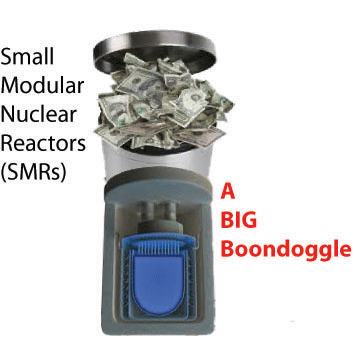 “In our view the technology has moved on and small modular reactors and thorium need to be investigated,” Mr Pitt said.
…….. Critics of nuclear energy claim it would be unable to compete economically with renewable energy and storage.
……. The Morrison government has been reluctant to consider changes to the EPBC Act on nuclear power. But the act in its entirety is up for statutory review this year.
……. The Nationals MPs expect a public review to take from 18 months to two years.
 The call for a national inquiry coincides with a review into the potential of nuclear power in NSW, to include former federal Labor Party leader and newly elected One Nation MP Mark Latham.
Mr Latham has introduced a bill in the upper house of the NSW parliament to repeal the uranium mining and nuclear ban in the state.
A parliamentary inquiry will be held by the eight-member, multi-party Standing Committee on State Development of the upper house. Mr Latham will be a member of the committee.
An issues paper is being prepared by the NSW Parliamentary Research Service for public release. The committee will call for submissions and is likely to conduct public hearings as early as September. https://www.theaustralian.com.au/nation/nationals-mps-urge-rethink-on-nuclear/news-story/4c5c90a4b49f890dba49a10444f1294d
Robert Parker still pushing the fantasy that nuclear power could be viable in Australia
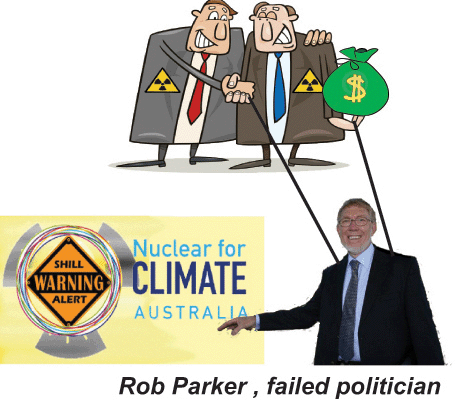
Australian Nuclear Association vice-president Robert Parker joins Jane to discuss the future of the industry in Australia.
Australian States taking the lead on energy policy, as renewable energy generates more Queensland jobs than coal does,
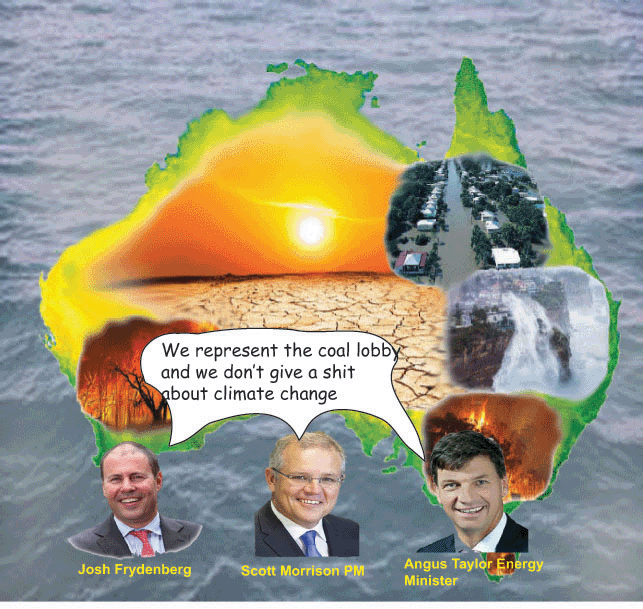
It’s ironic, perhaps, that in an election cycle where a number of regional Queenslanders voted for the promise of blue-collar jobs, backing the party that backed the Adani coal project, renewables generated more than 13,000 actual jobs in construction, with a lot of that activity in north Queensland.
Liberal states in talks to revive Turnbull’s dumped energy policy In Canberra, a month on from Scott Morrison’s election victory, there is talk of feasibility studies for a new Queensland coal plant, and a nascent nuclear debate. But if we shift our vantage point to Adelaide, Australia’s near-term energy outlook looks very different.
Dan Van Holst Pellekaan, the Liberal energy minister, is talking about South Australia hitting 100% net renewables by the 2030s. When asked to explain what that means, he tells Guardian Australia “producing more renewable energy in South Australia than we need for our own consumption and exporting the surplus”.
There is no talk of coal, apart from the inevitability of its displacement.
The South Australian renewables export plan relies on a new interconnector with New South Wales. Van Holst Pellekaan says if the proposed interconnector is approved, there are opportunities to construct large-scale solar and wind farms in the north-east of the state, on pastoral land, adjacent to the transmission equipment. “Then we start to displace coal in NSW,” he says. “It’s not just about a bit of renewable energy making a difference … that’s where you start to get a really big win on emissions reduction.”
But pushing ahead with that kind of progress is much easier if there’s a national framework driving the transition. Post-election, Van Holst Pellekaan wants Canberra back at the table being collaborative, implementing a coherent energy policy.
What the South Australian doesn’t say, but is obvious to people who know how the Coag energy council works, is the states can force this issue if they choose to.
If they can agree among themselves about what needs to happen, they can create a framework setting out the rules of the road even if the commonwealth resists.
Liberal states drive energy policy reboot Continue reading
Climate change bringing sea-level rise to Victoria’s low-lying towns and suburbs
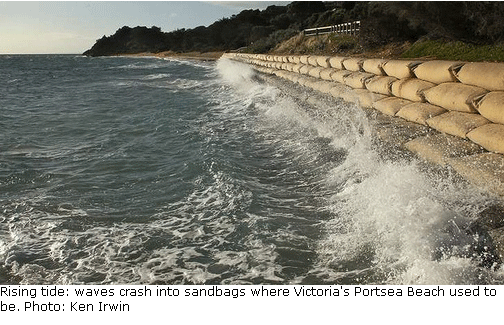 Rising sea, erosion to wreak havoc in low-lying suburbs: report, The Age , By Benjamin Preiss and Adam Carey
Other places at risk include areas around Queenscliff and Barwon Heads on the Bellarine Peninsula; the south-west Victorian towns of Port Fairy and Portland; and Tooradin, Lang Lang and Seaspray in the state’s south-east.
A report tabled in Victoria’s Parliament last week examines the myriad threats to the state’s fragile coastline, painting an alarming picture of damage to the environment and suburban Melbourne if no action is taken.
The Victorian Environmental Assessment Council report cites a 20-centimetre sea-level rise by 2040 and between 40 centimetres and one metre by century’s end.
Sea-level rise will lead to more frequent inundation of low-lying areas, loss of coastal habitat, cliff, beach and foreshore erosion,” the report says.
“Climate change will also put pressure on ageing coastal infrastructure and ultimately impact on feasibility of living in or developing some coastal locations.”
Increasing storm intensity, coupled with rising seas, will cause extensive erosion of the Victorian coastline by 2040, the report says.
“The most extensive area vulnerable to erosion by 2040 is the Gippsland coast,” it says. “Other coasts at risk include west of Portland, beaches in Port Phillip Bay between Mordialloc and Frankston, and the coast between Cape Paterson and Cape Liptrap in South Gippsland.”
Sydney City Council. Mayor Clover Moore to declare city climate emergency
Sydney Lord Mayor Clover Moore said Australia’s largest city needed to step up and show global leadership, especially given the failure of “successive federal governments (which) have shamefully presided over a climate disaster”.
Liberal Sydney Councillor, Craig Chung, one of two Liberal councillors who plan to oppose the motion, told The Australian while he supported action on climate change, he strongly objected to Ms Moore’s “hysterical, catastrophising” message.
“Language like climate emergency, climate catastrophe and extinction rebellion do nothing to further reasoned and rational debate,” Mr Chung said.
“If we learned one thing from the May 18 (federal) election, polarised fear mongering is not what the community want. The electorate expects us to take action, debate clearly and rationally about solutions, stop weaponising language and to deliver measurable and tangible outcomes for all Australians.”
Mr Chung said he would be proposing an amended version of the lord mayoral motion, stripped of all its “hysterical elements”.
Ms Moore said the nation was now experiencing such extreme weather “91 of the hottest places on Earth were in Australia”.
She said heatwaves across the country were now five times more likely, and “even more alarming — they start earlier, become hotter and last longer”.
“Seventy per cent of the world’s emissions are generated from cities, so the action city governments take is absolutely critical,” Ms Moore said.
Ms Moore has asked Council to call on the Federal Government to respond urgently to the emergency, by reintroducing a price on carbon to meet the Paris Agreement emissions reduction targets, and establishing a Just Transition Authority to ensure Australians employed in fossil fuel industries find appropriate alternate employment.
“Successive federal governments have shamefully presided over a climate disaster, and now we are at a critical juncture — we face a climate emergency,” she said.
“Australia’s greenhouse gas emissions have increased for four consecutive years. It is clear that the current Federal Government’s policies are simply not working and I call on council to declare a climate emergency, step up our efforts to hold the Federal Government to account. “With 96 per cent of NSW still drought affected, our farmers and rural communities are being decimated by drought, suffering from water shortages and extended bush fire seasons, witnessing unprecedented fish kills and the death of once mighty river systems.”
The Lord Mayor, outlining the City of Sydney’s action on climate change since 2008, committed to accelerate work in the development of its strategic plan till 2050.
“We set a goal to reduce our emissions by 70 per cent by 2030, and — following the Paris Climate Agreement in 2015 — we set a more ambitious goal to reach net zero emissions by 2050”, she said.
“We became Australia’s first carbon neutral council in 2007, and as of June 2017, we’d reduced emissions in our own operations by 25 per cent. By 2020, we will be powered by 100 per cent renewable energy, allowing us to meet our 2030 target by 2024 — six years early.”
According to the International Climate Emergency Forum, over 600 jurisdictions in 13 countries have now declared a climate emergency. The Climate Emergency Declaration campaign in Australia is supported by over 50 climate action groups, including the International Climate Emergency Forum, Extinction Rebellion, and Greenpeace Australia.
Environmental groups are now considering a legal challenge To Queensland’s approval of Adani mine
Queensland approval of Adani plan ‘unlawful’, say environment groups Activists consider legal challenge, saying rules related to source aquifer have been compromised, Guardian, Ben Smee@BenSmee 23 Jun 2019
The Queensland environment department may have acted “unlawfully” when it approved of Adani’s groundwater plan, in the process backing down on a longstanding requirement that the miner provide definitive proof about the source of an ancient desert spring.
Environmental groups are now considering a legal challenge to the approval, partly because the state’s Department of Environment and Science (DES) appeared to negotiate a last-minute compromise with Adani rather than applying strict conditions.
The DES insisted on Friday that it had not changed its position when granting approval for Adani’s groundwater dependent ecosystems management plan – the final hurdle that will allow the company to begin construction of the Carmichael coalmine.
But documents obtained by Guardian Australia, and an email sent by a DES spokesman on 9 April, indicate that the department softened its interpretation of a key requirement in the politically charged weeks before clearing the proposal.
The email of 9 April says the department believed the CSIRO and Geoscience Australia had highlighted “uncertainties” about whether Adani had identified the source aquifer of the Doongmabulla Springs complex.
“Based on the CSIRO and Geoscience Australia report, it would appear that a number of uncertainties remain, including whether the (groundwater plan) definitively identifies the source aquifers of the Doongmabulla Springs Complex, which has always been a requirement for state approval,” the email says.
Four days after the federal election, the Queensland premier, Annastacia Palaszczuk, insisted on a timeframe for DES to make a decision about the groundwater plan. When the clock ran out on 13 June, Adani’s plan was approved, and DES had subtly changed its language.
It said Adani had “sufficiently” identified the “main source aquifer”. The miner’s conditions require it to identify the “source aquifer(s)”……. https://www.theguardian.com/business/2019/jun/23/queensland-approval-of-adani-plan-unlawful-say-environment-groups
Northern New South Wales MP – “NO nuclear power – not on my watch!”
 Not on my watch” – MP fuming over backing for nuclear power – Gold Coast Bulletin, 21 June 19,
A NORTHERN NSW MP says she will fight tooth and nail against nuclear power after a southern Gold Coast politician said she was open to considering the divisive energy source.
Member for Richmond Justine Elliot pointed to a recent Sky News interview involving Minister for Industry, Science and Technology Karen Andrews, the Member for McPherson.
Shadow Minister for Climate Change and Energy Mark Butler seized on the comments and said it was another example of senior Liberals supporting nuclear power.
“Scott Morrison needs to make his position clear,” he said.
The back-and-forth over the issue prompted Mrs Elliot to weigh in and reaffirm her “longstanding opposition to nuclear power”.
“Our community on the North Coast does have a major issue with nuclear energy and I stand with them in opposing any nuclear power plants in coastal communities like ours on the NSW North Coast,” she said.
The Labor MP said she had a clear message for LNP Prime Minister Scott Morrison.
“As the local Federal MP my message to the Prime Minister is – no nuclear power – not on my watch,” Mrs Elliot said.
“The Liberal National government needs to come clean on their plans for nuclear power and reassure our community that it won’t become home to a nuclear power plant.
Mrs Elliot was adamant the northern NSW community “don’t want it in our area”.
“I stand committed in my opposition to nuclear power and under my watch the North Coast will never become home to a nuclear power plant,” she said.
Mrs Elliot added nuclear power plants could not legally be built in Australia and she said the pressure was on Mr Morrison to “take real action to end the energy crisis that has emerged under the Liberal National Government”.
“So far, all the Liberals and Nationals are promising in energy is expensive new coal-fired power stations and a growing pressure from Ministers such as Karen Andrews, for Australia to pursue even more expensive nuclear power,” she said.
Resources Minister Matt Canavan changes his tune – now REJECTS nuclear power !
 What a waste: Minister’s question for nuclear inquiry, Courier Mail, 21 June 19, RESOURCES Minister Matt Canavan has shied away from backing an inquiry into nuclear power in Australia, as he warns a permanent home would need to be found for high-level waste first.
He said a facility to store low-level radioactive waste from medical facilities had not been agreed on, despite a 40-year search.
Some of his Queensland LNP colleagues, led by Member for Hinkler Keith Pitt and Senator James McGrath, are pushing for a two-year inquiry into nuclear power
Senator Canavan said he did not believe it stacked up financially and it could cost more to generate power than existing energy sources.
He said the British Government had recently underwritten a nuclear power station, guaranteeing a price of $140/megawatt hour, which is higher than the $100/megawatt hour price currently paid in Australia.
“I don’t think it’s the right choice right now for Australia, mainly from a financial and cost perspective,” Senator Canavan said.
“The Government’s focus has been on getting prices down in Australia.
“That’s why right now I don’t think the current technology of nuclear technology is a solution to that.”
Senator Canavan also warned that a facility for storing high-level radioactive waste would need to be found. “We have been trying for 40 years to find a long-term repository for radioactive waste that is produced at Lucas Heights (nuclear reactor in Sydney) and some legacy waste we have from other activities,” he said.
“If we can’t find a permanent home for low-level radioactive waste associated with nuclear medicines, we’ve got a pretty big challenge dealing with the high-level waste that would be produced by any energy facilities.”
But he said he welcomed his colleagues bringing forth significant policy issues, and would speak to them seeking further detail.
Senator McGrath and Mr Pitt said this week they would write to the Prime Minister seeking his support for an inquiry into nuclear power to go ahead, given it has been more than a decade since the previous investigation.
Australian Nuclear Association lobbies government with its “nuclear vision”
 Australians urged to adopt nuclear power, World Nuclear News, 20 June 2019 The
  Australian Nuclear Association (ANA) has appealed to Australians to understand that nuclear energy is ready to make a valuable contribution to low emission dispatchable generation for Australia…… Although it is home to the 20 MWt Opal research reactor, nuclear power has been prohibited in Australia since 1998 under two Acts of Parliament: the Australian Radiation and Nuclear Safety Act and the Environment Protection and Biodiversity Conservation Act.In a declaration yesterday, signed by ANA President Dr Mark Ho, ANA noted that nuclear energy supplies 10% of the world’s electricity “safely, reliably, cleanly and economically”…….
To achieve these benefits, Australia needs to do nine things, the declaration says.
These are: repeal long-outdated federal and state legislation preventing its proper consideration; initiate informed public debate towards achieving social licence while acknowledging concerns of safe waste disposal and radiation protection; commit to a genuinely technology-neutral long-term energy policy; focus on affordability, reliability and sustainability, accounting for total system costs in establishing the optimal mix of low emission technologies; enhance Australia’s internationally respected nuclear regulatory regime; facilitate supportive international technology exchange linkages; invite proposals to establish the business case; enhance research and development, drawing on ANSTO’s facilities and expertise; and support every level of education and training needed by emerging industries.
ANA “strongly encourages” the governments of Australia and its states and territories and industry to deliver this vision. “We will contribute to balanced and open public education and communicate constructively with the media on the benefits of nuclear power to help Australia develop a safe, reliable and cost-effective energy sector,” it adds.
ANA is an independent incorporated scientific institution made up of people from the professions, business, government and universities with an interest in nuclear topics. http://www.world-nuclear-news.org/Articles/Australians-urged-to-adopt-nuclear-power
Extinction Rebellion activists occupy four Australian cities protesting Adani,
Extinction Rebellion activists occupy four Australian cities protesting Adani, Protesters are ramping up anti-Adani demonstrations – tonight taking over four major CBDs – as works on the controversial mine get underway.
SBS BY CHARLOTTE LAM
The Carmichael Coal Mine received its final environmental approvals to begin work on the central Queensland project, after nearly a decade of opposition and debate.
Queensland’s Environment Department last week approved the mine’s groundwater management plan, ultimately giving it the final go-ahead.
Around 60 people have begun construction activity that includes work on the mine access road……https://www.sbs.com.au/news/extinction-rebellion-activists-occupy-four-australian-cities-protesting-adani
“Chernobyl” miniseries is scary, but the dis-economics of nuclear power for Australia is scary, too
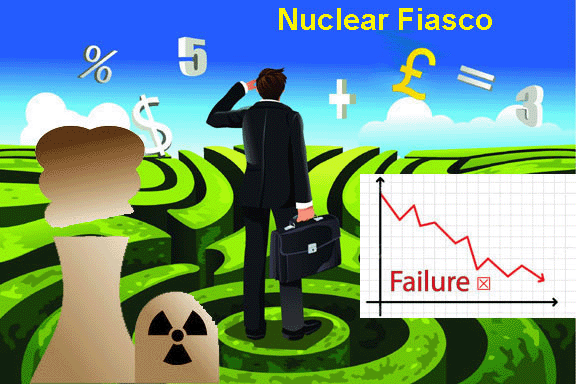
What’s more chilling: watching Chernobyl or cogitating on the cost of going nuclear? Michael West Investigative Journalism Jun 20, 2019, The sudden push by the Murdoch media and Coalition right-wingers to overturn Australia’s nuclear power ban ignores the chilling economic cost — huge public subsidies, storing radioactive waste for thousands of years, the heavy costs of decommissioning and, potentially, radiation-related health costs. Veteran nuclear writer Noel Wauchope reports on the popular TV series, Chernobyl, and the economics of nuclear power.
THE frightening TV miniseries “Chernobyl” could put a few Australians off the idea of nuclear power but nuclear economics might turn out to be the bigger scare.
It is bad news for the Minerals Council of Australia and nuclear lobbyists, that Chernobyl has now arrived on some Australian TV screens, but pro-nuclear advocates are continuing to push their campaign anyway.
The miniseries “Chernobyl” has just finished in Europe and USA, outdoing “Game of Thrones” in popularity. HBO’s Chernobyl topped film and TV database IMDB’s list of the greatest 250 TV shows of all time. The first episode was screened on 12 June, 2019 in Australia, on Foxtel.
The series has had a big impact. It was highly praised by numerous reviewers but criticised by pro-nuclear lobbyists, and infuriated some Russian politicians. ………
The Coalition’s renewed push for nuclear power
In March this year, 11 Coalition MPs (Andrew Broad, James Paterson, Tony Pasin, Tim Wilson, Chris Back, Craig Kelly, Eric Abetz, Andrew Hastie, Warren Entsch, Bridget McKenzie and Rowan Ramsey) urged then Prime Minister Malcolm Turnbull to put nuclear power on the table as an electricity source for Australia. That call is now repeated by Queensland and Coalition MPs calling for an inquiry into the feasibility of nuclear power in Australia.
Prime Minister Scott Morrison said he is open to considering nuclear power if it can stand on its own two feet. Energy Minister Angus Taylor told The Guardianon 12 June 2019 he wouldn’t rule out revising Australia’s nuclear ban “when there is a very clear business case which shows the economics of this can work”. Two days later, Environment Minister Sussan Ley also told TheGuardian she was open to the review considering a removal of the ban.
But — are the economics of nuclear power viable for Australia?
When even Australia’s former top nuclear promoter has doubts, it doesn’t look promising……….
How viable is nuclear power elsewhere?
Nuclear economics in America is really a tale of woe. You hardly know where to start, in trying to assess how much this industry is costing communities and tax-payers. There are the attempts to save the nuclear industry via subsidies. There are the continuing and ever-increasing costs of radioactive wastes. There are the compensation payments to workers with radiation-caused illnesses, $15.5 billion and counting, and the legal battles over where to put the wastes. Needless to say, really, America is not initiating any new nuclear “big build”. The much touted “Small Modular Nuclear Reactors” are turning out to have no market and little prospect of being economically viable……
The UK nuclear industry is in the doldrums with repeated postponement of new projects – Hinkley Point C, Wylfa Newydd, Moorside, Sizewell C, Oldbury B and Bradwell B……The 2018 forecast for future clean-up of Britain’s aging 17 nuclear power stations has blown out to £121 billion which has had to be spread across the next 120 years……
France’s Flamanville nuclear project is taking years, remains bogged down with costly problems. Electricite de France (EDF) has financial woes but hopes to save itself by switching from nuclear to renewables. France’s former nuclear giant AREVA went bankrupt and has changed its name to Orano and Framatome — and French tax-payers are still caught up in Areva/Orano costly legal corruption scandals.
Canada is up for increasing costs for managing its nuclear wastes. Interestingly, Canada abandoned its nuclear project for producing medical radioisotopes and now leads in non nuclear production of these isotopes.
India had grand plans for nuclear power, but has cut these back, and recently cancelled 57 reactors. It continues to have problems and many outages, at its huge Kudankulam nuclear station. ….
Russia keeps offering “generous” funding to the buyer countries. But will those countries end up with big debts? Reuters reports that in China, “No new approvals have been granted for the past three years, amid spiralling costs” ………….. https://www.michaelwest.com.au/whats-more-chilling-watching-chernobyl-or-cogitating-the-cost-of-going-nuclear/
1 This month
.

Australians deserve the truth
about
AUKUS – https://aukuspublicinquiry.com/

PETITION – To: Prime Minister Anthony Albanese and the Australian Labor Government

of the week – Australians for War Powers Reform (AWPR)
To see nuclear-related stories in greater depth and intensity

