“Australia’s nuclear waste is a national issue and putting the burden on two semirural communities isn’t fair”
|
Thousands call for SA nuclear dump plans to be scrapped, as Labor remains silent on the issue, The Adelaide Advertiser , 29 Apr 19, More than 3000 people have signed a petition urging the Federal Government to scrap plans for a nuclear dump at Kimba or Hawker. It comes as Federal Labor remains silent on whether it would push ahead with the stalled plans, if it came to power next month. The Hawker and Kimba communities say they are in a “holding pattern” as they await progress on work to select a nuclear dump site, which has ground to a halt amid a legal battle. No Dump Alliance’s Mara Bonacci said campaigners would tomorrow give Grey MP Rowan Ramsey a petition calling for the Government to take sites at Hawker and Kimba off the table. Ms Bonacci said it should introduce “an independent process to look at the best place for waste in SA”. “Australia’s waste is a national issue and putting the burden on two semirural communities isn’t fair,” she said. “They haven’t consulted anybody properly. They’re looking for a postcode, and not the best process.”
However, it was unclear whether a potential change of government might result in an overhaul of the trouble-plagued planning process, as Labor did not respond to The Advertiser’s repeated inquiries about the issue. Aboriginal associations in Hawker and Kimba have opposed a move to set up a radioactive waste dump in their traditional lands. The Barngarla Determination Aboriginal Corporation complained that Kimba Council’s plan to run a community ballot about whether it supported the dump, was discriminatory. It launched Federal Court action, taking issue with the council’s plan to exclude native-title owners from the ballot because they did not live in the district. Kimba Council chief executive Deborah Larwood in January gave evidence in court, but since then, has heard nothing about future proceedings. From the council’s perspective we’re basically in a holding pattern,” Ms Larwood said.
In Hawker, Flinders Ranges Mayor Peter Slattery said his district, too, was “in limbo” until court action — both the Barngarla case and another flagged by the Adnyamathanha Traditional Lands Association (ATLA) — was settled. “I think we’re looking at a pretty long hiatus,” Mr Slattery said. The dump debate had been a “divisive” issue. “Regardless of what happens, there’s not going to be a decision in the next six months and it could be much longer,” Mr Slattery said. The protracted debate was generating “growing frustrations” on both sides of the fence. “Everyone is wearying of the process and the antagonism it’s generated,” Mr Slattery said. Maurice Blackburn senior associate Nicki Lees, representing ATLA, said the Hawker ballot would have excluded a significant number of Adnyamathanha people. The organisation in December lodged a complaint in the Australian Human Rights Commission and was awaiting conciliation. It also claims Commonwealth contractors carried out ground disturbing work in the area, which desecrated land sacred to Adnyamathanha women, causing them “great distress”. Ms Lees said it made sense to await the outcome of the Kimba case before potentially launching ATLA’s own court action. Resources Minister Matt Canavan said the Hawker and Kimba ballots were due last year. “As this matter is before the courts, the Government cannot speculate on when any community ballot may be held,” Mr Canavan said.
|



Petition to stop federal government’s plans to build a nuclear waste facility in Kimba or Hawker
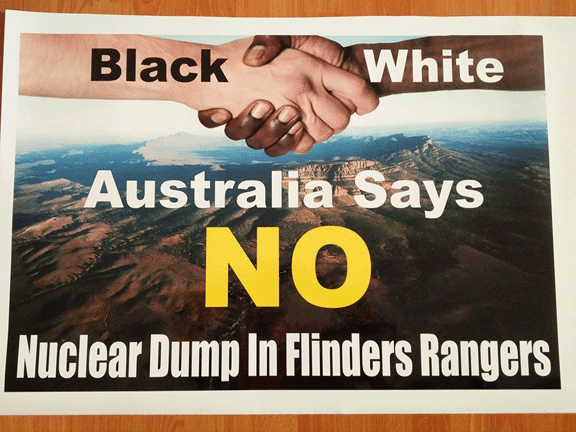 Alliance petition government over nuclear https://www.whyallanewsonline.com.au/story/6094410/alliance-petition-government-over-nuclear/, Louis Mayfield , 29 Apr 19,
A community postcard opposing the federal government’s plans to build a nuclear waste facility in Kimba or Hawker will be delivered to the Whyalla Office of Member for Grey Rowan Ramsey on Tuesday.
The postcard, which urges the federal government to ‘investigate all safe options before proceeding with this current plan’ has been put together by the No Dump Alliance, a group that represents community opposition to the nuclear waste dump.
Flinders Rangers Adnyamathanha woman Vivianne McKenzie said ‘there are many people in the community who have opposed this nuclear waste dump since it was first announced’.
Monday marked three years since Wallerberdina Station in the Flinders Ranges was named as the federal government’s preferred site for a national radioactive waste facility.
Currently three sites are under federal consideration: two near Kimba on the Eyre Peninsula and one near Hawker in the Flinders Ranges.
Doctor Susi Andersson from Hawker said most people, for or against the facility, felt that three years of uncertainty was too long.
“The process of finding a site for a NRWMF is dividing and harming our community,” she said.
Kimba farmer Peter Woolford said jobs were at risk because of the government’s ‘unpopular and unnecessary’ plan.
“We will not sit quietly and allow a flawed plan to have a lasting negative impact on our way of life,” he said.
 Member for Grey Rowan Ramsey said he totally agreed that three years was too long for the site selection process – however he noted that the nuclear proposal was tied up in a court case launched by the Barngarla Determination Aboriginal Corporation.
“While we’re still waiting for the judge’s decision there’s nothing we can do in that space,” he said.
“There are differing views (on nuclear) in each community, I am aware of that. From day 1 my government made a commitment that we wouldn’t be forcing this facility on a community that does not want it.
“The towns of Hawker and Kimba are without a doubt the best educated communities in Australia on this issue and should be left to have their say in a voting mechanism.”
Mr Ramsey said he would pass on the postcard from the No Dump Alliance to Minister Canavan.
Grey voters see red over 3 years of federal radioactive waste plan
Maria Bonacci, 29 April 2019, Today marks three years since the federal government named Wallerberdina Station in the Flinders Ranges as its preferred site for a national radioactive waste facility.
Since then, Kimba on the Eyre Peninsula has also been targeted. Members of both communities have since worked consistently to prevent becoming home to Australia’s radioactive waste.
Adnyamathanha woman from the Flinders Ranges Vivianne McKenzie said “there are many people in the community who have opposed this nuclear waste dump since it was first announced. We need Canberra to listen to us, because we will never give up.”
As part of these efforts a community postcard initiative opposing the planned waste site is being delivered tomorrow to the Whyalla office of current federal member for Grey, Mr Rowan Ramsey. He is being requested to take it to Federal Resources Minister Matt Canavan on behalf of the community. Copies will also be given to Shadow Minister Kim Carr, the Kimba District and Flinders Ranges Councils and the SA state government.
One of the messages collected on the postcards was “please investigate all safe options before proceeding with this current plan”. The Government is rushing and wrong and we want a different approach.
There are three sites currently under federal consideration: two near Kimba on the Eyre Peninsula and one near Hawker in the Flinders Ranges. All three sites are actively contested and all are in Grey, the largest electorate in South Australia.
Dr Susi Andersson from Hawker said “three years of uncertainty is too long. The process of finding a site for a NRWMF is dividing and harming our community. Most people, for or against the facility, feel three years is too long. This is affecting the well-being of individuals and the community.
“The Cadence Economic Report commissioned and published by DIIS predicts an 8% increase in GRP (gross regional product) when the facility is expected to be operational in 2030. SA tourism predict a State-wide rise in tourism activity by 2030 of 32%. Tourism and primary production are the basis of our economy and our future, not a radioactive waste facility. DIIS produces lots of slick propaganda promoting their proposal but when we ask questions or for clarification, it usually takes months to get an answer” Dr Andersson concluded.
Peter Woolford, a farmer from Kimba said “Our homes – our communities – our jobs are at risk from this unpopular and unnecessary plan. We will not sit quietly and allow a flawed plan to have a lasting negative impact on our way of life.”
The No Dump Alliance – a broad grouping of SA community, Aboriginal and agricultural representatives – is calling on the current and any future federal government to scrap the current site selection process, take the three sites in SA off the table and hold an independent inquiry into the full range of ways to manage Australia’s radioactive waste.
For media comment or to arrange interviews please call Mara Bonacci: 0422 229 970
Lynas’ rare earths miner: its troubles are a reminder that even renewables technologies involve radioactive trash
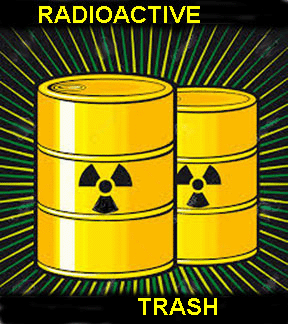 Toxic waste: Lynas Corporation and the downside of renewable energy, Independent Australia, 28 April 2019 In some cases, renewable energy can have profoundly harmful environmental effects if not managed correctly, writes Noel Wauchope.AUSTRALIA’S LYNAS CORPORATION is currently under the business and political spotlight. The current controversy over Lynas rare earth elements company is a wake-up call to an area of vulnerability in renewable technologies – the radioactive pollution produced by developing the rare earth elements essential for today’s hi-tech devices. Electric cars, batteries, energy efficient lighting, smartphones, solar panels, wind turbines and so on all need some of the 17 mineral elements classed as rare earth. The mining and processing of this produces radioactive trash. Toxic waste: Lynas Corporation and the downside of renewable energy, Independent Australia, 28 April 2019 In some cases, renewable energy can have profoundly harmful environmental effects if not managed correctly, writes Noel Wauchope.AUSTRALIA’S LYNAS CORPORATION is currently under the business and political spotlight. The current controversy over Lynas rare earth elements company is a wake-up call to an area of vulnerability in renewable technologies – the radioactive pollution produced by developing the rare earth elements essential for today’s hi-tech devices. Electric cars, batteries, energy efficient lighting, smartphones, solar panels, wind turbines and so on all need some of the 17 mineral elements classed as rare earth. The mining and processing of this produces radioactive trash.
Environmentalists, in their enthusiasm for renewable energy, seem unaware of this fact, while they rightly condemn coal and nuclear power, for their toxic by-products. Australia’s Lynas Corporation has two major rare earth facilities — mining at Mount Weld, Western Australia, and processing at Kuantan, Malaysia. For years, there’s been a smouldering controversy going on in Malaysia, over the radioactive wastes produced by the refining facility at Kuantan. Now, this has come to a head. On 17th April, the Malaysian Government insisted that Lynas Corp must remove more than 450,000 tonnes of radioactive waste from the country, for its licence to be renewed in September. Australian Government legislation and policy prohibits the import of radioactive waste. However, some categories of radioactive waste are exempt from this law, if they contain very low levels of radioactivity. Here’s where it all gets terribly complicated. Wesfarmers wants to take over Lynas. The Australian Securities and Investments Commission (ASIC) is examining this, and especially Wesfarmers’ involvement with the Malaysian government. The Age on 16 April, reported that Prime Minister Mahathir, following discussions with Wesfarmers, announced that a company interested in acquiring Lynas had promised to extract the radioactive waste before exporting the ore to Malaysia. All this raises the question of exactly what would an Australian company, such as Wesfarmers, do with that radioactive waste? This is a thorny problem. And what would Lynas do about their current problem?…… It is complicated to grasp the methods used and just what is required for the proper cleanup of the Lynas rare earth elements refining. Lynas CEO Amanda Lacaze maintains that the wastes left behind are only marginally radioactive. …… culture and history really have their impact, precisely in Malaysia’s experience of rare earth processing. Even if the Lynas waste really is only slightly radioactive, Malaysians remember the environmental and health disaster of Bukit Merah; where, early this century, rare earth processing left a toxic wasteland. China’s rare earth element processing disaster in Inner Mongolia is better known, an environmental catastrophe from the 1960s which lingers today. Modern processing has improved safety in waste management. In relation to nuclear power, there is an abundance of information on radioactive waste management, for China and for other countries. However, there’s little or no information that’s easily available to specifically discuss radioactive waste from rare earth processing. Australia does have another, smaller, rare earth elements mining and processing operation, Arafura Resources, in Central Australia. The Northern Territory Environment Protection Authority (EPA) found this acceptable….. What is clear, is that the production of the world’s hi-tech devices is not a simple matter as far as the environment goes. Climate change activists, anti-nuclear activists and environmentalists in general can keep on promoting renewable energy and electric cars. But they seem to be blind to the total picture, which includes the downside. Obviously, it is necessary to ensure safer disposal of the trash from rare earth mining and processing. A better idea is to develop the design of devices so that the minerals can be retrieved from them and recycled, thus greatly eliminating the need for mining rare earth. And this is beginning to happen. ….. Energy conservation is the biggest factor in the change that is needed. Social change, however difficult that will be, is going to be the most important answer — the transition from a consumer society to a conserver society. The Lynas radioactive trash controversy is not going to go away quickly, however much governments and corporations want to keep it under wraps. And it also could be a catalyst for discussion on that downside of renewable and hi-tech devices. This is something to think about as we throw away last year’s iPhone in favour of the latest model. https://independentaustralia.net/environment/environment-display/toxic-waste-lynas-corporation-and-the-downside-of-renewable-energy,12619#disqus_thread |
|
|
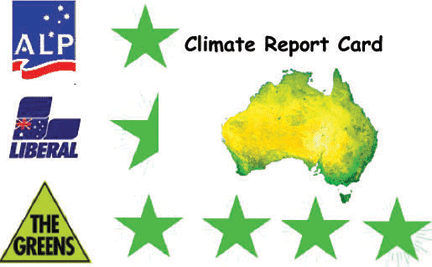
Liberal Coalition gets a poor rating on climate policy
|
Coalition scores ‘F’ on climate policy-ACF, https://www.sbs.com.au/news/coalition-scores-f-on-climate-policy-acf 28 Apr 19,The federal coalition government has scored a ‘fail” on its climate change policy but Labor has scraped through with a “pass”, a conservation group says.
A climate change advocate has scored the climate policies of the major policies, marking down the coalition as a fail but with Labor scraping through with a pass mark. The Greens, however, scored a high distinction. “Of the two major parties, Labor is miles ahead of the coalition on climate commitments, but neither party is doing enough to make Australians safe from climate damage,” Australian Conservation Foundation chief executive Kelly O’Shanassy warned. Given the importance of the response to climate change in the 2019 election campaign, the ACF assessed the policies on 50 key tests across four broad areas before giving each a score out of 100. These areas included ramping up renewables, phasing out coal, stopping Adani’s coalmine and protecting nature. The scorecard gives the Greens’ policies 99/100 and Labor 56/100, but the coalition just 4/100. “The coalition’s signature climate policy – the emissions reduction fund – has not curbed Australia’s climate pollution,” Ms O’Shanassy said handing down the scorecard on Monday. “For the coalition to again offer this ineffective policy as its main plan to tackle climate change shows a disregard for farmers, survivors of natural disasters fuelled by global warming and the next generation of Australians.” Meanwhile, the ACF believes while Labor has put forward a credible framework for cutting climate pollution and growing the renewable energy sector, it is only halfway to full marks because of its blind spot on coal and gas. In particular, Labor hasn’t (established) plans to phase out coal-fired power and hasn’t ruled out the Adani mine,” Ms O’Shanassy. However, the policies the Greens are taking to the election reflect the urgency of action that scientific bodies like the Intergovernmental Panel on Climate Change say is needed to keep global warming at relatively safe levels, she added. |
|
2019: the climate election
Friends of the Earth, APR 24, 2019,
Uranium miner coaxed government to water down extinction safeguards
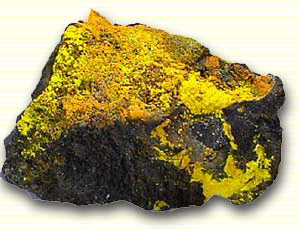 Guardian, Adam Morton@adamlmorton, 27 Apr 2019 Cameco did not have to show if WA mine would lead to extinction of tiny fauna before its approval on 10 April, A multinational uranium miner persuaded the federal government to drop a requirement forcing it to show that a mine in outback Western Australia would not make any species extinct before it could go ahead.
Canadian-based Cameco argued in November 2017 the condition proposed by the government for the Yeelirrie uranium mine, in goldfields north of Kalgoorlie, would be too difficult to meet.
The mine was approved on 10 April, the day before the federal election was called, with a different set of conditions relating to protecting species.
Environmental groups say the approval was politically timed and at odds with a 2016 recommendation by the WA Environmental Protection Authoritythat the mine be blocked due to the risk to about 140 subterranean stygofauna and troglofauna species – tiny animals that live in groundwater and air pockets above the water table.
A Cameco presentation to the department, released to the Greens through Senate estimates, shows the government proposed approving the mine with a condition the company must first demonstrate that no species would be made extinct during the works.
Cameco Australia said this did not recognise “inherent difficulties associated with sampling for and describing species”, including the inadequacy of techniques to sample microscopic species that live underground and challenges in determining whether animals were of the same species. It said the condition was “not realistic and unlikely to be achieved – ever”
The condition did not appear in the final approval signed by the environment minister, Melissa Price, which was made public after being posted on the environment department’s website on 24 April.
Instead, the government said the company should develop a groundwater management program, limit groundwater extraction in some places to 50cm and have evidence from a qualified ecologist that work in part of the area affected by the mine would not lead to extinction. All would need to be submitted to the environment minister for approval.
Mia Pepper, from the Conservation Council of WA, said the change to the conditions showed mining companies had a disproportionate influence in what was a flawed environmental approvals process.
She said a clear condition to stop extinction had been replaced with convoluted requirements that shifted the onus for stopping species loss from the company to the government.
“I think the public and government department should expect [that] companies can provide evidence that species won’t be made extinct,” she said. “The attitude in the mining industry around subterranean fauna has been pretty poor. Whether they are tiny species or cute and cuddly species, they should all be protected. Who are we to decide?”
Pepper said Yeelirrie had been subject to probably the most extensive subterranean fauna survey at an Australian mine site when it was owned by BHP Billiton. “The chances that these species exist elsewhere is almost zero to none. That is backed up by the BHP survey and the EPA,” she said……
Labor has called on Price to explain why the mine was approved in the shadow of an election campaign.
Cameco Australia general manager, Simon Williamson, welcomed the approval but said a decision to advance the Yeelirrie mine would depend on market conditions, which were currently challenging. The mine is also the subject of a legal challenge in the WA court of appeal by the conservation council and three Tjiwarl traditional owners. https://www.theguardian.com/environment/2019/apr/27/uranium-miner-coaxed-government-to-water-down-extinction-safeguards
Australian children want Australia to take action on climate change: it’s about their future!
 We underestimate young people because it’s convenient, SMH, By Caitlin Fitzsimmons, April 28, 2019 —
Of course, they are – climate change is an existential threat for Generation Z. Did you think they wouldn’t notice?
In a recent incident that made the news, the NSW Department of Education ordered Ramsgate Public School to remove two letters from students published in an online newsletter.
The children had written letters about climate change, notionally to Prime Minister Scott Morrison though the letters weren’t sent, as part of an exercise in persuasive writing.
A department spokesman told The Sun-Herald the letters were written after a geography lesson about the Great Barrier Reef. The spokesman said there was no problem with the lesson or the letters themselves but because they were addressed to the Prime Minister and were critical of government policy, the publication of the letters breached the Controversial Issues in Schools policy.
The incident was reported in The Daily Telegraph, which quoted two right-wing think tanks and a conservative academic in a story about how teachers are ostensibly subjecting children to a political agenda in the classroom and “brainwashing young, immature and vulnerable children with their politically correct ideology”.
Last week, Swedish climate change activist Greta Thunberg, the girl who started the worldwide school strike movement, addressed the British Parliament. Predictably, people who don’t want to hear her message choose to attack her instead – they mock her appearance and stern manner, her Asperger’s, claim she is paid to protest, and dismiss her on the basis that she has only just turned 16.
If you would prefer to listen to an adult who has studied the issue then by all means do so – they will tell you the same as Thunberg. The difference is that Thunberg’s youth gives her message about the future a certain moral clout.
Climate change is a tough issue for teachers and not just because they are hamstrung by policy………
Among the surveyed teenagers, the vast majority (86 per cent) view climate change as a threat to their safety, with 73 per cent saying it affects the world “a lot” now and 84 per cent saying it will affect the world “a lot” in the future.
Three out of four want Australia to be taking action on climate change, to lead by example and play our part in stopping its worsening effects. Only 8 per cent believe we shouldn’t take action because of negative effects on the economy and only 5 per cent that we are too small a nation to make a difference. Only 4 per cent do not believe climate change is both real and caused by human activity………
Young people and all future generations are the ones who will inherit a vastly depleted natural world. The only way to counter that moral authority is to call them “pawns” in a debate they couldn’t possibly understand.
Or we could hear the message and act. As Thunberg says, we need to act like the house is on fire – because it is.
More evidence that US may seek to prosecute Julian Asssange under the Espionage Act
, 28th April 2019 More evidence has emerged that WikiLeaks founder Julian Assange could be prosecuted for offences under the US Espionage Act. Although testimony provided by a digital forensics expert raises questions about the prosecution.
Uranium to be transported across Nullarbor Plain all the way from Yeelirrie to Port Adelaide

 They will ship uranium across the Nullarbor through Pt Adelaide. I understand that Pt Adelaide and Darwin are the only ports they can ship out of, as Fremantle refuses. That extremely long journey will put up the cost of the uranium which as I understand is still very low.
The yellowcake highway to Port Adelaide , The Adelaide Advertiser
Uranium produced from a controversial West Australian mine approved a day before the federal election was called will be exported from Port Adelaide……. (subscribers only)
Federal Environment Minister, Melissa Price, fails the environment with secretive Yeelirrie uranium approval.
South Australian aborigines again face a nuclear threat – as Federal Government plans a nuclear waste dump
 Trident celebrations ignore Aboriginal victims of British nuclear weapons testing, Green Left, Linda Pearson, April 26, 2019 Issue 1218, Scotland New threat from nuclear waste dump
“………..Aboriginal communities in South Australia now fear that they will be forced to bear the risks of radioactive contamination again. The Australian government is currently considering three sites for the location of a national nuclear waste dump, two on Barngarla land, near Kimba, and one on Adnyamathanha land at Wallerberdina Station, near the Finders Ranges.
The dump will host nuclear material currently stored at different sites in Australia, plus waste from Britain pursuant to a 2012 agreement between the British and Scottish governments. The agreement relates to waste generated by the reprocessing of Australian nuclear fuel at Dounreay. However, that waste is to remain where it is and a substituted amount will be shipped from the Sellafield nuclear reprocessing and decommissioning site, located on the coast of the Irish Sea.
The views of traditional owners have been sidelined throughout the process for choosing the dump’s location and Adnyamathanha’s traditional owners say that federal government contractors have already damaged sacred sites. As a result, two separate human rights complaints are outstanding in Australian courts.
Campaigners have called on the British and Scottish governments to halt the shipment while there is a risk that it will end up dumped on Aboriginal land without the consent of the Traditional Owners. However, the British government said the shipment “will comply with all relevant international laws” and the eventual destination of the waste is “a matter for the Australian authorities”. The British Environment Agency has so far failed to respond to requests to halt the shipment of waste from Sellafield.
The Scottish government has also failed to act to stop the shipment, despite expert advice it commissioned, which states that the Scottish Environment Protection Agency and, ultimately, Scottish ministers could refuse to authorise the shipment on human rights grounds.
Britain’s plans to celebrate 50 years of at-sea nukes erases the experience of Indigenous people affected by nuclear weapons testing. Those experiences should be front and centre in any discussion about nuclear weapons, as ICAN recognised.
Instead of celebrating, we should be looking at ways to redress the past and prevent future harm. Britain should apologise for its nuclear weapons testing and pay adequate compensation to those affected. The shipment of nuclear waste from Sellafield should be stopped.
But there is only one way we can prevent more lives being destroyed by nuclear weapons and that is by eliminating them altogether. https://www.greenleft.org.au/content/trident-celebrations-ignore-aboriginal-victims-british-nuclear-weapons-testing
Clandestine approval for controversial uranium mine is evidence Australia needs better environment laws
https://www.acf.org.au/clandestine_approval_for_controversial_uranium_mine, 26 APRIL 2019
|
Radioactive risks last longer than any politician and deserve real assessment, not backroom fast-tracking. The Morrison Government’s quiet approval of a controversial uranium mine in Western Australia on the eve of the federal election being called is more evidence our national environment laws are broken, the Australian Conservation Foundation (ACF) says. Environment Minister Melissa Price approved the Yeelirrie uranium mine on April 10, the day before the Prime Minister headed to Government House to call the 2019 federal poll. Ms Price did not announce the approval via a public release. Instead a notice was later placed on the Environment Department’s website. The mine had been previously rejected by the WA Environmental Protection Authority (EPA) because it could drive to extinction rare subterranean fauna species and do harm to other wildlife species like the Malleefowl, Princess parrot and Greater bilby. The Yeelirrie mine, which is in Ms Price’s electorate of Durack, is still being legally challenged on appeal by senior Tjiwarl native title holders and conservationists. Ms Price had previously told media: “My department advised that it was prudent to wait for the result of the WA Supreme Court proceedings before finalising the federal assessment [for Yeelirrie].” ACF Nuclear Free Campaigner, Dave Sweeney, said Yeelirrie could produce more than 35 million tonnes of radioactive mine waste, use up to 10 billion litres of groundwater, and require 2500 hectares of vegetation to be cleared for its nine-kilometre long open pit. “The lack of respect for the Australian people and due process demonstrated by this clandestine approval under the cover of a national election is astounding,” Mr Sweeney said. “The Western Australian EPA explicitly rejected this mine because it threatens rare native fauna with extinction and would harm other species. This prudent recommendation was overruled by the Barnett Government weeks before it lost the 2017 state election. “Now the Morrison Government has performed the same trick, approving it hours before a federal election was called. This was done without regard for the Tjiwarl Traditional Owners, on whose land the planned mine sits, or the people of Esperance, who could have radioactive material shipped through their port. “There are many with deep concerns about this project. Any move to mine at Yeelirrie will be actively contested. We thought the rushed approval of Adani’s plans to guzzle billions of litres of groundwater for its massive coal mine on the eve of the election was a new low. But somehow hours later this low point was dug deeper by Minister Price. “Radioactive risks last longer than any politician and deserve real assessment, not backroom fast-tracking. “For too long Australia’s environment laws have been abused and short-changed by politicians cutting deals that put the interests of big companies over nature, Traditional Owners and local communities. “The assessment of this project has been deficient. This rushed rubber stamp must be reviewed by any future federal government. “Australia needs new and stronger national environment laws that actually protect nature and take politics and undue influence out of approval decisions for major industrial projects. “These laws should be overseen by an independent national EPA that is charged with making approval decisions free from the interfering hand of big businesses and their politician mates.” |
|
Morrison govt approved Yeelirrie uranium mine just the day before calling the election
|
Government approved controversial uranium mine one day before calling the election ABC News, 25 Apr 19, by national environment, science and technology reporter Michael Slezak, The Morrison Government signed off on a controversial uranium mine one day before calling the federal election, and did not publicly announce the move until the environment department uploaded the approval document the day before Anzac Day.
Key points:
The Yeelirrie Uranium mine, located 500 kilometres north of Kalgoorlie in Western Australia, requires both federal and state approval. The state approval of the proposed mine is still being fought in the state’s Supreme Court by members of the Tjiwarl traditional owners. In 2016, the West Australian Environment Protection Agency advised the mine not be approved, concluding it posed too great a risk of extinction to some native animals. The former Liberal Barnett government controversially approved the mine in 2017, just weeks before it lost the West Australian election. Canadian company Cameco, the world’s largest uranium producer, is seeking to develop the uranium mine, which would cover an area 9km long and 1.5km wide. It would involve the clearing of up to 2,422 hectares of native vegetation. It is also approved to cause groundwater levels to drop by 50cm, and they would not completely recover for 200 years, according to Cameco’s environmental reports. A spokesperson for Environment Minister Melissa Price said the approval was subject to 32 strict conditions to avoid and mitigate potential environmental impacts. Traditional owner of the area, Tjiwarl woman Vicky Abdullah, said she was surprised by the announcement, and was hoping for the project to be rejected. “It’s a very precious place for all of us. For me and my two aunties, who have been walking on country,” she said……. Ms Price has declined an interview with the ABC. …… Dave Sweeney, an anti-nuclear campaigner at the Australian Conservation Foundation, said the timing suggested the decision was political. “We need decisions that are based on evidence and the national interest, not a company’s interest or not a particular senator’s or a particular government’s interest,” he said. “This reeks of political interference, rather than a legal consideration or due process.” The approval is one of several controversial moves the Government made before entering caretaker mode, where such decisions would be impossible, including approving Adani’s two groundwater management plans for its proposed Carmichael coal mine. At a federal level, both Labor and the Coalition support the development of uranium mining in Australia…….. The company said the mine was expected to produce up to 7,500 tonnes of yellow cake concentrate over a 15-year period. Over its life, the mine would produce around 36 million tonnes of radioactive waste, which would be stored at the site. The West Australian EPA’s recommendation to block the mine was based primarily on the impacts the mine would have on animals that live in groundwater, called stygofauna. Dr Tom Hatton, chairman of the West Australian EPA, said there was more stygofauna in the area near the mine “than anywhere else in the northern Goldfields”. “The stygofauna habitat at Yeelirrie is particularly rich, with 73 species recorded,” Dr Hatton said in 2017. The federal approval is conditional on Cameco producing a groundwater management plan, which manages the risks to those animals. It also has a number of other conditions, including surveys to confirm reports of night parrots in the area, and if they are found, a night parrot management plan would be required. Ms Abdullah told the ABC she and her family have used the area for years to hunt and camp. “Where are all the next generation of our kids going to go,” Ms Abdullah asked……. Ongoing court challengesIn October, it was reported that Ms Price would not approve the mine before the court case in Western Australia was resolved. “My department advised that it was prudent to wait for the result of the WA Supreme Court proceedings before finalising the Federal assessment,” she reportedly told the Kalgoorlie Miner. “This ensures that we know the state decision is valid and we can avoid overlapping with any state approval conditions.”…….https://www.abc.net.au/news/2019-04-26/government-approved-uranium-mine-day-before-election/11047252 |
|
Yeelirrie has a low grade of uranium, and Cameco has closed McArthur River mine with a much higher grade
 It’s not worth wiping out a species for the Yeelirrie uranium mine, SBS, BY GAVIN MUDD “……. So are the economic benefits worth wiping out a species?
Short answer: no. But let’s, for a moment, ignore these subterranean animals and look at whether the mine would be beneficial.
Yeelirrie is one of Australia’s largest uranium deposits – and yet it has a low grade of 0.15 per cent (as uranium oxide). This refers to the amount of uranium found in rock. For comparison, the average grade of uranium mines globally is normally 0.1 to 0.4 per cent of uranium oxide (with some higher and others lower).
And Cameco’s Cigar Lake and McArthur River mines in Canada have typically been 15-20 per cent of uranium oxide. Despite such rich ore, McArthur River was uneconomic and closed indefinitely in early 2018.
What’s more, the future of nuclear power is not bright. According to the World Nuclear Industry Status Report, the number of nuclear reactors under construction around the world is at its lowest point in a decade, as renewable energy increases. The amount of nuclear electricity produced each year is flat. And nuclear’s share of global electricity is constantly falling behind renewables……..https://www.sbs.com.au/news/it-s-not-worth-wiping-out-a-species-for-the-yeelirrie-uranium-mine
1 This month
.

Australians deserve the truth
about
AUKUS – https://aukuspublicinquiry.com/

PETITION – To: Prime Minister Anthony Albanese and the Australian Labor Government

of the week – Australians for War Powers Reform (AWPR)
To see nuclear-related stories in greater depth and intensity

