Young climate activist’s letter to Australia

‘I want my childhood back’: young climate activist’s letter to Australia, SMH ,By Bella Burgemeister, May 4, 2019, My name is Bella, I’m 13 years old and I’m a climate change activist and organiser……
My book – Bella’s Challenge – was published in 2017 and now all the schools in the South West region of WA have a copy! But there’s so much more to be done.
For most of my life, the major parties have done as little as they can get away with when it comes to climate change. Are we really that greedy that we can’t see the bigger, global picture?
Young people like me are the ones who will live with the consequences of inaction on climate
change.
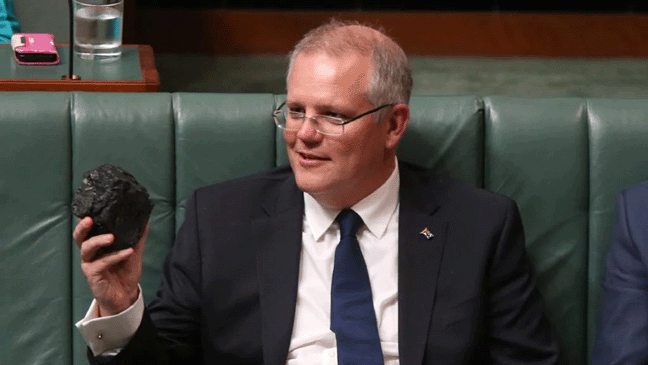
So, when I see our Prime Minister tossing around a lump of coal in the Parliament, I know I have to fight back. When I hear both future potential future prime ministers say they support the Adani coal mine, I know I have to fight back.
When the state government here in WA opens up an area two-thirds the size of Tasmania to gas fracking, I know that I have to fight back. And I’m not the only one.
I’m just one of tens of thousands of kids across Australiagiving up part of their childhood to fight for our future because we have so little time to turn around this human made disaster.
We’ve got until 2030 to get serious – that’s just three more elections – so we can’t waste another term of government.
The School Strike for Climate youth have three simple demands:
2. No new fossil fuel projects, especially drilling in the bight and fracking
3. 100 per cent renewable energy by 2030
The last action, which I was so proud to help organise, saw almost 200,000 young people around
Australia march in over 100 towns and cities.
The Prime Minister used the Parliament to tell us to stay in school, and the opposition leader told us we should have done it on the weekend – surely, he knows, as a former union boss, what the point of a strike is. This time we want to send an even bigger message!
This Friday, May 3, was a national day of action to remind the major parties that this is a climate change election.
Our demands aren’t radical, they’re the very least that needs to be done. They will take effort, but aren’t our futures worth it?
I want to stop worrying about my future and I want my childhood back.
Bella Burgemeister is a WA high school student and one of the key organisers of the WA ‘Schools Strike 4 Climate’ actions. https://www.smh.com.au/national/i-want-my-childhood-back-young-climate-activist-s-letter-to-australia-20190504-p51k2i.html
Schoolkids take their climate message to the politicians. Abbott pooh poohs it.
The earth has survived many things’, Abbott tells children protesting against climate change inaction, SMH, By Laura Chung and Jenny Noyes May 4, 2019 Dark clouds threatened rain as schoolkids gathered outside the Sydney electorate offices of both Labor and Liberal politicians on Friday, but it didn’t dampen their message on climate change.Prime Minister Scott Morrison, former prime minister Tony Abbott and Labor infrastructure spokesman Anthony Albanese were among those targeted as part of the nationwide protest against climate change inaction by federal MPs.
The protest held extra potency in Manly, where Mr Abbott’s 25-year grip on the seat of Warringah is under threat from independent candidate Zali Steggall in a campaign centred on climate change.
Armed with homemade signs, about a hundred students, parents and grandparents marched on Mr Abbott’s Manly office, chanting the slogan favoured by Steggall supporters: “Time’s up Tony”……..
A group of students tracked Mr Abbott down in a local cafe after the protest and voiced their concerns to him.
He also told them he didn’t believe the “environmental catastrophe” predicted by scientists would come about.
“I’m not saying that there isn’t going to be some time in the future when, for whatever reason, things come to an end, but I don’t believe that modest increases of atmospheric carbon dioxide concentrations over the next few decades are bound to bring about the kind of environmental catastrophe that you seem to fear.”……
Another protester dressed up in costume as Scott Morrison and a blackened piece of ‘coal’.
Another protester dressed up in costume as Scott Morrison and a blackened piece of ‘coal’.
Labor wasn’t let off the hook either.
Students also took their climate message to infrastructure spokesman Anthony Albanese’s Marrickville electorate office too, with a focus on urging Labor to pull the plug on the Adani coal mine. A Bill Shorten costume also made an appearance. https://www.smh.com.au/national/nsw/the-earth-has-survived-many-things-abbott-tells-children-protesting-against-climate-change-inaction-20190503-p51jts.html
Australia’s Liberal and Labor Parties on Climate Change – politics theme for May 2019
Federal Election: Whose climate change plan is better?
Shorten’s climate policy and why we don’t need to fear the Coalition’s ‘big scary numbers’ Guardian, Katharine Murphy, 2 May 2019
Scott Morrison wants voters to think that Bill Shorten is risky and reckless …
What’s the cost of not acting?
what Labor is saying is correct. It’s factual for this reason. Labor has set out the framework of its climate policies: the emissions reduction target, which is 45% (compared to the government’s 26%), and the various policy mechanisms to deliver that result.
But there is a fair bit of fine print missing because Labor wants to consult with stakeholders on final design before attempting to legislate the policy. …..
until we know the proportion of permits and a bunch of other things we don’t yet know – including what the Senate does to the policy if Labor wins – any number produced would be a guess. ….. https://www.theguardian.com/australia-news/2019/may/02/shortens-climate-policy-and-why-we-dont-need-to-fear-the-coalitions-big-scary-numbers
Climate change costings that don’t count the cost of inaction are worthless, Guardian, Greg Jericho 5 May 19 We must demand better of our political parties – and there is no excuse for the media either,Just seven months ago the United Nations told the world that we have 12 years to limit the climate change catastrophe. It means that to keep global warming to 1.5C above pre-industrial levels we need to cut carbon pollution by 45% by 2030 and down to zero by 2050. Twelve years. Actually scratch that – now it is 11 years.
 Now ask yourself how often that has been raised during this election campaign?
At the start of the 2019 federal election campaign Scott Morrison put out a video where he was all dewy-eyed about the future, saying “the next 10 years are important to everybody at every stage of life”.
And yet not once – NOT ONCE – did he mention that the UN has given us 11 years to do something about a global catastrophe.
No, instead it’s all standard of living and nothingness statements that would get shot down by any decent advertising firm 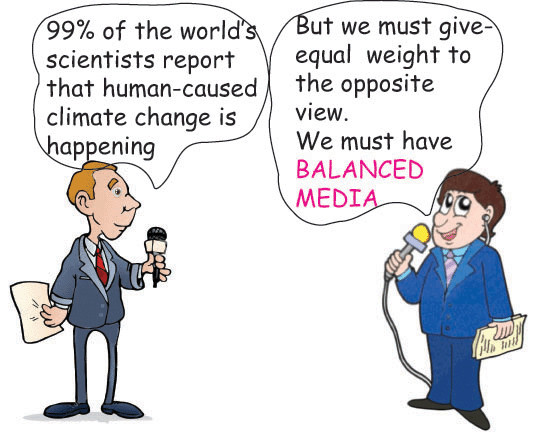 in the first meeting……..
Tony Abbott and his ilk – your time is done….
We need at a minimum a 45% reduction by 2030 and to get to zero net emission by 2050. So parties need to explain what they are going to do to get there and argue why their way is best.
It is left to rural South Australians to oppose the misguided national plan for nuclear waste dumping
 Dump opponents meet on ‘country in
  between’ https://www.eurekastreet.com.au/article/dump-opponents-meet-on–country-in-between Michele Madigan, 02 May 2019
We are the joy, the sadness, the anger and the peace.’ With these moving words, Adnyamathanha Elders Aunty Enice Marsh and Geraldine Anderson opened a significant gathering in Port Augusta last month. People from the Flinders Ranges and the Kimba farming region, still threatened by the federal government’s plans to deposit the nation’s radioactive waste, met again ‘on the country in between’.
Peter Woolford is the chairperson of the aptly named ‘It Goes Against the Grain’ group of farmers and townspeople of the Kimba region who oppose the dump and its threat to their international grain markets. From his long interview for the 7.30 Report on 28 March, only a few brief words survived the final cut, but he was pleased it was his main point: ‘We’re not activists — I’m a third generation farmer.’
His report to the Port Augusta gathering spoke of much activity, notably that the anti-dump farmers’ stand at the Cleve Field Days had attracted 1000 petitions. Meanwhile, farmer colleague Tom Harris, now on the Kimba Council, provides ‘some balance’ to the otherwise pro-dump farmers/townspeople councillors.
How can serious environmental matters in South Australia become as important in the national consciousness as those in the eastern states?”
Also in April, Friends of the Earth associates, Mara Bonacci and Dr Jim Green, travelled to Port Pirie, Port Augusta, Whyalla and Port Lincoln to meet with councils, election candidates for the Division of Grey, trade unions and Traditional Owners. Months after independent environmental expert David Noonan’s careful study of government documents revealed the ports named to possibly receive the nuclear waste, local people including council members of proposed port towns, still had no idea of this reality.
Younger members of the areas affected are speaking out. Adnyamathanha Candace Champion is standing for the Greens in the coming election. The Kimba young people are asking why they have been given no voice. As Adnyamathanha law student Dwayne Coulthard declares: ‘South Australia is being smashed right now — UCG [Underground Coal Gasification], the Bight and the Nuclear Waste Dump. How do we make this a reality for people?’
Good question! How can serious environmental matters in South Australia become as important in the national consciousness as those in the eastern states? Australia’s intermediate nuclear waste will be dangerous for 10,000 years. As Mara Bonacci explains, ‘It’s Australia’s waste, it’s a national issue, the burden of responsibility shouldn’t fall on two small regional communities.’
The SA Catholic Church recently suffered a great loss at the sudden passing of a key priest, Denis Edwards. Author of many internationally known books on a Christian response to the ecological crisis, Edwards had no hesitation in becoming a No Dump Alliance member: ‘I believe we are called by God to love and to respect this land as a gift, and to protect its integrity for future generations.’Good question! How can serious environmental matters in South Australia become as important in the national consciousness as those in the eastern states? Australia’s intermediate nuclear waste will be dangerous for 10,000 years. As Mara Bonacci explains, ‘It’s Australia’s waste, it’s a national issue, the burden of responsibility shouldn’t fall on two small regional communities.’
The SA Catholic Church recently suffered a great loss at the sudden passing of a key priest, Denis Edwards. Author of many internationally known books on a Christian response to the ecological crisis, Edwards had no hesitation in becoming a No Dump Alliance member: ‘I believe we are called by God to love and to respect this land as a gift, and to protect its integrity for future generations.’Good question! How can serious environmental matters in South Australia become as important in the national consciousness as those in the eastern states? Australia’s intermediate nuclear waste will be dangerous for 10,000 years. As Mara Bonacci explains, ‘It’s Australia’s waste, it’s a national issue, the burden of responsibility shouldn’t fall on two small regional communities.’
The SA Catholic Church recently suffered a great loss at the sudden passing of a key priest, Denis Edwards. Author of many internationally known books on a Christian response to the ecological crisis, Edwards had no hesitation in becoming a No Dump Alliance member: ‘I believe we are called by God to love and to respect this land as a gift, and to protect its integrity for future generations.’
No Dump Alliance is a broad grouping from the SA community, Aboriginal and agricultural representatives. On 29 April, the third anniversary of the day the federal government named Wallerbina, Flinders Ranges as the preferred site, the Alliance called for the scrapping of the present site selection process and the establishment of an independent inquiry to thoroughly explore all the scientifically safe options for management.
The next day, members presented hundreds of petitions to this end to federal member Rowan Ramsey. As Peter Woolford said, ‘Our homes, our communities, our jobs are at risk from this unpopular and unnecessary plan.’
Concerned Australians can offer solidarity by making an online submission here or by writing their own.
Michele Madigan is a Sister of St Joseph who has spent the past 38 years working with Aboriginal people in remote areas of SA, in Adelaide and in country SA. Her work has included advocacy and support for senior Aboriginal women of Coober Pedy in their campaign against the proposed national radioactive dump.
Clive Palmer enthuses about nuclear power for South Australia: Labor and Liberal do not agree
 Clive Palmer says SA needs nuclear to stop being a ‘backwater’ during federal election visit, ABC News, 3 May 19 Clive Palmer has described South Australia as a “backwater” which lacks “enterprise, energy and investment” during a campaign visit to Adelaide to spruik his party’s pro-nuclear policies. Clive Palmer says SA needs nuclear to stop being a ‘backwater’ during federal election visit, ABC News, 3 May 19 Clive Palmer has described South Australia as a “backwater” which lacks “enterprise, energy and investment” during a campaign visit to Adelaide to spruik his party’s pro-nuclear policies.
Key points:
The United Australia Party (UAP) leader wants nuclear reactors built in South Australia as a way of boosting investment and jobs. The State Government ruled out the nuclear option following a royal commission which concluded in 2016. A citizens’ jury also rejected a high-level waste dump “under any circumstances”. However, Mr Palmer said South Australia had the “world’s largest uranium deposits” and should embrace nuclear technology. “Australia has had nuclear reactors for 50 years at Lucas Heights in the middle of Sydney,” he said.
In 2018, an independent expert review found the Lucas Heights nuclear medicine lab failed modern nuclear safety standards and had a culture of “make-do and mend”. A contamination incident at the facility was deemed the most serious in the world in 2017 according to the International Nuclear Event Scale — the global grading system for nuclear incidents. Days after the review was released, another contamination scare at the reactor occurred, in which radiation levels rose “above allowable limits set by the regulator”. Mr Palmer said he hoped to secure the “balance of power” to work towards establishing “nuclear reactors and a vibrant manufacturing industry in South Australia”. He said any future reactor “may not be, or it may be, Australian-owned”……. Royal commission ruled out nuclear energyBoth the Liberals and Labor have hit back at Mr Palmer’s remarks, with Labor senator Penny Wong saying they prove “Clive would be devastating to South Australia…… Both the Liberal and Labor parties in South Australia rejected the royal commission’s suggestion that the state should pursue removal of federal prohibitions on nuclear power development. In a statement, SA Energy Minister Dan van Holst Pellekaan reaffirmed that commitment. “The State Government does not support the introduction of nuclear power in South Australia,” he said…….. https://www.abc.net.au/news/2019-05-02/clive-palmer-campaigns-for-federal-election-in-south-australia/11069286 |
|
|
Most people now realise that the Adani coal mine expansion is not likely to go ahead
 Adani plays a crucial symbolic role in all this. If the Carmichael project went ahead, it would open up the entire Galilee Basin, with catastrophic consequences for the global climate. Conversely, a clear-cut victory over Adani would signal the end of new thermal coalmines in Australia and, before too long, globally.
Yet a recent Newspoll conducted in Herbert estimates the two-party preferred vote unchanged from the knife-edge result of 50-50 in 2016, which saw Labor’s Cathy O’Toole returned with a margin of 37 votes. What is happening here?
The answer is that, whatever happens on 18 May, the Carmichael mine is unlikely to go ahead, and most people know this. Continue reading
A new political force in Australia- YOUNG PEOPLE WHO WANT ACTION ON CLIMATE CHANGE
Young people won’t accept inaction on climate change, and they’ll be voting in droves,
|
PhD Researcher in Science Communication, Australian National UniversityToday young Australians will hit the streets for the second Climate Strike of 2019. Youths are often brushed off as being politically disengaged, but the Australian Electoral Commission has reported record high numbers of youth enrolment, and climate change will be at the forefront of their minds when many take to the polls for the first time. Today young Australians will hit the streets for the second Climate Strike of 2019. Youths are often brushed off as being politically disengaged, but the Australian Electoral Commission has reported record high numbers of youth enrolment, and climate change will be at the forefront of their minds when many take to the polls for the first time……. While protests are an ancient tradition, Climate Strike is being led entirely by school students. Greta Thunberg, now aged 16, began the School Strike for Climate movement after attracting press to a then solitary protest at Swedish parliament in 2018. By March 15, 2019, the movement had grown to over 1.4 million studentsin more than 300 cities worldwide. This movement forces adults to acknowledge climate change is not only impacting the futures of an unknown, unborn generation, but also of those protesting here and now. Climate change, then, is not only an important issue for under 24-year-olds, but also a deeply personal one. Discussion of climate change often elicits intense emotions like fear and anxiety for their futures. In a speech earlier this year in Davos, Switzerland, Thunberg said:
 |
|

The black-throated finch – a species threatened with extinction, if Adani coal project goes ahead
Key points:
- The range of the black-throated finch has contracted by 80 per cent
- Birdlife Australia says it is already extinct in NSW
- The Carmichael mine proposal would consume one of the finch’s key habitats
Last night, the proposed coal mine was dealt a massive blow when the Queensland Department of Environment and Science (DES) rejected Adani’s current management plan for the southern black-throated finch.
It told the Indian miner the management plan “does not meet the requirements of the company’s environmental authority”.
The Carmichael mine would take up one of the last remaining healthy habitats for the black-throated finch.
A DES web page on the endangered bird explains that the black-throated finch (southern subspecies) once extended from Inverell in north-east New South Wales, through eastern Queensland, to the Atherton Tablelands and west to central Queensland.
It said the finch (southern subspecies) range had “contracted by approximately 80 per cent of its former extent over the last 20 years and is now restricted to the northern part of its former range”.
“The black-throated finch (southern subspecies) inhabits grassy woodland dominated by eucalypts, paperbarks or acacias where there is accessibility to seeding grasses,” DES said.
“Recent records from Queensland suggest that riparian habitat is particularly important as it seems to provide shelter within a highly fragmented and modified environment.”
Sean Dooley from Birdlife Australia said the finch was already extinct in New South Wales and that there were now only two small populations left in the world, both in Queensland.
There are believed to be fewer than 1,000 black-throated finches still alive.
There is a small population west of Townsville, but the main population is on the footprint of the Adani mine lease in the Galilee Basin. “Carmichael coal mine is ground zero for this bird,” Mr Dooley said………
Mr Dooley congratulated the Queensland Government for rejecting the company’s environmental management plan for the finch.
“Obviously the Queensland Government would have been under a lot of political pressure and pressure from interest groups to allow this to go through,” he said…….https://www.abc.net.au/news/2019-05-03/how-is-a-tiny-bird-such-a-big-problem-for-adani/11076386
Federal election candidates for Grey express their views on nuclear waste dump plan
Battle lines drawn in radioactive waste debate, Transcontinental, Amy Green, 1 May 19
Radioactive waste plans have been a topic of contention in Grey for three years so it’s no surprise federal candidates were asked to clarify their views at an election forum at Central Oval on Wednesday.
Battle lines were drawn as current Member for Grey Rowan Ramsey continued with his support to locate a National Radioactive Waste Management Facility at sites in the Flinders Ranges……..
Centre Alliance candidate Andrea Broadfoot rejected plans for the facility to be placed at either of the current proposed sites, a decision welcomed by the Adnyamathanha Traditional Lands Association.
“It is Australia’s responsibility to take care of its own waste,” Ms Broadfoot said.
“We are calling for there to be broad community support … but we haven’t seen a definition of broad community support.
“Barndioota and Kimba are not the places and we need to go back to the drawing board.”
Candidate for Labor Karin Bolton and candidate for United Australia Party Alexander Warren echoed Ms Broadfoot’s sentiments.
Australia’s radioactive waste is currently stored at a purpose-built ‘Interim Waste Store’ at Lucas Heights in new South Wales and has been since 2015.
Nuclear Free Campaigner Dave Sweeney rejected claims by Mr Ramsey that the Australian Radiation Protection and Nuclear Safety Agency (ARPANSA) will no longer licence this facility unless there are plans to relocate the waste by 2022.
“ARPANSA have licensed this facility through to 2055, it requires periodic updates about the status of the government project, but its license is in no way in doubt and for Rowan Ramsey to suggest, state or imply that it is, is incorrect,” Mr Sweeney said.
“His motivation is his to clarify but that statement is incorrect and where it becomes a problem in the current situation is that it could further the pressure on people over saying yes or no to a national radioactive waste dump.
“The really important thing here from the view of the Australian Conservation Foundation is that nuclear medicine in Australia is secure with or without the proposed government facility.
“To create a situation where the person who is elected to represent the one electorate in Australia that is facing this challenge and this issue is putting out information which is demonstrably incorrect. It’s not helpful.”
The selection process for the National Radioactive Waste Management Facility will continue after the May 18 federal election. https://www.transcontinental.com.au/story/6101887/battle-lines-drawn-in-radioactive-waste-debate/?fbclid=IwAR0Pbmh2mUWat1wuglHeuXjIumwnNGD9Alk-Tz_CciFYlmBprO5LfCHJuEk
The harm done to indigenous people, through uranium mining – and it’s happening again
Uranium mines harm Indigenous people – so why have we approved a new one? https://theconversation.com/uranium-mines-harm-indigenous-people-so-why-have-we-approved-a-new-one-116262 The Conversation, 1 May 19, In the 1970s, when the Ranger mine opened, the Mirarr people felt largely powerless in negotiations between mining companies and the federal government.
Last week, the Tjiwarl experienced similar disempowerment. Yet both communities are recognised by the government as traditional owners.
Unsurprisingly, Australia is yet to sign the Treaty on the Prohibition of Nuclear Weapons, continuing the persistently toxic legacy of Australia’s nuclear industry.May 1, 2019 Last week the federal government approved the Yeelirrie uraniam mine in Western Australia in the face of vigorous protest from traditional owners.
This Canadian-owned uranium mine is the newest instalment in Australia’s long tradition of ignoring the dignity and welfare of Aboriginal communities in the pursuit of nuclear fuel.
For decades, Australia’s desert regions have experienced uranium prospecting, mining, waste dumping and nuclear weapons testing. Settler-colonial perceptions that these lands were “uninhabited” led to widespread environmental degradation at the hands of the nuclear industry.
As early as 1906, South Australia’s Radium Hill was mined for radium. Amateur prospectors mined haphazardly, damaging Ngadjuri and Wilyakali lands. And an estimated 100,000 tonnes of toxic mine residue(tailings) remain at Radium Hill with the potential to leach radioactive material into the environment.
Uranium mines across Australia have similar legacies, with decades of activism from the Mirarr people against the Ranger and Jabiluka mine sites in Kakadu National Park.
In the 36 years since it began operating, the Ranger mine has produced over 125,000 tonnes of uranium and experienced more than 200 accidents. In 2013, a reported one million litres of contaminated materialspilt into the surrounding environment.
Aboriginal communities remain at a disproportionate risk because large uranium deposits exist in lands deemed sacred and significant, while the testing and dumping of nuclear material is rarely undertaken in areas inhabited by settlers.
The federal government’s ambivalence toward these impacts has most recently culminated in their decision to give Cameco the go-ahead for the Yeelirrle uranium mine, a blow to the traditional owners of Tjiwarl country.
Native title fails to protect traditional owners from the mining industry
The Tjiwarl people have fought the Yeelirrie mine alongside the Conservation Council of WA for more than two years. They now must grapple with the government’s decision to ignore their resistance.
And in 2017, the International Campaign to Abolish Nuclear Weapons (ICAN) negotiated with the United Nations to create a treaty banning nuclear weapons. The treaty, adopted on July 7, 2017, recognised the disproportionate impact nuclear material has on Indigenous communities around the world. It includes the mining and milling of uranium.
The treaty warns that parties should be:
mindful of the unacceptable suffering of and harm caused to the victims of the use of nuclear weapons (hibakusha), as well as of those affected by the testing of nuclear weapons, [and recognise] the disproportionate impact of nuclear-weapon activities on indigenous peoples.
Nuclear weapons sourced from Aboriginal lands
The toxic legacy of uranium mining is not isolated to the contamination of ecosystems.
Radium Hill provided uranium for weapons for the United Kingdom and United States, including the nuclear weapons tested at Maralinga and Emu Field in the 1950s and 1960s.
These weapons spread radioactive contamination and dispossessed Aboriginal communities in and around the Anangu Pitjantjatjara Yankunytjatjara (APY) lands.
Uranium from the Ranger mine in Northern Territory found its way into the Fukushima Reactor, a reality that plagues the Mirrar people. In 2011, traditional owner Yvonne Margarula expressed her sorrow for those affected by the Fukushima meltdown:
it is likely that the radiation problems at Fukushima are, at least in part, fuelled by uranium derived from our traditional lands. This makes us feel very sad.
These legacies are felt acutely by those who continue to struggle with the lack of protection from native title and other government policies apparently designed to prevent the exploitation of Aboriginal communities by various industries.
In the 1970s, when the Ranger mine opened, the Mirarr people felt largely powerless in negotiations between mining companies and the federal government.
Last week, the Tjiwarl experienced similar disempowerment. Yet both communities are recognised by the government as traditional owners.
Unsurprisingly, Australia is yet to sign the Treaty on the Prohibition of Nuclear Weapons, continuing the persistently toxic legacy of Australia’s nuclear industry.
British exhibition on nuclear testing glosses over the impact on Aboriginal people
Cold War exhibition tries to airbrush Britain’s dark history of nuclear testing, The Conversation, Researcher, Social History/Tutor in Medical Education, University of Dundee, May 2, 2019 A new exhibition about the Cold War recently opened at the UK National Archives at Kew in south-west London. Protect and Survive: Britain’s Cold War Revealed seeks to tell the story of how the years of high nuclear tensions affected the UK, from spy paranoia to civil defence posters to communications at the heart of government. …..
Files under review
Remembrance, The omissions at the London Cold War exhibition are a reminder about the UK’s low-key approach to its weapons testing history. The story doesn’t only need to be properly told at this exhibition, it needs a permanent public space. Yet no existing museum dedicated to Britain’s wars is interested in giving it house room – not even the records and memorabilia of all the military personnel sent to observe the tests. A number of years ago I was quietly told while walking down a corridor in one major institution not to offer it my own records because “they will end up in the skip”.
The long climate change trend gathering speed
 Climate change link to global droughts goes back a century, study finds, https://www.smh.com.au/environment/climate-change/climate-change-link-to-global-droughts-goes-back-a-century-study-finds-20190501-p51j2n.html, by Peter Hannam, May 2, 2019 Humans have contributed to increased global risks of drought for more than a century, scientists say, in findings that also point to “severe” consequences ahead with climate change.
The research by US-based scientists and published in Nature journal on Thursday comes as the latest Bureau of Meteorology data showed the first four months of 2019 were the hottest on record for Australia as drought tightened its grip on the country’s south-east.
The scientists, led by Kate Marvel at NASA’s Goddard Institute for Space Studies, used so-called drought atlases derived from tree-ring data combined with satellite observations and climate models to identify how soil moisture has changed.
They found drought increased during the first half of the 20th century, eased in the quarter century to 1975 and worsened again. The pause in the trend coincided with increased aerosol pollution.
Models project and observations show a re-emerging greenhouse gas signal towards the end of the 20th century, and this signal is likely to grow stronger in the next several decades,” the paper concluded. “The human consequences of this, particularly drying over large parts of North America and Eurasia, are likely to be severe.”
Paul Durack, a research scientist and an author of the paper, said the study was the first to show global-scale droughts to be impacted by human activities.
“This is potentially bad news for Australia, and similar climate regions such as California,” he said in a statement. “These regions have experienced devastating recent droughts, and if the model projected changes continue, such droughts will become more commonplace into the future.”
Andrew King, climate extremes research fellow at the ARC Centre of Excellence for Climate System Science, said while heat extremes caused by climate change have been clear, “droughts are very complicated”, with natural variability masking the trends, Dr King said.
Hot start to 2019
The Bureau of Meteorology said the first four months of the year were Australia’s hottest on record for maximum, mean and minimum temperatures.
Day-time readings, for instance, beat the previous record set only a year earlier by almost half a degree, coming in at 1.93 degrees above the 1961-90 average.
Regions such as the Murray-Darling Basin were also the hottest on record for mean temperatures, with rainfall this year slightly below half the norm – although rains later this week should help.
Sydney is tracking the hottest on record for daytime temperatures – averaging 27.2 degrees so far in 2019, or 2.4 degrees above average. Rainfall is about a 22 per cent below the norm.
NSW is also enduring its hottest start to any year for mean temperatures. The 2.79-degree anomaly eclipsed the previous record departure of 2.51 degrees from the 1961-90 average set only in 2018, the bureau said. Rainfall is running at 55 per cent below the average for the fourth-driest start to a year.
Most Melbourne sites have also been tracking their hottest starts to any year, while many locations are also having their driest January-April periods, the bureau said.
Traditional owners fight Adani coal project, – fear destruction of their sacred wetlands
|
Adani coal mine poses ‘alarming’ risk to sacred wetlands, traditional owners say, ABC News
Key points:
The ABC this week became the first media organisation to visit the remote springs complex — one of the world’s last unspoiled desert oases — which are at the centre of a controversial Morrison Government decision that thrust Adani forward as a federal election issue. The trip to the nationally important wetlands was at the invitation of a determined group of mine opponents within the Wangan and Jagalingou (W&J) people, who have vowed to take their fight all the way to The Hague. The Doongmabulla, which means “the place of many waters”, represents the key hurdles to Adani’s mining ambitions in a project already four years overdue. The miner still has to prove to the Queensland Government it can safeguard the springs, which are also the key cultural concern for traditional mine site owners who could further put the brakes on Adani by taking them to the High Court. Scientists dispute Adani’s mine impact modellingCommonwealth science agencies have raised doubts about Adani’s modelling of the mine’s impact on the springs, saying it could drain its underground water source by four times its legal limit. But Federal Environment Minister Melissa Price approved Adani’s groundwater plans after it agreed to extra monitoring and safeguards and amid pressure from Queensland colleagues to sign off before the election was called. However, concerns raised in a joint report by the CSIRO and Geosciences Australia are being assessed by the Queensland environment department, which said it could not let the mine proceed until Adani provided better evidence about the sources of the springs…….. https://www.abc.net.au/news/2019-05-01/adani-coal-mine-poses-alarming-risk-to-sacred-wetlands/11058854 |
|
Extradition of Julian Assange Threatens Us All
|
VIPS: Extradition of Julian Assange Threatens Us All Consortium News, April 30, 2019
|
|
The progress of the Stop Adani convoy
The Stop Adani convoy so far – on to Canberra, Echo Net Daily, April 30, 2019 | by Eve Jeffery, On Wednesday April 17, Bob Brown and a few hundred of his closest friends, began a journey from Hobart to the Gallilee Basin in Queensland, to highlight the devastation that will be caused if the Adani Carmichal Mine goes ahead……
We look forward to people joining us. Almost 2000 have inquired about joining the convoy.
The group of beginners left Hobart for Devonport, then Melbourne for a rally on Parliament Lawns.
As the convoy came off the Spirit of Tasmania for the rally in Melbourne, Brown said that from the outset that the convoy, involving hundreds of vehicles and thousands of people, was about the May 18 election being a national referendum on the climate emergency and Adani…….
From Melbourne the growing group visited Albury-Wodonga before a rally in Sydney on April 20.
With flags flying, the cavalcade gave colour and contention to Prime Minister Scott Morrison’s press conference in Parramatta.
The convoy, now 200 cars, including a dozen electric cars, left a rally of nearly 1000 people in Parramatta Park to drive north, passing Morrison’s conference outside Westmead Hospital. Mr Morrison was diverted by cries of ‘Stop Adani’ as the convoy slowly passed.
At the rally an Aboriginal leader from the Adani mine site region in central Queensland, Adrian Burragubba, said he, his father, and grandfather were born at Clermont where the convoy arrives next week. He described the Adani mining company as ‘thieves’…..
Next was the north coast on Easter Sunday with stops in Coffs Harbour and Mullumbimby on the way to Brisbane.
The Bob Brown Foundation were stunned and delighted by the massive crowd in Mullum
‘This is the biggest turn out anywhere in Australia,’ Brown said.
From there it was a trip across the border into Queensland……..
Murdoch newspapers throughout Queensland, including Brisbane’s Courier-Mail, all ran the same article by journalist Renee Viellaris.
Ms Viellaris wrote a very disparaging description of the convoy including that participants were ‘blow-ins’.
‘As ever, I absolutely repudiate offensive comments such as those headlined in today’s Murdoch press,’ said Brown.
‘Offensive comments are taken down by our foundation just as they are taken down off Murdoch media sites………
Brown said that a number of Clermont business owners had expressed regret at the hostility the convoy received the previous day when cars were stoned, and an older women travelling alone, along with young families in cars, were abused and threatened and had flags ripped from their vehicles. Brown praised the Queensland Police for keeping the peace in trying conditions…….
Tensions mounted between opposing ideas in Clermont over the weekend – pro-Adani violence appalled other locals and failed to halt the convoy’s progress.
‘Everyone is concerned for our friend knocked down by the out-of-control horse,’ said Brown.
‘We hope she has a speedy recovery. The incident came after a much-publicised publican friend of Matt Canavan was refused entry to the Wangan and Jangilingou Council’s Karmoo Dreaming celebration which the convoy was enjoying at the Clermont Showground.
‘The horse rider charged between the crowd and the stage where Neil Murray was singing. Children had been dancing in that area.
Both the publican and Minister Canavan have verbally abused the convoy people……..
A witness said a second group of pro-Adani cars at the gate cheered the horse rider as he charged back out after the woman was knocked down in the arena……..
From the Gallile, the convoy will now visit Toowoomba, Armidale, Bathurst and Orange, and drive in Canberra on May 4 for a Rally for Climate on Sunday May 5.
Fo more details, visit the Bob Brown Foundation website. more https://www.echo.net.au/2019/04/stop-adani-convoy-far-canberra/
1 This month
.

Australians deserve the truth
about
AUKUS – https://aukuspublicinquiry.com/

PETITION – To: Prime Minister Anthony Albanese and the Australian Labor Government

of the week – Australians for War Powers Reform (AWPR)
To see nuclear-related stories in greater depth and intensity

