Angus Taylor again falsely claims Australia’s greenhouse emissions are falling, Guardian, Amy Remeikis
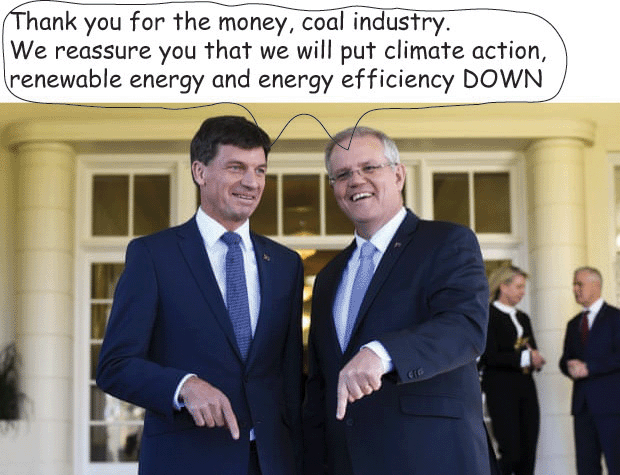
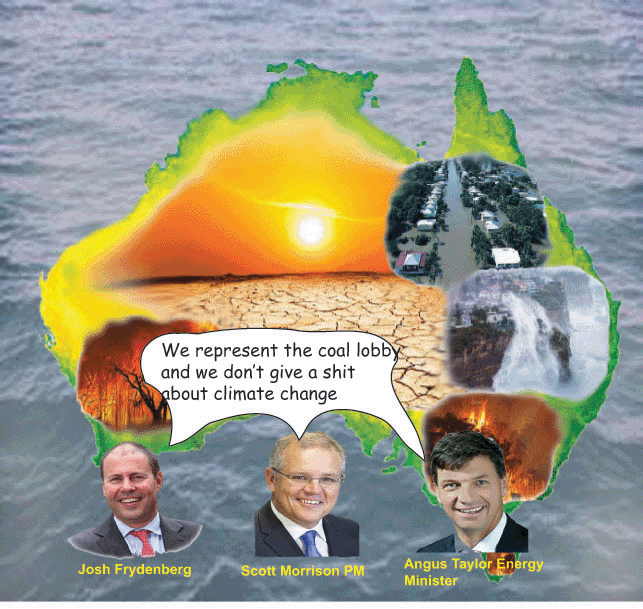
@amyremeikis The energy minister repeats PM’s line that emissions fell by 1% when the government’s own figures show the opposite The energy minister has again insisted Australia’s emissions are going down, when the government’s official figures show emissions continue to increase, as the government struggles to sell the latest incarnation of its energy policy.
Why Victoria’s bushfires generated their own lightning, The Age , By Liam Mannix, March 4, 2019 —There are few sights more terrifying for a firefighter: a vast, dark storm cloud brewing above a bushfire, shooting out lightning.
On Sunday, the Licola bushfire east of Melbourne burned with such intensity it generated a huge thundercloud that fired hundreds of lightning strikes at nearby forests.
The Bunyip fire, which is believed to have wiped at least one town off the map, also generated its own weather system which fed the fire with extreme winds.
“It’s absolutely terrifying. And it’s dangerous as well, because that lightning can start new fires before the main fire,” says Dean Narramore, a meteorologist at the Bureau of Meteorology’s extreme weather desk.
How bushfires generate their own weather
As a bushfire burns, it generates hot, smoke-filled air.
This air is hotter than surrounding air and rapidly rises, forming a smoke plume.
As the plume rises, atmospheric pressure falls. This causes the plume to spread out, generating a “mushroom” on top of the plume.
The smoke plume is filled with moisture which is released by burning trees. The higher you go in the atmosphere, the cooler it gets, so the top parts of the plume get chilled.
This causes the moisture in the plume to condense (turn from water vapour into tiny water droplets) and form a cloud.
As the plume rises rapidly into the sky, cool air is sucked in to replace it. This causes extreme winds near the firefront. To fight a fire, you need to know which way it is burning. But when a fire-cloud forms and starts generating strong and unpredictable winds, the fire can become chaotic.
‘Not very happy’: Tasman Sea warmth puts the heat on key fisheries, Brisbane Times, By Peter Hannam, March 2, 2019Back-to-back summer heatwaves in the Tasman Sea that have affected marine life and seafood industries in Australia and New Zealand could be another sign of the warming climate, scientists say.
Australia has just had its warmest summer by far, with the role of so-called blocking highs in the Tasman seen by meteorologists as key to the build-up of record-breaking heat over the country’s south-east.
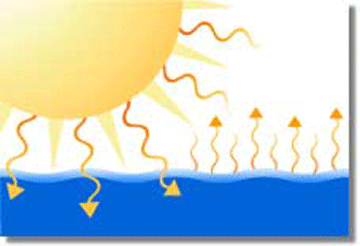
The still conditions brought by those highs have the effect of limiting ocean mixing, while the relatively cloudless skies allowed solar radiation to warm the waters of the Tasman to a greater-than-usual depth.
By the Bureau of Meteorology’s definition, a marine heatwave occurs when temperatures in the top 10 per cent of readings for that time of year exist for at least five days. The Tasman Sea has met the definition for months on end, two years in a row………
NSW election roundup: independents join forces on climate changeThree possible kingmakers write to premier and opposition leader. Plus: the key promises made this week , Guardian, Josephine Tovey
Three independent MPs who could become kingmakers in the event of a hung parliament have put climate change, and “future-proofing” the environment and economy, at the forefront of their agenda. Sydney’s Alex Greenwich, Lake Macquarie’s Greg Piper and Wagga Wagga’s Joe McGirr joined forces on Friday to call on the two major parties to commit to a 10-year adjustment strategy for coalmining communities, “backed by substantial financial resources to affected regions”.“A transition away from coal is what the planet urgently needs but it requires planning to avoid social and economic impacts in mining regions,” they wrote in a letter to the New South Wales premier and opposition leader.
Polls have consistently suggested the main parties are locked in a dead heat, and a Coalition minority government is widely regarded as a likely outcome of the 23 March election.
Green finance experts say Australia is out of step with World Bank, Europe and the US, which are using funding to combat global warming
Australia is the only developed country that allows climate change funding to be used to upgrade coal-fired power plants, green finance experts say.
Experts say allowing Vales Point coal-fired power station to register with the Morrison government’s emissions reduction fund, rebadged this week as a “climate solutions” policy, puts Australia out of step with the World Bank, Europe and the US, which have all rejected using climate financing for coal power retrofits.
The World Bank has issued US$13bn in green bonds since 2008 to stimulate spending to combat global warming.
China has used green bonds to help build new coal-fired plants to replace older, dirtier stations on the grounds it reduces nitrogen-based emissions causing the country’s oppressive air pollution. But it announced in Decemberit would no longer consider “clean coal” plants – which still emit significant amounts of greenhouse gas – investments in green technology.
Sean Kidney, chief executive of the London-based Climate Bonds Initiative, says China’s shift leaves Australiaout on its own.
“If you were committed to meeting the goals of the Paris climate agreement, which the Australian government says it is committed to, this is just lunacy,” Kidney says.
“No investors in the western world will accept any green bonds that incentivise anything like coal station retrofits. From an investor’s perspective, coal is a dead duck.”
Emma Herd, chief executive of the Investor Group on Climate Change, says Australia is moving acrossthe trend by considering giving taxpayer support to coal. In addition to the potential support through the climate solutions fund, the government is considering underwriting the cost of building new coal-fired power stations.
In the past fortnight, mining giant Glencore has said it will cap coal production in response to pressure from shareholders, while Rio Tinto stressed it was the only large mining company with no fossil fuel investments, having sold its final coal assets to Glencore last year……..
ABC News 1 Mar 19 Three staff at the Lucas Heights nuclear facility have been decontaminated after being exposed to a chemical spill.
Key points:
Australia’s only nuclear reactor is located at Lucas Heights, about 40km south of Sydney’s CBD
Two men and a women were decontaminated and taken to Sutherland Hospital
The facility has had several contamination scares in recent years
A spokesman for Australia’s Nuclear Science and Technology Organisation (ANSTO) said the workers were exposed to sodium hydroxide when a cap came off a pipe in the nuclear medicine manufacturing building…………
Contamination scares
The Lucas Heights facility, about 40 kilometres south of the Sydney CBD, has had several contamination scares in recent years.
In August 2017 a worker suffered blisters on his hands after he dropped a vial of radioactive material and was contaminated through two pairs of gloves.
The event was deemed the most serious in the world in 2017, according to the International Nuclear Event Scale — the global grading system for nuclear incidents.
ANSTO apologised to the worker who was exposed to the radioactive material and produced an “action plan”, in response.
An independent review of the facility was conducted in October 2018 and found that it failed modern nuclear safety standards and should be replaced.
I did enjoy watching Australia’s not very bright Minister for Resources, Matt Canavan, floundering about as he tries to cover up his ignorance of the subject! I did enjoy Matt Canavan triyng hard to shut up Senator Rex Patrick with his inconvenient questions about risks of nuclear waste – risks explained by Dept of Defence!
Hansard extract of Estimates Hearing on 21 February 2019 radioactive waste. [20:46]
Senator Canavan :….. we do have the uncertainty of a court case at the moment, the government hasn’t made any decision around future steps to test support for a radioactive waste facility at Kimba or Hawker. ……
Sen Patrick: – Could you give me some idea as to whether locations 45 and 45A were considered by the Commonwealth in the selection process? I note that both of those sites were recommended as a possibility in this very extensive report.
Sen Canavan: I’m not familiar with the land ownership of these two sites there. Are you saying they’re on Defence land— ……
Sen Patrick: Senator PATRICK: I just thought the department would have been aware of this study and would have some information…..
Senator PATRICK: If it is Defence land and outside the WPA, there has to be another reason, and I’m just asking for what that reason is. …
Sen Patrick I think everyone’s aware of 3 the CSIRO waste at Woomera, but there’s also another facility called Koolymilka, which is owned by Defence and has some intermediate-level waste, some of it owned by Defence, some of it administered by Defence.
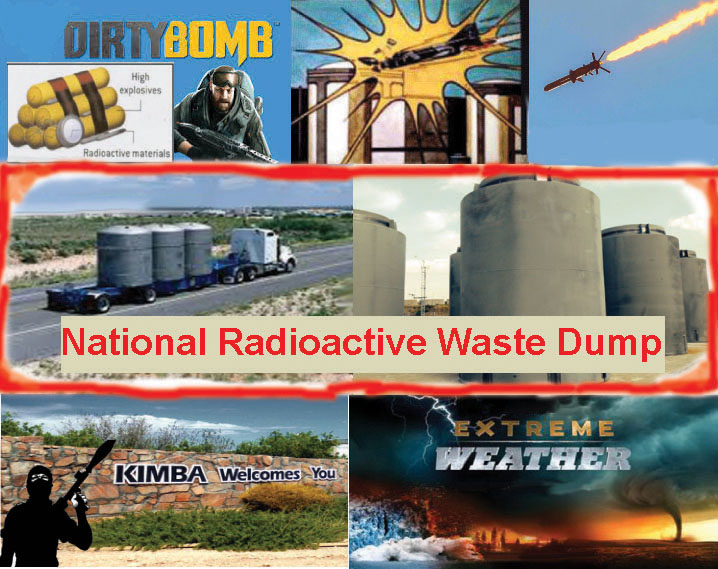
I did ask for a copy of their manual, their emergency response plan. In that plan there were a number of risks that they identified associated with the facility. They included things like fire, flood, storm, civil protest activity at Woomera, missile strike from something that might be on the range, aircraft strike from an aircraft nearby and they mention, ‘terrorist activity aimed at accessing the facility for publicity purposes, or for removing drums from the facility for use in a dirty bomb’. That is a Defence assessment. It’s in their emergency response plan and they have a contingent for it. some sort of way of reacting to that plan. I’ve spoken to residents of Kimba who basically have said that the Department of Industry has been silent on that particular prospect even though it has been raised during community consultation. I’m giving the department an opportunity to lay out has the community been consulted about the possibility of a terrorist attack and what was the nature of that consultation, if there was any?
Senator Canavan: Can I say up-front that I’ve never been provided with any advice that this is at all a risk …. this has never been raised as an issue. I have no reason to believe there is any risk of this. …….. There is extensive work around the security of the facility. This is not an issue that we would consider to be a major risk. In the same way it’s been managed at Lucas Heights for decades, it will be managed in another site once that is developed, so it would be—
Senator PATRICK: Sorry, on what basis do you say that? Have you got some defence background? Have you had some briefings on this? Senator Canavan: Senator, this has been looked at, sorry, no— Senator PATRICK: I understand that. Senator Canavan: I’m going to intervene here, because now you’re verballing public servants— Senator PATRICK: No. I simply asked on what basis did she make the claim that there’s no risk
Senator Canavan: Yes, but you made the claim in an editorial way. I don’t want to go further. But I think you’re bordering on being highly irresponsible to be 5 throwing around potential risks that I don’t think are well formed. The assessments of— Senator PATRICK: This is a Department of Defence document, Minister ….
Jim Green shared a link. Nuclear Fuel Cycle Watch South AustraliaUnpublished letter to The Advertiser … Congratulations to The Advertiser for exposing the terrorist risks associated with Canberra’s plan to establish a national nuclear waste dump in SA. The government’s claim that the dump would pose “no security or safety risk to the community” is contradicted by the plan to station 14 security and safeguards officers at the site.
The nuclear dump would be subject to aircraft strikes and intrusions. It would also be a target for terrorists removing drums to make a radioactive “dirty bomb” ‒ risks that have previously been flagged by nuclear engineers Alan Parkinson and John Large:
”If terrorists can raid a nuclear waste repository or store and steal radioactive material,” Mr Parkinson said, “they can easily spread it by conventional explosives.”
Nuclear terrorist hazards also apply to nuclear waste transportation. In 2006, a reporter succeeded in planting a fake bomb on a train carrying nuclear waste in north-west London.
A NSW Parliamentary Inquiry found there “is no doubt that the transportation of radioactive waste increases the risk of accident or incident – including some form of terrorist intervention”.
Premier Steven Marshall did himself proud by standing up against the dangerous plan to turn SA into the world’s nuclear waste dump. Will the Premier now stand up to Canberra and oppose the plan to turn SA into the nation’s nuclear waste dump?
Jim Green, Friends of the Earth https://www.facebook.com/groups/1021186047913052/
Olympic Dam Major Development Declaration, Friends of the Earth 28 Feb 19. The South Australian Minister for Planning has declared that a proposal by BHP Ltd to expand the operations of the Olympic Dam copper and uranium mine, located 550 km NNW of Adelaide, shall constitute a Major Development under section 46 of the Development Act 1993.
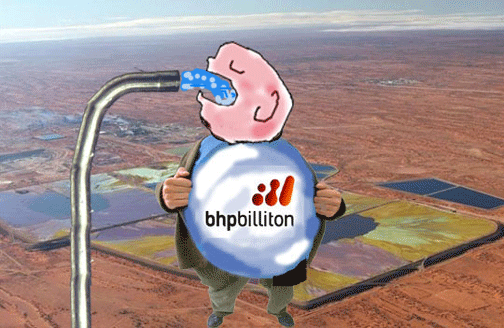
The proposal covers the expansion of mining and processing activities at Olympic Dam, including an additional take of water from the Great Artesian Basin. It allows for an increase in copper production from 200,000 tpa Cu and associated products to up to 350,000 tpa Cu and associated products, as well as new and/or expanded facilities to support the development.
The declaration of a Major Development takes the project outside the bounds of the usual development assessment process. The type of assessment and reporting required for this project has yet to be decided by the State Planning Commission and Minister for Energy and Mining. That decision will determine the degree of public consultation on offer, which this eBulletin will endeavor to report as soon as possible.
The largest player in the Morrison government’s flagship emissions reduction fund says a $2 billion cash injection should not be the government’s only major climate policy and the Australian Industry Group says the plan is not “a comprehensive or permanent” solution to curbing dangerous carbon pollution.
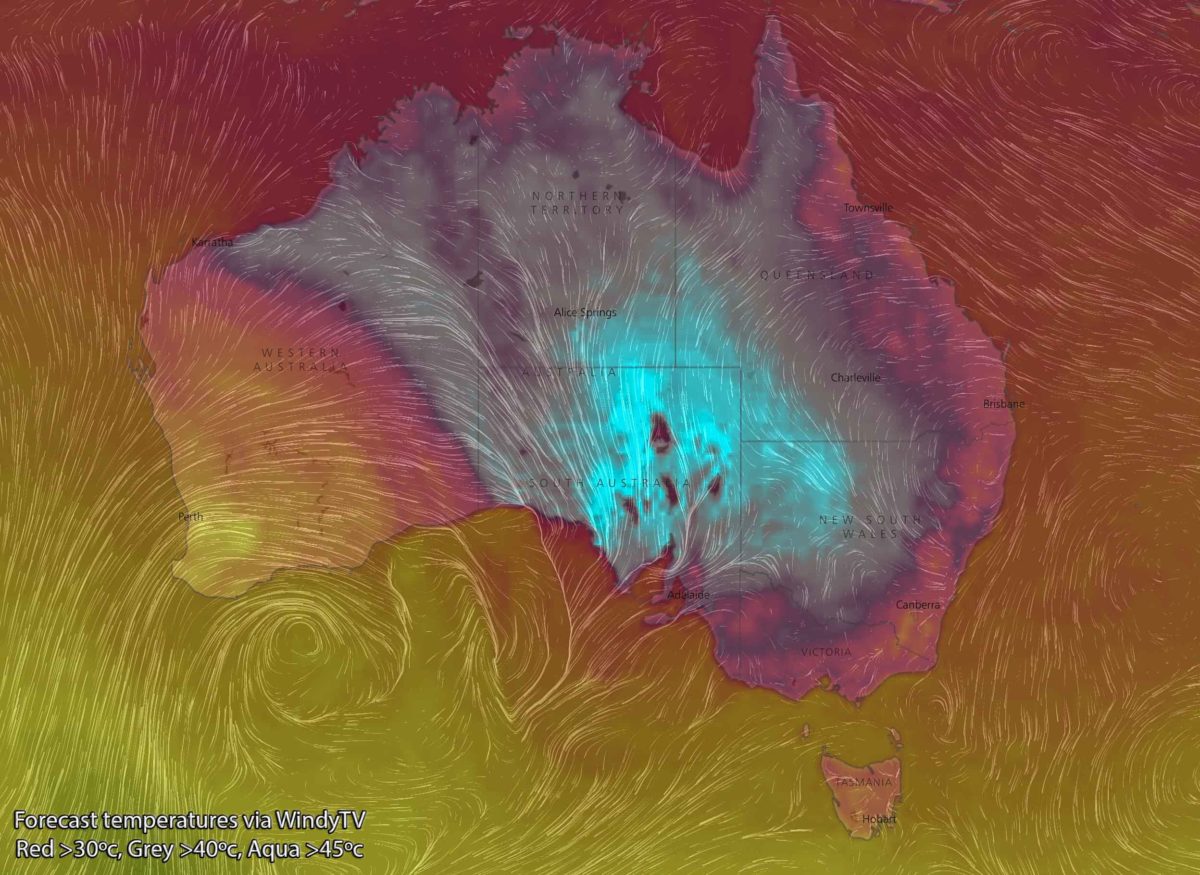
It’s been extreme’: Australia’s summer smashes seasonal heat records, Brisbane Times, by Peter Hannam, February 27, 2019 Australia has posted its hottest summer and the first season in which temperatures exceeded two degrees above the long-term averages, according to the Bureau of Meteorology.
With one more day to round out the season, it is clear Australia has eclipsed the previous hottest summer set in 2012-13, David Jones, manager of the bureau’s climate monitoring, told the Sydney Morning Herald and The Age.
“It’s been extreme and certainly something we haven’t seen before,” Dr Jones said. “It’s been dry and intensely hot right through summer.”
While final temperatures for February will be set on Thursday, maximum and mean temperatures will come in about two degrees above the 1961-90 period the bureau uses as its benchmark. While minimums were less extreme, they will eclipse the previous record for overnight temperatures set one year earlier.
The previous record summers were about one degree warmer than the average, underscoring how anomalously warm the summer just ending has been.
The heat was widespread, with NSW, Victoria and Western Australia among the regions posting a record-hot summer.
December and January were the hottest on record nationally and February will come in among the top five warmest. January alone registered eight of the 10 hottest days recorded based on area-averaged heat.
Rainfall was about 30 per cent below average, making it the driest summer since 1982-83, a season affected by a strong El Nino event. Conditions in the Pacific were at near-El Nino levels this summer, too, but temperatures were about one degree higher than that season 36 years ago…….
December and January were the hottest on record nationally and February will come in among the top five warmest. January alone registered eight of the 10 hottest days recorded based on area-averaged heat.
War, What Is It Good For… Besides Blood Lust And The Avalon Airshow? New Matilda, Dave Sweeneyon February 26, 2019
The iconic Avalon Airshow kicks off next week. But events actually get underway today, with a special exhibition for those who like their planes weaponized for death and destruction, writes Dave Sweeney.Australians are generally lucky where it comes to the air – we have big skies and safe planes that routinely take off and land and relocate us for holidays, family re-unions and commerce.
Our airborne images are red kangaroos, flying doctors and grainy newsreels of early aviators breaking new records in old planes.
It is a world away from many other places experience of the sky as a hostile space that threatens rapid and remote destruction and death………
The Avalon Airshow is comprised of two concurrent events: the Australian International Aerospace and Defence Exposition is an industry-only trade-fest that runs for three days before merging with the co-located and more public Australian International Airshow for a further three days of ‘the ultimate family adventure’.
If websites could get breathless this one would need a respirator.
Experience the awesome power of military aviation. A high voltage array of combat aircraft takes centre stage with the thrust and grunt of the latest heavy metal. Marvel as jet fighters, strike bombers and heavy lift leviathans are joined by swarms of attack helicopters, from home and abroad, for a series of breath taking routines and simulated combat manoeuvres.
Facility should be scrapped, Eyre Tribune,AUSTEN EATTS, Kimba, 20 Feb 19,
My concerns are not with ANSTO, I appreciate and am aware of the work that is done there and its value.
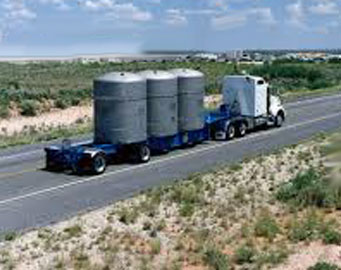
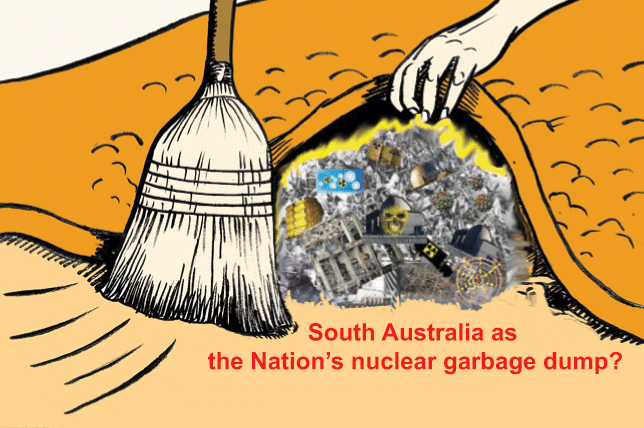
My concern is the disposal of the waste that is created in the proposed National Radioactive Waste Facility in the Kimba district.
I realise the need for the waste facility for Australia’s waste only.
If it is as safe as claimed why transport the waste half way across Australia to become the responsibility of the rural community also when we have so much arid and semi-arid land in Australia.
The site will be here for hundreds if not thousands of years the responsibility of future generations.
I went to the first meeting organised by Rowan Ramsey our federal member, he said it would be low level waste that would be deposited in the proposed site.
The next meeting there would also be stored on a temporary basis intermediate level waste for a time of approximately three or four decades and an offer of ten million dollars and 15 jobs.
Now it is $31 million plus two million dollars every year for at least two years, a total of $35 million, plus 45 jobs.
The storage time for the intermediate waste could be 100 years.
The cost to build the waste facility is estimated to be approximately $200 million.
The 100 hectares of land will become federal government property, our local government, state government and present federal government will have no control over its future use.
The money offered is a bribe to call it anything else is just playing with words.
Regarding the proposed voting, at present between 700 and 800 people in the Kimba district have the right to vote.
The population of South Australia is approximately 1.5 million people.
The voters in the Kimba district will make the decision as to whether not only Kimba or Eyre Peninsula but the whole of South Australia will have a radioactive waste facility whether they want it or not.
It is undemocratic, unfair, the whole proposition should be scrapped.













 Antinuclear