NUCLEAR POWER STATIONS ARE NOT APPROPRIATE FOR AUSTRALIA – AND PROBABLY NEVER WILL BE by Climate Council / 23 January 2019
Periodically, as with the changing of the seasons, various individuals appear in the media extolling the virtues of nuclear energy, promising a panacea of clean and reliable electricity to solve Australia’s energy crisis. But the truth is far less rosy.
…….steps involved in producing nuclear power (from mining, to construction, decommissioning and waste management) result in greenhouse gas pollution. Greenhouse gas pollution associated with nuclear power could be similar to a gas power station, with estimates ranging from 80 – 437 kg/MWh.
But nuclear energy is not “renewable”. Uranium is a finite resource just like coal or gas……
Nuclear energy doesn’t make sense in Australia
…..there are a number of reasons why nuclear power is not appropriate for Australia.
- Nuclear power stations are highly controversial, can’t be built under existing law in any Australian state or territory, are a more expensive source of power than renewable energy, and present significant challenges in terms of the storage and transport of nuclear waste, and use of water.
- Nuclear power stations also present significant community, health, environmental, and cost risks associated with potential impacts from extreme weather events and natural disasters, such as occurred in Fukushima, Japan in 2011. Nuclear power stations leave a long-term and prohibitively expensive legacy of site remediation, fuel reprocessing and radioactive waste storage.
- Australia is one of the sunniest and windiest countries in the world, with enough renewable energy resources to power our country 500 times over. When compared with low risk, clean, reliable and affordable renewable energy and storage technology in Australia, nuclear power makes no sense.
Nuclear power stations are expensive
Nuclear power stations are extremely expensive to build. For example, the Hinkley nuclear power station under construction in the UK will cost 20 billion pounds (AU$36 billion). Nuclear cannot compete on a cost basis with wind and solar, which are the cheapest forms of new generation. The cost of energy from the Hinkley Power station is significantly higher than large-scale solar, wind and offshore wind energy in the UK.
On average, nuclear power stations take a decade to build
The Hinkley power station will take nine years to build. The global average is 9.4 years. This would be even longer in Australia given there is currently no nuclear industry here. It is not unusual for nuclear power stations to take over a decade between the start of approvals and coming online. For comparison, wind and solar farms take just one to three years.
Australia cannot wait this long to replace our ageing fleet of coal power stations, which are already struggling to cope with extreme heat.
Nuclear power stations are inflexible and ill-suited to a modern grid
Nuclear power stations are inflexible – that is, they cannot quickly increase or decrease the amount of electricity they produce.
Nuclear power generation is not well suited to modern, fast and flexible electricity grids with large amounts of wind and solar generation. Unlike inflexible nuclear, fast response technologies such as batteries, pumped hydro and solar thermal can be turned on and off, or ramped up and down to balance electricity supply and demand.
In California, where wind and solar provides more than 30% of the state’s power needs, the last nuclear power plant will shut by 2026.
Nuclear power stations need a lot of water
Nuclear power stations require massive quantities of water to operate. In a dry continent like Australia, prone to hot summers and drought conditions which are only likely to get more severe as climate change worsens, it would be reckless to rely on a water-hungry power source like nuclear.
The bottom line is this: it makes no sense to build nuclear power stations in Australia.
For more information on what Australia needs to build a modern electricity grid, read the Climate Council’s report ‘Powering a 21st Century Economy: Secure, Clean, Affordable Electricity’.https://www.climatecouncil.org.au/nuclear-power-stations-are-not-appropriate-for-australia-and-probably-never-will-be/?fbclid=IwAR17owy2q3hjcXz71kId35__kQPL4GZEp1JdN-1UOo4o7iQ0RYCorZKtdWs
January 26, 2019
Posted by Christina Macpherson |
AUSTRALIA - NATIONAL, politics |
Leave a comment
January 21, 2019, “RISE: Refugees, Survivors and eX-detainees – the FIRST self-determined advocacy and welfare organisation in Australia run by Refugees for Refugees – makes a public call for a boycott of “Australia Day”, for the seventh year in a row.
We eX-detainees, Asylum Seekers and Refugees from RISE condemn any group or individual who claims to be pro-refugee but celebrates “Australia Day” on the 26th of January 2019. Instead, RISE encourages all Refugees, eX-detainees, Asylum Seekers and allies to support First Nations peoples in their actions against “Australia Day”.
RISE represents over 30 refugee community groups in Australia and is the first (and one of the few) self-determined, registered, non-profit refugee organisations in Australia governed and managed by eX-detainees, Asylum Seekers and Refugees. As eX-detainees, Asylum Seekers and Refugees in Australia, we acknowledge that the land we seek protection on is the land of Aboriginal and Torres Strait Islander Peoples whose sovereignty was never ceded. ‘Always was, always will be Aboriginal land’.
We believe the systemic abuse of Aboriginal and Torres Strait Islander peoples is a result of over 200 years of discrimination as part of the white colonial genocide strategy that continues to this day and this template is now being used against our own refugee communities. How can we dismantle the white Australian government’s refugee torture camps built within and outside its colonial borders without addressing the root cause of this criminal abuse?
RISE fully supports Aboriginal and Torres Strait Islander peoples’ sovereignty and self-determination and stands in solidarity with them every day in our commitment to fighting for justice on this land on their terms.”
ReadMore at theSource includingEvents: riserefugee.org/rise-refugee-survivors-and-ex-detainees-invasion-day-solidarity-statement-2019/
January 26, 2019
Posted by Christina Macpherson |
aboriginal issues, AUSTRALIA - NATIONAL |
Leave a comment
Adelaide now hottest capital city on record as temperatures soar throughout SA, ABC News, By Sarah Scopelianos and Camron Slessor– 26 Jan 19
Adelaide has hit a sweltering 46.6 degrees Celsius, surpassing the previous record set in Melbourne a decade ago to officially become the hottest capital in the country.
Key points:
- More than 20 locations hit record temperatures in South Australia on Thursday
- Meteorologist Hilary Wilson said records had been broken right across the state
- The CFS warned communities were at risk during extreme heat
Earlier on Thursday, Adelaide topped its 1939 heat record after hitting 46.2C.
The temperature then climbed up to 46.6C, topping the previous capital city record of 46.4C set in Melbourne in 2009.
More than 20 locations hit record temperatures in South Australia on Thursday, including Adelaide Airport, Minlaton, Noarlunga, Snowtown and Port Lincoln.
Ceduna set a record for the second day in a row, reaching 48.6C.
Meteorologist Hilary Wilson said records had been broken right across the state……….
‘Incredibly high’ temperatures overnight for Victoria
BOM Victoria’s Richard Russell said temperatures in parts of the state were going to be “nothing short of oppressive”, particularly in northern Victoria where it was expected to reach the mid-40s………https://www.abc.net.au/news/2019-01-24/sa-heating-up-with-records-expected-to-be-broken/10745220
|
|
|
January 26, 2019
Posted by Christina Macpherson |
climate change - global warming, South Australia |
Leave a comment
Newer coal-fired power stations break down more often per gigawatt than older power generators, the Australia Institute has found. https://www.sbs.com.au/news/reliability-of-newer-coal-power-questioned Reliability of newer coal power questioned
Newer coal-fired power stations break down more often per gigawatt than older power generators, the Australia Institute has found.
The reliability of “high efficiency low-emissions” coal fired power plants is being questioned, with a new report finding they break down more often per gigawatt than older generators.
Australia’s newest coal power station, the 12-year-old Kogan Creek Power Station in Queensland, broke down six times last year, the Australia Institute found.
“These new supercritical coal plants are touted by proponents as ‘high efficiency, low emissions’ coal plants, but this could not be further from the truth … they are more emissions-intensive than renewable energy and even gas,” the Australia Institute’s Richie Merzian said.
January 26, 2019
Posted by Christina Macpherson |
AUSTRALIA - NATIONAL, climate change - global warming |
Leave a comment
Response to Warren Mundine, letter published in the Australian Financial Review, Kado Muir, April 2012, http://nuclearfree.wordpress.com/media/?preview=true&preview_id=11&previ…
(at left Kado Muir) It’s time to stop radioactive racism
Globally the nuclear industry is in decline and has been for a long time. The price of uranium was briefly inflated along with false dreams of a nuclear renaissance, in reality the industry is waning. The Fukushima disaster reminded both communities and financial institutions that nuclear power is far too risky for life on this planet.
In Western Australia we have a very aggressive uranium exploration program, sponsored by the State Government, yet deeply opposed by the people. We have a strong history of resistance against uranium mines and a proud history of stopping these mines. In the 1970′s my elders fought against uranium mining at Yeelirrie. In the 1980′s people from the Western Desert marched down St Georges Terrace in the thousands against uranium mining on their lands and we are proud to say we’ve never had a uranium mine in WA. We are going to keep it that way.
Warren Mundine wrote to the Financial Review promoting the nuclear industry. He wants uranium mining, he wants nuclear power and he wants the international community to dispose of its nuclear waste here, all on our lands. Mr Mundine does not speak for us here in Western Australia and has no right to talk about what should or should not happen on our country.
Some of the communities who are being barraged by these wanna be miners have generations of knowledge about uranium ‘poison’. We know better than most, the dangers of uranium. We also have generations worth of experience in dealing with mining companies , of witnessing their broken promises and the deep enduring failures of government to protect our country and people.
We don’t need someone from the East Coast, from Canberra or Canada to tell us what we should or shouldn’t do. Uranium stays in the ground. We have a saying, “Wanti* Uranium, leave it in the ground!” (*leave it)
The nuclear industry across Australia takes it’s toll on Aboriginal communities; from the nuclear weapons testing in Maralinga and Monte Bello island, from the trial mines in Wiluna, Yeelirrie and Manyingee in WA, to the abandoned mines in the NT & Queensland at Rum Jungle and Alligator River and Mary Kathleen, the existing mines at Ranger and Beverley and Roxby Downs in SA. The defeated proposed waste dump in South Australia now proposed for Muckaty Station in the NT. This industry preys on remote Aboriginal communities keeping everything out of sight and out of mind.
Across Australia there has never been a uranium mine that has not leaked radioactive mine waste into the environment, this industry has been tried and consistently failed.
The risk to our lands, to life itself far outweigh the measly rewards, the few jobs on offer, the State government royalties. It is not worth the long term damage to our country and to our water.
These mines will only last for 10 years or 20 years but as custodians we have thousands of years of waste. Long after this State government is a memory, long after the mining companies have gone broke we will be living with the radioactive legacy of their greedy short term ambitions. I and the people of West Australian Nuclear Free Alliance will not sell future generations short.
Kado Muir is the Chairperson of the West Australia Nuclear Free Alliance, he is a Ngalia man and a custodian for Yeelirrie – one of the uranium deposits under exploration by BHP Billiton.
January 24, 2019
Posted by Christina Macpherson |
politics, Western Australia |
Leave a comment
 Warren Mundin’s article appeared today in the Daily Telegraph. It is behind a paywall. In the Herald Sun, extreme right wing writer Andrew Bolt obligingly supplied extracts from it, and rejoiced in Mundine’s anti-environment stand.
MUNDINE’S LIST OF GREEN SABOTAGE Andrew Bolt, Herald Sun January 24, 2019 Warren Mundine, the former Labor president who is now the Liberal candidate for Gilmore, lists just some of the damage done by Greens whose ignorance is even greater than the self-importance that drives them:
Green activists are fighting mining, industry and agriculture every step of the way, … often with funding from foreign organisations and wealthy elites with deep pockets…
ACF and GetUp! are trying to prevent North Queensland’s Carmichael mine — even though it’s passed all environmental hurdles… It will create thousands of jobs and business opportunities, especially for local Aboriginal people and Townsville…
Just look at the damage done by green activists and politicians to South Australia, now our poorest state. They have banned GM food crops, blocked development of a world-class nuclear waste facility, destroyed coal-fired power stations and restricted exploration for coal-seam gas. Nuclear power is also banned.
All of these policies are based on irrational green fears. Coal-fired power is not causing dangerous global warming, coal-seam gas extraction techniques are safe, nuclear waste dumps operate safely, and nuclear power stations safely producing low-emissions power around the world.
Sadly, though, we’re increasingly putting our future in the hands of wilfully ignorant scaremongers and mystics…..
https://www.heraldsun.com.au/blogs/andrew-bolt/mundines-list-of-green-sabotage/news-story/47a8e93ab8d0a813f78fe947dff1a56f,
|
|
|
January 24, 2019
Posted by Christina Macpherson |
AUSTRALIA - NATIONAL, spinbuster |
Leave a comment
Guardian, Paul Karp , 22 Jan 19 Indigenous leader and former Labor boss to be parachuted in as a Liberal in the NSW electorate held by retiring MP Ann Sudmalis
January 24, 2019
Posted by Christina Macpherson |
AUSTRALIA - NATIONAL, politics |
Leave a comment
Steve Dale, Nuclear Fuel Cycle Watch South Australia, 23 Jan 19
The nuclear lobby seems to have got a foothold with gullible miners. Ben Heard will be attending “Energy Mines and Money” in Brisbane (June). From the “About” section of the conference – “Energy Mines and Money Australia will showcase the east coast’s strategic mineral, coal and oil and gas opportunities, and match projects with global investment.”
He will be talking about “The role of small modular reactors”. From my observations, the role of small modular reactors is as fantasy bait for gullible politicians, miners, broadcasters – basically anyone silly enough to believe that these things are available, portable and small. A concept picture of a “small” reactor appears below (remember, the red arrow points to a tiny human figure for scale).https://www.facebook.com/groups/1021186047913052/

January 24, 2019
Posted by Christina Macpherson |
AUSTRALIA - NATIONAL, spinbuster, technology |
Leave a comment
Dirty deeds: how to stop Australian miners abroad being linked to death and destruction, The Conversation, Julia Dehm
Lecturer, La Trobe UniversityJanuary 23, 2019 Australian companies dominate African mining. The Department of Foreign Affairs and Trade counts
175 ASX-listed companies operating in 35 African countries. Professional services company PwC reckons there are
more than 200, and that “a golden age of Australia-Africa relations has begun”.
But Australian miners also arguably stand implicated in both human rights and environmental abuses in pursuit of Africa’s mineral wealth.
…….In June 2017 the Australian government
established an advisory group for implementing the UN Guiding Principles on Business and Human Rights. The group quickly
recommended developing a national action plan, in line with international standards. But in October the government announced it was “not proceeding with a national action plan at this time”.
We can do better
Other countries are doing more.
France has introduced a “duty of vigilance” law requiring companies ensure their supply chains respect labour and other human rights.
In Switzerland there is a push for a constitutional amendment obliging Swiss companies to incorporate respect for human rights and the environment in all their activities.
Canada is soon to appoint an independent Canadian Ombudsperson for Responsible Enterprise to investigate allegations of human rights abuses linked to Canadian corporate activity overseas.
It’s increasingly recognised on a purely pragmatic level there are legal, reputational and financial risks if companies attempt to operate without community consent.
Studies show the huge financial costs of conflicts with Indigenous communities, which can delay projects significantly.
January 24, 2019
Posted by Christina Macpherson |
AUSTRALIA - NATIONAL, civil liberties, uranium |
Leave a comment

Warren Mundine’s nuclear allegiances, Jim Green, Online Opinion, 11 April 2012, more https://nuclear.foe.org.au/warren-mundines-nuclear-allegiances/?fbclid=IwAR32gwKze3jcbZV26e-sqsyRjE0lkFycLcyDj_lVWKVRxac1u4cttGzLeHM
Warren Mundine, a member and former National President of the ALP, and co-convener of the Australian Uranium Association’s Indigenous Dialogue Group, has been promoting the nuclear industry recently. Unfortunately he turns a blind eye to the industry’s crude racism, a problem that ought to be core business for the Indigenous Dialogue Group.
Mundine could have mentioned the legacy of uranium mining in the Wiluna region of WA; to pick one of many examples. Uranium exploration in the region in the 1980s left a legacy of pollution and contamination. Greatly elevated radiation levels have been recorded despite the area being ‘cleaned’ a decade ago. Even after the ‘clean up’, the site was left with rusting drums containing uranium ore. A sign reading “Danger − low level radiation ore exposed” was found lying face down in bushes.
In August 2000, coordinator of the Wiluna-based Marruwayura Aboriginal Corporation Steve Syred said that until 1993, 100−150 people were living three kilometres from the spot where high radiation levels were recorded. Syred told the Kalgoorlie Miner that the Aboriginal community had unsuccessfully resisted uranium exploration in the area in the early 1980s. Since then many people had lived in the area while the Ngangganawili Aboriginal Corporation was based near the contaminated site. Elders still hunted in the area.
Another example ignored by Mundine was in late March when the NSW government passed legislation that excluded uranium from provisions of the NSW Aboriginal Land Rights Act 1983 thus stripping Aboriginal Land Councils of any say in uranium mining.
Yet another example ignored by Mundine was the 2011 amendments to the S.A. Roxby Downs Indenture Act 1982. This is the legislation that governs operations at the Olympic Dam uranium and copper mine and retains exemptions from the S.A. Aboriginal Heritage Act. Traditional Owners were not even consulted in the amendments or exemptions. The S.A. government’s spokesperson in Parliament said: “BHP were satisfied with the current arrangements and insisted on the continuation of these arrangements, and the government did not consult further than that.”
That disgraceful performance illustrates a broader pattern. Aboriginal land rights and heritage protections are feeble at the best of times. But the legal rights and protections are repeatedly stripped away whenever they get in the way of nuclear or mining interests. The Olympic Dam mine is largely exempt from the S.A. Aboriginal Heritage Act and any uranium mines in NSW are to be exempt from provisions of the NSW Aboriginal Land Rights Act. Likewise, sub-section 40(6) of the Commonwealth’s Aboriginal Land Rights Act exempts the Ranger uranium mine in the N.T. from the Act.
Mundine claims that Australia has “a legal framework to negotiate equitably with the traditional owners on whose land many uranium deposits are found”. That claim is disingenuous.
Native Title rights were extinguished with the stroke of a pen by the Howard government to seize land for a radioactive waste dump in South Australia. Aboriginal heritage laws and Aboriginal land rights are being trashed with the current push to dump in the Northern Territory. Federal Resources Minister Martin Ferguson’s National Radioactive Waste Management Act overrides the Aboriginal Heritage Act, sidesteps the Aboriginal Land Rights Act, and allows for the imposition of a dump on Aboriginal land even in the absence of any consultation with or consent from Traditional Owners.
David Ross, Director of the Central Land Council, noted in a March 14 media release: “This legislation is shameful, it subverts processes under the [Aboriginal] Land Rights Act and is clearly designed to reach the outcome of a dump being located on Aboriginal land in the Northern Territory, whether that’s the best place for it or not. This legislation preserves the Muckaty nomination without acknowledging the dissent and conflict amongst the broader traditional owner group about the process and the so-called agreement. The passage of this legislation will further inflame the tensions and divisions amongst families in Tennant Creek, and cause great stress to many people in that region.”
A small number of Traditional Owners support the N.T. dump proposal. However most are opposed and the Northern Territory Government supports that opposition, key trade unions including the Australia Council of Trade Unions, church groups, medical and health organisations, and environmental groups. If push comes to shove, there will be a blockade at the site to prevent construction of the dump.
A pro bono legal team is assisting Traditional Owners with their legal challenge against the nomination of the Muckaty site. At a Federal Court hearing on March 27, a Commonwealth lawyer argued that the government’s legislation allows the nomination of a dump site to stand even if the evidence regarding traditional ownership is false.
These patterns are evident in other countries. North American Indigenous activist Winona LaDuke from the Anishinabe Nation told the Indigenous World Uranium Summit in 2006: “The greatest minds in the nuclear establishment have been searching for an answer to the radioactive waste problem for fifty years, and they’ve finally got one: haul it down a dirt road and dump it on an Indian reservation”.
Here in Australia the situation is scarcely any better than it was in the 1950s when the British were exploding nuclear bombs on Aboriginal land. Which brings us to another of Mundine’s blind spots. He could have mentioned the latest ‘clean up’ of the Maralinga nuclear test site, which was done on the cheap. Nuclear engineer and whistleblower Alan Parkinson said of the ‘clean-up’: “What was done at Maralinga was a cheap and nasty solution that wouldn’t be adopted on white-fellas land.”
Mundine’s claim to support Aboriginal empowerment is contradicted by his consistent failure to speak out when mining and nuclear interests and governments that support those interests disempower Aboriginal people.
January 24, 2019
Posted by Christina Macpherson |
aboriginal issues, AUSTRALIA - NATIONAL, politics |
Leave a comment
LIFT URANIUM MINING BAN, Pauline Hanson’s ONE NATION, 23 Jan 19, NSW One Nation will end the uranium mining ban which has been in place since 1986.
Across our western border, South Australia has been able to reap the benefits of this billion dollar national industry….. There are too many government regulations holding back the NSW economy, with the uranium mining ban one of the dumbest.
If One Nation holds the balance of power after the 23 March election in the lower and/or upper houses, we will want any new government to free up the uranium mining and nuclear power industries…..The only way to properly develop the industry, creating much needed investment and jobs, is to remove all government restrictions on uranium exploration, mining and power generation..https://nsw.onenation.org.au/policies/lift-uranium-mining-ban/?fbclid=IwAR2gtbjrtk0hCTimeBwT2acb9bOy47LLKHUtpuKrm6EWE-C1AG0V3y-FUNM
January 23, 2019
Posted by Christina Macpherson |
AUSTRALIA - NATIONAL, politics |
Leave a comment
Mining sector pushes for nuclear option to lowering Australia’s energy costs and emissions, Sheradyn Holderhead,
January 22, 2019 https://www.dailytelegraph.com.au/news/nsw/mining-sector-pushes-for-nuclear-option-to-lowering-australias-energy-costs-and-emissions/news-story/3a38633b287f190b34421522a60d9086
With power prices skyrocketing, the mining sector has called for the nuclear option with hopes a high-level review could end a ban on the prohibited energy source.
The Minerals Council of Australia has seized on the upcoming review of environmental protection laws under which nuclear power is banned.
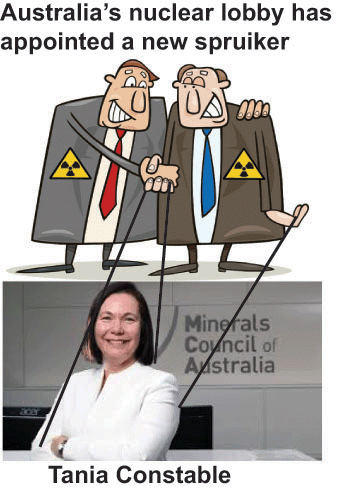
Chief executive Tania Constable said removing the four words — “a nuclear power plant” — in one section of the law would allow the industry to be considered for development.
Federal Environment Minister Melissa Price said while the extent of the review had not yet been determined it must examine the full operation of the laws.
“The review will involve extensive consultation and will consider all ideas put forward by industry, environment and community groups to improve and strengthen national environmental law,” she said.
Ms Price said under law the review of the Environment Protection and Biodiversity Conservation Act had to be completed by October.
But Opposition leader Bill Shorten ruled out any changes under a Labor government.
“Labor has no plans to build nuclear power plants, full stop. We will deliver more renewables and cheaper power for Australians, and we will do it without building nuclear power plants in our cities and towns,” he said.
Ms Constable said that along with upgrades to existing coal-fired generators, nuclear power was a “commonsense approach” to lowering power prices and also reducing emissions.
In December, Labor signed off on its new national platform which states “Labor will … prohibit the establishment of nuclear power plants and all other stages of the nuclear fuel cycle”.
About 30 countries rely on nuclear power, with France generating nearly 75 per cent of its electricity that way.
The World Nuclear Association lists Hungary, Slovakia and Ukraine as generating more than half from nuclear, while Belgium, Sweden, Slovenia, Bulgaria, Switzerland, Finland and the Czech Republic use it for more than one-third of their power.
Prime Minister Scott Morrison said he was open to changing the law but wanted to be sure of the economic case.
“I’m not too much into an ideological debate about from what source it comes, I just want to make sure it turns up and that it brings power prices down,” he said. “The only work I have seen on that … is that (lower prices) is only achieved with very significant government subsidies.”
January 22, 2019
Posted by Christina Macpherson |
AUSTRALIA - NATIONAL, politics |
Leave a comment
Australia’s solar, wind boom to power past grid woes in 2019, Sonali Paul, MELBOURNE (Reuters) 21 Jan 19 – Australia’s wind and solar boom looks set to power through 2019 following a record year, despite grid constraints and extra scrutiny from network operators to make sure new projects don’t spark blackouts like ones that hit two years ago.
Abundant wind and sun, falling turbine and panel costs, and corporate demand for contracts to hedge against rising power tariffs have attracted dozens of international developers looking to build wind and solar farms Down Under.
Even though the developers have met with flip-flops on energy policy, a strained grid that has trouble integrating intermittent renewable power, and unexpected hook-up costs, they still see Australia as a growth market.
“We believe that we have a great future in Australia, because we have the right answers,” said Xavier Barbaro, Chief Executive of France’s Neoen (NEOEN.PA), whose biggest market is Australia.
Companies like Neoen, its compatriot Total-Eren (TOTF.PA), India’s Adani (ADEL.NS), U.S. utility AES Corp (AES.N) and Germany’s Sonnen are expanding in Australia, looking to fill a gap as ageing coal-fired plants are retired over the next two decades.
“Confidence is high as the industry enters 2019, with unprecedented levels of construction activity under way,” said Anna Freeman, a director at the Clean Energy Council, an industry group.
Australia generates nearly 20 percent of its electricity from renewables. This is forecast to jump to 75 percent over the next 20 years.
A total of 14.7 gigawatts (GW) of large-scale solar and wind projects worth A$20 billion ($14 billion) were under construction or reached financial close last year, more than double 2017’s record, according to the Clean Energy Council.
……….HOOK-UP HICCUPS
A Clean Energy Council survey of senior executives in December found grid connection is the biggest industry concern heading into 2019, Freeman said.
UK-based solar investor Octopus Investments said grid issues were what took it two years to choose its first investment in Australia. The Darlington Point solar farm is about to begin construction and will be the country’s largest.
“The grid is the biggest issue where assets fail in our project filter,” Octopus Managing Director Sam Reynolds told Reuters, declining to name projects the company rejected……..https://www.reuters.com/article/us-australia-renewables/australias-solar-wind-boom-to-power-past-grid-woes-in-2019-idUSKCN1PE0V8
January 22, 2019
Posted by Christina Macpherson |
AUSTRALIA - NATIONAL, energy |
Leave a comment
REneweconomy, Giles Parkinson21 December 2018 Australia’s leading scientific research group and the country’s energy market operator have released a benchmark study that shows the cost of new wind and solar – even with hours of storage – is “unequivocally” lower than the cost of new coal generation.
January 22, 2019
Posted by Christina Macpherson |
AUSTRALIA - NATIONAL, energy |
Leave a comment
|
The work – based on a two-year project between the University of Technology Sydney, the University of Melbourne and German Aerospace Centre – found a combination of renewables and energy efficiency can achieve the net-zero emissions outcome needed by 2050.
“The main barrier is neither technical nor economic – it’s political,” Sven Teske, research director at the UTS’s Sydney’s Institute for Sustainable Futures, said, adding “it’s not too late” to restrict global warming to 1.5 degrees, the lower end of the Paris climate target.
The research, released on Monday at the World Economic Forum in Davos, modelled 72 regional energy grids at hourly increments through 2050, including the Australian states on the National Electricity Market and other regions.
Costs would be moderated in Australia because the average age of coal-fired power plants was about 40 years, and would soon have to be replaced anyway. Solar and wind-generated electricity was also already cheaper than new coal, he said.
Fossil-fuel use in other sectors, such as transport and agriculture, could also be phased out and replaced by synthetic fuels, particularly hydrogen. Australia’s abundant sun and wind resources gave the nation an advantage only matched by north Africa and the Middle East as a renewable powerhouse, Dr Teske said.
Australia would benefit from the transition from the export of hydrogen-based or other synthetic fuels, and from shipments of cobalt and silver used for storage and solar panels, respectively.
While biofuels offered potential to supplement renewables, the sector would be constrained by the need to maintain farm land to feed growing populations. Reforestation would also be needed to provide a carbon sink to help reduce carbon-dioxide levels, he added.
“Citing a growing body of research, we show that using land restoration efforts to meet negative emissions requirements, along with a transition to 100 per cent renewable energy by 2050, gives the world a good chance of staying below the 1.5-degree target,” Malte Meinshausen, founding director of the Climate and Energy College at the University of Melbourne, said.
The research, understood to cost in the range of $1 million, was the first in Australia by the foundation set up by prominent actor and environmentalist Leonardo DiCaprio.
Given the scant carbon budget left to keep warming from reaching dangerous levels, “every year of delay is a huge problem”, Dr Teske said.
|
|
January 22, 2019
Posted by Christina Macpherson |
AUSTRALIA - NATIONAL, energy |
Leave a comment