 Response to Warren Mundine, letter published in the Australian Financial Review, Kado Muir, April 2012, http://nuclearfree.wordpress.com/media/?preview=true&preview_id=11&previ…
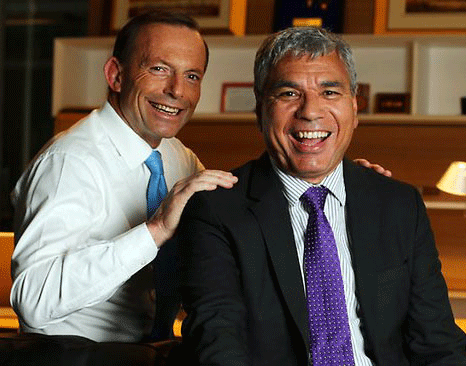
(at left Kado Muir) It’s time to stop radioactive racism
Globally the nuclear industry is in decline and has been for a long time. The price of uranium was briefly inflated along with false dreams of a nuclear renaissance, in reality the industry is waning. The Fukushima disaster reminded both communities and financial institutions that nuclear power is far too risky for life on this planet.
In Western Australia we have a very aggressive uranium exploration program, sponsored by the State Government, yet deeply opposed by the people. We have a strong history of resistance against uranium mines and a proud history of stopping these mines. In the 1970′s my elders fought against uranium mining at Yeelirrie. In the 1980′s people from the Western Desert marched down St Georges Terrace in the thousands against uranium mining on their lands and we are proud to say we’ve never had a uranium mine in WA. We are going to keep it that way.
Warren Mundine wrote to the Financial Review promoting the nuclear industry. He wants uranium mining, he wants nuclear power and he wants the international community to dispose of its nuclear waste here, all on our lands. Mr Mundine does not speak for us here in Western Australia and has no right to talk about what should or should not happen on our country.
Some of the communities who are being barraged by these wanna be miners have generations of knowledge about uranium ‘poison’. We know better than most, the dangers of uranium. We also have generations worth of experience in dealing with mining companies , of witnessing their broken promises and the deep enduring failures of government to protect our country and people.
We don’t need someone from the East Coast, from Canberra or Canada to tell us what we should or shouldn’t do. Uranium stays in the ground. We have a saying, “Wanti* Uranium, leave it in the ground!” (*leave it)
The nuclear industry across Australia takes it’s toll on Aboriginal communities; from the nuclear weapons testing in Maralinga and Monte Bello island, from the trial mines in Wiluna, Yeelirrie and Manyingee in WA, to the abandoned mines in the NT & Queensland at Rum Jungle and Alligator River and Mary Kathleen, the existing mines at Ranger and Beverley and Roxby Downs in SA. The defeated proposed waste dump in South Australia now proposed for Muckaty Station in the NT. This industry preys on remote Aboriginal communities keeping everything out of sight and out of mind.
Across Australia there has never been a uranium mine that has not leaked radioactive mine waste into the environment, this industry has been tried and consistently failed.
The risk to our lands, to life itself far outweigh the measly rewards, the few jobs on offer, the State government royalties. It is not worth the long term damage to our country and to our water.
These mines will only last for 10 years or 20 years but as custodians we have thousands of years of waste. Long after this State government is a memory, long after the mining companies have gone broke we will be living with the radioactive legacy of their greedy short term ambitions. I and the people of West Australian Nuclear Free Alliance will not sell future generations short.
Kado Muir is the Chairperson of the West Australia Nuclear Free Alliance, he is a Ngalia man and a custodian for Yeelirrie – one of the uranium deposits under exploration by BHP Billiton.
January 24, 2019
Posted by Christina Macpherson |
politics, Western Australia |
Leave a comment
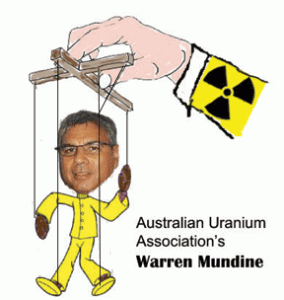 Warren Mundin’s article appeared today in the Daily Telegraph. It is behind a paywall. In the Herald Sun, extreme right wing writer Andrew Bolt obligingly supplied extracts from it, and rejoiced in Mundine’s anti-environment stand. MUNDINE’S LIST OF GREEN SABOTAGE Andrew Bolt, Herald Sun January 24, 2019 Warren Mundine, the former Labor president who is now the Liberal candidate for Gilmore, lists just some of the damage done by Greens whose ignorance is even greater than the self-importance that drives them:
Green activists are fighting mining, industry and agriculture every step of the way, … often with funding from foreign organisations and wealthy elites with deep pockets…
ACF and GetUp! are trying to prevent North Queensland’s Carmichael mine — even though it’s passed all environmental hurdles… It will create thousands of jobs and business opportunities, especially for local Aboriginal people and Townsville…
Just look at the damage done by green activists and politicians to South Australia, now our poorest state. They have banned GM food crops, blocked development of a world-class nuclear waste facility, destroyed coal-fired power stations and restricted exploration for coal-seam gas. Nuclear power is also banned.
All of these policies are based on irrational green fears. Coal-fired power is not causing dangerous global warming, coal-seam gas extraction techniques are safe, nuclear waste dumps operate safely, and nuclear power stations safely producing low-emissions power around the world.
Sadly, though, we’re increasingly putting our future in the hands of wilfully ignorant scaremongers and mystics…..
https://www.heraldsun.com.au/blogs/andrew-bolt/mundines-list-of-green-sabotage/news-story/47a8e93ab8d0a813f78fe947dff1a56f,
|
|
|
January 24, 2019
Posted by Christina Macpherson |
AUSTRALIA - NATIONAL, spinbuster |
Leave a comment
 Guardian, Paul Karp , 22 Jan 19 Indigenous leader and former Labor boss to be parachuted in as a Liberal in the NSW electorate held by retiring MP Ann Sudmalis
January 24, 2019
Posted by Christina Macpherson |
AUSTRALIA - NATIONAL, politics |
Leave a comment
Steve Dale, Nuclear Fuel Cycle Watch South Australia, 23 Jan 19
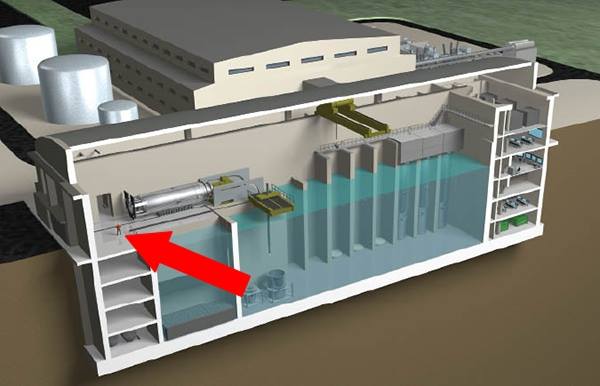
The nuclear lobby seems to have got a foothold with gullible miners. Ben Heard will be attending “Energy Mines and Money” in Brisbane (June). From the “About” section of the conference – “Energy Mines and Money Australia will showcase the east coast’s strategic mineral, coal and oil and gas opportunities, and match projects with global investment.”
He will be talking about “The role of small modular reactors”. From my observations, the role of small modular reactors is as fantasy bait for gullible politicians, miners, broadcasters – basically anyone silly enough to believe that these things are available, portable and small. A concept picture of a “small” reactor appears below (remember, the red arrow points to a tiny human figure for scale).https://www.facebook.com/groups/1021186047913052/
January 24, 2019
Posted by Christina Macpherson |
AUSTRALIA - NATIONAL, spinbuster, technology |
Leave a comment
 Dirty deeds: how to stop Australian miners abroad being linked to death and destruction, The Conversation, Julia Dehm
Lecturer, La Trobe UniversityJanuary 23, 2019 Australian companies dominate African mining. The Department of Foreign Affairs and Trade counts
175 ASX-listed companies operating in 35 African countries. Professional services company PwC reckons there are
more than 200, and that “a golden age of Australia-Africa relations has begun”.
But Australian miners also arguably stand implicated in both human rights and environmental abuses in pursuit of Africa’s mineral wealth.
…….In June 2017 the Australian government
established an advisory group for implementing the UN Guiding Principles on Business and Human Rights. The group quickly
recommended developing a national action plan, in line with international standards. But in October the government announced it was “not proceeding with a national action plan at this time”.
We can do better
Other countries are doing more.
France has introduced a “duty of vigilance” law requiring companies ensure their supply chains respect labour and other human rights.
In Switzerland there is a push for a constitutional amendment obliging Swiss companies to incorporate respect for human rights and the environment in all their activities.
Canada is soon to appoint an independent Canadian Ombudsperson for Responsible Enterprise to investigate allegations of human rights abuses linked to Canadian corporate activity overseas.
It’s increasingly recognised on a purely pragmatic level there are legal, reputational and financial risks if companies attempt to operate without community consent.
Studies show the huge financial costs of conflicts with Indigenous communities, which can delay projects significantly.
January 24, 2019
Posted by Christina Macpherson |
AUSTRALIA - NATIONAL, civil liberties, uranium |
Leave a comment

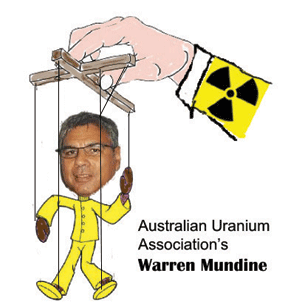
Warren Mundine’s nuclear allegiances, Jim Green, Online Opinion, 11 April 2012, more https://nuclear.foe.org.au/warren-mundines-nuclear-allegiances/?fbclid=IwAR32gwKze3jcbZV26e-sqsyRjE0lkFycLcyDj_lVWKVRxac1u4cttGzLeHM
Warren Mundine, a member and former National President of the ALP, and co-convener of the Australian Uranium Association’s Indigenous Dialogue Group, has been promoting the nuclear industry recently. Unfortunately he turns a blind eye to the industry’s crude racism, a problem that ought to be core business for the Indigenous Dialogue Group.
Mundine could have mentioned the legacy of uranium mining in the Wiluna region of WA; to pick one of many examples. Uranium exploration in the region in the 1980s left a legacy of pollution and contamination. Greatly elevated radiation levels have been recorded despite the area being ‘cleaned’ a decade ago. Even after the ‘clean up’, the site was left with rusting drums containing uranium ore. A sign reading “Danger − low level radiation ore exposed” was found lying face down in bushes.
In August 2000, coordinator of the Wiluna-based Marruwayura Aboriginal Corporation Steve Syred said that until 1993, 100−150 people were living three kilometres from the spot where high radiation levels were recorded. Syred told the Kalgoorlie Miner that the Aboriginal community had unsuccessfully resisted uranium exploration in the area in the early 1980s. Since then many people had lived in the area while the Ngangganawili Aboriginal Corporation was based near the contaminated site. Elders still hunted in the area.
Another example ignored by Mundine was in late March when the NSW government passed legislation that excluded uranium from provisions of the NSW Aboriginal Land Rights Act 1983 thus stripping Aboriginal Land Councils of any say in uranium mining.
Yet another example ignored by Mundine was the 2011 amendments to the S.A. Roxby Downs Indenture Act 1982. This is the legislation that governs operations at the Olympic Dam uranium and copper mine and retains exemptions from the S.A. Aboriginal Heritage Act. Traditional Owners were not even consulted in the amendments or exemptions. The S.A. government’s spokesperson in Parliament said: “BHP were satisfied with the current arrangements and insisted on the continuation of these arrangements, and the government did not consult further than that.”
That disgraceful performance illustrates a broader pattern. Aboriginal land rights and heritage protections are feeble at the best of times. But the legal rights and protections are repeatedly stripped away whenever they get in the way of nuclear or mining interests. The Olympic Dam mine is largely exempt from the S.A. Aboriginal Heritage Act and any uranium mines in NSW are to be exempt from provisions of the NSW Aboriginal Land Rights Act. Likewise, sub-section 40(6) of the Commonwealth’s Aboriginal Land Rights Act exempts the Ranger uranium mine in the N.T. from the Act.
Mundine claims that Australia has “a legal framework to negotiate equitably with the traditional owners on whose land many uranium deposits are found”. That claim is disingenuous.
Native Title rights were extinguished with the stroke of a pen by the Howard government to seize land for a radioactive waste dump in South Australia. Aboriginal heritage laws and Aboriginal land rights are being trashed with the current push to dump in the Northern Territory. Federal Resources Minister Martin Ferguson’s National Radioactive Waste Management Act overrides the Aboriginal Heritage Act, sidesteps the Aboriginal Land Rights Act, and allows for the imposition of a dump on Aboriginal land even in the absence of any consultation with or consent from Traditional Owners.
David Ross, Director of the Central Land Council, noted in a March 14 media release: “This legislation is shameful, it subverts processes under the [Aboriginal] Land Rights Act and is clearly designed to reach the outcome of a dump being located on Aboriginal land in the Northern Territory, whether that’s the best place for it or not. This legislation preserves the Muckaty nomination without acknowledging the dissent and conflict amongst the broader traditional owner group about the process and the so-called agreement. The passage of this legislation will further inflame the tensions and divisions amongst families in Tennant Creek, and cause great stress to many people in that region.”
A small number of Traditional Owners support the N.T. dump proposal. However most are opposed and the Northern Territory Government supports that opposition, key trade unions including the Australia Council of Trade Unions, church groups, medical and health organisations, and environmental groups. If push comes to shove, there will be a blockade at the site to prevent construction of the dump.
A pro bono legal team is assisting Traditional Owners with their legal challenge against the nomination of the Muckaty site. At a Federal Court hearing on March 27, a Commonwealth lawyer argued that the government’s legislation allows the nomination of a dump site to stand even if the evidence regarding traditional ownership is false.
These patterns are evident in other countries. North American Indigenous activist Winona LaDuke from the Anishinabe Nation told the Indigenous World Uranium Summit in 2006: “The greatest minds in the nuclear establishment have been searching for an answer to the radioactive waste problem for fifty years, and they’ve finally got one: haul it down a dirt road and dump it on an Indian reservation”.
Here in Australia the situation is scarcely any better than it was in the 1950s when the British were exploding nuclear bombs on Aboriginal land. Which brings us to another of Mundine’s blind spots. He could have mentioned the latest ‘clean up’ of the Maralinga nuclear test site, which was done on the cheap. Nuclear engineer and whistleblower Alan Parkinson said of the ‘clean-up’: “What was done at Maralinga was a cheap and nasty solution that wouldn’t be adopted on white-fellas land.”
Mundine’s claim to support Aboriginal empowerment is contradicted by his consistent failure to speak out when mining and nuclear interests and governments that support those interests disempower Aboriginal people.
January 24, 2019
Posted by Christina Macpherson |
aboriginal issues, AUSTRALIA - NATIONAL, politics |
Leave a comment
 LIFT URANIUM MINING BAN, Pauline Hanson’s ONE NATION, 23 Jan 19, NSW One Nation will end the uranium mining ban which has been in place since 1986.
Across our western border, South Australia has been able to reap the benefits of this billion dollar national industry….. There are too many government regulations holding back the NSW economy, with the uranium mining ban one of the dumbest.
If One Nation holds the balance of power after the 23 March election in the lower and/or upper houses, we will want any new government to free up the uranium mining and nuclear power industries…..The only way to properly develop the industry, creating much needed investment and jobs, is to remove all government restrictions on uranium exploration, mining and power generation..https://nsw.onenation.org.au/policies/lift-uranium-mining-ban/?fbclid=IwAR2gtbjrtk0hCTimeBwT2acb9bOy47LLKHUtpuKrm6EWE-C1AG0V3y-FUNM
January 23, 2019
Posted by Christina Macpherson |
AUSTRALIA - NATIONAL, politics |
Leave a comment
Mining sector pushes for nuclear option to lowering Australia’s energy costs and emissions, Sheradyn Holderhead,  January 22, 2019 https://www.dailytelegraph.com.au/news/nsw/mining-sector-pushes-for-nuclear-option-to-lowering-australias-energy-costs-and-emissions/news-story/3a38633b287f190b34421522a60d9086
With power prices skyrocketing, the mining sector has called for the nuclear option with hopes a high-level review could end a ban on the prohibited energy source.
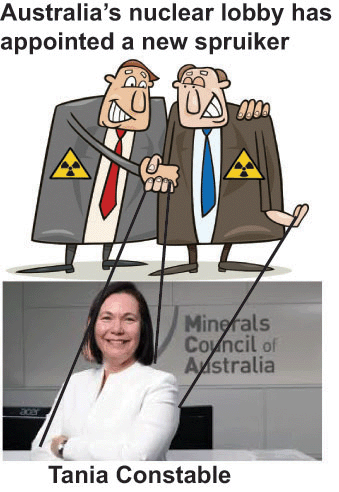
The Minerals Council of Australia has seized on the upcoming review of environmental protection laws under which nuclear power is banned.
Chief executive Tania Constable said removing the four words — “a nuclear power plant” — in one section of the law would allow the industry to be considered for development.
Federal Environment Minister Melissa Price said while the extent of the review had not yet been determined it must examine the full operation of the laws.
“The review will involve extensive consultation and will consider all ideas put forward by industry, environment and community groups to improve and strengthen national environmental law,” she said.
Ms Price said under law the review of the Environment Protection and Biodiversity Conservation Act had to be completed by October.
But Opposition leader Bill Shorten ruled out any changes under a Labor government.
“Labor has no plans to build nuclear power plants, full stop. We will deliver more renewables and cheaper power for Australians, and we will do it without building nuclear power plants in our cities and towns,” he said.
Ms Constable said that along with upgrades to existing coal-fired generators, nuclear power was a “commonsense approach” to lowering power prices and also reducing emissions.
In December, Labor signed off on its new national platform which states “Labor will … prohibit the establishment of nuclear power plants and all other stages of the nuclear fuel cycle”.
About 30 countries rely on nuclear power, with France generating nearly 75 per cent of its electricity that way.
The World Nuclear Association lists Hungary, Slovakia and Ukraine as generating more than half from nuclear, while Belgium, Sweden, Slovenia, Bulgaria, Switzerland, Finland and the Czech Republic use it for more than one-third of their power.
Prime Minister Scott Morrison said he was open to changing the law but wanted to be sure of the economic case.
“I’m not too much into an ideological debate about from what source it comes, I just want to make sure it turns up and that it brings power prices down,” he said. “The only work I have seen on that … is that (lower prices) is only achieved with very significant government subsidies.”
January 22, 2019
Posted by Christina Macpherson |
AUSTRALIA - NATIONAL, politics |
Leave a comment
 Australia’s solar, wind boom to power past grid woes in 2019, Sonali Paul, MELBOURNE (Reuters) 21 Jan 19 – Australia’s wind and solar boom looks set to power through 2019 following a record year, despite grid constraints and extra scrutiny from network operators to make sure new projects don’t spark blackouts like ones that hit two years ago.
Abundant wind and sun, falling turbine and panel costs, and corporate demand for contracts to hedge against rising power tariffs have attracted dozens of international developers looking to build wind and solar farms Down Under.
Even though the developers have met with flip-flops on energy policy, a strained grid that has trouble integrating intermittent renewable power, and unexpected hook-up costs, they still see Australia as a growth market.
“We believe that we have a great future in Australia, because we have the right answers,” said Xavier Barbaro, Chief Executive of France’s Neoen (NEOEN.PA), whose biggest market is Australia.
Companies like Neoen, its compatriot Total-Eren (TOTF.PA), India’s Adani (ADEL.NS), U.S. utility AES Corp (AES.N) and Germany’s Sonnen are expanding in Australia, looking to fill a gap as ageing coal-fired plants are retired over the next two decades.
“Confidence is high as the industry enters 2019, with unprecedented levels of construction activity under way,” said Anna Freeman, a director at the Clean Energy Council, an industry group.
Australia generates nearly 20 percent of its electricity from renewables. This is forecast to jump to 75 percent over the next 20 years.
A total of 14.7 gigawatts (GW) of large-scale solar and wind projects worth A$20 billion ($14 billion) were under construction or reached financial close last year, more than double 2017’s record, according to the Clean Energy Council.
……….HOOK-UP HICCUPS
A Clean Energy Council survey of senior executives in December found grid connection is the biggest industry concern heading into 2019, Freeman said.
UK-based solar investor Octopus Investments said grid issues were what took it two years to choose its first investment in Australia. The Darlington Point solar farm is about to begin construction and will be the country’s largest.
“The grid is the biggest issue where assets fail in our project filter,” Octopus Managing Director Sam Reynolds told Reuters, declining to name projects the company rejected……..https://www.reuters.com/article/us-australia-renewables/australias-solar-wind-boom-to-power-past-grid-woes-in-2019-idUSKCN1PE0V8
January 22, 2019
Posted by Christina Macpherson |
AUSTRALIA - NATIONAL, energy |
Leave a comment
 REneweconomy, Giles Parkinson21 December 2018 Australia’s leading scientific research group and the country’s energy market operator have released a benchmark study that shows the cost of new wind and solar – even with hours of storage – is “unequivocally” lower than the cost of new coal generation.
January 22, 2019
Posted by Christina Macpherson |
AUSTRALIA - NATIONAL, energy |
Leave a comment
|
The work – based on a two-year project between the University of Technology Sydney, the University of Melbourne and German Aerospace Centre – found a combination of renewables and energy efficiency can achieve the net-zero emissions outcome needed by 2050.
“The main barrier is neither technical nor economic – it’s political,” Sven Teske, research director at the UTS’s Sydney’s Institute for Sustainable Futures, said, adding “it’s not too late” to restrict global warming to 1.5 degrees, the lower end of the Paris climate target.
The research, released on Monday at the World Economic Forum in Davos, modelled 72 regional energy grids at hourly increments through 2050, including the Australian states on the National Electricity Market and other regions.
Costs would be moderated in Australia because the average age of coal-fired power plants was about 40 years, and would soon have to be replaced anyway. Solar and wind-generated electricity was also already cheaper than new coal, he said.
Fossil-fuel use in other sectors, such as transport and agriculture, could also be phased out and replaced by synthetic fuels, particularly hydrogen. Australia’s abundant sun and wind resources gave the nation an advantage only matched by north Africa and the Middle East as a renewable powerhouse, Dr Teske said.
Australia would benefit from the transition from the export of hydrogen-based or other synthetic fuels, and from shipments of cobalt and silver used for storage and solar panels, respectively.
While biofuels offered potential to supplement renewables, the sector would be constrained by the need to maintain farm land to feed growing populations. Reforestation would also be needed to provide a carbon sink to help reduce carbon-dioxide levels, he added.
“Citing a growing body of research, we show that using land restoration efforts to meet negative emissions requirements, along with a transition to 100 per cent renewable energy by 2050, gives the world a good chance of staying below the 1.5-degree target,” Malte Meinshausen, founding director of the Climate and Energy College at the University of Melbourne, said.
The research, understood to cost in the range of $1 million, was the first in Australia by the foundation set up by prominent actor and environmentalist Leonardo DiCaprio.
Given the scant carbon budget left to keep warming from reaching dangerous levels, “every year of delay is a huge problem”, Dr Teske said.
|
|
January 22, 2019
Posted by Christina Macpherson |
AUSTRALIA - NATIONAL, energy |
Leave a comment

Meetings with Minister Pellekaan and the DIIS, Anti-Nuclear Coalition of South Australia,  January 2019
Report back from ANC members’ meetings with SA Minister for Energy and Resources, Dan van Holst Pellekaan, on Nov. 14, and with two bureaucrats from the DIIS (Department of Industry, Innovation & Science).
This second meeting was held in Adelaide at the Department of Industry, Innovation & Science (DIIS) offices on November 28. Ms Sam Shard the GM for the NRWMFT (National Radioactive Waste Management Taskforce) fielded all questions, and Wendy (no one heard her surname), Head of Policy, who only spoke once throughout the hour-long meeting. Requests for meetings with federal Minister Canavan (delegated to his department’s officials) and his SA counterpart, Minister Pellekaan, were made several months ago, and both only came about as a result of persistent efforts.
In this summary, the NRWMF (National Radioactive Waste Management Facility)=the dump.
Pellekaan Meeting: In his initial response to the ANC’s request to meet – first declined – Pellekaan outlined his government’s support for a national dump, “in one central, secure location” for LLW (low level waste) the justification being that such waste resulted from “life-saving medical procedures and research”. Notably, he omitted any reference to the planned ‘temporary’ storage of ILW (intermediate level waste).
(Last year on talkback radio, then, Premier Weatherill, similarly, omitted any mention of co-location of the very long-lived ILW at a national dump.)
Pellekaan and his leader’s support for a national dump (“one dump is better than many”) are predicated entirely on there being a willing host community. He wouldn’t, “refuse a dump to a community that gave its broad support”.
During the half-hour (only) meeting the emphasis from five ANC participants was on his omission to mention the co-location of the ILW (he did say that he had talked about it on radio). Also, on the significance of a radioactive dump for all South Australians, not only the two small communities targeted for a dump. On the latter point, Pellekaan argued that, if the wider community were to prevent a willing local community from hosting a dump it would disenfranchise local people(!) It was pointed out to him that it is South Australians, in general, who are being disenfranchised by the federal government’s strategy.
Regarding the ILW, Pellekaan was not overly concerned about the temporary storage, considering it would be just as safe at a rural SA location as at Lucas Heights, saying, “It has to be stored somewhere”.
Other questions and comments were about the classification of radioactive waste; the regulator’s (ARPANSA) licensing arrangements, about which he said that he was, “not across the detail”; the longevity of the ILW and the implications of the SA Nuclear Waste (Prohibition) Act.
He downplayed any special role he might have as either the responsible SA Minister or as the Member for Sturt, the electorate in which a national dump could well be located, emphasising that it would not be his decision, but a cabinet decision.
Regarding the South Australian legislation, he considers that at least, in part, it would have to be altered to allow the dump. This was not seen in any way as a hindrance because legislation can be enacted and repealed, if the parliament wishes.
In summary, Pellekaan follows faithfully the federal government’s arguments for the dump. His apparent lack of knowledge about High Level Waste (HLW) and Intermediate Level Waste (ILW); the length of time the ILW could remain stored above ground at the ‘interim’ site; the lack of any permanent plans for its disposal, or facilities and technical expertise for dealing with radioactive hazards at an interim dump is deeply troubling and unacceptable.
Note: Ally apologises for inaccurately stating in the prepared questions to put to Pellekaan that the ARPANSA licencing arrangement for the temporary storage of ILW at Lucas Heights is conditional on it being transferred to a permanent site. This is not the case. However, what it does say is, “The NRWMF will cater for the long-term above ground storage (approximately 100 years) of Intermediate Level Waste including the waste processed in France and the United Kingdom.”https://www.arpansa.gov.au/sites/g/files/net3086/f/legacy/pubs/comment/iws/IWSO-LA-WCP-WasteContingencyPlan_ Final_ARPANSA.pdf
Department of Industry Innovation and Science (DIIS) Meeting: Four people from ANC met with two departmental bureaucrats (see above) for an hour – not a minute more. Unfortunately, no full set of notes was taken. This report is based on notes taken by Mnem Giles, Colin Mitchell and Ally Fricker. Getting into the commonwealth offices in Franklin St was farcical with security having difficulty establishing who qualified as bone fide visitors, and negotiating with a boss up on the thirteenth floor to allow a fourth person to attend. Another five people remained on the street with placards and leaflets. A press release was sent out. The main entrance door was locked and only unlocked after we departed the building.
Mnem presented Sam Chard with a submission to the Senate Standing Committee from WILPF as requested by Ruth Russell. It was explained who WILPF is.
NOTE: Sam Chard’s comments are not always direct quotes. They are highlighted in red to make it clearer when it is her comments.
Sam Chard was the only person who responded to our questions. We established very quickly that we had not come to hear the government’s PR; that we were quite familiar with it. Head of Policy Wendy … commented only once saying that a permanent national dump for the intermediate waste would require two decades to plan.
The questions and comments attached were largely followed. We emphasised our request for the DIIS to hold a public meeting in Adelaide to inform politicians, media and public (who remain very confused) about the full plans for the national dump.
Response: The state is aware of the details and all the information is on-line.
It was also stressed that a national radioactive waste dump is an issue of national significance, not only an issue for locally targeted communities. (There is little likelihood that an Adelaide meeting would occur without follow up with a formal letter from the ANC and persistent demands to DIIS, the Minister and other relevant agencies.)
Chard agreed that a national dump was an issue of national significance because 1 in 2 people in Australia need nuclear medicine.
Other Issues Raised: 1. The lack of transparency at the Barndioota Consultative Committee meeting held at Quorn on the previous day (Nov 27) NO observers were allowed to attend, even after several had signed the usual request to sign confidentiality statements!
Response: This is entirely at the Chairman’s discretion and to allow free and frank discussion. The reason for the cancellation of the Kimba meeting (due on Nov 28) was because of it being “harvest time”, not because of the Barngarla legal challenge, as people inside the committee meeting at Quorn were told.
- Disposal of DoD (Department of Defence) waste.
Response: it is not wanted at Woomera for “operational reasons”, which would be classified. Re the quantity and location of DoD waste, the document, Australian Radioactive Waste Framework April 2018, was distributed to everyone, and referred to throughout the meeting, but this document fails to give any detail about what activities created the waste in the first place. Chard took on notice further questions relating to DOD waste stored at Woomera.
- Illegality of a national dump in SA: Response – Once land is acquired by the commonwealth, the federal Act (2012) would override the SA Act prohibiting a nuclear dump. Note this differs from Pellekaan’s response.
- Still after decades of planning, there remains no full inventory of waste intended for a national dump.
Response: A new ARPANSA document is now available which discusses the possible acceptance criteria for a national dump, but no further information, apart from the Framework document available (at the meeting). The first phase of acceptance criteria is available on the web.
- DIIS document titled,National Radioactive Waste Management Facility. Lucas Heights Sydney 2017 says, about long-term disposal of waste at Lucas Heights, “ . . .it’s not allowed. ANSTO’s Lucas Heights campus is only licenced . . . to store waste on a temporary basis, and on the condition that a plan is developed by the end of the decade for final disposal pathway for its waste.” (Our emphasis) It was pointed out that this was unambiguous. Response: There was no elaboration. ARPANSA document,Information to Stakeholders (May 2017) notes that temporary storage of ILW at a national dump ‘could be in excess of 100 years.’
Response: this is not correct. We responded in which case, ARPANSA should be corrected. Response: 100 years refers to the LLW only. ILW would only remain at an interim location for a couple of decades, or up to 30 years, or up to 40 years – 40 years is, conveniently, the approximate lifetime of the TN81 steel containers in which the reprocessed spent fuel is packaged.
- What facilities would be available at a temporary dump for re-packaging the TN81 containers?
Response: Waste entering the dump would be checked, but there are no plans for re-packaging facilities. The waste would not be there for long enough to require them. There are also, as yet, no facilities at Woomera for re-packaging any of the CSIRO waste currently stored there that might require
- These would need to be established.
- Co-location of LLW and ILW in other countries:
Response – There are models overseas for this. Where is it occurring? Response – Would take on notice. It was pointed out that the LLW and ILW stored permanently at Aube, France was not the equivalent of the co-location planned in SA because French classification of ILW is not the same as Australia’s, and definitely does not include reprocessed spent fuel. Response – Don’t know the specifics of Frances’ arrangements.
- Storage of ILW at Lucas Heights: Response -It’s in a dedicated facility. It is only there on a temporary basis; it’s quite safe there. Storage at a national dump would be the same as at Lucas Heights.
- Difference between French and Australian classification of the returned reprocessed spent fuel:
Response – The French have now changed their reference to HLW and brought the classification into line with Australia’s requirements. France now agrees with Australian authorities.
- Future availability of reprocessing facilities in France and any alternative arrangements: Response – Would take on notice.
- Commercial in confidence re the business case for the expansion of medical radioisotope production at Lucas Heights: Response – the expansion is for the export business (therefore commercial?)
- Classification of spent fuel: Response –Spent fuel from a nuclear power reactor is HLW, but from a research reactor it is ILW – there is a significant difference between ILW and HLW. A request to explain the difference was taken on notice.
- Permanent disposal of ILW, no site, no plans and no technology on the horizon: Response: That entity not yet defined.
- Permanent disposal of waste, ‘too dangerous’ to leave at Lucas Heights: ALP Shadow Minister for Energy and Resources, Kim Carr, spoke to Susan Craig and said that this was the reason why waste had to be removed to another interim site. Response: DIIS could not comment on this.
Formal minutes taken by DIIS staff were requested and an undertaking to forward them to ANC was made. Mnem followed this up and was told the minutes were being ‘cleaned up’. Mnem said we would prefer them as they were recorded. As with minutes from the Minister Pellekaan meeting, we are still waiting . . .
Thanks to Mnem for persisting with the arrangements for this meeting with DIIS, and the people who waited outside, and to Kate who distributed many leaflets.
January 21, 2019
Posted by Christina Macpherson |
Federal nuclear waste dump, South Australia |
Leave a comment
‘It’s like hell here’: Australia bakes as record temperatures nudge 50C , Fears rise for homeless and vulnerable people as communities brace for another week of relentless hot weather , Guardian, Naaman Zhou, @naamanzhou, Sun 20 Jan 2019
It was 48.9C last Tuesday in
Port Augusta, South Australia, an old harbour city that now harvests solar power. Michelle Coles, the owner of the local cinema, took off her shoes at night to test the concrete before letting the dogs out. “People tend to stay at home,” she said. “They don’t walk around when it’s like this.”It’s easy to see why: in the middle of the day it takes seconds to blister a dog’s paw or child’s foot. In Mildura, in northern Victoria, last week gardeners burned their hands when they picked up their tools, which had been left in the sun at 46C.
Fish were dying in the rivers.
Almost every day last week a new heat record was broken in Australia. They spread out, unrelenting, across the country, with records broken for all kinds of reasons – as if the statistics were finding an infinite series of ways to say that it was hot.
The community of Noona – population 14 – reached the highest minimum ever recorded overnight in Australia – 35.9C was the coldest it got, at 7am on Friday. It was 45C by noon.
A record fell on Tuesday in Meekatharra in Western Australia – the highest minimum there ever recorded (33C). Another fell on Wednesday, 2,000 miles away, in Albury, New South Wales – their hottest day (45.6C).
It was 45C or higher for four consecutive days in Broken Hill – another record – and more than 40C for the same time period in Canberra, the nation’s capital. Nine records fell across NSW on Wednesday alone. Back in Port Augusta, Tuesday was the highest temperature since records began in 1962………..
In South Australia, they declared a “code red” across Adelaide, the state capital. Homelessness services were working overtime and the Red Cross started calling round a list of 750 people who were deemed especially vulnerable
At the Australian Open in Melbourne, only the sea breeze kept the temperature below 40C. At Adelaide’s Tour Down Under, a bike race, it was 41C.
On Monday last week the hottest spot in New South Wales was Menindee, a river town that feeds the country’s largest water system, the Murray-Darling basin. It was 45C. It climbed to 47C on Wednesday, and by Thursday the fish were gasping.
Australia’s native Murray cod can live for decades under normal conditions, growing all the while. The oldest are a metre long, with heavy white bellies that have to be held with both hands. Last week, hundreds died, choked of oxygen due to an algal bloom that fed and grew in the heat, and collapsed when temperatures dipped.
Blue-green algae flourishes in hot, slow-moving water. Then, when temperatures inevitably drop, the algae dies and becomes a food source for bacteria, who multiply and starve the river of oxygen. The fish rise to the surface.
The mass fish death has reignited a debate over water management in the region, where cotton farmers upstream have been accused of taking more water than they should.
The heat is not the root cause, the locals stress. But the five punishing days settling over the river have not made it better. Last Thursday the cod were up near the surface and struggling. On Friday, it was 45C again. In Menindee, the locals believe the fish kill will happen again, with temperatures in the 40s expected to continue into this week. The water will be running hot……….https://www.theguardian.com/australia-news/2019/jan/19/australia-swelters-as-relentless-hot-weather-smashes-records
January 21, 2019
Posted by Christina Macpherson |
AUSTRALIA - NATIONAL, climate change - global warming |
Leave a comment
Australia faces ‘new normal’ of year-round bushfires ,Greg Mullins, Daily Telegraph
Extreme bushfire conditions in Australia are becoming worse, fires are burning in areas that should never burn at times when there should not be fire, former Fire and Rescue NSW commissioner Greg Mullins says to describe our now unpredictable fire seasons….. (subscribers only)
January 21, 2019
Posted by Christina Macpherson |
AUSTRALIA - NATIONAL, climate change - global warming |
Leave a comment
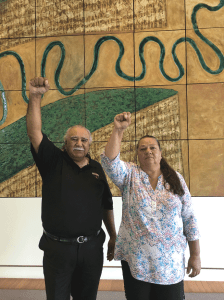 Northern Basin Aboriginal Nations, 21 Jan 19 MDBA Water management: “Don’t leave Dracula in charge of the Blood bank”
KEY POINTS
- Support for a Royal Commission
- Representation at the decision making table of MDBA
- Acknowledge Legal Rights of First Nations as determined in Mabo (2)
- Explain why different standards are set for First Nations’ Organisations
- Demand Criminal Prosecutions be an integral part of Royal Commission findings
Northern Basin Aboriginal Nations (NBAN) Deputy Chair, Ghillar Michael Anderson and NBAN Director Cheryl Buchanan announce NBAN’s support for Sarah Hanson-Young’s call for a Royal Commission into the mismanagement and over extraction of the waters of the Murray Darling Basin. [The Guardian, 16 January 2019]
NBAN has now learnt that the disaster that we are experiencing in the Murray/Darling Basin is a perfect electric dry storm of massive fish kills and drying riverbeds.
It is NOT caused just by the drought but is also a culmination of man-made mismanagement; corruption at the highest levels; and major development without scientific evidence-based planning in the formative years of the MDBA.
NBAN has great difficulty in understanding why the so-called experts water planners would attempt to normalise our current circumstances. First Nations now demand urgent answers and to be included in all future top-level water planning within the Murray Darling Basin……..
NBAN is critical of the fact that NSW Water planners admit that from 2012 to 2018 they did nothing to properly prepare for evidence-based planning in relation to water management in the northern basin, and that their assessments in terms of quantities of water are based on hypothetical values and assumptions. Now there is a mad rush to review water planning on the basis of A, B and C water licencing in the Barwon/Darling and there is a suggestion to amalgamate these water licences into two or one licence. NBAN’s problem with this is that there are too many vested interests in the process calling for this to happen. Water planning from NBAN’s point of view needs to be reviewed so as to plan on the basis of what real volumes of water are in each valley catchment. With all the science and technology we have in today’s society there is no excuse for hypotheticals and assumptions.
From NBAN’s perspective these admissions clearly demonstrate that there are failures by the Water Ministers responsible for due diligence in their portfolios and departments.
Playing the blame game and shirking responsibility will not help our dying rivers. Clearly, corporate water users, irrigators and mining companies are driving the agenda. For example, the Broken Hill pipeline is for the mining interests rather than the community. Then we need to take into account the Proposed Uranium Mining near Menindee.
The Board of the MDBA is made up of members who have vested interests. A clear example of this is the Chairman, Brian Andrews, (former Speaker of the House of Representatives under PM John Howard) who is an orchardist dependant on irrigation waters from the Murray River in South Australia.
NBAN further expresses deep concern for the integrity of politicians and MDBA authority members. Clearly, there is an inference in recent media reporting that what is currently going on in the MDBA is a major defrauding of the public purse, which can never be condoned. This is in tandem with water theft by irrigators who were never investigated and escape prosecution for their criminal acts. As the Sydney Morning Heraldreported on 8 March 2018:……….
Also there was the warning of water theft by irrigators in the northern basin by a former MDBA staffer Maryanne Slattery, who now works for the Australia Institute, testified to this effect at the South Australian Royal Commission, based on satellite imagery tracking the fate of environmental water flows. This experimental project called Data Cube was rudely interrupted and shut down by MDBA, because Ms Slattery was exposing the theft of environmental water by illegal diversion. It was also reported MDBA staff were denied by the MDBA Board the right to give evidence to the Royal Commission and Minister Littleproud refused to co-operate with the Commissioner, Brett Walker QC,
The greens Senator, Sarah Hanson-Young, is correct to call for a Commonwealth Government Royal Commission into the water management and expenditure of public funds in the MDB. The question that is on everybody’s lips right now is: What have they done with the $13B. Clearly, cotton growers and irrigators are getting money for nothing and continue to live on their lands drawing on other Commonwealth funds under Works and measures programs through ‘Toolkit’ measures for water efficiency.
NBAN is seriously concerned about what was reported in the Sydney Morning Herald on 9 March 2018 in . In this article it was reported that:Cry me a river: Mismanagement and corruption have left the Darling dry.
Surely, what Barnaby Joyce has done is criminal. When the Indigenous Land Corporation (ILC) bought Yulara village, the Commonwealth financial regulators questioned why the ILC acquired the village resort for $60M above market price. To this end the Commonwealth government chastised the ILC and lowered the market price to its correct value, thereby denying the right ILC to sell their interest at the price they paid for it, which denied them millions of dollars.
This demonstrates that there continues to be two standards: one for First Nations Peoples and one for non-First Nations Peoples. What makes this worse is the fact that sitting politicians are involved in a major profiteering scam on a scale never seen before in this country.
Clearly having people like the Minister David Littleproud being given the portfolio of Agriculture and Water and coming from the same location where Barnaby Joyce first gained his start in Politics at the Commonwealth level does raise serious concerns about the integrity of portfolio allocations in the Commonwealth government. People like Barnaby Joyce and David Littleproud can be accused of not disclosing their full interest in farming and irrigation. There is much to be desired in these appointments as Barnaby Joyce and Littleproud are sitting members of the national party. They are elected to look after the interests of their constituents and in the case of the appointment of Barnaby Joyce and Littleproud to the Water portfolio is likened to the appointment of Dracula being appointed to be in charge of the Blood Bank.
This demonstrates that there continues to be two standards: one for First Nations Peoples and one for non-First Nations Peoples. What makes this worse is the fact that sitting politicians are involved in a major profiteering scam on a scale never seen before in this country.
Clearly having people like the Minister David Littleproud being given the portfolio of Agriculture and Water and coming from the same location where Barnaby Joyce first gained his start in Politics at the Commonwealth level does raise serious concerns about the integrity of portfolio allocations in the Commonwealth government. People like Barnaby Joyce and David Littleproud can be accused of not disclosing their full interest in farming and irrigation. There is much to be desired in these appointments as Barnaby Joyce and Littleproud are sitting members of the national party. They are elected to look after the interests of their constituents and in the case of the appointment of Barnaby Joyce and Littleproud to the Water portfolio is likened to the appointment of Dracula being appointed to be in charge of the Blood Bank.
On the 16th, the NBAN Delegation then met Dr Lindsay White, Director Northern Basin Section, Lindsay White is also responsible for Wetlands, Policy and Northern Water Use Branch Commonwealth Environmental Water Office, and Hilary Johnson, Director, Southern Basin Section, Southern Water Use, Aquatic Science and Community Engagement Branch Commonwealth Environmental Water Office.
NBAN advised the CEWO that within the river systems we have sacred waterholes where our creative water spirits live. These culturally significant water spirits are dependent on regular flows. For First nations Peoples these flows are what we call cultural flows. Without the modern development pre-Christmas rainfalls would have replenished these waterholes and they would have sufficient water to take them through the current drought or until a new rain event within the northern regions. But, with modern development and mis-management these water holes are under serious threat and our Native Fish will lose their refuges. Past river recordings prior to development demonstrate that this is the case with these waterholes. It is important to understand that these Waterholes are critical fish refuges and serve to protect species diversity and are responsible for repopulating rivers in recovery after flooding.
The Delegation sought clarification of the role of the Commonwealth Environmental Water Holders. What shocked the delegation was the limitation of the CEWO, because the First Nation held the view that CEWO were responsible for not just managing environmental water flows, but also were responsible for the actual purchasing of any water requirements. Instead we were advised that the purchasing responsibilities lay with the Minister and the Department of Agriculture. Under the Current circumstances much of the responsibilities associated with managing environmental water needs lay at the feet of the Ministers responsible.
The NBAN delegation now demand that First Nations People’s must be at the table in all future water and environmental planning at all levels of government.
In calling for the royal Commission, NBAN demand that criminal prosecution be part of the terms of reference to hold those responsible, accountable, and to bring transparency into the murky process that has persisted to this day.
NBAN Sources: nationalunitygovernment.org/content/mdba-water-management-dont-leave-dracula-charge-blood-bank
pdf: nationalunitygovernment.org/pdf/2019/NBAN-Media-Release-17-January-2019.pdf
January 21, 2019
Posted by Christina Macpherson |
aboriginal issues, AUSTRALIA - NATIONAL, environment |
Leave a comment