
Crisis in Australia’s one great river system: climate change a factor
Drought, climate change and mismanagement’: What experts think caused the death of a million Menindee fish, ABC Science, By environment reporter Nick Kilvert, – 16 Jan 19
Matt Canavan’s ‘urgent’ new nuclear waste dump: The devil is in the detail
|
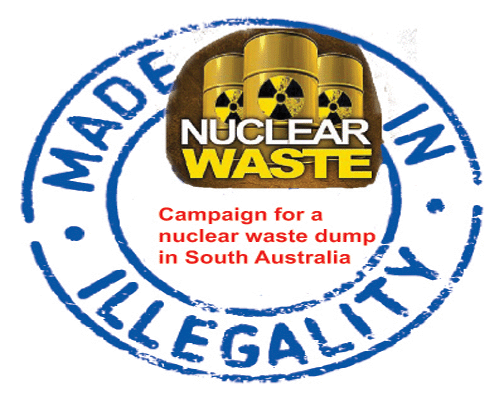
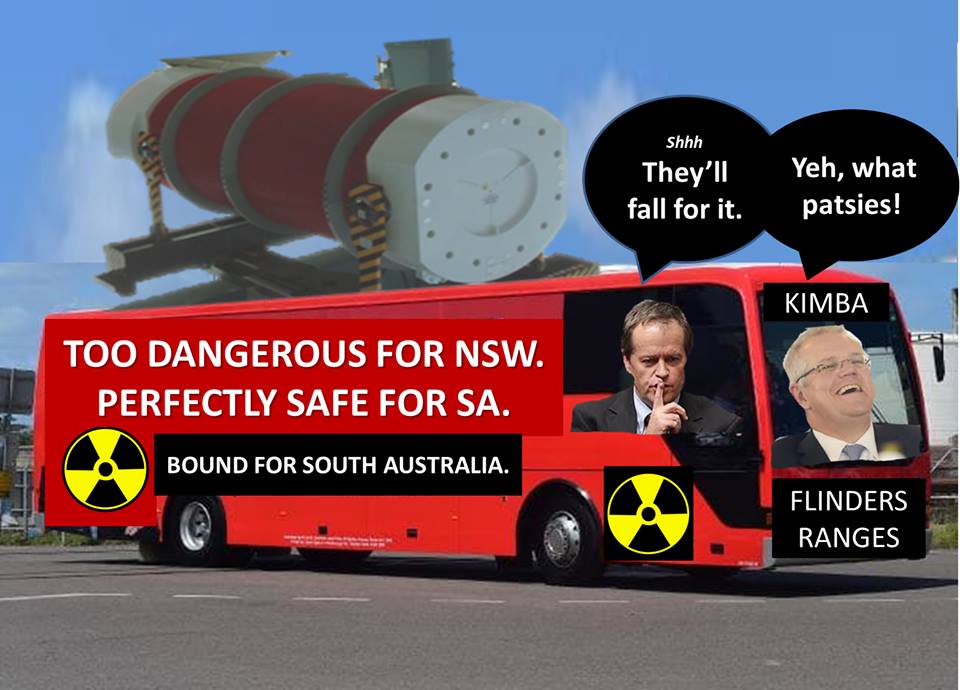
Matt Canavan’s ‘urgent’ new nuclear waste dump: The devil is in the detail https://www.foe.org.au/canavans_nuclear_waste_dump – Dave Sweeney, December 18 It is a national problem that has taken 60 years to make and will last 10,000 years, but according to Canberra, it will be soon be sorted. Radioactive waste management has been a challenge for successive federal governments, with communities across South Australia and the Northern Territory consistently rejecting plans for the dumping and storage of wastes in their region. Now the pressure is right back on regional South Australia, with a concerted federal push to locate a site either near Kimba on the Eyre Peninsula, or Hawker in the iconic Flinders Ranges. The plan sounds straightforward: take radioactive waste from around Australia to a central site, where low-level material would be disposed of and higher-level wastes stored, pending a final management decision. But, as ever, the devil is in the detail. Or in this case, in the profound lack of detail. Despite two years of promotional newsletters, shopfronts and drop-in centres, and publicly funded visits from pro-nuclear advocates, there remains a disturbing lack of clarity and deep concerns over the federal government’s plan and process. Radioactive waste is a complex policy area. The stuff lasts a long time, poses a real management challenge and, understandably, raises community concerns. Responsible decisions are best based on the “T” factor: talk, time, testing and trust. Sadly, the current federal push has failed to learn from this history and is replicating a failed formula. Despite plenty of talk about the benefits of the plan, the federal Government has actively refused to debate critics in open forums, key project assumptions have never been independently verified or tested, and many community members, Aboriginal landowners and wider stakeholders do not trust the process. Time is now running out on Minister for Resources and Northern Australia Matt Canavan’s long stated plan to make a siting decision this year. This timeline won’t be met ‒ largely due to legal action initiated by the Barngarla Determination Aboriginal Corporation. The Barngarla Traditional Owners have sought legal redress over their exclusion from the community ballot planned to assess public opinion in the Kimba region, arguing that this breaches the Racial Discrimination Act. Despite this delay the Minister still hopes to push ahead with the plan before the 2019 federal election, expected in May. The federal Government has been spending big and promising large, with job and community benefit estimates and assurances soaring since the ballot was announced. The Government is working to localise this issue and present it as an economic opportunity for a small region, but this plan is a national issue with profound and lasting implications. Around 95 per cent of the material planned to be moved to any new facility is currently managed at two secured federal sites. Low-level waste that needs to be isolated for 300 years is currently at the Woomera defence lands in South Australia’s north. The more problematic intermediate level waste, that needs isolation for 10,000 years, is stored where it was made at the Australian Nuclear Science and Technology Organisation’s (ANSTO) Lucas Heights facility in southern Sydney. Both sites have the physical, technical and regulatory capacity to continue to store these wastes for many years, and the current sense of federal urgency and pressure is being driven by politics and ANSTO’s corporate preferences, rather than by evidence or need. The federal nuclear regulator the Australian Radiation and Nuclear Safety Agency has repeatedly confirmed that there is no urgency to move the waste from ANSTO. In any discussion around radioactive waste management, a lot of airspace is devoted to the question of nuclear medicine. No one disputes either the importance or the need for secure access to nuclear medicine. The planned national radioactive waste facility is not expected to receive nuclear medicine waste from any hospital or medical clinic in Australia. These wastes would continue to be managed at these multiple sites on the current “store and decay” basis. A national radioactive waste facility would take nuclear reactor waste from the process that generated the nuclear medicine, but not nuclear medical waste. Importantly, this means that a national waste facility is not required to ensure access to nuclear medicine. Currently, Australia’s most serious radioactive waste is stored above ground at ANSTO. This makes sense, as the waste is already on site and Lucas Heights also has clear tenure, high levels of security and policing, the most advanced radioactive monitoring and emergency response capacity in the country, and it is the workplace of around 1,200 people. The federal Government’s plan is to move this material from this facility to one in regional South Australia with far less capacity and institutional assets. There is no radiological protection rationale to move this material from extended above ground storage in Sydney to extended above ground storage with far fewer checks and balances in regional South Australia. The current federal approach to the intermediate level waste is not consistent with international best practice and is merely kicking the can further down a less travelled road. The current federal plan is a retreat from responsibility, which is playing short-term politics with a long-term hazard. It is extraordinary that, after over six decades of making waste and two decades of sustained and successful community resistance to federal siting plans, Australia has never had an objective review of management practises and options. We need this now. Dave Sweeney works on nuclear issues with the Australian Conservation Foundation and was a member of the Federal advisory panel on radioactive waste. You can follow him on Twitter @nukedavesweeney Published in Chain Reaction #134, December 2018. National magazine of Friends of the Earth Australia. www.foe.org.au/chain_reaction |
|
Australia’s energy trends: we could be 100% renewable sooner than you think
Australia could hit 100% renewables sooner than most people think, Guardian,
Not since the invention of the steam engine have we seen the pace of change occurring in energy systems around the world. In Australia our electricity system is changing rapidly, from new technologies and business models to changes in policy and perhaps even regulation. As the year begins, here are five energy trends you should expect to see in 2019.
1. More action towards 100% renewable energy
Last year was a boom year for renewables. Despite rhetoric from some political quarters talking up coal and talking down renewable energy, we installed more solar panels and wind turbines than ever before. There are at least 40 large-scale wind and solar projects in construction in Australia, totalling over 6000MWs of new generation capacity. This means renewables will continue on a steep growth curve as analysis by the Melbourne University Climate and Energy College shows.
This rapid growth in renewables and soon battery storage is at least in part driven by a corresponding reduction in cost. Bloomberg New Energy Finance analysis reveals a compound annual reduction in cost of battery storage of 21% over eight years. Facts such as these are the engine driving us towards 100% renewables at a pace much faster than most pundits think.
At a political level California has just legislated a move to 100% renewables, while at home South Australia, Tasmania and the ACT are on track to be net 100% renewables in the next few years. With everyone from tech billionaires to school students demanding 100% renewables, pressure for a more rapid shift to renewables is likely to continue to build.
In the corporate sector, global initiative The RE100 has arrived in Australia. This initiative which encourages companies to commit to 100% renewables has seen global companies headquartered outside of Australia such as Carlton United Breweries and Ikea lead the way. In late 2018 Commonwealth Bank became the first Australian company to join, signing a large power purchase agreement in the process.
2. Solar for renters and other locked-out energy users……..For a long time these households have been in the too-hard basket for policymakers and industry alike. However, there are signs that in 2019 this could be changing. The Victorian and South Australian governments have announced policies to support 50,000 rental properties to access solar, and for South Australia, batteries also. In NSW the government is trialling a program of solar for 15,000 low-income energy rebate customers. These are small steps, but if scaled could start to change the current trend towards solar energy haves and have-nots.
3. Community energy going gangbusters
Communities are also taking matters into their own hands, developing innovative community-owned clean energy projects and implementing plans to move to 100% renewables. Despite a lack of interest from mainstream energy players and little policy support, Australia’s community energy sector has grown to more than 105 groups and 174 operating projects. Most famously the communities of Yackandandah and Daylesford……
4. A battle between good and bad hydrogen
Hydrogen fuel is not a new idea, yet in 2019 hydrogen is likely to make significant strides towards becoming a major part of our global energy ecosystem……..
5. Clean energy elections
No 2019 trend article is complete without mentioning the upcoming elections. According to researcher Rebecca Huntly climate change is a top issue with the electorate and as such both the NSW and federal elections are going to have a focus on climate and energy policy whether politicians like it or not…….https://www.theguardian.com/commentisfree/2019/jan/14/australia-could-hit-100-renewables-much-sooner-than-most-people-think
Proposed nuclear waste dump in Flinders Ranges – an urgent issue for South Australians, and all Australians
“We do not have a position on the sites in South Australia for a NATIONAL NUCLEAR WASTE facility. However, we do have a position on LUCAS HEIGHTS, (NSW). We need to get the nuclear waste out of there because it’s TOO DANGEROUS to keep the nuclear waste in densely populated metropolitan Sydney.”
Extract from “Economic Priorities Document”. South Australian Government.
“South Australian food, wine and beverages are world class and our unique regions, products and the CLEAN, GREEN ENVIRONMENT that they come from provides the COMPETITIVE EDGE required to secure and maintain PREMIUM status in our markets of choice.”
I have endeavoured to engage our State politicians on both sides for over a year now, to publicly speak to the people of South Australia on this issue, yet their silence is confounding and shameful. The nuclear waste proposed for South Australia is for both low level and intermediate level. Exposure to intermediate level nuclear waste, is 100% fatal with life expectancy of 4 -6 weeks. It will remain radioactive for 10,000 years. The Federal Government are targeting KIMBA in our farming land and The Flinders Ranges in the heart of tourism. The Flinders Ranges site will be just 10kms from Wilpena Pound! The waste will be stored for up to 100 years, above ground in a tin shed in one of the most seismic areas in Australia and prone to regular severe flooding. The floods waters in 1989 entered Spencer Gulf.
All South Australian’s need to be involved and told the truth about the Federal Government’s proposal for our state, as it will go beyond tarnishing our reputation that so many South Australian’s have worked hard for, but more so this proposal is both immediately and transcendingly dangerous for all Australians.
This decision is so catastrophically wrong it demands to be challenged by all of us, including our politicians. https://www.facebook.com/groups/344452605899556/
Every State and Territory in Australia to be hit with record heat (nothing to do with climate change?)
Record-breaking heatwave to hit every state and territory, https://www.sbs.com.au/news/record-breaking-heatwave-to-hit-every-state-and-territory Every state and territory in Australia will experience heatwave conditions on Monday, forecasters say. A cyclone is brewing off Western Australia’s Kimberley coast while much of the country is set to swelter in heatwave conditions.
Every state and territory will cop the heat on Monday when temperatures soar with some regions to experience severe and extreme hot weather.
The Bureau of Meteorology forecasts low intensity heatwave conditions in parts of central WA to southern parts of the Northern Territory, southwestern Queensland and across NSW, Victoria, Tasmania and South Australia.
It will be worst in South Australia where multiple days of temperatures above 40C, an unusual event even for summer, meteorologist Dean Narramore said on Sunday.
Particularly northern South Australia, they’re looking at maybe five days in a row above 45 and normally they might only get five or 10 a year,” he said.
Melbourne can expect to see a few days in the mid to high 30s, while temperatures in Sydney’s west will peak above 40C for four or five days.
ALERT: Adani Contractor Locked Up and Blockaded
New Adani contractor Eastern Tree Services found themselves locked out of five premises in three states this morning, with citizens blocking work trucks at another two premises.ETS, a large privately-owned company, operates tree clearing services from 20 sites across the country. They start tree clearing work at Abbott Point Coal Terminal this week and sources confirm ETS have accepted a contract to clear the rail corridor from Adani’s controversial Carmichael Coal Mine to link in with the existing railway travelling to Abbott Point. Jai, a spokesperson for Frontline Action on Coal said:
“ETS must listen to the majority of Australians who do not want Adani’s coal mine to go ahead and completely rule out destroying precious bushland for the proposed Adani rail corridor.”
This is not the first Adani contractor to be the target of long-running protests, with prior campaigns leading to banks, insurers and contractors ruling out supporting the mine. Emma from the Brisbane blockade protest said:
“Big businesses need to understand that if they work with Adani they will be held accountable for the damage to the reef, land, culture and climate that will ensue if Adani’s dirty coal mine goes ahead. Adani contractors like ETS will find themselves targets of ongoing protests until they rule out working with Adani.”
“Adani fail to get approvals and keep their promised work deadlines time and time again. They cannot be trusted and should not be allowed to build a climate wrecking coal mine that Australia doesn’t want, and the world doesn’t need.” SourceDoc Frontline Action on Coal: mailchi.mp/frontlineaction.org/adani-contractor-locked-out-as-warning-to-cut-ties-with-the-unpopular-carmichael-coal-mine
The problem of hazardous waste from discarded old solar panels
I have long been worried that environmentalists are seen to be enthusiastic about renewable energy, seeing it as the panacea for the world’s climate woes. Solar power is a great technology for replacing polluting fossil fuel power, but it’s only a part of what needs to be done – in the urgently needed transition from our wasteful CONSUMER SOCIETY to a CONSERVER SOCIETY. It must not become a contributor to the waste disaster. Australia’s enthusiastic embrace of rooftop solar has brought clear environmental and economic benefits, but critics say governments have dragged their feet in addressing the looming waste crisis.
As of December more than 2 million Australian households had rooftop solar installed. The uptake continues to grow due to the technology’s falling cost and rising electricity bills.
Photovoltaic panels last about 30 years, and those installed at the turn of the millennium are nearing the end of their lives. Many have already been retired due to faults or damage during transport and installation.
The nation’s environment ministers in April last year agreed to fast-track the development of new product stewardship schemes for photovoltaic solar panels and associated batteries. Such schemes make producers and retailers take responsibility for an item across its life cycle.
However, Total Environment Centre director Jeff Angel, a former federal government adviser on product stewardship, said action was long overdue and the delay reveals a “fundamental weakness” in Australia’s waste policies.
“We’ve had a solar panel industry for years which is an important environmental initiative, and it should have been incumbent on government to act in concert with the growth of the industry so we have an environmentally responsible end-of-life strategy,” he said.
Mr Angel said photovoltaic panels contain hazardous substances and “when we are sending hundreds of thousands of e-waste items to landfill we are also creating a pollution problem”.
“It’s a systemic problem that [applies to] a whole range of products”, he said, saying schemes were badly needed for paint, batteries, floor coverings, commercial furniture and many types of electronic waste.
Photovoltaic panels are predominantly made from glass, polymer and aluminium, but may also contain potentially hazardous materials such as lead, copper and zinc.
Australian Council of Recycling chief executive Peter Schmigel attributed delays in product stewardship schemes to both “bureaucratic malaise” and unfounded concern about cost.
The national television and computer recycling scheme, which since 2011 has required manufacturers and importers to participate in industry-funded collection and recycling, showed that regulatory measures can work, he said.
“Recovery rates have been out of sight since the beginning of the scheme, nobody has said anything at all about there being an inbuilt recycling cost. It generates jobs, it generates environmental outcomes and yet for some reason we have policymakers who are hesitant about [establishing similar schemes] for solar PVs and batteries,” he said.
Victoria will ban electronic waste in landfill from July 2019, including all parts of a photovoltaic system, mirroring schemes imposed in Europe.
Sustainability Victoria is also leading a project examining end-of-life management options for photovoltaic systems, which may progress to a national program. The issue is particularly pertinent in Victoria where a new $1.3 billion program is expected to install solar power on 700,000 homes.
Sustainability Victoria resource recovery director Matt Genever said there was strong support from industry, government and consumers for a national approach to photovoltaic product stewardship. Final options are due to be presented to environment ministers in mid-2019.
He rejected suggestions that plans were progressing too slowly.
“The analysis we’ve done in Victoria … shows that it’s in 2025 that we see a real ramp up in the waste being generated out of photovoltaic panels. I certainly don’t think we’ve missed the boat,” he said.
A report by the International Energy Agency and the International Renewable Energy Agency in 2016 found that recoverable materials from photovoltaic panel waste had a potential value of nearly $US15 billion by 2050.
Reclaim PV director Clive Fleming, whose business is believed to be the only dedicated photovoltaic recycler in Australia, said it recycles 90 per cent of materials in a panel. The company has been lobbying for state bans on solar panels entering landfill.
The NSW Environment Protection Authority said it has commissioned research to better understand how e-waste, including solar panels, was managed. The panels can be dumped in NSW landfill, however given their life span they were “not a common item in the waste stream”, it said.
The Queensland government is developing an end-of-life scheme for batteries used in solar systems and other appliances.
Mr Genever hoped the review would result in a broader range of products being subject to stewardship programs and take steps to ensure voluntary schemes were effective.
Both the Smart Energy Council and the Clean Energy Council, which represent solar industry operators, said a well-designed product stewardship scheme was important and should be developed through cooperation between industry, governments and recyclers.
Doubt about what happens to spent nuclear fuel rods within casks
Derek Abbott Nuclear Fuel Cycle Watch South Australia, 13 Jan 19, Something that is never discussed about dry cask storage (before it is transferred into a repository canister) is that the fuel rods have been emitting alpha particles for 40 years in the dry cask. The nuke enthusiasts who don’t understand physics naively think those alpha particles are impotent. They say “a piece of paper can block an alpha particle.” True but misleading.What actually happens is that alpha particles do indeed get blocked and don’t go far within a fuel rod, but they get converted to back to helium. [Remember an alpha particle is a helium nucleus anyway].So you get helium bubbles building up inside the fuel rod. Over 40 years this can fracture the fuel rod into pieces. So transferring the rods into a repository canister may not be possible. Because no one has actually opened up a bunch of old dry casks to get the rods into a repository yet, there isn’t much experience on exactly how much alpha particle damage affects the rods. I’m not sure there has even been a proper study of this. I am searching and will post it here if I find a study. https://www.facebook.com/groups/1021186047913052/
Australia’s environment – a winner at National Labor Party Conference
Labor will strengthen the law to protect Australia’s Environment and Heritage – TONY BURKE
Environmental wins at the National Labor Conference, Independent Australia By Stephen Williams | 13 January 2019 Stephen Williams questions national co-convenor Felicity Wade of the Labor Environment Action Network (LEAN) about new Labor policy.
“………Our goal was to ensure climate action was no longer an issue to be used tactically, becoming instead an article of faith. We believe a deep-rooted response to the environmental challenges of the 21st Century is essential to the long-term survival of a modern social-democratic party.
At the 2015 Labor National Conference, LEAN won the commitments to 50% renewable energy and 45% emission reductions by 2030. But it was just a few days ago, at the 2018 National Conference, that our real goal was won. Watching the debate on the floor, there was confidence and enthusiasm. Labor not only believes climate change is real, but that it is core business.
Party heavyweights lined up to affirm their commitment to turning around the “climate emergency”, as one of the motions described it. The continued challenge of the proposed Adani coal mine in Queensland is still outstanding. LEAN believes that while Labor will continue to support existing coal operations for some time, allowing a new, huge coal basin to be opened up is both risky and undermines perceptions of our commitment to climate change.
LEAN’s next task is to rebuild commitment to the natural environment in the same way. On issues of the natural environment, it is more about remembering something lost, rather than embracing something new. Visionary environmental policy has a Labor history and this week’s commitment to a new environment Act and an independent Environment Protection Authority are the first steps in reclaiming this.
The current environmental legislation, the Environment Protection and Biodiversity Conservation Act 1999 (Cth) (EPBC), is from the Howard era. It is primarily a tool to facilitate development, not to protect the environment. What’s more, it annoys business, and costs money by creating delays and confusion, little of which translates into good environmental outcomes. The only proactive aspects of the Act create lists of environmental threats with no power to protect anything or make a difference to real-world outcomes.
Since the EPBC Act was legislated in 1999, the number of threatened species and ecosystems has increased by 30%, with three animals going extinct. About 7.4 million hectares of threatened-species habitat (more than the size of Tasmania) has been cleared. Only 0.3% (21 of 6,100 developments assessed by the Act) have been rejected for unacceptable risks to the environment.
Australia has the highest rate of mammal extinctions in the world and is the only developed nation in the world’s top ten land-clearers. About 3,000 Australians die each year due to air pollution, plastics clog our waterways, while the community’s efforts to recycle are not matched by government-led national responses to ensure the waste is re-used.
We need more power at the federal level to stem these losses. ……..
When asked by our campaigners how they felt about climate change policy, the message they sent back to the party was unequivocal: 370 local ALP branches endorsed our call for 50% renewables by 2030 and credible emission-reduction targets.
Having achieved the policy outcome at the 2015 National Conference, we applied the same methodology to our call for a complete overhaul of Australia’s environmental laws and institutions. And thanks to Bill Shorten, who personally advocated for the reforms, Labor committed to these outcomes at the 2018 National Conference………https://independentaustralia.net/environment/environment-display/environmental-wins-at-the-national-labor-conference,12270
Bushfire in Adelaide Hills is still a threat
Just after 4pm on Sunday, the Country Fire Service issued an alert to residents around the Mt Lofty Ranges after a fire started on Montacute Rd, Montacute.
The fire, started from a discarded cigarette butt, was burning steep terrain, making it difficult for crews to access. The spread of the fire has been contained, however the hot and dry conditions forecast this week mean it could pick up again, the CFS say……….A severe fire danger warning, as well as a total fire ban, has been issued today for the Mt Lofty Ranges due to very hot and dry conditions. https://www.adelaidenow.com.au/news/south-australia/sas-breaking-news-blog-the-pulse-fire-crews-battle-uncontained-fire-in-mt-lofty-ranges/live-coverage/dc7bcd73c3c461533c4d8f911319fd20
Air conditioners make a massive contribution to global warming (Why not promote SOLAR air-conditioning?)
Why does this article not mention that solar-powered air conditioners are the most successful way to overcome this problem ?
Treaty on HFCs aims to curb global warming from greenhouse gases in air conditioning, refrigeration https://www.abc.net.au/news/2019-01-12/rising-demand-for-air-conditioning-alarms-climate-change-experts/10710956, ABC Weather By Ben Deacon In many parts of Australia, air conditioners have gone from being a luxury to what many consider a necessity.
It’s a trend that’s being echoed around the world as billions of people in hot counties lift themselves out of poverty.
But the explosion in demand for the energy-intensive appliance is alarming climate change experts, who say we’re heating the world up by cooling it down.
Victoria MacLean, who runs the Bureau of Meteorology’s weather station in Alice Springs, said the start of 2019 was unbearable, even by local standards.
“We had 11 days in a row recently of 40-degree-plus days. We had a 45.6 day. In fact we had another one like this as well and that did break the record for the Alice Springs airport,” said the meteorologist.
During the heatwave, Alice Springs had more days over 45 degrees Celsius in a single week than the town has recorded in the past 76 years.
Like most people in the desert community, Ms MacLean coped by running her air conditioner flat out.
“We closed off the downstairs side of the house and we actually stayed down there, we slept down there a few times, just to stay cool.
“We’ve got two dogs; we had to keep them inside because they just couldn’t handle it.”
But she does worry about the environmental impact of air conditioning.
“It’s kind of ironic that you’d been using the air conditioning, and we’ve got climate change going on, so we’re trying to conserve energy, but then you have to use more of it.”
Air conditioners’ environmental impact
Air conditioners are a double whammy in terms of climate change.
They’re the most energy-hungry appliance in the average home, which in Australia is mostly powered by fossil fuels, and the refrigerants inside air conditioners are potent greenhouse gases
Experts say demand for air conditioning is increasing so fast internationally that it will have a real impact on the earth’s climate. Continue reading
Australian Julian Assange in new danger as Ecuador caves in to USA pressure (and Australian govt does nothing)
More troubles for Julian Assange as ecuador bows to pressure to extradite him following this letter, http://thewikidaily.com/more-troubles-for-julian-asange-as-ecuador-bows-to-pressure-to-extradite-him-following-this-letter/ We have been monitoring Julian asange’s asylum in Ecuadorian embassy in britain to outline the dangers the computer proggrammer and wikileaks founder face in coming future and it seems alot have been happening lately than the mainstream media’s are reporting.
Ecuador has begun a “Special Examination” of Julian Assange’s asylum and citizenship as it looks to the IMF for a bailout, the whistleblowing site reports, with conditions including handing over the WikiLeaks founder.
Former Ecuadorian President Rafael Correa tweeted an image of the letter he received from the State Comptroller General on December 19, which outlines the upcoming examination by the Direction National de Auditoria.
The audit will “determine whether the procedures for granting asylum and naturalization to Julian Assange were carried out in accordance with national and international law,” and will cover the period between January 1, 2012 and September 20, 2018.
Assange has been in the Ecuadorian Embassy in London since he sought asylum there in 2012. He was granted Ecuadorian citizenship last December in a bid to protect him from being extradited to the US where he fears he faces secret charges for publishing US government cables and documents.
WikiLeaks tweeted the news on Wednesday, joining the dots between the audit and Ecuador’s consideration of an International Monetary Fund bailout. The country owes China more than $6.5 billion in debt and falling oil prices have affected its repayment abilities.
According to WikiLeaks, Ecuador is considering a $10 billion bailout which would allegedly come with conditions such as “the US government demanded handing over Assange and dropping environmental claims against Chevron,” for its role in polluting the Amazon rainforest.
Assange’s position has increasingly been under threat under Correa’s successor, President Lenin Moreno, with Ecuadorian authorities restricting his internet access and visitors.“I believe they are going to turn over Assange to the US government,
From uranium mining to nature conservation – Kakadu National Park to get $216 million boost,
Kakadu National Park to get $216 million boost, SBS News, 13 Jan 19, The federal government will invest $216 million in the Northern Territory’s Kakadu National Park to improve road access and tourist facilities. The World Heritage-listed Kakadu National Park will receive at least $216 million in funding to improve to improve roads and tourist facilities no matter who wins this year’s federal election.
Labor has pledged $220 million for Kakadu if it wins government.
Prime Minister Scott Morrison on Sunday announced the coalition’s $216 million package for the Northern Territory site during a visit to the town of Jabiru in Kakadu……https://www.sbs.com.au/news/kakadu-national-park-to-get-216-million-boost
UK “reviewing” files on nuclear bomb tests in Australia- this smacks of a cover-up
“To now withdraw previously available documents is extremely unfortunate and hints at an attempted cover-up.”
“worrying that properly released records can suddenly be removed from public access without notice or explanation.”
Review or ‘cover up’? Mystery as Australia nuclear weapons tests files withdrawn https://edition.cnn.com/2019/01/11/australia/uk-australia-nuclear-archives-intl/index.html, By James Griffiths, CNN
More than 65 years since the UK began conducting secret nuclear weapons testing in the Australian Outback, scores of files about the program have been withdrawn from the country’s National Archives without explanation.
The unannounced move came as a shock to many researchers and historians who rely on the files and have been campaigning to unseal the small number which remain classified.
“Many relevant UK documents have remained secret since the time of the tests, well past the conventional 30 years that government documents are normally withheld,” said expert Elizabeth Tynan, author of “Atomic Thunder: The Maralinga Story”.
“To now withdraw previously available documents is extremely unfortunate and hints at an attempted cover-up.”
Withdrawal of the files was first noted in late December. Access to them has remained closed in the new year.
Dark legacy The UK conducted 12 nuclear weapons tests in Australia in the 1950s and 1960s, mostly in the sparsely populated Outback of South Australia.
Information about the tests remained a tightly held secret for decades. It wasn’t until a Royal Commission was formed in 1984 — in the wake of several damning press reports — that the damage done to indigenous people and the Australian servicemen and women who worked on the testing grounds became widely known.
Indigenous people living nearby had long complained of the effects they suffered, including after a “black mist” settled over one camp near Maralinga in the wake of the Totem I test in October 1953. The mist caused stinging eyes and skin rashes. Others vomited and suffered from diarrhea.
These claims were dismissed and ridiculed by officials for decades — until, in the wake of the Royal Commission report, the UK agreed to pay the Australian government and the traditional owners of the Maralinga lands about AU$46 million ($30 million). The Australian authorities also paid indigenous Maralinga communities a settlement of AU$13.5 million ($9 million).
While the damage done to indigenous communities was acknowledged, much about the Totem I test — and other tests at Maralinga and later at Emu Field — remained secret, even before the recent withdrawal of archive documents.
“The British atomic tests in Australia did considerable harm to indigenous populations, to military and other personnel and to large parts of the country’s territory. This country has every right to know exactly what the tests entailed,” Tynan said. “Mysteries remain about the British nuclear tests in Australia, and these mysteries have become harder to bring to light with the closure of files by the British government.”
Alan Owen, chairman of the British Nuclear Test Veterans Association, which campaigns on behalf of former servicemen, said “the removal of these documents affects not only our campaign, but affects the many academic organizations that rely on this material.”
“We are very concerned that the documents will not be republished and the (Ministry of Defense) will again deny any responsibility for the effects the tests have had on our membership,” Owen told CNN.
Unclear motives Responding to a request for comment from CNN, a spokeswoman for the National Archives said the withdrawal of the Australian nuclear test files was done at the request of the Nuclear Decommissioning Authority (NDA), which has ultimate responsibility over them.
The NDA said that “a collection of records has been temporarily withdrawn from general access via The National Archive at Kew as part of a review process.”
“It is unclear, at this time, how long the review will take, however NDA anticipates that many of the documents will be restored to the public archive in due course,” a spokeswoman said.
Jon Agar, a professor of science and technology at University College London, said the withdrawal “is not just several records but two whole classes of files, many of which had previously been open to researchers at the National Archives.”
“These files are essential to any historian of the UK nuclear projects — which of course included tests in Australia. They have been closed without proper communication or consultation,” he added.
Agar shared correspondence he had with the NDA in which a spokeswoman said some files would be moved to a new archive — Nucleus — in the far north of Scotland. However the Nucleus archives focus on the British civil nuclear industry, and it is unclear why files on military testing would be moved there, or why those files would need to be withdrawn to do so.
Nucleus also does not offer the type of online access to its records as the National Archives does.
“Why not just copy the files if the nuclear industry needs them at Nucleus for administrative reasons? Why take them all out of public view?” Agar wrote on Twitter.
Information freedom In correspondence with both CNN and Agar, the NDA suggested those interested in the files could file freedom of information (FOI) requests for them.
Under the 2000 Freedom of Information Act, British citizens and concerned parties are granted the “right to access recorded information held by public sector organizations.”
FOI requests can be turned down if the government deems the information too sensitive or the request too expensive to process. Under a separate rule, the UK government should also declassify documents between 20 and 30 years after they were created.
According to the BBC, multiple UK government departments — including the Home Office and Cabinet Office — have been repeatedly condemned by auditors for their “poor,” “disappointing” and “unacceptable” treatment of FOI applications.
Commenting on the nuclear documents, Maurice Frankel, director of the Campaign for Freedom of Information, a UK-based NGO, said it was “worrying that properly released records can suddenly be removed from public access without notice or explanation.”
“It suggests that the historical record is fragile and transient and liable to be snatched away at any time, with or without good reason,” he added.
Bureau of Meteorology’ reveals Australia’s record-breaking month of climate change
The stunning chart revealing Australia’s record-breaking run of rising temperatures https://www.brisbanetimes.com.au/politics/federal/the-stunning-chart-revealing-australia-s-record-breaking-run-of-rising-temperatures-20190110-p50qk1.html By Nicole Hasham10 January 2019
If there was any question Australians are enduring a more extreme, topsy-turvy climate, look only to the month just gone.
In early December, Cyclone Owen unloaded 678 millimetres of rain in one day on the tiny North Queensland town of Halifax. It was a new December daily rainfall
By mid-December, a month’s worth of rain fell in parts of Victoria in 24 hours. On December 20 it was Sydney’s turn when a monster thunderstorm dropped giant hail stones – some the size of cricket balls. The insurance bill is nearing $675 million.
Then, the sun came out. By month’s end, much of Australia was baking under torrid temperatures. Marble Bar in Western Australia reached 49.3 degrees – the third-highest December temperature recorded anywhere in the country.
Advertisement
The record-breaking events are outlined in the Bureau of Meteorology’s 2018 climate statement released on Thursday, which confirmed the nation experienced its third-warmest year on record in 2018. The bureau attributed the year of meteorological extremes to both climate change and natural variability.
The national mean temperature in 2018 was 1.14 degrees above average. Nine of the 10 warmest years on record have occurred since 2005.
The bureau’s senior climatologist Lynette Bettio said every state and territory experienced above-average day and night temperatures last year.
“The average maximum temperature for the country as a whole was particularly warm, sitting 1.55 degrees above the 1961-1990 average, making 2018 Australia’s second warmest year on record for daily high temperatures,” Dr Bettio said.
Australia’s September rainfall was the lowest on record. Nationally, rainfall in 2018 was the lowest since 2005 and 11 per cent below average, while rainfall in some areas was significantly further below normal.
“Large areas of southeastern Australia experienced rainfall totals in the lowest 10 per cent on record, which exacerbated the severe drought conditions,” Dr Bettio said.
“NSW had its sixth driest year on record, while the Murray-Darling Basin saw its seventh-driest year on record.
“We did see some respite in the final three months of the year with decent rainfall in the east of the country.”
In other significant weather events last year, Broome broke its annual rainfall record just two months into the year and Tropical Cyclone Marcus was the strongest to affect Darwin since Tracy in 1974.
In August and September, up to 100 bushfires were active across NSW, Queensland and Victoria when warm, dry conditions brought an early start to the bushfire season
The Morrison government has been riven with internal tensions over climate change policy. Under the Paris climate accord, Australia has vowed to reduce greenhouse emissions, based on 2005 levels, by 26 per cent before 2030.
The government says Australia will meet that target “in a canter” however this claim has been contradicted by international bodies and the government’s own data.
Most recently, figures released by the Department of Environment and Energy last month showed that on current trends Australia will reduce emissions by just 7 per cent on 2005 levels by 2030, a massive 19 percentage points or two-thirds of the way short of the Paris agreement.
A major report prepared by the United Nations body for climate change, the Intergovernmental Panel on Climate Change, in October said coal-generated electricity must be phased out globally by 2050 if the world is to avoid the most catastrophic impacts of global warming, including the total destruction of the Great Barrier Reef.
The bureau said Australia was strongly influenced by both natural variability and climate change in 2018. Natural drivers included sea surface temperatures in the southern Tasman Sea which rose to “exceptionally high levels” in late 2017 and early 2018, contributing to warm overland conditions.
The report said Australia’s climate “is increasingly influenced by global warming” and the nation has warmed by just over one degree since 1910. Most warming has occurred since 1950.
Australia could use a little-known loophole to help meet up to half its Paris climate commitments in a move that analysts warn could undermine the global accord.
It said radical, swift efforts must be taken to curb greenhouse gas pollution and keep the global temperature increase below the critical 1.5 degree threshold.
“The background warming trend can only be explained by human influence on the global climate,” the bureau said.