Morrison government cynically tries to hide the truth on greenhouse gas emissions
Our emissions reduction target of 26-28 per cent below 2005 levels by 2030 is woefully inadequate and is not aligned with what the science says is necessary to effectively tackle climate change. Rather than doing it at “a canter” we’re like the champion sprinter, Chautauqua, stuck in the barriers.
Australia is one of the most vulnerable developed countries in the world to the impacts of climate change.
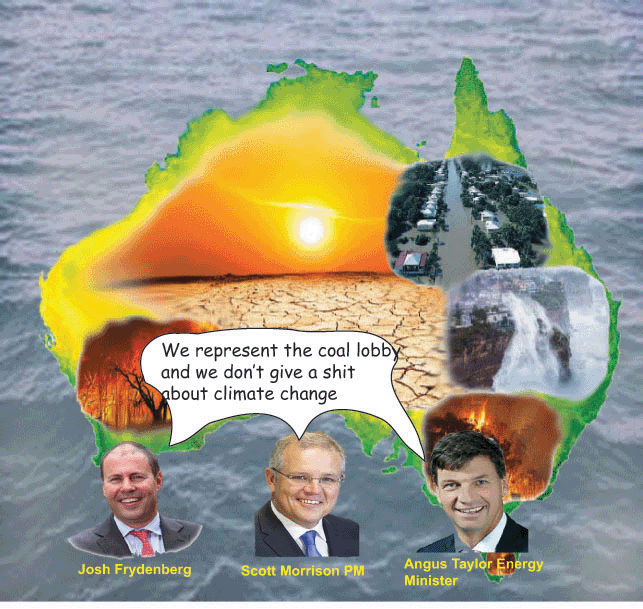
A cynical attempt to avoid scrutiny https://www.brisbanetimes.com.au/environment/climate-change/a-cynical-attempt-to-avoid-scrutiny-20181001-p5074d.html, By Martin Rice, 1 October 2018 —
It had held onto the information for months, seemingly waiting for the right time to “take out the trash”. The news for it, and for us, was grim. Australia’s greenhouse gas pollution levels have risen yet again.
The reporting of Australia’s rising emissions has been buried on a number of occasions, with data released on Christmas Eve, on weekends, holiday periods, or during major events. It’s a cynical attempt to avoid scrutiny.
For climate policy to be a winner, greenhouse gas pollution levels must be trending downwards; there are no Norm Smith or Clive Churchill medals for the federal government, with emissions increasing by 1.3 per cent for the year to March 2018. Worse still, greenhouse gas pollution has risen three years in a row – we’re chasing the wooden spoon.
On Sunday, Prime Minister Scott Morrison told the ABC Insiders program that people “choose and pick their figures to make a political argument”. This is not a political argument. The figures tell us very clearly that emissions are going up.
The Prime Minister also repeated his claim that Australia will meet its Paris obligations “at a canter”. There are numerous reports – from the Australia Institute last week and the UN Environment Program last year – that outline why Australia won’t meet its 2030 Paris commitments.
Our emissions reduction target of 26-28 per cent below 2005 levels by 2030 is woefully inadequate and is not aligned with what the science says is necessary to effectively tackle climate change. Rather than doing it at “a canter” we’re like the champion sprinter, Chautauqua, stuck in the barriers.
Australia is one of the most vulnerable developed countries in the world to the impacts of climate change. Heatwaves are becoming longer, hotter and starting earlier in the year. In the populous south of the country, dangerous bushfire weather is increasing, and cool season rainfall is dropping off, stretching firefighting resources, putting lives at risk and creating challenges for the agriculture industry.
The unprecedented bleaching events on the Great Barrier Reef in 2016 and 2017 resulted in mass coral mortality, with the 2016 bleaching event at least 175 times more likely to occur due to intensifying climate change. Not only is the reef a natural icon of global significance, it’s a multi-billion dollar economic asset, contributing around $6.4 billion to the Australian economy a year (of which $5.7 billion comes from the tourism industry), and supporting 64,000 direct and indirect jobs. Climate change is putting this industry, and the broader economy, at risk.
NSW and Queensland are experiencing severe drought conditions, with dire consequences for farming and rural communities. Southern Australia, particularly along the eastern coast and hinterlands, could experience devastating bushfire conditions this season. There would be little reprieve for firefighters exhausted from battling fires in the height of the Australian winter (yes, winter!) or helping suppress fires overseas.
The burning of coal, oil and gas is causing temperatures to rise at unprecedented rates and is making extreme weather events more intense, damaging and costly. The window of opportunity to effectively tackle climate change is closing fast. We need to rapidly and deeply cut our emissions.
The solutions are available. We need to accelerate the transition to clean, affordable and reliable renewables and storage technologies and ramp up other climate solutions in the transport, agriculture and other sectors.
At a time when credible federal government climate policy remains missing in action, it has never been more important for transparent greenhouse gas pollution information. Yet the federal government has consistently withheld or hidden vital emissions data; it’s a serial offender when it comes to climate censorship.
Martin Rice is the Climate Council’s acting chief executive and head of research.
Kidston Renewable Energy Hub in Far North Queensland fast tracked
 Kidston renewable energy hub one step closer, REneweconomy,
 Minister for State Development, Manufacturing, Infrastructure and Planning Cameron Dick said the project, located at the decommissioned Kidston Gold Mine within Etheridge Shire, proposes an innovative use of two existing adjacent water-filled mine pits to generate hydroelectricity.
“If approved, the project could employ 370 people during the two-year construction and have a minimum lifespan of 50 years,” he said.
“When complete, Stages 1 and 2 of the Kidston Renewable Energy Hub will provide enough energy to power around 160,000 Australian homes – enough power for a city bigger than Cairns.
“Stage 1 alone will produce enough power to supply more than 26,000 Australian homes, offsetting 120,000 tonnes of CO2 per year and remove 33,000 cars off Australian roads.
“Genex has set a strong mandate to provide local residents with job opportunities, whether that be direct on-site employment, consultancy or indirect contract work.
“This renewable energy project has the ability to revitalise the local economy and I commend Genex on making sure locals benefit from the project……..
The Kidston Renewable Energy Hub comprises:
Stage 1 solar power project (50 MW) which has been constructed
Stage 2 proposed new solar project (270 MW) to integrate with the K2H project (250 MW) currently undergoing assessment
Stage 3 wind farm project (150 MW) which is in the feasibility stage.
Energy generated by Stage 2 (combined solar and hydro) will be via a new transmission line connecting the Kidston site to Mount Fox, near Ingham…….
Mr Dick said the introduction of large-scale, low-cost flexible energy storage also provides another solution to Queensland’s growing power requirements.
If approved construction is due to commence in 2019 and expected to be completed by 2021.
For more information visit: www.dsdmip.qld.gov.au/kidstonhydro https://reneweconomy.com.au/kidston-renewable-energy-hub-one-step-closer-34630/
Nuclear whistleblowers strive for a green future for generations to come.
We are in debt to people like Rick Parks receiver of the IEEE Barus Ethics award while being a nuclear whistleblower, and Australia’s own ANSTO whistleblower David Reid, whom I hold in great regard of their honesty and credibility, that of which the opposing dichotomy has proven to have shortcomings. These whistleblowers have suffered loses to erode our ignorance, and we owe it to them to keep passing the anti-nuclear baton and strive for a green future for generations to come. https://www.facebook.com/groups/344452605899556/?multi_permalinks=837501786594633%2C837469919931153¬if_id=1538379410382955¬if_t=group_activity
Julian Assange’s health in danger- but he lacks medical care
 Assange’s Defense Attorney Denounces Risks to Client’s Health https://www.telesurtv.net/english/news/Assanges-Defense-Attorney-Denounces-Risks-to-Clients-Health-20180930-0011.html
“We are very concerned about his health: he has been locked up in the embassy for more than six years, without proper access to medical care,” said Robinson during an interview with the Catalan publication, Nacio Digital.
The lawyer stressed her client’s wavering health, which, she said, the embassy is unable to properly moderate due to lack of proper medical equipment and facilities.
“The embassy is not equipped for prolonged detention to provide a reasonable environment … the prolonged uncertainty of indefinite detention deeply affects the psychological and physical trauma above and beyond the expected stressors of incarceration,” the Australian lawyer said.
Robinson also showed concern over the “very serious” threat of Assange’s extradition to the United States for trial. “If Assange faces a trial in the US, he can not benefit from the first amendment of the Constitution, which refers to freedom of the press.
“We can not forget that he is only an editor who published material of public interest,” Robinson said.
The defense lawyer also explained the recent change in Ecuador’s administration has only served to complicate the case, which she described as a 180-degree change in political position between President Rafael Correa to his successor, the incumbent President Lenin Moreno, particularly in regards to bilateral relations with the United States.
On Mar, 28, just days after hosting a delegation of the United States Southern Command (Southcom), Ecuador’s President Lenin Moreno decided to cut his guest’s communications with the outside world, denying him access to the internet and banning visitors who are not part of his legal team.
Julian Assange was granted political asylum in the Ecuadorean embassy in the U.K. in 2012. Assange faced extradition to Sweden from England, over allegations of sexual assault on two women, which he categorically denied.
Although the judicial process for the alleged sexual crimes in Sweden was lifted, he fears that if he is given to British authorities he could face prison for skipping bail and face extradition to the United States, where he would be tried for espionage and could be sentenced to death for exposing U.S. war crimes in Iraq and Afghanistan.
The value of Australia’s coal exports is forecast to decline sharply
Thermal coal prices forecast to drop 25% and metallurgical coal prices 23% as value of iron ore exports also falls, Guardian, Gareth Hutchens@grhutchens, 2 Oct 2018 The value of Australia’s coal exports is forecast to decline sharply over the next 18 months as thermal coal prices drop 25% and metallurgical coal prices fall 23%.
Department of Industry, Innovation and Science chief economist enthusiastic about the lithium industry
|
Lithium ‘buzz’ could be worth hundreds of billions to Australia, WA Today By Hamish Hastie, 2 October 2018 —Australia has the potential to capture more wealth and jobs from its lithium sector by moving down the battery supply chain but this would be contingent on a number of factors, one of the federal government’s top economists thinks.
In his resources and energy quarterly update Department of Industry, Innovation and Science chief economist Mark Cully said lithium and battery demand could result in billions of dollars for a country that grabbed the opportunity………https://www.watoday.com.au/business/the-economy/lithium-buzz-could-be-worth-hundreds-of-billions-to-australia-20181002-p507cb.html |
|
|
‘Economic benefit’ from nuclear waste dump falsely pushed by Department of Industry, Innovation and Science
 Paul Waldon Fight To Stop Nuclear Waste Dump In Flinders Ranges SA, 1 Oct 18,
 ANSTO has a duty to deal with their waste, and as their name implies it should be done scientifically and not by shifting the waste to a backroom of the country. However this is an industry that has shortcomings worldwide in the R&D arena, with one claim that Consolidated Edison’s of New York only principle innovation after 25 years of operating was to paint their smoke stacks red white and blue.
Moreover the Department of Industry, Innovation and Science’s cogent manufactured factoids lead the minority of locals to espouse to radioactive wastes for purely false economical reasons. https://www.facebook.com/groups/344452605899556/?multi_permalinks=837324089945736%2C837259113285567%2C837129993298479%2C836953179982827%2C836913929986752¬if_
‘Adani and the War Over Coal’ – a new book: Quentin Beresford spills the devious beans
 BOOK REVIEW: ‘Adani and the War Over Coal’ — a pox on both their Parties, Independent Australia John Biggs 30 September 2018 The story of the devious and secretive negotiations between Adani and Australian governments of both stripes is appalling, writes John Biggs. “…… Conservation groups, Indigenous people and, eventually, a strong majority of ordinary Australians are outraged. In this book, Dr Beresford brings his sharp research and writing skills to tell this story of the war over coal.Gautam Adani had close connections with India’s PM Narendra Modi, who protected Adani over environmental and human rights violations in India. Adani donated heavily to both major Australian parties, especially to the Coalition. The Abbott and subsequent Coalition governments pushed for Adani as hard as they could. At first, so did Labor, but then sort of didn’t, but if certain conditions are met, well, maybe .
ISSUES IN DISPUTE
The major issues in dispute, as Bereford see it, are as follows.
Climate change
If all the Carmichael coal is burned – here or anywhere – the carbon emissions would be more than Australia already produces. That would likely tip global warming irreversibly. The pro-Adani group deny this.
Great Barrier Reef
The Reef is already seriously endangered by climate change, drainage from fertilised farmlands, and starfish. The mine would make matters immeasurably worse, as dredging (authorised byLabor’s Tony Burke) has already indicated.
Julie Bishop even denied the Great Barrier Reef would be in any danger.
Beresford notes (p.361):
‘None of the major parties has been prepared to unequivocally put the reef’s long term health over the interests of the fossil fuel industry.’
Great Artesian Basin
The Great Artesian Basin, vital for Australian agriculture, would be seriously endangered by the mine, either through using the water or by puncturing and draining the Basin. Adani supporters say this is exaggerated, and anyway coal mining is a thirsty business.
Native title
Doongmabulla Springs is in the mining area and is of high cultural significance to the Wangan and Jagalingou peoples. However Indigenous Land Use Agreements (ILUAs) that favour developers have been foisted onto the locals. These are currently under appeal.
Economic case
The costs of mining coal are now higher than the costs of producing renewables — and the difference is rapidly widening. With Adani’s projected costs, current debts and likely returns, Adani is predicted to lose crippling amounts of money if it proceeds.
Adani’s poor safety, criminal and environmental record
First in India and now here, Adani operations have already badly polluted land in the Carmichael region.
WHY, WHY, WHY?
Given all of this, why on Earth would Australian governments be so determined to support the Adani project?
Beresford discusses these issues and others in depth. His findings and assertions are fully referenced, his arguments convincing.
While much of this is due to the shocking judgement and wickedness of individual people, Beresford sees (p.360) as even more important the way in which the coal wars have transformed politics: …….https://independentaustralia.net/environment/environment-display/book-review-adani-and-the-war-over-coal–a-pox-on-both-their-parties,11949
PM Morrison’s dodgy claim about Australia meeting Paris climate commitment
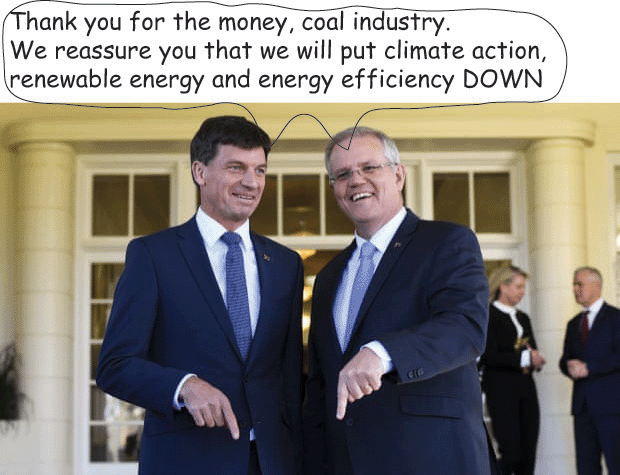 PM claims Australia will meet Paris target ‘in a canter’
  despite emissions climbing
Morrison says rate of increase not as high as previous years and renewables investment will ensure Australia meets commitment, Guardian, Amy Remeikis, 30 Sept 18, Australia’s greenhouse gas emissions have continued to rise, but Scott Morrison seized on the silver lining, maintaining Australia would meet its Paris commitment, despite the government having no legislated instrument to help it get there.
Figures released on Friday showed Australia’s emissions increased 1.3% in the year to March 2018, up all sectors – except land use and electricity, where renewable technologies were having an impact on the latter.
The prime minister jumped on the rate of the increase not being as high as in previous years……..
Morrison said Australia would meet its Paris targets “in a canter”, largely based on investment in renewable energy technologies, despite concerns a lack of legislated instrument may impact investor confidence in the sector. …..
“We still have large-scale and small-scale policies there. We still have the Clean Energy Finance Corporation, and we still have the Emissions Reduction Fund for the period that it’s currently for, and we’re on track to hit it.”…..
Critics of the government’s stance have repeatedly called for legislation to ensure Australia meets the targets it agreed to when Tony Abbott signed the nation up to the Paris agreement.
But with the national energy guarantee a casualty of the leadership spillwithin the Liberal party, the government has no legislated instrument to ensure emission reductions, and no plans to create one…..
He said lowering electricity prices remained the government’s priority and criticised Labor for its policy. ….Labor has said it will look to legislate a version of the national energy guarantee the government abandoned as policy to ensure Australia does meet its targets. The Greens announced its parliamentary team will take a “hard line” on making sure any future Labor government does not back down.
Research released earlier this month found that emission reductions targets were not responsible for driving up power prices. https://www.theguardian.com/australia-news/2018/sep/30/pm-claims-australia-will-meet-paris-target-in-a-canter-despite-emissions-climbing
Australia’s solar hydrogen industry – CSIRO sees an export future
Sun shines on CSIRO’s cheap hydrogen industry, Brisbane Times, By Cole Latimer, 30 September 2018, Curtin University researchers have developed a cheaper and safer way to bottle and store Australian sunshine as hydrogen fuel.
Researchers from Curtin University’s School of Molecular and Life Sciences have created a lower-cost and less toxic method of developing hydrogen fuel from solar energy, paving the way for the growth of a hydrogen industry in Australia.
Hydrogen is currently being touted by the CSIRO and the government as Australia’s next major energy export industry, valued at up to $1.6 billion by 2025, and as a potential replacement for natural gas and petrol.
Current methods for creating hydrogen from solar power involve running an electric current generated by solar panels through water and requires either highly toxic cadmium or very expensive platinum as a catalyst to kick off the process.
Curtin University’s Dr Guohua Jia said the new process uses an extremely common, and much safer material, zinc selenium, which is sold in many pharmacies around Australia as a vitamin supplement…….
The new development comes as Australia’s chief scientist, Alan Finkel, tours Japan and promotes a hydrogen energy partnership between the two countries.
The Office of the Chief Scientist said Dr Finkel “led a delegation of Australian industry and government leaders interested in pursuing Australia’s potential as hydrogen supplier on an official visit to Japan”…..
the department said. “The Hydrogen Strategy Group, chaired by Dr Finkel, reported to the Coalition of Australian Government energy ministers that Australia has the necessary resources to supply hydrogen produced by near zero-emissions methods, at scale, to Japan and like-minded nations.”……https://www.brisbanetimes.com.au/business/the-economy/sun-shines-on-csiro-s-cheap-hydrogen-industry-20180928-p506px.html
White roofs – an effective cooler for houses
Another option is not to whitewash roofs, but to green them with foliage. This is already being adopted in many cities
There is a third option competing for roof space to take the heat out of cities — covering them in photovoltaic cells. PV cells are dark, and so do not reflect much solar radiation into space. But that is because their business is to capture that energy and convert it into low-carbon electricity.
Solar panels “cool daytime temperatures in a way similar to increasing albedo via white roofs,” according to a study by scientists at the University of New South Wales. The research, published in the journal Scientific Reports last year, found that in a city like Sydney, Australia, a city-wide array of solar panels could reduce summer maximum temperatures by up to 1 degree C. …….
The lesson then is that light, reflective surfaces can have a dramatic impact in cooling the surrounding air – in cities, but in the countryside too. Whitewashed walls, arrays of photovoltaic cells, and stubble-filled fields can all provide local relief during the sweltering decades ahead.

|
Urban Heat: Can White Roofs Help Cool World’s Warming Cities?
It has long been known that installing white roofs helps reduce heat buildup in cities. But new research indicates that making surfaces more light-reflecting can have a significant impact on lowering extreme temperatures – not just in cities, but in rural areas as well.Yale Environment 360 MARCH 7, 2018 Summers in the city can be extremely hot — several degrees hotter than in the surrounding countryside. But recent research indicates that it may not have to be that way. The systematic replacement of dark surfaces with white could lower heat wave maximum temperatures by 2 degrees Celsius or more. And with climate change and continued urbanization set to intensify “urban heat islands,” the case for such aggressive local geoengineering to maintain our cool grows.The meteorological phenomenon of the urban heat island has been well known since giant cities began to emerge in the 19th century. The materials that comprise most city buildings and roads reflect much less solar radiation – and absorb more – than the vegetation they have replaced. They radiate some of that energy in the form of heat into the surrounding air. The darker the surface, the more the heating. Fresh asphalt reflects only 4 percent of sunlight compared to as much as 25 percent for natural grassland and up to 90 percent for a white surface such as fresh snow. Continue reading |
Jobs for South Australians at nuclear morgue? That is a shaky promise.
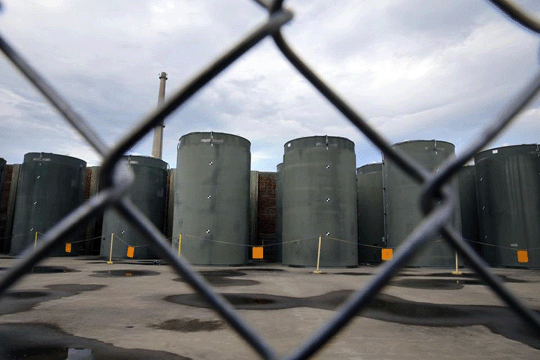
A nuclear waste jobs bonanza for regional South Australia? http://www.onlineopinion.com.au/view.asp?article=19959, – Jim Green, 27 Sept 19
The federal government is trying to persuade regional communities in South Australia to host a national radioactive waste facility – an underground burial repository for lower-level radioactive wastes and an above-ground ‘interim’ store for long-lived intermediate-level waste. One site under consideration is near Hawker in the Flinders Ranges, and two other sites under consideration are on farming land near Kimba at the top of the Eyre Peninsula.
The government is promising 45 jobs, three times its earlier claim that there would be 15 jobs at the proposed facility. The compensation package on offer has also tripled and now stands at $31 million.
Forty-five jobs would be welcome in small regional communities. But is it plausible that 45 jobs would be created? When the Howard government was attempting to establish a radioactive waste repository in SA from 1998 – 2004, the government said there would be zero jobs – not even any security guards. The government-commissioned PR company Michels Warren said: “The National Repository could never be sold as “good news” to South Australians. There are few, if any, tangible benefits such as jobs, investment or improved infrastructure.”
From 2005 to 2014, Coalition and Labor governments targeted sites in the Northern Territory for a radioactive waste repository and said there would be just six jobs, all of them security guards.
Last year, with SA once again in the firing line, the government said: “At least 15 full-time equivalent jobs will be needed to operate the facility. These will be in site management, administration, security, environmental monitoring, site and building maintenance as well as receiving and packaging waste materials.”
Recently, the jobs estimate was upped to 45, with the government saying: “In addition to the 15 operational jobs already confirmed, the structure now includes roles for community liaison, management, tourism, environmental monitoring, security, health and safety: a total of 45 staff.”
This is the breakdownof the 45 jobs:
14 – security and safeguards
13 – waste operations and technicians
8 – site management and community outreach
5 – environmental protection and quality control
5 – safety and radiation protection
That estimate comes with caveats: “the final workforce design and structure will be based on a number of factors including advice from security agencies, the views of the independent regulator and the details of the final business case, with inputs from across government.”
Overseas comparisons
The Centre de Stockage de l’Aube (CSA) radioactive waste facility in France handles over 200 times more waste per yearcompared to the proposed facility in SA yet it employs only four times as many staff as the proposed facility in SA. CSA processes 73 cubic metres (m3) per employee per year (13,164 m3 / 180 staff).
Is the estimate of 45 jobs credible? Not if overseas radioactive waste facilities are any guide.
The El Cabril radioactive waste facility in Spain has a staff of 137 people and processed an average of 1,395 m3 per year from 1993 to 2016. That equates to 10.2 m3 per employee per year.
Yet the Australian government estimates a workforce of 45 people to process 45 m3 per year: 1 m3 per employee per year compared to 10.2 in Spain and 73 in France. The government evidently has a dim view of the productivity of Australian workers, or, more likely, its jobs estimate is grossly inflated.
Will the government pay staff to do nothing?
Measuring jobs-per-employee doesn’t account for some jobs required whether a facility processes 1 m3 or 1 million m3 per year: administration, security and so on. As a government official stated: “There are a base number of jobs related to the management of the waste which are not linear with volume and a number of jobs that would scale with larger volumes.”
Nevertheless, productivity at the proposed Australian facility would be dramatically lower than comparable facilities overseas.
If we assume that Australia matched the lowest of the figures given above – 10.2 m3 per employee per year at El Cabril in Spain – then the staff at an Australian facility would be processing waste for just one month each year and they’d have 11 months to play ping-pong.
The current government might be willing to pay 45 staff to play ping-pong for 11 months each year, but it’s not a sustainable situation. The Department of Finance wouldn’t tolerate it. If staff at the waste facility are paid by the federal government to do nothing for most of the time, what sort of a precedent does that set, and why shouldn’t the rest of us be paid to do nothing for 11 months out of 12 at a cost to taxpayers of several million dollars each year?
Almost certainly, staffing would be dramatically culled. Almost certainly, a future government would revert to the plan pursued by previous governments: keeping the waste facility closed most of the time, and opening it occasionally for waste disposal and storage. In the jargon, this is called a campaign-based approach with occasional waste disposal ‘campaigns’.
Previous governments said that waste would be sent to the facility just once every 3 – 5 years. For example, the government said in 2003 that waste would be transferred to the facility just once every five years: “It is considered for planning purposes that an average period of 5 years between campaigns will be appropriate” (Volume III of DEST application to ARPANSA, Ch.9, ‘Waste – Transfer and Documentation’, p.5).
In a recent attack on me for questioning its estimate of 45 jobs, the Department of Industry, Innovation and Science said it was unable to locate any previous government documents regarding periodic, campaign-based plans. The federal government can’t find federal government documents? Seriously?
The government says that it wants continuous operation of the repository (for reasons unexplained) rather than a periodic, campaign-based approach. But even so, the government only plans to shift waste to the facility once or twice each yearaccording to a 2016 document. A July 2018 government document states: “This facility will be an operational facility and not as some have suggested, a minimally crewed warehouse to be opened once or twice a year.” But it is the government itself which says that waste will only be transported to the facility once or twice each year!
Broader economic impacts Continue reading
Barngarla Determination Aboriginal Corporation to continue legal fight over proposed nuclear waste dump
 Kimba District Council, 28 Sept 18 : The Australian Human Rights Commission has today formally terminated conciliation between the Barngarla Determination Aboriginal Corporation and the District Council of Kimba. The matter is now likely to proceed through a judicial process. In the meantime, the National Radioactive Waste Management Facility site selection ballot will not be undertaken until the matter is resolved.
A spokesperson for Council said that during the conciliation, alternative options for resolution were put to BDAC by the Department of Industry, Innovation and Science, but were not accepted. For this reason, the outcome is disappointing, but Council remains committed to facilitating a forum on behalf of the Minister for Resources and Northern Australia that ensures the Kimba community has an opportunity to be heard on the issue.
Given the matter is still before the court, Council will be making no further comment, but will keep the community informed as the situation develops.

American transnational corporation AECOM would be the biggest beneficiary from a South Australian radioactive suppository
 Tim Bickmore shared a link No Nuclear Waste Dump Anywhere in South Australia,
Q. Who would mostly benefit financially from a South Australian radioactive suppository?
A. American transnational corporation AECOM. They already have Oz Gov brass in pocket from the NRWMF, from ADANI, from the NBN. In the UK AECOM services both the Sellafield & Cumbria radioactive waste facilities. AECOM is the 18th largest service provider to the US Govt; runs Los Alamos plutonium factory; Kennedy Space Center & NY World Trade Center.
AECOM is in the box seat to manage & run any OZ radioactive waste facility……https://www.facebook.com/groups/1314655315214929/
Great Barrier Reef scientists told to focus on projects to make government look good
 Emails tabled in Senate inquiry recommended ‘trade-offs’ to Great Barrier Reef Foundation, Guardian, Ben Smee @BenSmee 26 Sep 2018
Great Barrier Reef scientists were told they would need to make “trade-offs” to the Great Barrier Reef Foundation, including focusing on projects that would look good for the government and encourage more corporate donations, emails tabled in the Senate reveal.
The documents, including cabinet briefing notes, contain significant new details about the workings of the foundation and the government decision to award it a $443m grant, including:
- The executives of mining, gas and chemicals companies – and international financial houses that actively back fossil-fuel projects – were among the guests at a six-star retreat hosted by the foundation less than a month after the grant was announced;
- The media companies Foxtel and Fairfax and the tech giant Google are among a tightly held list of donors to the foundation;
- The only CSIRO employee contacted about the grant before the announcement in April was in Patagonia, and did not get the email. Documents have previously revealed that the government’s peak science agency was cut out of the decision to award the grant;
- In August, as scrutiny of the grant intensified, public servants pushed to block a long-planned meeting between the then science minister, Michaelia Cash, and the head of the foundation, Anna Marsden, because of concern about the “optics”.
Emails sent by staff at the Australian Institute of Marine Science outline how government expectations, the ability to leverage private donations and public perceptions “may drive the [foundation] to prioritise shorter-term research initiatives in order to demonstrate progress and return on investment”.
“Where it becomes challenging is that … interventions with the largest future benefit also take the longest to develop,” the institute’s executive director of strategic policy, David Mead, wrote in an email to colleagues.
“Among other trade-offs, we will need to determine to what degree we focus on quick wins or whether we progress longer-term strategic interventions and accept that we will only partially progress them during the next five years (perhaps with little outward visibility of success/progress).”
The emails also reveal an initial state of uncertainty about how a $100m allocation for reef restoration and adaptation would be handled……. https://www.theguardian.com/environment/2018/sep/26/great-barrier-reef-scientists-told-to-focus-on-projects-to-make-government-look-good?CMP=share_btn_tw.
1 This month
25 October – Film –Britain’s Nuclear Bomb Scandal: Our Story – part of the Adelaide Film Festival,
Screening and Conversation
A screening of Britain’s Nuclear Bomb Scandal: Our Story (2024) followed by a talk with 2026 Bettison and James Awardee and Tradtional Owner Karina Lester in conversation with Simone Tur.
When: Sun 25 Oct, 12:00pm-Screening, 1:15pm-Talk
Where: The Mercury
Free admission, register below by clicking on BUY TICKETS and select free event tickets, at end of web page:
https://www.adelaidefilmfestival.org/program/2026/britains-nuclear-bomb-scandal-our-story
.

Australians deserve the truth
about
AUKUS – https://aukuspublicinquiry.com/

PETITION – To: Prime Minister Anthony Albanese and the Australian Labor Government

of the week – Australians for War Powers Reform (AWPR)
To see nuclear-related stories in greater depth and intensity

