Australia’s Prime Minister Scott Morrison joins the pro nuclear bandwagon
 Whatever it takes: ScoMo prepared to go nuclear if it cuts power prices https://www.theaustralian.com.au/national-affairs/climate/whatever-it-takes-scomo-prepared-to-go-nuclear-if-it-cuts-power-prices/news-story/1193fd298fb3ff1d57b4e48accea3ee1 GREG BROWN, OCTOBER 8, 2018 Scott Morrison says he would overturn the ban on building nuclear reactors in Australia if he believed it would put downward pressure on power prices.
The Prime Minister said he would do “whatever it takes” to make electricity cheaper, and he would have no issues allowing nuclear reactors to be built if it would make lower household bills.
But warned the investment case to build a nuclear reactor did not “stack up”.
You’ve got to make the investment stack up,” Mr Morrison told 2GB radio.
Last month, former PM Tony Abbott called on the Morrison government to lift the prohibition on nuclear power.
Mr Abbott told 2GB there was “absolutely no reason why, when it’s economic, we shouldn’t have nuclear power generation in Australia”.
The push to revive the nuclear debate comes after Mr Morrison last month declared the NEG dead, while opposition energy spokesman Mark Butler held out the prospect of Labor moving to revive the policy in government following engagement with industry.
The former chair of the Australian Nuclear Science and Technology Organisation and current chair of 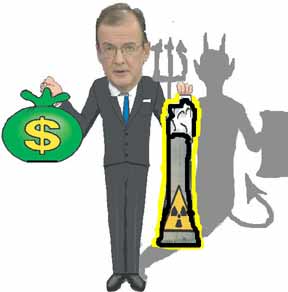 NBN Co, Ziggy Switkowski, told The Weekend Australian it was sensible to clear the regulatory pathway for the next generation of small nuclear reactors.
Meanwhile, the International Atomic Agency says nuclear energy is vital to meeting the global challenge of climate change but projections were for a dramatic shortfall in capacity by 2050.
A new report from the agency revealed without nuclear, cumulative greenhouse gas emissions between 2018 and 2050 could be up to 12 gigatonnes higher, more than 20 times Australia’s entire emissions last year.
Called Climate Change and Nuclear Power 2018, the report said climate change was one of the most important issues facing the world today.
Nuclear energy could make an important contribution to reducing greenhouse gas emissions while delivering energy in the increasingly large quantities needed for global economic development.
“Nuclear power plants produce virtually no greenhouse gas emissions or air pollutants during their operation and only very low emissions over their full life cycle,” the report said.
No Australian government support for “nonsense” like climate change action
 Morrison vows no money for climate conferences and “all that
 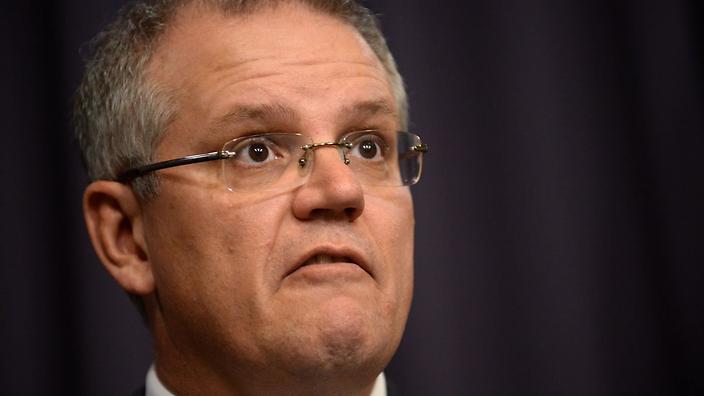 nonsense” https://reneweconomy.com.au/morrison-vows-no-money-for-climate-conferences-and-all-that-nonsense-38468/ 8 October 2018 Australia’s prime minister Scott Morrison has responded to the latest UN Intergovenmental Panel of Climate Change report by declaring that he had no intention of spending money on global climate conferences and “all that sort of nonsense.”
New political party – Stop Selling Australia party
Stop Selling Australia party.
We mainly focus on the prevention of our assets and essential services being sold off to foreign countries, we also care about the long term future of Australia.
This includes the dumping of nuclear waste in Australia which is not in the interest of our kids.
We are planning on running a candidate in each state, but as yet don’t have one for South Australia.
If you know anyone who might be suitable, please contact me and we can have a chat.
Thanks,
Mike Barclay https://www.facebook.com/groups/344452605899556/
Australia lagging behind in electric cars, though they save lives and cut costs
6 October 2018 Deaths from air pollution would be prevented and the Morrison government would meet its pledge to make electricity more reliable and affordable if more Australians drove electric cars, but a lack of political will is holding back the benefits.That is the widespread view expressed to a Senate probe into electric vehicles in Australia. Electric car maker Tesla, headed by controversial entrepreneur Elon Musk, is among those who assert that “government leadership” is the main barrier to increasing electric vehicle uptake in Australia, while the government’s own infrastructure adviser warned that Australians “risk being left behind” in the global transition.
Australia trails the world in the adoption of electric vehicles. Just 2284 were sold last year – 0.2 per cent of total vehicle sales. This is largely attributed to a lack of vehicle choice, fears about limited driving range and higher upfront costs than traditional cars.
In contrast, electric vehicles make up about 20 per cent of new sales in Norway, and are expected to reach 30 per cent of sales in China by 2030.
The Senate inquiry, chaired by independent South Australian senator Tim Storer, is investigating the benefits and opportunities of electric vehicles in Australia.
It is broadly acknowledged that electric vehicles improve air quality, help address climate change, boost public health and are cheaper to run than conventional vehicles.
……The Morrison government said these two outcomes – making electricity more reliable and affordable – would be its “unrelenting” focus following the demise of the National Energy Guarantee. However the government provided only limited support for electric-vehicle adoption.
Tesla told the inquiry that thousands of Australians had placed deposits for its model 3 sedan and research showed 50 per cent of Australians would consider an electric vehicle for their next purchase.
But it said governments must help ensure Australians could access charging infrastructure and a wide range of vehicle models, and reduce financial and logistical hurdles.
“The main barrier to increasing electric vehicle uptake in Australia is not consumer appetite; rather it is clear government leadership,” Tesla wrote.
The NRMA, ClimateWorks and the Electric Vehicle Council also called on governments to act to encourage the uptake of electric vehicles in various ways, such as implementing vehicle emissions standards, supporting the establishment of charging infrastructure and setting targets for government fleets. ……
The Senate committee is due to report in December. https://www.smh.com.au/politics/federal/electric-cars-would-save-lives-and-cut-costs-but-australians-risk-being-left-behind-20180914-p503th.html
Un-paid people who care -speak out against nuclear waste dump plan for South Australia
 I am always struck by the fact that opponents of the nuclear industry are very many unpaid people. Just people who care. Some are highly educated academically. Many are not – but then they take the trouble to find out, and speak with the authority of both their local knowledge and wider information.
As for nuclear proponents they’re a small number of paid individuals, with another small number of hangers on who expect financial benefits from the nuclear industry.
Barb Walker shared a post. on Flinders Local Action Group– more – https://www.facebook.com/search/top/?q=flinders%20local%20action%20group
 ABC Radio Adelaide Evenings with Peter Goer. Talkback 4 Oct 18. This show was inundated with hundreds of South Australians phoning in and texting about the proposed nuclear waste dump. ALL SAID NO! Are you listening DIIS and ANSTO !!!??…. IT’S A BIG NO FROM SOUTH AUSTRALIA!!! http://www.abc.net.au/…/adelaide/programs/evenings/evenings…
Port Augusta – proudly the ‘renewables capital of Australia’
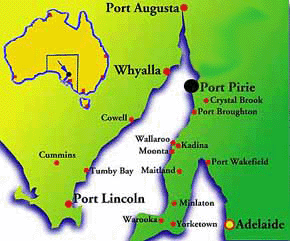 ‘Renewables capital of Australia’? Port Augusta shows off its green
  energy credentials, ABC
Thirteen renewable energy projects are underway or under consideration — from wind farms and pumped hydro-electric power to solar with storage that can shift electricity made when the sun’s shining to meet peak demand in the evening.
“The one great resource we have here in Port Augusta and the upper Spencer Gulf is this wonderful natural resource called the sun,” Mr Johnson said.
“It’s no different to having a massive uranium deposit, a massive gold deposit, a massive copper deposit.”
In a country drenched in sun, this natural resource is particularly abundant in the arid landscape around Port Augusta, and there are also plenty of flat expanses on which to build the facilities needed to exploit it.
Framed by the Flinders Ranges, stage one of the Bungala solar farm stretches over 300 hectares of land owned by the Bungala Aboriginal Corporation about 10 kilometres north-east of town.
Bungala uses a solar photovoltaic technology, with panels mounted on a tilting axis that can follow the sun’s path from east to west, maximising output and efficiency.
“It’s not only the largest solar project in Australia,” Mr Johnson said. “It’s also the largest in the southern hemisphere. And it’s only half complete.”
When stage two is complete, the entire project will cover more than 800 hectares — an expanse nearly as big as the Melbourne CBD — and generate up to 570 gigawatt hours of electricity a year, enough to power about 82,000 households, according to its owners, Italian multinational Enel Green Power and the Dutch Infrastructure Fund.
“Note that the Northern Power Station, when it was operating, was only producing between 500 and 540 megawatts,” Mr Johnson said.
“Obviously, it was operating 24-7, while the solar plant will only operate when the sun is shining, but when you start to incorporate battery storage and solar thermal, you then build in the energy security.”
Solar that releases energy even when the sun doesn’t shine
The Aurora project about 30 kilometres north-west of Port Augusta addresses the criticism often levelled at renewable energy — that when the sun doesn’t shine, and the wind doesn’t blow, the power doesn’t flow.
Construction is due to start soon on the concentrated solar thermal power station. It will able to store a massive 1,100 megawatt-hours of electricity, according to the project proponent, SolarReserve.
When it is built, an impressive sight will greet observers: a tower full of molten salt standing about 250 metres high, surrounded by more than 10,000 heliostats — movable mirrors, the size of billboards, algorithmically programmed to track the sun.
Those thousands of mirrors will reflect and concentrate sunlight, beaming it onto a receiver straddling the top of the tower.
During the day, molten salt will flow through the receiver and be heated to temperatures as high as 566 degrees Celsius, then stored in tanks overnight.
The energy will be dispatchable as electricity when needed — after dark in the evening peaks, or in the morning, hours after it was generated. It will be enough energy to power 90,000 homes, according to SolarReserve, which wants to build six of these plants in South Australia.
Crescent Dunes in the Nevada desert uses an identical technology.
There is one key difference: the price of the power.
“Pricing has come down dramatically, as it has throughout the renewable energy industry,” Kevin Smith, the chief executive of SolarReserve, said.
Crescent Dunes, the first plant of its kind, began operating in 2014.
Construction was aided by a concessional loan of $US737 million ($1,040 million) from the US Department of Energy. Despite that subsidy, it was contracted to supply electricity to Nevada at $190 a megawatt hour. Not cheap.
The Aurora project is receiving a much smaller concessional loan from the Australian Government — about $110 million — but will supply energy at a fraction of the price.
SolarReserve is cagey about the precise figure (the contractual conditions are complex) but Mr Smith agreed with reports that put the cost at about $78 a megawatt hour.
At current exchange rates, that is well under half the price of electricity from its inaugural plant in the US — and far cheaper than new coal-fired power.
“In terms of cents per kilowatt hour, we can supply electricity 30 to 40 per cent cheaper than new-build coal,” Mr Smith maintained.
A town blanketed in ash
Coal used to be Port Augusta’s lifeblood………
“We have incredible geography. We have everything we need to become the renewables capital of the world.”
An exaggeration? Maybe, but it’s not far off the mark.
The arid-zone landscape of the upper Spencer Gulf has solar resources ideally suited for concentrating solar thermal power, wind in abundance at speeds well suited for turbines, and a coastal location that opens the possibility of pumped hydro energy using seawater.
What you won’t find are fields of fruit and vegetables — but where there’s a will, there’s a way.
That white beacon of light on the edge of town? It’s a solar thermal power plant that runs a massive greenhouse that grows truss tomatoes.
Sundrop Farm is using the solar thermal electricity to desalinate water, create electricity to power the operation, and pump heat through 60 kilometres of pipe around the vines.
It’s a testament to human ingenuity, like much of what’s happening in the renewal of Port Augusta. http://www.abc.net.au/news/2018-10-05/port-augusta-becomes-australian-renewable-energy-hub/10338812
High level nuclear wastes returned from France to Australia are not actually wastes of Australian origin
 Orano explains about foreign nuclear waste https://actu.fr/economie/orano-sexplique-sur-dechets-nucleaires-etrangers_18903890.html
The 2017 report on the treatment of spent fuels from abroad gave rise to a debate on Thursday October 4 before the local information committee of Orano la Hague.Posted on 4 Oct 18 Without waiting for October 16 and the decision of the Judge of the Court of Cherbourg , which will rule in the dispute between Greenpeace and Orano , the issue of spent fuels Australian was on the agenda of the meeting of the local commission of information from Orano la Hague, this Thursday, October 4th.
“All the waste goes back to their country”Orano first presented its 2017 report on the treatment of spent fuels from abroad. These fuels, not yet treated, they represent only 0.4% of the 9 970 tonnes present at the end of last year in the pools of the establishment of La Hague.
Most of the fuel is actually owned by EDF. Less than 40 tonnes belong to Belgian, Italian and Dutch electricians.
And René Charbonnier, the deputy director of Orano, the hammer:
The principle is that all the ultimate waste goes back to their country.
He cites the example of Germany, for which the date of return of compacted waste, fixed by contract, is exceeded. Or Spain, where the deadline was December 21, 2011. Since then, Spanish electricians pay compensation.
If he does not mention any amount, the deputy director of Orano confirms:
The difficulty, says Greenpeace on the eve of a public debate on the national plan for radioactive materials and waste management , is that these countries have no or little solution for storing final waste.
No Mox for Australia
This is not the case of Australia . A first contract, signed in 1999 between Orano and the Australian agency Ansto, gave rise in 2015 to a first return of this waste. A new contract was awarded in 2016 .
It is in this context that 2 tonnes of spent fuel – 236 elements from the Opal research reactor – were landed on September 14 in Cherbourg .
Australia does not have a reactor that can run on Mox fuel from reprocessing. Under the terms of this contract, to which Greenpeace seeks legal access, uranium and plutonium, which account for 92% of the material weight, are purchased by Orano and reused to manufacture Mox.
As for the ultimate waste, they are vitrified with others. Yannick Rousselet observes:
It is not actually the initial material that is returned, but the equivalent in weight and radioactivity. Orano has it on the shelf, and could have sent it back immediately.Orano agrees: “Yes,” replied René Charbonnier.
Australian government grossly inflates the number of jobs to be needed at planned South Australian nuclear waste dump
 Paul Edwards Fight To Stop Nuclear Waste Dump In Flinders Ranges SA, 5 Oct 18 The Centre de Stockage de l’Aube (CSA) radioactive waste facility in France handles over 200 times more waste per year compared to the proposed facility in SA yet it employs only four times as many staff as the proposed facility in SA. CSA processes 73 cubic metres (m3) per employee per year (13,164 m3 / 180 staff).
The El Cabril radioactive waste facility in Spain has a staff of 137 people and processed an average of 1,395 m3 per year from 1993 to 2016. That equates to 10.2 m3 per employee per year.
Yet the Australian government estimates a workforce of 45 people to process 45 m3 per year: 1 m3 per employee per year compared to 10.2 in Spain and 73 in France. The government evidently has a dim view of the productivity of Australian workers, or, more likely, its jobs estimate is grossly inflated. SO there are other sites that would be happy to have the containated waste …………..DO NOT allow the Flinders Ranges SA to become another FUKUSHIMA………Nearly one million tons of water from the Fukushima Nuclear Power Plant is still dangerously radioactive, according to Tokyo Electric Power…….PLEASE Fight To Stop Nuclear Waste Dump In Flinders Ranges SA
Labor Senator Gallacher joins the Labor-Liberal pro nuclear dance team
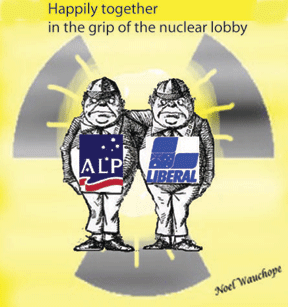 Katrina Bohr – No Nuclear Waste Dump Anywhere in South Australia Labor Senator Alex Gallacher made his interests quite clear on Friday at the Public hearing in Hawker.In a conversation, he declared there is no difference between transporting uranium or radioactive waste. He condones the continued export of nuclear medicines, which will feed the waste here.
I felt during the proceedings that he wasn’t showing impartiality.
He made disparaging remarks about certain evidence presented during the day.
I like to know who.
Department of Industry, Innovation and Science – no resolution of dispute with Barngarla Aboriginal group. Submissions are still accepted
Statement on Australian Human Rights Commission conciliation meeting 2 OCTOBER 2018
https://radioactivewaste.gov.au/news/statement-australian-human-rights-commission-conciliation-meeting
The following can be attributed to a spokesperson for the Department of Industry, Innovation and Science:
“The department understands the Barngarla Determination Aboriginal Corporation and District Council of Kimba have ended conciliation in the Australian Human Rights Commission without being able to resolve their differences,” said the spokesperson.
“Community consultation is central to this process, and the department is continuing to actively seek views about the National Radioactive Waste Management Facility. As the legal case between the two parties’ remains ongoing it is not possible at this point to fix a date for the closure of the consultative processes.
“However, we are mindful of the need to reach a decision on the current nominations as quickly as possible and the department thanks the communities around the three nominated sites for their patience.
“The Government continues to work to hear the views of all community members, including local residents, neighbours, business owners and Traditional Owners.
“This includes our direct work with Aboriginal communities both for and against the proposal, and surrounding all three sites currently under consideration.
“We are continuing to accept submissions, our community liaison officers continue to work on the ground and the department is continuing to visit the relevant communities.
“Anyone wanting more information about the project ahead of the decision on the three sites this year, can continue to drop in to one of our project offices, call, email or make a submission.”
For more information on the project, go to: www.radioactivewaste.gov.au
WA Indigenous community tries to rid water supply of unsafe level of uranium
Western Australian government refused to install water treatment plant due to size of Buttah Windee, Guardian, Calla Wahlquist, 3 Oct 18, An Aboriginal community in Western Australia is trying to raise money to fix its water supply, which contains unsafe levels of uranium.
Buttah Windee is a community of four houses about 3km from Meekatharra, a mining town that’s name means “place of little water” in the local Yamatji language.
It has 12 permanent residents and is supplied with bore water that is contaminated with uranium at more than twice the maximum safe level.
The WA government was notified of the uranium contamination in 2012 but refused to install a water treatment plant, saying the cost of doing so was “excessive given the small size of the community”.
Instead it put up signs warning residents not to drink or cook with the water and offered alternative public housing in Meekatharra itself.
Yamatji man Andrew Binsiar has been fighting to stay put. He has raised more than $10,000 through crowdfunding and an art auction and hopes to install a water filtration system to supply both the community and a new fish farm, which is part of a remote Indigenous employment program.
Binsiar discovered the uranium contamination nine years ago when all of the fish in his backyard koi pond died. He sent the water away to be tested and found that it had uranium levels of 0.04mg/L.
Health guidelines state that the maximum safe level is 0.017mg/L.
“I had it tested again this year, it’s still exactly the same,” Binsiar told Guardian Australia.
He installed a 9,000-litre tank on each house, which he fills with tap water from the town supply, to be used for drinking and cooking.
Uranium is a naturally occurring contaminant throughout parts of outback Australia.
A 2015 report by the state auditor general’s office found that the water in one in five remote Aboriginal communities in WA exceeded safe levels for nitrates or uranium.
The Department of Communities currently tests the water supply in 82 remote Aboriginal communities, and said it had seen a significant improvement in water quality since installing chlorine treatment units and reverse osmosis filtration systems in some communities.
“The community elected to continue to reside at Buttah Windee and accept responsibility for the provision of housing and associated services to residents,” assistant director Greg Cash said. “The department ceased providing management services in 2013 and has had no formal relationship with the community since then.”
Binsiar said: “They came and sat on the veranda over here and said they were going to put a bulldozer through my house and put be back into [public housing provider] Homeswest.”
In 2014, then premier Colin Barnett said up to 150 remote Aboriginal communities faced “closure” because they were “not viable” after the federal government withdrew municipal services funding.
The current government opposed that policy but has adopted the remote community reform process started under Barnett which focuses investment on larger communities. It has also cited funding woes linked to the end of the remote housing agreement.
Binsiar said many remaining residents – Wadjarri people and his wife’s extended family – had lived there since it was established on Wadjarri land in 1993.
He said the community was a safer place to raise children, away from the drug and alcohol issues of Meekatharra.
Unless the community’s water supply can be fixed, the new aquaculture enterprise, which is part of the federal community development program, will have to close.
“If we get this thing to a stage and we can’t fix the water, all the young fellas are going to say, ‘Oh, we have to get this far and then stop again’,” Binsiar said. “I want to show people that Australia is truly a generous, generous mob of people. If you are willing to work, people will help.”
Flinders Ranges – a top tourist destination – a crazy choice for a nuclear waste dump

TODAYS ADELAIDE NEWS HEADLINE (3rd October 2018): “South Australia’s outback landscapes, such as Wilpena Pound, are attracting domestic tourists.
Staggering, the Flinders Ranges hosting the Jewel in our tourism crown “Wilpena Pound” recently nominated for consideration as one of Australia’s “7 Wonders” is being celebrated here yet as we speak, Scott Morrison (ScoMo)‘s Federal Government is planning to build an above ground National Nuclear Waste Storage Dump within a short drive from Wilpena Pound and the Hawker, South Australia Township.
Our Premier Steven Marshall committed in the lead up to the last State Election that: “A Marshall Liberal Government will not support the building of a nuclear waste repository in South Australia”..”Let’s Aim Much Higher” yet he will not be drawn on this topic. It would seem his Federal counterparts have his measure and have compelled him to silence as it also seems our Tourism Minister, David Ridgway has also been silenced on this matter.
Curiously David Ridgway was quoted in this article as saying: “Our outback landscapes and other assets are attracting 62 per cent of all domestic visits – that’s huge,”
Huge! yet clearly not huge enough to advocate for its protection.
If that doesn’t concern you, we have learnt in recent times that: Project leaders demonstrate little to no knowledge of the life cycle of a TN81 storage canister, ANSTO’s safety record is deplorable, it is proposed to be built within one of Australia’s most seismic regions, on a fault line, on a flood plain, above ground, with national parks either side, neighbouring working farmland, near human habitation, defying traditional ownership appeals to not do this, heck the list for lunacy goes on.
In the light of all this, it would be safe to say Brand South Australia will certainly be swimming against the tide trying to sell one of our great Wonders once it has the NUCLEAR tag over the top of it. https://www.facebook.com/groups/344452605899556/?multi_permalinks=838591016485710¬if_id=1538530176717096¬if_t=group_activity
SA tourism: visitors expenditure reaches record $4 billion, Jade Gailberger, Federal Political Reporter, The Advertiser, October 3, 2018 FAMILY and friends visiting South Australians are splashing a record amount of cash and choosing day trips to the state’s iconic regions, new tourism data shows.
SA’s national visitor expenditure reached a record $4 billion, up four per cent for the year ending June 2018. (subscribers only)
Greens propose 30 renewable energy zones, backed by grid fund
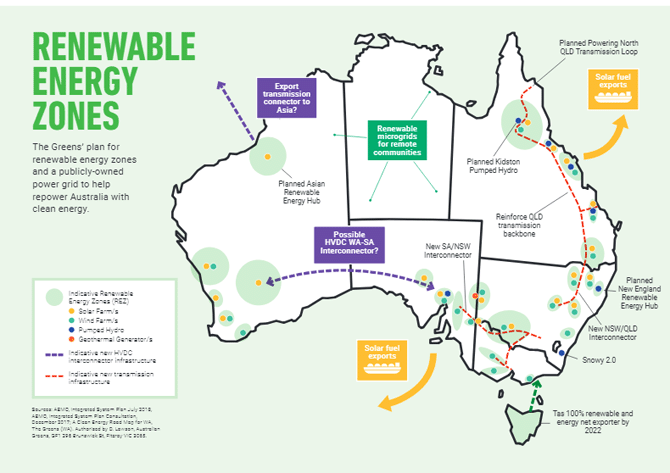
REneweconomy 3 October 2018 The Australian Greens are proposing to create up to 30 special renewable energy zones across Australia, backed by a $2.8 billon grid transformation fund to help drive the transition towards 100 per cent renewables.
Victoria’s renewable energy boom set to create thousands of jobs
 Green Energy Markets predicts more than 6,000 annual jobs will be created but urges federal policy intervention, Guardian, Calla Wahlquist @callapilla 2 Oct 2018 The renewable energy construction boom in Victoria is on track to create more than 6,000 annual jobs, according to a new analysis.
As of August 2018, large-scale wind and solar projects under construction in Victoria had created 5,169 job years of employment – meaning one person working full time for one year – overtaking Queensland with 5,156, according to an analysis by Green Energy Markets released by GetUp on Tuesday.
When the remainder of the projects greenlit under Victoria’s renewable energy auction come online, job years of employment will increase to 6,072.
Victoria has 26 operational large-scale wind and solar projects, 12 under construction and 28 with planning approval.
But the Green Energy Markets director of analysis, Tristan Edis, said that without federal policy intervention the construction boom would being tapering off in 2020, because the large-scale generation certificates scheme would be over-supplied.
Renewable energy made up 25.5% of the electricity fed into the major east and west coast power grids in August, enough to power 12.1m homes, the report said.
As of August there were another 6,184MW of new large-scale renewable energy projects under construction, creating 15,511 jobs, the bulk of which were in Queensland and Victoria. Wind generation accounted for 54% of the new projects and the remainder were large-scale solar……..
Victoria and Queensland also on track to meet their state-based renewable energy generations targets of 40% and 50% respectively by 2030.
Victorian environment minister Lily D’Ambrosio said the construction jobs were the product of a record investment in renewable energy and that investment would be under threat if the Coalition won the state election next month.
NSW currently leads the number of jobs in the rooftop solar installation industry, followed by Queensland, Victoria and WA, although jobs in rooftop solar in Victoria are forecast to increase due to its $2250 solar panel rebate.https://www.theguardian.com/australia-news/2018/oct/01/victorias-renewable-energy-boom-set-to-create-thousands-of-jobs
The Federal Government’s plan for a Radioactive Nuclear Waste Dump is blatantly negligent
The Federal Government’s plan for a Radioactive Nuclear Waste Dump is blatantly negligent in identifying and evaluating the best site in Australia. The Australian Government fail in their duty of care to select a site that constitutes the highest level of safety now and into the far future for the purpose of protecting people and the environment from harmful effects of radiation and display an irresponsible use of Australian tax payer’s money.
This calls for an independent enquiry to reassess the proposal in scientific manner, devoid of political agendas. In the meantime, ANSTO have the expertise and capacity (500 hectares) to continue storing Australia’s nuclear waste for another three decades. We should use this time to develop a cohesive, intelligent solution for the safest place in Australia for a national radioactive nuclear waste facility. https://www.facebook.com/groups/344452605899556/?multi_permalinks=837501786594633%2C837469919931153¬if_id=1538379410382955¬if_t=group_activity
1 This month
25 October – Film –Britain’s Nuclear Bomb Scandal: Our Story – part of the Adelaide Film Festival,
Screening and Conversation
A screening of Britain’s Nuclear Bomb Scandal: Our Story (2024) followed by a talk with 2026 Bettison and James Awardee and Tradtional Owner Karina Lester in conversation with Simone Tur.
When: Sun 25 Oct, 12:00pm-Screening, 1:15pm-Talk
Where: The Mercury
Free admission, register below by clicking on BUY TICKETS and select free event tickets, at end of web page:
https://www.adelaidefilmfestival.org/program/2026/britains-nuclear-bomb-scandal-our-story
.

Australians deserve the truth
about
AUKUS – https://aukuspublicinquiry.com/

PETITION – To: Prime Minister Anthony Albanese and the Australian Labor Government

of the week – Australians for War Powers Reform (AWPR)
To see nuclear-related stories in greater depth and intensity

