Australia stands to REALLY lose face on climate change at coming international summits
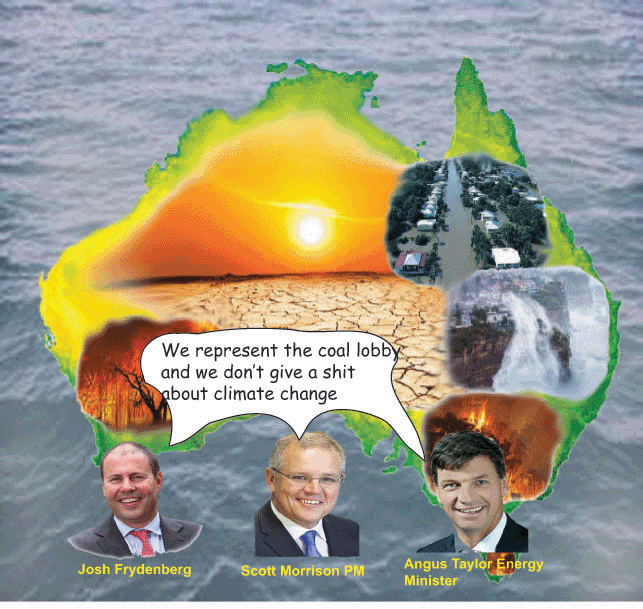 Morrison will face mounting pressure from the vocal band of conservatives in his party room not to commit to anything on climate change, be it symbolic or tangible.
Australia is neither a small nation nor one of the most powerful, but for many years it has been a trusted nation. Historically, Australia has been seen as a good international citizen, a country that stands by its international commitments and works with others to improve the international system, not undermine it.
With Australia’s new foreign minister, Marise Payne, attending instead of the prime minister – not a good look, albeit understandable in the circumstances – the government came under yet more international pressure to state plainly its commitment to the Paris climate agreement.
Pacific nations may be divided on many issues, but climate change is rarely one of them.
Before the meeting, Pacific leaders urged Australia to sign a pledge of support for the agreement and to declare climate change “the single greatest threat to the livelihoods, security and wellbeing” of the region.
The government now has a chance to catch its breath before international summit season begins in earnest in November with the East Asia Summit in Singapore, followed quickly by APEC in Papua New Guinea and then the G20 summit in Buenos Aires on November 30 and December 1, not to mention the next round of UN climate negotiationsin Poland in December. Continue reading
Dr Joe McGirr, independent and supporter of climate action, is set to win Wagga Wagga by-election
 Wagga Wagga by-election: Antony Green calls it for Dr Joe McGirr ABC News , By Nick Sas and Jennine Khalik 9 Sept 18, ABC election analyst Antony Green has called the Wagga Wagga by-election for independent candidate Dr Joe McGirr.
Speaking on ABC News on Sunday night, Green said he felt safe calling Saturday’s by-election, slightly more than 24 hours after the polls closed.
“He is a certain winner,” Green said.
The race for the seat, which had been vacated by disgraced Liberal MP Daryl Maguire, became a two-man battle between Labor’s Dan Hayes and Dr McGirr after the Liberals were hit with a 29 per cent swing against them…..
Dr McGirr, a medical doctor and academic at the University of Notre Dame Australia, has lived in central Wagga since 1991 and only decided to run for the seat three weeks ago……http://www.abc.net.au/news/2018-09-09/antony-green-calls-by-election-for-joe-mcgirr/10219584
Julian Assange’s future safety hangs in the balance
 WikiLeaks Whistleblower Awaits Fate, American Free Press , he fate of gutsy WikiLeaks founder and whistleblower Julian Assange rests in the hands of the government of Ecuador, first reported here in AFP’s Issue 33&34. Assange has lived at the Ecuadorian embassy in London since 2012 and will be instantly arrested by the UK if he leaves the building. Just-released news that his health is deteriorating rapidly makes even more urgent Ecuadorian action’s even more urgent.
By S.T. Patrick As the future of WikiLeaks founder Julian Assange twists in the political winds, the United States, Great Britain, and Ecuador continue to negotiate over the life of the Australian computer programmer and hacker. Continue reading
Flexibility of Renewable Energy Systems is Shifting the Power Balance
 By 2040 Bloomberg New Energy Finance predicts that more than half of global energy capacity will come from renewables and flexible sources, such as battery storage and demand side response
 NuClear News Sept 18 Tom Greatrex of the Nuclear Industry Association (1) says we should ignore the National Infrastructure Commission’s (NIC’s) recommendation that we only order one more nuclear station on top of Hinkley Point C before 2025 (2), because cutting carbon without the help of nuclear is a “risky business”. He says the Government understands the inherent value of a baseload low carbon source of generation.
The NIC says: “It is now possible to conceive of a low-cost electricity system that is principally powered by renewable energy sources.” It says at least 50% and up to 65% of electricity in 2030 should come from renewables. (3)
 Australia is having similar debates where the fossil fuel lobby argues that because “coal” is “baseload”, it must therefore be “reliable”, but wind and solar are intermittent, so they cannot be relied upon to keep the lights on. It’s political rhetoric that belies the reality of the electricity system. Australia’s grid has challenges, but they are not necessarily ones that can be solved just by having more “baseload”. What is really needed – as the Australian Energy Market Operator, chief scientist Alan Finkel, and any number of other independent experts point out – is dispatchable and reliable generation, one that the grid operator can count on, at times of peak demand and heat stress. And the answer does not lie in traditional “baseload” generation – the more than 100 trips of big fossil fuel plants since December, often at times of soaring heat, underline that point.
The energy debate is usually dominated by simple political rhetoric – based around emissions or no emissions, cheap prices or expensive ones, baseload versus intermittency. That just skims over the surface. Behind the scenes, as the clean energy transition continues, debates are raging about good engineering practices and the design of markets. One of Australia’s leading electrical engineers, Kate Summers says large diverse renewable resources are far more stable in output than singular sources. She uses a series of graphs to illustrate that at moments when stability can be won or lost it has been wind and solar that have held firm, and acted as what one might consider to be “baseload”. And it has been coal and gas that has proved “intermittent” at the very minutes that stability is needed. (4)
It’s the Flexibility Stupid
A new report from Chatham House says evidence is growing that highly flexible electricity systems could deliver lower whole-system costs, especially given the dramatic projected falls in solar and wind power costs by 2030. Continue reading
Australia could set up a network of cyclotrons to produce medical isotopes
 Steve Dale Nuclear Fuel Cycle Watch South Australia, 8 Sept 18
“Nuclear medicine crisis drags on despite ‘fix’” – Australian, 7 Sept 2018
“Australia’s supply of nuclear medicine generators needed for crucial diagnostic tests remains disrupted almost three months after a conveyor belt breakdown.” … “Amid doubts over the ability of ANSTO to satisfy demand, nuclear medicine expert Geoff Currie last night hit out at the “unexpectedly lengthy crisis” that appeared likely to continue into next month. ……”
(Note: Geoff Currie in his twitter feed strongly advocates for nuclear power, denigrates renewables and often retweets Shellenberger and Heard. I think Australia needs to find nuclear medicine experts willing to learn from Canada’s amazing progress in Cyclotron research.) https://www.facebook.com/groups/1021186047913052/
 |
ReplyForward
|
ICAN takes the Nobel peace message to country Australia
 ICAN Nobel Peace Prize Ride: On the road to a future free of nuclear weapons https://www.examiner.com.au/story/5631777/on-the-road-to-a-future-free-of-nuclear-arms/?cs=97, Gem Romuld and Lavanya Pant, 7 Sept 18
Cycling through the green hills, surrounded by stately gums and wattle blossoms, it’s hard to believe that nuclear weapons pose a threat to everything we hold dear. Yet nine nations cling to 14,500 nuclear weapons, enough to annihilate our planet many times over.
The risk is real and growing. We know from the Red Cross Red Crescent movement that any use of nuclear weapons would have catastrophic humanitarian consequences and be impossible to respond to. This is something we cannot risk.
Driven by deep concern for the humanitarian impacts of nuclear weapons, a global majority of nations are taking action.
Chemical and biological weapons have long been outlawed by international treaty.
Last year, 122 nations united to put nuclear weapons in the same legal category. In July, they voted to adopt the Treaty on the Prohibition of Nuclear Weapons at the United Nations. This is the first agreement to clearly outlaw nuclear weapons, setting a standard for all nations and providing a legal pathway for their total elimination.
The Australian-founded International Campaign to Abolish Nuclear Weapons was awarded the 2017 Nobel Peace Prize for our role in helping to achieve this treaty.
Regrettably, Australia hasn’t yet signed on to the ban. Our government is a proud signatory to the treaties prohibiting landmines, cluster munitions, biological and chemical weapons, but is resisting signing the nuclear weapon ban treaty. This must change, to reflect the will of the vast majority of Australians who do not want weapons of mass destruction used in their name.
A diverse group of ICAN supporters is cycling the Nobel Peace Prize medal and a giant copy of the nuclear weapon ban treaty from Melbourne to Canberra to share this story with communities, and highlighting the imperative for Australia to join the ban.
We’re sleeping in church halls, sharing potluck dinners with locals and hosting events in Benalla, Albury and Gundagai.
Our journey culminates in Canberra on September 20, the first anniversary of the nuclear weapon ban treaty opening for signature at the UN. We’re hitting the road with our hand-sewn flags, Nobel medal in the backpack, to cycle a little closer to a future free of nuclear weapons.
Gem Romuld is Australian director of ICAN. Lavanya Pant is Nobel Peace Ride co-ordinator.
Did Australia weaken language on climate change, at pacific Forum? Marise Payne plays dumb
Minister tight-lipped on claims Australia watered down climate change declaration, SBS News, 7 Sept 18 Foreign Affairs Minister Marise Payne is tight-lipped on claims Australia watered down language on climate change in an official Pacific Islands Forum document. Foreign Affairs Minister Marise Payne has defended “robust” discussions with Pacific Island leaders about the security threat posed by climate change.
Some leaders claim Australia watered down language on climate change in an official Pacific Islands Forum joint statement this week.
Boe Declaration Press Conference (Part 1)
Leaders capped off the 18-nation Pacific Islands Forum on Wednesday by signing a “Boe Declaration”, expanding on security themes to include the environment, cybercrime and transnational crime.
As was widely expected, the forum communique said climate change presented “the single greatest threat to the livelihood, security and well-being of Pacific people” and underscored the need for “immediate urgent action”.
Leaders also called on large emitters to fully implement national emissions mitigation targets and for the United States to return to the Paris Agreement on tackling climate change.
However, Tuvalu’s prime minister Enele Sopoaga is reported to have later told media a country whose name started with A – Australia being the only candidate – had raised concerns about some of the language around climate change during talks.
Comment has been requested from the Department of Foreign Affairs and Trade about whether Australia objected to parts of the declaration.
The focus on climate change recognises concerns that have been the key priority for Pacific leaders at the annual meeting.
New Zealand Prime Minister Jacinda Ardern called the Boe Declaration the most significant statement on the region’s security in a generation.
“Modern-day regional security challenges include climate change, cybercrime and transnational crime,” she said.
New Zealand’s foreign ministry, in a statement, said it had supported all climate change clauses in the declaration.
The Australian Conservation Foundation said the signing of the declaration was an important recognition of the issue by the new Morrison government but needed to be followed up with policy.
“This international commitment by our nation must be matched by domestic action,” ACF chief Kelly O’Shanassy said.
“Australia’s climate pollution is rising, and we have observed another collapse of domestic policy to cut emissions from electricity generation.”
Ahead of the forum, Australian ministers tried to ease concerns among Pacific leaders about its seriousness on climate change, saying the government was still committed to its reduction targets despite the recent collapse of its planned emissions legislation.
The Australian Conservation Foundation said the signing of the declaration was an important recognition of the issue by the new Morrison government but needed to be followed up with policy.
“This international commitment by our nation must be matched by domestic action,” ACF chief Kelly O’Shanassy said.
“Australia’s climate pollution is rising, and we have observed another collapse of domestic policy to cut emissions from electricity generation.”
Ahead of the forum, Australian ministers tried to ease concerns among Pacific leaders about its seriousness on climate change, saying the government was still committed to its reduction targets despite the recent collapse of its planned emissions legislation……https://www.sbs.com.au/news/minister-tight-lipped-on-claims-australia-watered-down-climate-change-declaration
Australia, New Zealand launch planes to monitor nuclear North Korea
Defence Minister Christopher Pyne on Friday announced the deployment of two Australian AP-3C Orion patrol aircraft in addition to a P-8A Poseidon sent out earlier this year.
A“It is a continuation of our strong stand to deter and disrupt illicit trade and sanctions evasion activities by North Korea and its associated networks,” he said.
The planes will be based out of Japan.
Meanwhile, a New Zealand Air Force Orion P-3K2 would also be carrying out surveillance of international waters in north Asia, New Zealand Foreign Affairs Minister Winston Peters announced separately.
“We welcome the recent dialogue North Korea has had with the United States and South Korea,” he said.
“However, until such time as North Korea abides by its international obligations, full implementation of the United Nations Security Council Sanctions resolutions will be essential.”
In particular, the aircraft would be on the look-out for ship-to-ship deliveries that may contravene Security Council resolutions, he said.
The United States has been using sanctions to put pressure on the hermit kingdom to give up its nuclear weapons program.
In August, it announced penalties against two Russian companies over what is said were transfers of refined petroleum to North Korean ships.
Since US President Donald Trump’s high-profile meeting with North Korean leader Kim Jong-un this year, relations between their countries have cooled.
A diplomatic visit by US Secretary of State Mike Pompeo to North Korea was cancelled last month, with Mr Trump citing a lack of progress on denuclearisation.
New Zealand’s government recently agreed to replace its ageing fleet of six surveillance aircraft with four high-tech Boeing P-8A Poseidons.
Analysts said the purchase signalled New Zealand’s willingness to keep in touch with traditional allies such as the United States and Australia and showed its seriousness about military deployments in the region.
PM Scott Morrison declares the National Energy Guarantee ‘dead’
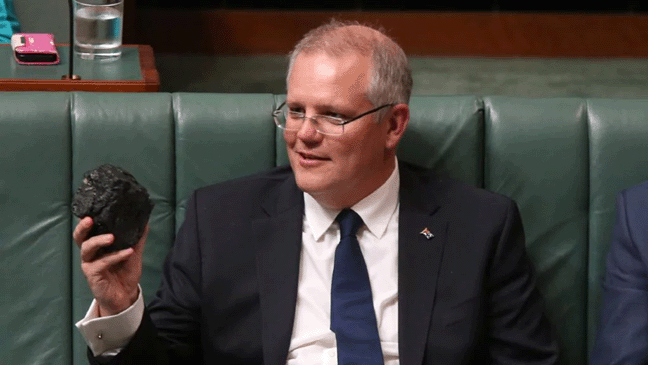 National energy guarantee ‘dead’ as Morrison sets new course THE AUSTRALIAN, SIMON BENSON, NATIONAL AFFAIRS EDITOR @simonbenson, SEPTEMBER 8, 2018 Scott Morrison has declared the national energy guarantee “dead” and will seek endorsement from cabinet to tear up the Paris emissions target legislation when it meets formally for the first time on Monday, as the new Prime Minister moves to stamp his authority over a new policy direction for the government.
“The NEG is dead, long live reliability guarantee, long live default prices, long live backing new power generation,” Mr Morrison said in an interview with The Weekend Australian.
In a signal that he intends to steer the Coalition back to a more socially conservative agenda, Mr Morrison said he would take personal carriage of the promised religious and freedom-of-speech protections, including parental rights that had been demanded by conservatives during the bitter gay-marriage debate last year.
And in what he claims will be the key economic “fault line” between the Coalition and Labor in the run-up to the next election, the new Liberal leader will roll out a wide-ranging small business reform program that goes beyond further tax reduction to include industrial relations reforms.
Mr Morrison said the first order of government business, with parliament due to return next week for the first time since the leadership spill, was putting to rest the issue of the Turnbull administration’s signature energy policy. The NEG had become emblematic of internal divisions within the Coalition and ultimately provided the trigger for the spill that elevated Mr Morrison into the top job on August 24.
“Next week we will be putting to rest the issue of the legislation … it won’t be proceeding,” Mr Morrison said in an interview in Albury on Thursday.………..https://www.theaustralian.com.au/national-affairs/climate/national-energy-guarantee-dead-as-morrison-sets-new-course/news-story/1e0db1f87ba30117317cdcc24f537a88?nk=ba26857f63080120cbd5fc74c94d3959-1536357325
Increased risk of fire and flood – climate change predictions for Queensland
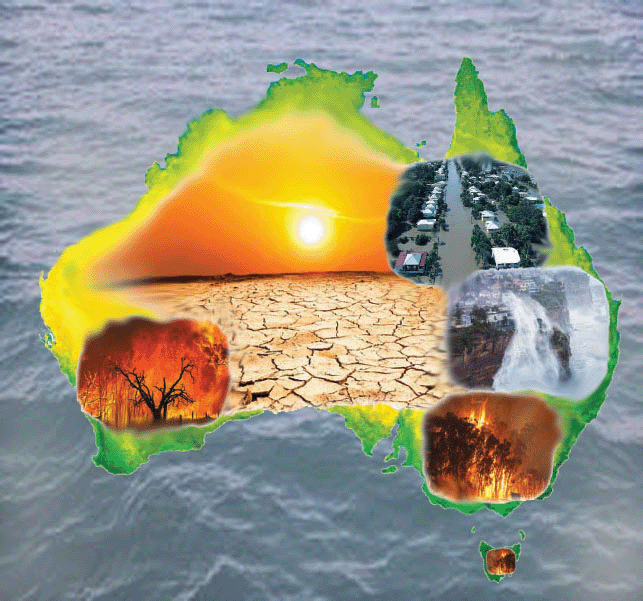 Climate change report warns of increased demand on emergency services in Queensland http://www.abc.net.au/news/2018-09-07/queensland-climate-change-strategy-increased-fire-flood-risk/10209896
5 eyes – countries, including Australia,increasing surveillance of social media
Big Brother is keeping ‘Five Eyes’ on you, Darius Shahtahmasebi is a New Zealand-based legal and political analyst, currently specialising in immigration, refugee and humanitarian law. Rt.com 7 Sep, 2018 Just last week, the world’s leading snooping powers quietly and without notice issued a disturbing warning to tech giants, telling them to surrender unprecedented backdoor access to their citizens’ data.
Not many people know this, but the United Kingdom has some of the most extreme spying powers in the developed world. At the end of 2016, passing what some people called the “Snooper’s Charter,” the UK put into law some of the most draconian anti-privacy laws that we have ever known, allowing its government to compel companies to break their own encryption.
The UK plays a pivotal part in the so-called Five Eyes alliance, which also includes the US, Canada, Australia and New Zealand. Nobody knew it at the time, but the American military base which my family and I grew up next to has played a crucial role in delivering US drone strikes across the Middle East and beyond. America’s drone-strike regime, largely considered illegal for numerous reasons, is not something that countries should willingly participate in lightly and without public scrutiny.
Why am I mentioning this? Because it goes to the very heart of my point: the extent to which we know or do not know what our governments are doing behind closed doors is quite literally a matter of life and death.
Now, it has been revealed that the Five Eyes alliance, dedicated to a global “collect-it-all”surveillance task, has issued a memo calling on their governments to demand that tech companies build backdoor access for states to access users’ encrypted data or face measures that will force companies to comply.
The memo was released quietly with little media coverage last week by the Australian Department of Home Affairs, and essentially demanded that providers “create customized solutions, tailored to their individual system architectures that are capable of meeting lawful access requirements.” The memo was reportedly released after ministers for the intelligence agencies of the Five Eyes nations met on Australia’s Gold Coast last week……
Will those tech companies cave in to these government’s demands? You can bet your bottom dollar that eventually, yes, they very well might. ……
It is worth noting that there has been next to no criticism of these Five Eyes powers for delivering such a blatant attack on our right to privacy. Remember that, of course, Russian President Vladimir Putin is attempting to “wrest control of the internet,” as the Guardian wrote approximately three years ago. But these same Western media companies are awkwardly silent about what their own governments are proposing to do, something which other nations could only dream about achieving on such a global scale. …….https://www.rt.com/op-ed/437895-privacy-five-eyes-encryption/
Ignoring Energy Market Operator’s forecast for coal, Matt Canavan keen to open new coal plants
 Paris climate deal doesn’t stop us building new coal plants, Canavan says
Minister says agreement Australia committed to ‘doesn’t actually bind us to anything in particular’, Guardian, Katharine Murphy Political editor @murpharoo 7 Sept 18 Australia does not need to quit the Paris climate agreement because our commitments are non-binding, and new coal plants can continue to be constructed, according to the resources minister, Matt Canavan.
Canavan told Sydney broadcaster Alan Jones on Friday he had never been to Paris, and was “happy to leave the Champs-Élysées for others”, but people needed to be clear the treaty Tony Abbott committed Australia to in 2015 “doesn’t actually bind us to anything in particular”.
The 2GB host said Paris needed to be “ripped up”.
A recent forecast by the Australian Energy Market Operator predicted 30% of Australia’s coal generators will approach the end of their technical life over the next two decades, and it said it was important to avoid premature departures if the looming transition in the national energy market is to be orderly.
But it was also clear that the most economical replacement for the ageing coal fleet was not new coal, but “a portfolio of utility-scale renewable generation, storage, distributed energy resources, flexible thermal capacity, and transmission”.
Injunction to halt Kimba nuclear waste ballot remains, Wallerberdina needs similar injunction
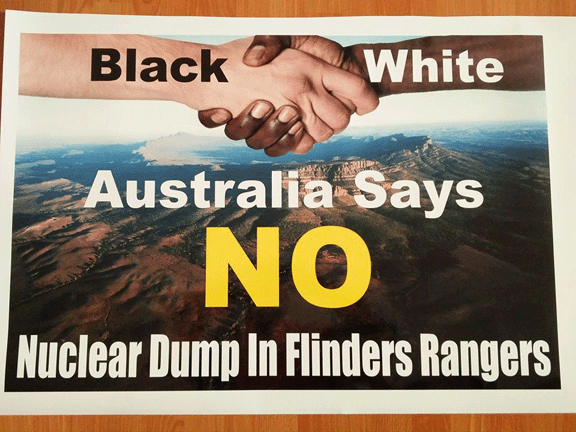 Jim Green shared a link. Fight To Stop Nuclear Waste Dump In Flinders Ranges South Australia, Sept 7 18 – The District Council of Kimba today attended conciliation in the Australian Human Rights Commission with representatives of Barngarla Determination Aboriginal Corporation and the Department of Innovation, Industry and Science, with parties agreeing to continue ongoing discussions in the hope a resolution satisfactory to all can be reached.
The interlocutory injunction restricting Council from conducting the National Radioactive Waste Management Facility site selection ballot remains in place.
As conciliation is a confidential process, Council will be making no further comment, but remains committed to keeping members of the Kimba community informed as new information becomes available. https://www.facebook.com/groups/344452605899556/?multi_permalinks=822945051383640%2C822909001387245%2C822613141416831%2C822573228087489¬if_id=1536234627130021¬if_t=group_activity
The Federal Government no longer pushing exclusively for a vote to determine support for a nuclear waste facility at Kimba and opal licence fees set to increase – News for the 7th of September 2018, read by Tom Rohde.
Australian government out to wreck international climate talks
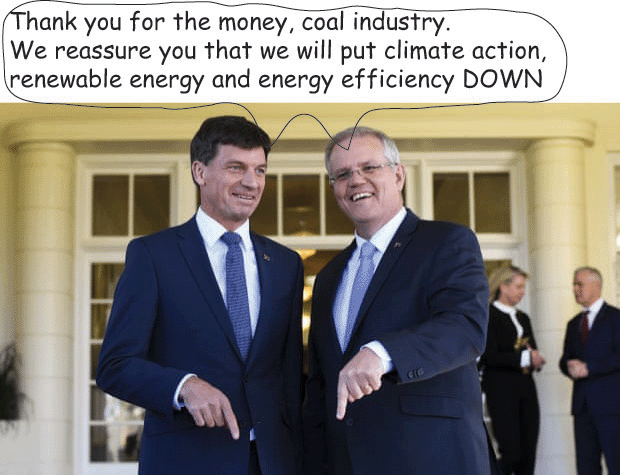
Australia gets out the wrecking ball, again, in international climate talks https://reneweconomy. com.au/australia-gets-out-the-wrecking-ball-again-in-international-climate-talks-17099/
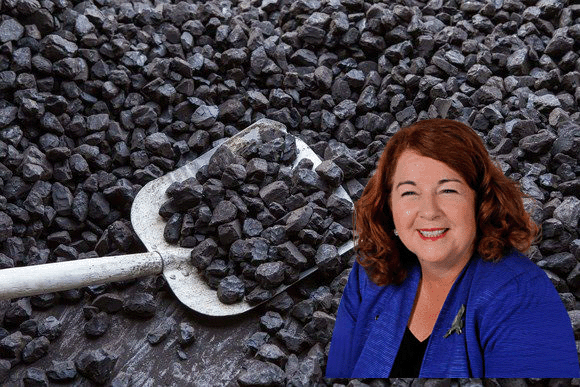
The international community is looking on in horror, and so are the main business lobby groups in Australia, such as the Business Council of Australia – who have campaigned vigorosuly for a decade to minimise Australia’s contribution to climate action, but understand the considerable reputational, trade and business consequences of choosing to do nothing.
Morrison has so far resisted calls from the party’s far right to follow Trump out of the Paris climate treaty, but in crucial and complex climate talks in Bangkok this week, sided with the US and Japan in a dramatic attempt to weaken climate finance obligations.
The Bangkok talks were called to give negotiators extra time to put together the so-called “rule-book,” which will provide the fine details of the Paris agreement, particularly as countries gear up to increase their climate targets to try and drag the collective efforts closer to the target of limiting global warming to “well below” 2°C, and possibly 1.5°C.
But little progress has been made in Bangkok, forcing the UNFCCC, which runs the climate talks, to call for the annual talks scheduled this year in Poland to begin a day earlier, in the hope that visiting heads of state have something to work with when they turn up.
One of the biggest road-blocks has been erected by Australia, the US and Japan, who put in a joint submission that seeks to water down climate finance guidelines, and casts doubt that this week’s Bangkok negotiations will deliver the clear climate rules UN leaders have been calling for. Climate campaigners say the proposed text on article 9.7 of the Paris accord, which refers to accounting and is meant to establish rules about how developed countries report what finance they provide to developing countries, serves to muddy the rules rather than clarify them.
The campaigners say that the proposal would allow countries to report whatever items they like – including commercial loans ≠ as climate finance, in contrast to demands of clear financial and technical packages to help them developing countries cope with future extreme weather-related events.
“(This) does not create any meaningful rules on how climate finance is accounted for, and instead it essentially says ‘countries should report what they want,’” Brandon Wu, director of policy and campaigns for ActionAid USA, told Devex.
“This would completely let rich countries off the hook and deprive developing countries of real money for real action,” Wu said. Other campaigners said this meant climate finance could just be re-badged existing aid.
These problems are being felt acutely in the Pacific, where island nations are furious with Australia’s stance on climate, its attachment to coal, and its refusal to act on its declarations that “it takes climate change seriously.”
The current Coalition government still has no policy in place to try and reach what is regarded as a very low interim target of a 26-28 per cent reduction in emissions by 2030. Continue reading
Very reluctantly, Australian govt signs declaration on Pacific climate threat
Australia signs declaration on Pacific climate ‘threat’, islands call on US to return to Paris deal, ABC News, By Pacific affairs reporter Stephen Dziedzic, Michael Walsh and Jack Kilbride, 5 Sept 18
Australia, New Zealand and Pacific nations have signed a declaration highlighting climate change as “the single greatest threat” to Pacific people, while island nations called on the United States to return to the Paris agreement.
Key points:
- The declaration expands the idea of regional security to include environmental issues
- It specifically names climate change as the region’s “single greatest threat”
- It recognises that the Pacific is “increasingly crowded” in terms of geopolitics
The communique was signed at the end of the Pacific Islands Forum in Nauru, attended by large and small island states as well as New Zealand’s Prime Minister Jacinda Ardern and Australia’s Foreign Minister Marise Payne.
But there was last-minute wrangling over the language on climate change, with some Pacific nations privately accusing Australia of trying to water down the final declaration from leaders.
Australia would also not back a statement from small island states which calls for countries to “urgently accelerate” reductions in carbon emissions.
Tuvalu’s Prime Minister Enele Sopoaga didn’t directly name Australia, but when pressed by journalists confirmed a country “starting with a capital A” had objected.
“The issues are so critical for leaders of smaller island states because of their vulnerability to climate change,” Mr Sopoaga said.
“We appealed to Forum leaders to endorse [the statement] so we can walk the talk.”
Australia and New Zealand also didn’t join a call from other Pacific Island Forum members for the United States to re-join the Paris climate change agreement.
Washington formally announced it would withdraw from the landmark climate agreement in August last year.
The Boe Declaration is named after the district in Nauru it was signed in.
It declares that climate change “remains the single greatest threat to the livelihood, security and wellbeing of the peoples of the Pacific”.
Leaders also signed a communique saying they would work together in the lead-up to this year’s COP24 climate conference in Poland, in order to “ensure effective progress on Pacific priorities with regards to the Paris Agreement”……. http://www.abc.net.au/news/2018-09-05/australia-and-pacific-nations-sign-climate-security-declaration/10204422
1 This month
25 October – Film –Britain’s Nuclear Bomb Scandal: Our Story – part of the Adelaide Film Festival,
Screening and Conversation
A screening of Britain’s Nuclear Bomb Scandal: Our Story (2024) followed by a talk with 2026 Bettison and James Awardee and Tradtional Owner Karina Lester in conversation with Simone Tur.
When: Sun 25 Oct, 12:00pm-Screening, 1:15pm-Talk
Where: The Mercury
Free admission, register below by clicking on BUY TICKETS and select free event tickets, at end of web page:
https://www.adelaidefilmfestival.org/program/2026/britains-nuclear-bomb-scandal-our-story
.

Australians deserve the truth
about
AUKUS – https://aukuspublicinquiry.com/

PETITION – To: Prime Minister Anthony Albanese and the Australian Labor Government

of the week – Australians for War Powers Reform (AWPR)
To see nuclear-related stories in greater depth and intensity

