Solar energy microgrid for Euroa, Victoria

The Euroa Environment Group is behind the $6 million grassroots project to install 589 kilowatts of new solar photovolatic (PV) panels, and up to 400 kilowatts of new batteries.
It will work with Mondo Power and Globird Energy as well as 14 businesses within Euroa which will install the technology.
The project may eventually extend to the residential community of Euroa and to other towns as it will demonstrate how a microgrid can operate.
The town has endured countless blackouts and it is hoped the microgrid will address the issue in the lead-up to summer.
The closure of the Hazelwood coal-fired power station in Victoria last year drove up energy power prices in southern states and put pressure on the market operator to deliver enough power to meet demand on summer’s hottest days.
Shirley Saywell, who is a business owner in Euroa and president of the group, said power options had been limited.
“This microgrid within another microgrid will give us the opportunity to generate power locally, store power locally and share power locally. It’s the town making itself more resilient in these times of uncertainty.
“There’s been stories about how complicated renewables are, and I see my role as showing people that it shouldn’t be as complicated as it’s made out to be.”
The intention of the project is to give the town greater reliability in its power supply as well as decrease the price of energy.
Energy strategy one of many Continue reading
Australia’s two-faced attitude to Pacific Islands on climate change
 Australia relationship with Pacific on climate change ‘dysfunctional’ and ‘abusive’
Palau’s climate change coordinator says Australia provides aid to region but on world stage undermines attempts to halt global warming, Guardian, Kate Lyons in Koror and Ben Doherty 5 Sep 2018 Australia’s relationship with the Pacific region on the issue of climate change has been described as “dysfunctional” and “abusive” – providing aid to the region to deal with the effects of global warming but undermining attempts to halt its progress, according to a climate change representative for the Pacific nation of Palau.
Xavier Matsutaro, the national climate change coordinator for Palau, a small nation in the north-west Pacific, said Australia’s relationship with the Pacific was “dysfunctional”, adding that Australia was also responsible for diluting the strength of previous regional declarations on climate change.
“Australia is a bit of an anomaly, because on the floor [of climate summits] they’re basically sometimes as far right as Trump in some of their views on climate change, at one point they even denied that it existed … But then on a regional basis they’ve actually given a lot of support to our region,” said Matsutaro.
“Sometimes the way I think about it … it’s like you’re in a relationship and you get abused by your spouse but at the same time they feed you and clothe you and things like that,” he said. “You could say it’s a bit of a dysfunctional relationship.”…….
Matsutaro said Australia, which has historically been the key aid partner for the Pacific region, had supported projects in Palau related to climate change, including a coastal erosion project and research on coral bleaching. Australia even provided research on the impact of climate change on Palau which formed the basis for a section of Palau’s climate change policy.
But when it came time to make commitments on climate change, Matsutaro, who has attended COP meetings on Palau’s behalf for the last five years, said Australia was regularly out of sync with the rest of the region, and was responsible for diluting the strength of resolutions on the environment.
“They’re responsible for making our declarations weaker sometimes in the region. So there’s been forums that were formulated so [Australia] won’t be involved in it, they’re not members, so that whatever language that really reflects our views and our circumstances is actually reflected in the declaration,” he said.
Pacific leaders have called for Australia to do more to reduce emissions and act to curb the effects of climate change……..https://www.theguardian.com/environment/2018/sep/05/australia-relationship-with-pacific-on-climate-change-dysfunctional-and-abusive
On climate change, Scott Morrison contradicts the energy advice of Energy Security Board
 Scott Morrison contradicts energy advice, saying Paris targets can be met ‘at a canter’, Guardian, Katharine Murphy Political editor@murpharoo 5 Sep 2018
 Prime minister claims Australia will easily meet its obligations without an emissions reduction policy Scott Morrison is continuing to insist that Australia will meet its Paris climate commitments “in a canter” despite the government having no emissions reduction policies to achieve that result.The prime minister used a radio interview on Wednesday afternoon to declare “the business-as-usual model gets us there in a canter” – which contradicts advice from the Energy Security Board that says business as usual will mean the electricity sector will “fall short of the emissions reduction target of 26% below 2005 levels”.
Even if the the ESB projections are wrong, and the electricity sector managed to reduce emissions by 26% with no policy to drive that result, the Paris target applies across the economy, not just to the electricity sector, and the government’s own data shows emissions in other sectors of the economy are rising.
Morrison told 2GB on Wednesday that business as usual “and technology and the amount of renewable technologies that are already in the system and not being subsidised off into the future means these [Paris] targets are hit”.
A summary of modelling undertaken by the ESB and released only a month ago said if no policy was put in place in the electricity sector – which is the business-as-usual case the prime minister refers to – emissions would fall initially, then flatten out and rise towards the end of the decade to 2030 as forecast demand increased, then dip again in 2029-30.
The ESB said if the national energy guarantee wasn’t implemented, the national electricity market would “fall short of the emissions reduction target of 26% below 2005 levels”.
On Wednesday the prime minister initially said that the renewable energy target was driving up power prices “and that’s why we are stripping [subsidies] out of the system”, then said later in the same interview that the biggest driver of higher power prices was gold-plating of the electricity networks.
Asked by his host on 2GB what was ultimately more important, complying with Australia’s international climate obligations, or lowering power prices, Morrison said: “Power prices.” He counselled against being “distracted by ideological debate”.
The ESB has warned that if governments fail to implement the national energy guarantee – the policy Malcolm Turnbull shelved to try and stave off the civil war that ultimately cost him the prime ministership – that will “prolong the current investment uncertainty, and deny customers more affordable energy”……..https://www.theguardian.com/australia-news/2018/sep/05/scott-morrison-contradicts-energy-advice-saying-paris-targets-can-be-met-at-a-canter
Coalition aims to clamp down on activist charities
 Push to clamp down on activist charities
Senior Coalition government figures are pushing for politically active charities including Greenpeace and the Australian Conservation Foundation to lose their charity status in a pre-election crackdown… (subscribers only)
Australia losing credibility, reputation, in the Pacific, as it follows Trump’s anti-climate policies
Australia’s authority in Pacific ‘being eroded by refusal to address climate change’
Top climate scientist says leaders disenchanted with Australia’s promotion of coal and slowing down action on meeting Paris targets, Guardian, Ben Doherty, 6 Sept 18 Australia’s regional authority and influence is being eroded by its refusal to address the threat climate change poses to many of its Pacific neighbours, according to a pre-eminent climate scientist.
As part of the Pacific Islands Forum, Australia was a signatory to the Boe declaration in Nauru on Wednesday which said climate change represented “the single greatest threat to the livelihoods, security and wellbeing of the peoples of the Pacific”.
But Australia attempted to water down the language of the declaration, other Pacific countries have said, resisting language around urgent action to cut emissions, and issued qualifications to part of the Pacific Islands Forum communique over the Paris climate agreement.
The prime minister of Tuvalu, Enele Sopoaga, said the name of the country seeking qualifications “[started] with capital A”. Australia is the only country in the PIF beginning with A.
Several sources from the PIF forum have corroborated Australia’s efforts to weaken the Boe Declaration. Vanuatu’s minister for foreign affairs Ralph Regenvanu said: “I was there, and can confirm this is true. And unfortunate.”
Asked specifically by Guardian Australia whether Australia had sought to weaken the language of the declaration, Australia’s foreign minister Marise Payne neither rejected nor confirmed the allegation……
Dr Bill Hare, managing director of Climate Analytics and a lead author on the IPCC fourth assessment report, told Guardian Australia that Pacific leaders were growing increasingly disenchanted with Australia’s refusal to commit to cutting carbon emissions, even as their nations faced massive economic, physical and social disruption, even existential threat.
“The leaders are not fools, and they are increasingly confronted by the problems of climate change, in all its different dimensions,” Hare said. “The problem for Australia is it doesn’t have credibility on climate…….https://www.theguardian.com/world/2018/sep/07/australias-authority-in-pacific-being-eroded-by-refusal-to-address-climate-change
Australia’s new Energy Minister Angus Taylor is not a climate science denier – he’s much more dangerous.
Just as we begin to imagine life without Tony Abbott undermining every sensible interaction between climate and energy policy, his “energy brain” in the form of the new energy minister, Angus Taylor, is now calling the shots.
Taylor has been fighting against the wind industry since the late 1990s, when developers came knocking, wanting to build a windfarm on his parents’ Monaro Plains property. The Taylor family turned down the opportunity, and the Boco Rock windfarm was instead built on the next ridgeline. Last year the windfarm generated enough zero-emissions electricity to power more than 70,000 average New South Wales households, and pumped $6.7m through the local economy.
Ever since that first approach, Taylor has been tilting at windmills.
Just two weeks ago, when Malcolm Turnbull was risking his prime ministership over a policy that would have done practically nothing for emissions, Taylor was busy working conservative talkback radio. Taylor boasted to Ray Hadley that he’s been speaking out against renewables policies “for many many years, well before anyone else … I argued in the party room many times to reduce it … I was able … to reduce the [RET] working with Tony as prime minister”.
While Taylor didn’t get everything he wanted, he did manage to cut 40% out of the renewable development pipeline……
for Australia, the chance of real progress is bleak under Team Morrison. It’s now clear that Taylor will continue Josh Frydenberg’s campaign of half truths and politicisation. When Taylor faced the media (sort of) for the first time in his new role last Thursday, he spoke forcefully of South Australia’s “failed experiment” with renewables.
The truth is that South Australia is an international model of success for energy transition. That such a statement goes so far against the orthodoxy shows the depravity of our national energy conversation – bear with me:
Exhibit A: Wind and solar have pushed coal completely out of South Australia and even displaced some gas. While the state imports 8% of its power from Victoria, it sends more in the other direction.
Exhibit B: Electricity prices in South Australia have always been high, but while its wholesale prices are lower than a decade ago in real terms, prices have risen elsewhere.
Exhibit C: Over the past decade, South Australia has reduced its electricity sector emissions by 56% from 10.1 MtCO2-e to 4.5 MtCO2-e.
Exhibit D: In the same decade SA cut its emissions intensity (measured in kg CO2-e/MWh) from 734 to just 340, five times as fast as the reduction in NSW, Victoria and Queensland.
Exhibit E: And while we’ve been regaled with endless stories about blackouts, the truth is that SA has only been caught short of generating power for 1.9 “load minutes” this decade (0.00004%), down from 16.8 load minutes last decade (0.00032%).
- Tell the truth – our grid is reliable and renewables aren’t the cause of high prices.
- Depoliticise energy – industry is crying out for bipartisan policy certainty.
- Respond to the science – any policy that’s incompatible with climate science is not credible, and therefore unstable.
Unfortunately Taylor chose to reject all of the above in week one, condemning us to another round of deep stupidity on climate and energy.
Taylor has always been quick to claim he’s on board with the climate science. Yet, as Abbott’s protege, he’s chosen to spend his time in politics actively undermining sensible and effective climate and energy policy.
Angus Taylor is not a climate science denier – he’s much more dangerous.
- Simon Holmes à Court is senior adviser to the Climate and Energy College at Melbourne University https://www.theguardian.com/commentisfree/2018/sep/04/angus-taylor-condemns-us-to-another-round-of-energy-stupidity
Another lithium mine opened in Western Australia
WA’s newest lithium mine plans to double down, WA Today By Hamish Hastie, 5 September 2018 Western Australia’s newest lithium mine was officially opened this morning, marking the seventh operating mine in the state.
Altura Mining’s 100 per cent-owned Pilgangoora lithium mine is located 90 kilometres south-east of Port Hedland and will support 130 ongoing jobs. The mine will produce about 220,000 tonnes per annum of lithium spodumene concentrate but the company is already considering plans to double production to tap into growing global battery demand for electric vehicles and storage.
The Pilgangoora lithium deposit currently has an ore reserve estimate of 41.1 million tonnes…..
Beyond just exporting lithium the state government’s lithium and energy materials industry taskforce is investigating the state’s ability to produce and process lithium and other energy materials.
The taskforce will present a lithium and energy materials strategy to cabinet over the next few months……https://www.watoday.com.au/business/companies/wa-s-newest-lithium-mine-plans-to-double-down-20180905-p501v3.html?crpt=index
Walkatjurra anti-uranium Walkabout completed
The Walkatjurra Walkabout has finished with a storm (literally)! An awesome walk into Leonora with lots of support to keep WA nuclear free. A successful public meeting the following day having CCWA Director Piers Verstegen come into Leonora to support the community and in particular the three Tjiwarl native title holders, Shirley, Lizzy and Vicky on the court challenge that included a visit to the proposed radioactive waste dump. You can see photos and read about their adventures here.
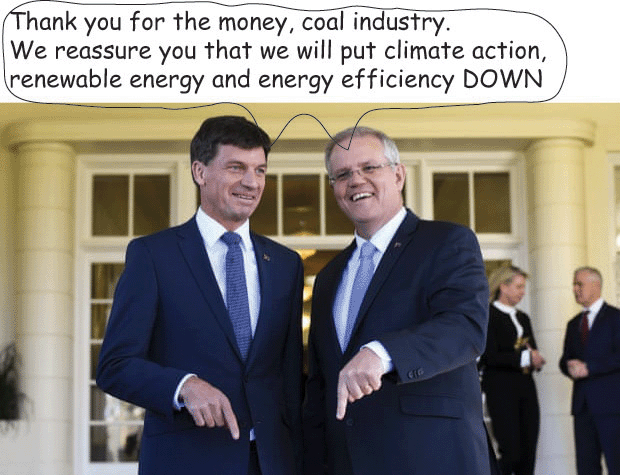
Prime Minister Scott Morrison and Energy Minister Angus Taylor pretend to be meeting Paris climate goals
Scott Morrison contradicts energy advice, saying Paris targets can be met ‘at a canter’, Guardian, Katharine Murphy Political editor@murpharoo 5 Sep 2018
Prime minister claims Australia will easily meet its obligations without an emissions reduction policy Scott Morrison is continuing to insist that Australia will meet its Paris climate commitments “in a canter” despite the government having no emissions reduction policies to achieve that result.
The prime minister used a radio interview on Wednesday afternoon to declare “the business-as-usual model gets us there in a canter” – which contradicts advice from the Energy Security Board that says business as usual will mean the electricity sector will “fall short of the emissions reduction target of 26% below 2005 levels”.
Even if the the ESB projections are wrong, and the electricity sector managed to reduce emissions by 26% with no policy to drive that result, the Paris target applies across the economy, not just to the electricity sector, and the government’s own data shows emissions in other sectors of the economy are rising.
Morrison told 2GB on Wednesday that business as usual “and technology and the amount of renewable technologies that are already in the system and not being subsidised off into the future means these [Paris] targets are hit”.
A summary of modelling undertaken by the ESB and released only a month ago said if no policy was put in place in the electricity sector – which is the business-as-usual case the prime minister refers to – emissions would fall initially, then flatten out and rise towards the end of the decade to 2030 as forecast demand increased, then dip again in 2029-30.
On Wednesday the prime minister initially said that the renewable energy target was driving up power prices “and that’s why we are stripping [subsidies] out of the system”, then said later in the same interview that the biggest driver of higher power prices was gold-plating of the electricity networks.
Asked by his host on 2GB what was ultimately more important, complying with Australia’s international climate obligations, or lowering power prices, Morrison said: “Power prices.” He counselled against being “distracted by ideological debate”.
The ESB has warned that if governments fail to implement the national energy guarantee – the policy Malcolm Turnbull shelved to try and stave off the civil war that ultimately cost him the prime ministership – that will “prolong the current investment uncertainty, and deny customers more affordable energy”……..https://www.theguardian.com/australia-news/2018/sep/05/scott-morrison-contradicts-energy-advice-saying-paris-targets-can-be-met-at-a-canter
Cyclists start 900km journey to Canberra, with Nobel Peace Prize and aim to end nuclear weapons
 Nobel Peace Ride: Cyclists carry medal to Canberra, urging end to nuclear weapons, A group of cyclists have set off from Melbourne, bound for Canberra to deliver a message to Australia’s new Foreign Minister on banning nuclear weapons. 2 Sept 18 , SBS News, By Biwa Kwan, Twenty cyclists have begun a 900km journey to Canberra from Melbourne.
Australian War Memorial: Stop accepting funding from weapon-makers

The Australian War Memorial increasingly seeks and accepts sponsorships from the world’s largest multinational weapon manufacturers. These companies reap enormous profits from war; for them, ongoing warfare leads to greater business success. They have no place in a memorial to our war dead.
PETITION To: Australian War Memorial Director and Council
From: [Your Name]
To the Director and Council of the Australian War Memorial:
We are horrified to learn of AWM sponsorships from weapons manufacturers.
It is unacceptable that:
• Every visitor to the AWM is greeted by an illuminated screen featuring the corporate logos of these companies.
• The ‘BAE Systems Theatre’ is actively promoted for hire, thus marketing Britain’s biggest weapons maker. BAE Systems is a major military supplier to Saudi Arabia, a country known to sponsor terrorism, and which is currently committing atrocities against civilians in Yemen. BAE has been the subject of multiple corruption investigations, including for its dealings with Saudi Arabia.
• You have a three-year partnership deal with Lockheed Martin, the world’s largest weapons manufacturer, which also has a history of corruption. The deal includes assistance with commemorating the centenary of Armistice Day. During World War 1, the weapons industry made huge profits as Australians and others were slaughtered in unprecedented numbers.
We also note many other multinational weapons companies are sponsors and donors, including Boeing, Northrop Grumman, Raytheon, and Thales.
We would not accept cigarette or alcohol company sponsorship of hospital wards. It is totally inappropriate for weapons makers to sponsor our national War Memorial.
The Australian War Memorial should be a place of genuine commemoration and learning. Vested interests in warfare are incompatible with both of these goals. All funding from weapons companies should cease.
Australia’s failure on climate action is likely to doom the $15b European trade deal
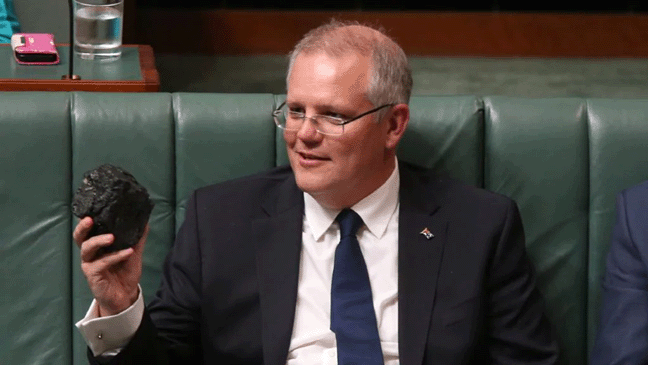 ‘Is this a red line for us?’ $15b European trade deal doomed if Australia dodges Paris pledge, SMH, By Nicole Hasham, 31 August 2018 The Coalition’s internal climate war risks damaging the economy after Europe declared it would reject a $15 billion trade deal with Australia unless the Morrison government keeps its pledge to cut pollution under the Paris accord.
Prime Minister Scott Morrison this week reset his government’s course on energy policy, declaring a focus on lowering electricity bills and increasing reliability, while relegating efforts to cut dangerous greenhouse gas emissions.
He has reaffirmed his government’s commitment to the Paris accord despite persistent calls by conservative Coalition MPs, led by Tony Abbott, to quit the agreement.
However there is deep uncertainty over how Australia will meet the Paris goal of reducing Australia’s carbon emissions by 26 per cent by 2030 given the government does not have a national strategy to meet the target.
The policy ructions did not go unnoticed at a meeting of the European Parliament’s Committee on International Trade in Brussels, where the EU’s chief negotiator on the deal, Helena König, faced angry questions from the floor over Australia’s commitment to climate action.
Australia and the EU will in November enter a second round of negotiations over the deal that would end restrictions on Australian exports and collectively add $15 billion to both economies.
In a video of this week’s proceedings, Ms König told the committee that “it’s the [European] Commission’s position … that we are talking about respect and full implementation of the Paris agreement [as part of the trade deal]”.
“No doubt we will see what comes out in the text [of the deal agreement] but that I expect to be the minimum in the text, for sure.”
Her assertion is a clear signal that any failure by Australia to meet its international climate obligations would have serious economic consequences.
Ms König fired off the warning after a question by Klaus Buchner, a German Greens member of the Parliament who said “the intention of the new Australian regime to withdraw from the Paris Agreement unsettles not only Australians”. …….
The EU bloc is Australia’s second largest trading partner, third largest export destination and second largest services market. The EU was also Australia’s largest source of foreign investment in 2017.
…….The Paris climate accord is deeply unpopular with conservative MPs, including Nationals MPs whose electorates would benefit from an EU trade deal. Keith Pitt resigned as an assistant minister last week in protest at the Paris treaty. “I will always put reducing power prices before Paris,” he said.
A 2017 report by the United Nations environment program that found Australia’s emissions were set to far exceed its Paris pledge and government data released in January showed Australia’s annual emissions had risen for the fourth year running.
Labor’s climate change and energy spokesman Mark Butler said the government had no emissions reduction plan and would fail to meet its Paris goal.
“The Prime Minister might think he can get away with [failing to cut emissions] domestically, but it is clear it will not be accepted by our international trading partners, who rightly have an expectation the Australian government will act to deliver on our international obligations,” he said.
European Australian Business Council chief executive Jason Collins, whose organisation has lobbied for the trade deal, said Europe’s commitment to the Paris agreement was “fundamental”. ……
Australian Conservation Foundation chief executive Kelly O’Shanassy said the European Union’s stance on the trade deal showed the Coalition’s climate policy division “has real-world consequences for our country”. https://www.smh.com.au/politics/federal/is-this-a-red-line-for-us-15b-european-trade-deal-doomed-if-australia-dodges-paris-pledge-20180831-p50109.html
Climate change is the big security issue for Pacific Island nations, – and for Australia?
 For Pacific Island nations, rising sea levels are a bigger security concern than rising Chinese influence, The Conversation, Head of Department, Politics and Philosophy, La Trobe University, August 31, 2018 When the Pacific Islands Forum is held in Nauru from September 1, one of the main objectives will be signing a wide-ranging security agreementthat covers everything from defence and law and order concerns to humanitarian assistance and disaster relief.
The key question heading into the forum is: can the agreement find a balance between the security priorities of Australia and New Zealand and the needs of the Pacific Island nations?
Even though new Prime Minister Scott Morrison is not attending the forum, sending Foreign Minister Marise Payne instead, the Biketawa Plus security agreement remains a key aim for Canberra……….
A focus on climate change as a security issue
One key reason for updating Biketawa is to realign Australia’s security interests with those of Pacific Island countries that have grown more aware of their shared interests and confident in expressing them in international relations. This growing confidence is clear in the lobbying of Pacific nations for climate change action at the United Nations and in Fiji’s role as president of the UN’s COP23 climate talks.
In the absence of direct military threats, the Pacific Island nations are most concerned about security of a different kind. Key issues for the region are sustainable growth along a “blue-green” model, climate change (especially the increasing frequency and intensity of natural disasters and rising sea levels), illegal fishing and over-fishing, non-communicable diseases (NCDs), transnational crime, money laundering and human trafficking. ……..
Climate change adaptation and mitigation must also be elevated to the top of the agenda in Australia’s relations with the region. It is the most pressing problem in the Pacific, but for political and economic reasons, it hasn’t resonated to the same extent with Canberra.
In fact, Australia has recently been identified as the worst-performing country in the world on climate action. This has not gone unnoticed in the Pacific. Fiji’s prime minister, in particular, has been clear in highlighting that Australia’s “selfish” stance on climate change undermines its credibility in the region.
These shifting priorities in the Pacific present a greater challenge for Australia, especially now that there are more players in the region, such as China, Russia and Indonesia. Australia may see these “outsiders” as potential threats, but Pacific nations are just as likely to view them as alternative development partners able to provide opportunities………
there can be no authentic engagement with the region without addressing climate insecurity as well. https://theconversation.com/for-pacific-island-nations-rising-sea-levels-are-a-bigger-security-concern-than-rising-chinese-influence-102403
Australia has no policies to really deliver on its Paris climate promises
Options on energy policy leave Coalition in a sticky situation, Guardian, Katharine Murphy, 1 Sept 18, The government finds itself in a mess after the national energy guarantee was used as a catalyst to evict Turnbull.
We’ve lost another prime minister in the front bar brawl that is Australian politics, but we’ve lost something else as well, something that’s a bit harder to see.
For the last decade or more, a group of people in the political system have been trying to land a bipartisan consensus on energy policy and climate change, persevering through all the dispiriting cycles of trying to achieve that end, hoping that a corner could be turned.
That animating current in politics, and it’s been a significant one, now seems to have hit a dead end. That’s the feeling. We’ve reached a point of no return
If that supposition proves to be correct, this a profound problem for the country, more profound than the revolving door at the Lodge, which is deeply disconcerting, but just one symptom of a deeper malaise.
The Coalition is in a terrible mess on this issue. The national energy guarantee, the last roll of the dice for consensus, was used as a catalyst to blow up a prime minister, just as emissions trading was deployed for the same end, removing the same party leader, in 2009.
As a consequence of that rancid history, the imperative of emissions reduction now hangs over Liberal leaders like the sword of Damocles. Any leader wanting to do something knows they will have to run the gauntlet of the conservatives, and the brains trust of the conservative faction has proven itself so resistant to facts and evidence that it can’t even count numbers for a leadership spill………
The Morrison government is in a position where it is a signatory to the Paris agreement, yet there are no policies to deliver the outcome. There is a talking point doing the rounds that Australia will meet its Paris commitments “in a canter” – but this is complete nonsense.
It is possible (although the Energy Security Board says otherwise) that we could reduce emissions by 26% in the electricity sector without a settled policy to get us there because emissions in the sector are already falling (because ageing coal is leaving the system and the renewable energy target has pulled forward investment).
But what about the rest of the economy? Emissions are rising elsewhere, and there is no plan or roadmap to curb them.
This government has dithered for years about the imposition of new emissions standards for vehicles. Ministers have not been brave enough to bring forward a concrete proposal because the Coalition party room would limber up for another implosion.
Then there’s agriculture. Many Nationals take it as a personal affront if someone suggests anything be done in agriculture. The fact that their own constituents are now being battered by horrendous drought and hanging on grimly in areas gradually being rendered unviable by inexorable climatic change is an irony that seems lost of many of our elected representatives.
So that’s the outlook on emissions. Now let’s ponder the concept of certainty.
The national energy guarantee was proposed to create policy certainty to help drive the correct mix of investment in Australia’s electricity generation assets. That was its purpose. That policy is now on the back burner.
What isn’t on the back burner is the new Morrison government’s need to deliver a fix on power prices once the prime minister has concluded the healing and stability tour. That’s on the front burner. But this is a problem with no easy fix.
The government slapped together a package of measures in the dying days of the Turnbull regime designed to lower power prices – work that would have normally taken months of careful deliberation in a cabinet subcommittee.
So now we have no over-arching mechanism for investment certainty, and a bunch of expedited measures proposed on the fly, including heavy handed market interventions, such as breaking up power companies if they don’t play ball with the government and lower prices.
Call me crazy, but that doesn’t sound like the building blocks of a stable investment climate……..https://www.theguardian.com/australia-news/2018/sep/01/options-on-energy-policy-leave-coalition-in-a-sticky-situation
South Australia’s Greens leader Mark Parnell urges a united stand against nuclear waste dump plan.
 Last week, I went to Port Augusta and Hawker to meet with residents fighting against the Federal Coalition Government’s plans to build a national nuclear waste dump in South Australia. It was great to see both the Kimba and Flinders Ranges communities working together to show that they are NOT the “willing” communities that the Government was hoping for.
This ill-conceived push by the Federal Government to dump low to intermediate level nuclear waste in regional South Australia has seen farmers, residents, business people, Traditional Owners, community campaigners and the Greens join together, united in their call for the dump to be dumped.
I was pleased to speak at the rally held in Port Augusta on 19 August, outlining the Greens’ continued opposition to the dump and highlighting the grossly mismanaged site selection process that the Federal Government has conducted and how divisive this has been to the affected South Australian communities.
I had timed my visit to the region to coincide with the ballot of local residents to gauge their views on the dump. However, days before the ballot papers were due to be sent out, the vote at both locations was postponed following a Supreme Court injunction brought by the Barngarla people – the Traditional Owners of much of Eyre Peninsula including land in the Kimba region.
The Barngarla people successfully argued that it was potentially a matter of racial discrimination to allow property owners to vote in the ballot, but not Native Title holders. Similar arguments apply to the Adnyamathanha people of the Finders Ranges, all of whom have strong attachments to the land, but most live outside the narrow area to be balloted. The case has now been referred to the Human Rights Commission.
Additionally, the people of Port Lincoln, Whyalla and Port Pirie are seriously concerned that they too have no opportunity to participate in the ballot. The Greens want to see the community consultation and ballot extended to local Traditional Owners as well as those living in the proposed nuclear waste ports or along the nuclear waste transport corridor.
Everyone who is potentially impacted by this plan should be included and their voices should be heard.
To have your voice heard, make a submission to Federal Minister for Resources Senator Matt Canavan via email at radioactivewaste@industry.gov.au by 24 September.
1 This month
25 October – Film –Britain’s Nuclear Bomb Scandal: Our Story – part of the Adelaide Film Festival,
Screening and Conversation
A screening of Britain’s Nuclear Bomb Scandal: Our Story (2024) followed by a talk with 2026 Bettison and James Awardee and Tradtional Owner Karina Lester in conversation with Simone Tur.
When: Sun 25 Oct, 12:00pm-Screening, 1:15pm-Talk
Where: The Mercury
Free admission, register below by clicking on BUY TICKETS and select free event tickets, at end of web page:
https://www.adelaidefilmfestival.org/program/2026/britains-nuclear-bomb-scandal-our-story
.

Australians deserve the truth
about
AUKUS – https://aukuspublicinquiry.com/

PETITION – To: Prime Minister Anthony Albanese and the Australian Labor Government

of the week – Australians for War Powers Reform (AWPR)
To see nuclear-related stories in greater depth and intensity


Three months before he entered parliament in 2013, Taylor wrote a paper for the Coalition party room advocating for the immediate end to the renewable energy target (RET). In the middle of Abbott’s attempt to implement the vision, Taylor boasted to constituents (captured on film) that he had party backing.