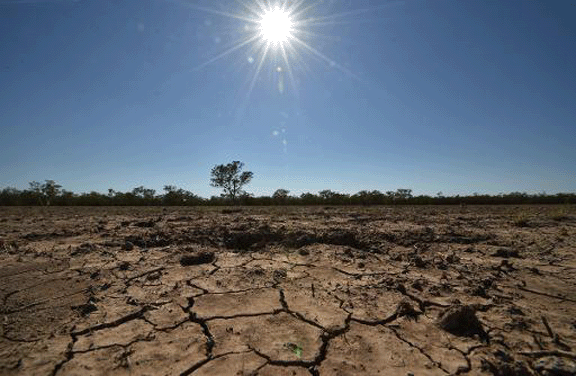
Drought, wind and heat: Bushfire season is starting earlier and lasting longer
 ABC News, The Conversation By Owen Price 17 Aug 18
Barngarla Aboriginal people win injunction to halt nuclear waste dump vote
 South Australian Aboriginal group wins injunction to halt nuclear ballot http://www.abc.net.au/news/2018-08-16/aboriginal-group-wins-injunction-to-halt-nuclear-ballot/10129292, By Claire Campbell
Several federally-owned land parcels, including Woomera could be assessed as nuclear dump site
 Documents released under the Freedom of Information Act reveal the Industry Department last year identified several federally-owned land parcels which met the suitability criteria to be assessed as possible waste dump sites
————-
Supreme Court orders temporary halt on vote to build nuclear waste facility near Kimba
Peter Jean, The Advertiser August 16, 2018
https://www.adelaidenow.com.au/news/south-australia/supreme-court-orders-temporary-halt-on-vote-to-build-nuclear-waste-facility-near-imba/news-story/05df593fd70326c541f931b7f3225d04
A COMMUNITY vote on whether a radioactive waste storage centre should be built near Kimba has been stalled by a Supreme Court injunction.
The court action comes as The Advertiser can reveal the Turnbull Government looked at federally-owned land parcels as possible alternatives to the three South Australian sites short-listed for a national radioactive waste management facility.
Residents in the Kimba and Hawker districts had been due to begin voting next week in ballots to determine whether they would be willing to accept a low-level radioactive waste dump.
But the Barngarla indigenous people argued the Kimba ballot was discriminatory because native-title holders who lived outside the municipal boundaries would be denied voting rights. An injunction was granted ahead of a hearing before the full court next week.
Two sites near Kimba and one near Hawker have been short-listed for the waste centre. Meanwhile, documents released under the Freedom of Information Act reveal the Industry Department last year identified several land parcels which met the suitability criteria to be assessed as possible waste dump sites.
The documents also reveal the Defence Department was concerned that a site at the Woomera Defence Range could become the national radioactive waste management facility “by default’’.
Radioactive material from the CSIRO is held at the Woomera Defence Range.
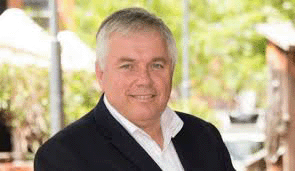
Centre Alliance Senator Rex Patrick, pictured, said the Government should release full details of the Government sites which had been studied. “I find it highly disturbing that the Government has kept the Commonwealth-owned land options a secret,’’ Senator Patrick said. “It’s quite apparent that Defence didn’t want to touch the Nuclear Waste Facility with a barge pole — they’d rather it just went to Kimba or Hawker.’’
Speaking before the court injunction was granted, Industry Minister Matt Canavan said it was up to local communities to decide whether they were willing to accept a radioactive waste facility.
“We will not impose a facility on an unwilling community,’’ Senator Canavan said.
The centre proposed by the Federal Government would be used to store low and intermediate-level radioactive waste stored at sites around Australia. About 45 local jobs would be created in the district where the centre was located and the local community would receive a $31 million incentive package from the federal Government.
Resources Minister Matt Canavan is deceptive in his statements about “Low Level “nuclear waste
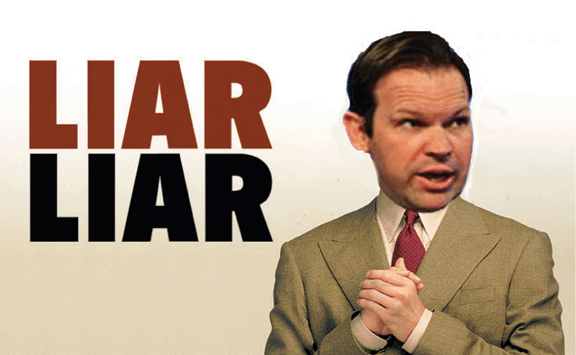 Greg Bannon, Quorn 16/08/2108
Senator Canavan introduces the concept of nuclear energy into the debate on radioactive waste storage, (The Advertiser, 15/08/2018) but refers only to low level waste.
He does not mention the long-lived intermediate level waste. In April, he announced that this would also be stored at the facility. His Department admits there are no plans for its disposal at this stage, only moving it from current temporary storage, to park it temporarily near Hawker or Kimba for several decades.
People in both communities, including the Traditional Owners have said “No”.
Nuclear power generation is another matter entirely. The Scarce Royal Commission into the nuclear fuel cycle rejected nuclear power generation two years ago. The Citizens Jury even rejected the Commission’s recommendation to investigate storing nuclear waste in South Australia. The Senator’s Department vehemently denied any connection between their waste facility and the Scarce Commission’s investigation. The Senator’s reference to nuclear energy seems strange timing.
Nuclear stooge Senator Matt Canavan deplores delay in decision on nuclear waste dump
Note the Advertiser makes the mistake of saying its only for low level waste.
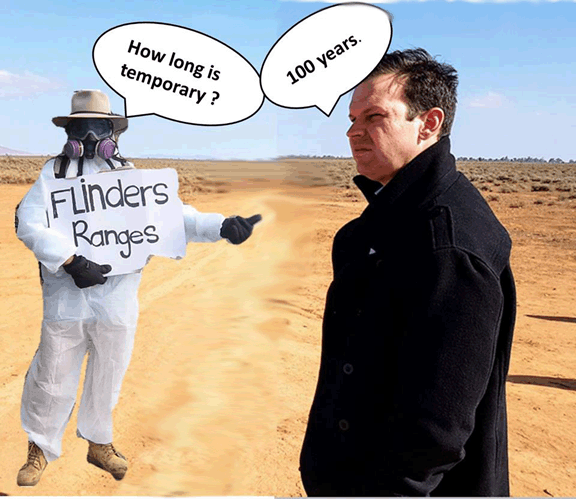 Federal Industry Minister Matt Canavan says Australia can’t have a serious debate about nuclear energy until a radioactive waste dump is built, Peter Jean, Senior Federal Political Reporter, The Advertiser,
Senator Canavan made the comments after lawyers for the Barngarla Determination Aboriginal Corporation launched legal action to try to prevent a community vote on radioactive waste going ahead in the Kimba district next week.
Kimba and Hawker district residents are scheduled to vote on whether they’d be willing to accept a low-level radioactive waste facility in their local areas.
A hearing on the Barngarla application to stop the Kimba vote will be heard in the Supreme Court today.
The Barngarla group argues that members who are native title holders in the Kimba District but don’t live there should be permitted to vote on the waste dump proposal.
Senator Canavan said the Barngarla people were entitled to take their concerns to court.
He said discussion about the establishment of a nuclear power industry in Australia wouldn’t get off the ground unless the nation found a way to manage low-level radioactive waste, including by-products of the Lucas Heights nuclear reactor in Sydney.
“If we can’t find a long-term repository for our low-level waste – which we produce from a reactor that produces nuclear medicines, not power – we have no hope of building a nuclear power station that would produce high-level waste,’’ Senator Canavan said.
“We are supporters of an open and mature debate around this issue but we recognise that any move to nuclear power in this country would take years and require bipartisan support, those are things that we don’t have now.’’
Two sites near Kimba and one near Hawker have been short-listed as possible locations for a radioactive waste storage facility. The community votes are being held before the Government proceeds with selecting a preferred site.
Kimba Mayor Dean Johnson said he was unable to comment on the Barngarla application because the matter was before the courts.

Inadequate report from Senate Committee on selection process for nuclear waste dump
The final report on the senate inquiry into the selection process for a national radioactive waste management facility in South Australia was released on Tuesday but those who oppose the facility say it has failed to address their main concerns.
The recommendations included the Department of Industry, Innovation and Science (DIIS) working with local stakeholders to use part of the 60 hectare buffer zone to grow and test agricultural produce to reassure the community and agricultural markets the produce is safe for consumption.
However, while the No Radioactive Waste on Agricultural Land in Kimba or SA group is thankful for the time and effort put into the inquiry, member Kellie Hunt said it was “disappointed” with the recommendations.
“We are disappointed that the recommendations do not address any of our primary concerns,” she said. “In particular, our issues regarding the lack of definition of what constitutes broad community support, and the lack of genuine need to move the intermediate level waste from Lucas Heights to a second interim storage location.
“We continue to oppose the siting of this facility on agriculture land in the Kimba district.”
The Senate Economics References Committee wrote the report using submissions made by stakeholders in in the affected communities near the sites in Kimba and Hawker, as well as public hearings in Kimba, Hawker and Canberra.
A spokesperson from the Department of Industry, Innovation and Science said the department thanked the committee for the report and that it “looks forward to reviewing it.”
“We have the opportunity to take account of the findings ahead of the community ballot that is scheduled to begin on August 20.”
The full report is available on the senate inquiry website at aph.gov.au/Parliamentary_Business/Committees/Senate/Economics/Wastemanagementfacility
Why is the Australian government so secretive about Commonwealth land available for nuclear wastes?
Senator Rex Patrick No Nuclear Waste Dump Anywhere in South Australia
LOOK AT CROWN SITES FOR RADIOACTIVE WASTE MANAGEMENT FACILITY
Yesterday I received copies of minutes from the National Radioactive Waste Management Facility (NRWMF) Steering Committee under Freedom of Information laws.
What is clear from these minutes is that the Government has secretly considered a number of Commonwealth owned land parcels as potential NRWMF sites. Why has this fact not been made public? Why don’t we know what sites were considered? Why has the analysis and any decisions associated with potential Commonwealth sites not been made public?
It staggers me, in a process that the Minister claims to be open and transparent, that this important aspect of site selection process has not been made public, nor open to scrutiny.
I have written to Minister Canavan asking him to provide me with details of sites considered and the associated analysis. If he won’t I will seek a Senate Order for Production of Documents to get access to them.
Copies of the minutes are available here.
https://www.dropbox.com/s/g1nmw3nmgljp…/NRWMF%20Minutes.pdf… https://www.facebook.com/groups/1314655315214929/?multi_permalinks=2498364660177316%2C2498213100192472¬if_id=1534461842151654¬if_t=group_activity
A HYDROGEN INDUSTRY ON THE NATIONAL AGENDA
| Hydrogen could be Australia’s next multibillion dollar export opportunity, according to a panel of energy, technology and policy leaders who presented their findings to the COAG Energy Council last week., 17 Aug 18 |
| Dr Alan Finkel, Chair of the Hydrogen Strategy Group and Australia’s Chief Scientist, said that hydrogen’s time has come.
“Hydrogen produces only water vapour and heat when burned. When produced from water using renewable electricity, or from coal or methane combined with carbon capture and storage, it’s a close to zero-emissions fuel. With appropriate safeguards, it’s just as safe as natural gas, and just as convenient for consumers. “In Australia, we have all the necessary resources to make hydrogen at scale: wind, sun, coal, methane, carbon sequestration sites and expertise. “It’s simply never been commercially viable. Now, the economics are changing.” Dr Finkel explained that the key developments were the falling costs for renewable energy and Japan’s commitment to be a long-term, large-scale customer for hydrogen produced through low-emissions methods. “Japan currently imports 94% of its energy in the form of fossil fuels. To reduce its emissions, government and industry have put ambitious hydrogen uptake targets at the heart of a comprehensive energy transition plan,” Dr Finkel said. “We’re not alone in this race. Norway, Brunei and Saudi Arabia are all boosting their credentials as future hydrogen suppliers. This is the time for Australia to stake its claim as supplier of choice not just to Japan, but to other nations like South Korea, hungry for a twenty-first century fuel.” With the right policy settings, Australian hydrogen exports could contribute $1.7 billion and provide 2,800 jobs by 2030, according to a recent report from the Australian Renewable Energy Agency (ARENA). Many of the opportunities will be concentrated in regional communities, where proof-of-concept hydrogen trials are already underway. Hydrogen could also be introduced in the near-term into Australia’s existing gas network for heating and cooking, and as a low-emissions alternative to diesel for long-distance heavy transport. The COAG Energy Council agreed that Dr Finkel, in close consultation with officials, will bring back a proposal for the development of a national hydrogen strategy to its December 2018 meeting. Dr Finkel thanked the members of the Hydrogen Strategy Group and taskforce for their work in developing the briefing paper. Hydrogen for Australia’s Future is available at: https://www.chiefscientist.gov.au/2018/08/briefing-paper-hydrogen-for-australias-future/. Media inquiries: 0410 029 407 or communications@chiefscientist.gov.au |
An end to 34-year saga: Final stones laid at Aboriginal burial ground at Moree Cemetery
‘The Aboriginal burial ground at Moree Cemetery now stands completed,
after the final stones were laid at the site on Tuesday.
‘“I finally feel like it’s a job done. It has taken me nearly 34 years
to see this part of the cemetery come to fruition,”
Aunty Noeline Briggs-Smith OAM said.
‘The sandstone blocks were placed at the foot of the Ngindi Baababili Tubbiabri sign,
followed with a carpet of pebbles. Aunty Noeline said
the sandstone matched the type of rocks at the Tranquility Area.
‘The laying of the stones closes off more than a three-decade saga,
during which time Aunty Noeline has sought to restore identities
to more than 200 previously unmarked Aboriginal grave sites.
‘“It’s a relief to know all are now resting in eternal sleep
and that people from the community can come and visit
their relatives at the final resting places,” Aunty Noeline said. … ‘
www.moreechampion.com.au/story/5584734/final-stones-laid-at-aboriginal-portion-of-cemetery/
Bangarla Aboriginal Corporation to go to Supreme Court to halt Kimba vote on nuclear waste dump
 Barngarla People seeking Supreme Court injunction to halt Kimba vote on nuclear waste facility, 2018 https://www.adelaidenow.com.au/…/87afb1b5d47db75b415c402d97…Peter Jean, Jade Gailberger, The Advertiser, August 14, 2018
A VOTE by Kimba residents on whether they want a radioactive waste dump in the district is in jeopardy after an indigenous group sought an injunction to stop it.
The Barngarla People on Tuesday applied for an urgent Supreme Court injunction to halt the Kimba vote.
The Hawker district will also vote.
Two sites near Kimba, on the Eyre Peninsula, have been short-listed as possible locations for a low-level radioactive waste storage facility. A third short-listed site is near the Flinders Ranges community of Hawker.
The Barngarla Determination Aboriginal Corporation will argue that native title-holders who live outside Kimba District Council boundaries should be entitled to vote.
The Barngarla have more than 200 members, most of whom live outside the council’s boundaries.
The group will argue that the ballot breaches the Racial Discrimination Act and that Kimba Council does not have the power to conduct the vote.
The corporation is seeking a court hearing this week. The ballots are to help the Federal Government determine a preferred site for the radioactive waste storage centre.
The legal challenge was launched as a Senate inquiry recommended that grain and produce be grown in the buffer zone of the national radioactive waste dump to “reassure the community” that it is safe.
A Senate inquiry into the selection process for three SA sites proposed by the Federal Government says that it “sees value” in the Department of Industry, Innovation and Science working with local stakeholders so that part of the remaining 60ha buffer zone can be used to “grow and test agricultural produce”.
It believes this would “reassure the community and agricultural markets” that food grown in the surrounding region does not contain “excessive amounts of radiation” and is “safe for consumption”, a report tabled in Parliament yesterday reveals.
Cameron Scott, in a submission to the inquiry, raised concerns about reputational impacts a waste facility could have on regional exports.
“All grain from Eyre Peninsula is delivered, blended and exported out of Lower Eyre Peninsula,” Mr Scott wrote.
“Therefore, Kimba’s grain is mixed with every other town’s grain on Eyre Peninsula — the effect that this could have on our exports hasn’t been taken into consideration at all.”
However, the experience of French farmers who live around a waste disposal facility in Aube was this month used to squash the “potential perception issues” from stakeholders.
The Australian Greens, in a dissenting report, called on the Federal Government to abandon its plans to build a nuclear waste dump in Outback SA.
Centre Alliance Senator Rex Patrick said the Hawker and Kimba communities were bitterly divided and the selection process had been unfair. The Federal Government has offered $31 million worth of incentives for the community where the radioactive waste centre is built.”
Senator Rex Patrick: Additional Comments on Senate Report re selection process for siting nuclear waste dump
Recommendation 1 The Minister must quantify how broad community support will be determined and do so before vote.
Recommendation 2 As a minimum, broad community support must mean a 65% vote in favour in the AEC vote, AND agreement from all adjoining neighbours AND the agreement from aboriginal communities.
Recommendation 3 The ANSTO Act should be changed to permit the storage of intermediate-level waste until such time as an appropriate facility site has been identified and a facility built and commissioned
Senator Rex Patrick Senator for South Australia, Selection process for a national radioactive waste management facility in South Australia, 14 August 2018
p. 67 Additional Comments by Senator Rex Patrick Kimba and Hawker, when you finally surrender, it must be of your own free will!
The Work of the Committee
1.1 I thank the committee for the work it has done in relation to this very important inquiry. I also thank the secretariat for their behind the scenes efforts.
1.2 I support the general findings in this report and the recommendations that flow from them, but I feel they do not address several substantive issues with enough force.
1.3 Out of responsibility to the communities of Hawker and Kimba, I address those issues now. Continue reading
Conflict of interest: Richard Yeeles, adviser to South Australian Premier on Olympic Dam Aboriginal Trust
 Tim Bickmore shared a link.No Nuclear Waste Dump Anywhere in South Australia, 15 Aug 18
The Olympic Dam Aboriginal Trust distributes funding to 3 aboriginal groups based upon income from the mine. Those groups are: Barngarla, Kuyani (Adnymathanha) & Kokotha.
Barngarla & Kuyani are currently the groups targeted by the radioactive waste site suppository process.
According to the ODAT website, currently Richard Yeeles, senior economic adviser to State Premier Steven Marshall is listed as a BHP representative on the council which determines who gets what monies…..
Conflict of interest? https://www.facebook.com/groups/1314655315214929/?multi_permalinks=2493650837315365%2C2493518107328638¬if_id=1534298281981165¬if_t=group_activity
Greens Dissenting Report on selection process for nuclear waste dump
The definition of broad community support has been inconsistent throughout the entire process
decision-making power of the Minister is wholly arbitrary. It is nonsensical to say that we must accept an arbitrary decision-making process as a means to avoid arbitrary decision-making processes.
The Adnyamathanha people have a demonstrable interest in the process of site selection.
it is condescending and inaccurate to suggest that community concerns around the impact of a radioactive waste dump on agriculture and tourism perceptions of safety and attractiveness are unfounded.
It is imperative that all stakeholders within transport corridors should be consulted.
 Dissenting Report from the Australian Greens Selection process for a national radioactive waste management facility in South Australia, 14 August 2018
1.1 The Australian Greens believe the site selection process is fundamentally flawed. There has been a consistently stated commitment by the Minister to respect the views of the communities relevant to the process by not proceeding without “broad community support”, ensuring that the absence of such shall serve as an effective veto. However, the Minister has refused to explain what he would consider to be sufficiently “broad”, ensuring that any number can be considered sufficient, or insufficient, and ultimately disenfranchising affected communities in the name of ministerial ‘discretion’.
1.2 Jobs figures have been floated and inflated. Traditional owners have been cherry-picked or ignored altogether. Sites have been nominated by absentee landowners with no direct tie to the community on which the site selection process is being inflicted. And this process is simply unnecessary. It does nothing to address the need for long-term intermediate level storage, consistent with international best practice. It avoids amending the relevant Act by spending millions of dollars on a divisive and unnecessary process that is being pushed through to align with the electoral cycle instead of the science.
1.3 ARPANSA Chief Regulatory Officer Mr Jim Scott has told the Committee that Lucas Heights cannot offer long-term storage of low-level waste under the ANSTO Act. He argues that this requires the identification of a long-term disposal facility.
1.4 Low-level waste is set to be disposed at the NRWMF, consistent with international best practice regarding low-level waste management. However, intermediate level waste is also set for long-term storage at the NRWMF. This is not consistent with international best practice which supports medium to deep burial disposal of intermediate level waste. Continue reading
Senate Report on Selection Process for Nuclear Waste Facility in South Australia
The report is at https://www.aph.gov.au/Parliamentary_Business/Committees/Senate/Economics/Wastemanagementfacility/Report
It is 77 pages. I confess to have only skimmed through it at this stage. It appears to be a careful attempt to bless the process, while not having a real opinion about it, one way or the other. To be fair, it does contain a few questions, does not appear to be a “full go ahead” recommendation.
Coalition Senators Senator Jane Hume Senator Dean Smith put in Additional Comments. Short and not very interesting.
Greens, Senator Hanson-Young put in a longer Dissenting Report report, strongly criticising the process.
Senator Rex Patrick put in Additional Comments, also criticising the process
RECOMMENDATIONS in the Report
Chapter 2 Community sentiment
- 22. Recommendation 1 2.67 If a National Radioactive Waste Management Facility were to be sited in an agricultural region, the committee recommends that the Department of Industry, Innovation and Science work with local stakeholders, so that part of the remaining 60 hectare buffer zone can be used to grow and test agricultural produce, in order to reassure the community and agricultural markets that the produce from the surrounding region does not contain excessive amounts of radiation and is safe for consumption.
- 23 Chapter 3 Indigenous support
- 31 Recommendation 2 3.40 The committee recommends that the Minister intensify and expedite efforts to fully engage with the Indigenous stakeholders near Kimba and Hawker so that comprehensive heritage assessments for all nominated sites can be completed
- 33 Chapter 4 Financial compensation and incentives to communities
p.36. 4.22 The committee notes that it is unfortunate for a former politician, particularly one with significant exposure to the nuclear waste issues, to place the government in the invidious position of p. 37 deciding whether he should receive financial compensation for hosting a NRWMF on his property, thereby further politicising an already contentious process.
Recommendation 3 4.25 The committee recommends that the government undertake an independent valuation of the land to be acquired to ensure that the financial compensation is consistent with the original proposal to compensate the landholder at four times the land value.
- 43 Chapter 5 General comments about the site selection process
- 49 Recommendation 4 5.35 The committee recommends that the Department of Industry, Innovation and Science make submissions received during the consultation process publicly available in the circumstances where the authors originally intended for their submission to be made public. ((That requirement has apparently been fulfilled)
- 50 Recommendation 5 5.37 The committee recommends that the Office of the Chief Economist within the Department of Industry, Innovation and Science undertake a policy evaluation of the first two phases of the site selection process for a National Radioactive Waste Management Facility.
The committee made no other general recommendation)
Nuclear waste being shipped to Australia by company with a terrible safety record
Responsibility overboard: the shocking record of the company shipping nuclear waste to Australia http://www.onlineopinion.com.au/view.asp?article=19892&page=0
| By Natalie Wasley -, 14 August 2018In the very early hours of Sunday July 29, the federal government carried out a highly secretive transport of spent nuclear fuel. Helicopters and hundreds of police accompanied trucks from the Australian Nuclear Science and Technology’s reactor at Lucas Heights to Port Kembla in Wollongong.
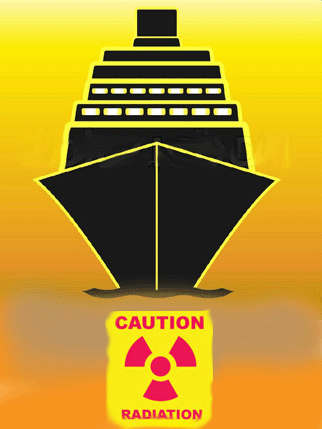
Any transportation of nuclear materials carries risks, but Briese has a particularly terrible safety record, including leaking oilfrom vessels, losing cargo overboard and failing to follow basic navigation rules. In 2015, French nuclear giant Areva (now Orano) chartered the controversial Briese ship the BBC Shanghai to bring reprocessed spent fuel waste back to Australia. This was despite the ship being recently detained in Australia and Spain, and banned from carrying government cargo in the United States, for failing safety inspections The transport occurred during a federal Parliamentary Inquiry into Flag of Convenience ships, where it was revealed that the BBC Shanghai was “owned and operated by a web of German companies, registered in the tiny Caribbean islands of Antigua and Barbuda and crewed by a mix of Russian and Ukrainian seafarers.” At the time, independent Senator John Madigan accused the government of “tendering out its national security to the lowest common denominator.” A complex web of ownership and vessel registration allows Briese to circumvent systematic regulation and accountability. Along with safety breaches, vessels have been caught carrying weapons, allegedly intended for war-ravaged nations. Briese is known to have transported Russian and Ukrainian weapons and has an “important functional role” of “heavy weapons shipments to countries with poor infrastructure” as part of the Odessa Network that has allegedly supplied weapons used in Syria. Briese ships have been stopped and crew detained with weapons cargo and tanks “presumably intended” for Sudan and Singapore. Amnesty International identified a Briese vessel moving cluster bombs between South Korea and Pakistan in 2010, contravening the 2008 Convention on Cluster Munitions. The vessel was not sailing under a German flag, and therefore did not need the permit that would usually be required under German law. Workers’ rights Briese has a terrible track record on workers’ rights. In 2015, the Maritime Union of Australia (MUA) argued that the crew of the BBC Shanghai only signed a binding wage agreement en route to Australia after the radioactive waste shipment attracted public scrutiny. International Transport Federation National Coordinator Dean Summers inspected a sister ship at Port Kembla and found the crew was underpaid and working under a “sham” collective agreement. The MUA has a long held policy of opposition to all aspects of the nuclear industry. The position recognises that handling and transport of radioactive materials is a risk to stevedores, seafarers and other transport and emergency workers. It also expresses support for Traditional Owners and community members resisting imposition of nuclear projects. When the BBC Shanghai docked in 2015, MUA Southern NSW Branch Secretary Garry Keane reiterated: “Our members do not support the nuclear industry. There is no totally safe way to transport or store waste which remains a danger and threatens communities for thousands of years.” Community opposition The reprocessing waste that returned to Australia was categorised as long-lived intermediate level waste (ILW). The intention was for it to be stored at a purpose built national radioactive waste facility, along with other low and intermediate level waste that would be transported from around the country. However, the attempts of successive federal government to construct such a facility have been thwarted by persistent community campaigns and legal actions. Nominated sites in South Australia (1998-2004) and the Northern Territory (2005-2014) were dropped by the federal government after years of hard fought campaigning. Significant government resources are currently being thrown at advancing the assessment of three shortlisted sites in South Australia- one on Adnyamathanha country in the Flinders Ranges and two in the Kimba region of the Eyre Peninsula. The SA waste dump plan has caused great anxiety and stress for Traditional Owners and local community members near the sites. Adnyamathanha Traditional Owner Regina McKenzie describes the Flinders Ranges as “arngurla yarta” (spiritual land). Upon receiving the 2016 Peter Rawlinson environment award, Regina said: “The proposed dumpsite contains thousands of Aboriginal artefacts. Our ancestors are buried there. We don’t want a nuclear waste dump here on our country and worry that if the waste comes here it will harm our environment and muda (our lore, creation).” Communities – including many of Regina’s extended family – have campaigned for decades to stop uranium mining and nuclear waste dumps and to fight for compensation for people affected by nuclear bomb tests conducted in the 1950s and 1960s. The nuclear chain is toxic from start to finish. As we move, albeit slowly, towards creation of long-term, sustainable and safer jobs in renewable industries there will be ongoing need ‒for many generations ‒to manage the radioactive materials already stockpiled around the world. Instead of continuing with plans to greatly expand the production and export of radioactive medical isotopes from Lucas Heights, the federal government should start planning to replace the reactor with more benign technologies for scientific and medical applications. A recent conveyor beltbreakdown and two spills of radioactive material that affected workers in the past year highlight the risks and vulnerabilities inherent in this industry. Environment groups, trade union and health organisations have long called for an independent inquiry into the production, transport and management of radioactive waste in Australia that includes all key stakeholders. This is essential to take the discussion around intergenerational management out of the trenches and to the table. Arthur Rorris from the South Coast Labour Council summarised it well in the lead up to the 2015 transport: “When a shipment of solarpanels comes through the port you don’t see hundreds of cops blocking highways and a national security operation. Communities the world over want to see the back of the nuclear industry so we don’t have to endure these unnecessary risks to public health, the environment and our national security.” |
1 This month.
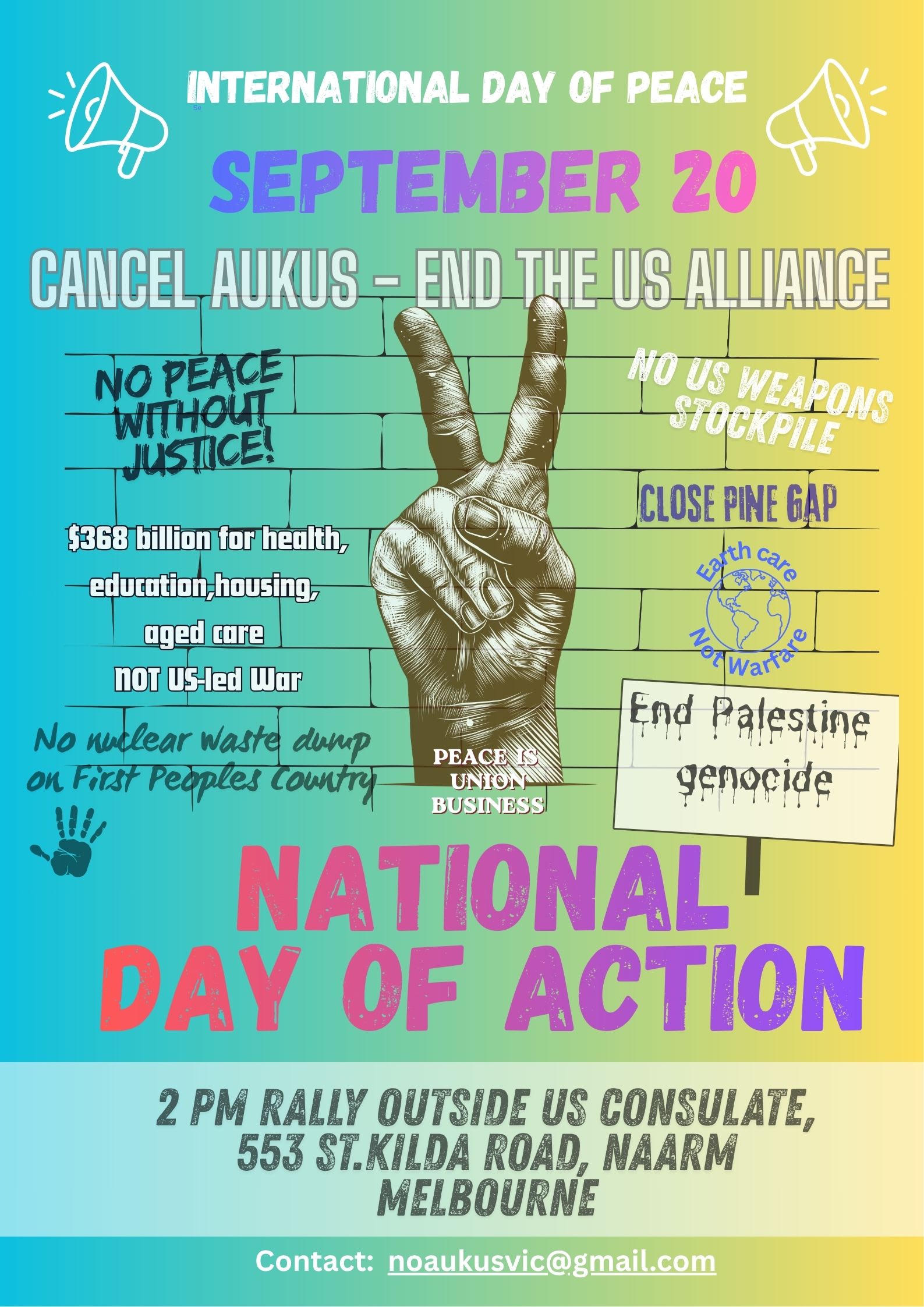
20 September –National Day of Action in Melbourne on the International Day of Peace

Help Aunty Sue Protect Her Land and Sacred Sites From Destructive Rocket Testing.
.

Australians deserve the truth
about
AUKUS – https://aukuspublicinquiry.com/

PETITION – To: Prime Minister Anthony Albanese and the Australian Labor Government

of the week – Australians for War Powers Reform (AWPR)
To see nuclear-related stories in greater depth and intensity
 Antinuclear