The Department of Innovation, Industry and Science says there will be no discussion on whether ports, including in Port Lincoln, will have nuclear waste material move through them until a storage site has been chosen.
AECOM Australia prepared site characterisation technical reports for the department for each of the proposed sites for the National Radioactive Waste Management Facility.
For the site reports for Lyndhurst and Napandee, near Kimba, it discusses the potential for waste to be shipped from Port Kembla, New South Wales, to key ports including Port Lincoln, Port Pirie and Whyalla.
It also details the potential for a new commodities port in the upper Spencer Gulf to be used to transport waste to either Lyndhurst or Napandee.
The report details Port Lincoln’s potential to utilise rail to transport the waste from the port, but would be subject to third party restrictions due to the railway being privately owned.
Despite these report findings, department head of resources Bruce Wilson said no transport routes had been locked in and would not be discussed until the storage site itself was determined.
“Our initial focus will be on getting approval to build the site, then identify potential transport routes,” he said.
“We will consult the communities as required when we identify waste routes.”
Mr Wilson said there would also be a small number of waste shipments that would go through, with about four to five identified in the next 40 years.
He said the low to intermediate waste that would be transported would be safely secured and would meet the standards set by the Australian Radiation Protection and Nuclear Safety Authority.
Regional Development Australia Whyalla and Eyre Peninsula economic development manager Peter Scott said the organisation would work closely with the department should a transport route through Eyre Peninsula be identified so a consultation plan could be developed for all affected communities.
K-A Garlick at Nuclear Free WA, 15 Aug 18 The Walkatjurra Walkabout have survived the first 10 days of the protest walk in freezing overnight temperatures and long hot walking days. Walking strong a group of 55 people gathered at Yeelirrie to support Traditional Owners, Aunty Shirley, Lizzie Wonyabong and Vicky Abdhullah in their 40-year struggle to stop the proposed Yeelirrie uranium mine.
The three women have shared stories of the area where they and their families grew up on. and their ancestors grew up. The group was joined by Youno Downs Station, who shared stories of the history of uranium exploration and company intimidation over the years they have lived on the pastoralist station. “Water is what the company is after, they (Cameco) need up to 10 millions of litres of water and they want us to give it to them!” ……. to be continued!
Radioactive sheep shed light on secret nuclear weapons test, https://nypost.com/2018/08/14/radioactive-sheep-shed-light-on-secret-nuclear-weapons-test/Christopher Carbone, Fox News, August 14, 2018 Newly discovered data from radioactive sheep provides strong evidence that a mysterious “double flash” detected almost 39 years ago near a remote island group was a nuclear explosion.
Ever since the flash was observed by a US Vela satellite orbiting above Earth in September 1979, there’s been speculation that it was produced by a nuclear weapon test by Israel. International researchers in the journal Science & Global Security analyzed previously unpublished results of radiation testing at a US lab of thyroid organs from sheep in southeastern Australia in order to make their determination.
The flash was located in the area of Marion and Prince Edward islands, which are in the South Indian Ocean about halfway between Africa and Antarctica.
“A new publication sheds further light on the Vela Incident of 1979,” said Professor Nick Wilson of Otago University at Wellington, who highlighted the findings but was not involved with the study itself. “[The research] adds to the evidence base that this was an illegal nuclear weapons test, very likely to have been conducted by Israel with assistance from the apartheid regime in South Africa.”
Wilson, an epidemiologist and member of the Australia-based Medical Association for the Prevention of War, said the test would have violated the Limited Test Ban Treaty signed in 1963, and urged the United Nations to mount a full inquiry.
The researchers conclude that iodine-131, which is an unstable radioactive form of the element iodine found in the thyroids of some Australian sheep, “would be consistent with them having grazed in the path of a potential radioactive fallout plume from a [Sept. 22, 1979] low-yield nuclear test in the Southern Indian Ocean.”
Thyroid samples from sheep killed in Melbourne were regularly sent to the US for testing — monthly in 1979 but also in the 1950s and 1980s, researchers say.
According to a report in the New Zealand Herald, the sheep had been grazing in an area hit by rain four days after the flash incident was observed, which would have been in the downwind path from the suspected explosion site.
Researchers also said the detection of a “hydroacoustic signal” from underwater listening devices at the time is another piece of evidence pointing to a nuclear test.
Israel, which has neither confirmed nor denied the existence of a nuclear program, dismissed the claim that it was responsible for the 1979 incident.
srael’s ambassador to New Zealand, Itzhak Gerberg, told the Herald, when asked if Israel was responsible for the explosion: “Simply a ridiculous assumption that does not hold water.”
However, the country’s former Knesset speaker, Avrum Burg, told a conference in 2013 that “Israel has nuclear and chemical weapons” and called for public discussion.
Commenting on the findings, US nuclear weapons expert Leonard Weiss of Stanford University said in the online Bulletin of the Atomic Scientists that the “important” new evidence “removes virtually all doubt” that the flash was a small-yield nuclear explosion.
Weiss added that there was “growing circumstantial evidence” that it was conducted by Israel.
“Israel was the only country that had the technical ability and policy motivation to carry out such a clandestine test,” he said.
Katrina Bohr No Nuclear Waste Dump Anywhere in South Australia, 12 Aug 18
Had an extensive conversation in person with Peter Malinauskas, SA State Opposition Leader.
I shared my concerns for the people in the communities, and the process that’s been imposed on them.
He agreed that the process is wrong, and gave me his word, that the issue will be brought up in Parliament as soon as it returns.
Lyn BlumeFight To Stop Nuclear Waste Dump In Flinders Ranges SAHere is another good reason to not dump nuclear waste in SA as this is a seismic region in Australia, here is the most recent record. Earthquake Details
NW of Blinman, SA
Summary
Origin (UTC): 06/08/2018 22:35:45 Epicentral Time: 07/08/2018 08:05:45
Longitude: 138.511 Latitude: -31.000
Magnitude: 2.4 (ML) Depth: 10 km
Event Id: ga2018pkbnhd https://earthquakes.ga.gov.au/ Blinman is a town deep in the Flinders Ranges, in the mid-north of South Australia. It is very small but has the claim of being the highest surveyed town in South Australia. It serves as a base for large acre pastoralists and tourism. The town is just north of the Flinders Ranges National Park, is 60 kilometres(km) north of Wilpena Pound and 485 km north of Adelaide. https://www.whereis.com/search-results?query=Blinman%20SA….
Ian Carpenter, Chelsea Haywood, John Hennessy and Janice McInnis sent in another submission to the Senate, on 19 July – Submission to Senate Inquiry on Selection Process for Nuclear Waste Facility They call themselves “Say Yes to 45 Jobs”.This submission consists entirely of criticism of, indeed an attack on, the Flinders Local Action Group (FLAG), (no mention of jobs, or any other aspect of the process) . They claim that FLAG used deceptive means to oppose the nuclear waste plan for Wallerberdina. They criticise the FLAG survey, FLAG’s distribution of petition forms, and FLAG’s submission to the Senate. They criticise Flag’s criticising of the Barndioota Consultative Committee (BCC) and od DIIS personnel. “FLAG have no regard for the truth or scientific fact”. They single out Dr Susan Anderson. They include FLAG’s brochure, with survey questions. (I have not, so far, been able to copy this submission)
ANGELINA STUART – Submission to Selection process for a national radioactive waste management facility in South Australia Submission 112
My name is Angelina Stuart, formally McKenzie, and I am the oldest sister of the McKenzie family. I was born in January 1943 on the land. My mother and father were living on the eastern side of the Flinders Ranges. That’s named Viliwarinha and it’s my birthplace – I was born out where the dingos were howling.
My late father was a strong Adnyamathanha man. As me and my siblings travelled through the Flinders Ranges, Dad would tell us Dreamtime stories about certain places. We were told the stories of the landscape that gave us a map of the area – the hills and creeks, these were the stories my dad told us. My dad made recordings and we still have his voice to listen to today.
My two older brothers and one sister who has now passed on, were born in the heart of the Flinders Ranges as well in 1938, 1940, and 1949, and I was born in 1943. Two siblings were then born in 1947 and 1950 in Beltana. There were 4 born in Hawker in 1944, 1952, 1956 and 1959. When we moved to Port Augusta, and that was the first time I saw Wallerberdina. After that, 3 siblings were born in Port Augusta, along with my five children.
I moved back to the land in 1998 to Yappala Station, next to Wallerberdina. In the mid-nineties I was one to put a claim for Station.
It is very upsetting to me that stories are being told that shouldn’t be told, and that stories are being said are ours, even though they are not our stories. The one that is distressing, is the story of the seven sisters because it isn’t our story – my father told me the Dreamtime story, and it was a different story. The story being told of the seven sisters isn’t right – it belongs to the other side of Lake Torrens, not near Wallerberdina.
On this land, this site at Wallerberdina, I’ve been out there with the heritage assessment with RPS. I know where they walked, and where the site is, and there are no visuals sites on the ground, I didn’t see anything. Any little cuttings would be from people passing through. It’s a lie to say the stories and lore of the land would disappear if a facility was built on Wallerberdina.
This process has given everyone a chance to sit down and meet. I really appreciate that we’ve been able to sit down and talk, and share our culture. If the facility did go ahead, I would want to see work done by Adnyamathanha to explain to non-Indigenous and other groups the value of our land, the spiritual side of it, so that the lore of the land and the tradition of the area around it is carried on. It is still there and it will always be there.
Thinking about my grandkids and great grandkids, I want to see development on the land, so that they can return to the land and surrounding areas, and so they can come back and get opportunities of employment. They need to be able to come back to the land.
Mining industry in promotional push targeting school students, The Age By Nicole Hasham13 August 2018
Resources companies including Adani are targeting school students in a campaign to spruik the benefits of mining and recruit future workers, in a strategy some say risks pushing a biased agenda onto young minds.
The programs in primary and high schools include teacher training and free curriculum material, such as a fact sheet on mining and the environment that fails to mention climate change…….. Former Rio Tinto boss Tom Albanese has pointed to an image problem facing the coal industry, reportedly saying in June that “coal is becoming the next tobacco … Who’s gonna join coal as a career?”
The Queensland Resources Council in 2005 created the Queensland Minerals and Energy Academy, which last year grew to involve more than 3000 students, some aged as young as 10.
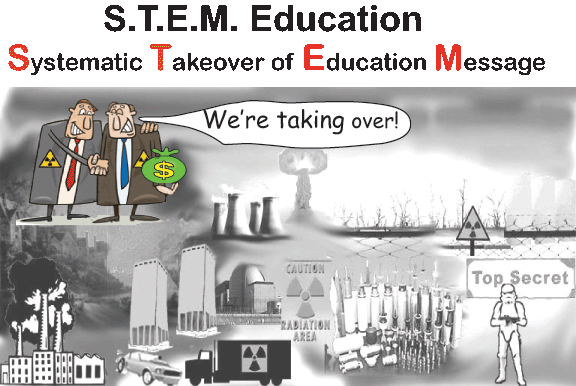
The academy receives $1 million a year in industry funding as well as state government support, and places “students onto pathways into the resources sector and other science, technology, engineering and maths (STEM) industries”.
……Programs include students working with industry representatives in engineering and other challenges that replicate steps in the mining process.
Staff from Indian mining giant Adani – proponent of the controversial Carmichael coal mine – this year visited several schools to discuss the industry. Adani told Fairfax Media it was one of 30 sponsors of the academy and no information on the Carmichael project was included in the academy’s educational content.
The academy also runs professional development for teachers including robotics and 3D printing sessions in a resources context…….
The Oresome Resources website, backed by the nation’s peak mining bodies, provides free educational content to teachers across Australia. It includes a fact sheet titled “Mining and the Environment” that covers effects such as habitat destruction and land subsidence, but makes no mention of climate change resulting from burning coal. ……..
Dalrymple Bay Coal Terminal near Mackay has been accused of marketing coal to young children through its mascot Hector, a lump of coal with his own Youtube channel who offers advice on topics such as nutrition, bus safety and making new friends.
In NSW, the Upper Hunter Mining Dialogue school tours program is offered to all schools in the region. About 1000 students are expected to visit mine sites this year.
NSW Mining has previously offered scholarships to high school students studying mining-related subjects.
Most Victorian schools, as well as state government-run science and mathematics centres, develop partnerships with industry and business such as the Australasian Institute of Mining and Metallurgy, which supports the Earth Ed science centre near Ballarat.
……Tom Swann, researcher at progressive think-tank the Australia Institute, said industry engagement with education brought risks as well as benefits.
“Think of a school that takes funding or teaching materials from a coal mining company. Is that school also going to teach its children about the need to keep most of the coal in the ground and transition quickly into other forms of energy?” Mr Swann said.
“It is essential … that we do not allow education to become part of a public relations campaign.”….
University of Queensland professor Bob Lingard, who has researched commercialisation in schools, said it was the responsibility of governments, not the mining industry, to promote STEM subjects.
“There is teacher concern … [about] too much potential commercial involvement in schools,” he said.
‘Ghillar, Michael Anderson, Convener of the Sovereign Union, 13 Aug 18
last surviving member of the founding four of the Aboriginal Embassy and
Head of State of the Euahlayi Nation, said from Sydney today:
‘I am extremely concerned that the enthusiasm to quickly negotiate so-called Treaty/Treaties
with the illegal occupying colonial States under the Federation of the Commonwealth of Australia
will lead to First Nations unwittingly ceding their inherent sovereignty.
‘I must ring alarm bells nationwide, while the Australian Government and its colonial States
are sitting back in their warm and comfortable offices slowly applauding
the stupidity of our ‘childlike race’. …
‘The Governments have been very clever in the last thirty years to use the disunity within our communities
to withdraw funding and shut down burgeoning successful community organisations. The Governments
achieved the total destruction of these organizations by the First Nations lackeys,
of whom there are plenty, to shut down our hard fought for successes
and now these communities have nothing.
‘The regurgitated Constitutional Inclusion/Recognition and the Yulara Statement
have been rejected by the grassroots across Australia.
It’s only the half-educated half-baked Blacks, living off the blood money being paid by Governments,
who are still pushing this barrow. …
‘We need to make it very clear that there is no single body in this country that can speak for the many Nations.
I was reminded by the Yorta Yorta stalwart today that the NSW Aboriginal Land Council is an instrument of the Crown,
where the Minister, with a stroke of a pen, can shut it down and take back everything it has acquired,
in the name of the Crown. Monica Morgan of the Yorta Yorta also made the point that there is in excess
of 280 000 Aboriginal people in New South Wales alone and
only 10% are members of the NSW Aboriginal Land Council. …
‘How can any one of you neo-liberal Blacks and the Two-Bob Mob want to negotiate with our foreigner occupiers
when their oppression meets all the definitions of the law against genocide,
the1948 Convention on the Prevention and Punishment of the Crime of Genocide: (a) Killing members of the group;
(b) Causing serious bodily or mental harm to members of the group;
(c) Deliberately inflicting on the group conditions of life calculated to bring about its physical destruction in whole or in part;
(d) Imposing measures intended to prevent births within the group;
(e) Forcibly transferring children of the group to another group.
On Thursday WikiLeaks Twitter account posted a screenshot of a letter received by some of the residents of no. 18 Hans Cres, London — an apartment building across from the Ecuadorian Embassy that serves as an asylum for Julian Assange. The letter, which has a BBC News logo in its top right corner, asks permission to install permanent cameras outside residents’ apartments so that they overlook the embassy.
The letter was motivated by a desire to better cover Julian Assange’s story and promised to compensate for any disturbances caused. The letter also contains Jonathan Whitney’s email as a contact for those interested in the offer. According to Whitney’s profile, he is a BBC News Deployment Editor.
WikiLeaks chief editor Julian Assange has been living in Ecuador’s UK Embassy since 2012 fearing the UK may extradite him to the US, where he could face prosecution over WikiLeaks’ publication of leaked US military and diplomatic documents. Recently Ecuadorian President Lenin Moreno touched upon the issue of expelling Assange from the embassy, but noted that the UK must first guarantee the activist’s safety.
His statements followed conflicting media reports that Ecuador might revoke Assange’s asylum and that the whistleblower might leave voluntarily to due increasing health issues.
Assange may finally leave Ecuadorian embassy in London as health worsens – report Julian Assange, who has spent more than 2,230 days in the Ecuadorian embassy in London, is expected to leave the building soon with his health deteriorating, sources say.
This latest information about the WikiLeaks founder, who was already expected to leave the embassy “in the coming weeks,” was Wednesday by Bloomberg which cited “two people with knowledge of the matter.” The news agency reported that the whistleblower’s health “has declined recently.”
The news comes days after Ecuadorian President Lenin Moreno announced that Assange must “eventually” leave the embassy. “Yes, indeed yes, but his departure should come about through dialogue,” the Ecuadorian president said in answer to a reporter’s question on whether he will eventually have to leave.
“For a person to stay confined like that for so long is tantamount to a human rights violation,” Moreno said, stressing that Ecuador wants to make sure that nothing “poses a danger” to the whistleblower‘s life.
The whistleblower’s health is deteriorating, according to the Courage Foundation, a group that fundraises for the legal defense of whistleblowers. Assange is in “a small space” and has “no access to sunlight,” the group , adding that this has a serious impact “on his physical and mental health.”
Rape allegations, stemming from Assange’s visit to Sweden in August 2010, were the main reason that he sought refuge in London’s Ecuadorian embassy in 2012 when a warrant was issued for his arrest. Assange maintained that he could be extradited from Sweden to the US, where he would be prosecuted for his whistleblowing and would not receive a fair trial. Swedish prosecutors dropped the investigation in 2017, but a British warrant for violating bail conditions still stands.
Washington simply “wants revenge” for the “embarrassment” WikiLeaks caused it, and wants it to serve “as a deterrent to others,” human rights activist Peter Tatchell told RT earlier in July. “Someone who’s published that information in the same way that the New York Times or the Guardian publish information, I don’t think they should face risk 30 or 40 years in jail in the United States,” Tatchell added.
Launched in 2006, the WikiLeaks project is aimed at exposing government and corporate secrets. It garnered global attention back in 2010 with its massive release of classified US military documents, which included those detailing how American military equipment was deployed in Afghanistan and Iraq. Assange won thousands of admirers, with many applauding his willingness to speak the truth.
The Department has completely stage managed the initial identification and nomination of the current sites at Kimba and all the accompanying procedures for the Kimba community before the nominations were made
It has similarly staged managed all subsequent aspects of the nominations including such things as selecting and effectively running the various community advisory groups including preparing meeting agenda and minutes
AZARK SUBMISSION to SENATE COMMITTEE INQUIRY INTO THE SELECTION PROCESS FOR A NATIONAL RADIOACTIVE WASTE MANAGEMENT FACILITY IN SOUTH AUSTRALIA (Submission no. 110)
INTRODUCTION
This submission is made by Azark Project Pty Ltd (ACN 618 973 792) on behalf of itself and Shire of Leonora and Goldfields Carbon Group Pty Ltd as the joint participants in and proponents of what is known as the Azark Project.
The Azark Project relates to the nomination of a previously identified and examined area of land near Leonora in the Eastern Goldfields of Western Australia as the site for selection by the federal government for the national for a national radioactive waste management facility.
In addition the Azark Project includes the possible development at that site of an underground nuclear waste disposal facility as a commercial enterprise.
TENOR OF SUBMISSION
It is submitted that the selection process adopted by the federal Department of Industry Innovation and Science and its responsible minister for the selection of a site for a national radioactive waste management facility at Kimba and Hawker in South Australia is completely inappropriate and lacks any proper and thorough investigation and assessment.
It seems that the selection of a site at Kimba is a predetermined decision by the federal government irrespective of the site suitability and the strong objections of a large community group which makes a complete mockery of the selection process.
Moreover the federal government has seemingly no regard to the financial aspects involved as it is intent on unnecessarily wasting taxpayers’ money by literally buying the support of the community while failing to properly assess and consider the far cheaper and technically superior option and advantages of the Azark site at Leonora in Western Australia.
The events and reasons for that submission are more full explained in the following notes on the respective nominations.
The overall submission is that the process by which the federal government is determining the site is neither appropriate nor thorough and fails to properly deal with the referred terms relating to financial compensation and the definition and determination of broad community support including indigenous support and consequently it is submitted that the process relevant to the Kimba and Hawker nominations has become a farcical exercise. Continue reading →
(Azark-) No interference with the heritage sites area would exist • No other heritage problems . No watercourses or other issues with water or flooding since well above the floodplain in low rainfall region. nominated site is geologically completely stable and free of all seismic activity as granite hard rock which has not moved for 2.6 billion years.
Submission AZARK PROJECT to Senate Inquiry (submission No 110) Attachment 1
LEONORA WESTERN AUSTRALIA COMPARISONS OF SITES
BARNDIOOTA (SOUTH AUSTRALIA) VS AZARK SITE (WESTERN AUSTRALIA)
COMPARISON DESCRIPTION
BARNDIOOTA (SOUTH AUSTRALIA) AZARK SITE COMMENT Size 6,300 ha 3,000 ha Only 100 ha at most required for the facility, but whole area is typographically the same throughout Topography Relatively flat and dry Totally flat and dry Entire Azark nominated site and surrounding land is granite hard rock 4km deep throughout and well above the floodplain Being hard rock granite, there is no water table
these seismic surveys are many times more intensive and informative than what has been suggested for Kimba (and Hawker)
The Azark Project has on several previous instances fully documented all of the features and attributes of its site and the availability of all infrastructure and services and manpower which would fully support and cater for the construction and operation of both an above or below ground facility
AZARK PROJECT LEONORA Submission to Senate (no. 110) Attachment 3 National Radioactive Waste management Facility Site Charcterisation Project Comparison of the site characterisation by AECOM of Kimba with the Azark Project site
Technical assessment information for the Azark Project at Leonora compared to the AECOM Characterisation Project for Kimba – February 2018
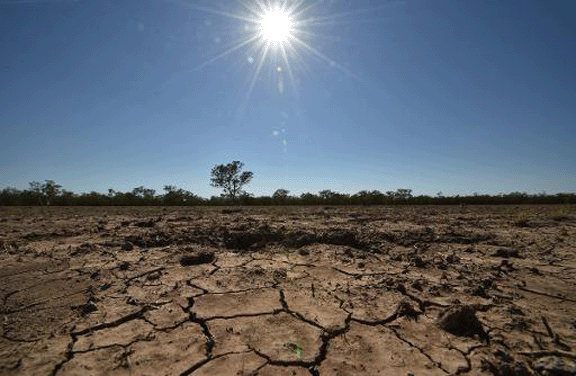
Amidst the worst drought in living memory, the world’s driest continent is also heating up due to climate change. Critics say too little is being done to prevent increasing temperatures and decreasing rainfall.
New South Wales, which is Australia’s most populous state and about the size of France, was declared 100 percent in drought on Wednesday.
Despite the fact that it is winter, farmers in the state and throughout the southern region of Australia are struggling to maintain their livelihood as crops fail and livestock die.
With grazing land turned to dust, some farmers have resorted to hand-feeding to keep their stock alive. They also have permission to shoot kangaroos that compete for pasture. Depression and suicide among farmers are on the rise.
And yet, there is no end in sight to this crippling drought, unseen for generations. The predicted start of bushfire season has been brought forward two months in New South Wales to prepare for what could be an apocalyptic summer scenario.
Though Australia is the driest inhabited continent on Earth and has regularly experienced intense droughts since modern record-taking began after European colonization, the relatively fertile southern regions continue getting hotter while receiving less rain.
Autumn of 2017 in southern Australia was the driest for 116 years. And 2017 was also the hottest year ever in New South Wales.
Increasing drought
“These regions experienced increasing intensity and frequency of hot days and heat waves over the past 50 years, in turn increasing drought severity,” said Lesley Hughes, a professor of biology at Sydney’s Macquarie University and councillor with the Climate Council — a climate change information nonprofit created after the current government closed down the state-funded Climate Commission.
But the “source of the problem is complex,” she told DW.
Scientists are confident that warming linked to human-induced climate change “has contributed to a southward shift in weather fronts from the Southern Ocean, which typically bring rain to southern Australia during winter and spring,” Hughes explained of the reduced precipitation.
As rain-inducing weather fronts drift away from land to the Southern Ocean, the risk of drought has increased, especially in agricultural heartlands such as the Murray Darling Basin in New South Wales.
Benjamin Henley, a research fellow in climate and water resources at the University of Melbourne, shares this view.
“Climate model projections suggest that with anthropogenic emissions, the storm track will shift south, reducing rainfall [over land] in the south,” he told DW.
But global warming could also be increasing the intensity of drought. “Higher temperatures during droughts, which influence evaporation rates, can be due to both the lack of rain itself [due to the reduced evaporative cooling], and the higher probability of warmer temperatures due to climate change,” Henley explained.














 Antinuclear