“Community Consent: for nuclear waste dump site? Minister Canavan further muddies the waters
 Katrina Bohr No Nuclear Waste Dump Anywhere in South Australia When asked
  in Question time,Matt Canavan said ‘Submissions and views of people that live outside the formal regions, with an interest, will also be part of broad community consent.’
The elusive “broad community consent” continues. yes https://www.facebook.com/groups/1314655315214929/
Voting in Flinders Ranges Council is open to a broad range of people


Voting in council elections is open to a broader range of people than state and federal elections.
The voters’ roll for council elections consists of two components – the House of Assembly (State) roll, and the council supplementary roll.
If you are on the State (House of Assembly) electoral roll you will automatically receive a voting pack in the mail in late October 2018.
If you are not enrolled on the House of Assembly roll you may be eligible to register on the council supplementary roll if:
You have been resident at your current address for one month and are not on the State Electoral Roll;
You are a sole owner/occupier of rateable property;
You are NOT an Australian Citizen but you have been a resident at your current address for one month;
You are a landlord for rateable property;
You are an organisation/business owner or occupier of rateable property; or
You are a group of owners or occupiers of rateable property.
To register for Council’s Supplementary Voters Roll please download the appropriate form from Councils website here: http://www.frc.sa.gov.au/election
Analysing the pro nuclear submissions about nuclear waste dump plan
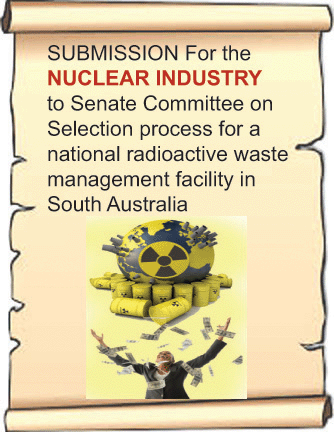 Just started on this – but so far, the quality of these submissions is indeed markedly poorer than in the anti nuclear submissions. I have previously briefly summarised the first 4 pro nuclear submissions (all remarkably similar), and also the cleverly manipulative one from Ben Heard.
Pat Beinke (submission No.17) is very pleased with all the guest speakers,and very happy with the financial aspects (sycophantic in tone, no facts given)
Robyn Stewart. (No. 10) “Whenever I have spoken to people elsewhere, I have found that most people get the low level repository confused with the high level facility that the State Government held a citizen’s jury on. Therefore, I feel the wider community beyond our council boundary would not have the knowledge to make an informed decision.” (No facts given)
Brett Stokes challenges the ABC to investigate the National Radioactive Waste Management Facility project.
ANSTO, as part of normal operations, manufacture and release radioactive poisons into the air.
These radioactive poisons are known to cause miscarriages (and other problems).
ANSTO give no warnings of these “controlled emissions” and justify this by claiming that they are not a health hazard – this claim is based on dodgy seventy year old data from Japan plus a bunch of dodgy number crunching.
Australian women suffer many many thousands of “unexplained” miscarriages (and many Aussies get “unexplained” cancer dementia etc etc).
And this is not the only dodgy aspect of ANSTO’s operations – the reactor is not needed at all for medicine – as in Canada, cyclotrons can be used to produce the required isotopes safely and reliably and without creating problematic “radioactive waste”.
ANSTO are using the lie that “nuclear medicine requires a nuclear waste dump” as a central part of the taxpayer funded bribery and deception program called the National Radioactive Waste Management Facility project.
The taxpayer funded National Radioactive Waste Management Facility project is illegal under South Australian law and is clearly a “foot in the door” for the (now decades old) nuclear industry campaign to make South Australia a nuclear waste repository as per the dodgy recommendations of the dodgy Scarce Royal Commission.
I encourage you to look in to this horror story of taxpayer money funding nuclear fanatic traitors.
Hypocrisy in Australia – our truly awful climate policy
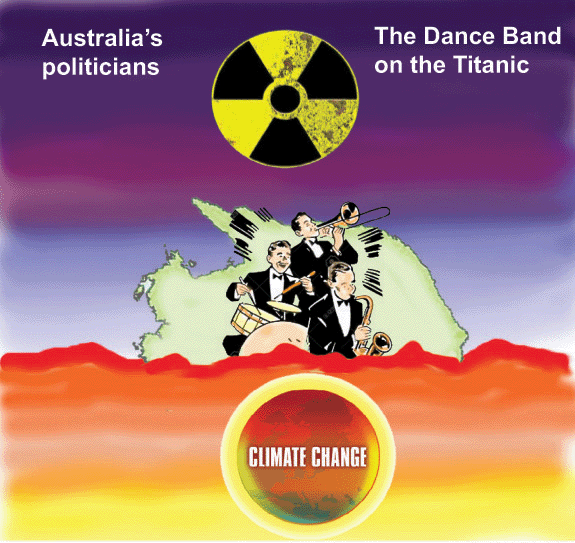 Australia’s history on climate policy is so awful it makes the NEG look like a victory https://www.crikey.com.au/2018/06/28/energy-this-is-what-success-looks-like-in-a-fractured-polity/ Australia is headed for a fifth-best climate and energy policy — and we’ll be told it’s a triumph. Bernard Keane, Politics editor If, as seems more likely than not at this point, Energy Minister Josh Frydenberg manages in the next three months to bring the states and territories on board for the his National Energy Guarantee (NEG) proposal and secure both federal Labor and joint party room support, the headlines will be glowing about his achievement. He’ll be the new golden-haired boy of the government, his leadership credentials burnished, the man who delivered us from a decade of policy paralysis on energy and climate action.
The plaudits will be well-earned, if only for Frydenberg repeatedly enduring the silliness of fossil fuel advocate and rabid coal-seam gas opponent Alan Jones. But they’ll in effect be celebrations of a profound policy failure, Australia’s worst since John Howard lied us into the Iraq War.
For a short while (two years), Australia had a high-quality climate action policy, one that lowered our emissions while having a minimal impact on inflation. That was abandoned in 2014 when the Abbott government repealed the Gillard government’s carbon-pricing scheme. Gillard had also taken some tentative steps to addressing the relentless gaming of the electricity market by participants — especially state-owned distributors — which were, in retrospect, entirely inadequate. We’d have to wait several more years for a government to take real action to stop the gaming.
The carbon pricing scheme, which was by no means perfect, was “replaced” by a kind of joke policy, a back-of-the-envelope idea devised in a hurry by Greg Hunt after Malcolm Turnbull was rolled in 2009, in which the government would hand billions to corporations and farmers to undertake energy efficiency projects they would have done anyway, or plant trees and otherwise conjure “soil magic”.
More sensible figures within the Liberal Party hacked this idiot policy back until it eventually appeared briefly as a $3 billion handout program that wasn’t renewed. That left the Renewable Energy Target, investment by the Clean Energy Finance Corporation — which Abbott was desperate to abolish — and various state renewable energy targets as Australia’s climate policy — even as the Abbott government signed itself up a hard commitment to reduce emissions by 26-28% on 2005 levels.
But Abbott had an informal policy, too, one of relentlessly demonising renewable energy, which drove a 90% fall in renewable energy investment. Malcolm Turnbull’s ascension to the prime ministership changed this dynamic. Indeed, there’s a fair argument that Turnbull’s primary contribution to energy policy as Prime Minister has been his signalling that the war on renewable energy that had been launched by his predecessor was over. Renewable energy investment has surged since he became Prime Minister, such that we’re on track to comfortably beat the Renewable Energy Target for 2020. It’s the one positive in climate-energy policy — to the extent that we actually have any “policy” other than the remnants of former government’s targets, state government one-out commitments and an energy market regulatory framework that’s in recovery phase from the over-optimism of neoliberal policy design.
After being tempted by an emissions intensity scheme, which was strongly backed by business and backed by the opposition, Turnbull backtracked from that under pressure from the right. The subsequent Finkel Review recommended a Clean Energy Target, which Turnbull was initially keen on, but again was forced to abandon under pressure from the right. Then came the National Energy Guarantee, effectively a requirement for retailers to back on-demand (not baseload) power, with a figleaf of emissions reductions thrown in.
Julia Gillard’s carbon-pricing scheme was never perfect, but if that was the closest to best policy we got, an emissions intensity scheme would have been second best policy. A renewable energy target, or a Clean Energy Target a la Finkel, would have been third best. To the extent that a NEG pitched at Australia’s woefully low Paris Accord targets slows the surge in renewables investment, it will be clearly fourth best in policy terms. But the Nationals and some of the Neanderthal faction Liberals like Abbott want to make the NEG worse by tacking on government intervention (because that worked so well with Soil Magic) in the form of billions in funding for state-controlled coal-fired power, because the private sector won’t ever touch coal again.
That would give us fifth-best policy — and be portrayed as a remarkable political achievement. That says a lot both about the government and the media.
Restoring Kakadu to its former glory (now that uranium mining is finished)
Kakadu at a crossroads: Traditional owners welcome call to restore park to its former glory http://www.abc.net.au/news/2018-06-29/kakadu-at-a-crossroads:-traditional-owners-tourism/9921510 By Felicity James
Nuclear enthusiast Matt Canavan keen to quickly wrap up waste dump site in Flinders Ranges

“I would be chuffed if we can find a solution, we’re very close, we have two communities in South Australia that have voted in favour of considering a site.
“In a couple of months time, they will vote again on whether to accept our detailed proposal.
“I’m quietly hopeful, but it’s now in the communities hands.
“If we can’t find a site for low-level waste… the idea that we build a full-blown nuclear power reactor’s probably a pipe-dream.”
He tells Ben the reason government hasn’t acted on nuclear is that Australia has such easy access to other resources.
“We have cheap coal or gas, or we have in the past… so we haven’t probably needed to look for the alternatives as much as some other countries have been forced to do.
“We are the world’s largest producers of uranium but we don’t have any nuclear power plants here.”
Delay in production of Technetium-99m (Tc-99m) at Lucas Heights
Fault at Lucas Heights nuclear reactor halts production of medical isotope, Guardian, 28 June 18
Spokesman says no safety risk but there are fears patients could face delays in cancer diagnosis “….. production of the most commonly used isotope in nuclear medicine was halted at the Lucas Heights nuclear reactor in Sydney’s south.
The Australian Nuclear Science and Technology Organisation (Ansto) usually produces about 10,000 doses a week of Technetium-99m (Tc-99m), which is used to diagnose a variety of heart, lung and musculoskeletal conditions, as well as cancers.
An Ansto spokesman said production was temporarily suspended on Friday “after a mechanical fault was identified with a piece of equipment”. There was no safety risk due to the stoppage, he said………https://www.theguardian.com/australia-news/2018/jun/28/fault-lucas-heights-nuclear-reactor-halts-production-of-medical-isotope
Brett Stokes shows how plans for nuclear waste dumping in South Australia have breached S.A. law

Nuclear Waste Storage Facility (Prohibition) Act 2000. – No public money to be used to encourage or finance construction or operation of nuclear
waste storage facility
13. Despite any other Act or law to the contrary, no public money may be appropriated,
expended or advanced to any person for the purpose of encouraging or financing any activity
associated with the construction or operation of a nuclear waste storage facility in this State.
Prohibition against construction or operation of nuclear waste storage facility
8. A person must not construct or operate a nuclear waste storage facility.
Prohibition against importation or transportation of nuclear waste for delivery to nuclear
waste storage facility
9. A person must not—
(a) bring nuclear waste into the State; or
(b) transport nuclear waste within the State,
for delivery to a nuclear waste storage facility in the State
Brett Stokes – Appendices to Submission to Senate on Selection process for a national radioactive waste management facility in South Australia
Appendix A
Breaches of s13 of the NWSF(P) Act 2000:
During 2015 and 2016, s13 has been breached by spending of public money on many promotional and planning aspects of nuclear waste importation, in particular the “Business Case” prepared by JacobsMCM for Kevin Scarce (Attorney General’s Department tender AGD 027852).
This “single-quote” Business Case document has been criticised because it was prepared by people with vested interests.
This “single-quote” Business Case document contains economic predictions which have been challenged by UniSA economists Barbara Pocock and Richard Blandy and by many others.
These economic predictions have been promoted as “facts” by Kevin Scarce and associates.
The amendment to s13 in early 2016 did not allow “spruiking” for nuclear waste importation, said Mark Parnell MLC.
– “The law now says that the Government can use public money to consult the community but they’re not to use public money for promoting or designing or even buying land for a nuclear waste dump.” – Mark Parnell MLC, April 2016
Many people have spoken out about the biased information and processes involved with the public funded Nuclear Schools Engagement Program, the public funded KNOW Nuclear advertising campaign, the public funded Your Say Nuclear advertising campaign and the public funded Nuclear Citizens Juries.
Therefore s13 has been breached during 2016 by participants in the Nuclear Schools Engagement Program, the KNOW Nuclear advertising campaign, the Your Say Nuclear advertising campaign and the Nuclear Citizens Juries.
The Nuclear Schools Engagement Program involved indoctrination of young children who were not all fooled:
“Listen to us more rather than spend days like today talking to us. Answer questions that deal with the negatives. Many questions were dodged by the experts.” Mt Lofty/Bridgewater Primary School.
“The day has provided an opportunity to find out more about nuclear storage in SA, but we feel as though the information has been biased and pro-nuclear” Streaky Bay/Ceduna.
“It was great to be given the opportunity and it was informative but all information has been very bias toward pro-nuclear. The other side needs to be heard!” Cleve Area School and Cowell Area School.
Appendix B
Threats and conspiracy to commit offences prohibited under s8 and s9 of the NWSF(P) Act 2000:
Since early 2016, there has been an open conspiracy to breach s8 and s9, with planning and promotion of importation and storage of nuclear waste into South Australia.
Detailed plans for importation and storage of nuclear waste into South Australia were produced in the “Business Case” prepared by JacobsMCM for Kevin Scarce (Attorney General’s Department tender AGD 027852).
These plans were then promoted by Kevin Scarce and associates.
Brett Stokes-Submission on “community consultation” and the illegality of the campaign for a nuclear waste dump in South Australia
Why has this submission not been published on Senate website?
From: Brett Stokes Sent: Sunday, 18 February 2018 To: Senate Standing Committees on Economics Subject: Submission on Selection process for a national radioactive waste management facility in South Australia
Terms of Reference addressed:
e) whether wider (Eyre Peninsular or state-wide) community views should be taken into consideration and, if so, how this is occurring or should be occurring;
======================================
Dear Committee Members
I am one of hundreds of South Australians who have signed the following Online Open Letter calling for police action against illegal threats to import nuclear waste and to establish nuclear waste dump(s).
Please take note of this community rejection of nuclear waste importation into South Australia.
Please take note of this community support for the laws which prohibit nuclear waste importation into South Australia. Please cease this process which threatens present and future South Australians and shows contempt towards South Australian law.
Best wishes
from Brett Stokes
Dear Commissioner of Police,
We are citizens of Australia who want action taken to enforce the law, including the South Australian Nuclear Waste Storage Facility (Prohibition) Act 2000 (abbreviated herein as the NWSF(P) Act 2000).
We are sick and tired of being threatened with illegal importation of nuclear waste.
We are sick and tired of public money being spent illegally to plan and promote illegal importation of nuclear waste.
We want action now to stop current threats of illegal importation of nuclear waste. We want action now to deter future threats of illegal importation of nuclear waste.
It is clear that the Nuclear Waste Storage Facility (Prohibition) Act 2000 has been breached.
During 2015 and 2016, s13 has been breached by spending of public money on many promotional and planning aspects of illegal nuclear waste importation, as briefly described in Appendix A.
Since early 2016, there has been an open conspiracy to breach s8 and s9, with planning and promotion of importation and storage of nuclear waste into South Australia, as briefly described in Appendix B.
There are ten year imprisonment penalties and multi million dollar fines for offences – these are very serious penalties, in accord with the gravity of the threat.
As well as these offences against the NWSF(P) Act 2000, there are also other offences, including fraud, which may become more apparent as your investigation proceeds.
Please act now to enforce the law.
Please act now to end this illegal threat.
Please act now to “protect the health, safety and welfare of the people of South Australia and to protect the environment in which they live”. (Quote from s3 Objects of Act of the NWSF(P) Act 2000)
Thank you for your attention to this important matter.
Signed (Name and Postcode) Continue reading
Geologists warn that the Barndioota region is a dangerous site for nuclear waste dumping
Barb Walker to Quorn – Out & About Fight To Stop Nuclear Waste Dump In Flinders Ranges SA
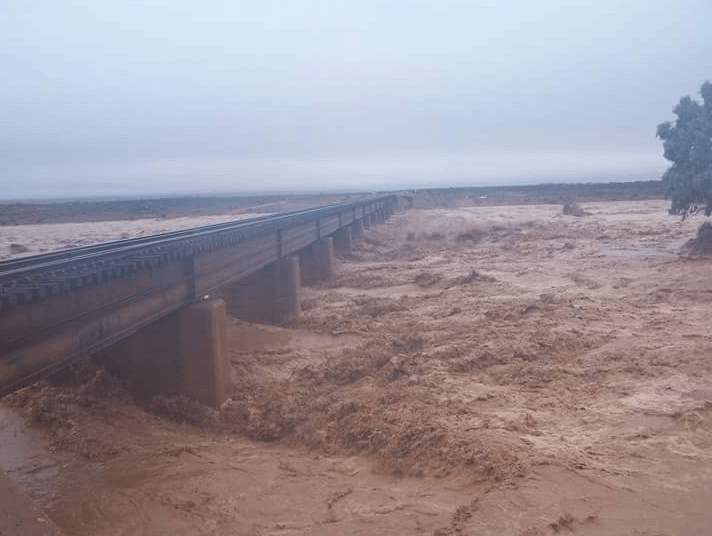 From: Professor Chris von der Borch
For distribution: The Advertiser, The Transcontinental, The Town Crier, Quorn Out and About, The Mercury and Get About – Hawker.
Received: Sunday, June 24th 2018
Subject: Proposed nuclear waste dump near Hawker.
“A site on the western slopes of the Flinders Range west of Hawker is one of the key areas currently under consideration for storage of low level, and the much more dangerous intermediate level, nuclear waste. A number of distinguished geological colleagues and myself, who collectively share many decades of geological research in the proposed area, are very concerned that the one of the suggested storage sites, in the Barndioota region, ticks “all the wrong boxes” as a fail-safe option.
Such nuclear waste, which would have a radioactive half-life of tens of thousands of years, needs a careful consideration of the geological parameters of a proposed responsible storage site, rather than what appears to be “political expediency”! And the site under consideration would certainly not satisfy these geological considerations.
It lies in one of the most seismically active regions of Australia. It lies in a zone which is subject to catastrophic flash-flooding and mudflow activity. The area is adjacent to a major saline lake, Lake Torrens, which is a “terminal drainage area”, meaning that all surface and underground run-off from the ranges ends up in the periodically drying surface lake sediments. So the bottom line is that, were such a storage site were to break down within the next several thousand years, radioactive material would end up in the surface sediments of Lake Torrens. Dry desert winds would then have the potential to disperse radioactive dust over large areas which may well be occupied by humans in the future.” https://www.facebook.com/search/top/?q=Fight%20To%20Stop%20Nuclear%20Waste%20Dump%20In%20Flinders%20Ranges%20SA
Regina McKenzie’s detailed letters to Minister Matt Canavan ask the hard questions about the proposed Barndioota nuclear waste dump
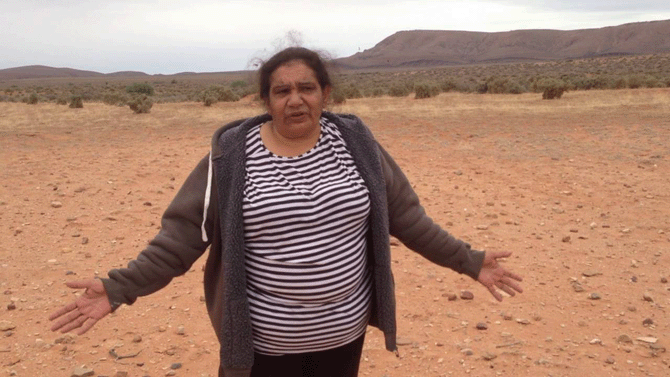
- The Commonwealth Government commitment to not harm Aboriginal cultural heritage has failed and requires urgent reparation/damage assessment.
Senator Rex Patrick questions the government’s big submarine spend-up
Was this much too expensive choice made because these submarines could easily be converted to nuclear submarines?
THIRTY BILLION DOLLARS OF QUESTIONS
Australia’s Future Submarine program could blow out by billions, Senator Rex Patrick warns
This week I revealed in Parliament that the Coalition Government’s choice of the French submarine builder as the preferred partner for the Navy’s Future Submarine will cost taxpayers $30 billion more than the price offered by the unsuccessful German builder.
The Government is refusing to explain the difference in cost.
We’re talking a whopping $30 BILLION. That’s $30 billion that could have been better spent on other defence projects or even health, education and/or infrastructure. I will be pursuing this further.
Here is my question to the Defence Minister this week.
You can also read more here: https://rex.centrealliance.org.au/…/releases/thirty-billion/.
South Australian top university big-wigs are nuclear industry promoters
South Australia’s academic bigwigs infected with pronuclear delusions.
UniSA Chancellor Jim McDowell is also Chair of the ANSTO Board & ex-CEO of BAE.
AdUni Chancellor is Nuclear Fuel Chain Royal Commissioner Kevin Scarce.
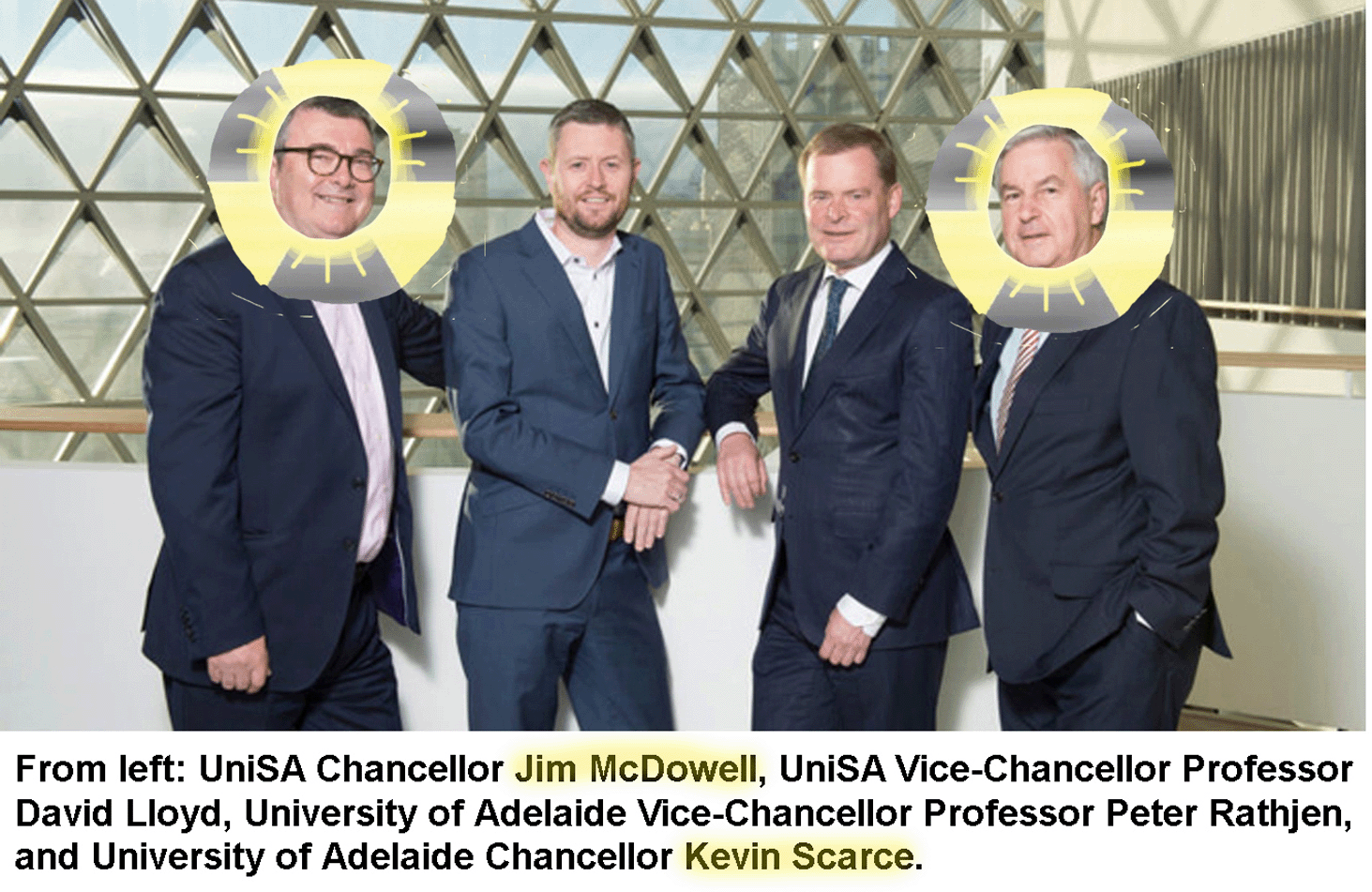
University of Adelaide and UniSA in merger talks, InDaily, Bension Siebert- 19 June 18 The University of Adelaide and UniSA have announced historic talks to merge into a single university which they claim could be immediately placed within the world’s top 100 universities.
The governing councils of both universities have agreed to a six-month “period of collaboration” to negotiate a potential merger, according to a joint statement released by the universities today.
University of Adelaide Vice-Chancellor Professor Peter Rathjen and UniSA Vice-Chancellor David Lloyd will oversee a joint report into the prospective merger, to be delivered by the end of the year.
The university councils will decide on the viability and merits of a merger at that time.
In a joint statement, University of Adelaide Chancellor Kevin Scarce and UniSA Chancellor Jim McDowell say now is the right time to consider joining together as a single university.
“Now is the time to facilitate a conversation about whether uniting our universities would create a new internationally renowned university of scale that would be well placed to anticipate and respond to this changing landscape,” the statement reads……..
Merging the Adelaide University and UniSA was an ambition of former Labor Premier Jay Weatherill in 2015, but universities and both sides of federal politics were opposed to the idea. ……..
However, this morning Federal Education Minister Simon Birmingham, Premier Steven Marshall and SA Labor Leader Peter Malinauskas all congratulated the universities on the move. …..https://indaily.com.au/news/2018/06/19/breaking-university-adelaide-unisa-merger-talks/
Aboriginal land and nuclear waste dumping: A critically important Submission to Senate from Regina McKenzie
Ed note. This submission has an important attachment – a letter – which will later be published on this site
Regina McKenzie Selection process for a national radioactive waste management facility in South Australia (Submission No.107)
This independent submission addresses the following key points of the Terms of Reference of the Australian: Senate Economic Reference Committee inquiry (2018) into the appropriateness and thoroughness of the site. selection process for a national radioactive waste management facility at Kimba and Hawker in South Australia:
- c) how any need for Indigenous support has played and will continue to play a part in the process, including how Indigenous support has been or will be determined for each process advancement stage; and
- f) any other related matters.
My name is Regina McKenzie and I am an identified (Aboriginal) Kuyani traditional owner for the area of land currently subject to the National Radioactive Waste Management Facility Project (NRWMFP) at Barndioota, South Australia. I have extensive cultural knowledge of this portion of Adnyamathanha country and have been working collaboratively with non Aboriginal specialist for well over ten years to investigate and report on this area. Some of the projects that I have worked on in my cultural interest area include:
- Numerous archaeological investigations with a number of Australian universities;
- Palaeontology investigations with Flinders University, South Australia;
- Aboriginal heritage investigations for NRM projects with multiple State Government agencies;
- Archaeological investigations for SA Power Networks;
- Archaeological training programs with the Heritage team of the South Australian Department of Premier and Cabinet, Aboriginal Affairs and Reconciliation Division (DPC AARD) (now Department of State
- Development Aboriginal Affairs and Reconciliation – DSD AAR);
- Cultural heritage management planning for the Commonwealth Government’s Indigenous Protected Area (IPA) program.
- The development of large area cultural mapping protocols for the SA State Government;
- The translation and spatial mapping of one of my Nation’s ancestral story lines that includes the nominated NRWMFP area in Barndioota.
The reference committee should understand that the Adnyamathanha People are an historical conglomeration of multiple and individually identified Aboriginal tribal Nations, each of which has its own cultural interest area. The Adnyamathanha people, as a whole, hold native title over much of the Flinders Ranges and this is managed by a prescribed body corporate on behalf of all traditional groups by the Adnyamathanha Traditional Lands Association (ATLA). I would also like to note that only individual people, not organisations, can hold cultural knowledge and be considered as traditional owners (there is case law in South Australia to this affect). It is also vital that the committee appreciate the difference between Aboriginal cultural heritage laws and obligations (whether they be State or Federal), and Native Title laws, rights and interests. My submission is focussed on the cultural heritage rights and interests of identified traditional owners and the State/Federal obligations for those that wish to investigate /or harm Aboriginal cultural heritage.
Many of my concerns with the Aboriginal cultural heritage consultation process for the NRWMFP in Barndioota have been summarised in a recent letter to Minister Canavan (see Attached) [ed. note: This letter will be published on this site, as a separate post] . I would appreciate if the committee accepts the attached letter as part of my submission. I note that despite repeated requests to Minister Canavan’s office, I still have not received a response to this letter and many questions remain unanswered and concerns unresolved. I believe that these questions and concerns must be addressed for the DIIS consultation process to be considered effective.
In addition to my questions and concerns detailed in the attached letter, I would appreciate some clarification on the following:
- Australia’s commitment to Article 29.2. of the United Nations Declaration on the Rights of Indigenous Peoples which notes:
States shall take effective measures to ensure that no storage or disposal of hazardous materials shall take place in the lands or territories of indigenous peoples without their free, prior and informed consent.
I would appreciate some clarification on the Australian Government’s or the the Department of Industry, Innovation and Science (DIIS) position on this United Nations charter and how it applies to proposed developments on traditional Aboriginal lands and lands that contain significant cultural value to relevant Aboriginal people.
The DIIS, on behalf of the Commonwealth Government of Australia, took no steps during the nomination and shortlisting process to secure either the free, or the prior, or the informed consent of the Indigenous peoples who have significant cultural ties to the NRWMFP area in Barndioota. To the best of my knowledge, the DIIS believed that the Commonwealth Government did not need to consult with Aboriginal people in Barndioota because the proposed project area was not subject to Native Title. This was stated to myself and my sister when we first called the DIIS to enquire about the project after we heard about it on ABC news. This was also repeated by DIIS representatives at their initial public meetings in Hawker.
Importantly, and from an Aboriginal cultural heritage perspective, ATLA and the relevant cultural custodians of the Barndioota area have repeatedly advised the DIIS that they do not support the siting of the NRWMFP within our traditional country.
- The DIIS initially confused Aboriginal cultural heritage obligations with Native Title constraints and only consulted with affected Aboriginal people after repeated requests for information from myself and my sister
- The Aboriginal cultural heritage investigations undertaken to support the Barndioota NRWMFP have not been undertaken in accordance with the Commonwealth Government’s best practice requirements for investigating and reporting on Aboriginal cultural heritage (see attached letter). Importantly, this failure to adhere, recognise or use the Commonwealth best practice guidelines has led the DIIS to:
- Consult with inappropriate Aboriginal people who do not hold cultural information for Barndioota, and
- Completely ignore the significant cultural/gender restrictions associated with the NRWMFP area, and
- Alienate relevant culturally appropriate people from participating in the NRWMFP assessment, and
- Not have access to vitally important cultural information associated with the NRWMFP area.
These factors alone have made the DIIS Aboriginal cultural heritage assessment ineffective, inappropriate, and incomplete. This significantly flawed consultation process needs to be completely abandoned as soon as possible because it has caused significant mental health issues within our broader Aboriginal community and continuing lateral violence within our immediate family. The NRWMFP Aboriginal consultation process has left me feeling ostracised within my own family and I find myself constantly witnessing aggressive, misogynistic and culturally inappropriate behaviour from a select few who have been validated through the DIIS Aboriginal cultural heritage assessment process.
- The DIIS has failed to abide by their own governance guidelines that they established for the Aboriginal cultural heritage consultative committee. There have been too many instances of aggressive and inappropriate behaviour that have not been recorded or addressed.
- The DIIS has inappropriately engaged a cultural heritage consultancy:
- Against the wishes of both ATLA and the relevant cultural custodians of the NRWMFP area,
- Without presenting any tangible proof that the consultancy has/can record the intangible values associated with large area cultural sites to a level that is similar to, or better than, that developed by DPC AARD,
- Without developing the scope of work for the assessment with ATLA and the relevant cultural custodians of the NRWMFP area,
- Without informing ATLA or the relevant cultural custodians of the agreed scope of work between the DIIS and the consultancy for the Aboriginal cultural heritage assessment
- The nomination and short-listing process of the Barndioota NRWMFP site failed to acknowledge the unique and intrinsic Aboriginal cultural heritage values of the associated cultural landscape. Many of these values have been documented by the State Government through extensive cultural mapping and archaeological investigations, and acknowledged by the Commonwealth Government for the neighbouring IPA program. Importantly, the failure to acknowledge the values of this cultural landscape also extended to a failure to recognise and acknowledge the nominated traditional custodians of the land subject to the NRWMFP area. These custodians are well known to DPC AAR who hold the contact details for the custodians of all of our recorded sites.
- Ministers Frydenberg and Canavan have both issued seperate commitments that no Aboriginal cultural heritage will be harmed through this project. The DIIS has been informed of the extensive archaeologyand all-encompassing intangible values associated with the NRWMFP area, and the impossibility of situating the NRWMFP and its associated road/power infrastructure without harming Aboriginal cultural heritage which includes our cultural beliefs, lore and customs. Could the committee please clarify the DIIS’/the Commonwealth Government’s understanding of what Aboriginal cultural heritage means and how the DIIS intend to avoid/not cause harm, particularly to our system of lore, custom and belief. We believe that this is a major constraint for the NRWMFP and that valuable public funds could have been saved if the relevant Ministers honour their commitments and resolved this matter early in the project.
- During Phase one, the DIIS never undertook any formal Acknowledgement of Country, and has never requested a formal Welcome to Country from any Adnyamathanha elder for any of the meetings held in Hawker.
- Retired Liberal Senator Chapman’s nomination of the Barndioota site has never been questioned either in the context of any potential political conflict of interest, or for his prior engagement in the Federal Senate and his involvement in past Senate committees who were tasked to investigate the establishment of above ground Nuclear waste facilities nearly two decades ago. We have been assured that the nomination of the Barndioota site is not related in any way to the current Liberal government or to the ex Senator’s prior profession. I would like this matter to be assessed in a transparent way.
- Key Hawker community representatives who support the NRWMFP in Barndioota have long term relationships with, and have worked for Wallerbedina Station for many years. This potential conflict of interest needs to be identified and acknowledged in a transparent manner.
1 This month
25 October – Film –Britain’s Nuclear Bomb Scandal: Our Story – part of the Adelaide Film Festival,
Screening and Conversation
A screening of Britain’s Nuclear Bomb Scandal: Our Story (2024) followed by a talk with 2026 Bettison and James Awardee and Tradtional Owner Karina Lester in conversation with Simone Tur.
When: Sun 25 Oct, 12:00pm-Screening, 1:15pm-Talk
Where: The Mercury
Free admission, register below by clicking on BUY TICKETS and select free event tickets, at end of web page:
https://www.adelaidefilmfestival.org/program/2026/britains-nuclear-bomb-scandal-our-story
.

Australians deserve the truth
about
AUKUS – https://aukuspublicinquiry.com/

PETITION – To: Prime Minister Anthony Albanese and the Australian Labor Government

of the week – Australians for War Powers Reform (AWPR)
To see nuclear-related stories in greater depth and intensity

