 Prolonged SA heat could break records, Herald Sun Caitlin Guilfoyle, Australian Associated Press, April 7, 2018
A total fire ban has been issued for parts of South Australia amidst a wave of warm weather that could break records.
Above-average temperatures are expected through the weekend until Tuesday and that is “most unusual” at this time of year, Bureau of Meteorology duty forecaster Peter Webb says.
“I think three days over 33 in a row would be a new record, if it happens,” he told AAP on Saturday.
“Prolonged heat like this is pushing the boundaries.”
Temperatures are expected to reach up to 40 degrees in the far west, while the mercury will likely climb into the high 30s in northern parts of the state……http://www.heraldsun.com.au/news/breaking-news/heat-wind-leads-to-total-fire-ban-in-sa/news-story/a7446a9b478d413f0c013deb78cf7bbd
April 8, 2018
Posted by Christina Macpherson |
climate change - global warming, South Australia |
Leave a comment
Both these documents show that the facility should not be located on agricultural land, and yet both nominated sites at Kimba are specifically located on farms. Directly next to farming country, and entirely neighboured by productive farms.
 Submission to Senate Inquiry: Selection process for a national radioactive waste
  management facility in South Australia by Mrs Justine Major I am a fourth generation farmer in Kimba, South Australia. I have a strong understanding of the project being put forward for consideration, and whilst am not against the idea of the consolidation of radioactive waste into one facility, I do not believe it needs to be located in a food producing region. Personally, this process has been one of ongoing stress, additional workload and a steep learning curve into the political machinations of an Australian Government project.
Please find following my response to the Terms of Reference of this Inquiry.
B) How the need for ‘broad community support’ has played and will continue to play a part in the process, including; a. The definition of ‘broad community support’, and b. How ‘broad community support’ has been or will be determined for each process advancement stage;
The definition of ‘broad community support’ has been a moving target that has never been clearly defined in the Radioactive Waste Management Facility project. The hallmarks of a well developed project include the establishment of standardised measurable milestones that allow all stakeholders to have a clear understanding of the path being traversed as well as clear acknowledgement that these milestones have or have not been achieved. The constantly moving goal posts throughout this process has been an ongoing source of frustration to those of us trying to work within the Governments framework.
Despite numerous requests, the Government has continued to refuse to provide clarity around what factors would be included in their consideration when determining if broad community support had been achieved; what weighting each of the factors would contribute to this outcome, or what the required result in percentage terms was necessary to allow this process to proceed to the next stage
There has been an ongoing lack of clearly defined, factual, measurable targets that are defendable from both sides of the debate, accepted by both sides of the debate and not able to be influenced by the results put before it. The Minister advised that the vote would not be the only determining factor for progressing the Kimba site through to the second stage, however when looking at the statistics surrounding alternate factors it is hard to see where any other factor has been included. All media that I have seen surrounding Minister Canavans decision simply continued to reference the 57.4% in favour of progressing result of the vote. Based on the data included in the “National Radioactive Waste Management Facility (NRWMF) Phase 1 Summary Report, Kimba 2017” showing the results of the community consultation on which the decision to progress to Phase 2 was made, written submissions received throughout this phase were seen to be 86% opposed to the facility. Had both factors been taken into consideration equally, there would have been 35.7% approval rating to this project. Should we even provide a 20% weighting to the written submissions and 80% weighting to the vote, the outcome would achieve a 48.7% approval. None of this comes close to being “broad community consent”.
Another area included in “broad community support” is supposedly the opinions of neighbours. In the first round of community consultation the definition of neighbour, was any property or person within a 10km radius. When the second round of community consultation occurred in December 2016 it was reduced to neighbours within a 5km radius, and at the time of the vote the definition of neighbour was those who immediately bordered the nominated parcel of land. This continuous shift in parameters appears to me to have occurred in order to reduce those included in the sample of neighbours, resulting the Department able to make the statement included in the “National Radioactive Waste Management Facility (NRWMF) Phase 1 Summary Report, Kimba 2017” that “Neighbour support around the proposed sites is strongly supportive”. This ongoing lack of defined measureables and the Ministers ability to make a decision as to what the pass mark is after the results have been declared is disingenuous.
D) Whether and/or how the Governments ‘community benefits program’ payments affect broad community and Indigenous community sentiment;
The removal of incentive payments would absolutely change the support levels found within a community. The idea of the Radioactive Waste Management Facility being sited in Kimba was promoted along the lines of “think what this money could do for us”. All the way through this process has been a money grab. There is anecdotal evidence of people saying that they would vote “Yes” to going through to the second round of this process in order to receive the $2M Community Benefit Funds, with the plan to say “No” at the next vote. They have no intention of wanting the facility located at Kimba, but think they are playing a game whereby they can “get $2M for nothing”.
There is speculation of strategies in play to prolong the Phase 2 process to ensure it pushes into the second financial year in order to gain a further $2M. For those of us who are against the location of this facility in the Kimba region, regardless of the funds thrown around, this is a difficult process. We are defending our position against the facility being located in our region, with genuine concern regarding our business and livelihoods, whilst community members are playing a game to access funding. I also believe that the $10M one-off payment included in the Act will be paid to the State Government has not been clearly highlighted throughout this process. Most people within the community believe the money will be coming to the community directly, with complete access to, and management of, the funds. When people discover this money is to be paid to the State Government, their opinion on the matter changes very quickly.
F) Any other related matters
The Code for Disposal of Solid Radioactive Waste provided by ARPANSA clearly states that the siting of a Radioactive Waste Management Facility should not be on agricultural land: “Section 3.1.29 (a) the immediate vicinity of the facility has no known significant natural resources, including potentially valuable mineral deposits, and which has little or no potential for agriculture or outdoor recreational use.”
The National Radioactive Waste Management Facility, Nomination of Land Guidelines, November 2016 also clearly states in Attachment A, Section A8 under the Community Well Being Objective the criteria: “Is the site located within an area that is likely to be expanded upon for community or industrial use or for natural/agricultural use in the foreseeable future”. The weighting to this criteria when taking site selection into consideration according to the guidelines was stipulated as “High”. Both these documents show that the facility should not be located on agricultural land, and yet both nominated sites at Kimba are specifically located on farms. Directly next to farming country, and entirely neighboured by productive farms. That this part of the ruling is not being enforced is beyond me. It would be apparent to most people that under best practice the production of food should be separated from the production or storage of nuclear waste. That it is not the case in other countries does not provide adequate reason as to why Australia should lower their standards with regards to this. It is imperative that this part of the legislation is upheld and made mandatory, rather than being optional.
April 7, 2018
Posted by Christina Macpherson |
Federal nuclear waste dump, South Australia |
Leave a comment
 Nationals rule out nuclear power ‘madness’ Echo Daily April 6, 2018 | by The Echo
The NSW Nationals have ruled out plans for building a nuclear power station on the north coast in the face of mounting pressure to do so ‘once and for all’.
Labor candidate for the seat of Ballina, Asren Pugh, made the call in the wake of the recent attendance at a US nuclear industry conference by NSW Nationals leader and Deputy Premier, John Barilaro.
But Mr Barilaro’s spokesman told Echonetdaily there were ‘absolutely’ no plans for such plants on the north coast nor nuclear energy ‘anywhere in NSW’.
However, the spokesman said Mr Barilaro’s views ‘are not representative of the party’s position or the NSW governments’.
‘Nuclear energy is banned under federal law,’ the spokesman said.
On Tuesday during a radio interview, Mr Barilaro said that premier Berejiklian was “open minded” to nuclear power in NSW.
But the deputy premier’s spokesman said the Nationals did not support the idea of nuclear power in NSW, and that Mr Barilaro was ‘expressing his personal views, in the interests of sparking a conversation about the prospects and environmental benefits of nuclear energy’.
Mr Pugh said Mr Barilaro not only participated in the US conference but was a key speaker, billed as one of the ‘Biggest Names in Nuclear’.
He said that since returning to Australia from the International SMR and Advanced Reactor Summi, in Atlanta, Mr Barilaro ‘has been spruiking nuclear power right across NSW, claiming that it could be a reality within 10 years’.
‘When the Nationals leader started this madness, most people thought it was just an April Fools joke, but this is now getting serious,’ Mr Pugh said. ‘There are no circumstances in which our community on the North Coast want nuclear power here. ‘Nuclear power is unsafe, dangerous and leaves a legacy of toxic waste to our children and our children’s children.
‘Our community doesn’t want a discussion about nuclear power on the North Coast, or anywhere in NSW. I am calling on the Nationals MPs from across the North Coast to stand up for our community and say no.
‘I am asking for a clear commitment to a nuclear free North Coast,’ Mr Pugh said.
Mr Barilaro’s spokesman said the deputy premier’s position on nuclear energy ‘is his own. It is not the position of the Nationals or the NSW Government’……….https://www.echo.net.au/2018/04/nationals-push-nuclear-power-north-coast-madness/
April 6, 2018
Posted by Christina Macpherson |
New South Wales, politics |
Leave a comment
South Coast nuclear option ‘makes no sense’: Mike Kelly http://www.begadistrictnews.com.au/story/5325720/nuclear-not-a-real-option-says-mp-kelly/ 5 Apr 18,
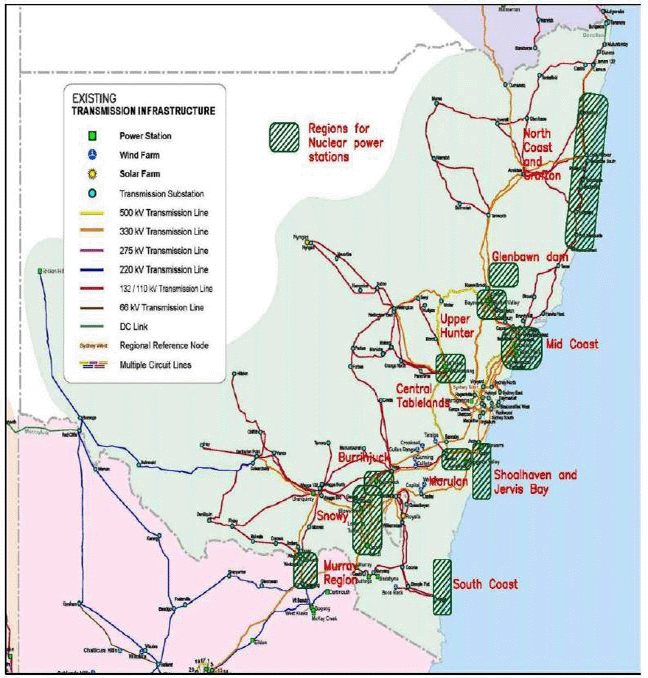
The stretch of coastline between Merimbula and Bermagui has been earmarked as having the potential to host a nuclear power station.
In a study by the Nuclear for Climate Australia group published on its website, the Far South Coast is among 18 proposed sites or “areas of interest” in NSW.
Eden-Monaro MP Mike Kelly, a vocal supporter of renewable energy investment in the electorate, said while he understood potential benefits, the study “makes no sense whatsoever”.
“The way I look at it, we haven’t solved issues around disposing of the waste, and risk issues,” Dr Kelly said.
“The results can be catastrophic.”
Dr Kelly said Jervis Bay has long been looked at as a nuclear site, even as recently as by prime minister John Howard.
“If we were going to move down that road, we would’ve had to in the 1960s,” he said.
“Why do it if you have the opportunity to avoid it?”
Nuclear for Climate Australia states the reactor would “have potential if included with other power plants built at East Gippsland, the Snowy or Jervis Bay”, would be cooled in sea water, and would require an “extensive grid upgrade” and a port upgrade at Twofold Bay.
“The big issue is they [nuclear power plants] require water, and our rivers don’t have enough, which means you need the coastline, and where on our coast would you want one?” Dr Kelly said.
“Development would take 20 years, and in that time we have every available renewable energy resource here in Australia, which will transfer to cheaper power, especially with the Snowy Hydro announcement.
“For our region there’s real benefit in becoming a hub for research and development, and even manufacturing components.”
April 5, 2018
Posted by Christina Macpherson |
New South Wales, politics |
Leave a comment
We are locked into an arms race that no one wants to happen, global researchers warn
A CHILLING letter claims the world is on the cusp of opening a dangerous Pandora’s box — and there is no going back. http://www.news.com.au/technology/innovation/we-are-locked-into-an-arms-race-that-no-one-wants-to-happen-global-researchers-warn/news-story/fc6dfa060c66ed876beb79d1b7530cc6 Nick Whigham@NWWHIGHAM 5 Apr 18
The boycott comes in advance of a meeting next Monday in Geneva, Switzerland, of 123 member nations of the United Nations discussing the challenges posed by lethal autonomous weapons. Twenty-two of those nations have already called for an outright and pre-emptive ban on such weapons.
The open letter announcing the boycott against the South Korean university said autonomous weapons are the “third revolution in warfare” and warned about letting the genie out of the bottle.
“At a time when the United Nations is discussing how to contain the threat posed to international security by autonomous weapons, it is regrettable that a prestigious institution like KAIST looks to accelerate the arms race to develop such weapons,” the letter said.
“We therefore publicly declare that we will boycott all collaborations with any part of KAIST until such time as the President of KAIST provides assurances, which we have sought but not received, that the Center will not develop autonomous weapons lacking meaningful human control,” the researchers said.
“If developed, autonomous weapons will be the third revolution in warfare. They will permit war to be fought faster and at a scale greater than ever before. They have the potential to be weapons of terror. Despots and terrorists could use them against innocent populations, removing any ethical restraints. This Pandora’s box will be hard to close if it is opened.”
Professor Walsh organised the boycott which involves researchers from 30 countries and includes three of the world’s top deep learning experts, Professor Stuart Russell from the University of California, Berkeley, who authored the leading textbook on AI and roboticist Prof Wolfram Burgard, winner of the Gottfried Wilhelm Leibniz Prize, the most prestigious research prize in Germany.
“Back in 2015, we warned of an arms race in autonomous weapons,” Professor Walsh said in a statement alongside the letter. “We can see prototypes of autonomous weapons under development today by many nations including the US, China, Russia and the UK. We are locked into an arms race that no one wants to happen.
“KAIST’s actions will only accelerate this arms race. We cannot tolerate this.”
Professor Walsh has long campaigned against the development of autonomous weapons.
He has previously travelled to speak in front of the United Nations in an effort to have the international body prevent the proliferation of so-called killer robots with the ability to think for themselves.
Speaking to news.com.au last year he said “the arms race is already starting.”
He believes it’s no longer a question of whether military weapons are imbued with some level of autonomy, it’s just a matter of how much autonomy — which poses a number of worrying scenarios, particularly if they fall into the wrong hands.
“They get in the hands of the wrong people and they can be turned against us. They can be used by terrorist organisations,” he warned.
“It would be a terrifying future if we allow ourselves to go down this road.
April 5, 2018
Posted by Christina Macpherson |
AUSTRALIA - NATIONAL, weapons and war |
Leave a comment
Three local sites identified as possible nuclear power stations https://www.lakesmail.com.au/story/5318455/munmorah-eraring-vales-point-identified-as-possible-nuclear-reactor-sites/ 3 April 18 Eraring has been identified as a possible future site for nuclear power by the Australian Nuclear Association.
YASMIN Catley is calling for Premier Gladys Berejiklian to rule out nuclear power in NSW.
The Member for Swansea’s comments came after it was revealed the Deputy Premier John Barilaro was on a taxpayer-funded trip to the US where he attended the International SMR and Reactor Summit, in Atlanta, on March 27.
The NSW Nationals leader has on previous occasions called for nuclear power to be “part of the debate” about the state’s future energy mix.
Mr Barilaro was an invited speaker at the summit and billed on its website as one of the “biggest names in nuclear”.
While in the US he also met with representatives from NuScale and U-Battery, his office said.
These companies are “developing Gen IV reactors which will possibly be available mid 2020s, as well as the US Department of Energy to get an insight in relation to the Government’s approach to new nuclear technology,” a spokesperson for his office said.
“This was an opportunity to learn and gain knowledge about the sector.”
Ms Catley pointed to a 2016 map produced by the Australian Nuclear Association which identified two sites in Lake Macquarie and one site at the Central Coast – Eraring, Vales Point and Munmorah – which could be potential nuclear power plants.
However, Mr Barilaro’s office said he had not considered locations for any future nuclear power sites.
 The Australian Nuclear Association’s Robert Parker said the Lake Macquarie and Central Coast sites were among many his organisation had identified across Australia.
The local sites’ suitability was due to existing power generation infrastructure, population density, access to cooling water, road and transport infrastructure, and an existing skilled workforce, Mr Parker said.
He stressed his organisation were proponents of small modular reactors, not large reactors.
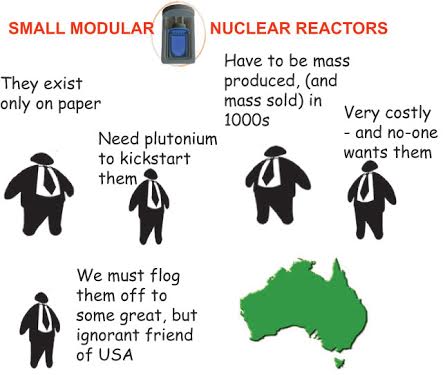
The organisation would like to see 18 reactors operating in NSW by 2040.
“It’s impossible for them to have meltdown issues like at Fukushima,” Mr Parker said.
Ms Catley has called on the Premier to rule out nuclear power in NSW. “The Central Coast has a long history of being the powerhouse for NSW, but nuclear is not the way forward,” Ms Catley said.
The Member for Lake Macquarie Greg Piper said while he did not support nuclear power in Lake Macquarie, “Mr Barilaro should not be shut down if he believes it’s something that should be looked at.”
“But the people of Lake Macquarie would have a meltdown.”
April 4, 2018
Posted by Christina Macpherson |
New South Wales, politics |
Leave a comment
Premier Berejiklian ‘openminded’ to nuclear energy, deputy premier says 2GB, BEN FORDHAM, 3 April 18 Premier Gladys Berejiklian is “openminded” to nuclear power in Australia according to Deputy Premier John Barilaro.
Mr Barilaro has touched back down in Australia this week after visiting the US to push new nuclear technology in our state.
After meeting with American companies who are building the world’s first small modular reactors, he says this is the way of the future.
April 4, 2018
Posted by Christina Macpherson |
New South Wales, politics |
Leave a comment
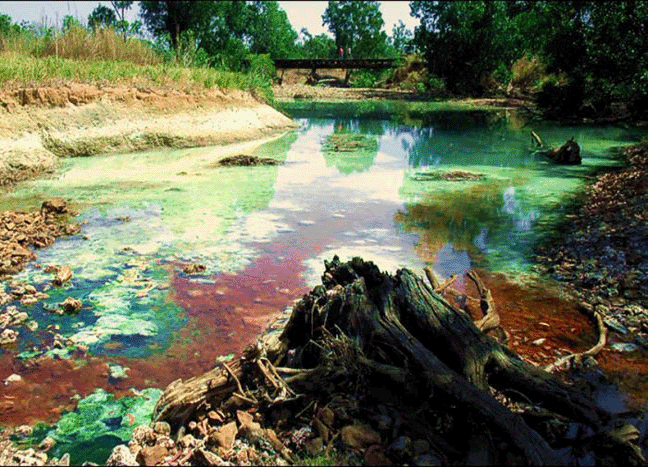
Above: Finniss River polluted by Rum Jungle mine’s toxic metallic and radioactive debris
Rum Jungle uranium mine rehabilitation jeopardised by NT Resources Department, traditional owners warn http://www.abc.net.au/news/2018-04-03/uranium-mine-rehabilitation-jeopardised-nt-resources-department/9612056 By Sara Everingham
The long-awaited $300 million rehabilitation of the abandoned Rum Jungle uranium mine in the Top End is being jeopardised by the Northern Territory Department of Resources and the Government should find another agency to run the project, Aboriginal traditional owners have warned. Continue reading →
April 4, 2018
Posted by Christina Macpherson |
environment, Northern Territory |
Leave a comment
Guardian 2nd April 2018, One of Australia’s proudest land rights struggles is passing an important
anniversary: it is 20 years since the establishment of the blockade camp at
Jabiluka in Kakadu national park.
This was the moment at which push would
come to shove at one of the world’s largest high-grade uranium deposits.
The industry would push, and people power would shove right back.
The blockade set up a confrontation between two very different kinds of power:
on the one side, the campaign was grounded in the desire for
self-determination by the Mirarr traditional Aboriginal owners,
 particularly the formidable senior traditional owner Yvonne Margarula. They
were supported by a tiny handful of experienced paid staff and backed by an
international network of environment advocates, volunteer activists and
researchers. https://www.theguardian.com/commentisfree/2018/apr/03/20-years-on-from-the-jabiluka-mine-protest-we-can-find-hope-in-its-success
April 4, 2018
Posted by Christina Macpherson |
aboriginal issues, AUSTRALIA - NATIONAL, history, Opposition to nuclear |
Leave a comment
 Antarctica retreating across the sea floor, EurekAlert , UNIVERSITY OF LEEDS , 3 April 18 Antarctica’s great ice sheet is losing ground as it is eroded by warm ocean water circulating beneath its floating edge, a new study has found.
Research by the UK Centre for Polar Observation and Modelling (CPOM) at the University of Leeds has produced the first complete map of how the ice sheet’s submarine edge, or “grounding line”, is shifting. Most Antarctic glaciers flow straight into the ocean in deep submarine troughs, the grounding line is the place where their base leaves the sea floor and begins to float.
Their study, published today in Nature Geoscience, shows that the Southern Ocean melted 1,463 km2 of Antarctica’s underwater ice between 2010 and 2016 – an area the size of Greater London.
The team, led by Dr Hannes Konrad from the University of Leeds, found that grounding line retreat has been extreme at eight of the ice sheet’s 65 biggest glaciers. The pace of deglaciation since the last ice age is roughly 25 metres per year. The retreat of the grounding line at these glaciers is more than five times that rate.
The biggest changes were seen in West Antarctica, where more than a fifth of the ice sheet has retreated across the sea floor faster than the pace of deglaciation……….https://www.eurekalert.org/pub_releases/2018-04/uol-ara032918.php
April 4, 2018
Posted by Christina Macpherson |
AUSTRALIA - NATIONAL, climate change - global warming |
Leave a comment
Daniel Ellsberg’s decision to release the Pentagon Papers was an act of valor—his actions saved countless lives. He was a whistleblower who changed the course of history and curtailed an ongoing genocide which ended up preventing the needless dissolution of American soldiers and Vietnamese civilians alike. The publishing of the Pentagon Papers is a prime example of the critical part a free press plays in keeping governments in check and exposing the corrosive nature of consolidated power. This is why the First Amendment of the Bill of Rights enshrines the rights to free speech and of a free press in the United States Constitution.
Tyrants throughout history have targeted journalists and reporters for a reason.
On Wednesday afternoon, Julian Assange, who has been forced into self-imprisonment at the Ecuadorian embassy since 2012 to ward off prosecution from the United Kingdom and the United States, had his internet access cut off. Assange is our generation’s Daniel Ellsberg; WikiLeaks—the online publication he started—has been invaluable in letting the public know about the malfeasance of their elected officials and highlighting the duplicity of governments throughout the world. In an era where mainstream journalists have been turned into a corporate-state propagandists, WikiLeaks stands out in their dogged pursuit of truth and exposing deep-seated corruption and graft.
 Where Is the Outrage About Julian Assange’s Silencing? https://www.truthdig.com/articles/where-is-the-outrage-about-julian-assanges-silencing/ 3 April 18, Teodrose Fikre / The Ghion Journal
On October 12, 1969, Daniel Ellsberg copied a secret dossier with the intention of disclosing the truth about the Vietnam War. The Pentagon Papers were a chronicle of events that recorded the scope of operations in Vietnam and beyond—details which were being withheld from the American public. The Vietnam War was built on the foundation of lies; we were rushed into the war using the Gulf of Tonkin as a false flag and defending freedom as a pretext to further the interests of the defense-financial complex. The truth eventually caught up to the lies of politicians and bureaucrats; Defense Secretary Robert McNamara later admitted the Gulf of Tonkin attack never took place. Continue reading →
April 4, 2018
Posted by Christina Macpherson |
AUSTRALIA - NATIONAL, civil liberties |
Leave a comment
Fingerboard mine changes are ‘significant and disturbing’ — MFG, http://www.gippslandtimes.com.au/story/5272468/mine-changes-are-significant-and-disturbing/8 Mar 2018, MINE-Free Glenaladale has not been directly advised by Kalbar what the changes to its project will entail, and spokesperson Pat Williams said it was waiting for the revised project description to be posted on Kalbar’s website.
“One of our members tried to get more information from Kalbar. All he was told was that the new project area was 1675 hectares (an increase of more 200 hectares) and that there would be a revised project description on their website in a few days,” Pat Williams said.
“So the only information we have to go on is the interview with Kalbar spokesman Martin Richardson.”
Mine-Free Glenaladale believes rather than being “refinements”, the extra processing plant for rare earths, as well as zircon and titanium, and the new mine path, are significant and substantial changes to the original proposal that was put to the referral for the environmental effects statement.
“It is unfathomable that as an effectively different project, they shouldn’t be required put in a new referral to allow for public comment,” Pat Williams said.
“Rare earth mining and processing has very bad press around the world.
“We understand there are only a handful of rare earth mines in Australia, and none in areas where there are so many conflicting land uses and such potential damage to the environment.”
Mine-Free Glenaladale also disputes Mr Richardson’s description of the mine tailings as sand, quartz and clay, claiming tailings from mineral sands mines contain large amounts of concentrated heavy metals and radioactive elements.
Concerns are also held about the possibility of high levels of radioactive elements thorium and uranium.
The intervention of the mining warden with some affected landowners to effect mediation with Kalbar has also been viewed by the group as intimidatory.
Mine-Free Glenaladale has called on Kalbar to hold a “whole of community” meeting so people can hear the same information at the same time and get the opportunity to ask questions.
April 4, 2018
Posted by Christina Macpherson |
environment, Victoria |
Leave a comment
Nuclear Fuel Cycle Watch South Australia, 2 April 18 Larry Anthony is the president of the National Party, but is also the founding director of the SASGROUP, a lobbying firm. SASGROUP clients include Delta Electricity and St Baker Energy Innovation Fund. Both involve Trevor St Baker who is director of SMR Nuclear Technology company. Even Tony Abbott has concerns about the unhealthy mixture of lobbying and politics. http://lobbyists.pmc.gov.au/register/view_agency.cfm?id=227
‘We need to have a discussion’ about nuclear energy: MP, Northern Star, by JASMINE BURKE, 31st Mar 2018 ………NSW Labor Opposition has called on the Premier to intervene and put an end to the investigation by her Deputy, National Party Leader John Barilaro, into the potential establishment of a nuclear power industry in NSW.
In his speech to the Small Modular Reactor Summit in Atalanta this week Mr Barilaro said: “We need to have the discussion (about nuclear energy) and we need to have it now.”
He added the discussion will take place over a “5-10 year period”, before any nuclear energy options could even be introduced in Australia.
A spokesperson for Mr Barilaro said he met with some companies in the US including NuScale and U-Battery, who are developing Gen IV reactors which will possibly be available mid 2020’s, as well as the US Department of Energy to get an insight in relation to the Governments approach to new nuclear technology.
They said “the meetings were an opportunity to learn and gain knowledge about the sector”.
The Nuclear for Climate Australia website identifies 18 possible sites for nuclear power plants in NSW – including a 250km stretch of coast from Port Macquarie to north of Grafton.
The plan envisages the 18 reactors being constructed in NSW by 2040.
Last year NSW Labor leader Luke Foley accepted Mr Barilaro’s invitation to debate nuclear power and suggested Lismore host the forum.
In a letter addressed to the Premier dated June 1 2017, Mr Foley described nuclear power as “both risky and irresponsible” and said: “I accept your call for a debate and propose that we hold a public debate in Lismore to discuss the issues at stake.
“Lismore would be an appropriate location for such a debate as it is one of the most environmentally conscious communities in NSW.”
But when asked if Mr Barilaro was considering the offer his spokesperson said Mr Foley was “playing politics with the issue and is completely ignorant to the issues and clueless about the technology”.
……….More recently, Shadow Minister for Industry, Resources and Energy, Adam Searle MLC and Shadow Minister for Primary Industries, Mick Veitch MLC, made a two day visit to the North Coast to meet with primary producers and explore potential solutions to the energy crisis.Mr Searle said nuclear reactors would tarnish NSW’s clean and green image, and threaten the reputation and emerging markets of many north coast primary industries.
“Mr Barilaro’s nuclear thought bubbles were a distraction from real long term energy solutions that provide the cheapest and most sustainable forms of electricity for the community and business – which is renewable energy,” he said.
“The Premier has let this debate run for too long and now needs to rule out herself any proposal to build nuclear power plants here in NSW.”
He also called for the Deputy Premier to “come up to the North Coast and explain why the National Party believes nuclear reactors are the best option”.
Mr Veitch said: “North Coast primary producers pride themselves on the quality of their goods and their clean and green reputation.”
“The National Party Leader’s obsession with building nuclear reactors would jeopardise this hard fought for advantage for local producers on the North Coast,” he said…..https://www.northernstar.com.au/news/nuclear-power-plants-still-on-the-cards-for-north-/3374502/
April 2, 2018
Posted by Christina Macpherson |
New South Wales, politics |
1 Comment
 Gary See Fight To Stop Nuclear Waste Dump In Flinders Ranges SA, 1 April 18
The Senate inquiry selection process for a national radioactive waste management facility in South Australia said that there would be a committee meeting at the end of March that would discuss certain submissions and whether or not they were acceptable to be considered in the inquiry. This doesn’t include the 5 submissions supporting the selection process already accepted.
March is now over and the deadline for submissions is April 3rd. I’ve not heard anything about my submission.
If I get a chance to resubmit a rejected submission I’d include the submission process for this inquiry in my evidence that the selection process isn’t being done well.https://www.facebook.com/groups/344452605899556/
April 2, 2018
Posted by Christina Macpherson |
AUSTRALIA - NATIONAL, Federal nuclear waste dump |
Leave a comment
While this issue has huge impacts for the areas under current assessment in Kimba on the Eyre Peninsula and in Hawker in the Flinders Ranges – it is a proposal for a national waste dump and needs national attention and consideration
No Nuclear Waste Dump in Flinders Ranges No Nuclear Waste Dump Anywhere in South Australia, 31 Mar 18
What I wrote in the Senate Inquiry into the Waste Dump selection process:
Thank you for reviewing federal government plans for a radioactive waste facility in South Australia.
I come from the southern Flinders Ranges and have grown up there, spending the first 18 years of my life in Peterborough, not too far from Hawker, one of the selected dump sites. I presently study Environmental Science and plan to return to the area to assist in conservation efforts of the southern Flinders Ranges. It is my home regardless of whether I am physically present, and the connection to the land described by the wise and insightful Adnyamathanha people of the ranges resonates with me. I was therefore absolutely outraged to hear that my home had been nominated as a site for nuclear waste disposal.
To have a singular person, Grant Chapman, select the site on his property, without care or consultation with other surrounding communities, is undemocratic and unrepresentative of the wider area’s opinions and values. The waste dump will affect every locality in the mid north and northern areas of the state and perhaps elsewhere, such as along South Australian borders; the waste will be transported to the site, passing through towns and beside farming properties if trucked. Even more complicated issues exist if transported by sea to ports.
Potential accidents and their health and environmental consequences have the ability to spread to nearby locations through ground water and material within dust. None of these were even slightly touched on in the Nuclear Fuel Cycle Royal Commission Report for the international waste dump proposal, which contained many attempts to sugar coat the deal despite its own geological experts testifying to the significant earth quake activity present within the Flinders Ranges, the national dump site.
To have one, single person, who chaired a committee to establish a waste dump industry in SA in 1995, nominate his property as a potential site, is clearly a conflict of interest and completely bypasses the obtaining of any other consent from surrounding communities. I personally feel completely ashamed of being of European descent when such ideas are generated by the Neo-Liberal system that Australia is presently under. We care more about cash, ‘industry’, tax cuts for major companies and figures at the end of spreadsheets than making real, responsible decisions and respecting the oldest living culture on this planet.
I felt Regina and Vivienne McKenzie’s pain when they said they feel attacked; the nomination by Grant Chapman with complete disregard for the rare freshwater spring, biodiversity, cultural storyline and indigenous community living beside his nominated property is nothing short of a continuation of forceful Colonialism. It is an Administrative Rationality which decides what is ‘good’ for everyone else, despite never really placing itself in the shoes of its constituents. His excuse was that the nearby town of Hawker is appreciative of the $10 million bribe that will go along with the nuclear waste site. In other words, the largely non-Aboriginal community’s consent, obtained through bribes that are only valuable in a society indoctrinated into Neo-Liberal, penny-counting thinking, can override Indigenous views. It is representative of our failure to learn anything from the oldest and most successful living human culture throughout evolution. If only each of us had a little more love and empathy for the land, perhaps our country would be better off all over. In essence, it is unacceptable that, in a country which avidly nags its citizens to be more accepting of other cultures and demonstrate our so called ‘multiculturalism’, that it does not extend this to Indigenous welfare and their views on land management.
In a society pre-occupied with scientific evidence and proof, it seems strange that we cannot see the value in a culture that has thrived in Australia beyond ice-ages, sea level rises, climate changes and retains knowledge that only esteemed academics in geology manage to figure out with diggings, measurements and tests. The nomination of the waste dump beside the beautiful Hookina Springs really is just another slap in the face to the very culture that we should actually be listening to as a nation.
In addition, the nomination of Kimba, also, breaches all comprehension of a fair process. It is, once again, a single property owner and one vocal community member, pushing the nuclear waste agenda in the town, at the expense of everyone else’s views. Advocates for the waste dump declare that Hawker and Kimba cannot say no to the dump because they will only be re-locating the plans to another place (the anti-NIMBY claim), yet I do not see any city residents avidly supporting the facility be planted next to them and disregarding their neighbours’ views. Yet, ironically, they fail to realise that their wheetbix and other products depend upon the good agricultural practices of these rural areas. 100 years the waste could be stored above ground – does any one person have the right to say ‘YES’ on behalf of a community, a state or a country? No! No way.
To summarise, I have deep concerns about this plan including that;
• A single individual or property owner should not be allowed to nominate a site for a nuclear waste dump.
• The federal government have not made a clear or compelling case that we need a national nuclear waste dump in SA.
• The consultation process has been deficient and has caused division in our communities.
• The federal government plan lacks social licence or community consent. Traditional Owners have flagged concerns over cultural heritage issues.
• The project has not considered the full range of options to best advance responsible radioactive waste management in Australia. Australia’s worst waste should be dealt with better.
I do not support this current plan and welcome this opportunity to formally convey my concerns and opposition to the inquiry.
While this issue has huge impacts for the areas under current assessment in Kimba on the Eyre Peninsula and in Hawker in the Flinders Ranges – it is a proposal for a national waste dump and needs national attention and consideration.https://www.facebook.com/groups/1314655315214929/
March 31, 2018
Posted by Christina Macpherson |
AUSTRALIA - NATIONAL, Federal nuclear waste dump |
1 Comment