After a certain point criticizing the hypocrisy and contradictions of the US-centralized empire starts to feel too easy, like shooting fish in a barrel. But hell let’s do it anyway; the barrel’s right here, and I really hate these particular fish.
Russian security services have formally filed espionage charges against Wall Street Journal reporter Evan Gershkovich, who has been detained in Russia since his arrest last month. Gershkovich reportedly denies the spying allegations and says he was engaged in journalistic activity in Russia.
This news came out at the same time as a joint statement was published by Senate Majority Leader Chuck Schumer and Senate Minority Leader Mitch McConnell condemning Gershkovich’s detention as a violation of press freedoms.
“Let there be no mistake: journalism is not a crime,” the senators write. “We demand the baseless, fabricated charges against Mr. Gershkovich be dropped and he be immediately released and reiterate our condemnation of the Russian government’s continued attempts to intimidate, repress, and punish independent journalists and civil society voices.”
The use of the phrase “journalism is not a crime” is an interesting choice since the most common individual case you’ll hear it used in reference to is surely that of Julian Assange, who has been locked in a maximum security prison for four years while the US government works to extradite him for the crime of good journalism. Every pro-Assange demonstration I’ve ever been to has featured signs with some variation of the phrase “journalism is not a crime,” and any Assange supporter will be intimately familiar with that refrain.
So as an Assange supporter it sounds a bit odd to hear that slogan rolled out by two DC swamp monsters who have both enthusiastically supported the persecution of the world’s most famous journalist.
“He has done enormous damage to our country and I think he needs to be prosecuted to the fullest extent of the law. And if that becomes a problem, we need to change the law,” McConnell said of Assange after WikiLeaks published thousands of diplomatic cables in 2010.
“Neither WikiLeaks, nor its original source for these materials, should be spared in any way from the fullest prosecution possible under the law,” Schumer said in 2010.
“Now that Julian Assange has been arrested, I hope he will soon be held to account for his meddling in our elections on behalf of Putin and the Russian government,” Schumer tweeted when Assange was dragged from the Ecuadorian embassy in London almost exactly four years ago. (Assange has not been charged with anything related to Russia or the 2016 election, and allegations of collusion with Russia remain completely unsubstantiated to this day.)
These are two of the most powerful elected officials in the world, puffing and posing as brave defenders of press freedoms after having actively facilitated their government’s attempts to destroy those very press freedoms. Their government is working to extradite and imprison Assange under the Espionage Act for engaging in what experts say is standard journalistic activity, which will allow them to set a legal precedent in which any journalist anywhere in the world can be extradited and prosecuted for exposing US war crimes like Assange did.
There is no greater threat posed to world press freedoms than the one the US is presenting with its persecution of Julian Assange, a persecution which has been fervently endorsed by Schumer and McConnell and all the other Washington swamp creatures who are melodramatically rending their garments about Evan Gershkovich today.
Which is of course ridiculous. You don’t get to say “journalism is not a crime” while literally working to criminalize journalism. Those positions are mutually exclusive. Pick one.
It’s worthwhile to point out the hypocrisy of US empire managers, not because hypocrisy in and of itself is some uniquely grave evil but because it shows that these people do not stand for what they pretend to stand for. The US empire does not care about press freedoms, it cares about power and domination, and the noises it makes in support of journalism are only ever made as a cynical ploy with which to bludgeon disobedient foreign governments on the world stage.
Assange exposed many inconvenient facts about the US empire in his work with WikiLeaks, but none have been so inconvenient as what he’s exposed by forcing them to come after him and reveal their true face in their brazen persecution of the world’s greatest journalist.
Environment and Other Legislation Amendment (Removing Nuclear Energy Prohibitions) Bill 2022 Submission No 126
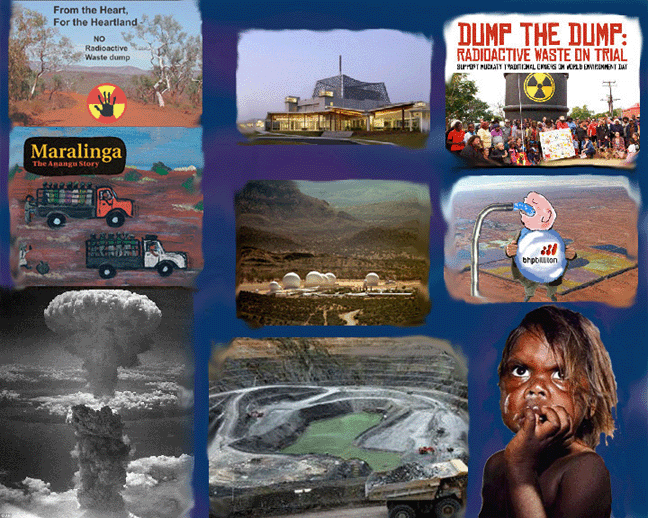
AUSTRALIA DOES NOT NEED TO EXPOSE OURSELVES TO THE DANGERS OF NUCLEAR ENERGY
Interestingly, attitudes to nuclear energy align with attitudes to climate change. Climate change deniers tend to approve of nuclear energy, and oppose renewable energy.
Scientists who accept the reality of climate change and the risks associated with nuclear energy oppose it as a ‘solution’ to the climate.
These are the reasons for retaining our ban on nuclear energy and our focus on clean, cheaper renewable energy:
Nuclear is the most expensive energy option can take decades to build nuclear reactors and would require a decade or more to develop the legislative framework Nuclear is dangerous. Either through human error, disaster, or as a military target the catastrophic consequences of a nuclear disaster would create permanent pollution. Nuclear is unwanted. There is long standing popular opposition to nuclear power in Australia because of the issues above as well as the unsolved problem of nuclear waste and the link to nuclear weapons. Alternatives like renewables, storage and energy efficiency are faster, cheaper, more deployable and enjoy much more public support
The Prime Minister agrees: “Nuclear power has never overcome the dangers that we have seen played out around the world time after time. The arguments against nuclear energy are laid out cogently by Professor Ian Lowe, most recently in Long Half-Life which puns on both the interminable time nuclear remains dangerous in our environment and the steadfast opposition by ideologues to the facts about nuclear energy and its dangers. https://www.aph.gov.au/Parliamentary_Business/Committees/Senate/Environment_and_Communications/Nuclearprohibitions/Submissio
LONDON, April 8 (Xinhua)http://eng.chinamil.com.cn/VOICES/16215442.html The United States, Britain and Australia have been pressing ahead with nuclear submarine cooperation despite being widely questioned, which creates nuclear proliferation risks and undermines the international non-proliferation system, the Chinese Embassy in Britain has said.
In response to a question concerning the trilateral Australia-UK-U.S. (AUKUS) cooperation on nuclear submarines, the embassy said on Friday that such cooperation will exacerbate the resurgence of the Cold War mentality, trigger a new round of arms race, and further provoke regional security and military confrontation, seriously jeopardizing regional peace, stability and prosperity.
The Asia-Pacific is now the most dynamic and fastest growing region in the world, which hasn’t come easily, the embassy said in a press release. “The AUKUS cooperation is designed to serve the U.S. geopolitical agenda to introduce group politics and Cold War confrontation into the Asia-Pacific with military deterrence. It is aimed at creating a NATO-replica in the Asia-Pacific, which runs counter to peace and stability in the region.”
The AUKUS nuclear submarine cooperation marks the first time for nuclear weapon states to transfer naval nuclear propulsion reactors and weapons-grade highly enriched uranium to a non-nuclear weapon state, it noted.
As the current International Atomic Energy Agency (IAEA) safeguards system is incapable of ensuring effective safeguards, such cooperation poses serious nuclear proliferation risks, seriously compromises the authority of the IAEA, and deals a blow to the agency’s safeguards system, the embassy said.
“If the three countries are set on advancing the cooperation, other countries will likely follow suit, eventually leading to the collapse of the international nuclear non-proliferation regime,” it said.
China urges the three countries to heed the call of the international community and regional countries, discard the outdated zero-sum Cold War mentality and narrow geopolitical mindset, earnestly fulfil their international obligations and do more things that are conducive to regional peace, stability, unity and development, the embassy said.
“This serves the fundamental and long-term interests of regional countries as well as the three countries themselves,” it said. “The UK is not a country in the region and it is unwise to overstretch itself.”
https://www.rt.com/news/574018-cia-spies-assange-firm/2 Apr 23, A private contractor installed microphones inside the Ecuadorian Embassy in London where the WikiLeaks co-founder lived, an El Pais investigation has found.
The CIA used private Spanish security company UC Global to secretly install microphones inside the Ecuadorian Embassy in London to monitor WikiLeaks co-founder Julian Assange, El Pais reported on Wednesday, citing the company’s internal communications.
UC Global was hired to provide security for the embassy. Assange, who was granted asylum by Ecuador at the time, resided in the diplomatic compound from 2012 to 2019, before he was forcibly removed by British police. The Spanish company’s alleged links to US intelligence agencies were first reported by El Pais in 2019.
According to the newspaper, UC Global founder and head David Morales first came into contact with the CIA in 2017. Around that time, Morales informed his employees that the company would have to provide a new American client named ‘X’ with remote access to the server that collected the data from the Ecuadorian Embassy in London, which was referred to as the ‘Hotel’.
“Regarding the Hotel work, I would like to offer our information collection and analysis capability to the American client,” Morales wrote in a September 2017 email. “We must… try to make it attractive and easy to interpret.”
The information shared reportedly included profiles of Assange’s visitors, including lawyers and diplomats, as well as cell phone data. Morales was quoted as saying in a chat message that “the people in control are our friends in the USA.”
One of microphones that Morales’ team secretly planted inside the embassy was hidden in the base of a fire extinguisher in order to listen in despite Assange’s habit of using a white noise machine to prevent surveillance, El Pais said. Stickers were attached to window corners to avoid vibrations and allow sound to be recorded through laser microphones. “I know it is of the utmost interest and that the USA wants to do it,” Morales reportedly wrote to his employees.
According to El Pais, UC Global’s work helped Washington foil a plan to sneak Assange out of the embassy in December 2017. Lenin Moreno, Ecuador’s president at the time, allegedly wanted to grant the WikiLeaks co-founder Ecuadorian citizenship and get him out of Britain in a diplomatic car.
Morales’ team reportedly recorded a conversation between Assange and Ecuadorian officials and then quickly sent it to the US. Washington responded by issuing an arrest warrant for Assange to Britain, which apparently prompted organizers to abort the plan.
In 2019, the Spanish authorities launched an investigation into Morales’ company and briefly detained him. He has since been released on bail.
ERA hopes to raise $369 million to continue rehabilitation of Ranger uranium mine in Kakadu The operator of a decommissioned uranium mine in Kakadu National Park is hoping to raise $369 million to continue paying for rehabilitation, with its current funds due to be exhausted by the end of September. Energy Resources Australia (ERA) has been trying to find enough money to return the Ranger uranium mine, 250 kilometres east of Darwin, to its pre-mining state, after operations shut in January 2020.
Senior Labor figures say a decision on where to put a future submarine base on Australia’s east coast is unlikely to be made until after the next federal election, insisting locking in a location is not an immediate government priority.
Key points:
Labor says a decision on where to put a future east-coast submarine base is unlikely to be made before next election
Port Kembla appears to be the preferred option, though residents are wary of becoming a military target
Officials claim they are in no rush and the new base is “not needed” until the 2040’s
Last year former prime minister Scott Morrison announced Port Kembla as one of three potential options for a new naval facility to house Australia’s future nuclear-powered submarines, along with Brisbane and the NSW city of Newcastle.
The AUKUS agreement attempts developments that will shift Australia into a zone that will threaten the existence of Australia itself.
I am not merely thinking of the militarisation of Australia, although that is definitely one likely outcome. I also have in mind our way of life that, while still set in settler-colonial assumptions that give First Nations people no substantial value in Australian society, is relatively relaxed when compared with the way of life of people in the United States. Australia has not experienced the focus upon security that high-powered militarisation associated with nuclear weapons brings. This is the world our leaders are leading us towards.
I want to take up two lines of inquiry into Aukus in this brief article. Firstly AUKUS brings together three Anglo-settled countries – two examples of settler-colonial domination that date back two centuries and more. plus of course the original Anglo-source nation, the United Kingdom. This may seem like an insignificant reference to an aspect of European colonialism that has shaped the whole world for centuries. However, Anglo colonialism has a particular complexion. Here I am drawing in part on the book by James Belich, Replenishing the Earth, about the history of Anglo colonialism. It is well-known these days in anti-colonialism circles that the Anglo slavery pursued in the Caribbean by England was the worst form of slavery, with cruelty on a scale that makes slavery in the United States seem enlightened. Anglo colonialism is typified by relations of difference that deal with colonised peoples with a vengeance. It is noteworthy that Anglo-settled countries like Australia have not at all come to terms with the cultures that pre-existed them. All invading cultures find this difficult, but Anglo-based cultures, as Belich shows, are a special case. It is no coincidence that Adolf Hitler looked with admiration to the United States for its ‘handling’ of its First Nations ‘problem’—a form of extermination of the Native American population—in how to think about the treatment of Jews and Slavs in Europe. Anglo cultures’ commitment to freedom and democracy has a repellent underbelly of racism and cultural suppression, not to mention genocidal elimination.
Significant cultural reform is always difficult but clearly the Anglo-powers have made the decision, at a time when in many respects their backs are up against the wall, to stand and fight—not for their own territory, but against the emergence of China, which was itself on the humiliating receiving end of Anglo colonialism in the nineteenth century. AUKUS in a strong sense is a thumbing of the West’s nose at all the emerging powers in Asia—on racial grounds. They must toe the line.
This is surely a crisis for an Australia seeking in the first half of the twenty-first century to survive in our region. To survive here Australia has to change its spots profoundly. It needs a form of cultural regeneration, in significant combination with Australian First Peoples, to justify its presence outside of the strategies of colonial power. While cultural change is always slow and complex, it is Australia’s only hope of both flourishing and being accepted in this region. It is also crucial because our allies are, in any case falling apart.
While I think the Voice could be the first step towards a significant and substantial change, only a weak version of the Voice, suitable for photo opportunities and feel-good policy, will survive the reassertions of this new Anglo alliance. Australia combines an especially empty form of recognition of First Nations with the arrogance of a superior colonial presence, coloured only a little by multiculturalism, and all this in a region where it has no basic right to exist.
The AUKUS alliance represents an incapacity to flexibly adjust to an emerging situation in which a new world power has emerged, one that will not go away. It is deeply ironic that the United States has fostered this emergence by its global development strategies, just as it fostered its opponents in Afghanistan at an earlier time.
That China is a new superpower is a reality—not that being a superpower is good for China or for us. Like large bureaucracies, superpowers develop self-oriented agendas related to their size, and are not to be trusted. But linking up with the remnants of the old powers to resist emergence means that Australia has resorted to a last gasp Anglo-cultural alliance rather than enter a serious process of rethinking its social composition and its place in the world.
The second line of comment is about nuclear submarines, drawing on a piece that appears in Arena Quarterly, just publishe
I want to take up two lines of inquiry into Aukus in this brief article. Firstly AUKUS brings together three Anglo-settled countries – two examples of settler-colonial domination that date back two centuries and more. plus of course the original Anglo-source nation, the United Kingdom. This may seem like an insignificant reference to an aspect of European colonialism that has shaped the whole world for centuries. However, Anglo colonialism has a particular complexion. Here I am drawing in part on the book by James Belich, Replenishing the Earth, about the history of Anglo colonialism. It is well-known these days in anti-colonialism circles that the Anglo slavery pursued in the Caribbean by England was the worst form of slavery, with cruelty on a scale that makes slavery in the United States seem enlightened. Anglo colonialism is typified by relations of difference that deal with colonised peoples with a vengeance. It is noteworthy that Anglo-settled countries like Australia have not at all come to terms with the cultures that pre-existed them. All invading cultures find this difficult, but Anglo-based cultures, as Belich shows, are a special case. It is no coincidence that Adolf Hitler looked with admiration to the United States for its ‘handling’ of its First Nations ‘problem’—a form of extermination of the Native American population—in how to think about the treatment of Jews and Slavs in Europe. Anglo cultures’ commitment to freedom and democracy has a repellent underbelly of racism and cultural suppression, not to mention genocidal elimination.
Significant cultural reform is always difficult but clearly the Anglo-powers have made the decision, at a time when in many respects their backs are up against the wall, to stand and fight—not for their own territory, but against the emergence of China, which was itself on the humiliating receiving end of Anglo colonialism in the nineteenth century. AUKUS in a strong sense is a thumbing of the West’s nose at all the emerging powers in Asia—on racial grounds. They must toe the line.
This is surely a crisis for an Australia seeking in the first half of the twenty-first century to survive in our region. To survive here Australia has to change its spots profoundly. It needs a form of cultural regeneration, in significant combination with Australian First Peoples, to justify its presence outside of the strategies of colonial power. While cultural change is always slow and complex, it is Australia’s only hope of both flourishing and being accepted in this region. It is also crucial because our allies are, in any case falling apart.
While I think the Voice could be the first step towards a significant and substantial change, only a weak version of the Voice, suitable for photo opportunities and feel-good policy, will survive the reassertions of this new Anglo alliance. Australia combines an especially empty form of recognition of First Nations with the arrogance of a superior colonial presence, coloured only a little by multiculturalism, and all this in a region where it has no basic right to exist.
The AUKUS alliance represents an incapacity to flexibly adjust to an emerging situation in which a new world power has emerged, one that will not go away. It is deeply ironic that the United States has fostered this emergence by its global development strategies, just as it fostered its opponents in Afghanistan at an earlier time.
That China is a new superpower is a reality—not that being a superpower is good for China or for us. Like large bureaucracies, superpowers develop self-oriented agendas related to their size, and are not to be trusted. But linking up with the remnants of the old powers to resist emergence means that Australia has resorted to a last gasp Anglo-cultural alliance rather than enter a serious process of rethinking its social composition and its place in the world.
The second line of comment is about nuclear submarines, drawing on a piece that appears in Arena Quarterly, just published.
The AUKUS strategy seeks to assert massive power, especially surveillance in the Pacific, surrounding China. Nuclear submarines combined with surveillance are the main focus of this attempt to cripple what actually, as I see it, cannot be stopped, in a way similar to Paul Keating’s argument. AUKUS shifts the whole emphasis away from how we protect our independence to what is needed to contain China. For Australia this seems to mean we have to achieve interoperability with US weaponary and systems, with nuclear submarines a key aspect of this. It means Australia must take a first step into adopting nuclear technology, and its consequences. We should not be assured by those who claim that it will be the last step.
Much has been written about the dangers of nuclear power and weapons over the years, to the point where it seems many in the community are now blasé about it—unless radiation waste is to be placed next door to you. Part of what the nuclear industry and its supporters have done is to launch smaller scale tactical nuclear weapons and also small-scale nuclear power plants because both large-scale nuclear weapons and large-scale power plants have unmanageable consequences and poor public acceptance, either because of non-human-scale destruction or ridiculous costs, which only keep escalating.
No one, with the exception of some military strategists, favours nuclear war. The reasons are obvious. The level of destruction of atomic bombs steps beyond our capacity to comprehend: it steps into another realm, a post-human one. Even the seemingly more mundane questions associated with nuclear waste are on another scale because they cannot be effectively disposed. All around the world nuclear waste is piling up around nuclear power stations as well as ‘storage’ of used nuclear submarines components because the waste is not of this world. There is no solution to the waste question. Nuclear waste is killing us on an increasing scale, as exposed by Kate Brown in her book A Manual for Survival. Contrary to the findings of mainstream Western science, she argues that low-level radiation is a mass killer and a general source of ill health As one Russian scientist she quotes puts it: ‘Chronic radiation is a crime’, and chronic radiation is a process that Australia has just signed up for with its nuclear submarines, adding its contribution to the systemic decline of the Earth’s environment, at least one that is suitable for human habitation.
We need to give some focus to this because it is an embarrassment to the nuclear lobby, which they handle and largely get away with by resorting to silence. But nuclear waste is a contradiction that will not go away. All attempts at solutions have failed in every part of the world. This cannot be emphasised enough.
What sort of contradiction is this?
Like nuclear technology, nuclear waste is usually simply regarded as a special category of danger. But its special effects arise out of a social process that is usually ignored. And this is a disaster because that social process is transforming our world in unprecedented ways.
This new world first burst upon us in 1945, with the practical scientific triumph of the atomic bomb. It was not merely novel. It was a consequence of the practical/conceptual reconstructions in the early twentieth century we associate with Albert Einstein and his associates. It was not merely a new theory. It was a combination of abstract academic theory with practical technology in the real world that gave birth to technoscientific society and culture, most importantly through its systematic approach to the transformation of nature. As such, academic theory entered the world of production, as an alternative or supplement to the transformations performed by the working classes, in a way that has expanded exponentially ever since. For better or worse, our world has become increasingly composed socially of the intellectually-trained.
The novelty of nuclear technology is contained within this social approach. Scientific intellectuals now uncover deep levels of the natural world, levels never before encountered by human societies that turn out to be mysterious and unmanageable. Nuclear is not the only example but it is a key one that destroys whatever it touches.
This is the world we are now entering, and doing so with great enthusiasm. It is not only a question of nuclear war. It is just as much one of the levels of security needed when dealing with what we do not know how to control. Nuclear weapons have been ‘controlled’ by such monstrosities as the Cold War and MAD (Mutually Assured Destruction) strategies that give reason a bad name. And low-level radiation has been controlled by denial of any major effects, while the environment of Planet Earth deteriorates. As Brown remarks, ‘Western researchers are discovering, like Soviet scientists before them, that radioactive decay at low doses changes the way cells behave in subtle and life-changing ways’, laying the basis for ‘chronic radiation syndrome’.
AUKUS is a strategy that pursues these outcomes systematically, our leaders planning to leave submarine waste in the desert, once again to be dealt with by First Nations people, now to be permitted by the WA Labor government. Among other things, the crime of chronic radiation poisoning needs to be sheeted home to the powers that be, and in particular now, the Albanese government.
A group of leading defence figures is urging the Albanese government to release a secret report on the national security risks of climate change even though its contents may alarm Australians.
Former Defence Force chief Admiral Chris Barrie said climate change posed a bigger risk to Australia than China’s rapid military build-up, and it was crucial to inform the public about the security implications of warmer temperatures, rising sea levels and increased natural disasters.
Potential impacts included famines caused by global warming, conflicts over access to scarce resources and the mass migration of people to Australia from vulnerable Asia-Pacific nations in the coming decades.
“We are worried about the possible collapse of societies because of starvation, a lack of fresh water and shortages of food supplies,” said Barrie, a member of the Australian Security Leaders Climate Group.
Barrie said he understood the Office of National Intelligence (ONI) had delivered a landmark report on external climate risks to the government in December but a declassified version had not been released to the public.
“I expect it might contain things that are a bit scary, but we’re adults and we are up for it,” he said. “This is about transparency and keeping people informed.”
As the government prepares to spend up to $368 billion on nuclear-powered submarines over the next three decades under the AUKUS pact, Barrie said: “I see climate change as an existential threat.
“It’s a much bigger threat to our national security than a potential fight with China or some other conflagration. Only a nuclear war could be more catastrophic.”
Labor went to last year’s federal election promising to deliver a strategic climate security threat assessment and put ONI director-general Andrew Shearer in charge of the project soon after taking government.
Barrie said famine helped trigger the 1917 Russian Revolution and the phenomenon could recur in other countries in coming decades as a result of global warming.
Australia’s large land mass and relatively small population would make it an attractive destination for people displaced by climate change, he said.
The retired navy officer, who led the Defence Force from 1998 to 2002, said Australians living on flood plains and in bushfire zones should also be informed about the domestic threats posed by climate change, which are believed to be examined in a separate report by the Office of National Intelligence.
Spokespeople for the Office of National Intelligence and the Department of Prime Minister and Cabinet declined to comment on whether a public version of the report, which is based on classified information, would be released.
The Australian Security Leaders Climate Group, which includes retired air vice-marshal John Blackburn and the Department of Defence’s former head of preparedness and mobilisation, Cheryl Durrant, said nations such as the United States and United Kingdom had released public versions of similar reports on the national security risks of climate change.
The federal government had also released declassified reports on threats such as cyberattacks and COVID-19 to help inform the public, they said.
US President Joe Biden’s director of national intelligence, Avril Haines, has described climate change as an urgent national security threat, saying it was likely to increase global political instability in future decades.
Despite insisting that Julian Assange has been held captive for too long, the Albanese Government still won’t intervene while the AUKUS pact keeps us in lockstep with the U.S., writes Dr Binoy Kampmark.
THE SHAM that is the Julian Assange affair, a scandal of monumental proportions connived in by the AUKUS powers, shows no signs of abating. Prior to Prime Minister Anthony Albanese assuming office in Australia, he insisted that the matter dealing with the WikiLeaks publisher would be finally resolved. It had, he asserted, been going on for too long.
Since then, it is very clear, as with all matters regarding U.S. policy, that Australia will, if not agree outright with Washington, adopt a constipated, non-committal position. “Quiet diplomacy” is the official line taken by Albanese and Foreign Minister Penny Wong, a mealy-mouthed formulation deserving of contempt.
‘“Quiet diplomacy” to bring Julian Assange home by the Albanese Government is a policy of nothing. Not one meeting, phone call or letter sent.’
Kellie Tranter, a tireless advocate for Assange, has done sterling work uncovering the nature of that position through Freedom of Information requests over the years:
‘They tell a story – not the whole story – of institutionalised prejudgment, “perceived” rather than “actual” risks and complicity through silence.’
The story is a resoundingly ugly one. It features, for instance, stubbornness on the part of U.S. authorities to even disclose the existence of a process seeking Assange’s extradition from the UK, to the lack of interest on the part of the Australian Government to pursue direct diplomatic and political interventions.
Former Australian Foreign Minister Julie Bishop exemplified that position in signing off on a Ministerial Submission in February 2016 recommending that the Assange case not be resolved; those in Canberra were ‘unable to intervene in the due process of another’s country’s court proceedings or legal matters, and we have full confidence in UK and Swedish judicial systems’. Given the nakedly political nature of the blatant persecution of the WikiLeaks founder, this was a confidence both misplaced and disingenuous.
The same position was adopted by the Australian Government to the United Nations Working Group on Arbitrary Detention (WGAD), which found that same month that Assange had been subject to ‘different forms of deprivation of liberty: initial detention in Wandsworth Prison which was followed by house arrest and his confinement at the Ecuadorean embassy’.
The Working Group further argued that Assange’s ‘safety and physical integrity’ be guaranteed, that ‘his right to freedom of movement’ be respected and that he enjoy the full slew of ‘rights guaranteed by the international norms on detention’.
At the time, such press outlets as The Guardian covered themselves in gangrenous glory in insisting that Assange was not being detained arbitrarily and was merely ducking the authorities in favour of a “publicity stunt”.
The conduct from Bishop and her colleagues did little to challenge such assertions, though the Department of Foreign Affairs and Trade (DFAT) did confirm in communications with Tranter in June 2018 that the Government was ‘committed to engaging in good faith with the United Nations Human Rights Council and its mechanisms, including the Working Group on Arbitrary Detention’. Splendid inertia beckoned.
The new Australian High Commissioner to the United Kingdom, Stephen Smith, has kept up that undistinguished, even disgraceful tradition: he has offered unconvincing, lukewarm support for one of Belmarsh Prison’s most notable detainees. As the ABC reports, he expressed pleasure “that in the course of the next week or so, he’s agreed that I can visit him in Belmarsh Prison”. (This comes with the usual qualification: that up to 40 offers of “consular” support had been previously made and declined by the ungrateful publisher.)
The new High Commissioner is promising little:
“My primary responsibility will be to ensure his health and wellbeing and to inquire as to his state and whether there is anything that we can do, either with respect to prison authorities or to himself to make sure that his health and safety and wellbeing is of the highest order.”
Assange’s health and wellbeing, which has and continues to deteriorate, is a matter of court and common record. No consular visit is needed to confirm that fact. As with his predecessors, Smith is making his own sordid contribution to assuring that the WikiLeaks founder perishes in prison, a victim of ghastly process.
As for what he would be doing to impress the UK to reverse the decision of former Home Secretary Priti Patel to extradite the publisher to the U.S., Smith was painfully predictable:
“It’s not a matter of us lobbying for a particular outcome. It’s a matter of me as the High Commissioner representing to the UK Government as I do, that the view of the Australian Government is twofold. It is: these matters have transpired for too long and need to be brought to a conclusion, and secondly, we want to, and there is no difficulty so far as UK authorities are concerned, we want to discharge our consular obligations.”
Former Australian Senator Rex Patrick summed up the position rather well by declaring that Smith would be far better off, on instructions from Prime Minister Albanese, pressing the current UK Home Secretary Suella Braverman to drop the whole matter. Even better, Albanese might just do the good thing and push U.S. President Joe Biden and his Attorney-General Merrick Garland to end the prosecution.
Little can be expected from the latest announcement. Smith is a man who has made various effusive comments about AUKUS, an absurd, extortionately costly security pact appropriately described as a war-making arrangement. The Albanese Government, having placed Australia ever deeper into the U.S. military orbit, is hardly likely to do much for a publisher who exposed the war crimes and predations of the Imperium.
Even among Australia’s roll call of opinionated former prime ministers, Paul Keating stands out—not least for his unmatched ability to dress down those who oppose him. But few thought he would ever turn this skill on his own political party, the Australian Labor Party, which finally seized government in 2022 after a decade in the wilderness. That was until last week, when Keating publicly condemned the AUKUS defense pact between Australia, the United Kingdom, and the United States and Prime Minister Anthony Albanese for signing it.
That tripartite deal, details of which were announced with fanfare just two days earlier, was “the worst international decision by an Australian Labor government” since conscription was attempted during World War I, Keating said during an appearance at Australia’s National Press Club. The decision to purchase nuclear-powered submarines—at a cost of up to 368 billion Australian dollars ($245 billion)—would invariably draw Australia into any potential conflict between the United States and China, he warned.
No words were minced: “Signing the country up to the foreign proclivities of another country—the United States, with the gormless Brits, in their desperate search for relevance, lunging along behind is not a pretty sight.”
Another former prime minister, Malcolm Turnbull of the Liberal Party, also chimed in with concerns, though he put them slightly more delicately.
…………….Turnbull has questioned whether the use of U.S. submarines—employed as a stopgap until British-designed, Australian-built subs are complete—could compromise Australia’s sovereignty. ……………….
Sam Roggeveen, the director of the international security program at the Sydney-based Lowy Institute, told Foreign Policy that his sovereignty concerns regarding AUKUS stretch beyond personnel. “When you build a weapon system that is almost specifically designed to operate thousands of kilometers to our north, and which is perfectly suited to fighting a military campaign against China,” he said, “then at the final moment when the call comes from the White House—‘Will you take part in this war, or won’t you?’—it will be very difficult, almost impossible, for Australia to say no.”
………… Should this relationship continue to devolve, AUKUS could prove “very dangerous” to Australia, dragging the country into a conflict between the two great powers. Ultimately, more debate was needed about the deal, he said, particularly because Australia will bear all of its cost and risk………………………………………………………….
“Many rank-and-file [Labor] members would and do agree with Keating’s criticism, if not all aspects of his argument,”said Chris Wallace, a political historian and professor at the University of Canberra. And some local branches, the bedrock of the party, have recently been pushing back against the deal.
Similarly, the Nobel Peace Prize-winning International Campaign to Abolish Nuclear Weapons, which was founded in Australia in 2007, warned that AUKUS posed “both a major proliferation risk and could be seen as a precursor to Australia acquiring nuclear weapons.” The organization said the purpose of the submarines was, clearly, “to support the [United States] in a war in northeast Asia. Whether with China, North Korea or Russia, there is an alarming risk of any such war escalating to use of nuclear weapons.”
Recent polling suggests the Australian people may also be coming around to Keating’s point of view. Leading pollster Essential found this month that the public’s belief that AUKUS would make Australia more secure has fallen to just 40 percent, down from 45 percent when the pact was first announced back in 2021. On the question of the nuclear-powered submarines in particular, Essential reported that 55 percent of people surveyed either thought the purchase was unnecessary or too expensive.
…………………………………. “There is no rational basis for the Albanese government facilitating the withering expense of nuclear submarines,” Keating wrote, “other than to suit and comply with the strategic ambitions of the United States—ambitions which slice through Australia’s future in the community of Asia, the basis of our rightful and honourable residency.”
The backlash to the recent announcement, from adversaries and allies alike, Wallace said, should prompt the Albanese government to go back to the drawing board and actually vet whether the deal—including the procurement of submarines powered by weapons-grade uranium—was the best option for Australia. “Instead, the government made the announcement first and expected everyone to back in behind it,” she said. “They were dreaming.”
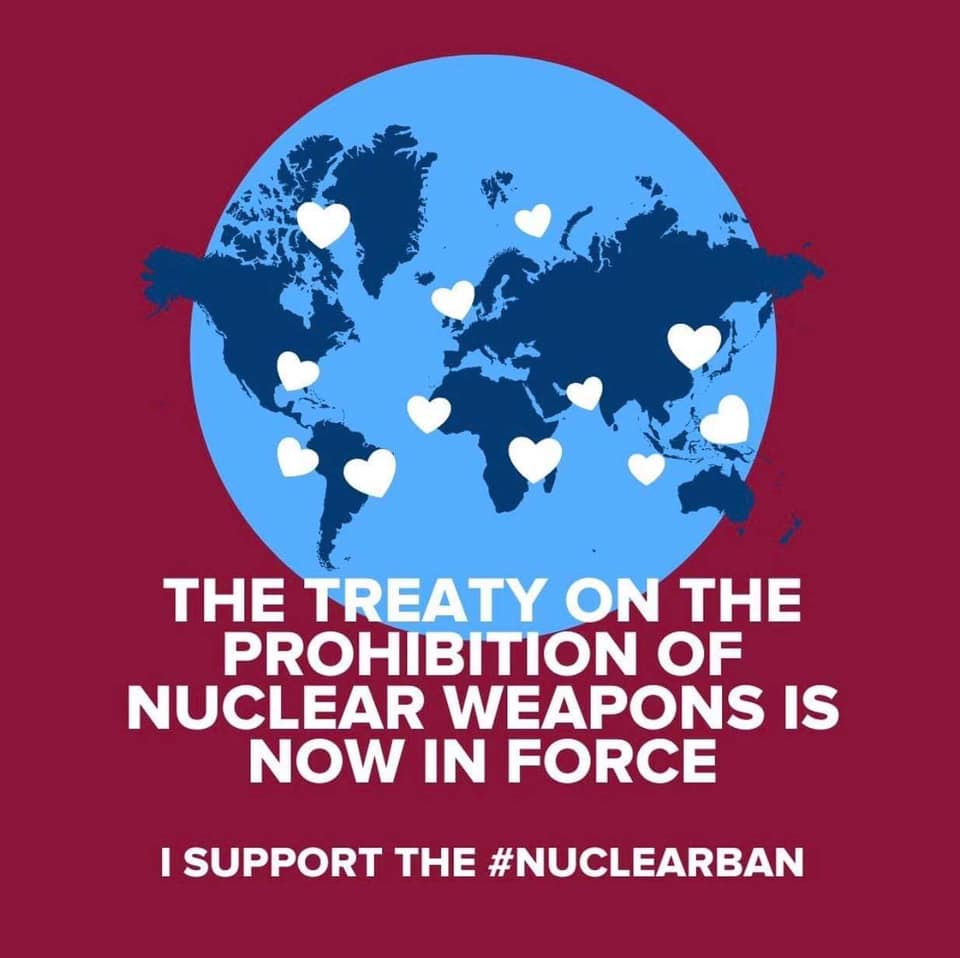
The Albanese government is weighing whether to make a dramatic break with the United States and sign an anti-nuclear weapons treaty that would aggravate Washington and launch a new era in Australian security policy.
Anti-nuclear campaigners are urging the government to join over 90 countries and sign the Treaty on the Prohibition of Nuclear Weapons (TPNW) before the next election, a step that would see Australia abandon a key pillar of the US alliance by removing itself from America’s “nuclear umbrella” in the Asia-Pacific.
Labor’s national platform commits the party to signing and ratifying the treaty – which prohibits member states from participating in any nuclear weapon activities – but only after certain conditions are met.
Prime Minister Anthony Albanese has been a strong supporter of signing the treaty, describing the idea as “Labor at our best”.
The US strongly opposes the treaty and has previously urged friendly nations not to support it, on the grounds it would undermine peace and security.
……………………… A spokeswoman for Foreign Minister Penny Wong said the government will consider the treaty “systematically and methodically as a part of our ambitious agenda to advance nuclear non-proliferation and disarmament”.
“There are a number of complex issues to be considered,” she said.
…………………………………….. Gem Romuld, Australian director of the International Campaign to Abolish Nuclear Weapons, said “if the government is committed to non-proliferation and disarmament, it will sign the TPNW during this term of government”.
“That would be warmly welcomed by countries across the Asia-Pacific, most of which have already signed the treaty, as well as most of the Australian public,” she said.
Romuld acknowledged ratifying the treaty would represent a “big change for Australia, ending a practice we have had in our security policy for a couple of decades” by prohibiting Australia from hosting American assets armed with nuclear weapons, such as B-52 bombers.
………….. Romuld said the AUKUS pact – under which Australia will acquire a fleet of nuclear-powered submarines – does not prevent the government from signing the treaty. “In fact it only underlines the importance of it,” she said.
………………….
Labor MP Josh Wilson, the chair of the joint standing committee on treaties, said the TPNW represented a “much-needed jolt of momentum in the global nuclear disarmament effort”.
Environment and Other Legislation Amendment (Removing Nuclear Energy Prohibitions) Bill 2022 Submission No. 118 (Name Withheld)
Don’t let the nuclear lobbyists scuttle the clean energy movement to line their bottomless pockets
Senate members may not realise that hundreds of submissions to lift the ban on nuclear power in Australia have come from a so-called environmental protection organisation, RePlanet. This group has broadcast a lengthy pre-prepared submission, advising that lodging it (by simply giving a name and an email address) will “help Australia’s federal politicians understand that there is strong public support for lifting the ban on nuclear energy so that it may be used as part of the clean energy transition”.
This lobby group argues that nuclear has the lowest lifecycle environmental impact, provides reliable 24/7 clean energy, has a very small land use footprint, and provides high paying, long term employment. Nothing could be further from the truth, on all counts – including ‘strong public support’.
Nuclear’s environmental impact is horrendous (Three Mile Island, Chernobyl, Windscale, Fukushima). It is demonstrably the dirtiest and most dangerous of all forms of energy. Its land use footprint and the employment it provides are irrelevant – a solar panel on a rooftop has a very small footprint, and projects designed around genuinely clean green energy conversions will provide countless high paying long-term job opportunities.
Please don’t be swayed by the hundreds of submissions from this source. Australians on the whole are moving to renewable energy, voting with their rooftops. RePlanet is trying to infiltrate genuine groups caring for the future of this planet. We succumbed to the oil barons’ promises a hundred years ago, and lost an amazing electric car industry.
How could a conversation between President Biden, PM Albanese and PM Sunak, which he was in just two weeks ago, not be the most important kind of quiet diplomacy to use to free Julian Assange? And why wasn’t it used?
Foreign Affairs Minister Penny Wong has all but confirmed in Parliament the government is doing nothing to bring the world’s foremost political prisoner home. What’s the scam with “quiet diplomacy”?
Despite claiming the government is deploying “quiet diplomacy” to urge the US to free Julian Assange, and despite the government committing to a $368b spend on submarines – the biggest transfer of public money in Australia’s history – to US and UK weapons makers, there is no evidence whatsoever that our elected representatives have even muttered one word on the matter.
Thursday at 2:14 pm, Senator Shoebridge stood up in question time and asked Senator Wong a question about Julian Assange. He asked whether Prime Minster Anthony Albanese had used the opportunity created by the March 14, AUKUS ‘Kabuki Show’ to lobby for the release of Assange.
Senator Wong did all things possible to avoid having to say “no.”
Shoebridge acknowledged the implied “no” when he asked further:
How could a conversation between President Biden, PM Albanese and PM Sunak, which he was in just two weeks ago, not be the most important kind of quiet diplomacy to use to free Julian Assange? And why wasn’t it used?
Wong again ducked and weaved and then said, “We are doing what we can between government and government, but there are limits to what that diplomacy can achieve.”
wo and half hours later, in the last working minute of the day that Parliament was set to rise until May, the Department of Foreign Affairs sent me the response to an FOI request for “all cablegrams sent between the Department of Foreign Affairs and Trade and the Embassy of Australia, Washington DC, since 24 November 2022 that relate to Julian Paul Assange”. They advised:
“Thorough searches conducted by the Consular Operations Branch and the United States, United Kingdom & Canada Branch found no documents.”
The scam is, that while the government purports to be working quietly in background on the release of Julian Assange, the reality is that they are doing nothing.
The sham that is the Assange affair, a scandal of monumental proportions connived in by the AUKUS powers, shows no signs of abating. Prior to Prime Minister Anthony Albanese assuming office in Australia, he insisted that the matter dealing with the WikiLeaks publisher would be finally resolved. It had, he asserted, been going on for too long.
Since then, it is very clear, as with all matters regarding US policy, that Australia will, if not agree outright with Washington, adopt a constipated, non-committal position. “Quiet diplomacy” is the official line taken by Albanese and Australian Foreign Minister Penny Wong, a mealy-mouthed formulation deserving of contempt. As Greens Senator David Shoebridge remarks, “‘quiet diplomacy’ to bring Julian Assange home by the Albanese Government is a policy of nothing. Not one meeting, phone call or letter sent.”
Kellie Tranter, a tireless advocate for Assange, has done sterling work uncovering the nature of that position through Freedom of Information requests over the years. “They tell the story – not the whole story – of institutionalised prejudgment, ‘perceived’ rather than ‘actual’ risks, and complicity through silence.”
The story is a resoundingly ugly one. It features, for instance, stubbornness on the part of US authorities to even disclose the existence of a process seeking Assange’s extradition from the UK, to the lack of interest on the part of the Australian government to pursue direct diplomatic and political interventions
Former Australian Foreign Minister Julie Bishop exemplified that position in signing off on a Ministerial Submission in February 2016 recommending that the Assange case not be resolved; those in Canberra were “unable to intervene in the due process of another’s country’s court proceedings or legal matters, and we have full confidence in UK and Swedish judicial systems.” Given the nakedly political nature of the blatant persecution of the WikiLeaks founder, this was a confidence both misplaced and disingenuous.
The same position was adopted by the Australian government to the United Nations Working Group on Arbitrary Detention (WGAD), which found that same month that Assange had been subject to “different forms of deprivation of liberty: initial detention in Wandsworth prison which was followed by house arrest and his confinement at the Ecuadorean embassy.” The Working Group further argued that Assange’s “safety and physical integrity” be guaranteed, that “his right to freedom of movement” be respected, and that he enjoy the full slew of “rights guaranteed by the international norms on detention.”………………………….
At the time, such press outlets as The Guardian covered themselves in gangrenous glory in insisting that Assange was not being detained arbitrarily and was merely ducking the authorities in favour of a “publicity stunt”………………………………
The new Australian High Commissioner to the United Kingdom, Stephen Smith, has kept up that undistinguished, even disgraceful tradition: he has offered unconvincing, lukewarm support for one of Belmarsh Prison’s most notable detainees. ……………………………………
As with his predecessors, Smith is making his own sordid contribution to assuring that the WikiLeaks founder perishes in prison, a victim of ghastly process.
As for what he would be doing to impress the UK to reverse the decision of former Home Secretary Priti Patel to extradite the publisher to the US, Smith was painfully predictable. “It’s not a matter of us lobbying for a particular outcome. It’s a matter of me as the High Commissioner representing to the UK government as I do, that the view of the Australian government is twofold. It is: these matters have transpired for too long and need to be brought to a conclusion, and secondly, we want to, and there is no difficulty so far as UK authorities are concerned, we want to discharge our consular obligations.”……………………… https://theaimn.com/inglorious-inertia-the-albanese-government-and-julian-assange/
Rep. Rashida Tlaib is collecting signatures on a letter calling on Attorney General Merrick Garland to end the extradition drive against WikiLeaks’ Julian Assange.
REP. RASHIDA TLAIB, D-Mich., is circulating a letter among her House colleagues that calls on the Department of Justice to drop charges against Julian Assange and end its effort to extradite him from his detention in Belmarsh prison in the United Kingdom.
The letter, a copy of which was obtained by The Intercept, is still in the signature-gathering phase and has yet to be sent to Attorney General Merrick Garland.
The Justice Department has charged Assange, the publisher of WikiLeaks, for publishing classified information. The Obama administration had previously decided not to prosecute Assange, concerned with what was dubbed internally as the “New York Times problem.” The Times had partnered with Assange when it came to publishing classified information and itself routinely publishes classified information. Publishing classified information is a violation of the Espionage Act, though it has never been challenged in the Supreme Court, and constitutional experts broadly consider that element of the law to be unconstitutional.
“The Espionage Act, as it’s written, has always been applicable to such a broad range of discussion of important matters, many of which have been wrongly kept secret for a long time, that it should be regarded as unconstitutional,” explained Daniel Ellsberg, the famed civil liberties advocate who leaked the Pentagon Papers.
The Obama administration could not find a way to charge Assange without also implicating standard journalistic practices. The Trump administration, unburdened by such concerns around press freedom, pushed ahead with the indictment and extradition request. The Biden administration, driven by the zealous prosecutor Gordon Kromberg, has aggressively pursued Trump’s prosecution. Assange won a reprieve from extradition in a lower British court but lost at the High Court. He is appealing there as well as to the European Court of Human Rights. Assange’s brother, Gabriel Shipton, who has been campaigning globally for his release, said that Assange’s mental and physical health have deteriorated in the face of the conditions he faces at Belmarsh.
Tlaib, in working to build support, urged her colleagues to put their differences with Assange the individual aside and defend the principle of the free press, enshrined in the Constitution. “I know many of us have very strong feelings about Mr. Assange, but what we think of him and his actions is really besides the point here,” she wrote to her colleagues in early March. “The fact of the matter is that the [way] in which Mr. Assange is being prosecuted under the notoriously undemocratic Espionage Act seriously undermines freedom of the press and the First Amendment.”
Tlaib noted that the Times, The Guardian, El País, Le Monde, and Der Spiegel had put out a joint statement condemning the charges, and alluded to the same problem that gave the Obama administration pause. “The prosecution of Mr. Assange, if successful, not only sets a legal precedent whereby journalists or publishers can be prosecuted, but a political one as well,” she wrote. “In the future, the New York Times or Washington Post could be prosecuted when they publish important stories based on classified information. Or, just as dangerous, they may refrain from publishing such stories for fear of prosecution.”
So far, the letter has collected signatures from Democratic Reps. Jamaal Bowman, Ilhan Omar, and Cori Bush. Rep. Ro Khanna said he had yet to see the letter but added that he has previously said Assange should not be prosecuted because the charges are over-broad and a threat to press freedom. Rep. Pramila Jayapal is not listed as a signee but told a Seattle audience recently she believes the charges should be dropped. A spokesperson for Rep. Alexandria Ocasio-Cortez said that she intends to sign before the letter closes.
Chip Gibbons, policy director for Defending Rights & Dissent, said that the relative silence from Congress on the Assange prosecution has undermined U.S. claims to be defending democracy abroad. “In spite of the rhetoric about opposing authoritarianism and defending democracy and press freedom, we really haven’t seen a comparable outcry from Congress — until now,” said Gibbons, whose organization has launched a petition calling on the Justice Department to drop charges. “Rep. Tlaib’s letter isn’t just a breath of fresh air, it’s extremely important for members of Congress to be raising their voices on this, especially those from the same party of the current administration, at this critical juncture in a case that will determine the future of press freedom in the United States.”
A significant number of Democrats continue to hold a hostile view of Assange……………..
David Noonan will speak on public interest concerns over the new Roxby Downs Indenture Act 2026 on BHP copper-uranium mining and ore processing in SA, and on how AUKUS may face SA with a High-Level nuclear waste agenda.
Dr Jim Green will discuss international developments in the field of nuclear power including ‘small modular reactors’ and Generation 4 ‘advanced’ nuclear reactor concepts.