Greens fear AUKUS overreach as State Development Coordination and Facilitation Bill 2025 passes SA parliament

A new $4m planning office will be granted unprecedented powers, sparking calls to temper the power of the four bureaucrats set to wield them.
Sweeping new powers will be invested in a $4m office to fast track “significant” SA projects including housing and AUKUS – raising fears they could avoid tougher planning checks.
The State Government is planning to appoint four staff to the office, including an AUKUS expert, with unprecedented powers to “case manage” projects.
Premier Peter Malinauskas has flagged this would allow faster approvals in designated “go zones” for projects like the AUKUS nuclear-powered submarines, housing and renewable energy projects.
The move flared concerns about existing heritage, environment, coastal protection and pastoral land act processes being downgraded after the State Development Coordination and Facilitation Bill 2025 passed this week.
Mr Malinauskas previously said the law meant the State Government could designate “state development areas” as “go-zones”.
Regulatory work in these zones would be completed before developers moved in “allowing for quicker approvals within them once an application is made”.
This was meant to save time in passing “urgent and significant projects”.
A government spokesperson assured provisions meant the new office must perform any assessment independently and it could not be directed “by any Minister to either approve or reject any application.”
The office could not deal with nuclear waste projects.
And the Adelaide Parklands was protected by the Adelaide Parklands Act and the new bill states it “may never be designated as a state development area”.
But SA Greens party co-leader Robert Simms was still concerned.
He feared the inclusion of an AUKUS expert meant approvals for the project would bypass usual safety guards.
“SA parliament has just given the Malinauskas Government the biggest blank cheque in South Australian history,” he said.
“This bill gives an unelected office the power to override South Australian laws to enable controversial projects, including AUKUS, yet it passed the Upper House in the blink of an eye.”
“This bill isn’t about facilitating housing developments, it’s about giving the state government the power to ride roughshod over the community. It’s a power grab of epic proportions that should have been given much more scrutiny.”
It was confirmed in the senate the office would cost $4m a year to operate.
State Liberals nuke nuclear promise

The SA Liberals have broken a key election promise with just 10 months to go until the state poll, with Liberal leader Vincent Tarzia dumping his party’s only energy policy.
5 May 25,https://www.premier.sa.gov.au/media-releases/news-items/state-liberals-nuke-nuclear-promise
In a stunning backdown, Mr Tarzia admitted on ABC Radio Adelaide that the Liberals’ election commitment to hold a Royal Commission into nuclear energy would be dumped in the wake of the federal election:
Rory McClaren: That’s what I was going to ask you… should nuclear from a Liberal Party policy perspective now be parked?
Vincent Tarzia: Yes, at the moment it’s been comprehensively rejected and we know the thing is with the energy transition, in three years’ time we will be in another position again.
The State Liberals made the pursuit of nuclear power their top priority, announcing their pursuit of a Royal Commission as their key commitment in their Budget Reply speech in June.
In August, Liberal Leader Vincent Tarzia appointed Stephen Patterson as Shadow Minister for Nuclear Readiness.
Now, just eight months later, the promise has been abandoned.
The 2016 Nuclear Fuel Cycle Royal Commission found nuclear power was not commercially viable in South Australia.
Quotes
Attributable to Tom Koutsantonis
What do the South Australian Liberals stand for?
They’re breaking election promises even before they’ve got to an election.
Only a few months ago, they were making the pursuit of nuclear energy their sole energy policy focus. Now, they’ve dumped it.
Vincent Tarzia must now dump his Shadow Minister for Nuclear Readiness, who has absolutely no policy offering other than the pursuit of an energy source that evidence shows will drive up bills for South Australians.
At a time when the Opposition should be outlining its policy platform ahead of the 2026 State Election, the State Liberals are instead ditching their only energy policy.
Election Lesson: Coalition Must Dump Nuclear Policy

Friends of the Earth Adelaide Federal Election Campaign, Philip White May 5, 2025
Friends of the Earth Adelaide ran a targeted campaign in two marginal seats leading up to the federal election. We created an election leaflet advising voters about the dangers of nuclear power and asking them to “vote nuclear free”.
We are pleased that the Australian people rejected the nuclear option. We hope the Coalition gets the message and dumps its nuclear energy policy and becomes a constructive supporter of real climate action. Let this election mark an end to the climate wars.
Boothby
We delivered 50,000 of our leaflets to the letterboxes of voters in Boothby, a marginal seat in southern Adelaide held by Labor on a 3.3% margin prior to the election. Our aim was to prevent Boothby falling to a pro-nuclear candidate. We are very grateful to a grant from FOE Australia which paid for much of the printing and distribution of 45,000 of the leaflets by Australia Post. The remaining 5,000 leaflets were delivered by hand by our volunteers, who we are also very grateful to. We considered that a good reach of the 80,000 letterboxes in Boothby.
We are very pleased that Boothby was retained by an anti-nuclear candidate (Louise Miller-Frost for Labor, with Joanna Wells of the Greens also doing well). That’s one more seat to keep Australia free from nuclear power. We hope that the large loss the Coalition received means they will drop nuclear power as a policy.
Sturt
In late April a bus load of Traditional Owners from Port Augusta came to the city for a meeting in the marginal eastern Adelaide suburb of Sturt, held by the Liberals on a 0.5% margin prior to the election. Their aim was to appeal to Sturt voters for their support in keeping Port Augusta nuclear free. Friends of the Earth Adelaide co-hosted the meeting along with Don’t Nuke Port Augusta, with financial help from CANA. Traditional Owners spoke strongly of their lives and love for Port Augusta’s land and waterways, and of the tragic intergenerational consequences for their families of the nuclear testing in SA in the 1950s. The meeting was videoed and can be seen at https://www.youtube.com/live/lJ1tpcfkZIU and many great photos are on the Don’t Nuke Port Augusta Facebook page.
The Port Augusta contingent were prominent at the May Day Worker’s Right’s rally the following day. They got a great shoutout from the MC, the SA Unions Secretary, and huge applause and appreciation from the crowd of unionists. Also, that evening, they staged a demonstration at the Arkaba Hotel where Peter Dutton was promoting the Liberal candidate for Sturt. They said, “If Dutton won’t visit us, we’ll come to him.”
Victorian Liberal leader distances state party from Peter Dutton’s nuclear proposal: ‘Our focus is gas’
Brad Battin says he had a conversation with the federal opposition leader about the ‘language’ he would use about plans to build a nuclear reactor in eastern Victoria
Benita Kolovos Victorian state correspondent, https://www.theguardian.com/australia-news/2025/apr/15/victorian-liberal-leader-brad-battin-distances-state-party-from-peter-dutton-nuclear-proposal
The Victorian opposition leader says he discussed the language he would use to distance the state party from the federal Coalition’s campaign to build a nuclear reactor in the Latrobe Valley, telling Peter Dutton “it’s your campaign”.
The Loy Yang coal-fired power station in the Latrobe Valley east of Melbourne is one of seven proposed sites for the federal Coalition’s proposal to build nuclear reactors, the centrepiece energy policy the federal Liberal leader will be taking to the 3 May poll.
But in his first interview with Guardian Australia since becoming the state Liberal leader in December, Brad Battin was clear to separate his team from the proposal, saying: “Our focus is gas, let the feds get on with what they’ve got to get on with.”
He confirmed he had not spoken to anyone in the federal Coalition about its two-and-a-half-year consultation plan for each proposed nuclear site, with the issue “barely raised” at all on the campaign trail.
However, Battin said a conversation had taken place with Dutton and his office about how he would handle questions on the policy.
“I’ve had the conversation with Dutton and his office around what my language is going to be, which is basically saying, ‘We’re happy to have a conversation at the right time. But for us, it’s your campaign at the moment. Our priority, our focus, is on gas,’” he said.
Battin said the federal Coalition would need state parliament to overturn Victoria’s Nuclear Activities (Prohibitions) Act of 1983, which bans the construction and operation of nuclear facilities in the state. Asked if he would be happy with that law being overturned, he said: “I’ll let you know on 4 May.”
Without the support of state parliament, Battin said a Dutton government would face a “difficult process” under section 109 of the constitution, which allows federal law to override state law in the case of conflict.
At his campaign launch on Sunday, Dutton vowed that Australia would become a “nuclear-powered nation” under the Coalition if elected. He said nuclear energy would reduce the need for “sprawling solar and windfarms or laying down 28,000km of transmission lines”.
Battin, however, said most Victorians wanted cheaper energy but “don’t know what the answer to that is yet”.
He said that as existing gas fields in Victoria’s Gippsland and Otway basins continue to deplete, the state should prioritise expanding onshore gas exploration instead.
The comments mark a shift in tone for Battin, who has spent months sticking to a carefully worded position that the Victorian Coalition was open to an “adult conversation” about the policy. He has also repeatedly refused to provide a personal view on nuclear energy.
Response to Submarine Construction Yard Environmental Impact Statement
Friends of the Earth Adelaide 31 Mar 2025
Our submission raised questions about assumptions made about the nuclear submarine agreements:
“The Environmental Impact Statement (EIS) is premised on the assumption that the proposed AUKUS nuclear submarines are in Australia’s strategic interest (pp. 9-10) and South Australia’s economic interests (pp. 12-13). Both these premises are false.
Many highly qualified defence experts argue that nuclear submarines are not in Australia’s strategic interest. [1]
Along with these experts, and retired senior politicians like Paul Keating, Gareth Evans and Malcolm Turnbull, we believe that Australia will be less safe if it acquires nuclear powered submarines. Although it is the federal government that has made this strategic blunder, the EIS should not lend it any credence (as in section 1.5.4).…
AUKUS submarines will also be prejudicial to our economic interest. Some of the abovementioned analysts don’t think Australia will actually ever get the promised nuclear submarines, certainly not in a reasonable time frame. This is a view not restricted to left-leaning people. Conservative commentator Greg Sheridan has criticised AUKUS for this reason.[2]”
[1] Hugh White, “From the submarine to the ridiculous”, The Saturday Paper, 18 September 2021 https://www.thesaturdaypaper.com.au/2021/09/18/the-submarine-the-ridiculous/163188720012499#mtr
Major General Michael G Smith AO (Ret’d), ‘How should Australia defend itself in the 21st century? Silencing the drums and dogs of war’, The New Daily, May 26, 2023 https://thenewdaily.com.au/news/world/2023/05/26/how-should-australia-defend-itself-in-the-21st-century-silencingthe-drums-and-dogs-of-war/
Sam Roggeveen, ‘Spiky questions remain for AUKUS proponents’, Inside Story, 19 March 2024 https://insidestory.org.au/spiky-questions-remain-for-aukus-proponents/[2] Greg Sheridan, ‘Our nuclear subs fantasy adds up to military net zero’, The Australian, 6 October 2021. https://www.theaustralian.com.au/commentary/our-nuclear-subs-fantasy-adds-up-to-military-net-zero/newsstory/cec3b5e94c5bacac405a5eb535b3a628
Read our full submission: 250314AUKUS EIS – FoEAdelaide
Response to Osborne Submarine Construction Yard Strategic Assessment
Friends of the Earth Adelaide 1 April 25
Our recommendations:
1. Correct the factual errors regarding the effects of radiation.
2. Include active commissioning in the assessment.
3. Include the disposal of radioactive waste in the assessment and publish plans for management, storage and disposal of all streams of radioactive waste, including intermediate and high-level waste and spent nuclear fuel.
4. Include a proper analysis of the risks and consequences of incidents and accidents that could lead to a release of radioactive material into the environment.
5. Inform the public about the potential for exposure to radiation and the levels of radiation they could be exposed to.
6. The Commonwealth Government should consult with other levels of government, the Australian Radiation Protection and Nuclear Safety Agency, emergency services and with the general public to develop a response plan for radiological emergencies.
7. Publish the Strategic Assessment Plan before finalizing the Strategic Impact Assessment Report.
Read our full submission: https://adelaidefoe.org/wp-content/uploads/2025/03/250314AUKUS-SIA-FoEAdelaide.pdf
The Lizard’s Revenge
topnrosdeS146ag, https://www.facebook.com/profile.php?id=100064594993745
Anti-nuclear activists target BHP headquarters and block Collins St to mark the 14th anniversary of the Fukushima nuclear disaster.
Just after 10am today around 20 anti-nuclear activists dressed in white radioactive suits used barrels marked with the radioactive symbols and a car decorated with anti-nuclear statements to block the BHP head office. Inside the car a man in his 60s
secured himself to the steering wheel using a bike lock.
The Desert Liberation Front, who organised the protest highlighted the relationship between uranium mined by BHP and the Fukushima disaster:
“BHP makes its billions from destroying the planet and it is not only complicit in Fukushima by supplying the uranium but is part of the push for nuclear power in Australia, a plan that puts all of us and our planet in danger of another Fukushima.”
“The 14th anniversary of the Fukushima nuclear disaster comes at a time in Australia when the Liberal Party is attempting to dress up nuclear power as safe and the Labor Party is continuing with its commitment to AUKUS, a plan that will not only bring nuclear subs to ports around the country but will also result in nuclear waste dumps on sacred land.”
“We call on all political parties and private companies operating in this country to commit to banning the mining of uranium and the banning of all forms of nuclear power, both for weapons of war and as a false alternative to renewable energy.”
What if a Fukushima-sized nuclear accident happened in Australia?
Today is the 14th anniversary of the Fukushima disaster, and this morning the good folks at Don’t Nuke the Climate released a huge research project that shows what a Fukushima-style nuclear disaster would look like if it happened at one of Dutton’s seven proposed reactor sites.
About these maps, https://nuclearplume.au/ 11 Mar 25
The seven sites on this map have been selected by the federal Coalition to house multiple nuclear power reactors.
You can select the reactor site and wind direction to see how a Fukushima-scale nuclear disaster would contaminate different areas surrounding the seven sites in Australia.
The interactive map uses a radiation plume map, originally peer reviewed and published by the European Geosciences Union. It shows the deposition of radioactive caesium-137 from the Fukushima disaster as of July 2011. The darker the shading, the higher the level of radioactive contamination and the higher the radiation exposures for people in those areas. At distances far from the Fukushima plant, radiation exposures were low but even low radiation doses can cause negative health impacts including fatal cancers and cardiovascular disease.
Caesium-137 has been one of the most significant radioactive contaminants since the March 2011 Fukushima disaster but many other types of radioactive particles contaminated wide areas (iodine-131, xenon-133, etc.).
Other radiation fallout maps from the Fukushima disaster can be seen here and here.
Australia’s technocratic drive to nuclear ignorance
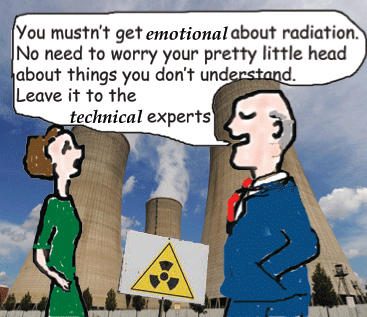
The worshipped role of the expert has excised public debate from nuclear policy. The expert’s validation exonerates the government from the onus of explanation, excluding constituents from relevant information and thus precluding commentary. Nuclear science, a field shrouded in esotericism, marks the summit of techno-scientific rationality, in which utter destruction is intellectually atomised out of politics to the realm of the expert/executive.
ARENA, Sybilla George, 11 Dec 2024
Australia is ‘going nuclear’. The addition of nuclear-powered submarines to Australia’s defence arsenal through the $368 billion AUKUS deal passes a threshold of nuclear legitimisation that Oceania’s anti-nuclear activists have been battling for decades. Nuclearisation used to be an eco-ethical debate, as with the anti- vs pro-uranium mining battles since the 70s that have seen wins and losses on both sides. The rapid increase of Australia’s nuclear involvement, however, signals the reframing of national nuclear rhetoric as techno-scientific rationality that precludes dialogue and authorises executive ruling.
While the AUKUS deal plays out in the limelight, at RAAF Tindal in the Northern Territory the building of facilities to host six United States B-52H Stratofortress bombers on rotational deployment, alongside ‘up to 75’ US Armed Force permanent staff, is underway. The facility renovations are funded through the Force Postures Initiative, the most recent phase of the Force Postures Agreement which since 2014 has defined the United States’s military agenda in Australia, with the consent of successive Australian governments. The Enhanced Air Cooperation branch of the US Alliance was recently ratified when Australian Defence provided ‘air-to-air refuelling’ to B-2 Spirit bombers involved in the US’s October strike on Houthi targets in Yemen.
More than half of the United States’s stock of 76 active B-52 bombers is capable of carrying and deploying nuclear weapons; the remainder is conventionally armed. These jets have been flying over Australian airspace for half a century; however, stationing them at RAAF Tindal signals a significant escalation in nuclear involvement, as it will produce for the first time the conditions ‘to support potential nuclear combat missions from Australian soil’, according to a Nautilus Institute Special Report published in August.
This would be illegal under the United Nations Treaty on the Prohibition of Nuclear Weapons (TPNW), an agreement on which Australia under Labor has abstained since 2022 when it rescinded the Coalition government’s ‘No’ vote. Signing and ratifying the treaty features as a goal in Labor’s 2023 National Platform. Yet progress seems unlikely, given Australia’s third abstention on the TPNW on 1 November 2024 and the persistent silence from the government on the United States’s policy to ‘neither confirm nor deny’ the presence of nuclear arms aboard aircraft or ships. Under this policy, Australia will not be informed whether B-52 bombers on deployment at RAAF Tindal are carrying nuclear weapons.
The public interest in the disclosure of the presence of nuclear weapons includes matters of security, ethics and democratic transparency. Of great concern is the Albanese government’s passive concession to a foreign state’s policy that conflicts with its own commitment to ‘full knowledge and concurrence’ of foreign activities conducted in Australia. Restricted speech has been increasingly utilised as a tactic to expedite pro-nuclear policy in the rush towards technological rationality.
Another example is Albanese’s Nuclear Power Safety Bill, which was rammed through the Senate without debate in October 2024. It stipulates two dumping ‘zones’ for highly irradiated ‘spent nuclear fuel’, to be located within dozens of kilometres of Perth and Adelaide—Western and South Australia being selected once again to play host to nuclear, as during the United Kingdom’s nuclear testing campaign. Indeed, Defence recently withdrew its environmental approval application for developments to prepare HMAS Stirling to host nuclear-powered submarines, and The Australian has reported that the government will resubmit the application with an additional request for the rights to store irradiated waste materials at the facility, which would thus be ‘subject to a single round of community feedback’.
Deferral to the United States’s ‘neither confirm nor deny’ nuclear weapons policy is an appeal to ignorance, and thus innocence, which in turn forecloses systems of accountability, since governments’ denial of information renders their constituents ignorant. The current government’s silence on the presence of nuclear weapons on US aircraft stationed at RAAF Tindal eerily resembles Robert Menzies’ ‘extreme’ commitment to the United Kingdom’s ‘need to know’ policy during the nuclear testing campaign from 1952 to 1963. As prime minister, Menzies exclusively assented without consulting Cabinet or scientific advisers to the use of the Montebello Islands as the site of Operation Hurricane, the nuclear bomb detonation that cemented the United Kingdom as the world’s third nuclear power. The program was not announced until 1952, prior to which Menzies deliberately misled the media about plans for nuclear testing on Australian soil, claiming he had ‘heard nothing’ about it.
The worshipped role of the expert has excised public debate from nuclear policy. The expert’s validation exonerates the government from the onus of explanation, excluding constituents from relevant information and thus precluding commentary. Nuclear science, a field shrouded in esotericism, marks the summit of techno-scientific rationality, in which utter destruction is intellectually atomised out of politics to the realm of the expert/executive.
. The UK nuclear testing campaign caused massive human and ecological suffering to Aboriginal communities in Western and South Australia. It was not until the publication of the 1985 Royal Commission into British Nuclear Tests in Australia, more than two decades after the final tests, that the extent of Australian government collusion was revealed, typified by Menzies’ ‘complete’ acceptance that Australia be entirely excluded from technical information about the tests. This submission to an allied foreign state enacts the technocratic power of nuclear, which pitches influence disproportionally towards those with technical knowledge and renders those without it mute and nakedly vulnerable to, in the case of nuclear arms, annihilation………………………………
The Albanese government’s silence on the presence of nuclear weapons aboard B-52s at RAAF Tindal regurgitates the United States’s policy so as to allow it to skirt its democratic responsibility to inform the public of potential nuclear escalation. Extensive control of messaging and media across the decade-long nuclear testing campaign by Menzies on behalf of the United Kingdom, particularly regarding its true health risks, denied Australians the opportunity to establish informed opinions on the tests. The drive to ignorance common to both Menzies’s and Albanese’s nuclear policy strategies has been achieved via the interiorisation of allied foreign states’ intelligence protocols. This techno-scientific rationale dangerously licences executives to accelerate nuclear proliferation beyond the forum of public debate to which it belongs, and into reality. https://arena.org.au/australias-technocratic-drive-to-nuclear-ignorance/
Coalition trying to brainwash Queenslanders into nuclear

David Wilson, Rothwell, Qld, The Saturday Paper, 8 Feb 25
The Coalition are spending big trying to brainwash Queenslanders into nuclear, and as this letter to the Saturday Paper points out, it contains a lot of misinformation.
“… Selective reasoning
I have just received the Coalition’s A3 double-sided promo arguing the case for nuclear energy. When a political party argues a policy case based on misinformation, suppression of economic and critical science analysis, and contextomy of scientific experts, they go beyond bias and enter the realms of propaganda.
The pamphlet argues we should develop small modular reactors (SMRs) because nuclear generation is common in 32 other countries. It fails to point out that no country has established the cost-benefit of SMRs or operates them commercially.
Furthermore, the 32 countries cited employ large-scale reactors that have achieved cost-benefit only by their economies of scale. SMRs depend on a supply of enriched uranium. While pointing out Australia has uranium, it fails to address the virtual impossibility of enriching it – given the enormous cost of set-up, supply chains, political opposition, and available expertise (Karen Barlow, “Exclusive: Dutton’s nuclear plan requires ‘huge’ new bureaucracy”, February 1-7). Importing enriched uranium will have similar problems and costs.
Former chief scientist Alan Finkel is quoted selectively as a supporter of Coalition policy when in fact his focus is renewable energy and energy storage. Perhaps we can speed up political fact-checking with AI? – …” https://www.thesaturdaypaper.com.au/letters/2025/02/07/selective-reasoning?fbclid=IwY2xjawITiE1leHRuA2FlbQIxMQABHSG1rbvgyOAkw2CIH8F4KBgSOe81fOz4SJAZ8JmjDMZaGceUg1ZguRtGNA_aem_ki4o0GqJqIOC-jNRB_HK8A#mtr
Former US beauty queen and nuclear energy expert Grace Stanke promotes nuclear in WA

“The perception from a lot of the community is they were using beauty to brainwash.”
By Kate Forrester, ABC South West WA
In short:
A campaign by proponents of nuclear have funded former Miss America and engineer Grace Stanke’s pro-nuclear tour of Australia.
Attendees say they had mixed emotions to whether or not the campaign message was what locals needed to hear.
What’s Next?
The tour, funded by Australian electronics mogul, Dick Smith will see the 22-year-old visit locations around Australia over the next week, to advocate for a nuclear future.
Nuclear energy advocates have begun a national tour to win the hearts and minds of coal towns promised nuclear facilities by the opposition.
Last year, federal opposition leader Peter Dutton identified seven sites across the nation to transition coal-fired power stations into nuclear power plants.
The South West town of Collie, 200 kilometres south of Perth, is one of seven sites identified by Mr Dutton.
Collie was the first stop on the campaign, spearheaded by former Miss America and nuclear fuels engineer Grace Stanke…………………………………..
One of the points the American presented to the crowd was jobs being transferable.
“I think for this town specifically, a lot of the skills current coal workers have can translate into a nuclear power plant or multiple power plants,” she said.
Differing opinions
Greg Busson, Secretary of the Mining and Energy Union, went to the meeting on Thursday night.
He disagreed with Ms Stanke’s position on jobs being transferable from coal to nuclear but said hearing another perspective was always worth it. ….majority of the workers I cover in Collie are coal miners. I don’t see where the link is there. They’ve never worked in a powerhouse.
“We don’t mine uranium, so where do those people fit in? What other industries are there that are linked to the nuclear industry that will give those coal workers comfort?”
Mr Busson said, looking around the hall, he thought a lot of the attendees had come from out of town.
“I think part of the problem is they portrayed Grace as a beauty queen, not just as a nuclear engineer,” Mr Busson said.
“The perception from a lot of the community is they were using beauty to brainwash.”…………………………………..more https://www.abc.net.au/news/2025-01-31/former-beauty-queen-grace-stanke-promotes-nuclear-in-wa-/104881056
Sovereignty not worth a nickel?
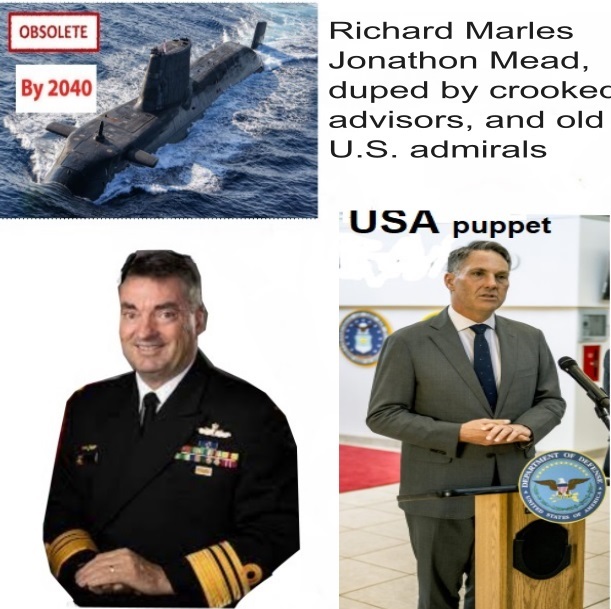
A terse exchange between Greens Senator David Shoebridge and Vice Admiral Jonathan Mead during a Senate Estimates hearing earlier this year revealed that contracts signed by the Australian government that have handed billions of taxpayer dollars to American and British shipyards, supposedly to support the faster delivery of submarines, did not include standard protective clawback provisions.
If we never see a submarine—as is possible—we don’t get any of our billions back.
In influence and dollar terms, foreign-owned companies comprise the vastly dominant proportion of the industrial base, not “part of” it. Research by the Australian Strategic Policy Institute in 2017 showed that the top 15 weapons contractors received 91 per cent of the Department’s expenditure.
A decade of spin from both sides of politics has inured Australians to the stark reality of our loss of independence inside the US alliance. At what cost?
Michelle Fahy, Jan 12, 2025, https://undueinfluence.substack.com/p/sovereignty-not-worth-a-nickel?utm_source=post-email-title&publication_id=297295&post_id=154382292&utm_campaign=email-post-title&isFreemail=true&r=1ise1&triedRedirect=true&utm_medium=emailAustralia’s independence has been dangerously compromised by Labor and Coalition governments, which have signed up to deep-rooted military agreements with the United States of America. These agreements have also underpinned the increasing militarisation of Australia: witness the 2022 speech by Labor’s Richard Marles, the newly appointed deputy prime minister, in Washington DC when he announced that Australian military forces would now become interchangeable with those of the United States.
In August, after this year’s formal annual talks with the United States, Defence Minister Marles announced that the meeting had “built on the last two in seeing a deepening of American force posture in Australia”.
He added: “American force posture now in Australia involves every domain: land, sea, air, cyber and space.”
A decade of spin from both sides of politics has inured us to the stark reality of our loss of independence. Much is made of “defence industry cooperation” with the United States, for example, but this is simply code for the expansion of the US arms industry in Australia in support of its increasing military presence on our soil.
The day before AUKUS was launched in 2021, the US State Department made plain the importance of Australia in supporting America’s military-industrial base:
Australia is one of America’s largest defence customers, supporting thousands of jobs in the United States … The United States is Australia’s defence goods and services partner of choice … the partnership is expected to deepen further over the coming decade, including in the area of defence industry cooperation.
Soon after this statement was published, Marles flew to Washington to endorse its sentiment. He reassured the Americans that when it came to arms production, “our ultimate goal is to supplement and strengthen US industry and supply chains, not compete with them”.
Meanwhile, our much-trumpeted “sovereign defence industrial base” is simply a collection of the world’s top arms multinationals, dominated by the British-owned BAE Systems, the French-owned Thales, and the American-owned Boeing.
Then there is the egregious erosion of Australia’s sovereignty contained within the little-known Force Posture Agreement (FPA) with the United States, which the Abbott Coalition government signed in 2014.
In short, the FPA permits the US to prepare for, launch and control its own military operations from Australian territory.
Yet AUKUS dominates the headlines, even though other decisions by our political leaders that have sold out the public interest have received little coverage in the mainstream media.
A terse exchange between Greens Senator David Shoebridge and Vice Admiral Jonathan Mead during a Senate Estimates hearing earlier this year revealed that contracts signed by the Australian government that have handed billions of taxpayer dollars to American and British shipyards, supposedly to support the faster delivery of submarines, did not include standard protective clawback provisions. If we never see a submarine—as is possible—we don’t get any of our billions back.
The single most important downside of the US alliance, rarely mentioned, is arguably Australia’s military dependence on a foreign power. The Australian Defence Force is critically dependent on US supply and support for the conduct of all operations except those at the lowest level and of the shortest duration.
We were warned about this substantial sacrifice of national freedom of action. In 2001, a Parliamentary Library research paper stated that “it is almost literally true that Australia cannot go to war without the consent and support of the US”.
Foreign-dominated “sovereign” defence industry
Australia’s political and defence hierarchy regularly assert the need to build “a sovereign defence industrial base”. Most people would assume this to mean Australian-owned defence companies, with profits that stay local. This is not what the Defence Department means by it.
The world’s largest weapons companies, including BAE Systems (UK), Thales (France) and US companies Boeing, Lockheed Martin, Raytheon and Northrop Grumman, dominate the local defence industry. Almost all of the top 15 weapons contractors to the Defence Department are foreign-owned. In June 2024, Deputy Secretary Christopher Deeble, the head of the Capability Acquisition and Sustainment Group—the Department’s arms-buying group—explained in a Senate Estimates hearing the government’s definition of “sovereign” in this regard. Deeble agreed with independent senator David Pocock that the local subsidiaries of foreign weapons multinationals, such as Lockheed Martin Australia, were not “sovereign” Australian companies. Nevertheless, he said, the Department considers such foreign-owned subsidiaries to be “part of the sovereign defence industry base here in Australia”.
In influence and dollar terms, foreign-owned companies comprise the vastly dominant proportion of the industrial base, not “part of” it. Research by the Australian Strategic Policy Institute in 2017 showed that the top 15 weapons contractors received 91 per cent of the Department’s expenditure.
Force Posture Agreement
The erosion of Australian sovereignty accelerated in 2011, when Labor prime minister Julia Gillard agreed that up to 2,500 US Marines could be stationed in Darwin on a permanent rotation, and that an increased number of US military aircraft, including long range B-52 bombers, could fly in and out of the Top End and use Australia’s outback bombing ranges.
This agreement was expanded dramatically a few years later by the Force Posture Agreement, which provides the legal basis for an extensive militarisation of Australia by the US, particularly across the Top End.
The tri-nation military pact AUKUS, between Australia, the United Kingdom and the United States, was later negotiated and agreed to, in secret, by the Morrison Coalition government. AUKUS gained bipartisan support within one day of it being revealed to Anthony Albanese’s Labor opposition in September 2021. Among other things, AUKUS, in conjunction with the FPA, ensures that Australia’s navy will be tightly integrated with the US navy for the purpose of fighting China, and that the two navies can operate as one from Australian ports and waters.
Two months after Labor assumed office in May 2022, Marles was in Washington DC announcing that Labor would “continue the ambitious trajectory of its force posture cooperation” with the United States. Australia’s engagement with the US military would “move beyond interoperability to interchangeability” and Australia would “ensure we have all the enablers in place to operate seamlessly together, at speed”.
Non-lethal” F-35 parts
Australia’s newest high-tech major weapons systems make us more reliant than ever on the United States. As veteran journalist Brian Toohey reported in 2020, “The US … denies Australia access to the computer source code essential to operate key electronic components in its ships, planes, missiles, sensors and so on”. This includes the F-35 fighter jets, which both Foreign Minister Penny Wong and Defence Minister Marles have noted form the largest proportion of the air force’s fast jet capacity.
When it agreed to buy Lockheed Martin’s expensive and controversial fifth generation fighter jets, Australia became one of the early members of the F-35 consortium. As part of the deal, Australia negotiated a role for local industry in the F-35 global supply chain. As of June 2024, more than 75 Australian companies had shared in $4.6 billion worth of work, according to the Defence Department.
But there’s been a significant ethical downside. Israel, also a member of the F-35 consortium, is using its F-35s in its war against Gaza. Israel stands accused in the world’s highest court of conducting a genocide in Gaza. Every F-35 built contains Australian parts and components, and for some of these Australia is the sole source.
A senior Defence Department official, Hugh Jeffrey, said in a Senate Estimates hearing in June 2024:
“We are a member of the F-35 consortium [which] exists under a memorandum of understanding … That gives the defence industry opportunity to contribute to that supply chain. It also requires Australia to provide those contributions in good faith…” [emphasis added]
Jeffrey also noted that when assessing any export permit, “we have to have high confidence that, in agreeing to the permit, it’s consistent with our national security requirements and with our international legal obligations”.
What happens if the Department perceives a conflict between Australia’s “national security requirements” and its “international legal obligations”? Is Australia “required” to continue supplying Australian-made arms “in good faith”?
In June, after nine months of spreading disinformation, the Australian government was forced to admit that Australia was still supplying parts and components to the F-35 global supply chain. At the time of writing, the government was allowing this supply to continue despite repeated calls from the UN asking nations—and multinational weapons makers—to cease supplying weapons to Israel, including parts and components, or risk being responsible under international law for serious human rights violations.
Decoded: Defence Department’s deadly deceits
Michelle Fahy, July 10, 2024
Critical Archival Encounters and the Evolving Historiography of the Dismissal of the Whitlam Government (Part 2)

I will never forget the day when I, living in a country area, ran to answer a phone call. It was my mother, in the faraway city. And I’ll never forget her exact words: “The queen’s man has sacked our elected Prime Minister!”
My Mum summed it up. Later, I have realised that this was a case of the UK government toeing the line of the USA government, and making sure that Australia got that USA military intelligence hub, Pine Gap.
January 8, 2025 AIMN Editorial, By Jenny Hocking
Continued from Part 1
After years of legal action, still absent from public view are crucial documents from a most contentious time in British imperial history: the 1947 and 1948 diaries covering the Mountbattens’ shared involvements in pre-Independence India, transition and partition, among “scores of other files” not yet released.
These remain locked away, and Lownie has spent £250,000 of his own funds in pursuit of public access to papers which constituted a purportedly public archive, while the Cabinet office has spent £180,000 keeping them secret. Particularly disquieting is Lownie’s recent claims that he has himself become the target of security surveillance as he continues to pursue the closed Mountbatten files.
Somewhere among those voluminous Mountbatten papers are letters between Mountbatten and the Governor-General, Sir John Kerr, about the dismissal of the Whitlam government. These letters were briefly cited by Mountbatten’s authorised biographer Philip Ziegler in which Mountbatten declared that he “much admired” Kerr’s “courageous and constitutionally correct” action in dismissing Gough Whitlam.
Several years ago, I visited Southampton University hoping to see Mountbatten’s dismissal correspondence with Kerr since, as discussed below, bizarre circumstance means that it no longer exists in Kerr’s papers in the National Archives of Australia. Although Ziegler had been granted access and had quoted from Mountbatten’s congratulatory letter to Kerr, I was denied access to the diaries and letters. Instead, I was handed some thin, rather desultory files containing a handful of itineraries, dinner placements, menus, and invitations to Mountbatten during his visit to Australia. No diaries and certainly no letters between Mountbatten and Kerr.
……………………………In relation to Kerr’s secret correspondence with the Queen, “the Palace letters” regarding the dismissal, it was the use of this uniquely powerful word in the archival lexicon – “personal” – that had placed the letters outside the reach of the Archives Act 1983 and necessitated an arduous Federal Court action to challenge their continued closure. Livsey notes in relation to the migrated Kenyan archive that the construction of “regimes of secrecy” in which the label “personal” was used to control access to and knowledge of British colonial practice; “files labelled ‘Personal’ could be consulted by white British officials only and ‘should not be sighted by local eyes’”…………………..
Lownie’s now four-year legal battle has been described as eerily similar to the Palace letters legal action which I took against the National Archives of Australia in 2016, arguing that the Queen’s correspondence with the Governor-General was not personal, and seeking its release. The case ended in the High Court in 2020 with a resounding 6:1 decision in my favour, the Court ruling that the Palace letters are, as I had argued, not personal and that they are Commonwealth records and come under the open access provisions of the Archives Act. The letters were released in full in July 2020, in a striking rebuff to the claimed convention of royal secrecy on which the Archives had in part relied.
…………………………………….. At its most significant, the denial of access to royal documents as “personal” enables the sophistry that the monarch remains politically neutral at all times to persist……………….
…………Although the Queen was publicly a careful adherent of that core requirement of neutrality, something the “meddling Prince” Charles most assertively was and is not, Hocking argues that “the much vaunted political neutrality is a myth, enabled and perpetuated by secrecy”. Professor Anne Twomey similarly notes that “If neutrality can only be maintained by secrecy, this implies that it does not, in fact, exist”.
Our own history gives us a powerful example of the way in which archival secrecy functions as a Royal protector, casting a veil over breaches of the claimed political neutrality of the Crown, in the changing historiography of the dismissal of the Whitlam government. ……………………….
For decades, the dismissal history was constrained by the impenetrable barrier of “Royal secrecy” which denied us access firstly, to any of Kerr’s correspondence with the Queen, ………………………………………….
Sir John Kerr’s abrupt dismissal, without warning, of the Whitlam government on 11 November 1975 just as Whitlam was to call a half-Senate election, was an unprecedented use of the Governor-General’s reserve powers and “one of the most controversial and tumultuous events in the modern history of the nation”, as the Federal Court described it.
These powers, derived from those of an autocratic Monarch untroubled by parliamentary sovereignty and even less by the electoral expression of the popular will, had not been used in England for nearly two hundred years, and never in Australia…………………………………………………………………. more https://theaimn.net/critical-archival-encounters-and-the-evolving-historiography-of-the-dismissal-of-the-whitlam-government-part-2/
Jenny Hocking is emeritus professor at Monash University, Distinguished Whitlam Fellow at the Whitlam Institute at Western Sydney University and award-winning biographer of Gough Whitlam. Her latest book is The Palace Letters: The Queen, the governor-general, and the plot to dismiss Gough Whitlam. You can follow Jenny on X @palaceletters.
Can true nuclear independence be achieved without ending the US Alliance?
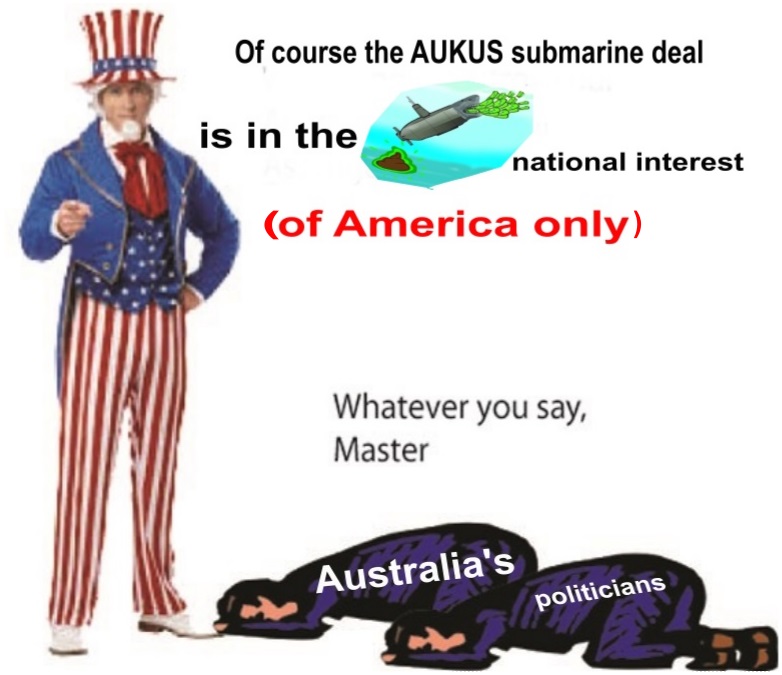
By Donald Wilson, Jan 4, 2025, https://johnmenadue.com/can-true-nuclear-independence-be-achieved-without-ending-the-us-alliance/
Australia’s historical commitment to nuclear disarmament is facing new challenges, as critics say the nation’s alliance with the United States is leading to a conflicted stance on nuclear non-proliferation.
While Australia has actively participated in global nuclear arms control initiatives, such as the Nuclear Non-Proliferation Treaty (NPT) and the Comprehensive Nuclear-Test-Ban Treaty (CTBT), it simultaneously relies on the so-called “US nuclear umbrella” for security. This duality has led to ongoing debate about whether Australia’s security policies align with its disarmament principles.
Australia’s approach to nuclear non-proliferation has shifted over recent years. In 2016, Australia voted against a United Nations General Assembly resolution aimed at creating a legally binding instrument to prohibit nuclear weapons. The following year, it refused to join negotiations that led to the Treaty on the Prohibition of Nuclear Weapons (TPNW). As a result, Australia remains one of the few regional countries not signed onto this treaty, despite a 2018 resolution by the Australian Labor Party to consider joining under a future government.
Critics argue that if Australia were to adopt the TPNW, it would be compelled to prohibit any support for other countries’ nuclear weapons programs—potentially forcing the closure of Pine Gap, a key joint defence facility with the US. Yet government supporters claim that distancing from the US would leave Australia vulnerable, especially amid regional tensions with China.
However, questions have arisen about the reliability of this “nuclear umbrella.” Currently, US military systems, including missile defence, offer limited protection against intercontinental ballistic missiles (ICBMs). After investing over $400 billion in missile defence research and development, no system has yet achieved dependable protection against ICBMs. Critics argue this leaves Australia exposed rather than safeguarded, despite assurances from the US.
In addition, Australia’s recent defence agreements, particularly the AUKUS pact and the US-Australia Force Posture Agreement (FPA), have raised concerns over sovereignty. Signed in 2014, the FPA allows the US to store and control defence equipment on Australian soil. According to Article VII of the agreement, the US retains “exclusive control” over its prepositioned military supplies in Australia, with full ownership rights, effectively restricting Australian authority over the use of these materials.
Article XII of the FPA states that US government vehicles, aircraft, and vessels are exempt from inspection by Australian authorities without US consent. This clause has fuelled arguments that the FPA has compromised Australia’s independence by allowing the US to make defence decisions within Australian borders. For instance, US B2 bombers have launched from Australian bases in operations overseas, reportedly without consulting the Australian public.
As Australia contemplates its nuclear policy, the debate over whether it can maintain both its alliance with the United States and a commitment to nuclear non-proliferation will likely intensify. This complex question has implications not only for Australia’s defence but also for its sovereignty and international standing in the movement toward nuclear disarmament.
‘Don’t want nuclear power’: Wild scenes as protestors storm Perth’s CBD during inquiry into nuclear energy.
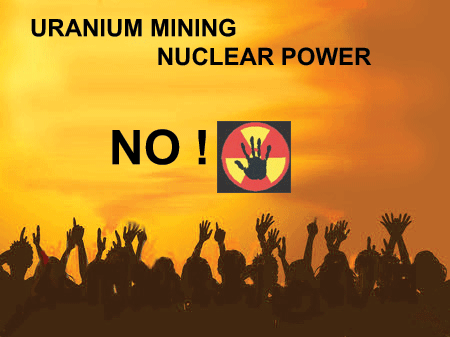
Wild scenes have erupted in one Aussie city’s CBD as protestors stormed the area during an inquiry into nuclear energy – with one protest leader calling it a “front” for the “fossil fuel industry”.
Emma Kirk, news.com.au December 18, 2024 -NewsWire
Wild scenes have erupted in Perth’s CBD after protestors attempted to crash an inquiry into nuclear power being held in the city.
Members from Nuclear Free WA, community groups and the public provided evidence to the inquiry on Tuesday, but it was not open to everyone.
Nuclear Free WA convener Liam Lilly said the Perth protest was an opportunity for people who could not attend the inquiry to have their voices heard in opposition to nuclear power in Australia.
Protestors were allegedly blocked from entering an inquiry held in the southwest town of Collie earlier this year, where a nuclear energy power station has been proposed.
Mr Lilly said it showed how much of a democratic process and the type of democratic values the proponents of the proposal were trying to push.
“They are just trying to bury opposition to these proposals and not have a fair democratic process in that regard,” he said.
“We do not want nuclear power in WA, we have better options in renewables.
“We also have great concerns about the longevity of waste products which remain radioactive for tens of thousands of years, if not hundred thousands.
“Unfortunately, the Coalition want to go ahead with nuclear.” Mr Lilly said in the time it would take Australia to move towards nuclear energy the climate crisis would be exacerbated.
“This is just a front for the coalition to extend the life of the fossil fuel industry,” he said……………………………………..
Climate Change and Energy Minister Chris Bowen said Australia needed new, cheap power now, not expensive power in 20 years.
“Ageing, expensive and unreliable coal plants are closing and we have to fill the gap. Dutton’s nuclear scheme would have us short on power for two decades – a sure-fire recipe for rolling and expensive blackouts,” he said. https://www.news.com.au/national/western-australia/dont-want-nuclear-power-wild-scenes-as-protestors-storm-perths-cbd-during-inquiry-into-nuclear-energy/news-story/4ac311659be07d70160723983dc08b0b
1 This month
17 October, Free Public Talk on Nuclear Issues in South Australia
David Noonan will speak on public interest concerns over the new Roxby Downs Indenture Act 2026 on BHP copper-uranium mining and ore processing in SA, and on how AUKUS may face SA with a High-Level nuclear waste agenda.
Dr Jim Green will discuss international developments in the field of nuclear power including ‘small modular reactors’ and Generation 4 ‘advanced’ nuclear reactor concepts.


Help Aunty Sue Protect Her Land and Sacred Sites From Destructive Rocket Testing.
.
Australians deserve the truth
about
AUKUS – https://aukuspublicinquiry.com/

PETITION – To: Prime Minister Anthony Albanese and the Australian Labor Government

of the week – Australians for War Powers Reform (AWPR)
To see nuclear-related stories in greater depth and intensity

