How anger at Australia’s rollout of renewables is being hijacked by a new pro-nuclear network

Facebook groups opposing renewables projects are now increasingly full of pro-nuclear content, and groups such as Nuclear for Australia have set up dedicated social media accounts targeting specific sections of the community – such as an Instagram account titled “Mums for Nuclear” – as they gear up for the election campaign.
Facebook groups opposing renewables projects are now increasingly full of pro-nuclear content, and groups such as Nuclear for Australia have set up dedicated social media accounts targeting specific sections of the community – such as an Instagram account titled “Mums for Nuclear” – as they gear up for the election campaign.
An alliance of political groups is harnessing real fears about the local impact of wind and solar farms – and using them to spruik nuclear power.
By Ariel Bogle and Graham Readfearn
The entrance is marked by an AI-generated image of a dead whale, floating among wind turbines. On the first floor of the East Maitland bowling club, dire warnings are being shared about how offshore wind may impact the Hunter region – alongside a feeling of not being consulted, of being steamrolled.
“Environment and energy forums” like this one in late November have been held up and down the east of Australia, aiming to build a resistance to the country’s renewable energy transition.
Today’s event is being cohosted by No Offshore Turbines Port Stephens (NOTPS) and the National Rational Energy Network (NREN), a group with informal National party links that was behind February’s Reckless Renewables rally in Canberra. The advocacy group Nuclear for Australia is also here.
“We’re not a political group,” the NOTPS secretary and a Port Stephens resident, Leonie Hamilton, tells Guardian Australia.
“We’re not there to push [politicians] into parliament, but we are going to listen to what they have to say.”
Hamilton says she’s undecided on the issue of nuclear power.
The coastline of the Hunter was declared a potential area for offshore wind in mid-2023 after “extensive community consultation”, according to the federal government. But some, such as NOTPS’ Ben Abbott, are still angry about a perceived lack of detail about the project.
Today’s forum is about raising awareness across the Hunter, Hamilton says. “We think it’s important it happens before the election, so that people understand what the costs are.
“[The coast] belongs to everyone and they should have the opportunity to understand what’s going on.”
There are local groups like NOTPS around Australia that want their broad concerns about the rollout of renewable energy to be heard but say they do not want to be used for a political agenda and do not advocate for particular energy sources.
But working alongside those groups is an increasingly coordinated alliance of conservative thinktanks, political lobby groups and politicians who are flatly opposed to the clean energy transition.
Fears about the environmental and social impact of renewables projects are finding purchase in an information gap critics say has been ceded by the government, the industry and environmental groups – and there are plenty of interested parties willing to step in.
An earlier NREN event in Sydney was sponsored by the Institute of Public Affairs.
Sandra Bourke, a cohost of the Maitland event, is an NREN member but also a spokesperson for the conservative lobby group Advance – which was a key player in the defeat of the Indigenous voice to parliament and is now fundraising on a “lies of renewables” campaign.
A Facebook account under Bourke’s name is present in almost 20 community Facebook groups and pages opposing renewable projects, from Kilkivan, Queensland, to Bunbury, Western Australia, regularly sharing Advance clips and links to Sky News.
The upcoming election is a “crossroads”, she tells the crowd, while declining an interview with Guardian Australia. There’s an Advance sign-up form on every seat.
Up the back of the room are “Where’s Meryl?” posters, referring to the Labor incumbent MP Meryl Swanson, who holds the local electorate of Paterson.
The Liberal candidate Laurence Antcliff is here, along with three men in T-shirts bearing his name. He tells the room he is opposed to the offshore wind project in Port Stephens and will “fight every single day” to ensure it does not go ahead.
Swanson, who has said “many, many meetings” were held with local groups about the proposal, was not invited.
The nuclear energy wedge
In June the Coalition announced it would lift the bans on nuclear energy if it won next year’s election, then build nine publicly owned reactors at sites around the country.
The announcement gave extra fodder to advocacy groups and conservative thinktanks that have long opposed the shift to renewables.
Last week the opposition leader, Peter Dutton, appeared in Port Stephens alongside Antcliff. “It’s in this community’s best interest that [the windfarm] project does not proceed,” he said, as he spruiked the alternative of nuclear power.
Facebook groups opposing renewables projects are now increasingly full of pro-nuclear content, and groups such as Nuclear for Australia have set up dedicated social media accounts targeting specific sections of the community – such as an Instagram account titled “Mums for Nuclear” – as they gear up for the election campaign.
A new report looking at the pro-nuclear information ecosystem, funded by the progressive campaign group GetUp, found a “likely-coordinated and sophisticated ecosystem” of thinktanks, not-for-profits and political operatives engaged in pro-nuclear messaging.
For these interests, the focus on nuclear energy is a chance to “present a solutions-based response to climate change, and divert attention from their pro-coal and gas positions”, the report concluded.
“Nuclear energy provides a wedge for the environmental movement, climate independents, the Labor party and Greens, because it stokes division and can bog them down in technical explanations of why nuclear is neither desirable nor viable in Australia.”
Ed Coper, who is the chief executive of the communications agency Populares and has worked on teal campaigns, says the volume of noisy opposition to renewables is disproportionate to community attitudes. Nevertheless, he predicts nuclear will be an effective election campaign wedge.
For parties opposed to the clean energy transition, this is an opportunity to “peel off” environmental support from renewables support. The message to this cohort is broadly that “renewable energy generation is ruining pristine farming land and is not a good use of land and destroys the habitats of protected species and pristine views”, he says.
“That gives [the Coalition] a whole new constituency. If Labor goes into the election assuming everyone is against nuclear energy, they’ll be in for a shock.
“Energy transition requires an enormous amount of social licence.”
Solar plans discovered by chance
About 200km north-east of Melbourne, John Conroy and his family have been producing beef in Bobinawarrah since the 1960s. In a neighbouring paddock are plans for the large Meadow Creek solar farm and battery – plans he discovered by chance in September 2022 after a visit from the electricity distribution company AusNet.
“We alerted the community,” he says. “The project had been in the process for 12 months before we even knew about it
He says the main concerns of the community surround fire risk – both from the project but also the liability of landholders if fires on their properties spread to the solar farm.
In April the Victorian government removed the rights of landholders to appeal against planning decisions made on renewables projects.
“That is a real slap in the face,” Conroy says. “We’re a community of working-class people, producing food, doing our best to keep footy clubs going, and then the government takes away your rights to have a say.”
The independent federal MP for Indi, Helen Haines, says questions about insurance liability “should have been answered long ago”.
“We should be having these conversations long before a project is up for a planning permit.”
Families like the Conroys in her electorate are spending hundreds of hours getting across technical details of projects and government rules. “It shouldn’t be that way,” she says.
Haines says communities are operating in a “vacuum” and she wants to see information hubs in regional centres where people can go for trusted information and support.
The MP, with Senator David Pocock, last year successfully pushed for a government review into the way communities were being asked to host major renewables projects.
More than 700 people attended 75 meetings, with the review making nine recommendations the government said it would implement in collaboration with the states.
Governments needed to allow only reputable developers to build projects, the review said, and zones should be identified to avoid projects targeting inappropriate land areas.
“There is pushback – this is real and the concerns that communities have are existential,” Haines says. “We have to stop trying to generate social licence after a decision has been made.”
Instead, she says, the transformation should be about regional development and making sure communities have genuine long-term benefits from any projects.
“I want to look back and see better roads, better healthcare and internet, better childcare services, and see that the renewable energy transformation helped us get there. But communities are just not seeing that.”
Locals want ‘some control and influence’
“The fundamental issue here is there’s an assumption that there is no time to properly talk to people and give them not just a tokenistic say, but give them some control and influence in managing their local environment,” says Georgina Woods, who has 25 years of climate change activism and advocacy behind her.
Woods is head of research and investigations at the campaign group Lock the Gate, an organisation that emerged from the unrest among farmers and landholders at the coal seam gas boom in Queensland in the 2000s.
Governments have failed to clearly articulate why the transformation is needed and the urgency of climate action, she says. “We are getting further away from a broad consensus on why these projects are being done in the first place.”
“Until we put people and landscapes and nature at the centre, we’re at risk of repeating the same mistakes with renewable energy that we made with mining.”
West of the Blue Mountains in New South Wales are the gently rolling hills of Oberon. Outside town are plans for a 250-turbine windfarm on pine plantations owned by the state government.
Chris Muldoon, a committee member of Oberon Against Wind Towers, says that would mean local landholders would miss out on any financial benefits of hosting turbines while the town would have to live with the sight of turbines almost 300 metres tall in an area known for its postcard aesthetic.
“They’re chasing the wind and the towers, but there’s no consideration of the economic or social impact,” says Muldoon, who manages Mayfield Garden in Oberon, a tourist attraction owned by the wealthy Sydney-based businessman Garrick Hawkins.
Hawkins has contributed to the campaign to block the windfarm, says Muldoon, as have many locals.
In September the group put up nine candidates for the Oberon council elections, with two elected. Their pitch was uncompromising. “Oberon First are the only candidates who have committed to slamming the door in the face of greedy, arrogant wind tower developers,” the group said.
Oberon has a lot of hobby farmers and second homes for people in Sydney, says Muldoon, which means they have “city skills” that have mobilised against the development, something other communities do not have.
The group is not against windfarms or renewable energy, insists Muldoon, but “you just need to make less invasive decisions about the rollout”.
He points to people living in renewable energy zones, where surveys have shown broad support among farmers for renewables projects.
Outside those areas, he says, projects often come as a surprise to communities that are ill-prepared to navigate the technicalities of dealing with planning regulations, or wading through environmental impact statements “that can be 1,000 pages long”.
“Outside the renewable energy zones, the framework isn’t working,” he says. “It’s the wild west.”
Oberon is in the federal electorate of Calare, where the independent Kate Hook is trying to unseat Andrew Gee, who quit the Nationals to sit on the crossbench in 2022 over the party’s opposition to an Indigenous voice to parliament.
Hook left her job in September working for a not-for-profit to help communities negotiate with governments and renewable energy companies to get the most benefit from projects.
She says the “missing piece” causing communities to push back is a lack of understanding of why the transition away from fossil fuels is needed and how it could benefit them.
“People shouldn’t have to rely on Google, but this is why people are anxious,” she says. “There’s a tsunami of misinformation.”
“People might not like the look of windfarms, but do they want farmers to be able to stay on their land? Because these projects can help them do that.
“What we need is discussion, not division.”
A spokesperson for the climate change and energy minister, Chris Bowen, said the government was “working with local communities to secure regional jobs and provide energy security”.
“Unfortunately, the former Coalition government spent 10 years failing to make the necessary reforms to improve community engagement in a rapidly changing energy market,” she said.
The government was implementing the community engagement review “to enhance community support and ensure that electricity transmission and renewable energy developments deliver for communities, landholders and traditional owners”.
The question of nuclear in Australia’s electricity sector

https://www.csiro.au/en/news/All/Articles/2024/December/Nuclear-explainer 9 Dec 24
In Australia’s transition to net zero emissions, the electricity sector has a major role to play. But does nuclear power have a place in our future grid?
Key points
While nuclear technologies have a long operational life, this factor provides no unique cost advantage over shorter-lived technologies.
Nuclear power does not currently provide the most cost competitive solution for low emission electricity in Australia.
Long development lead times mean nuclear won’t be able to make a significant contribution to achieving net zero emissions by 2050.
This explainer was updated on 09 December 2024 to reflect costings included in the draft GenCost 2024-25 Report.
As Australia works towards emissions reduction targets in the transition to net zero, we know the electricity sector has a major role to play. We also know it makes sense to assess a full range of technologies: some new and emerging, some established and proven.
In this context some proponents want nuclear to be considered as an option for decarbonising the electricity sector.
Despite nuclear power being a component of electricity generation for 16 per cent of the world’s countries, it does not currently represent a timely or efficient solution for meeting Australia’s net zero target.
Here’s why:
- Nuclear is not economically competitive with solar PV and wind and the total development time in Australia for large or small-scale nuclear is at least 15 years.
- Small modular reactors (SMRs) are potentially faster to build but are commercially immature at present.
- The total development lead time needed for nuclear means it cannot play a major role in electricity sector emission abatement, which is more urgent than abatement in other sectors.
Understanding GenCost calculations
GenCost is a leading economic report by CSIRO in collaboration with the Australian Energy Market Operator (AEMO) to estimate the cost of building future electricity generation and storage, as well as hydrogen production in Australia.
It is a policy and technology neutral report and the annual process involves close collaboration with electricity industry experts. There are opportunities for stakeholders to provide pre-publication feedback, ensuring the accuracy of available evidence.
Paul Graham, our Chief Energy Economist and lead author of the report, said GenCost is an open and public process.
“The report’s data is not just for AEMO planning and forecasting; it’s also used by government policymakers and electricity strategists who require a clear, simple metric to inform their decisions,” Paul said.
“To facilitate a straightforward comparison across different technologies, the GenCost report conducts a levelised cost of electricity analysis. This method calculates a dollar cost per megawatt hour (MWh) over the economic life of the asset, incorporating initial capital expenses and any ongoing fuel, operation, and maintenance costs.”
The draft GenCost 2024-25 Report released on 09 December 2024 found renewables continue to have the lowest cost range of any new build electricity generation technologies.
[Excellent table here -on original]
One of the factors that impacts the high and low cost range is the capacity factor. The capacity factor is the percentage of time on average that the technology generates to its full capacity throughout the year. Costs are lowest if technologies. such as nuclear, can operate at full capacity for as long as possible so they have more generation revenue over which to recover their capital costs.
Nuclear technology is capable of high capacity factor operation but globally its capacity factor ranges from below 60% to above 90% with an average of 80%. Australia operates a similar steam turbine based technology in coal generation for which the average capacity factor over the last decade was 59% with a maximum of 89%.
The shape of the electricity load and competition from other sources is very different between countries and so our preference is to always use Australian data where it is available. Consequently, we apply the historical coal capacity factors when considering the potential future capacity factors of Australian nuclear generation.
Capital cost assumptions
While nuclear generation is well established globally, it has never been deployed in Australia.
Applying overseas costs to large-scale nuclear projects in Australia is not straightforward due to significant variations in labour costs, workforce expertise, governance and standards. As a result, the source country for large-scale nuclear data must be carefully selected.
GenCost estimates of the cost large-scale nuclear are based on South Korea’s successful continuous nuclear building program and adjusted for differences in Australian and South Korean deployment costs by investigating the ratio of new coal generation costs in each country.
The large-scale nuclear costs it reported could only be achieved if Australia commits to a continuous building program, following the construction of an initial higher-cost unit or units. Initial units of all first-of-a-kind technologies in Australia are expected to be impacted by higher costs. A first-of-a-kind cost premium of up to 100 per cent cannot be ruled out. These assumptions remain for the draft GenCost 2024-25 Report.
Life of the investment
GenCost recognises the difference between the period over which the capital cost is recovered (the economic life) and operational life of an asset.
GenCost assumes a 30-year economic life for large-scale nuclear plants, even though they can operate for a longer period. It is standard practice in private financing that the capital recovery period for an asset is less than its full operational life, similar to a car or house loan. For power stations, warranties expire and refurbishment costs may begin to fall around the 30-year mark. As a result, we use a 30-year lifespan in our cost calculations.
After the final GenCost 23-24 Report was released in May 2024, nuclear proponents clarified they will seek to achieve longer capital recovery periods, closer to the operational life, by using public financing to realise potential cost advantages.
The draft GenCost 2024-25 Report has calculated those cost advantages for the first time (using a 60-year period), finding that there are no unique cost advantages arising from nuclear technology’s long operational life. Similar cost savings are achievable from shorter-lived technologies, even accounting for the fact that shorter lived technologies need to be built twice. This is because shorter-lived technologies such as solar PV and wind are typically available at a lower cost over time, making the second build less costly.
The lack of an economic advantage for long-lived nuclear is due to substantial nuclear refurbishment costs to achieve long operational life safely. Without new investment it cannot achieve long operational life. Also, because of the long lead time in nuclear deployment, cost reductions in the second half of their operational life are not available until around 45 years into the future, significantly reducing their value to consumers compared to other options.
Current figures for Small Modular Reactors (SMRs)
The Carbon Free Power Project was a nuclear SMR project in the United States established in 2015 and planned for full operation by 2030. It was the first project to receive design certification from the Nuclear Regulatory Commission, an essential step before construction can commence. In November 2023, the project was cancelled following a 56 per cent increase in reported costs.
Despite being cancelled, this project was the first and currently remains the only project to have provided cost estimates for a real commercial venture with detailed data. Until now, most sources were for theoretical projects only.
“The main area of uncertainty with nuclear SMR has been around capital costs,” Paul said.
“The Carbon Free Power Project provided more confidence about the capital costs of nuclear SMR and the data confirms it is currently a very high-cost technology.”
“We don’t disagree with the principle of SMRs. They attempt to speed up the building process of nuclear plants using standardised components in a modular system and may achieve cost reductions over time. However, the lack of commercial deployment has meant that these potential savings are not yet verified or realised,” Paul said.
Time is running out for the energy transition
Nuclear power has an empty development pipeline in Australia. Given the state and federal legal restrictions, this is not surprising.
But even if nuclear power was more economically feasible, its slow construction and its additional pre-construction steps, particularly around safety and security, limit its potential to play a serious role in reducing emissions within the required timeframe.
In the last five years, the global median construction time for nuclear has been 8.2 years. Furthermore, in the last ten years, no country with a similar level of democracy to Australia have been able to complete construction in less than 10 years. Overall, it will take at least 15 years before first nuclear generation could be achieved in Australia.
“The electricity sector is one of our largest sources of emissions and delaying the transition will make the cost of addressing climate change higher for all Australians,” Paul said
The electricity sector must rapidly lead the transition to net zero, so other sectors like transport, building and manufacturing can adopt electrification and cut their emissions.”
Nuclear energy inquiry draws emotional response in Port Augusta

By Annabel Francis and Arj Ganesan, ABC North and West SA, 7 Dec 24
In short:
The select committee conducting an inquiry into nuclear power generation in Australia has triggered strong opinions from both sides of the fence.
Aboriginal leaders, resident representatives, and leaders from the mining and energy sector have spoken during a hearing at Port Augusta.
What’s next?
Should the opposition win the next election, it has promised to hold a two-and-a-half year consultation period over its nuclear plans.
The federal government’s select committee inquiry into nuclear power generation at Port Augusta has stirred strong emotions among those making a submission.
For anti-nuclear activist and Yankunytjatjara Anangu woman Karina Lester, it is a debate she is tired of having.
“Governments change, committee members change … organisations, company members, CEOs of companies change,” Ms Lester said.
“Those of us that are in the frontline are constantly needing to remind governments of the impacts of nuclear in our communities.
“Aboriginal people of South Australia have always said no to nuclear.”
Ms Lester, who gave evidence at a select committee hearing in Adelaide, describes herself as a survivor of the Emu Field nuclear tests.
She said Indigenous people had seen the impacts of nuclear technology first-hand.
Her father, Yami Lester, went blind at the age of 16 following British weapons testing in Maralinga in South Australia in the 1950s.
Ms Lester said she feared Indigenous groups would suffer if the federal opposition’s nuclear plans went ahead.
“Aboriginal communities are always the solution or pressured to be the solution for the waste issues,” she said.
“The history shows us that locations identified are locations that are First Nations or Aboriginal people’s traditional lands.”
Port Augusta’s former coal power station was one of seven sites that was earmarked as a possible location for the opposition’s nuclear energy plan.
The Nukunu Wapma Thura Aboriginal Corporation, which holds native title over the proposed site, has voiced strong opposition to any nuclear proposal.
“Aboriginal people throughout the region and state of South Australia have historically and overwhelmingly opposed nuclear energy, and the storage of its waste,” a spokesperson said.
Greg Bannon from the Flinders Local Action Group gave evidence at the public hearing in Port Augusta about the potential risk of a nuclear accident.
He has opposed nuclear technology for decades and said the time to switch to nuclear energy had passed. “I think it’s old technology, and I don’t think we need it,” he said.
Mr Bannon said any accident or error would not only have a devastating impact on the local community but also on vulnerable marine ecologies, such as the giant Australian cuttlefish that aggregates about 50 kilometres away from Port Augusta……………………………https://www.abc.net.au/news/2024-12-06/nuclear-energy-hearing-emotional-port-augusta/104694596
Peter Dutton cops backlash over push to build seven nuclear power stations in Australia

Opposition wants nuclear power plants over Anthony Albanese’s renewables
Daily Mail 4th Dec 2024, By BRETT LACKEY FOR DAILY MAIL AUSTRALIA
Aussies have hit back at plans to build nuclear power stations in the country as the Coalition ramps up its push to establish seven sites as part of its election promise.
Parliament’s House Select Committee on Nuclear Energy is investigating the proposal and is travelling around the country hearing views from local communities.
At a meeting in Traralgon in Victoria’s Gippsland region on Tuesday angry locals fired up at the plan, which would see one of the new nuclear plants built at the currently winding down Loy Yang coal plant just 10 minutes out of town.
The other six locations Peter Dutton has outlined for nuclear plants are at the coal plant sites of Tarong and Callide in Queensland, Liddell and Mount Piper in NSW, Port Augusta in SA and Muja in WA.
‘We do not need nuclear in Australia. We need to be pushing more renewable energy and the technology will develop more and more as we go to keep the lights on,’ president of community group Voices of the Valley, Wendy Farmer, told the meeting.
Shadow energy minister Ted O’Brien, also the committee’s deputy chair, asked if it was ‘just a no’ from Ms Farmer or if she was interested in studying whether nuclear could be a safe and effective form of electricity.
‘The Coalition have told us that they would consult with us for two and a half years but then they would go ahead with nuclear, whether we wanted it or not and our community would have no rights of veto,’ Ms Farmer fired back.
‘How can we trust the Coalition to have an independent study when you say proposal but where’s the proposal?’
Darren McCubbin, the CEO of Gippsland Climate Change Network, got a standing ovation when he told the meeting renewables were ‘ready to go’ while nuclear power stations would require years of consultations and reports.
‘I’d like to congratulate Mr O’Brien for recognising that we don’t have the science, that we need a work plan, that we need two and a half years of consultation,’ Mr McCubbin said.
‘Good on him for coming here and saying we don’t know the answers and we need to find them because they don’t have the answers.’
Mr McCubbin pointed to the 2GW of Victorian offshore wind power projects slated to be online by 2032, which would increase to 5GW by 2035.
Look right now we’ve got a stream towards renewables, we’ve got targets in place. We’ve got an industry waiting to go, we’ve got people coming from all over the world looking in Gippsland and saying we have a way of transitioning out [of coal-fired electricity].
‘We’ve got the science, we’ve got the community [support]. We’ve had Star of the South [wind farm project] here for five years doing community consultation and I appreciate that you recognise you haven’t done that.
‘So we’re ready to go and putting things off for two and a half years to have work plan after work plan and work plan is not a solution for jobs and growth within our region.’
A recent Demos AU poll of 6709 adults between July 2 and November 24 found that 26 per cent of women said nuclear would be good for Australia, compared with 51 per cent of men.
But only one in three of the men surveyed were willing to live near a nuclear plant.
Almost two-thirds (63 per cent) of women said they don’t want to live near a nuclear plant and more than half (57 per cent) said transporting radioactive waste isn’t worth the risk.
The report card follows polling by Farmers For Climate Action that found 70 per cent of rural Australians support clean energy projects on farmland in their local areas and 17 per cent were opposed.
That support came with conditions, including proper consultation and better access to reliable energy.
Sanne de Swart, co-ordinator of the Nuclear Free Campaign with Friends of the Earth Melbourne, claimed nuclear electricity would ‘increase power bills, increase taxes and increase climate pollution’.
The independent Climate Council said it was concerned the coalition was relying on one private sector ‘base case‘ for nuclear costings rather than expert advice such as from the Australian Energy Market Operator.
‘What’s crucial is that any new investment is made at the least cost to Australian consumers,’ a council spokesperson said. ‘Only renewables – solar, wind, hydro – together with energy storage is capable of delivering on this, and it’s being built right now,’ the council said.
Minister for Climate Change Chris Bowen recently took a swipe at Peter Dutton and the Coalition’s nuclear proposal saying that it would take too long to get the plants up and running.
‘Net zero by 2050 is not optional. Which means the critical decade is now.’
With six years to go to reach the legislated target of a 43 per cent reduction in greenhouse gas emissions, he said the nation was on track to meet it and to make 82 per cent renewable electricity in the national grid by 2030.
On Wednesday the House Select Committee was told legal requirements to make the former coal sites safe to build nuclear reactors will take decades of rehabilitation before they can be used.
‘We’re talking significant periods of time of two or three decades,’ Victoria’s Mine Land Rehabilitation Authority chief executive Jen Brereton said. https://www.dailymail.co.uk/news/article-14154479/Australia-nuclear-power-plant-locations-backlash.html
Greens welcome Victorian government ending agreement with Elbit
Guardian, 28 Nov 24
The Greens MP Gabrielle de Vietri has welcomed the news the Victorian government has ended its agreement with weapons manufacturer Elbit Systems:
Relentless community pressure has forced Victorian Labor to end its partnership with Elbit – a company whose drones killed Australian aid worker Zomi Frankcom and countless Palestinian and Lebanese civilians. It shouldn’t have taken this long for Labor to cut its ties with genocide.
She questioned why the government hadn’t announced the Elbit decision since writing to the Labor MP Bronwyn Halfpenny last week:
This is an important step in the right direction, but why are Labor still leaving Victorians in the dark, they clearly have something to hide. https://www.theguardian.com/australia-news/live/2024/nov/28/australia-politics-live-climate-super-social-media-ban-senate-anthony-albanese-peter-dutton-question-time
David Crisafulli stares down LNP division on abortion and nuclear power
Consternation remains in the ranks about way Queensland party handled two divisive issues, sources say
Guardian, Ben Smee 17 Nov 24,
The Queensland premier, David Crisafulli, has told Liberal National party members the party “does not exist for culture wars” in an address seeking to stare down potential division about his positions on abortion rights and nuclear power.
Crisafulli’s speech to the LNP state council meeting in Rockhampton on Sunday was his first opportunity to speak directly to the organisational wing, and party members, since last month’s state election victory.
Despite the election success, LNP sources say there remains consternation in the ranks about the way the party handled divisive issues including abortion and nuclear power, where the views of the grassroots membership – and the private views of many MPs – are at odds with Crisafulli’s promises not to change existing laws.
The premier did not directly mention either issue. But his speech to members hinted at “scare campaigns” by Labor during the election and said these would not work in four years if the party kept its word.
“One thing I can guarantee you about me … that is my word counts for something and I value a culture when you say you’re going to do something you do it, and when you say you won’t do something, you won’t do it,” Crisafulli said……………………………………. more https://www.theguardian.com/australia-news/2024/nov/17/david-crisafulli-stares-down-lnp-division-on-abortion-and-nuclear-power
Plan to dispose of nuclear waste from Aukus submarines unanimously rejected by Adelaide council
City of Port Adelaide Enfield’s mayor says she hadn’t received correspondence about storage or disposal before or after bill passed federal parliament
Guardian Petra Stock, 18 Nov 24
Plans to dispose of low-level nuclear waste from Aukus submarines at an Adelaide naval facility have been unanimously opposed by the local council for the area, who say they weren’t consulted.
The Osborne naval shipyard, 25km north of Adelaide CBD, and HMAS Stirling at Garden Island 50km south of Perth in Western Australia, have both been designated as “radioactive waste management facilities” for nuclear waste from Aukus submarines under the Australian naval nuclear power safety bill, which passed parliament in October.
Last week, the City of Port Adelaide Enfield – responsible for the area surrounding the Osborne shipyard – voted to unanimously oppose the storage and disposal of radioactive waste at the site.
Its mayor, Claire Boan, said council had been briefed on aspects of the Aukus project but it had not received any correspondence or communication about management and disposal of nuclear waste at the site.
“While the decision-making regarding this is out of the control of the council, we will continue to advocate for our community and lobby for community consultation throughout the process,” she said.
Rex Patrick, a former independent senator for South Australia, said the situation highlighted the lack of consultation and transparency regarding Aukus nuclear waste.
“Albanese called for Dutton to disclose where he was going to put his nuclear power reactors, and yet there’s been complete secrecy around the entire process associated with where they’ll put the high-level waste from naval reactors,” he said.
No public announcements have been made about the site selection or consultation process for dealing with the high-level nuclear waste associated with the Aukus submarines, which the government agreed Australia would dispose of in March last year……………………….. https://www.theguardian.com/environment/2024/nov/18/plan-to-dispose-of-nuclear-waste-from-aukus-submarines-unanimously-rejected-by-adelaide-council
Adelaide residents blindsided by decision to store AUKUS nuclear waste at submarine shipyards
The act allows radioactive waste to be stored at both sites but does not define what level
the legislation was also ambiguous about the disposal of nuclear material from UK and US nuclear submarines.
By Angelique Donnellan 7.30 ABC
In short:
Federal parliament has passed legislation that allows for nuclear waste to be stored and disposed of at a shipping yard in Adelaide.
Residents said they were not consulted or told of the plan.
What’s next?
Construction of nuclear submarines is expected to start in Adelaide by the end of the decade.
The $368 billion AUKUS pact is promising thousands of jobs and the return of submarine construction to South Australia.
But residents have just learned the deal also means nuclear waste will be stored on their doorstep.
“It’s madness. It’s not only close to a residential area, but it’s right on a waterway,” Adelaide resident Eileen Darley told 7.30.
Last month legislation quietly passed the federal parliament that will allow for the storage and disposal of nuclear waste at the Adelaide shipyard in Osborne, which is 25 kilometres north-west of the city’s CBD and near the popular seaside suburb of Semaphore and historic Port Adelaide.
Residents said it was the first time they heard about plans for the waste facility.
Nuclear submarine construction at Osborne is expected to start by the end of the decade.
“There’s 30,000 people that live in this area,” Ms Darley, who runs the local action group Port Adelaide Community Opposing AUKUS, said.
“All the childcare centres, all the schools and the families that live in this area, but also waterways that feed the mangroves, that is a dolphin sanctuary, and so forth.
“None of us in this area have been consulted about it at all.”
The Osborne shipyard is in federal Health Minister Mark Butler’s safe Labor electorate of Hindmarsh.
In an interview with 7.30, he said residents would be consulted closer to when the facility would be established but stated the waste facility would go ahead even if residents did not want it.
“This is going to happen,” he said.
“The government and parliament have decided that the future defence strategy of the country will involve nuclear-propelled submarines.”
Indigenous elder criticises government’s ‘sly and conniving’ moves
The state Labor government is in lock-step with the Commonwealth on AUKUS but community concerns are growing.
The Port Adelaide Enfield Council has resolved to oppose any nuclear waste storage or disposal at Osborne and is calling for widespread community engagement.
Local resident and Indigenous elder Margaret Brodie said she was disappointed the government legislated the facility without people having a say. The shipyard is on the traditional lands of the Kaurna people.
“It’s sly and conniving. That’s how I feel about it,” she told 7.30.
“As an Indigenous woman I think I get used to it, government being underhanded, not telling us anything, or not asking.
“If you talk about closing the gap, they’re not going to close the gap by doing things like this.”
The legislation declares the Osborne Shipyard as well as the HMAS Stirling naval base near Perth as designated naval nuclear propulsion facilities.
The act allows radioactive waste to be stored at both sites but does not define what level……………………………………………………………………………
Ms Darley was sceptical.
“It does not allay our concerns to hear that the government is saying that it’s temporary and it’s low level,” she said.
“We’re the people who are most affected if something goes wrong.”
The Naval Nuclear Power Safety Regulator, which reports to the defence minister, would grant the licence for the operation of the waste facilities.
Waste from UK and US subs
Greens senator David Shoebridge told 7.30 the legislation was also ambiguous about the disposal of nuclear material from UK and US nuclear submarines.
“One of the key amendments we wanted was to prohibit the storage of high-level nuclear waste from any foreign country, the United Kingdom or the United States, and that was aggressively resisted by both the government and the opposition,” he said.
“Neither the UK or the US have any permanent solution for their nuclear waste, and the UK is the one that’s in the most trouble … and they have seen with AUKUS a potential sucker down here in Australia who’s literally put their hand up and said, ‘Yeah, we’ll take some of that. We’ll help out.'”
There is also opposition to the waste facility at Perth’s naval base, which needs to be up and running as early as 2027 when one UK nuclear submarine and up to four US boats start regular rotations.
But Mr Butler stated it would also only hold low-level nuclear waste taken from UK or US submarines which came to Australia.
“Intermediate and high-level waste [from overseas] will not be stored in Australia,” he said.
………………………………………………………………………………………………………………………………………………………………………………………………………………. In South Australia, the Port Adelaide Community Opposing AUKUS said it was prepared for a fight ahead of next year’s federal election.
“How far are we prepared to go? Well, I think we’re in it for the long haul. That’s for sure,” Ms Darley said.
“We don’t want our children, our grandchildren, to have to deal with this in the long run.
“We’ll definitely be making this an election issue.” https://www.abc.net.au/news/2024-11-18/aukus-nuclear-waste-to-be-stored-adelaide-suburbs/104605640
Pushing nuclear power in Queensland would be ‘hugely messy’ for a future Dutton government, constitutional law experts say

By Matt Eaton, 30 Oct 24, https://www.abc.net.au/news/2024-10-30/nuclear-power-plebiscite-peter-dutton-david-crisafulli/104532888
A clear line in the sand divides Queensland’s new Liberal National government from the federal Coalition on the topic of nuclear power.
On Sunday, just hours after the LNP’s state election victory, federal Nationals leader David Littleproud said he expected Queensland to fall into line on nuclear power if the Coalition wins the next federal election.
The Coalition has a plan to roll out nuclear power nationwide should it win office, including two nuclear power plants in Queensland.
Asked again about nuclear power yesterday, Queensland Premier David Crisafulli held firm to the LNP’s position that it will not repeal the state’s nuclear ban.
What does the law say?
Building nuclear reactors is prohibited by the Queensland Nuclear Facilities Prohibition Act 2007.
Constitutional law experts say Queensland ultimately has no legal power to stand in the way of a federal government determined to build nuclear reactors in this state.
Section 109 of the Australian Constitution is unequivocal on such a dispute: “When a law of a State is inconsistent with a law of the Commonwealth, the latter shall prevail, and the former shall, to the extent of the inconsistency, be invalid.”
But University of Queensland electoral law expert Graeme Orr thinks having a federal government override the state in this case would be nowhere near that simple.
On the contrary, he believes it would be “hugely messy”.
“There isn’t a simple precedent for this kind of thing, let alone for it being Liberal-on-Liberal conflict,” Professor Orr said.
“First of all, if the state doesn’t want to give up Crown land, the Commonwealth have to forcibly acquire that Crown land, pay for it and transfer it.”
Professor Orr said he was not opposed to nuclear power.
“My brother is a nuclear physicist in France, there’s benefits to it. But the economics of it are going to be problematic enough.”
‘A political minefield’
Australian National University legal expert Dr Ron Levy said there would be another problem.
Queensland’s nuclear prohibition bill includes a clause that if the relevant Queensland minister believes the Commonwealth is moving to construct a “prohibited nuclear facility”, the minister must seek Queenslanders’ views on the matter.
“If the federal government builds nuclear plants in the state, the people will vote on it,” Dr Levy said.
“That would not be binding — it would, however, be a political minefield for any future Dutton government.”
Professor Orr agrees the plebiscite clause makes the issue “fascinating”.
He said this clause of the Queensland law could not be overridden by the Commonwealth.
“It would have to be undone by the Queensland government, who now have a majority,” he said.
“If the Queensland government did roll over behind the scenes … that becomes like a loss of faith, particularly for the areas that are earmarked for possible nuclear power stations.”
Low-level nuclear waste from submarines to be stored at Osborne, South Australia
Adelaide Now, 30 Oct 24
Legislation passed will see a “radioactive waste facility’’ built in an Adelaide suburb, but federal and state ministers maintain it will only house “low level’’ material. Have your say.
Low-level radioactive waste generated by the building of the AUKUS nuclear submarines will be stored at Port Adelaide after legislation passed the federal parliament allowing for the construction of a “waste management facility’’.
However federal Defence Minister Richard Marles and his state counterpart Stephen Mullighan both denied any “intermediate’’ or “high-level” waste will be stored at the Osborne submarine facility, in Adelaide’s western suburbs
A spokesperson for Mr Marles said “submarine construction, test and commissioning activities planned for Osborne will generate small amounts of low-level radioactive waste’’, including personal protective equipment.
“This low-level radioactive waste will need to be managed and temporarily stored in a licensed facility,’’ the spokesperson said. “No intermediate-level waste or high-level radioactive waste (spent nuclear fuel) will be managed or stored in the facility.’’
Both the Albanese Labor government and the Peter Dutton-led Liberal opposition voted in favour of the Australian Naval Nuclear Power Safety Bill. The Bill ‘’regulate activities relating to conventionally armed, nuclear powered submarines’’.
Do you support a “radioactive waste facility’’ being built at the Osborne submarine base
Yes: It’s the right spot for it
69 %
No, I don’t want it anywhere in SA
31 %
563 votes
It names Osborne as a “designated zone’’ where “a facility for managing, storing or disposing of radioactive waste’’ could be built. The legislation does not specify what level of radioactive waste could be stored.
The legislation has sparked a community backlash, with a change.org petition started by former Liberal candidate Jake Hall-Evans already reaching almost 4000 signatures.
Mr Hall-Evans said there had been a lack of transparency about the possibility of a nuclear waste dump at Osborne.
“The people of Port Adelaide were promised submarine jobs, not a nuclear waste dump,’’ Mr Hall-Evans said.
He said Australia had struggled to find a suitable location for low-level radioactive waste, with a proposed facility at Kimba on the state’s Eyre Peninsula knocked back last year.
Premier Peter Malinauskas also opposed the dump at Kimba.
South Australian Greens Senator Sarah Hanson-Young said the new law was a “dangerous disaster for our state’’.
“This is toxic for South Australia,’’ Ms Hanson-Young, who is holding a nuclear forum at the Burnside Town Hall in the marginal seat of Sturt on Thursday.
“Peter Dutton not only wants nuclear reactors across Australia – he wants Adelaide to be an international dumping ground for nuclear waste,’’ she said.
A spokesperson for Port Adelaide Enfield Council said it had “not been consulted or advised of any licences being approved for a radioactive or nuclear waste storage site at Osborne’’.
Defence Minister Stephen Mullighan said there was “no proposal or capacity for nuclear waste, including low-level waste to be stored in the long term’’. term’’.
BHP’s untenable extraction of Great Artesian Basin waters for the Olympic Dam copper-uranium mine.
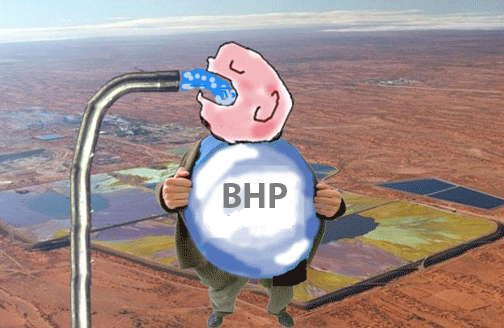
Jim Green, 26 Oct 24. BHP has had to move on Mound Springs protection issues regarding untenable extraction of GAB waters for the Olympic Dam copper-uranium mine, and an important Springs Study had now been released by SA Gov modelling reduced water extraction scenarios and affects on Springs & GAB waters.
A significant – if belated and partial – formal public commitment from BHP:
Milestone : FY2030 – cease abstraction from Wellfield A through switching to coastal desalination supply in partnership with the South Australian Government on the Northern Water Supply Project.
This partial win is a key if limited step toward proper protection for the unique and fragile Mound Springs of the GAB in SA, requiring:
is a key if limited step toward proper protection for the unique and fragile Mound Springs of the GAB in SA, requiring:
- closure of untenable BHP Wellfield A operations as soon as possible, that is warranted far sooner than by end of FY2030;
- BHP could prioritise and pay for whatever extent of water recovery at Olympic Dam to replace continued extraction from Wellfield A, which is projected to be run at 3.9 million litres a day ( Ml/d ) over next few years – about 10% of the volume BHP water take from the GAB;
- a campaign path to realise a phase out of the far larger adversely impacting Wellfield B operations that runs at 32 Ml/day, at least from when Northern Water supply becomes available at/after 2028 (this is difficult as BHP & SA Gov now think closing Wellfield A is all they have to do);
- a continued public interest campaign building on a lot of people’s roles and contributions over time…
an important Springs Study:
“Potential Impacts of Reducing Groundwater Abstraction from the Southwestern Great Artesian Basin: Modelled Aquifer Pressure and Spring Flow Response”
By Daniel Partington, Andrew Love, Daniel Wohling, Mark Keppel.
Goyder Institute for Water Research Technical Report Series No. 2024/01https://yoursay.sa.gov.au/84866/widgets/401081/documents/297652
see an extract from Goyder Institute Springs Study (at p.21 of doc & at p.31 of the pdf file, my bold below) citing the BHP commitment:
3.5 Output From the Modelled Scenarios Six experimental abstraction scenarios were proposed by Infrastructure SA to provide a spectrum of stimuli to assess the responsiveness of the aquifer to a change in abstraction volumes. The future abstraction rates from Wellfield A and B have not been confirmed, however there has been public commitment to cease abstraction from Wellfield A if water from the Northern Water project is available (see Olympic Dam Context- Based Water Targets).
Premier vows to hold vote on Coalition nuclear power plan ahead of federal election
Queensland state law forbids the construction and operation of nuclear reactors and other facilities under the Nuclear Facilities Prohibition Act.
LNP leader David Crisafulli, who is on track to lead the opposition to power, stands firmly against the proposal.
Fraser Barton, Oct 15, 2024, https://reneweconomy.com.au/premier-vows-to-hold-vote-on-coalition-nuclear-power-plan-ahead-of-federal-election/
Queenslanders will be asked to vote in a plebiscite on nuclear energy at the next federal election if Labor Premier Steven Miles is re-elected.
The premier believes a separate vote on Opposition Leader Peter Dutton’s nuclear proposals can be held at the same time as the federal poll.
“I’ve said I’ll comply with the law,” the premier told reporters alongside Prime Minister Anthony Albanese on Monday.
“The law bans nuclear in Queensland but also requires the minister to hold a plebiscite as soon as they reasonably believe that the Australian government intends to build a nuclear reactor.
“Peter Dutton said the first step to get nuclear reactors in Queensland is to elect David Crisafulli – they were his words – and that means that the first step to blocking Peter Dutton’s plan for nuclear reactors is to elect me in October.”
Albanese labelled the federal coalition’s nuclear energy goals a “fantasy”.
“They don’t have a proper plan here, and it’s no wonder that they should be held to account for it,” he said.
Dutton has promised to build seven nuclear plants across Australia if the coalition wins next year’s federal election.
Dutton has previously vowed to override states who refuse to adopt the energy plan.
But Queensland state law forbids the construction and operation of nuclear reactors and other facilities under the Nuclear Facilities Prohibition Act.
LNP leader David Crisafulli, who is on track to lead the opposition to power, stands firmly against the proposal.
Political analyst John Mickel said Labor would use nuclear’s high costs and dependency on water to woo regional voters, if the plebiscite goes ahead.
“What Labor would be trying to do there is bring that issue to the fore,” he told AAP.
Plans to build nuclear plants could cost up to $600 billion and the coalition said nuclear reactors could be online by 2037.
Queensland premier will hold plebiscite on nuclear power if he wins state election
Exclusive: Steven Miles says law requires a referendum be called if the commonwealth is likely to build a ‘prohibited nuclear facility’ in the state
Andrew Messenger and Graham Readfearn, Mon 14 Oct 2024
Steven Miles will hold a state plebiscite on Peter Dutton’s nuclear power plans if he wins the 26 October poll, a move that could polarise the electorate in the Coalition’s strongest state at the next federal election.
The Queensland premier said he had received legal advice on the nuclear issue and raised the possibility of initiating a plebiscite on the same day as the federal election.
“Depending on how things play out, you could even hold that plebiscite on the same day as the federal election, to save people going to the polls twice,” Miles said in an exclusive interview with Guardian Australia.
The federal opposition leader, Peter Dutton, will take a plan for seven Commonwealth-owned nuclear power stations to the next election. That includes two in Queensland, replacing existing coal plants at Callide and Tarong.
But an obscure provision in Queensland’s 17-year-old Nuclear Facilities Prohibition Act 2007 may stand in the way. The act bans granting a grid connection, development application or generating authority to any nuclear facility.
It also requires the minister call a plebiscite if “satisfied the government of the commonwealth has taken, or is likely to, take any step supporting or allowing the construction of a prohibited nuclear facility in Queensland”.
The state opposition leader, David Crisafulli, has repeatedly ruled out changes to the law, most recently at a joint press conference with Dutton this month……………………………………………………………………………………. more https://www.theguardian.com/australia-news/2024/oct/14/queensland-premier-will-hold-plebiscite-on-nuclear-power-if-he-wins-state-election
Western Australia Statement: Nuclear is No Climate Solution
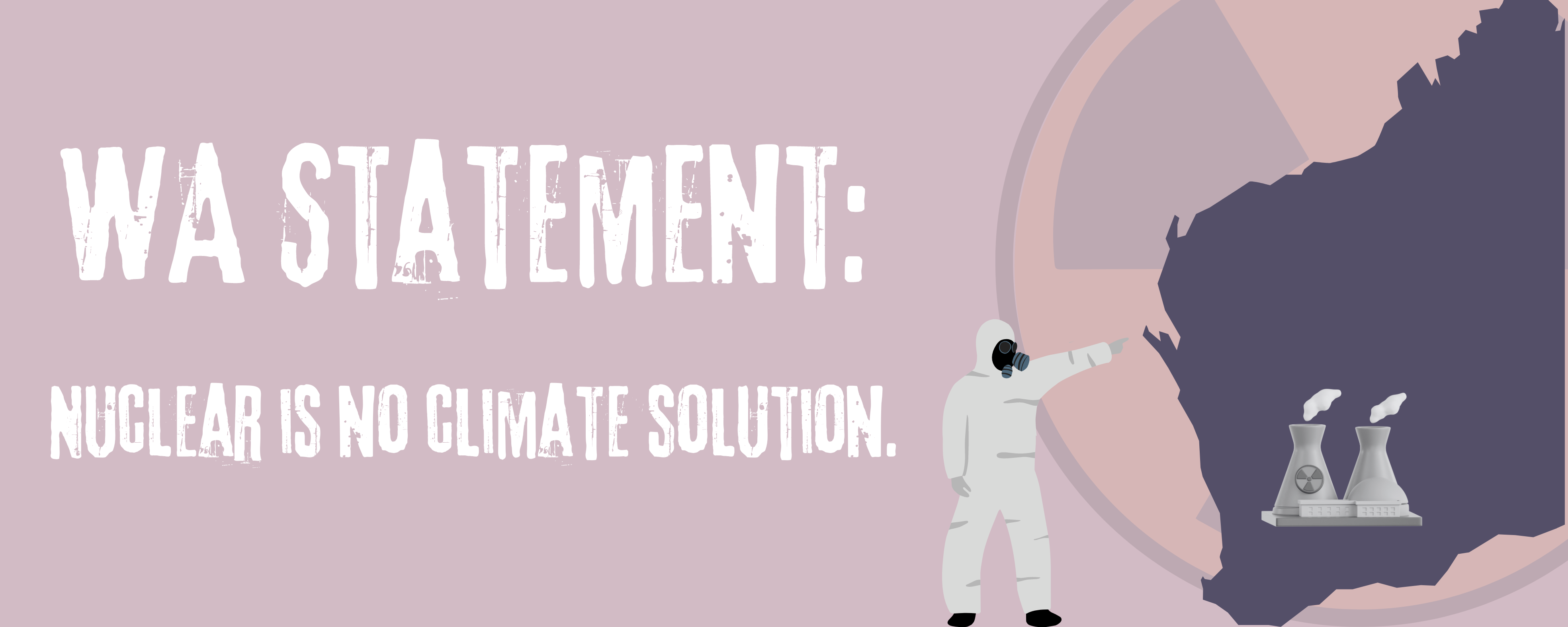
| SIGN THE STATEMENT Please take action to protect WA from the threat of nuclear power by signing the statement “Nuclear is No Climate Solution.” Please help grow the support to stop Dutton’s nuclear power push in the West. |
| Unlike other states WA does not have a prohibition on nuclear power. With the Federal election increasingly uncertain we face a very real risk of a Federal Coalition advancing nuclear power in WA. We are pushing the State government to legislate a prohibition as the best legal protection against a Federal Coalition who seek to impose nuclear power in WA and we need your help to get the WA government to act. |
Peter Dutton’s proposal for WA is to build Small Modular Nuclear Reactors (SMNRs) at the Muja Coal fired power station in Collie which is due to be closed in 2027. There are new developments in the region for hydrogen power steel recycling, wind farms and battery storage all feeding into the South West grid.
The irresponsible and reckless nuclear proposal for Collie undermines and derails climate action, creates uncertainty for renewable energy investors and locks in gas and fossil fuels for longer. We cannot underestimate how serious Peter Dutton is on nuclear power and we do not have time to delay climate action.
You can download a sign on sheet to collect signatures and send back to us Nuclear Free WA c/o CCWA PO Box 883, West Perth, WA 6872.
Thanks so much for helping grow the momentum to stop nuclear power in WA.
Mia Pepper
Nuclear Free WA Committee Member
Dutton’s nuclear remarks spark calls for clarity on Queensland LNP’s energy plan
Dave Copeman, 4 October 2024, https://www.queenslandconservation.org.au/duttons_nuclear_remarks_lnps_energy_plan?fbclid=IwY2xjawFvCu5leHRuA2FlbQIxMQABHWQFoEI2cqiTljqKHWH3tgX_Vn0_sbMmzV_mCAb1RfmcOcv0tqp3xtDDFw_aem_A3vBJVajSTGpG64uEbkoLg
As Queenslanders await clarity on the LNP’s energy plan, Peter Dutton has today raised the prospect of convincing a future LNP government to change its mind on nuclear power.
While David Crisafulli has rejected nuclear energy, it’s becoming apparent that the clear alternative currently being proposed to the Queensland Energy and Jobs Plan is from Peter Dutton.
Crisafulli has yet to present a detailed and transparent energy plan for Queensland, and his reluctance to outline a clear roadmap raises questions about the future of the state’s energy strategy, including the Queensland Energy and Jobs Plan.
The Queensland Conservation Council is calling for transparency from David Crisafulli regarding the LNP’s energy plans. Queenslanders deserve clarity on how the party intends to meet the state’s energy needs and emission reduction targets.
Queensland Conservation Council Director Dave Copeman said:
Peter Dutton’s comments today make it clear that he is prepared to convince any future LNP Queensland government to reconsider its stance on nuclear power.
While David Crisafulli has rejected nuclear, it’s clear that right now, Peter Dutton’s nuclear agenda is the main alternative being put forward to the Queensland Energy and Jobs Plan.
The Queensland Conservation Council is calling for transparency from David Crisafulli regarding the LNP’s energy plans. Queenslanders deserve clarity on how the party intends to meet the state’s energy needs and emission reduction targets.
Queensland Conservation Council Director Dave Copeman said:
Peter Dutton’s comments today make it clear that he is prepared to convince any future LNP Queensland government to reconsider its stance on nuclear power.
While David Crisafulli has rejected nuclear, it’s clear that right now, Peter Dutton’s nuclear agenda is the main alternative being put forward to the Queensland Energy and Jobs Plan.
Every day that David Crisafulli doesn’t outline his energy plan, the questions around Queensland’s energy future will only grow louder. Queenslanders need to know what the LNP’s strategy is, especially with the growing focus on nuclear from the federal Coalition. We know David Crisafulli doesn’t support Pioneer Burdekin Pumped Hydro, but we don’t have clarity on what he would suggest in its place.
The best way for David Crisafulli to confirm his opposition to nuclear power is to build on the strong pipeline of renewable energy projects Queensland already has and outline a clear plan for closing coal-fired power stations with renewable energy backed by storage.
Renewable energy is already helping to drive down power bills and create jobs, and it’s vital we have energy policy certainty to support this growing sector. The longer we wait for clarity, the more uncertain the future becomes to meet our emission reduction targets and avoid the worst impacts of climate change.
1 This month
17 October, Free Public Talk on Nuclear Issues in South Australia
David Noonan will speak on public interest concerns over the new Roxby Downs Indenture Act 2026 on BHP copper-uranium mining and ore processing in SA, and on how AUKUS may face SA with a High-Level nuclear waste agenda.
Dr Jim Green will discuss international developments in the field of nuclear power including ‘small modular reactors’ and Generation 4 ‘advanced’ nuclear reactor concepts.


Help Aunty Sue Protect Her Land and Sacred Sites From Destructive Rocket Testing.
.

Australians deserve the truth
about
AUKUS – https://aukuspublicinquiry.com/

PETITION – To: Prime Minister Anthony Albanese and the Australian Labor Government

of the week – Australians for War Powers Reform (AWPR)
To see nuclear-related stories in greater depth and intensity

