18 November More REneweconomy news
-
 Elon Musk finally unveils the Tesla Semi electric truckElon Musk is unveiling his company’s electric truck, the Tesla Semi, promising long range and big savings. Here’s what we know…
 -
‘Modern air is a little too clean’: the rise of air pollution denialDespite report after report linking air pollution to deterioration of the lungs, heart and brain, Professor Robert Phalen believes the air is “too clean” for children.
-
What Frydenberg was told about why NEG was bad policyThere is a better alternative to the NEG, taking the lead of the UK, Germany, Portugal, even China, who have all set policy to move aggressively towards clean energy.
-
Kidston solar + pumped hydro project wins another $5m from ARENAStage 2 of Genex Power’s solar and pumped hydro project set to reach financial close in 2018, with help of new federal government grant.
-
Queensland’s new coal generator would burn more money than coalA new coal generator in north Queensland would likely burn up to 79 per cent of its asset base – at the cost to Queensland taxpayers.
-
Solar industry launches big campaign in Queensland poll against LNPAustralian Solar Council launches massive campaign against LNP in Queensland poll, saying there is too much at stake to ignore.
18 November REneweconomy news
-
Networks push to take regional consumers, communities off gridNetworks and consumer groups say taking rural customers off grid – and providing them with solar and storage – can save billions, and make electricity cleaner, safer and more reliable. It’s a no brainer, but the regulator stands in the way.
-
GE Renewable Energy appoints Steve Oswald to lead its Wind business in Australia & New ZealandGE Renewable Energy has announced the appointment of Steven Oswald as the new Country Executive for the Wind business in Australia & New Zealand. Further, David Lian has been promoted to Head of Sales for Wind in Australia and New Zealand.
Lucas Heights is the obvious place for a National Radioactive Waste Management Facility
Gary See Fight To Stop Nuclear Waste Dump In Flinders Ranges SA, November 15
ANSTO at Lucas Heights are supposedly short of space to keep radioactive waste, but they are literally next door to a landfill site that is near to being closed. Anyone know if they’ve ever considered building a National Radioactive Waste Management Facility there?
It would seem a logical place for it. https://www.facebook.com/groups/344452605899556/

 Ed. note The Australian Government has made sure to get this sewn up. The Australian Radiation Protection and Nuclear Safety Agency (ARPANSA) has licensed the Lucas heights campus of ANSTO to store nuclear wastes only on a TEMPORARY basis, and on condition that a plan is developed for “a final pathway” for its disposal.
High level nuclear wastes, planned for South Australia dumping, but not mentioned by Australian Government
 Tim Bickmore Fight To Stop Nuclear Waste Dump In Flinders Ranges SA https://www.facebook.com/groups/344452605899556/ November 15
What the Barndioota Consultative Committee was presented in August 2017 regarding the nature of material storage in the proposed suppository. The guidelines (Waste Acceptance Criteria = WAC) are yet to be formalised, so we are expected to accept the unknown.
No reference to the decommissioned HIFAR & MOATA Reactors demolition waste – hunks of steel & concrete of unknown volume – & no mention of returned processed fuel.
http://www.radioactivewaste.gov.au/…/4.%20WAC%20presentatio…
Among 56 countries studied – Australia is close to worst on climate change action
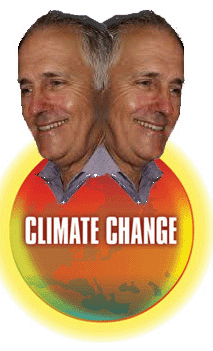 ‘Ringing alarm bells’: Australia near the bottom of the heap for climate action http://www.smh.com.au/environment/climate-change/ringing-alarm-bells-australia-near-the-bottom-of-the-heap-for-climate-action-20171115-gzm063.html Peter Hannam
Australia ranks as one of the world’s worst performing nations when it comes to climate action, with only South Korea, Iran and Saudi Arabia faring worse among 56 countries scrutinised by 300 international analysts.
The annual Climate Change Performance Index, led by Germanwatch and other groups, listed Australia as “very low-performing” for its greenhouse gas emissions, energy use and climate policy. It scored a “low’ rating for renewable energy.
The results were released as talks in Bonn, Germany, aimed at shoring up support for the 2015 Paris climate accord enter their final few days.
As in the past three years, Australia has foundered near the bottom of the major tables, prompting the commentators to call on the Turnbull government to “sufficiently implement credible policies” to meet its Paris targets.
Environment and Energy Minister Josh Frydenberg, now in Germany, earlier this week declared Australia remains committed to its pledgeto slice 2005-level emissions by 26-28 per cent by 2030.
Kelly O’Shanassy, chief executive of the Australian Conservation Foundation, said Australia had the highest per capita greenhouse gas emissions of those assessed, and was also one of the world’s largest exporters of fossil fuels.
“Australia’s continued failure to put in place a robust and comprehensive national plan to cut pollution is raising alarm bells around the world,” Ms O’Shanassy said, noting emissions have been increasing since 2013.
“This is a national embarrassment for a wealthy nation with so much at risk from climate change and such abundant sun and wind that could be harvested for clean energy,” she said.
Sweden was the top-ranked nation, marked highly for its efforts to boost low-carbon sources of electricity and its increasing forest cover.
The US was among the big movers in the ranking, sliding from 35th two years ago to just one slot above Australia this year.
It got marked down for its declaration to exit the Paris agreement – a move that left it isolated after Syria – the last nation holding out – recently signed up to the accord.
The Adani Carmichael Coal Mine: Introduction To A Special Five-Part Series
By Kristen Lyons, Morgan Brigg & John Quiggin , New Matilda, on November 16, 2017 newmatilda.com/2017/11/16/adani-carmichael-coal-mine-introduction-special-five-part-series/
‘Per head of population, Australia is already one of the world’s worst carbon polluters.
‘Despite this, our two major political parties – Labor and the Liberal-Nationals – are pushing ahead
with the approval of a coal mine in Queensland that will exponentially increase our carbon emissions.
‘The Carmichael mine, proposed by Indian mining giant Adani, will be the largest of its kind in the southern hemisphere and annually produce more carbon emissions than a small country.
‘In this special five-part New Matilda series, researchers from the University of Queensland,
along with the Wangan and Jagalingou Traditional Owners Council, and Australian Lawyers for Human Rights look at the ‘who, what, when, where and why’ of the proposed Adani Carmichael coal mine,
its impact on Traditional Owners, the terrible economics that surround it, and our inexplicable march towards climate oblivion.

‘This first introductory piece – the first in our series
– is written by University of Queensland researchers Kristen Lyons, Morgan Brigg and John Quiggin.’
Read more of this well-researched, informative and insightful article here:
newmatilda.com/2017/11/16/adani-carmichael-coal-mine-introduction-special-five-part-series/
Australian government helps business lobbies, while punishing charities
 Business lobbies get free rein, while govt delivers charities a legal body-slam https://www.crikey.com.au/2017/11/15/business-lobbies-get-free-rein-while-govt-delivers-charities-a-legal-body-slam/ Michael West, 15 Nov 17
The government is crunching charities for foreign donations and tax breaks. Why, then, are the Minerals Council and other corporate lobby groups allowed tax breaks on their foreign funding?
SLAPP: a strategic lawsuit against public participation (SLAPP) is a lawsuit that is intended to censor, intimidate, and silence critics by burdening them with the cost of a legal defence until they abandon their criticism or opposition. Such lawsuits have been made illegal in many jurisdictions on the grounds that they impede freedom of speech.
— Wiktionary
It’s all happening to charities: Australian Tax Office (ATO) audits, investigations by the charity regulator and the Australian Electoral Commission (AEC), and new laws slated for early next month to stymie tax deductibility, contain advocacy and ban or restrict foreign donations. Many in the not-for-profit sector are scared to speak out for fear of reprisal.
Left-wing activist group GetUp went before the Senate inquiry into political donations last week and pulled out a report detailing the vast amount of money that is spent buying influence in Australian politics.
I should declare an interest here: yours truly did the research, which found 18 corporate lobby groups had raised $1.9 billion over the past three years.
These are vast sums, yet they only represent a few of the most powerful advocacy groups in a handful of sectors: banking, mining, property and big pharma. There must be 100 more. And, together with an estimated $1 billion in corporate political donations since 1998, the “revolving doors” between industry and government, and the hundreds of millions spent by individual companies on “in-house” government relations and external consultants, the real numbers involved in swaying politicians must be well north of $1 billion a year, or more than $4 million per federal politician, per year.
There is already a dangerous imbalance between corporate political power and people’s political power in this country.
In her new autobiography, Christine Milne: An Activist Life, the former Greens leader warns of the shift from democracy to plutocracy. “The takeover is almost complete … The rush toward the revolving door between business and politics has become a stampede. Of the 538 lobbyists registered by the Department of Prime Minister and Cabinet in 2016, 191 were former government representatives,” wrote Milne.
The farmer, and veteran of death threats, jail time and arrests as an activist, describes the hegemony of corporate influence as a “major factor in the disillusionment with politicians and democracy”.
Meanwhile, the government is slapping down its ideological adversaries with Tax Office audits and investigations by the AEC and charities regulator, the Australian Charities & Not-for-Profits Commission (ACNC).
Draft legislation is prepared and a bill is tipped to come before parliament in the final sitting week of this year. There are serious implications for democracy and free speech.
One one of the main planks of this “reform” is expected to be a ban on foreign donations. It is mostly designed to hit environmental groups such as Greenpeace, 350.org, Lock the Gate and the Australian Conservation Foundation but will also affect those charities working with Indigenous people, poor people, sick people and medical research.
If the bill gets up — and this may depend on what deal is dangled in front of Opposition Leader Bill Shorten, given the government is no longer in majority in parliament — it may see off foreign donations and tax deductibility.
Such would leave an unlevel playing field. Membership to corporate peak bodies such as the Business Council of Australia and the Minerals Council of Australia is tax deductible. Like the charities and NFPs, they pay no tax, but their funding is enormous.
Keen to contain the influence of environmental groups whose message flourishes on social media, the Minerals Council has been the chief urger in lobbying for the government crackdown on NFP advocacy.
More pertinently, while the government moves against foreign donations for environmental and other civil society groups, the corporate lobby remains untouched. The question should be asked, is this fair? The Minerals Council, its state affiliates and the oil and gas peak body, Australian Petroleum Production and Exploration Association (APPEA), have raised more than half a billion dollars for advocacy over the past 11 years …
*Read the rest of this article at michaelwest.com.au
17 November More REneweconomy news
-
Australia fails again in climate rankings, but states get honourable mentionAustralia’s “unambitious, uninspired” climate policyagain puts it near bottom of global rankings. States get a mention for taking “independent action.”
-
Victoria’s battery storage won’t be ready for this summerVictoria will likely go without its much-vaunted battery storage installations this summer, following months of delays likely to be centred around finance and contracting.
-
Pilbara Solar eyes NAIF funding for plan to export WA solar to AsiaPilbara Solar seeks federal government funding for plan to export WA generated solar power to Indonesia, via a sub-sea cable.
Australian Solar Council launches campaign againstQueensland’s Liberal National Party
 Solar industry launches big campaign in Queensland poll against
  LNP http://reneweconomy.com.au/solar-industry-launches-big-campaign-queensland-poll-lnp-59401/ By Giles Parkinson on 17 November 2017 The Australian Solar Council – the peak body for the country’s solar industry – has announced a major advertising campaign against the Liberal National Party coalition in the Queensland election campaign, saying the future of the industry is at stake.
 The ASC says it is spending “hundreds of thousands” of dollars in the first stage of its campaign, which will include TV, designed to highlight the implications for the solar industry if the LNP win power.
“It is a huge step for the Australian Solar Council to do political advertising, but solar companies are concerned,” says John Grimes, the chief executive of the ASC.
Liberal National Party policies present a direct threat to profits in Queensland’s renewables industry.”
“The reality of what’s at stake is not well understood, we have got to shake people up,” Grimes said.
“The implications of a Queensland LNP government that abolishes the renewable target, abolishes the RET in Queensland and signs up to new coal fired power station is completely untenable. That’s why we are taking this action.”
The LNP has made clear it will remove all subsidies for renewable energy in the state, and focus instead on building a new coal fired power station in north Queensland – an idea that even other coal generation companies say is ridiculous.
Labor, on the other hand, has promised to reach “at least” 50 per cent renewable energy by 2020, and promised more funding for a first solar thermal plant with storage, more solar for schools, initiatives for renters and low income households, and a 400MW tender for solar and storage.
The result, however, is in the balance, with One Nation polling strongly enough to possibly win some seats, and provide the numbers to support the LNP in a minority government.
Grimes noted that there were more than 24 large scale solar projects under development, or committed, in Queensland, and a pipeline of at least double that.
“We right on the cusp of an energy transformation,” he said. “There is a whole lot of investment that will fall by the wayside if we get a change in government.
The ASC is also concerned about the LNP’s declared support for the proposed National Energy Guarantee, which critics say will end up supporting existing fossil fuel generators and effectively penalise and put a halt to renewable energy development. The National Energy Guarantee is really a guarantee for coal,” Grimes says. “It means delay, inaction and confusion for renewable energy. That’s untenable for Queensland’s solar industry.
“When the National Energy Guarantee was announced, the Australian Solar Council promised a pointed political campaign against it. We are making good on that promise through newspaper, radio and digital advertising in key marginal seats in Queensland.
“Thousands of regional jobs have been created by the solar boom, and billions of dollars are being invested in regional communities but the solar boom could turn to bust in the Sunshine State,” said Mr Grimes.
17 November REneweconomy news
 RenewEconomy
-
Gas generators profit from scarcity in S.A. again, and againBig gas generators in South Australia have combined again to create “scarcity” and push prices into orbit, pocketing windfall profits at the expense of consumers.
-
Tasmanian tech drives renewable RottnestHydro Tasmania’s Hybrid Energy Solutions team has installed a 600 kilowatt solar array to complement the island’s existing 600kW wind turbine.
-
Australia’s dirtiest industry dealt another blow as Commonwealth Bank rule out new coal projectsGreenpeace welcomes the announcement today by the Commonwealth Bank that the bank would distance itself from coal projects.
-
Consumers to displace fossil fuels as biggest supplier of energyNetwork operator Ausnet says consumers will provide nearly half of their electricity needs, surpassing fossil fuels as the biggest supplier to the grid.
-
NSW bowls club boosts solar capacity to 414kW, to cut grid power by 25%Warilla Bowls and Recreation Club joins commercial solar boom, adding another 314kW to existing 100kW array to save $75,000 a year.
-
“Autononbus” driverless shuttle trial kicks off at Victoria’s La Trobe UniDriverless shuttle bus trial kicks off at La Trobe University’s Bundoora campus, to test the use of autonomous vehicles as “last mile” transport solutions.
-
How China is driving global green shift in electric power sectorThe IEA has recently published its new report Renewables 2017, which received maximum coverage around the world for its argument that solar PV is now growing faster than any other energy source.
-
Victoria utility installs first large-scale solar system on water tankWannon Water says 100kW system first to be put on utility water tank in Australia, will provide all power for water treatment facility on sunny days.
-
Canberra homes battle to be energy championsACT homes with solar and batteries are taking energy saving to the next level by competing with their neighbours to be named Canberra’s super solar heroes thanks to a new website by Reposit Power and SolarHub.
-
Soltec to serve Australian solar marketThe European leader in solar tracking continues international expansion to APAC region with a new subsidiary in Sydney.
Federal radioactive waste in South Australia : three sites, two years, one message
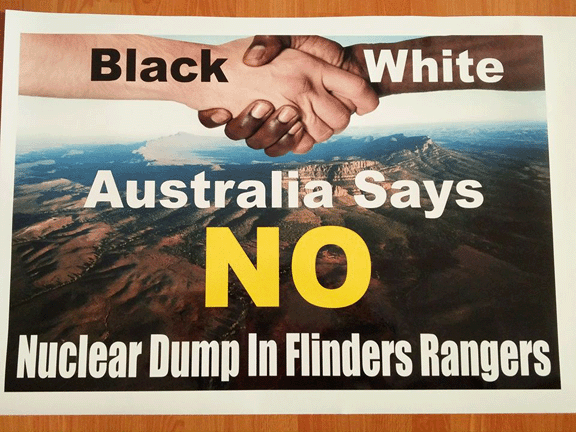 This week marks two years since the federal government announced its six shortlisted sites across Australia for the development of a National nuclear waste dump. Three of those sites were in South Australia and today both the Flinders Ranges and the Kimba agricultural region remain under threat.
The planned National Radioactive Waste Management Facility (NRWMF) project has been met with contest and concern from community members and state and national environment groups.
The waste issue is also set to be highlighted in the March state election with all SA politicians and hopefuls facing calls to explicitly back existing state legislation that makes any such dump illegal. Conservation SA was pleased to see an article in yesterday’s Australian newspaper disclosing Premier Jay Weatherill’s support for the Flinders Ranges community in their campaign against a radioactive waste dump in a letter to Prime Minister Turnbull urging him to respect Aboriginal opposition to the planned dump.
Regina McKenzie, Adnyamathanha Traditional Owner who lives next door to the Barndioota site and is a member of the Flinders Local Action Group (FLAG) said “The Liberal government’s plan is impacting the mental health and well being of the people in the Flinders Ranges and Kimba communities. We are happy that Premier Weatherill has opened his ears to us and is urging Malcolm Turnbull to do the same. For two years we have said no and we continue to say no.”
Kimba farmer Peter Woolford, chair of No Radioactive Waste on Agricultural Land In Kimba or SA, a group that formed around the issue, said “Two years on and the Commonwealth government continues to apply pressure to our small vulnerable community. The uncertainty, stress and toll this has taken on people within Kimba is immeasurable.
“Ministers and the Department of Industry, Innovation & Science state broad community support is critical for the facility, yet Kimba has continually been contested with strong opposition being maintained. The recent poll was clear that nearly half the community are opposed to siting a nuclear waste dump on farming land even with “disruption” money offered to communities to stay in the process.
“Current legislation in South Australia needs to be upheld and the Commonwealth should not ‘impose’ a national waste facility onto any unwilling community”, he said.
Radioactive waste dumps for non-SA wastes are illegal in SA. In response to earlier federal moves to dump waste in SA, state Parliament passed a law to say No: The Nuclear Waste Facility (Prohibition) Act 2000. This Act is “to protect the health, safety and welfare of the people of South Australia and to protect the environment in which they live by prohibiting the establishment of certain nuclear waste storage facilities in this state.”
The majority of Australia’s radioactive waste is currently securely stored at the Australian Nuclear Science and Technology Organisation’s (ANSTO) site at Lucas Heights, in southern Sydney. ANSTO says it “is capable of handling and storing waste for long periods of time.” ANSTO produced the waste and they are best placed to manage it until a proper disposal approach is agreed. The current substandard plan does not meet world’s best practice and there is no need for short term approaches to this long term issue.
Mara Bonacci, Nuclear Waste Campaigner at Conservation SA said “The current process is flawed and divisive and targets vulnerable remote communities. In the two years since the six shortlisted sites were announced, the government has got no closer to securing a site. In fact, the site nomination process is still open. The government has only succeeded in causing stress and division in the areas it has targeted. It is time to stop the clock and adopt an evidence based approach to waste management.
“The waste can and should remain secured and monitored at Lucas Heights until a dedicated public review of the full range of options for radioactive waste management is carried out. The focus needs to shift from targeting SA to establishing a fair, open and responsible process for the management of Australia’s most hazardous waste”, she concluded.
Pacific Islanders call on Australia and other nations, as climate change submerges islands
Pacific Island nations urge world leaders to act as islands expected to sink
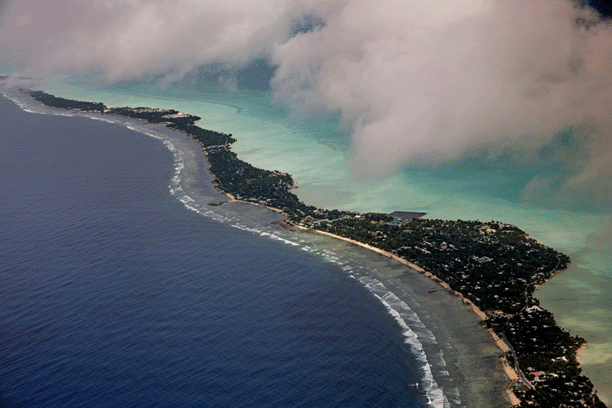
AUSTRALIA’S tropical island neighbours may exist today, but their leaders have urged us to help them from sinking. news.com.au, Matt Young@MattYoung 14 Nov 17 A LARGE swath of Pacific Island nations are slowly being eaten away until residents will be forced to evacuate and the islands eventually sink into the sea — and it’s coming sooner than we think.
This modern-day Atlantis is thanks to sea levels across small island nations that have seen a dramatic rise over the past few decades, a rate of up to 3-4 times larger than the global average. Tuvalu, in the western Pacific Ocean, will reportedly be uninhabitable by 2050, while its island neighbour Kiribati, is expected to be fully submerged by 2100.
The Maldives, which has the lowest elevation in the world and a population of 427,000, may also have sunk by the end of the century.
It has led experts — including Professor Tim Flannery, climate change expert and Professor at La Trobe University — to believe we are “on a trajectory that will see those nations compromised”.
Five reef islands in the Solomon Islands have already been lost forever while a further six have been completely eroded. Last year, the island of Nuatambu had already lost half of its habitable area.
Professor Flannery told news.com.au The Maldives, Kiribati, Marshall Islands, Tokelau and Tuvalu were most at risk.
“It’s very much on their minds, they’re trying to work out how to deal with it,” Mr Flannery told news.com.au.
Scientists are convinced more and more of these tiny islands at risk of sinking into the sea in the next 30 years and Pacific Island leaders have gathered to urge its neighbours, including Australia, to take action to save their dwindling nations……http://www.news.com.au/technology/environment/pacific-island-nations-urge-world-leaders-to-act-as-islands-expected-to-sink/news-story/9416ac1726d1f8d02a1ae435924e364f
Australian Aboriginal concerns will now be addressed in Scotland discussions on destination of reprocessed nuclear wastes
 Herald 13th Nov 2017, ABORIGINES challenging proposals to dump nuclear waste from northern Scotland to a sacred Australian site have won a breakthrough meeting with
government officials about their concerns.
Wallerberdina, 280 miles north of Adelaide, has been identified as a potential location for Australia’s
first nuclear waste dump as part of a deal that returns spent fuel processed at the nuclear facility currently being decommissioned in Dounreay, Caithness, to its country of origin.
This is despite claims that it is a priceless heritage site rich in archaeological treasures including
burial mounds, fossilised bones and stone tools. Some have claimed the
impact would be similar to “building a waste dump at the heart of the
Vatican”.
Campaigners who have appealed to the Scottish Government to halt
the plans to ship nuclear waste processed at Dounreay in Caithness to
Australia, have now been told that their concerns should be addressed
before any final decision is taken.
The Dounreay Waste Substitution Policy, agreed in 2012, sees waste from Australia, Belgium, Germany and Italy processed at the Scottish facility to make it safe for storage after being
returned to its country of origin. Campaigners have complained that the
intended South Australian destination forms part of an Aboriginal heritage
site rich in burial mounds, fossilised bones and stone tools.
http://www.heraldscotland.com/news/15655056.Breakthrough_in_Australian_aboriginal_challenge_to_nuclear_waste_transfers_from_Dounreay/
Australian World Heritage sites at special climate change risk- International Union for Conservation of Nature(IUCN)
 From the Everglades to Kilimanjaro, climate change is destroying world wonders
Number of natural world heritage sites at serious risk from global warming has doubled in three years, says the IUCN, including the Great Barrier Reef and spectacular karst caves in Europe, Guardian, Damian Carrington 14 Nov 17, From the Everglades in the US to the Great Barrier Reef in Australia, climate change is destroying the many of the greatest wonders of the natural world.
A new report on Monday from the International Union for Conservation of Nature(IUCN) reveals that the number of natural world heritage sites being damaged and at risk from global warming has almost doubled to 62 in the past three years.
Those at high risk include iconic places from the Galapagos Islands to the central Amazon and less well known but equally vibrant and unique sites such as the karst caves of Hungary and Slovakia and the monarch butterfly reserves in Mexico.
Coral reefs are particularly badly affected by rising ocean temperatures, from the Seychelles to Belize, where the northern hemisphere’s biggest reef is situated. Global heating is also causing mountain glaciers to rapidly shrink, from Kilimanjaro in Tanzania to the Rocky Mountains in Canada and the Swiss Alps Jungfrau-Aletsch – home to the largest Alpine glacier.
Other ecosystems being damaged are wetlands, such as the Everglades, where sea level is rising as the ocean warms and salt water is intruding. In the Sundarbans mangrove forest on the delta of the Ganges, Brahmaputra and Meghna rivers on the Bay of Bengal, two islands have already been submerged and a dozen more are threatened. Fiercer storms are also increasing the risk of devastation.
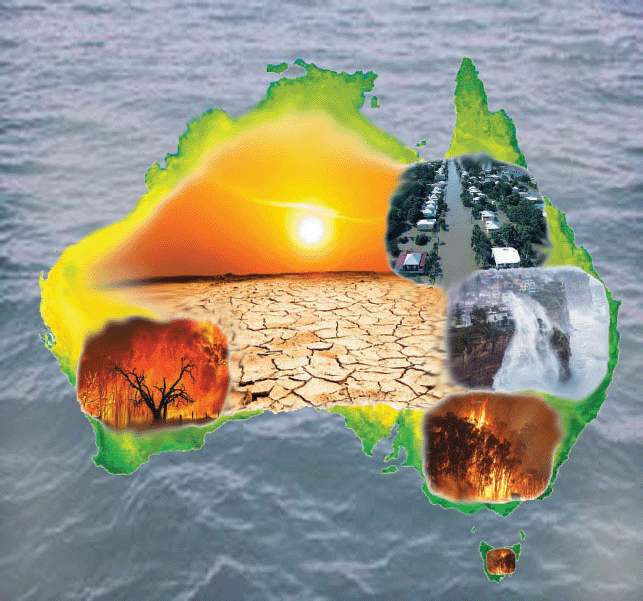
Australia is especially exposed as it has 10 natural heritage sites where climate change damage is rated as high or very high risk, from its Gondwana rainforests to Shark Bay in western Australia and islands such as Fraser and Macquarie.
The new IUCN report was launched at the UN climate summit being held in Bonn, Germany, where the world’s nations are working to put the 2015 landmark Paris agreement into operation.
“Protection of world heritage sites is an international responsibility of the same governments that have signed up to the Paris agreement,” said Inger Andersen, IUCN director general. “This report sends them a clear message: climate change acts fast and is not sparing the finest treasures of our planet. This underlines the need for urgent and ambitious national commitments and actions to implement the Paris agreement.”
Climate change is one of a range of factors that mean about a third of the world’s 241 natural heritage sites are being damaged, with invasive alien species being the top threat. Then, after global warming, comes unsustainable tourism, followed by other problems like poaching and construction…… https://www.theguardian.com/environment/2017/nov/13/from-the-everglades-to-kilimanjaro-climate-change-is-destroying-world-wonders
Western Australia: SUPREME COURT JUDICIAL REVIEW OF ENVIRONMENTAL APPROVAL for YEELIRRIE URANIUM MINE
DATE Thursday 16th November
TIME 9.30am
LOCATION Supreme Court of WA
David Malcolm Justice Centre
28 Barrack Street, PERTH WA 6000
The Supreme Court of WA will commence proceedings to review the environmental approval for the Yeelirrie Uranium mine proposal, brought by the Conservation Council of Western Australia and Traditional Owners.
1 This month
25 October – Film –Britain’s Nuclear Bomb Scandal: Our Story – part of the Adelaide Film Festival,
Screening and Conversation
A screening of Britain’s Nuclear Bomb Scandal: Our Story (2024) followed by a talk with 2026 Bettison and James Awardee and Tradtional Owner Karina Lester in conversation with Simone Tur.
When: Sun 25 Oct, 12:00pm-Screening, 1:15pm-Talk
Where: The Mercury
Free admission, register below by clicking on BUY TICKETS and select free event tickets, at end of web page:
https://www.adelaidefilmfestival.org/program/2026/britains-nuclear-bomb-scandal-our-story
.

Australians deserve the truth
about
AUKUS – https://aukuspublicinquiry.com/

PETITION – To: Prime Minister Anthony Albanese and the Australian Labor Government

of the week – Australians for War Powers Reform (AWPR)
To see nuclear-related stories in greater depth and intensity

