Australia’s Chief Scientist Alan Finkel urges more energy storage
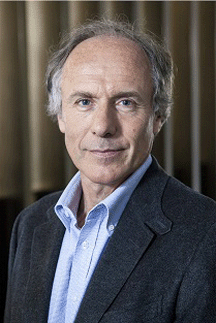 Alan Finkel pushes for more energy storage to keep bills down and maintain reliability http://www.abc.net.au/news/2017-11-20/energy-storage-needed-to-keep-bills-down-finkel-report-warns/9167610 Power bills will go up and energy supply will be less reliable unless Australia develops better storage systems, according to Chief Scientist Alan Finkel.
Key points:
- Report emphasises batteries and other storage solutions including turbines and demand response are key to keeping costs down and maintaining reliability
- It also notes Australia could source 50 per cent of its energy from renewables by 2030
- Energy ministers are due to meet this week to discuss Turnbull’s National Energy Guarantee
Storing the energy captured from renewable sources like solar and wind means suppliers are able to meet electrical energy demand at all times of the day.
Dr Finkel has recommended in the past that all large-scale wind and solar generators in Australia should have energy storage capacity.
In addition to battery storage, which today’s report said was the most cost-effective way to strengthen energy security, it also listed alternatives including fast-start gas turbines, spinning reserves in wind turbines, demand response and load shedding measures.
“As we have more and more penetration of variable renewable energy, solar and wind, then we’re going to need storage to be a very important component of having a stable, secure and reliable grid,” the report’s lead author Bruce Godfrey said.
“[That will also help to] enable the environmental benefits that come from low-emissions sources.”
The report estimates Australia will need to spend about $11 billion on storage before 2030 in order to provide a secure energy supply.
But more money may need to be spent to ensure power supply is reliable as Australia makes the transition to renewable energy.
Dr Finkel said Australia had a “long way to go” on storage, and predicted future storage projects would dwarf those already being developed.
“The challenge is to manage the transition from here to there. We are going to be moving to a new future, it’s happening around the world, it’s inevitable,” Dr Finkel said.
“What this report shows is that if storage is used effectively, we can manage that transition as smoothly at the lowest possible price.”
The report has been released ahead of a meeting of state and federal energy ministers to discuss the Turnbull Government’s National Energy Guarantee (NEG).
Under the NEG 28 to 36 per cent of power generation is projected to come from renewables by 2030.
Climate Council modelling shows that means Australia will miss out on between 6,000 and 20,000 new jobs that would have otherwise been created.
Andrew Stock, who has decades of experience in the energy sector and sits on the council, says at least 50 per cent of power generation should be renewable by 2030.
“The current aspiration level that the Federal Government is talking about, that’s way too short of what’s required, so we need more aspirational plans for electricity. That will bring more jobs, up to 20,000 more jobs in this sector,” he told AM.
The Chief Scientist’s report said this target could be easily met without risking reliability or requiring further significant investment in energy storage.
22 November More REneweconomy News
-
 Queensland’s election – what do the energy numbers say?I hate to break the news, but north Queensland will not be getting a new coal fired power station if the LNP are elected on Saturday.
 -
First turbine erected at Mount Emerald Wind FarmRatch Australia Corporation announced the completion of the first wind turbine at the Mount Emerald Wind Farm near Walkamin today after the three 16 tonne blades, each 57m long, were positioned in place atop a 90-metre tower.
-
ICO and ACCIONA sign a loan agreement for 75 million Australian dollars to finance the construction of a wind farm in AustraliaThe new wind farm, which will come on stream in the second semester of 2018, has a total capacity of 132MW. The electricity generated by the facility will all be sold in the wholesale market.
-
100% renewables “cheaper, less risky” than building new coal: ATAATA report says a 100% renewable grid by 2030 not just doable for Australia, but cheaper and safer than building new coal plants.
-
Solar and storage peak bodies rebrand as Smart Energy CouncilSolar and storage bodies create Smart Energy Council to better reflect merger of solar, storage and smart software technologies.
-
Plunging cost of solar means peak coal looms in IndiaNew modelling predicts India is within a decade of peak coal demand for the power sector. This is sooner than anyone has predicted.
-
The climate science denial promoters behind Queensland’s energy scare election headlinesIn the final week before an election, the biggest-selling newspaper in the Australian state of Queensland screamed a front-page headline that cut into one of the poll’s most divisive issues.
-
Coalition’s NEG aims to engineer an early death for big solarSo long solar. NEG design assumes no large scale solar investments in Australia for at least eight years – despite recognition that large scale renewables responsible for most bill reductions.
-
National Energy Efficiency Awards 2017Corporate leadership, individual excellence and energy efficiency innovation have been recognised and awarded at the National Energy Efficiency Awards 2017.
-
Coughing up for coal-fired powerIf Australian tax payers are made to cough up for a new coal plant in north Queensland, locals will also be coughing up – literally.
-
LNP, One Nation would force Queensland energy prices up; Greens, ALP downNew report says LNP and One Nation support for uneconomic coal fired power station would force prices up in Queensland, and add to system security risks.
-
Darth Vader or not, the Tesla truck changes everythingWith the Tesla truck, Elon Musk has torn down the final frontiers of the campaign against the clean energy transition: cost. And it matters little whether Tesla itself can pull it off – it has already turned two trillion-dollar industries upside down.
-
Australia to lead storage boom, as home batteries become “ubiquitous”BNEF report names Australia among 8 countries to lead global energy storage boom, with market forecast to double six times over between now and 2030.
-
Australia’s govt and nuclear lobby soften up South Australians for nuclear waste dumping
 National Radioactive Waste Management Facility:21 November 2017
Industry has one week left to tender for Site Characterisation Works
Industry is invited to get involved in the process to build a National Radioactive Waste Management Facility, with tenders now open for Site Characterisation works.
The tender is to deliver a range of technical assessments that will form part of Phase Two of the process in relation to the proposed National Radioactive Waste Management Facility, including:
- Assessing flora and fauna, geology, seismic activity, risks, the surrounding environment, transportation and other infrastructure.
- Inputting into the Detailed Business Case, with reference to the site specific design and cost estimates that arise from site characterisation.
- An additional option, following site characterisation, for the preparation and development of submissions for licensing and approvals process…….
Bruce McCleary, General Manager of the National Radioactive Waste Management Facility Taskforce said that site characterisation is an important activity in the next part of the project.
“Three sites, two in Kimba and one at Wallerberdina Station were voluntarily nominated by their landowners and moved to Phase Two assessment after the community supported continuing the discussion,” McCleary said.
“Phase Two involves building a detailed understanding of the nominated sites, through in depth community consultation and technical assessments.
“Community consultation is now well underway, including appointment of locally engaged officers and establishment of site offices at both sites, creation of committees and working groups, and regular visits from members of the project team and experts to provide information on the project.
22 November REneweconomy news

-
ACCIONA announces new head of Australian energy businessACCIONA has appointed Brett Wickham as the new Managing Director of its Australian energy business.
-
Spain: The high cost of political interference in power marketsSpain is the latest example of governments intervening in power markets to prop up gas, coal and nuclear power, including capacity and “grid reliability” payments.
-
Conservatives attack storage report as “eco-evangelism”, Finkel respondsConservatives says new report on battery storage is just “eco-evangelism”. This is what chief scientist Alan Finkel said in response.
-
Hunter Valley biofuel facility to advance ethanol productionAs part of a $48 million project, Ethtec aims to construct a $30 million purpose built pilot-scale facility based in the Hunter Valley in New South Wales.
-
Schott: Modelling assumptions change, but result more or less the sameSchott scolds government for “spitting the dummy” on Clean Energy Target, but defends design of NEG, saying it clear that more renewables have weakened energy system.
-
New Tesla roadster will be the fastest production car everIf the Corvette is the halo car for Chevrolet and General Motors, the new Roadster will be the halo car for Tesla.
-
Know your NEM: Waiting for COAG to vote on the NEGFederal Government is something of a lame duck and, in our view, lacks moral authority in the area of energy policy.
Big upset for Australia’s major parties, as Aboriginal Green candidate wins inner-city by-election
 Northcote by-election: Greens win inner-city seat, Thorpe to become first female Aboriginal MP, By Richard Willingham, Sunday 19 November 2017
www.abc.net.au/news/2017-11-18/greens-win-northcote-by-election/9164644 The Greens’ Lidia Thorpe will become the first Aboriginal woman in Victoria’s Parliament,
defeating Labor’s Clare Burns on the back of a campaign that included a
pitch to voters that they could make history while not toppling a progressive government.
‘It is the first time Labor has lost a Victorian by-election since 1948.’
King Islanders to get free electricity in renewable energy trial
 Renewable energy trial provides King Island with free power http://www.theage.com.au/business/energy/renewable-energy-trial-provides-tasmania-with-free-power-20171117-gznwk7.html, Cole Latimer
New technology will provide free power to King Island as it aims to prove low-cost energy generation claims.
Wave Swell Energy, a group developing ocean wave energy generation technology, is carrying out commercial validation trials off Tasmania’s King Island ahead of a potential listing.
The group has built what Wave Swell chief executive Tom Denniss described as “big concrete caverns”, which use the constant back and forth flow of the ocean to generate energy.
“As waves pass into the inside of the cavern the water level rises, this causes pressure on the air, which blows open valves at the top of the unit and turns a uni-directional turbine; as the water recedes it causes negative pressure which closes the valves, creating a cyclical process. The air opening and closing the valves turns a turbine, generating a consistent flow of power.
“What sets this apart from other wave generation technology is its lack of moving parts,” Mr Denniss said. “It sits just below the water line, it’s like an iceberg, but with only two-thirds underwater.”
The blocks are located in water depths of around 10 metres, and typically found up to 500 metres offshore. They connect to the mainland via undersea cables and provide energy to the onshore grid via a transformer unit.
A single, one-megawatt generation offshore unit weighs about 4500 tonnes. It is built onshore and moved into place using semisubmersible barges.
The group is carrying out commercial validation of its technology on King Island, and has signed an offtake agreement with Hydro Tasmania for an initial 200-kilowatt trial unit, and will operate during 2018 after its initial funding goals are reached.
Denniss said all energy generated will initially be provided to the King Island grid and Hydro Tasmania for free.
Current tests put generation costs at $100 per megawatt hour, or 10¢ a kilowatt hour.
“This is really about ensuring independent verification, and Hydro Tasmania verifying that we can produce at the low cost of 10¢ per kilowatt hour,” Mr Denniss said.
Typical solar systems cost around 13¢ per kilowatt-hour and wind about 7¢ per kilowatt-hour, not including grid costs.
Mr Denniss added that the units can also be used as breakwaters or as an artificial reef, with trials demonstrating an increase in marine life where they are installed.
Wave Swell is still looking to investors to raise $8.3 million over the coming months, having secured $2 million in investment to date, and has set a goal of raising $10 million in total funding, Mr Denniss told Fairfax Media.
“We are targeting anyone for funding, from energy companies, construction companies, or individuals who see upside in investing.”
It has used RFC Ambrian to arrange a private placement of 1.73 million shares at a value of $4.80, and anticipates having a total of 6.9 million shares on issue, putting a potential value of $33 million on the company.
The group plans to list after the successful commercial viability trials of the technology on King Island.
Mr Denniss said it will most likely carry out an initial public offering on London’s AIM exchange, although it will not rule out a listing on the ASX.
Australian government lending to Adani? A bad look internationally!
 Australia’s reputation faces ‘serious’ risks if Adani loan goes ahead: Figueres, http://www.smh.com.au/environment/climate-change/australias-reputation-faces-serious-risks-if-adani-loan-goes-ahead-figueres-20171118-gzo8fh.html Providing a $1 billion loan to underwrite Adani’s proposed mega coal mine in Queensland would have “serious negative impacts” for Australia’s international reputation and “unpick the progress” of the Paris climate agreement, according to Christiana Figueres, a former United Nations climate chief.
Ms Figueres has written to the Turnbull government’s Northern Australia Infrastructure Facility (NAIF), which is considering a concessional loan for a rail link from the mine to the coast
The former executive secretary of the UN’s Framework Convention on Climate Change
sought to highlight that under the NAIF’s own enabling legislation, it “must not act in a way that is likely to cause damage to the Commonwealth government’s reputation, or that of a relevant State or Territory”.
Ms Figueres warned the expected total lifetime carbon emissions from burning coal from the proposed Carmichael in the Galilee basin would be 4.64 billion tonnes of carbon-dioxide, according to details of the letter obtained by Fairfax Media.
At its peak, the mine’s product would trigger emissions of 120 million tonnes of CO2-equivalent, roughly equal to what Australia has pledged to cut by 2030 from current pollution levels under its Paris pledges.
“Based on these numbers, emissions that would result from burning Carmichael coal in one peak production year would completely cancel out the total emissions reduction effort Australia has committed to for the 13 years from now until 2030 under the Paris Agreement,” she said.
The rail loan, now being considered by NAIF, has been a key point of debate in Queensland’s state elections, with polls indicating little support for concessional finance for Adani, a mining conglomerate owned by Indian billionaire Gautam Adani.
Queensland Premier Annastacia Palaszczuk said her government, if re-elected at Saturday’s elections, would have no role in assessing the NAIF loan, effectively blocking it. Oppositional leader Tim Nicholls supports the loan and has blasted the premier’s stance as putting thousands of regional jobs at risk.
Ms Figueres said her intervention was prompted by a “deep concern for planetary well-being, I cannot, in all good conscience, remain silent on an issue that threatens to unpick the progress represented by the Paris Agreement”.
“A decision by the NAIF (and the Australian Government) to financially support the Adani project would be likely to have serious negative impacts on Australia’s reputation, in particular that of the Commonwealth Government,” Ms Figueres said, highlighting Australia’s commitment to “refrain from acts which would defeat” the Paris accord’s object and purpose.
Ms Figueres’ letter to the NAIF was dated November 17, the final day of the Bonn climate talks aimed at nudging nations to increase their commitments to cut emissions two years on from the Paris accord.
Australia copped criticism at the gathering for its promotion of coal, with Hilda Heine, president of the Marshall Islands calling for a change of government in Canberra and urging nations to stop burning the intensive-heavy fossil fuel.
Dean Bialek, a former Australian diplomat and advisor to small island states threatened by the rising sea levels driven by climate change, said Ms Figueres had been “utterly shocked to learn the government was considering a huge subsidy” for Adani during a recent visit to Australia.
“She felt compelled to explain to the NAIF Board how dangerous and irresponsible this project would be in global environmental terms, and the serious damage it would do to Australia’s international reputation and standing in the world,” said Dr Bialek, who now works with Ms Figueres on her Mission 2020.
The project is attempting to accelerate climate action to get global emissions peaking and then trending lower by 2020. A report out last week by the Global Carbon Project estimated emissions will jump this year by 2 per cent after flatlining for three years, to a record 41 billion tonnes of CO2.
Chief Scientist Alan Finkel says that Renewables could reliably contribute 50% to power grid
, says Alan Finkel, Guardian, Katharine Murphy, 20 Nov 17 , Chief scientist warns in new report that Australia risks missing out on global growth industry of energy storage because of ongoing policy uncertainty Australia’s power grid can reach penetrations of 50% renewable energy without a significant requirement for storage to support reliability, according to a new report commissioned by Australia’s chief scientist, Alan Finkel.
While the Turnbull government has made much of the need for storage to increase security and reliability in the national power grid, the new report from the Australian Council of Learned Academies (ACOLA) says at an aggregated national level, 50% renewables is possible without major investments in storage for reliability purposes.
But the report also points out that the requirement to shore-up network security as power systems decarbonise in accordance with international climate policy commitments is an ongoing task, and that transition means energy storage is now a major global growth industry.
It notes that new energy security requirements create opportunities to expand energy storage capacity for reliability at a lower marginal cost than would otherwise be the case.
It also warns that Australia risks missing out on the benefits of participating in global supply chains because of ongoing uncertainty over energy policy.
As well as focussing on building local manufacturing capacity, the report says Australia’s research and development performance in energy storage technologies is world class, “but would benefit from strategic focus and enhanced collaboration.”
The report points out that Australian energy storage start-ups face challenges, including access to venture capital, which are related to continuing uncertainty over energy and climate policy……
Last month, the Turnbull government dumped Finkel’s recommendation for a clean energy target and went with a policy which imposes new reliability and emissions reduction guarantees on energy retailers and large energy users from 2020 – a policy which will encourage new investment in storage.
The energy minister, Josh Frydenberg, is due to meet with his state counterparts later this week to consider whether or not consensus can be reached on the national energy guarantee – but going in to the discussions, some of the Labor states have resisted the proposal on the basis it isn’t sufficiently friendly to renewables.
The federal government needs buy-in from the states, because the new system requires jurisdictions to pass complimentary legislation to set up the national energy guarantee.
The new report by ACOLA , which assessed various energy storage technologies, also probed public attitudes, with focus groups in two capital cities and with a national survey of 1,015 respondents.
The research suggests Australians favour a more ambitious renewable mix by 2030, particularly solar and wind, with significant energy storage deployed to manage grid security………
Bruce Godfrey, chair of ACOLA working group, says the new report “clearly shows the two sides of the coin – that energy storage is an enormous opportunity for Australia but there is work to be done to build consumer confidence”.
Finkel, the chief scientist, and the man who led the review of the national electricity grid, says Australia should grab a major new export industry by developing our technical capacity. Given our natural resources and our technical expertise, energy storage could represent a major new export industry for our nation,” Finkel says.
“Energy storage is an opportunity to capitalise on our research strengths, culture of innovation and abundant natural resources.
“We have great advantages in the rapidly expanding field of lithium production and the emerging field of renewable hydrogen with export opportunities to Asia.” https://www.theguardian.com/australia-news/2017/nov/20/renewables-could-reliably-contribute-50-to-power-grid-says-alan-finkel
Surge in wind farms in Australia, drop in complaints about them
 ‘Desultory’: Wind farm complaints aren’t keeping up with surging industry, The Age, Peter Hannam, 19 Nov 17, The surge in new wind farm developments has failed to produce an upswing in complaints, with just nine of the 79 projects operating in Australia receiving any formal objections, Andrew Dyer, the National Wind Farm Commissioner, has said.
As of the end of October, the commission had received 54 complaints, for existing projects, with all but two resolved. Four people had relocated as part of the resolution process.
“There are no complaints for recently completed wind farms,” Mr Dyer told Fairfax Media.
Victorian wind farms have attracted the bulk of objections, accounting for 31 of the 54, while SA and NSW had 16 and seven complaints, respectively. Operating wind farms in other states have not triggered any complaints, Mr Dyer said.
The National Wind Farm Commissioner’s three-year term – which began in late 2015 with $2 million funding – followed a Senate inquiry prompted in part by efforts of a few anti-wind turbine groups.
Fears by supporters of renewable energy that the commission may have spurred an uptick in opposition to wind farms have largely been allayed, with the role now seen as helping developers understand and respond better to community concerns.
Simon Chapman, whose upcoming book, Wind turbine syndrome: A communicated disease, describes the number of complaints as “desultory”, said opposition to the industry from the cross-bench senators had backfired.
“There are no complaints for recently completed wind farms,” Mr Dyer told Fairfax Media.
Victorian wind farms have attracted the bulk of objections, accounting for 31 of the 54, while SA and NSW had 16 and seven complaints, respectively. Operating wind farms in other states have not triggered any complaints, Mr Dyer said.
The National Wind Farm Commissioner’s three-year term – which began in late 2015 with $2 million funding – followed a Senate inquiry prompted in part by efforts of a few anti-wind turbine groups.
Fears by supporters of renewable energy that the commission may have spurred an uptick in opposition to wind farms have largely been allayed, with the role now seen as helping developers understand and respond better to community concerns.
Simon Chapman, whose upcoming book, Wind turbine syndrome: A communicated disease, describes the number of complaints as “desultory”, said opposition to the industry from the cross-bench senators had backfired…….
Booming industry
Fairfax Media understands that some complaints originated from cases where landholders had expectations of hosting turbines and subsequently were denied that chance due to factors beyond their control.
A number of complaints citing a wind farm as at fault for a particular issue were resolved after the root cause of the problem was found to be something completely different. These complaints ranged from health-related matters through to poor television reception…….http://www.theage.com.au/environment/desultory-wind-farm-complaints-arent-keeping-up-with-surging-industry-20171116-gzn3q2.html
AGL to expand energy plan that allows householders to sell or share excess solar power
South Australia’s biggest electricity company AGL has announced the successful trial and expansion of a so-called “peer-to-peer” trading scheme in Adelaide, which uses an app to share the power. ….(subscribers only)
http://www.adelaidenow.com.au/news/south-australia/agl-to-expand-energy-plan-that-allows-householders-to-sell-or-share-excess-solar-power/news-story/7cadc833f2a17ce0a77de24509925296
Canberra stood out at Bonn climate talks as a progressive city, adopting renewable energy
Canberra climate action on show at UN talks in Germany, Canberra Times, 19 Nov 17, Tom McIlroy The role of cities like Canberra in affecting progress against global warming has been considered in the latest United Nations climate talks, with experts welcoming “a groundswell” of innovation.
World leaders including German Chancellor Angela Merkel, French President Emmanuel Macron and environment advocates gathered in the former German capital of Bonn last week for the 23rd conference for signatories to the UN Convention on Climate Change.
University of Canberra chair of Urban and Regional Planning Barbara Norman said a key message from the talks had been how mayors, governors and regional leaders could work together to create large-scale change, boosting wider efforts on a national and international basis.
Professor Norman said powering cities with 100 per cent renewable electricity, building integrated transport systems, designing green precincts and environmentally sustainable developments were key to meaningful progress……….
Chair of the ACT Climate Change Council, she said Canberra stood out among cities involved in an international cooperation network, including because the territory was on track to achieve its target of 100 per cent renewable electricity by 2020……..http://www.canberratimes.com.au/act-news/canberra-climate-action-on-show-at-un-talks-in-germany-20171118-gzoam8.html
1.4 billion to be saved, by replacing Liddell coal mine with renewable energy
 Replacing Liddell with renewables is $1.4 billion cheaper than government plan, report says, The Age, Nicole Hasham, 20 Nov 17
The Turnbull government’s plan to keep the worn-out Liddell power station running for another five years would cost about $1.4 billion more than replacing it with clean energy, and spew millions of tonnes of damaging carbon pollution, a new analysis shows.
The findings cast further doubt on the wisdom of keeping Australia’s oldest operating coal plant open beyond its slated closure in 2022, and have implications for the expected retirement of most existing coal-fired power stations within 15 years.
Prime Minister Malcolm Turnbull and Energy Minister Josh Frydenberg in September ordered energy giant AGL to keep open the coal-fired plant for five extra years or sell it to a party that will…….
The University of Technology Sydney’s Institute for Sustainable Futures compared the financial cost and pollution of three possible scenarios for Liddell: extending its life by five years, pursuing AGL’s plans for a combination of renewable and fossil fuel solutions to replace the lost capacity, and a package of clean energy measures.
It found keeping Liddell open until 2027 would cost $3.6 billion in capital and operating expenses, and that 40 million tonnes of carbon dioxide would be generated over this time.By comparison, a clean energy package would cost $2.2 billion and create no emissions. This would involve energy efficiency, new wind energy, managing the power demands of consumers and flexible pricing, which means electricity is charged at different rates depending on the time of day or year………
ACF chief executive Kelly O’Shanassy said Australia desperately needs a comprehensive climate change policy to allow a rapid transition to clean energy.
Any such policy “must be designed to encourage as much clean energy and smart technology as possible, and not prop up polluting coal plants that are damaging our planet”, she said.
ISF research director Chris Dunstan said replacing Liddell’s lost capacity with renewables could set a powerful precedent as the majority of Australia’s coal-fired power stations approach retirement age…….. http://www.theage.com.au/federal-politics/political-news/replacing-liddell-with-renewables-is-14-billion-cheaper-than-government-plan-report-says-20171118-gzo86a.html
Western Australia: Mulga Rock Uranium Project threatens environmental impacts from Tailings waste:
 Briefer (Nov 2017) by David Noonan, Independent Environment Campaigner
Uranium mining has unique, inherent risks and long term impacts. The West Australian Parliament has passed a Motion (Legislative Council 23 May 2012) recommending:
The government adopt equivalent or better environmental management regulatory requirements for any future uranium mine in Western Australia as exists under Commonwealth and Northern Territory legislation for the operation of the Ranger uranium mine in the Northern Territory with regard to the disposal of radioactive tailings, including the requirements that –
(a) The tailings are physically isolated from the environment for at least 10,000 years: and
(b) Any contaminants arising from the tailings do not result in any detrimental environmental impacts for at least 10,000 years.”
The Barnett era WA gov Approval for the Mulga Rock Uranium Project (Dec 2016) fails to comply with required Commonwealth & NT legislative standards or with the WA Parliament recommendation.
There are two types of intended Tailings Storage Facilities (TSF): an Above Ground TSF and multiple Mine Pit TSF’s in 4 areas across 30 km. An “authorised extent of physical and operational elements” (Approval Schedule 1 Table 2) place some limits on Above Ground TSF but no limits on Mine Pit TSF’s:
“Initial disposal for no longer than 2 years after commencement of mining operations, in the above ground TSF labelled on Figure 2. After this time, all disposal must be in the mine pits”;
“Disposal of no more than 3 Mtpa of beneficiation rejects and no more than 2 Mtpa of post-leaching tailings material”, within an Above Ground TSF cleared area of up to 106 ha.
Mine Pit TSF’s are not required to use “best available landform modelling over 10 000 years post mine closure” or to try to meet a safety outcome that is applied to the Above Ground TSF disposal:
“Condition 16 (1) ensure that the above ground TSF is safe to members of the public and non-human biota, geo-technically and geo-morphologically, and geo-chemically non-polluting.”
Condition 15-1 allows for a plume of tailings seepage and contaminants to move in groundwater:
“The proponent shall manage the design and maintenance of all TSF’s to … ensure that the tailings plume is within background groundwater concentrations at the M39/1080 lease boundary”.
The TSF Monitoring and Management Plan (C 15-3) provides for the proponent: “to manage impacts on groundwater quality including from seepage of contaminants into the groundwater and/or soil”.
Conditions 12 & 14 only seek to “minimise impacts” on Inland Waters, on groundwater, and impacts on water quality, including: “Acid and Metalliferous Drainage from seepage into groundwater”.
A number of Management Plans relevant to TSF’s, Groundwater & Environment issues are required: “prior to substantial commencement of the proposal or as otherwise agreed in writing by the CEO” (Conditions 6-1 & 7-1). These Plans require the approval of the CEO Depart of Environment. 2
Barnett era WA gov Uranium Approvals fail to protect Aboriginal Heritage sites:
Redress is required to WA Uranium Approvals authorisation of impacts to Aboriginal Heritage in favour of mining vested interests and irrespective of cultural & heritage values. Aboriginal people should have rights to Free, Prior and Informed Consent over any WA uranium mine proposal.
The WA Approval to the Mulga Rock Uranium Project (Condition 11-1 Aboriginal Heritage) authorises impacts to registered Aboriginal Heritage sites and to “unregistered sites”, with a weak objective to only minimise impacts on heritage sites rather than to properly protect sites and avoid impacts:
- minimise impacts as far as practical to registered sites DAA 1985 and DAA 1986 and unregistered sites.”
An Aboriginal Heritage Management Plan is required to be approved “prior to ground disturbing activities being undertaken” with decision powers held by the CEO of the Depart of Environment.
Flawed Federal Uranium Approval fails to mention Aboriginal Heritage or Tailings issues:
The Federal Approval to the Mulga Rock Uranium Project (02 March 2017, Minister Josh Frydenberg MP) inexplicably fails to mention Aboriginal Heritage or regulation of uranium mine radioactive tailings. These are unacceptable omissions of key Federal EPBC Act responsibilities to protect the environment from nuclear actions. The Federal ALP should commit to address this Liberal failure.
WA Approval Conditions require a “Compliance Assessment Plan” by May 2018:
WA Approval Condition 4 “Compliance Reporting” requires the proponent submit a “Compliance Assessment Plan” by May 2018, to the satisfaction of CEO Depart of Environment. This will test the new ALP State gov: acquiesce to uranium mining or require robust Plans to protect the environment.
Further, the CEO has a power under Condition 5 to require release of all validated environmental data relevant to assessment of the Mulga Rock Project “within a reasonable time period approved by the CEO”. These data sets should be made public ASAP and well prior to any Project commencement.
A marginal Uranium Project risks a pristine Priority Ecological Community:
The Mulga Rock Uranium Project site is entirely inside the Yellow Sandplain Priority Ecological Community and upstream from the Queens Victoria Springs ‘A Class Nature Reserve’. The project poses a serious long term risk to a listed ‘pristine’ area through production of approx. 32 million tonnes of radioactive tailings and seepage of wastes that require isolation for over 10 000 years.
The Bulletin Magazine (Oct 2016) reports capital costs for Mulga Rock processing and mining infrastructure and indirect costs at over A$360 million, with a planned annual production of uranium oxide concentrate at (only) 1,350 tonnes over a mine life of 16 years. A ‘break even’ Uranium Price for Mulga Rock has been estimated at US$50 per pound. Steve Kidd a former senior official of the World Nuclear Association writes in NEI Magazine (Sept 2017) that: “…uranium prices are set to remain in the US$20’s per pound for a long time, maybe throughout the whole of the 2020’s.”
For further info see: www.ccwa.org.au/nuclearfreewa and www.ccwa.org.au/mulga_rocks
Australia’s Ben Heard and the failed pro nuclear push at Bonn Climate talks
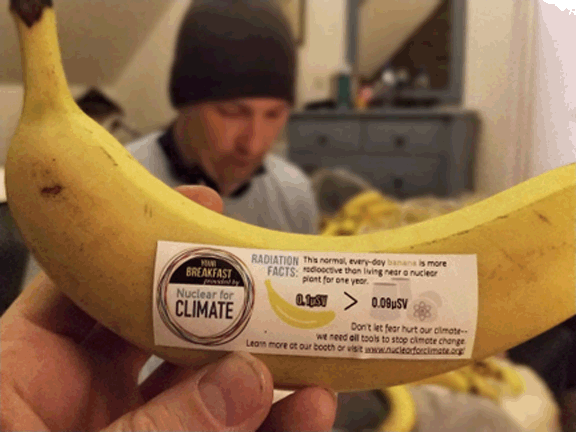
Above: Ben Heard at Bonn, 16 November
Ben Heard and the pro nuclear lobby group “Generation Atomic” were not very successful at the Bonn climate talks. A member of the group ‘marraskuu’ explains:
“we ran around Bonn, trying to secure a permission for a side event that our group would like to organize on Monday, when the UNEP [ United Nations Environment Programme ] Sustainable innovations forum, from which the nuclear industry was kicked out from, starts. They eventually ended up denying us the permission.
The evening was spent in one of the weirdest way I have ever spent an evening: By sticking up stickers on Bananas”
So – the nuclear lobby at the climate talks was reduced to pushing one of their most dishonest and silliest propaganda spins – the “banana argument”. Because our bodies contain a small amount of (mildly) radioactive Potassium 40 – and because there’s potassium 40 in bananas – then we are told not to worry about the nuclear fission produced highly radioactive ions like Cesium , Strontium, Iodine,
BUT – IN REALITY : When you eat a banana, your body’s level of Potassium-40 doesn’t increase. You just get rid of some excess Potassium-40. The net dose of a banana is zero.
Gautum Adani has India’s government under control, – now Australia’s, too?
Adani’s push to build a mega coal mine in Queensland has polarised opinions nationwide. It should come as no surprise: the billionaire behind the project has long been a focus of controversy in his native India.Tim Elliott
To Australians, however, he is best known for his proposed $16.5 billion Carmichael coal mine, to be built in central Queensland’s Galilee Basin. Construction was scheduled to start in October, but has been delayed due to political and financing issues. Should the mine proceed, it will be one of the largest in the world – roughly five times the size of Sydney Harbour – and produce up to 60 million tonnes of coal per year for anywhere between 50 and 60 years, all of which will be exported, the bulk of it to India…….
Companies in the Adani Group are being prosecuted in Delhi’s High Court for allegedly inflating the price of capital equipment imports, allowing the company to charge electricity consumers higher prices while diverting profits into tax havens in the Cayman Islands and Mauritius. (Adani denies any wrongdoing.)
“Adani should have been prosecuted for so many offences,” says Prashant Bhushan, a Delhi-based public interest lawyer who co-filed the High Court case. “There’s cheating the public and electricity consumers and shareholders; there are violations of the Foreign Exchange Management Act. There are probably corruption cases involving the banks.”
And yet investigations into Adani’s companies have a habit of being shelved indefinitely, being resolved in his favour or simply disappearing. “Mr Adani has a lot of influence in high places,” Bhushan tells me. “It is obvious, for instance, that he is very good friends with [the Indian Prime Minister] Narendra Modi.” …….
Saysthe energy consultant Tim Buckley, “Adani is getting exactly the same sort of treatment from Australian politicians to that which he is used to back in India. He has been offered a $1 billion subsidised loan from the Northern Australian Infrastructure Facility [NAIF], and a $600 million royalty holiday and free water from Queensland taxpayers. And as if that wasn’t enough, we’ve now learnt that the Queensland Government has compulsorily acquired prime agricultural land to make way for the Adani railway. It’s farcical.”…….. http://www.theage.com.au/good-weekend/carmichael-coal-mine-magnate-gautam-adani-from-school-dropout-to-12bn-empire-20171106-gzfobl.html
1 This month
25 October – Film –Britain’s Nuclear Bomb Scandal: Our Story – part of the Adelaide Film Festival,
Screening and Conversation
A screening of Britain’s Nuclear Bomb Scandal: Our Story (2024) followed by a talk with 2026 Bettison and James Awardee and Tradtional Owner Karina Lester in conversation with Simone Tur.
When: Sun 25 Oct, 12:00pm-Screening, 1:15pm-Talk
Where: The Mercury
Free admission, register below by clicking on BUY TICKETS and select free event tickets, at end of web page:
https://www.adelaidefilmfestival.org/program/2026/britains-nuclear-bomb-scandal-our-story
.

Australians deserve the truth
about
AUKUS – https://aukuspublicinquiry.com/

PETITION – To: Prime Minister Anthony Albanese and the Australian Labor Government

of the week – Australians for War Powers Reform (AWPR)
To see nuclear-related stories in greater depth and intensity

