Australian navy joins USA and South Korea in drills to stop and search North Korean weapons ships
Australia conducts naval drills to stop and search North Korean weapons ships, SMH, David Wroe, 6 Nov 17, Australia is stepping up its role in tightening the net around North Korea, carrying out naval drills with the United States and South Korea to practise intercepting ships suspected of carrying illicit weapons to and from the rogue regime.
Two Anzac Class frigates began the two-day joint exercises on Monday in seas to the South of the Korean peninsula alongside powerful guided-missile destroyers from the other two countries as well as four smaller warships, maritime patrol planes and helicopters.
The crews are rehearsing how to stop and search a suspect ship of any country but the drills are clearly aimed at North Korea, which is not allowed to trade in arms because of several sets of United Nations sanctions.
Defence Minister Marise Payne said the drills would enforce UN Security Council Resolution 2375, concerning “the interdiction of vessels carrying suspicious cargo”……..
The training mission came as the Pentagon outlayed the grim choices facing the US and its allies in stopping North Korea, saying that a full ground invasion of the country was “the only way” to be certain it could destroy all of Pyongyang’s nuclear weapons…….
The United States wanted to dramatically increase ship interdictions in the most recent round of UN sanctions aimed at reining in Pyongyang’s nuclear weapons program. That would have allowed the US and others to use force on the high seas to stop ships suspected of carrying any type of goods whose trade is prohibited by sanctions.
But veto-wielding Security Council members China and Russia stripped out those measures, leaving the noose of interdiction efforts only incrementally tightened, meaning that interdiction can only happen if ships are suspected of carrying arms materials, particularly anything used in the production of weapons of mass destruction and missiles to deliver them. http://www.smh.com.au/federal-politics/political-news/australia-conducts-naval-drills-to-stop-and-search-north-korean-weapons-ships-20171106-gzg01k.html
Dean Johnson, Kimba mayor, ecstatic about Kimba getting Federal govt bribe for radioactive trash dump search
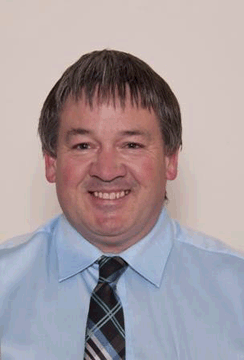 Make the most of the funding for Kimba Eyre Peninsula Tribune http://www.eyretribune.com.au/story/5039693/make-the-most-of-the-funding-for-kimba/ Kathrine Catanzariti , 7 Nov 17
It has been refreshing to have our nearby regional cities in Whyalla and Port Augusta in the news lately, having secured government and private funding for major projects and improvements in or near those cities. However, despite our continued optimism and positive ‘can do’ attitudes, we still find our rural towns and smaller community centres are battling to receive our fair share as we struggle to show population and economic growth that would build the case for increased funding.
With this in mind, the Kimba community is fortunate to benefit from a substantial injection of funds as a result of our continued consultation and engagement in the national radioactive waste management facility search. Continue reading
Fairfax media uncritically regurgitates China-Bill Gates pro nuclear propaganda

Bill Gates and China partner on world-first nuclear technology , Cole Latimer, SMH, The Age, and global media outlets, 8 November 17
Bill Gates’ nuclear firm TerraPower and the China National Nuclear Corporation have signed an agreement to develop a world-first nuclear reactor, using other nuclear reactors’ waste
TerraPower chairman Bill Gates and Chinese premier Li Keqiang signed a joint venture agreement to create the Global Innovation Nuclear Energy Technology company, which will build a Travelling Wave Reactor and commercialise the technology…… http://www.smh.com.au/business/energy/bill-gates-and-china-partner-on-worldfirst-nuclear-technology-20171106-gzfrf0.html

Australian government might not be able to bypass Queensland and give funds to Adani for coal mine rail line
Queensland election: Naif testimony casts doubts on claim Adani loan can bypass state. Annastacia Palaszczuk gets support from former LNP MP Vaughan Johnson, who says she made the right call on loan, Guardian, Joshua Robertson, 7 Nov 17, The Northern Australian Infrastructure Facility cannot bypass the Queensland government and award Adani a $1bn loan, according to Senate testimony from its own executives that casts doubt on fresh suggestions funds could be fast-tracked before the state election.
Annastacia Palaszczuk’s belated pledge to veto the Adani loan if Labor holds government remains a campaign flashpoint, with the treasurer, Curtis Pitt, forced to refute a report that his office said the state would process the loan.
The Queensland premier is under attack for framing her dramatic about-face as a bid to quash a rumoured “smear campaign” by Coalition senators about a conflict of interest from her partner’s role in Adani’s Naif application.
But Palaszczuk also gained an unlikely supporter in the former LNP MP Vaughan Johnson, who said she made the right call amid “mudslinging” from Canberra. The Guardian has been told that Labor’s decision to commit to a veto involved strategic input from the former Adani lobbyist Cameron Milner, who cut ties with the miner to devote himself to the party’s campaign.
A veto now hinges on Labor’s re-election after the opposition leader, Tim Nicholls, refused Palaszczuk’s request for bipartisan support in a caretaker period….https://www.theguardian.com/australia-news/2017/nov/07/queensland-election-naif-testimony-casts-doubts-on-claim-adani-loan-can-bypass-state
Turnbull’s climate policies ‘immoral’ says former Clean Energy Finance chief Oliver Yates
Former Clean Energy finance chief Oliver Yates slams Turnbull government’s ‘immoral’ climate policies, SMH, Nicole Hasham, 7 Nov 17, A Liberal Party veteran and former head of the federal government’s green bank has unleashed on his party’s “immoral” climate change policies, saying they “knowingly and willingly inflict damage on others”.
Ex-Macquarie banker Oliver Yates, chief executive of the government’s $10 billion Clean Energy Finance Corporation until April this year, said far-right members had hijacked the party and that “reform from the outside” may be required – in the form of a rival party that better reflects core Liberal values……
“If we don’t address climate change and start to reduce our emissions, then it’s likely that billions of families could be forced to move home unnecessarily,” Mr Yates said.
He “cannot understand how Liberals would knowingly inflict damage on others when they have a perfectly workable economic cure in front of them” – the adoption of clean energy.
Mr Yates lives in the inner-Melbourne electorate of Kooyong, held by Environment and Energy Minister Josh Frydenberg. A life-long member of the Liberal Party, he is the son of former federal Liberal MP William Yates and began campaigning for the party at the age of nine. He is the independent director of several emerging renewable energy companies. http://www.smh.com.au/federal-politics/political-news/former-clean-energy-finance-chief-oliver-yates-slams-turnbull-governments-immoral-climate-policies-20171106-gzfobv.html
Australia lagging on climate change action: Western Australia to experience extreme weather
 Climate Council report says WA is suffering impacts of warming world as Australia falls further behind on climate change https://thewest.com.au/news/wa/climate-council-report-says-wa-is-suffering-impacts-of-warming-world-as-australia-falls-further-behind-on-climate-change-ng-b88652279z Shane Wright, Economics EditorAustralia is now falling well behind the rest of the world in dealing with climate change, a report out today shows, with WA in the firing line from some of the worst impacts of a warming world.
The report from the Climate Council shows that greenhouse gas emissions in Australia resumed climbing in March 2015, with the country at a substantial risk of failing to meet its generous targets under the Paris Agreement.
This week, the World Meteorological Association said that this year was on track to be the third hottest on record and the hottest year not to be affected by an El Nino weather pattern.
According to the Climate Council, the window of opportunity to limit runaway temperature increases through the rest of the century was closing, with political inaction mostly to blame.
Climate Council chief executive Amanda McKenzie said the Federal Government was clearly failing to deal with climate change given the increase in greenhouse gas emissions on its watch.
She said the Government’s planned National Energy Guarantee would also not lead to reductions in greenhouse emissions. “This is a critical warning that the window of opportunity for the Federal Government to tackle climate change is closing,” she said.
“The vague offering of a National Energy Guarantee will not seriously deal with Australia’s climbing pollution levels. Australia cannot accept anything less than a long-term, bipartisan policy framework that turns away from fossil fuels, and embraces the inevitable clean energy future.”
The council’s report said parts of WA were clearly suffering from the impact of climate change which had resulted in a sharp increase since the middle of last century in the number of hot days and extremely hot days.
Apart from killing an increasing number of Australians, extreme weather had hit WA wildlife, with the deaths of thousands of zebra finches, budgerigars and Carnaby’s black cockatoos tied to heatwaves in 2009 and 2010.
The council said apart from the direct impact on the environment, climate change would pose a risk to Australia’s tourism sector.
Adani still could get Australian tax-payers loan for Queensland coal megamine
Why Adani may still get its government loan, The Conversation, Senior Lecturer in Law, University of Tasmania Even though Queensland Premier Annastacia Palaszczuk announced she would be vetoing the around A$1 billion loan to Adani for a rail link to its proposed Carmichael coal mine, funds could still flow to the company.
Currently in caretaker mode for the Queensland election, the premier would need the consent of the opposition party to exercise such a right. That is very unlikely given the LNP’s longstanding support of Adani’s mine.
This means any veto could not be exercised until late November, or more realistically, December 2017.
As the Northern Australia Infrastructure Facility (NAIF) loan doesn’t need state approval (but rather explicit veto) it could also mean the money will make its way to Adani, without any direct action by the state government.
How would Commonwealth money make its way to Adani?
The NAIF body was established in 2016 and administers A$5 billion in Commonwealth funds. It’s been empowered to award grants to the northern states and Northern Territory for infrastructure projects. Practically, however, these jurisdictions are used as financial conduits to pass this money to large corporations operating in northern Australia.
The NAIF is established under the “tied-grants” provision of the Constitution, Section 96, which states:
…the [Commonwealth] parliament may grant financial assistance to any state on such terms and conditions as the [Commonwealth] parliament thinks fit……….
Does Palaszczuk have a ‘veto’ power?
The premier’s reasoning for the veto is a continuation of her government’s legacy of having “no role to date in the federal government’s NAIF Loan Assessment Process for Adani” and no “role in the future”.
These statements seem to be contrary to earlier ones by the Queensland treasurer, Curtis Pitt, that the government would “do what is required” to facilitate Commonwealth funds going to Adani. In fact, as early as November 2016, Pitt declared in state parliament:
Since we came to office, we have been working very closely with the Commonwealth government to facilitate … the NAIF – in North Queensland… It is through the NAIF facility, which the state wholeheartedly supports, that Adani can get the infrastructure support that it needs.
As a result, it would seem that everything needed to pass the NAIF funds to Adani is provided for. The only thing to actively stop it is a formal, written statement by Palaszczuk to the NAIF refusing the loan (not to the prime minister as she claimed). Given Palaszczuk’s statement that she intends to write this statement, it is clear that no formal notice has yet been issued to the NAIF……..
unless the Queensland opposition takes the very unlikely step of agreeing to a veto, Palaszczuk would appear to lack the power to issue one herself until after the election.
In the interim, NAIF has no legal restrictions on issuing the loan and, with the apparent agreement of the Queensland treasury, this money is likely to flow through to Adani. While Palaszczuk can say her government gave no active assistance to Adani, without active measures to block the loan, it would certainly be a silent partner in the process. https://theconversation.com/why-adani-may-still-get-its-government-loan-86926?utm_source=twitter&utm_medium=twitterbutton
Decentralised energy solutions looking better than centralised
Will Tasmania be the ‘battery of the nation’? http://reneweconomy.com.au/will-tasmania-battery-nation-43911/ By Jack Gilding on 7 November 2017 Lately we have been subjected to Prime-ministerial statements on energy policy that jump from Snowy 2.0 to propping up aged coal-fired power stations in NSW, to government support for a new “clean” coal power station in Queensland and back to pumped hydro in Tasmania. Long term strategy seems to have gone missing.
The latest announcement is a feasibility study of pumped hydro in Tasmania supported by ARENA.
Is investing in Tasmania as the ‘battery of the nation’ likely to be a sensible idea?
Tasmania itself doesn’t need more centralised energy storage. At full capacity, our dams hold more than a year’s supply of electricity. Tasmania’s problem is lack of renewable generation, which leaves our energy security dependent on imports from Victoria and increasingly expensive gas fired electricity.
The mainland grid would certainly benefit from more large scale renewable generation backed by storage. Implementing this would require both a bipartisan consensus on closing down aged coal infrastructure and a long term policy in support of low emission renewable energy.
Pumped hydro is the most cost-effective form of large scale energy storage but it requires a stable investment climate, and in some locations, significant investment in transmission infrastructure.
Snowy 2.0 does have the advantage of being well connected to the NSW and Victorian grids. If the national battery is located in Tasmania it would require a billion dollar second interconnector to the mainland.
The sorts of big national project preferred by politicians are not the only solution. Our electricity system is rapidly moving from centralised energy generation to distributed generation and storage.
CSIRO and the Australian electricity network operators have developed one of the most credible scenarios for the future of the grid.
It anticipates that by 2050, 30-45% of our electricity would come from customer owned generators. The plan identifies the need for incentives to ensure that customer battery systems provide benefits to the network as well as to customers.
A recent ANU study has identified 22,000 potential sites for off-river pumped storage around Australia in a range of sizes. Only a few of these are likely to provide viable but they offer possible advantages in being smaller investments that can address local requirements and reduce rather than increase the need for network enhancements.
If there is a role for large scale pumped hydro storage, is Tasmania likely to be the most cost effective place to build it?
As Everett Dirksen never actually said, “A billion here, a billion there, pretty soon, you’re talking real money”. At over $1bn for a second interconnector, $2bn for a 600 MW wind farm on King Island or over $1bn for the Robbins Island and Jim’s Plain wind farms, and Hydro Tasmania’s estimate of $5bn to build 2500 MW of pumped storage, we are talking ‘real money’.
And it is ultimately our money, whether the infrastructure is built as a regulated asset (added to our electricity bill), by government grant (our taxes) or by private investment (including our super).
Investments on this scale take the best part of a decade to plan, fund and build, and are paid for by users over a 40 year period or more.
We need to be very sure that this is the most cost effective way to meet our energy security in an electricity market where the significant trends are to increased energy efficiency, local generation and storage, and demand management.
The detailed analysis of pumped hydro funded by Hydro Tasmania and ARENA will be a welcome contribution to the public debate. But big schemes may well have had their day.
Hydro Tasmania dropped work on the King Island project and the Tamblyn report on the viability of a second interconnector was lukewarm on its viability to say the least.
My prediction is that the market will have provided decentralised solutions to the challenge of reliable, affordable clean electricity long before these big schemes see the light of day. The flurry of announcements and feasibility studies mainly serves to convince the public that the politicians are dealing with the problem.
Jack Gilding is the Executive Officer of the Tasmanian Renewable Energy Alliance but the views in this article are entirely personal. This article first appeared in The Mercury and is republished here with permission of the author,
8 November REneweconomy news
-
Will Tasmania be the ‘battery of the nation’?Tasmania itself doesn’t need more centralised energy storage. Tasmania’s problem is lack of renewable generation.
-
Chile solar auction sets new record low for solar PVChile energy auction attracts record low bid for solar, with average prices for renewables down 75% since its first auction in 2015.
-
Is this the end for big wind and big solar in Australia?All eyes are on Victoria and the corporate sector for the future of large-scale renewables in Australia. With the renewable energy target now largely met, there is little else on offer for the pipeline of 20GW of wind and solar projects.
-
Graphs of the Day: A really bad day for so-called “reliable” coalMultiple fault with multiple coal generators on Monday highlight the perils of relying on “baseload” coal to keep the lights on.
-
Understanding the “Emissions Gap” in 5 ChartsFive charts that help explain the 2017 emissions gap report from UNEP.
-
Five things that should happen at the Bonn climate talks but probably won’tThis year’s climate talks in Bonn is not expected to be a deal-clinching, make-or-break one like Paris in 2015 or Copenhagen in 2009, but that doesn’t make it insignificant.
-
Albany Wave Energy Project activities underwayCarnegie Clean Energy has now commenced the Albany project design and development activities.
Nuclear propagandist Michael Shellenberger hated ABC interview, loved shock jock Alan Jones

6 Nov 17 The pro nuclear Twittersphere was alive with angry comments about the ABC’s interview with  nuclear propagandist Michael Shellenberger.
I missed that interview, but apparently the ABC interviewer asked some hard questions.
Shellenberger commented: “fighting to survive a brutal interview by a tough young reporter in Oz On ABC (the Aussie BBC)”
Australia’s own nuclear propagandist, Ben Heard, commented: “Shabby interview. Host evidently unfamiliar with topic”
However, those pro nuclear spinners were happy with shock jock Alan Jones on 2GB Alan Jones Breakfast Show. Jones said:
“Michael has turned on wind and solar with a passion: he’s now advocating for an all-atomic energy future, simply because the latter provides reliable power, whereas the former are a childish nonsense…..
the Finkel review totally ignored nuclear power as an option and pushed harder for more and more renewable energy. So Victoria’s looking at 25% renewables by 2025, South Australia 50%, the ACT 100%, Queensland 50%……
one of the world’s leading new-generation environmental thinkers has said the renewable energy experiment with wind and solar has failed. Michael Shellenberger is a former renewables advocate and adviser to Barack Obama when he was President. [ed. not true. Shellenberger sent an unsolicited submission to President Obama] He is now global champion for nuclear energy, which he said was the only option to replace coal and gas on a global scale. ……”
Shellenberger said:
every major study for the last 40 years finds that nuclear power is the safest way to make reliable electricity. You don’t have the risks that come with coal and fossil fuels, both in terms of mine collapses and air pollution, and the accidents themselves that everyone worries so much about hardly have any impact on people’s lives…
Wind and solar – They’re the worst. Really, all renewables are. The reason is easy to understand, in the sense that the fuels are very dilute, they’re very diffuse, and so you have to cover a huge amount of land with wind and solar……. solar produces huge quantities of toxic waste…… They produce two to three hundred times more toxic waste than nuclear plants, which are the only way of producing electricity that contain all of their potentially harmful waste. Of course it’s been contained so well that nobody has ever been harmed by the radiation from nuclear power waste, ever……
The other problem is that you just end up getting too much wind energy when you don’t need it, like the middle of the night. Solar and wind, it’s like they’re almost set up to destroy cheap, clean, reliable energy.
What happened was that there was a smaller group of anti-human so-called environmentalists that opposed nuclear precisely because it allowed for so much cheap and abundant power, and they thought, “Well, if we’re going to stop the human cancer, we have to cut off its energy supplies.” …..
You’ve got some really crazy anti-nuclear people down there…..
Alan Jones: “I’ll tell you something, when you arrive in this country, Michael we’ll have you on again. We can’t hear enough of you. It’s time we had a good healthy dose of common sense”
Pacific Islands leaders will pressure Australia at UN climate meeting
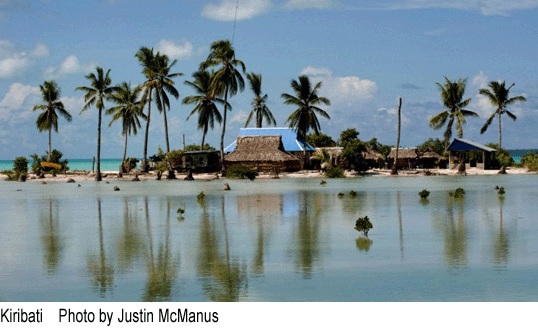 UN climate meeting: Pacific Islands leaders set to put heat on Australia http://www.sbs.com.au/news/article/2017/11/04/un-climate-meeting-pacific-islands-leaders-set-put-heat-australia Germany is hosting UN climate talks this week, but the main focus will be the front line of global warning – the Pacific region. By Rosemary Bolger
The world is watching South Australia’s record consumer-powered electricity grid
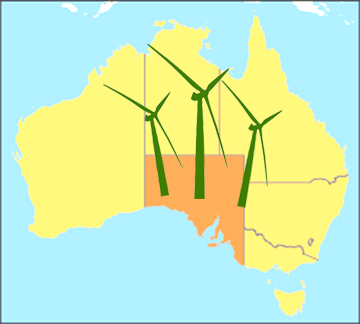 “South Australia gets half of its electricity from wind and solar …. and they are
  in the process of overcoming their problems and making systems of high penetration of renewables work,” Garnaut said. That is of international interest.”
Battery storage will also play an interesting role. South Australia has the Tesla big battery under construction – and due to be in operation in three weeks – as well as two other grid-scale batteries at Wattle Point wind farm, and proposed for Whyalla.
 South Australia’s stunning transition to consumer-powered grid http://reneweconomy.com.au/south-australias-stunning-transition-to-consumer-powered-grid-20463/ [good graphs] By Giles Parkinson on 6 November 2017 South Australia is already being hailed – or in some quarters demonised – for its leadership on renewable energy technology. But a new report from the Australian Energy Market Operator highlights how far out front it is in the tradition to a consumer-powered grid.
The new AEMO report highlights that 9.2 per cent of the electricity generated in the state over the last financial year came from small-scale (sub 100kW) of solar PV on the rooftops of households and businesses in the state.
That level of rooftop solar penetration is a record for any major grid in the world, and the contribution of rooftop solar is likely to have been well over 10 per cent in the last year when larger rooftop solar installations of more than 100kW are included.
The total will likely at least double over the next 10 years – according to AEMO forecasts – to more than 20 per cent, at which time rooftop solar will be pushing “minimum demand” from the grid to zero on occasions.
It’s already having an impact. As we report here, rooftop PV sent grid demand to a new record low of 554MW on Sunday, just six weeks after a previous low – which had in turn beaten the earlier low set a week earlier than that by nearly 25 per cent.
It’s a taste of what is to come. Major studies by the likes of the CSIRO and the networks association predict that by 2050, half of all demand will be met by what they describe as “distributed generation” – a mix of rooftop solar, battery storage, and “localised” generation.
This represents a major shift from the recent and current state of the industry from centralised energy controlled by major corporations, to local supply and demand – leading to new players and new business models.
But in South Australia – as is the case with so much of the energy transition – it could come quicker than that. By 2025/26, AEMO says rooftop solar could generate 2,500GWh a year. That would be around 22 per cent of total demand in the state.
Add in the proposals by the Liberty OneSteel, the new owners of the Whyalla steelworks, and more than one third of the state’s demand could be met by such distributed solar, and possibly up to half if its plans for 600MW of solar – for itself and other business users – comes to fruition. Continue reading
Australian Institute of Company Directors finds that corporate leaders want renewable energy growth
 What Australia’s corporate leaders really think about renewable energy https://arena.gov.au/blog/company-directors/ @DanielSilkstone 6 Nov 17, Renewable energy is so hot right now.
That’s the key message that emerges from a new study of corporate Australia, undertaken by the Australian Institute of Company Directors.
The Director Sentiment Index, released twice each year, maps the thoughts and priorities of the nation’s company directors. It provides an excellent window into the issues and concerns that are cropping up in boardrooms around the country.
There has been plenty of speculation in recent times about whether the political disagreement that has sometimes accompanied debates around the nation’s energy needs was acting as a handbrake on investment.
But the survey makes clear that the nation’s corporate leaders both want and expect the growth of renewable energy to continue. Continue reading
Record low electricity demand in South Australia, due to rooftop solar
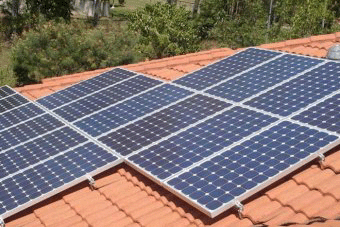
 Rooftop solar pushes South Australia to record low demand (again) http://reneweconomy.com.au/rooftop-solar-pushes-south-australia-to-record-low-demand-again-47836/By Giles Parkinson on 6 November 2017
The combination of growing rooftop solar installations, mild temperatures and sunny weather has pushed South Australia’s grid demand to yet another record low, this time shaving around 6 per cent off the previous low set just six weeks ago.
The new low was set just before 1.30pm in South Australia (just before 2pm on National Electricity Market time) when the minimum grid demand hit 554MW.
This shaved some 33MW off the previous low of 587MW set on September 17,which itself was nearly 200MW or 25 per cent the previous record low demand of 786MW set just a week earlier.
For six hours, according to the APVI solar map, rooftop solar PV provided more than 30 per cent of the state’s demand. For nearly three hours, rooftop solar provided more than 40 per cent of the state’s demand. As we explore in this article here, rooftop solar provided 9.2 per cent of the state’s local generation in 2016/17 and would likely be more than 10 per cent if larger rooftop solar installations were included.
Within a decade, that share is expected to double to more than 20 per cent, at which times on days like this Sunday, minimum demand may actually fall to zero because of the amount of solar being generated.
The Australian Energy Market Operator, which includes these forecasts in a new report into the South Australia grid, suggests that by that time it will be necessary to store some of that excess solar for use later in the day.
The same situation may occur in West Australia, too, because of the amount of rooftop solar being installed in a small grid. The uptake of rooftop solar is accelerating because of high grid prices and the falling cost of solar technology, and grid demand fell in W.A. to an 8-year low last week.
“At these times, South Australia could store or export its excess generation to the rest of the NEM via the interconnectors, provided they are in service,” AEMO notes in its report.
“This, in turn, will provide market participants with greater opportunity to manage their energy use.”
AEMO noted, as it has previously, that South Australia is the first region in the NEM in which high rooftop PV penetration has caused minimum demand to shift from overnight to near midday – a transition that occurred five years ago.
Many argue this is a good reason to shift the “controlled load” of electric hot water systems from the night-time to the mid-day hours, particularly since the closure of the coal fired generators which could not be switched off at night and needed something to power during the night time.
However, problems with the nature of the metering, and the potential expense of the shift, are barriers to the migration of hot water systems to the day-time hours.
6 November More REneweconomy news
 RenewEconomy
-
New solar investment fund seeks up to $300 million in ASX listingNew Energy Solar is hoping to bankroll big solar buy up in US, and Australia and other markets, with $300m IPO.
-
South Australia’s stunning transition to consumer-powered gridRooftop solar expected to provide more than 20% of local generation by 2025, ushering in transition to consumer focused grid in South Australia. Meanwhile, S.A. begins to benefit from renewables, with prices so far in 2017/18 lower than coal-dominated Victoria and NSW.
-
China wind giant buys 100MW wind project in NSWBeijing Jingneng Clean Energy adds Biala wind farm, approved for development in NSW Southern Tablelands, to growing Australian portfolio.
-
Garnaut says NEG may do little for prices, certainty or competitionGarnaut says proposed National Energy Guarantee may fail on price reductions, emissions, and reliability, and may serve to simply reinforce the power of the big energy incumbents.
-
Council approves 350MW PV farm, stage 1of massive solar and storage hubFirst phase of 1GW+ solar and battery storage hub in Gympie approved for development by local council.
-
Germany’s solar, wind generation hits high in OctoberPV and wind power systems generated 15 billion kWh of electricity in Germany in October, with renewables accounting for 44.1% of demand
-
Bonn voyage: climate diplomats head into another round of talksAt the Bonn climate talks that start today, Australia will cop some flak for its lack of reductions ambition, and action.
1 This month
25 October – Film –Britain’s Nuclear Bomb Scandal: Our Story – part of the Adelaide Film Festival,
Screening and Conversation
A screening of Britain’s Nuclear Bomb Scandal: Our Story (2024) followed by a talk with 2026 Bettison and James Awardee and Tradtional Owner Karina Lester in conversation with Simone Tur.
When: Sun 25 Oct, 12:00pm-Screening, 1:15pm-Talk
Where: The Mercury
Free admission, register below by clicking on BUY TICKETS and select free event tickets, at end of web page:
https://www.adelaidefilmfestival.org/program/2026/britains-nuclear-bomb-scandal-our-story
.

Australians deserve the truth
about
AUKUS – https://aukuspublicinquiry.com/

PETITION – To: Prime Minister Anthony Albanese and the Australian Labor Government

of the week – Australians for War Powers Reform (AWPR)
To see nuclear-related stories in greater depth and intensity

