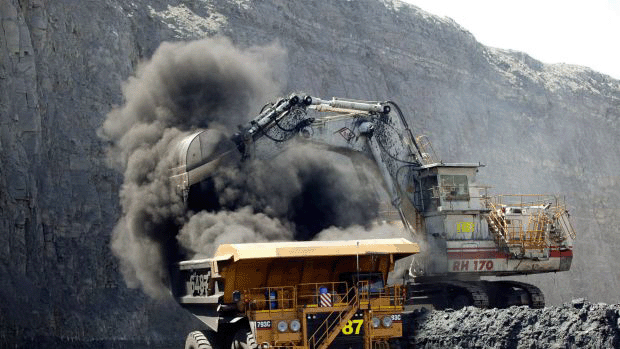
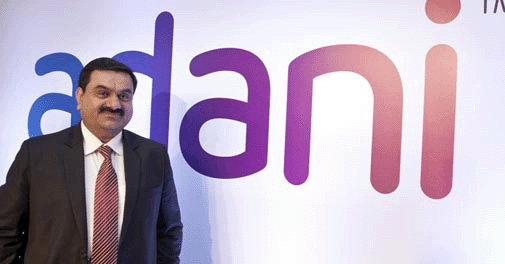
Adani mine: Annastacia Palaszczuk’s loan veto decision ‘jeopardises mine project and jobs’ ABC, AM By Katherine Gregory, 6 Nov 17, The Queensland Premier’s announcement that Labor would not support a concessional Federal Government loan for the Adani coal mine could stop the multi-billion-dollar project and jeopardises the thousands of jobs it would create, the Federal Coalition says.
Annastacia Palaszczuk made the shock announcement last night to eliminate any perceived conflict of interest after it was revealed her partner had links to the loan application.
Ms Palaszczuk has revealed her partner, Shaun Drabsch, worked on Adani’s application to the Northern Australia Infrastructure Fund (NAIF) with his employer, PricewaterhouseCoopers (PwC), which acted for the Indian mining company.
She said he worked on the project after it had received government approvals and although she had followed advice of the Integrity Commissioner, she said it was her decision to exercise her government’s “veto” to not support the loan.
The Indian mining giant is seeking $1 billion from the NAIF to build a rail link for its planned Carmichael coal mine in north Queensland.
The Premier, fighting for re-election on November 25, said she made the announcement because the Liberal National Party (LNP) in Canberra was poised to launch a smear campaign against her……..
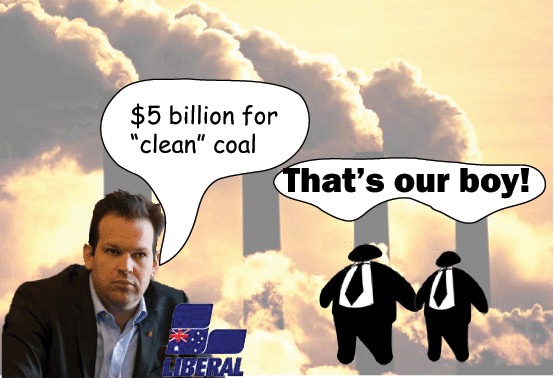
Federal Northern Australia Minister Matt Canavan said the Premier’s decision could jeopardise the mine.
Future-driven show heads to clean-energy hub Adelaide
The Australian Energy Storage Conference and Exhibition (AES 2018) is heading to the nation’s clean-energy leader, Adelaide, in 2018. Registrations to exhibit and sponsor are now open.
Herbert Smith Freehills advises New Energy Solar on its ASX listing and A$300 million public offering
The IPO is expected to be priced at between A$1.45 and A$1.55 per stapled security, which will raise between A$100 million and A$300 million for a projected market capitalisation of between A$387.4 million and A$587.4 million.
Redflow aims for 250 batteries per month from Thailand
ASX-listed Redflow announced last month that it has started installing battery production equipment at its new factory in Thailand, putting it on track to commence initial operation by the end of this year.
Yes – it’s true – Australia is sending fossil-fuel-and-nuclear stooge Josh Frydenberg off to Germany to sabotage the UN climate conference!
Ever since Kyoto, 1997, when the Australian delegation kept everybody up until 4 a.m to make sure of watering down climate action, Australia has been ?proudly subverting international climate action.
Frydenberg is adept at twisting things, to make himself look good, while he’s really no more than an agent for the polluting industries. He might find this harder than usual, in Bonn, where the Murdoch media does not hold sway.
Frydenbeg might find that the Pacific Islanders’ case for action on climate will be better received than his advocacy for Australia’s coal industry.
Look – we’re an international disgrace on our punishment of refugees. We’v e long been an international disgrace on our climate inaction.
Here’s hoping that Frydenberg and the rest of the Australian polluting shills don’t succeed again.
IT’S TIME THAT AUSTRALIA JOINED OUR ISLAND NEIGHBOURS AND THE WORLD IN FIGHTING CLIMATE CHANGE
Adani: Premier Annastacia Palaszczuk withdraws Government involvement in mine funding Queensland Premier Annastacia Palaszczuk has announced her Government will have “no role in the future” of an assessment of a $1 billion loan to Adani for its Carmichael coal mine. ABC News 3 Nov 17
The Northern Australia Infrastructure Fund (NAIF) is considering an application by the Indian company for concessional Commonwealth funds for a rail link.
Ms Palaszczuk late on Friday revealed her partner, Shaun Drabsch, worked on the application to the NAIF with his employer, PricewaterhouseCoopers (PwC), which acted for Adani.
She denied there was a conflict of interest and said her decision to exercise her government’s “veto” to not support the loan came as the Liberal National Party (LNP) in Canberra was poised to launch a smear campaign against her in the run-down to the November 25 state election.
“This afternoon I announce that my Government has had no role to date in the Federal Government’s assessment process for Adani — now we will have no role in the future,” she said.
The Abbott government was accused of attempting to set the Paris talks up for failure by insisting on legally binding emissions targets – something it knew the United States in particular wouldn’t swallow.
At the Bonn talks, Australia will cop (sorry) some flak for its lack of reductions ambition, and action.
It will win its usual disproportionate share of those “fossil fool” awards so beloved of activists.
Bonn voyage: climate diplomats head into another round of talks, The Conversation, Marc Hudson
COP this This year’s “Conference of the Parties” (COP) is happening in Bonn, Germany, (where the UN’s less-publicised “in between” climate meetings happen). But it is chaired by Fiji, which is not holding the meeting on its own (threatened) shores because of the logistical difficulty of hosting the tens of thousands of delegates.
Earlier this year Australia threw in A$6 million to help the Fijians with organisational costs.
But anyone who follows climate diplomacy knows that Australia has a chequered record at COP meetings, and hasn’t always been so generous when it comes to the negotiations themselves. So how has Australia fared at previous summits, and what’s on the table this time? Continue reading →
If the deal does go ahead with backing from Chinese state-owned enterprises, it could see Australia providing big direct and indirect subsidies to a company effectively owned by an Indian billionaire and the Chinese Government.
Adani: Chinese state-owned company could help bankroll Carmichael coal mine, ABC News, 2 Nov 17 By business reporter Stephen Long For years it has been a mystery where Adani would get the money to build its giant Carmichael coal mine in North Queensland.
Key points:
Chinese state-owned enterprise CMEC in negotiations with Adani
Deal would involve CMEC given manufacturing contract in return for procuring finance
Some close to the negotiations sceptical about deal being finalised
Now we may have the answer.
The ABC has learned that a Chinese state-owned enterprise, China Machinery Engineering Corporation (CMEC), is in negotiations with Adani and its principal engineering and procurement contractor, Downer EDI.
If the deal goes ahead, it would see CMEC awarded contracts to build key mining plant and equipment in return for China’s financial backing of the Carmichael mine.
CMEC is listed on the Hong Kong stock exchange, but is 78 per cent owned by the giant Chinese state-owned enterprise China National Machinery Industry Corporation Ltd, or Sinomach. Continue reading →
To Sovereign Union of First Nations and Peoples in Australia When resetting the agenda: Don’t cede your sovereignty or acquiesce, in your enthusiasm for Treaty-talks
Ghillar, Michael Anderson, ghillar29@gmail.com, Convenor of the Sovereign Union, last surviving member of the founding four of the Aboriginal Embassy and Head of State of the Euahlayi Peoples Republic provides further insight into a viable pathway going forward. 4 Nov 17
I propose a refocusing of our political agenda, after our successful and clear ending of the constitutional recognition campaign, because Sovereignty-educated grassroots First Nations people refused to accept mere symbolic inclusion in the colonial Constitution. This spelt the death knell for the bipartisan coercion to lure our Peoples into their racist colonial constitution, in order to put an end to the power of the Sovereignty Movement.
At least it is now clear that Aboriginal people have never been in the Australian Constitution and have never had citizenship, but instead are classified as ‘aliens’ by the constitution. The constitution clearly stipulates that children who are born of a foreign group who have been in hostilities with British colonisers at the time of their birth, which includes 100% of our people all over this country, are deemed to be and classified as ‘aliens’. This is confirmed by Quick and Garran’s interpretation of the constitution on the matter of aliens. This, in my view, confirms, that we, the descendents, continue to be classified as ‘aliens’ and non-citizens. This raises serious questions about the continued presence of all Aboriginal people in the Federal parliament, given they cannot produce any naturalisation nor citizenship papers. Continue reading →
Microgrid and wireless technologies will integrate renewable solar energy and reduce the use of fossil fuels to power World Heritage Site in South Africa.
Ausgrid turns to rooftop solar to save on network costs
Ausgrid offers big incentives for rooftop solar in Sydney, so it can save on network costs. It’s a welcome change from the usual narrative about how rooftop solar is a burden to networks and consumers. Are battery storage and micro-grids next?
Australia among the world’s worst on biodiversity conservation
Australia is among the top seven countries worldwide responsible for 60% of the world’s biodiversity loss between 1996 and 2008, according to a study published last week in the journal Nature.
Rooftop solar installer caught out for fraudulent STC creation
Clean energy regulator takes action against solar company found to have installed rooftop PV systems without compliant Certificates of Electrical Safety.
1st November 2017, Nuclear Fuel Cycle Watch The Greens Bill to finally end wasteful government spending on the proposed South Australian international nuclear waste dump passed through the upper house late tonight. As the Bill had support from the Government, we expect it to also pass the lower house in coming weeks.
“I’m delighted that this sorry saga of wasted public funds is now over”, said Mark Parnell MLC, Greens SA Parliamentary Leader. “Now that the dump has been comprehensively dumped, it is important to draw a line under any further public spending on this ill-conceived project. We don’t have final figures on what was spent on this folly but at least $14 million is a conservative estimate.
“The Greens’ Bill strengthens existing laws against using public money to “encourage or finance nuclear waste storage facilities” by removing the reference to spending money on further public consultation and debate over the dump. Of course, if a future government wants to spruik the merits of turning SA into the world’s nuclear dumping ground, they can always come to Parliament for approval. In a democracy, that’s the right approach.
Importantly, the Greens’ Bill does not prevent the Government managing or sharing the information that has been gathered over the last 2 years or engaging with the Federal Government over plans for a separate national nuclear waste dump in South Australia.
“The Greens will continue to oppose plans to send Lucas Heights’ intermediate-level nuclear waste to the Flinders Ranges or Kimba pending a proper review of Australia’s stores of domestic nuclear waste and how to deal with them. The State Labor Government in the past has fought tooth and nail to stop the Federal Government dumping domestic nuclear waste in our State. Spending public money to deal with other State and Territory governments in relation to nuclear waste will still be allowed.
The Greens now urge all political parties to focus on supporting industries and opportunities that will enhance our State, rather than those which risk South Australia’s economy, environment and reputation”, concluded Mr Parnell https://www.facebook.com/groups/1021186047913052/
Of course, the big number that swayed the government was the promise of 10,000 jobs, regularly discredited and just as regularly repeated. Adani’s own expert admitted that the modelling behind the claim was spurious and the true figure was closer to 1,500, but that hasn’t stopped the spruikers.
More importantly, these claims ignore the fact that the public money needed to get Adani started could be used to create more, and more socially productive jobs than those generated by a fly-in-fly-out (Fifo) mine and a largely automated railway. As I showed in work for Farmers for Climate Action, the agricultural sector alone could generate more jobs than the Adani project.
Palaszczuk faces an election campaign where she will be dogged by anti-Adani protesters on the one hand and doubts about her enthusiasm for the project on the other. The LNP faces no such problems. But should they win, their difficulties will start when the project falls over, as it almost certainly will.
Queensland Labor sits in the uncomfortable position of pleasing neither the pro- nor anti-Adani camps he Adani Group’s proposed mine-rail-port development linking a massive new coalmine at the Carmichael site in the Galilee basin to an expanded port at Abbot Point near Bowen was always going to be an electoral negative for the Palaszczuk Labor government.
One the one hand, Labor’s Liberal National party and One Nation opponents are enthusiastic backers of the Adani project, and will use this fact to campaign in marginal seats in Townsville and Rockhampton. On the other hand, the Greens, backed by the majority of the Australian public, are strongly opposed. The Adani issue could well cost Labor the inner-city seat of deputy premier Jackie Trad, and possibly others.
Lined up behind the Greens is all the environmental and economic evidence that the project should be abandoned. The mine, if it went ahead, would represent a disastrous increase in the global supply of coal. And, since it can only proceed with massive financial support from Australian governments, it will be an economic disaster as well. Continue reading →
Dry Cask Risks Not Known When Design Approved by NRC, 2 Nov 2017Former Nuclear Regulatory Commission (NRC) Administrative Judge Dr. Peter Lam discloses that the vulnerabilities of Diablo’s Holtec dry cask nuclear waste storage system to stress corrosion cracking – recently documented by Donna Gilmore – was not known to decision-makers 20 years ago, when the NRC approved the design.
Dr. Lam’s disclosure seems to throw into serious question the validity of the design basis of all planned and existing nuclear waste storage systems in California and elsewhere.
This is number four of four excerpts, posted as a public service by EON, from the Slo-Span.org video coverage of the Oct. 19, 2017 meeting of the Diablo Canyon Independent Safety Committee.
For more info: DCISC.org MothersForPeace.org SanOnofreSafety.org Slo-Span.org
The CEFC, in its annual report, said it had invested more than $2 billion in new capital to support renewable energy projects valued at more than $6.5 billion. Over the previous two years, the CEFC had only committed $1.32 billion in total.
Its total portfolio of investments now sits at $3.4 billion.
The CEFC said for every dollar it had invested in a project it helped to leverage an additional $2.10 from the private sector.
As well as investing in renewable energy projects, the group announced funding for a lithium mine, tapping into the growing demand for the metal that supplies rechargeable batteries.
The group also has an ongoing $1 billion Reef Funding Program investment, focused on targeting clean energy projects in the Great Barrier Reef catchment area, and supports the Australian government’s Reef 2050 plan to aid the long-term health of the reef.
CEFC’s projects are forecast to produce an annual abatement of nearly 7.3 million tonnes of carbon dioxide equivalent, or more than 121 million tonnes of CO2-e over its projects’ lifetimes.
The investments have had a positive yield for the nation beyond decarbonisation, CEFC chief executive Ian Learmonth said.
“Our $3.4 billion portfolio of investment commitments had a forecast lifetime investment yield of more than 5 per cent,” he said.
In the future, the Clean Energy Finance Corporation said it would invest in distributed energy, energy storage, improved grid transmission, network security and demand-response management.
The CEFC’s pipelines of investment has more than doubled since it began in 2014.
“This growth reflects increased interest in clean energy investment, coupled with a broader understanding of the role of the CEFC in working with investors and project developers,” the company said in its annual report.
could it be that our own government is walking into the middle of an economic contest between China and India for control over industry and infrastructure?
Surely our government wouldn’t be using public money to subsidise Adani’s mine, undermining its own country’s interest and supporting China to strengthen its grip on power and infrastructure in countries neighbouring India?
Last month I claimed that using a $900 million, publicly funded loan to bail out Adani’s otherwise unviable Carmichael coal mine proposal was the height of absurdity.
The Australian government has been equally desperate, creating an agency and filling it with taxpayers’ money so we can fund a project opposed by the majority Australians.
But the government’s efforts to support Adani stretch well beyond the financial.
Market Forces executive director Julien Vincent said more than a dozen commercial banks had ruled out involvement in the Carmichael mine and rail project due to its “financial and reputational risk”.
“To know that NAIF and EFIC are aware of these risks should underscore the argument against giving a $900 million loan to Adani,” he said.
Mr Vincent pointed to the Infrastructure Facility’s investment mandate, which says it “must not act in a way that is likely to cause damage to the Commonwealth government’s reputation”.
The emails, obtained under freedom of information laws, have fuelled the mine’s opponents, who say granting the $900 million loan would pose unacceptable risks to taxpayers and the Commonwealth.
Indian mining giant Adani has proposed a $16.5 billion Carmichael coal mine in Queensland’s Gallilee Basin, sparking legal challenges and widespread protests.
Australia’s big four banks have ruled out funding the project, and Adani has sought a federal government loan to build a railway line from the mine to the Abbot Point coal terminal, near the Great Barrier Reef.
The loan is being considered by the Turnbull government’s Northern Australia Infrastructure Facility, a taxpayer-funded concessional loan scheme. Critics have derided the facility as a Turnbull government slush fund.
Emails obtained by environmental campaign group Market Forces show officials involved in assessing the loan proposal have for months been weighing up Adani’s environmental and financial history.
Much of the content of the emails has been redacted. However one dated November 24 last year has the subject line “NGBR [North Gallilee Basin Rail] Project – Proponent’s environmental track record”.
Attached to the email is a Greenpeace briefing paper titled Adani’s record of environmental destruction and non-compliance with regulations.
The email was sent between senior officials at Australia’s export credit agency, Export Finance and Insurance Corporation, which is providing support to the Infrastructure Facility. Continue reading →
25 October – Film –Britain’s Nuclear Bomb Scandal: Our Story – part of the Adelaide Film Festival,
Screening and Conversation
A screening of Britain’s Nuclear Bomb Scandal: Our Story (2024) followed by a talk with 2026 Bettison and James Awardee and Tradtional Owner Karina Lester in conversation with Simone Tur.
When: Sun 25 Oct, 12:00pm-Screening, 1:15pm-Talk
Where: The Mercury
Free admission, register below by clicking on BUY TICKETS and select free event tickets, at end of web page: