Australia blocks North Korean youth football team over nuclear program, http://www.sbs.com.au/news/article/2017/10/10/australia-blocks-north-korean-youth-football-team-over-nuclear-program A youth football qualifying fixture is likely to be moved offshore after the government moved to stop the North Korean team from entering Australia. The federal government has prevented a North Korean youth football team from coming to Australia to play in a tournament, saying allowing them would be contrary to its opposition to the rogue nation’s nuclear program.
The North Korean U19 team was due to play in the Asian Football Confederation championship qualifiers in November, amongst a group consisting of Australia, Hong Kong, and the Northern Mariana Islands.
The North Korean team was due to play Australia on November 8 in Shepparton, Victoria. A Victorian Government spokesman said the fixture will now be moved to a “neutral venue”.
Foreign Minister Julie Bishop confirmed she stopped the group from arriving.
“The government has decided to not allow the North Korean U19 soccer team to enter Australia for the Asian Football Confederation U19 Championship Qualifiers,” Ms Bishop told SBS World News in a statement.
“Hosting the team would be contrary to the Government’s strong opposition to North Korea’s illegal nuclear and missile development programs.
“It would also be inconsistent with our efforts to increase diplomatic and economic pressure on Pyongyang to comply with UN Security Council resolutions.”
Football Federation Australia said it was disappointed that the qualifying fixtures would now be played elsewhere.
“Football Federation Australia is disappointed that qualifying fixtures for the Asian Football Confederation U-19 Championship … are now likely to be relocated outside Australia due to the Federal Government’s decision not to grant visas to the team from DPR Korea,” a spokesman told SBS World News.
“FFA respects the Australian Government’s responsibility to make decisions on visa applications.”
It’s understood the potential financial losses from the hosting rights would be minimal but the decision would cost the Australian youth team competitive advantage.
Earlier this year, Malaysia’s qualifying match against North Korea for the 2019 Asian Cup was postponed after the two countries were involved in a tiff over the assassination of the estranged half-brother of Pyongyang ruler Kim Jong-un.
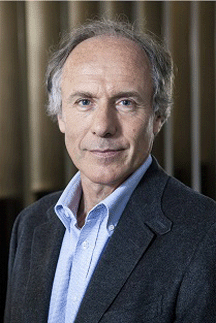
Chief Scientist Alan Finkel makes last ditch plea for clean energy target, SMH, James Massola, Cole Latimer, 9 Oct 17 Australia’s Chief Scientist Alan Finkel has made a last-ditch plea to save the proposed clean energy target, even as the Turnbull government signalled it will reject the proposal by the end of the year.
South Australian premier Jay Weatherill responded on Monday to the apparent standstill, saying the states should “bypass the federal government and provide investment certainty for the electricity sector” by adopting their own target.
The Turnbull government asked Dr Finkel to review Australia’s electricity market to set a policy path that would ensure reliability in the electricity system while also providing clear policy settings to drive investment in generation – something the business community has been demanding.
But in the face of strong opposition from sections of the Coalition backbench to the clean energy target, the Turnbull government delayed any decision on the target while adopting the other 49 recommendations in the Finkel review.
Now, it appears all but certain the target is dead in the water. The expectation is that by the end of the year, an alternative policy proposal that will focus on energy affordability and reliability – and removes incentives for renewable energy – will be brought by Energy and Environment Minister Josh Frydenberg to the cabinet and party room for approval.
That proposal could be put forward as soon as next week, when Parliament returns, though government insiders said that was unlikely at this stage.
Speaking at the Australian Financial Review‘s energy summit on Monday, Dr Finkel said his proposal offered a mechanism to solve the energy crisis and was still needed, while arguing that going back to coal was not the answer as Australia was making the transition away from fossil fuel energy………
Abbott went for the whole canon of tired climate science denial talking points – carbon dioxide is just food for plants, the climate has always changed, it’s the sun –
Abbott’s speech was also chock-full of internal contradictions. He suggested a conspiracy to tamper with temperature readings, but admitted the globe was warming. He described carbon dioxide as a “trace gas” and dismissed its role in warming, but elsewhere thought warming (which might not be happening) would be good. And the “trace gas” is insignificant, but not when it comes to its ability to “green the planet” and help plants grow.
Tony Abbott titled his London speech on climate change “Daring to Doubt” – a challenge, if you will, to reject mountains of evidence and instead lick your fingers and shove them into the plug socket of denial.
But what would constitute bravery for a conservative politician like Abbott? Changing your mind when the evidence tells you you’re dead wrong, or saying what you’ve always said, using the logical fallacies that you’ve always used? One step is brave, the other is cowardly.
Nobody should be surprised that what we got was an absolute crap speech from a man who confessed he still thinks climate science is “absolute crap”. Continue reading →
Netherlands to close all coal-fired generation by 2030
Netherlands decision to close coal plants include those only completed in 2015 – the phase-out combines with rise of renewables and the impact of improved efficiency that put old models at risk.
Get smart: AEMO unveils 200MW “virtual power plant”
AEMO and ARENA unveil a 200MW “virtual power plant” from demand response initiatives featuring incentives for commercial and household users, battery storage, and a range of Australian monitoring, smart meters and voltage control devices,
Nobel Peace Prize winners ICAN urge Australia to sign nuclear weapons treaty, SBS News 7 Oct 17 An Australian-born group that was awarded this year’s Nobel Peace Prize says Australia needs to join global efforts to abolish nuclear weapons.A Victorian-born international group that was awarded this year’s Nobel Peace Prize says it’s a shame the Australian government has not signed the treaty banning nuclear weapons that led to its award……
The organisation worked on negotiations for the Treaty on the United Nations Prohibition of Nuclear Weapons, which was adopted by 122 countries in July.
However, the treaty was shunned by nuclear powers the US, Britain, Russia and China. Australia also did not sign the treaty.
“It is a matter of deep regret that the Australian government has thus far refused to join the treaty, and boycotted the conference to negotiate it,” the group said in a statement on Saturday.
ICAN says Australia led a small group of nations who tried to derail efforts in 2016 to secure a UN mandate to launch treaty negotiations.
“Our government’s belief that nuclear weapons, for a select few, are a legitimate and essential source of security is not only misguided, but also dangerous, for it incites proliferation and undermines disarmament,” the group said.
ICAN hopes the federal government will change its stance on nuclear weapons given Australia’s commitment to other treaties prohibiting chemical and biological weapons, anti-personnel landmines and cluster munition.
ICAN now has 468 partner organisations in 101 countries. It was pivotal to the UN adopting the Treaty on the Prohibition of Nuclear Weapons (TPNW) on July 7 this year
A Nobel Peace Prize born in Australia http://www.smh.com.au/comment/a-nobel-peace-prize-born-in-australia-20171007-gyw93r.html, Margaret Beavis Australians can be very proud. The winner of the 2017 Nobel Peace Prize, the International Campaign to Abolish Nuclear Weapons (ICAN), started in Melbourne. It began when the Medical Association for the Prevention of War (MAPW) recognised that nuclear weapons, the very worst of the weapons of mass destruction, were still “legitimate”. This contrasted with chemical weapons, biological weapons, cluster munitions, land mines – even dumdum bullets, which all have been made illegal by UN treaty, with impressive results. Continue reading →
Leader attacks connection between lobbyists and politicians, saying democratic rules are ‘rigged’ in the state, Guardian, Gareth Hutchens and Katharine Murphy, 7 Oct 17 The Greens say they will offer Queensland voters a chance to clean up politics at the looming state election, and send a clear message that they don’t want the controversial Adani mine to proceed.
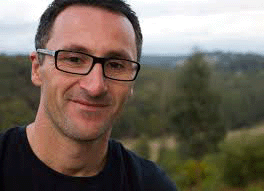
The federal Greens leader, Richard di Natale, will launch their campaign on Saturday with a speech declaring the state has a democratic deficit because of lobbying and political connections, with “a revolving door between politicians, their staff and the companies that profit from government decisions”.
Di Natale will declare that “the rules in Queensland are rigged”.
The Greens leader will criticise the practice of political staff from the major parties going on to work as corporate lobbyists, and point out that Adani’s lobbyists in Queensland, Next Level Strategic Services, also “act for property developers, gambling firms and Broadspectrum – the company running Manus and Nauru detention centres”.
Federal leaders from all parties have been highly attentive to Queensland in recent months, preparing the ground for when the Labor premier, Annastacia Palaszczuk, fires the starting gun.
One Nation is likely to be the kingmaker, with neither Labor nor the LNP guaranteed to win the 47 seats required for power in the unicameral parliament.
The Greens will also be in fierce competition with Labor for inner Brisbane seats. The Adani project provides a major point of difference between the two parties, and one the Greens will run hard on, as they have done in Melbourne.
Di Natale on Saturday will zero in on Labor’s assistance for the project. “Despite Queensland Labor’s election promise not to give any public money to Adani, they ultimately were able to secure a loan from the Queensland government so Adani don’t have to pay coal royalties that would go towards vital public infrastructure, schools and hospitals.”
The Greens leader will say the company was assisted in securing support from the state government by lobbyists, who were in frequent contact with the state government in the lead up to the royalties decision.
“We still don’t know what is in this contract, because the Palaszczuk government refuses to release it,” the text of Di Natale’s speech says.
“But what we do know through Queensland’s lobbyist contact register is that Next Level lobbyists were in contact with the premier’s office and her chief of staff every single day in the lead-up to the royalties announcement.”
The Queensland lobbyists contact register shows Next Level had daily contact with senior members of the Queensland government from 25 May to 30 May, when the final decision was made.
“We also know that up until that point the premier had had only 10 appointments with lobbyists – six of them were with Adani’s handlers.”
Adani: Thousands turn out across Australia to protest against Carmichael coal mine, ABC News 8 Oct 17 A national day of action to oppose the proposed Carmichael coal mine has seen thousands of protesters turn out in locations across Australia.
Rallies in locations including Sydney, Brisbane, Melbourne, the Gold Coast and Port Douglas in North Queensland heard messages against Indian company Adani’s proposed mine in the Galilee Basin.
Adani has promised thousands of local jobs but opponents say the project will fuel global warming and destroy the Great Barrier Reef.
“If this mine does go ahead it drives us into a dirty future and Australia is a country that’s smarter than that,” said Simon Fosterling, a Bondi surf life saver at the Sydney protest, which attracted about 2,000 people.
Protesters spelled out ‘#STOP ADANI’ by standing in formation on the sand………
Sydney Stop Adani campaigner Isaac Astill called the construction of the mine an international issue.
“It’s going to be the biggest coal mine in the southern hemisphere at a time when our climate is crumbling,” Mr Astill said.
It’s an international issue and that’s why we’re seeing people around the world and in Australia coming out in their thousands to say no to Adani.”
About 2,000 people rallied in Melbourne’s Princes Park carrying placards reading ‘Coal=CO2!!!’ and ‘Protect Our Future’.
Australian Conservation Foundation CEO Kelly O’Shanassy said she hoped the “big day of action” would send a strong message that taxpayers did not want their money subsidising the project…..
At Miami on the Gold Coast around 200 people turned out to oppose the mine.
“We know how important this is and we know there’s a growing movement and more and more people are realising how desperately we need this to stop,” said Shane Primrose of the Stop Adani Gold Coast group…….
Thousands of Australians also participated in protests against Adani at 45 locations across the country
Most Australians don’t want work on the Adani Group’s coal mine to go ahead, a new poll commissioned by Australia Institute has found.
As per the poll findings released on Saturday and Sunday, even more Australians oppose the proposed government assistance of $1 billion to the Adani Group. The borrowed money would reportedly be used to build a railway line to nearby Abbott Point coal port.
The poll findings were published in Guardian Australia.
The survey, conducted by market research agency ReachTel, interviewed 2,200 people across Australia. While 55.4 per cent opposed the mine, 18.4 per cent of the respondents remained undecided.
Meanwhile, thousands of Australians on Saturday across 45 locations also protested against Adani’s mine, forming human signs reading “Stop Adani.” The protests were reportedly organised by Stop Adani Alliance, a community group comprised of at least 31 environment organisations aimed at keeping the Carmichael Coal Mine from operating. The group has cited destructive environmental impact that the proposed mine could have on the waters of the Great Barrier Reef as a primary reason behind its reservations about the mine.
According to the Australia Institute survey, the opposition to Adani’s mine cut across political persuasions, with the findings showing that majority of Liberal and Labor voters opposed the project. While the Liberals are in power at the national level in a coalition, a Labor government is at the helm in Queensland.
Nearly 65.8 per cent of those polled stated that Annastacia Palaszczuk, Premier of Queensland, the state where the mine is proposed to come up, should veto the $1 billion loan being mulled for Adani’s project.
The Adani Group has been saying that the mine would generate thousands of jobs and help the troubled economy of Queensland, a claim endorsed by both the state and national governments. Critics, on the other hand, say that the claims are overrated, and the mine would spell disaster for the environment besides hitting the tourism revenue.
Enel and the Dutch Infrastucture Fund plan to have the 275MW facility — which is already under construction — operating on Bungala Aboriginal Corporation land, in early 2019.
The company expects about 200 jobs to be created during the construction period — which will see 860,000 solar panel built across 585 hectares.
Enel Green Power head Antonio Cammisecra said Bungala Solar would be the first step towards the company becoming a “key player” in Australia’s renewable energy industry.“The project marks the first step of our growth strategy in a country which boasts such an abundant resource base and whose renewable capacity is expected to surge in the next years,” Mr Cammisecra said.
“We’re calling on all countries to sign the new UN treaty prohibiting nuclear weapons, which offers a powerful alternative to a world in which threats of mass destruction are allowed to prevail.
“We will work in coming months to persuade more nations to sign this landmark treaty.
“One of our priorities will be to bring the Australian government on board.
By Jessica Haynes The International Campaign to Abolish Nuclear Weapons (ICAN) has taken out one of the world’s most prestigious awards, the 2017 Nobel Prize for Peace.
So how did a campaign from Melbourne make its way to the international stage?
Key points:
Group honoured for “ground-breaking efforts” to achieve nuclear ban treaty
ICAN also awarded for drawing “attention to the catastrophic humanitarian consequences” of nuclear weapons
215 individuals and 103 organisations were nominated for the prize
So what is ICAN?
ICAN describes itself as a coalition of non-governmental organisations in 100 countries promoting adherence to and implementation of the United Nations nuclear weapon ban treaty.
It has advocated at the United Nations and in parliaments around the world, bringing the stories of those impacted by nuclear testing and survivors of the Hiroshima and Nagasaki bombings to a world stage.
How did it form?
ICAN set up its first office in Melbourne, with disarmament campaigner Felicity Hill as the coordinator.
It officially launched in Vienna, Austria in April 2007 during the Non-Proliferation Treaty preparatory committee meeting.
ICAN campaign director Tim Wright said it was inspired by the International Campaign to Ban Landmines, which had played a major role in the negotiation of the Anti-Personnel Mine Ban Convention, also known as the Ottawa treaty. Continue reading →
Slow progress on key $12 million Queensland climate change policy, SMH, Tony Moore , 7 Oct 17, Progress appears slow on one of Labor’s key climate change policies to encourage coastal Queensland councils to formally adopt a 0.8-metre higher sea level to combat beach erosion and storm surge problems.
The state government cannot say how many of the 41 coastal councils in Queensland have formally adopted the higher sea level, despite two departments being given four days to answer.
However, funds from the $12 million set aside by the state government has now gone to 21 of the 41 oceanside councils to develop plans.
Gold Coast City Council last week formally adopted the higher sea level when they updated their Gold Coast City Plan last week, as part of Queensland’s Climate Adaption Strategy.
Fairfax Media believes Cairns and Townsville councils have adopted the 0.8-metre higher sea level but it remains unclear if Moreton Bay Regional Council has accepted the higher sea level.
The policy allows coastal communities to better prepare homes and businesses for sea erosion and storm surge damage from increasingly frequent storms and cyclones as temperatures warm by 2100.
Gold Coast City Council last week formally adopted the higher sea level when they updated their Gold Coast City Plan last week, as part of Queensland’s Climate Adaption Strategy.
Maps produced by Geoscience Australia for the Australian government show localised flooding in three scenarios: a 50-centimetre sea level rise, an 80-centimetre rise and a 1.1-metre rise.
The Geoscience maps show a considerable flood impact on the Gold Coast’s northern suburbs and in the canal estates…….
Earlier this year Local Government Association president Mark Jamieson said more than 30 Queensland councils would be gradually affected by rising sea levels.
“More than half of Queensland’s 77 councils will be exposed to coastal hazards in the future,” Cr Jamieson said.
“It’s vital that local governments work together to assess risks and identify practical solutions that will help coastal communities prepare for serious issues such as storm tide flooding, coastal erosion and sea level rise.”
He was 75 and had spent a lifetime raising awareness of the dangers of nuclear weapons, having been blinded during British weapons testing in Maralinga in South Australia in the 1950s.
“I think he’d be really pleased and very proud to know but also grateful that ICAN was able to provide that platform for us and that his story was so powerful,” Ms Lester said.
Ms Lester has become as passionate about the anti-nuclear movement as her father. “It’s not a happy story, it’s quite a sad and tragic story, but ICAN has certainly been a wonderful platform for us Anangu and Aboriginal people of Australia to really talk up strongly about what happened to us back in those days,” she said.
When she was younger, she did not know what had caused her father’s blindness.
“It wasn’t until later in life that I realised it was such a sad story … with the doings of the British Government and our Australian Government as well … allowing for tests to happen in South Australia in the 1950s and 60s.
“[And] that they were responsible for taking my father’s sight.
“There were a lot of people affected by this, not only Aboriginal people, there were non-Aboriginal people, ex-servicemen and women who were exposed to this as well.”
As a representative of Indigenous voices within ICAN’s 400-strong organisations around the world, she has told her father’s story to audiences around the Asia-Pacific region, including the Japanese city of Hiroshima, which was struck by an American nuclear bomb in 1945.
A later attack on the Japanese city of Nagasaki prompted an end to World War II.
Ms Lester has also exchanged stories with the people of the Marshall Islands and Tahiti affected by nuclear testing by French authorities from the 1960s until the 1990s.
“Many tests have taken place or nuclear issues have occurred in Indigenous countries around the world, so it’s a global issue for sure,” said Ms Lester, a Western Desert Pitjantjatjara Yankunytjatjara woman.
Her grandparents were part of efforts to prevent the establishment of a nuclear waste facility in SA.
She took her daughters to Hiroshima in November 2015 where Yami Lester’s experience was well understood.
“It’s important for us to continue on sharing that story for the next generation to know the story and [then] the next generation to know the story,” she said.
The historic treaty pushed by ICAN needs 50 nations to sign on before it will be activated.
Jim Green Nuclear Fuel Cycle Watch https://www.facebook.com/groups/1021186047913052/– 9 October 17 Ben Heard is a fake environmentalist ‒ Australia’s version of Patrick Moore. Heard’s last gig was for the COAL MINING funded Minerals Council of Australia!
Before that, he took money from General Atomics ‒ which is up to its neck in drone warfare. And he’s possibly the first and hopefully the last person to ask for speaking fees from small, unfunded community groups.
Corporations can donate to Heard’s fake environment group and he “will respect the company’s right to privacy if desired”. Since he openly takes money from coal miners and murderous military corporations, I shudder to think who he’ll accept secret donations from.
This is what the stridently pro-nuclear South Australian Royal Commission said about Heard’s Gen 4 nuclear plans: “[A]dvanced fast reactors and other innovative reactor designs are unlikely to be feasible or viable in the foreseeable future. The development of such a first-of-a-kind project in South Australia would have high commercial and technical risk. Although prototype and demonstration reactors are operating, there is no licensed, commercially proven design. Development to that point would require substantial capital investment.”
Heard got a $55,000 government grant to come up with his lunatic Gen 4 proposal and, needless to say, he refused to repay one cent of the money. #followthemoney http://www.archive.foe.org.au/…/oz/ben-heard-decarbonisesa
The case against Tesla and battery storage just hit peak stupid
AFR’s Chanticleer column writes article about battery storage so absurd and stupid it beggars belief that it was published. Such is the state of the energy debate in Australia. It’s not just politicians and vested interests that are letting consumers down, it’s the media.
Coalition wrestles with internal demons on clean energy target
Coalition had sought to dodge CET because renewables were too costly, now it is arguing they are too cheap. But Frydenberg says renewables without storage are a “costly burden.”
Know your NEM: Frydenberg’s election losing speech
If a CET is abandoned, it will be NSW that will be thrown under a bus. Victoria and QLD have renewable share policies that incentivise new generation. NSW has no policy and despite being an energy importer is not getting its share of new generation investment.
World Solar Challenge is an adventure in engineering and endurance
The World Solar Challenge begins this weekend when more than 40 solar cars brave the Australian Outback on a 3000-kilometre journey from Darwin to Adelaide.
S.A. tender attracts 60 proposals for “next-gen” renewables and storage
S.A. gets 60 proposals for batteries, bioenergy, pumped hydro, thermal, compressed air and flywheel technologies in response to its tender for next-gen renewables and storage.