Police said they charged 10 people with trespassing on business land, and those arrested had been taken to the Bowen watch house.
22 September REneweconomy news
 RenewEconomy
-
Battery ban off the table after industry roundtable “consensus”Standards Australia says industry roundtable has broadly agreed to “review” proposed rule banning li-ion batteries from being installed inside homes and garages. But rifts emerge in industry.
-
Back to 2009: Abbott declares war on everythingTony Abbott has drawn new battle-lines with interviews and an article that is a horror-show of ignorance, bias, conservative ideology and political dogma. Turnbull’s efforts to appease the right wing has gotten him and the Australian economy nowhere.
-
BHP under pressure to dump pro-coal lobby groups over climate policyA shareholder resolution highlighting the chasm between BHP’s stated climate policy and the pro-coal advocacy of its mining industry lobby has pushed the company to commit to reconsidering its membership of the hardline Minerals Council of Australia.
-
Off-grid solar + battery systems prove 15x more reliable than networkWestern Power pilot shows stand-alone solar + battery + diesel systems 15 times more reliable than grid, and could save $300 million in avoided network upgrade costs – but only if rules are change changed to allow the systems to be rolled out.
-
Battery storage uptake by households surges as grid costs soarNew data shows home battery storage installations set to treble in 2017, even without a price fall. Once the technology gets cheaper, says SunWiz, batteries will be as ‘common as the backyard pool.’
-
ACT tips another $4m into home battery subsidy schemeACT government opens third competitive grants round, in a $4m extension of its home battery storage subsidisation scheme.
-
The amazingly positive renewable story the Murdoch media won’t writeThe Australian buries its admission that Tuesday’s front page lead was fabricated, and still seeks to portray a cost saving to consumers as an extravagant “payday” for rich Saudi man.
-
Australia: stop being blindly aligned with nuclear weapons nations: sign the treaty!
Tomorrow The World Is Going To Try And Ban Nuclear Weapons. Australia Wants To Keep Them. New Matilda, By Rewena Mahesh on A global push to save the world from a nuclear armageddon has the backing of more than 120 nations. Australia isn’t one of them. Rewena Mahesh explains.
On July 7, a global treaty was adopted at the UN General Assembly to prohibit nuclear weapons. This treaty now sets precedence for a powerful norm that will change the course of history by helping promote disarmament and preventing further proliferation.
This treaty closes a large international law gap, by prohibiting states from developing, testing, producing, manufacturing, transferring, possessing, stockpiling, using, or threatening to use nuclear weapons once ratified by 50 states.
That will happen tomorrow, on the 20th of September.
Despite an overwhelming 122 countries endorsing the treaty, strongly and actively supported by hundreds of civic society organizations including the World Medical Association, Medical Association for Prevention of War, the World Federation of Public Health Associations, nine member countries that possess nuclear weapons and most NATO allies boycotted the agreement.
Shamefully, one of those countries absent from negotiations and which played a role in boycotting the treaty is Australia. We fall under the nuclear protection of the USA.
While Australia, possesses no nuclear weapons, it is a major producer and supplier of uranium used in the production of nuclear arsenals for the US and British military and most recently Russia, China and India.
Australia has had a long history with nuclear testing, hosting the British in the 1950s and 60s to conduct 12 major nuclear tests which dispersed radiation across much of the continent. In particular site workers and Aboriginal communities nearby have been suffering the consequences of radiation, seen in high rates of cancer with very little compensation, and a lack of capacity to use traditional land due to contamination.
As a result of Australia hosting the US military and intelligence facilities, such as Pine Gap near Alice Springs, we are offered protection in the face of a nuclear threat, under the extended nuclear deterrence, and thus consider nuclear weapons to be legitimate, useful and necessary despite their devastating and catastrophic effects……..
Given the current volatile environment with unpredictable leaders, the only guarantee we have against the spread and use of nuclear weapons is to eliminate them completely.
Indiscriminate weapons such as landmines, biological and chemical weapons, and cluster munitions which have all been permanently banned are increasingly accepted as illegitimate, and are losing their political status.
It is thus difficult to acquire resources for the production and modernisation of a prohibited weapon by companies or governments. It is then hoped that by eliminating nuclear weapons, this forms the new norm globally and they too will lose their legitimacy and political status in due course.
Nuclear weapons are also an ineffective means of combating almost all issues globally and nationally, such as cyber warfare, climate change, poverty, antimicrobial resistance etc.
The International Campaign to Abolish Nuclear Weapons (ICAN) showed that 84 per cent of Australians surveyed wanted the government to support the efforts of a treaty to ban nuclear weapons. Australia still has the opportunity to be on the right side of history by signing the treaty tomorrow.
Australia needs to be at the forefront of global efforts to eliminate nuclear weapons and not be misled by the notion of extended nuclear deterrence under the protection of the US.
Australia needs to look across the Tasman to its neighbour New Zealand, which for decades has remained an ally of the US, but has had an independent foreign policy.
Instead of blindly aligning ourselves with the nuclear policies of the US, Australia needs to consider the devastating health and social consequences of nuclear weapons and sign the treaty to increase credibility in the region and make the world a safer place. https://newmatilda.com/2017/09/19/tomorrow-the-world-will-adopt-a-treaty-banning-nuclear-weapons-australia-wont-be-there/
Nuclear lobby bringing top USA nuclear spruiker Michael Shellenberger to Australia
‘Michael Shellenberger will visit Australia in November to promote a rethink on nuclear at a minerals industry conference.
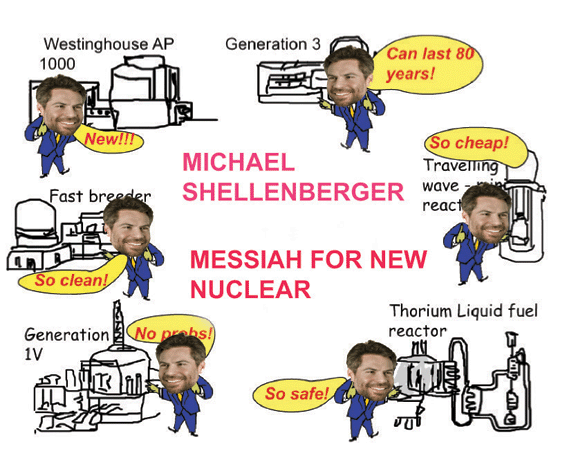
A radioactive wolf in green clothing: Dissecting the latest pro-nuclear spin https://independentaustralia.net/environment/environment-display/a-radioactive-wolf-in-green-clothing-dissecting-the-latest-pro-nuclear-spin,10735
Noel Wauchope Michael Shellenberger is a nuclear salesman posing as a new generation environmentalist with unsubstantiated energy “solutions”, writes Noel Wauchope.
LAST WEEK, The Australian excelled itself in uncritically regurgitating nuclear lobby propaganda in the article, ‘Nuclear the “only option” to replace coal and gas: Michael Shellenberger’.
To start with, they describe Shellenberger as ‘one of the world’s leading new-generation environmental thinkers‘. Well, that is sort of, a bit, right. Shellenberger is well known as the founder in 2003, with Ted Nordhaus, of The Breakthrough Institute — a nuclear front group dedicated to promoting “new generation” nuclear reactors. He is not a new generation environmentalist, as his focus is solely on the nuclear industry.
In the same opening paragraph, Shellenberger is described as ‘a former renewables advocate to Barack Obama‘. Well, Shellenberger’s advocacy consisted of lobbying Obama to promote not renewables but nuclear power. He is described as ‘now a global champion for nuclear energy’, as if he had only recently become a convert from renewables.
The Australian goes on to quote Shellenberger’s statements against renewable energy, uncritically, despite the fact that he provides no evidence for them:
“[Wind and solar] are doubling the cost of electricity and they have big environmental impacts. All existing renewable technologies do is make the electricity system chaotic and provide greenwash for fossil fuels.”
And:
“[Opposition to nuclear] is like a superstitious religious belief.”
Shellenberger was a one of Time Magazine’s ’30 Heroes of the Environment’ in 2008. True. However, he was chosen and discussed in Time by Bryan Walsh, a nuclear proponent and a member of The Breakthrough Institute. That choice was strongly disputed by genuine leading environmentalists Bill McKibben and Carl Pope, executive director of the Sierra Club.
Having thus established Shellenberger’s very shaky credentials as an environmentalist, The Australian gets to the gist of the story:
‘Michael Shellenberger will visit Australia in November to promote a rethink on nuclear at a minerals industry conference.’
We are told that Germany’s renewable energy transition is not successful and that Shellenberger believes better education about nuclear power is needed as well as ‘a leap forward in scientific literacy about radiation’.
He says:
“The reality is the death toll from Chernobyl in 1986, after 20 years, is less than 200 people.”
As we have come to expect from The Australian and from Michael Shellenberger, no references are given to back up these statements.
Also unsurprisingly, The Australian quotes Shellenberger’s conclusion without comment:
“Nuclear is the only technology that can lift everyone out of poverty and reverse human impact.”
As often happens, this article is followed by numerous positive comments, often glowing with praise, if somewhat lacking in information or insight. There were no negative comments. But then, only registered readers of The Australian are allowed to make comments. It is tiring but necessary to refute bald claims made by very manipulative nuclear spruikers.
Where to start?
Here are some links to thoughtful articles which address claims made in this article:
- The cost or electricity from renewables?
‘Renewable energy versus nuclear: dispelling the myths about costs‘, by Mark Diesendorf, Associate Professor in Interdisciplinary Environmental Studies in the School of Biological, Earth and Environmental Sciences at the University of New South Wales.
- Death toll from Chernobyl accident?
‘Radiation harm deniers? Pro-nuclear environmentalists and the Chernobyl death toll’, by Dr Jim Green, National Nuclear Campaigner with Friends of the Earth Australia and Editor of the Nuclear Monitor.
- Nuclear lifting the world out of poverty?
‘Nuclear Power Cost’, from the Union of Concerned Scientists.
Rural South Australia could end up with the curse of stranded nuclear wastes
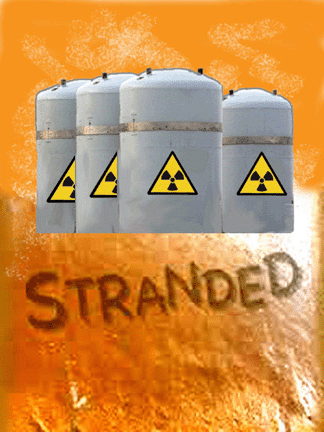 Robyn Wood, Fight To Stop Nuclear Waste Dump In Flinders Ranges SA, 19 Sept 17
Greg of FLAG has a letter to the editor in today’s Advertiser for those who can get around the paywall
On the charge
HEAD of Resources Division, Department of Industry, Innovation and Science (DIIS), Bruce Wilson’s statement that “the federal Government is not pushing for a … National Radioactive Waste Management Facility to be hosted in SA” is not supported by the facts (“Nuke healing”, The Advertiser, 6/9/17).
Since the call for potential sites across Australia in March 2015, the process narrowed to focus on three, all in SA, two near Kimba and one near Hawker.
For over a year, DIIS staff have visited Hawker and Quorn almost weekly promoting the facility and answering questions.
A consultative committee meets monthly, a community liaison officer has been appointed and an economic working group has been formed. Newsletters appear regularly.
A delegation from Champagne in France, where there is a similar facility, has been presented praising the benefits of the facility to their region. Individuals and groups, including school students, have been funded to tour Lucas Heights.
In 2016, the federal Government allocated a $2 million community benefit package to Hawker. Another $2 million is promised this financial year with a similar allocation for Kimba, which will also have its own consultative committee and community liaison officer.
Mr Wilson’s letter emphasises the disposal of waste from the production and use of radioactive medical isotopes. He does not mention that the problematic intermediate level component of this waste can only be stored there on a temporary basis with no plan for its disposal.
Current state legislation, the Nuclear Waste Storage Facility (Prohibition) Act 2000, prohibits the storage in SA of the type of material proposed for this site.
GREG BANNON, Chair, Flinders Local Action Group, Quorn. more https://www.facebook.com/groups/344452605899556/
Australia VERY QUIETLY signs up to help develop new nuclear reactors
 Noel Wauchope, 20 Sept 17, Now, many weeks after Australia signing up to the Framework Agreement For Generation IV Nuclear Energy Systems, the public is informed of this. I found it at the bottom of page 23 of the print version of The Age today. Why haven’t we heard about this before?
How is it that Dr Adi Paterson of ANSTO signed up to this, in advance of Parliamentary approval, and that the whole thing can be done without any proper public consultation? Australian tax-payers are now to be supporting the development of these new dreams of nuclear power – advanced nuclear reactors that exist now only as blueprints, and will be expensive, require government funding, and will not be commercially operational for many decades, if ever.
Surely it is time for a thorough inquiry into ANSTO’s funding and finances. The New Generation nuclear reactors are controversial, to say the least. They are in fact, part of the global nuclear lobby’s push to save itself – its future being threatened by its dire economics, and by its connection to the nuclear weapons industry.
The Australian media is regularly used to promote ANSTO’s nuclear reactor as having as its purpose “medical research” and “medical isotopes saving lives” – despite the fact that non nuclear production of these isotopes can be, and is, being done. The reality is that ANSTO is part of the global nuclear industry lobby, and its reactor produces long-lasting radioactive wastes and it should be shut down.
I couldn’t find it on The Age online. The print version, 19 Sept 17 – small article at the bottom of page 23:
Australia joins nuclear research club, by Cole Latimer
Australia has officially joined an international group focused on developing future nuclear energy systems, The Australian Nuclear Science and Technology Organisation has been welcomed into the Generation IV International Forum Framework, which aims to develop next generation nuclear power systems, and which ANSTO calls “a potential game-changer in global energy creation”.
Although Australia joined the GIF charter last year, the event marked the country’s official accession to the nuclear framework agreement, which is focused on six different nuclear reactor designs that provide poeer and “stringent standards in relation to safety and non proliferation”.
However, ANSTO stated that this was not about advancing the cause of nuclear energy in Australia’s current energy mix: instead it was about utilisingAustralian skills in research and development.
“Australia has no nuclear power program, but we do have significant local expertise in next generation research, which is what this partnership is about” ANSTO chief executive officer Adi Paterson said.
ANSTO will leverage our world class capabilities, particularly in relation to the development of advanced materials and with applications in extreme industrial environments, and of nuclear safety cases.
“This agreement will enable Australia to contribute to an international group focused on peaceful use of nuclear technology, and the international energy systems of the future”
An ANSTO spokesman said Australia was a world leader in terms of nculear safety, “due to the high levels of oversight and paperwork required” to operate.
GIF is a co-operative of 14 nations led by France, a country where nuclear power accounts for nearly 75% of energy generation. This reliance on nuclear energy has helped the nation slash its carbon emissions.

BHP supports climate change action – is at odds with Minerals Council
 But don’t let’s forget that BHP is a big member of the nuclear industry – which claims (incorrectly), that nuclear power is ‘clean’ energy, and the solution to climate change
BHP considering Minerals Council exit over lobby group’s climate policies
Key points:
- BHP under pressure to quit lobby groups that don’t support clean energy target
- Activist group backed by big investors including ANZ, AMP, Australian Super, Blackrock
- Board considering move before next month’s AGM
BHP announced it would review its membership of all industry associations, and publish the findings, by the end of this year.
The review comes hot on the tail of a demand by activist shareholders that the miner sever ties with the council, which successfully advocated for the abolition of the carbon price and is currently lobbying the Federal Government to reject a clean energy target.
“We are aware that some civil society and other organisations believe that, where an industry body advocates for a position which does not align with our own, we should cease to be a member of that industry body,” BHP said in a statement issued overnight.
The activist’s resolution to be tabled at the company’s AGM next month is also calling for BHP to terminate its membership of the World Coal Association which, along with the Minerals Council, is also calling for a rejection of a clean energy target.
The resolution was lodged on Friday, and it appears to have hit on some issues already being discussed in the BHP boardroom…….http://www.abc.net.au/news/2017-09-19/bhp-considering-quitting-minerals-council/8960298
Anti-Adani protesters arrested outside Abbot Point coal terminal near Bowen
http://www.abc.net.au/news/2017-09-19/anti-adani-protestors-arrested-bowen/8959752 ABC North Qld
Updated Police say they have arrested 10 protesters who were blockading the road to the Abbot Point coal terminal near Bowen in central Queensland.
About 50 people, including members of anti-Adani group Front Line Action on Coal, held banners and voiced their concerns at plans to develop the Carmichael coal mine facility in the north of the Galilee Basin in central Queensland.
Whitsundays Police inspector Steve O’Connell said it was unfortunate arrests had to be made, but he was happy with the overall peaceful nature of the protest.
Bowen resident of 50 years, Elvyn Smith, attended the protest because she had concerns about the environmental impact of the proposed mine.
“At this time with climate change and the knowledge we have on that, that it is not a good time to be opening a large coal mine,” Ms Smith said.
“With the extreme weather events that have been happening, coal is the thing that is fuelling this.
“I am here for future generations to protect this great place that we have.”
Local councillor Mike Brunker said the protesters did not represent the views of local residents who opposed the protest.
“Finally now we see a bit of light at the end of the tunnel, and now we come and see this sort of rubbish. People are sick of it,” Cr Brunker said.
Security ramped up at water reservoir
Whitsundays Mayor Andrew Wilcox said the council was taking extra measures to protect the Bowen water supply after activists hung a banner on the town’s reservoir.
Cr Wilcox said the council was not taking any risks.
“We’re taking extra precautions now. We are just making sure we’re doing more patrols,” Cr Wilcox said.
“At the end of the day it’s already all secured, but we’re just doing that and we’re also putting some cameras around the place.
“And then if we do catch some of these people, we hope that they face the long arm of the law.
A kind of censorship: Melbourne’s Federation Square restricts anti Adani protest
Anti-Adani protest censored by operators of Melbourne’s Federation Square
Exclusive: Operators demand images of newspaper headlines and politicians, and ‘explicitly negative’ environmental messages be removed, Guardian, Michael Slezak, 20 Sept 17 The operators of Melbourne’s Federation Square have censored the content of an anti-Adani slideshow presented there, demanding that all images of newspaper headlines and politicians, as well as “explicitly negative” environmental messages be removed.
On Saturday, a coalition of environmental groups held a screening of the documentary Guarding the Galilee at Federation Square, attended by about 300 people. The film is about the fight to stop Adani’s Carmichael coalmine, which would be the biggest coalmine ever built in Australia and one of the biggest in the world.
In the week before the event, Federation Square demanded to see the slideshow that would be presented before the screening and then demanded much of it be removed.
In email correspondence a Federation Square representative told the event organisers they “cannot permit any slides with protest messaging, slogans or memes together with slides that show pictures of politicians, newspaper headlines or any explicitly political messaging”.
The operators objected to any content that was “negative and inflammatory” and demanded the majority of the slides be removed or significantly altered.
That included removing all pictures of newspaper headlines, politicians, political memes, protests or pictures of the Great Barrier Reef with “inflammatory messaging”.
Federation square also demanded that the “stop Adani” logo be changed to black and white, and that it not take up a whole slide……….
The event was organised by groups including Bayside Climate Change Action Group, StopAdani Eltham, Crochet for Coral not Coal, Darebin Climate Action Now, GetUp Melbourne East, AYCC Victoria, Melbourne Ports Stop Adani Group and Market Forces.
The groups crowdfunded the event and major sponsors included the National Tertiary Education Union and Melbourne builders Jenkinson Building. https://www.theguardian.com/business/2017/sep/20/anti-adani-protest-censored-by-operators-of-melbournes-federation-square
Australia’s top 10 solar postcodes, and the top solar locations by state
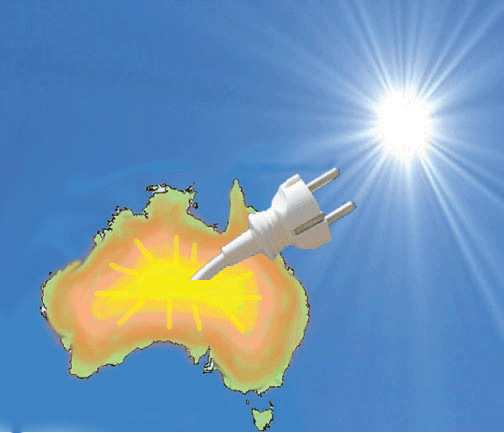 http://reneweconomy.com.au/australias-top-10-solar-postcodes-top-solar-locations-state-60359/
By Sophie Vorrath on 19 September 2017 [excellent map] One Step Off The Grid
We know Australia is leading the world in per capita uptake of rooftop solar, with total installed capacity on homes and businesses this year soaring past the 6GW mark.
But which parts of Australia are leading the country? New data from the Clean Energy Regulator has revealed the latest ranking of Australia’s top 10 postcodes for small-scale solar installation (up to 100kW), with some interesting new additions.
As you can see below, the list this year features a few new entries, and a more diverse spread across the states, instead of being dominated by Queensland and Western Australia locales.
Both the new entries and the old stagers on the list span the suburban, regional and rural areas of Victoria, New South Wales, Queensland and Western Australia, with no entries this year from South Australia, Tasmania, the ACT or the Northern Territory.
In order from the top, the Queensland town of Bundaberg has again secured the number one spot, followed by new entries on the list, the Victorian suburbs of Werribee and Hoppers Crossing. Last year, no Victorian postcodes made the top 10.
According to the CER data, these three postcodes have accumulated the highest number of small-scale renewable energy installations since the small-scale renewable energy scheme began in 2001, each reaching around 17 000 installations as at 1 September 2017.
In fourth place, down from second place last year, is the WA suburb of Mandurah, where the local council is also pushing hard to install PV on government buildings – and just last week agreed to install a 200kW (not a part of the SRES) system at the local pool and sports centre.
The Queensland suburb of Hervey Bay follows, moving to fifth place from third last year. And another Victorian new entry, the semi-rural south-eastern suburb of Cranbourne, is in sixth place.
Bringing up the rear are regular place holders Caloundra and Toowoomba in Queensland, and new entries Wangara (WA) and Lismore (NSW), the latter of which makes the list probably due to the May switching-on of a 99kW rooftop PV system at the Goonellabah Sports & Aquatic Centre, as part of a major community-based and funded renewables campaign.
Despite some bigger commercial installations coming into play, the CER says the average size of the solar postcode installations is 5kW – which is also the average size, now, of a household rooftop solar system. This indicates the dominance, still, of residential uptake in these numbers, considering the SRES encourages commercial systems, too – up to 100kW in size.
“Over the last 10 years, 23 per cent more Australians have embraced rooftop solar,” the CER said in a release on Monday. “That’s one in five homes and businesses now generating their own renewable energy and reducing carbon emissions through rooftop solar.
As we reported here, Australia hit a milestone of 6000 megawatt (6GW) capacity across 2.8 million small-scale installations of renewable energy systems such as solar PV, solar water heaters and air source heat pumps. Nearly 100MW was installed in August, alone.
Interestingly, while no South Australian suburbs on their own make the list, the entire state is setting all sorts of solar records, including a new record low for minimum demand – barely a week after the previous benchmark was set – with a fall to just 587MW on Sunday afternoon.
As Giles Parkinson notes, the record eclipsed the previous mark by nearly 200MW – with AEMO data showing minimum demand at 1.30pm of exactly 587.8MW, compared with the previous low mark of 786.42MW posted last Sunday – thanks to moderate spring temperatures, combined with the state’s more than 700MW of rooftop solar producing 538.54MW at the time of minimum demand.
“That is a phenomenal share of 47.8 per cent of the state’s electricity demand being met by rooftop solar (compares with 36 per cent in the previous record last week) and is clearly a record for South Australia, and for that matter in any large grid anywhere in the world,” Parkinson says.
Below [on original] is the list of last year’s Top 10 solar postcodes:
Liberal National Party member would consider taxpayer funding for private coal-fired power station.
Coal-fired pledge for Qld
Queensland LNP leader would consider diverting taxpayer funds from renewable energy into a privately built coal-fired power station.
http://www.theaustralian.com.au/national-affairs/state-politics/wed-invest-in-coalfired-plant-says-queensland-lnp-leader/news-story/20cff6c0ad81b8d6a85ef6ecb8d4c212
20 September REneweconomy news
RenewEconomy-
Better data would improve transparency in electricity marketBetter data would reassure consumers that price changes are the result of real problems, such as weather or machinery failure, rather than market manipulation.
-
Liddell: It would cost $900 million to keep it open till 2027Liddell coal generator visit reveals a work-force that wants it to close. Even betting agencies are punting on its closure.
-
Sci-Fi novel envisions corporatocracy in a climate-changed futureIn Tal Klein’s new novel, The Punch Escrow, humans have successfully tackled disease and climate change, but powerful corporations control everything.
-
Graph of the Day: Live renewable energy share and emissions by stateTwo new live graphs show renewable energy share and energy emissions in each state. Rooftop solar is lowering emissions significantly during the day.
-
Queensland big solar boom continues, as another 150MW project approvedQueensland’s Western Downs Region continues large-scale solar boom, with approval of 300MW battery ready Beelbee PV farm.
-
Redflow scores second major battery sale for remote Pacific Island projectsRedflow gets second major order within months for its zinc bromine batteries for application on remote, Pacific Island sites.
-
Brisbane Airport rolls out massive 6MW solar projectHuge 6MW solar upgrade at Brisbane Airport will supply 18% of electricity needs and save around $1m a year on energy bills.
-
SolarEdge enhancing residential PV offering for AustraliaIncreased power production with single-phase inverters and new three-phase inverters for cost-effective larger PV systems
-
Most Labor MPs have pledged to get Australia to sign & ratify the UN nuclear weapon ban treaty

A majority of Labor MPs have pledged to get Australia to sign & ratify the UN nuclear weapon ban treaty: http://icanw.org/projects/pledge/ … #nuclearban
To Malcolm Turnbull’s government, climate change is a joke
 Coalition MPs giggle, cackle, smirk and laugh in Parliament over climate change, Independent Australia , Simon Black Many of our current crop of conservative politicians laugh like naughty children whenever climate change is brought up. This can’t be how the world ends
NERO NEVER FIDDLED while Rome burned.
It is a popular myth, but it’s simply not true — there were no fiddles back in Roman times.
Nero is, however, reported to have sung a song about the sacking of Troy while watching as 70 per cent of Rome was swallowed by flames in a single blistering gulp.
Some of our current crop of politicians have gone one better — they now laugh like small children whenever climate change is brought up.
This week, the conservative side of politics continued what seems to be the running gag of climate change for the during a motion by Senator Peter Whish-Wilson calling for recognition of Australia’s climate scientists.
Whish-Wilson told the floor and later posted on social media, that it was “the angriest I have ever been in the Senate” as he watched members of the house openly mock climate scientists.
Liberal Senator James McGrath stood to read what appeared to be his party’s talking points in a deadpan monotone stopping a number of times to smirk and chuckle.
Leader of the Australian Conservatives Party, Cory Bernardi, rose to make a point of order, informing the house that it was, in fact, he who had been raucously laughing.
Presumably, he was concerned the people who voted him in would be upset if he wasn’t earning his base pay of $199,040 a year by chuckling his way through Senate motions.
Nice work if you can get it.
It’s part of a trend in Australian politics for conservatives to openly mock, laugh and ridicule climate change, even as the Great Barrier Reef bleaches and dies, even as we notch up record hot year after record hot year, even as natural disasters such as Hurricanes Harvey and Irma increase in frequency and intensity worldwide.
When asked about climate change in June this year by a Liberal colleague, Australian Environment Minister Josh Frydenberg had a good laugh.
He spent 30 seconds answering the question and then two-and-a-half minutes openly laughing about an interview where Labor MP Andrew Leigh mentioned climate change could have an impact on the ski season.
“He’s just worried about one thing: losing the ski season,” guffawed Frydenberg.
Someone else who is worried about the ski season is the CSIRO, who warned climate change could shrink Australia’s ski season by 80 days a year by 2050.
But never let reality get in the way of a good joke.
And it seems there’s nothing funnier than the threat posed by climate change — once described by Prime Minister Malcolm Turnbull (before he was Prime Minister) as “catastrophic”. ……..https://independentaustralia.net/politics/politics-display/this-is-how-the-world-ends–not-with-a-bang-but-with-a-chuckle,10722
Anti Adani coal project- action is seriously hotting up in Queensland
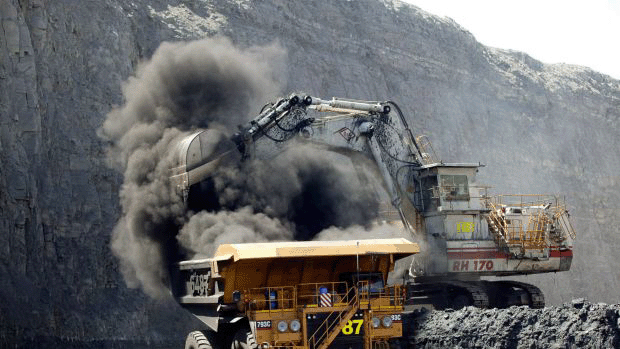 Anti-Adani protesters promise week-long action against Queensland mine https://www.brisbanetimes.com.au/national/queensland/qld-adani-protesters-promise-week-long-action-20170916-p4yvy9.html 16 September 2017
Renowned author Tim Winton on how Malcolm Turnbull betrayed our ocean s
How Malcolm Turnbull has trashed the Liberal Party record and betrayed our oceans, SMH, Tim Winton , 17 Sept 17 “……
Australians have always loved the ocean, but now, more importantly, we understand how vital the sea’s health is to the future of our island home…….
In 2012, after an exhaustive scientific process and wide community consultation, Tony Burke declared a system of marine national parks, one of the biggest and best in the world, the most significant conservation gain in Australian history.
That took courage. Because it put science before politics, prudence ahead of expediency. And it was popular. But as soon as he came to power in 2013 Tony Abbott announced an immediate moratorium on these parks and instigated a review. The purpose was purely political. To delay implementation, corrode consensus and deny the science. A move straight out of the culture warrior’s playbook.
After decades of forward-thinking leaders, the nation had fallen into the hands of a man whose loyalties were only to the past. It was a low moment. But Abbott’s reign was as brief as it was fruitless. It was a relief to see him replaced in 2015 by a man who’d actually done things, who believed in the future. Malcolm Turnbull did not scorn science. He seemed to understand the value and fragility of our natural estate. So there was new hope the marine parks review would now be expedited and redirected towards real conservation outcomes. With coral reefs bleaching and miners pressing for even more coal ports and seabed to drill, the need for protection had only grown more urgent.
Well, that moment of promise is long gone. Turnbull’s period in office has basically been a hostage drama. The bargain he made with powerbrokers rendered him captive to the party’s most illiberal wing, and if his performance on climate, energy and marriage equality aren’t evidence enough, last month’s announcement that marine parks would be slashed beyond all recognition puts it beyond dispute.
……The draft management plans recently released for consultation by Josh Frydenberg don’t just signify the gutting of the national system, they represent the largest removal of protection for Australian wildlife in our history. What the government is proposing is a nihilistic act of vandalism. Forty million hectares of sanctuary will be ripped from the estate. That’s like revoking every second national park on land. Under its new plan, 38 out of 44 marine parks will be open to trawling, gillnetting and longlining, 33 will be open to mining, and 42 exposed to the construction of pipelines. In total defiance of the scientific advice upon which the original system was designed, 16 marine parks will now have no sanctuary zones at all.
…….. The shame of it is, the Liberal Party has a worthy environmental record, especially with oceans. Malcolm Fraser declared the Great Barrier Reef a marine park in 1975 and in 1978 he ended whaling. And remember, the national push for marine parks began under John Howard. So this government is trashing its own party’s proud legacy……..http://www.smh.com.au/comment/how-malcolm-turnbull-has-trashed-the-liberal-party-record-and-betrayed-our-oceans-20170908-gydy2d.html
1 This month


Help Aunty Sue Protect Her Land and Sacred Sites From Destructive Rocket Testing.
.

Australians deserve the truth
about
AUKUS – https://aukuspublicinquiry.com/

PETITION – To: Prime Minister Anthony Albanese and the Australian Labor Government

of the week – Australians for War Powers Reform (AWPR)
To see nuclear-related stories in greater depth and intensity

